When your spending limit is modest, the best Valentine’s Day gift is one where your time, attention and creativity carry the value. People rarely remember the cost of a gift, but they often remember the effort. These ideas show how to shift the focus from money to meaning.
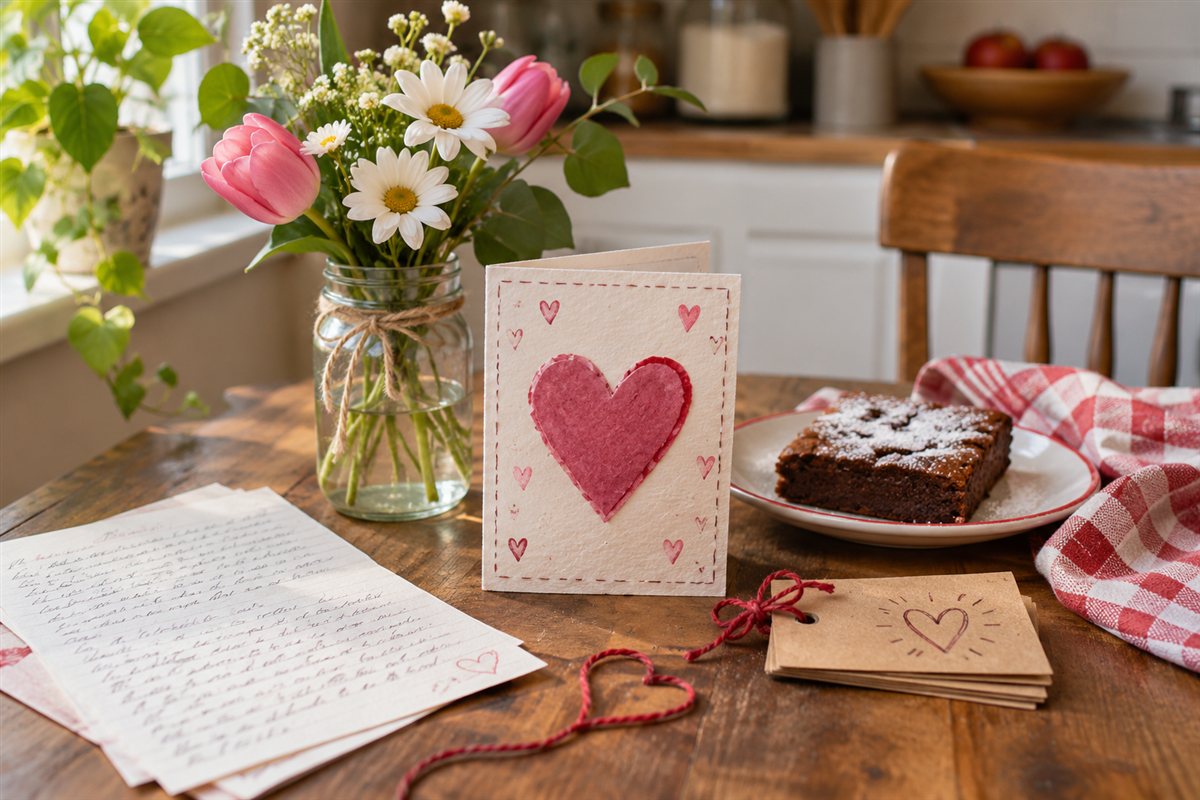
Principle: Put Effort Where Money Would Go
Each hour you spend on a gift can stand in for spending. A letter that takes an hour to write, a meal that takes an afternoon to cook or an album that takes an evening to assemble is the kind of effort that stays with people.
In this guide
Gifts Built From Time
- A letter: Write three pages about specific moments and what they mean.
- A homemade meal: Plan the menu around dishes tied to memories.
- A coupon book: Offer promises such as a morning off chores, a long walk or a movie night.
- A playlist: Arrange songs in the order of your story, with a note beside each.
Gifts Built From Photos You Already Have
- Scroll through your photo library and flag twenty favorites.
- Narrow to eight or ten with good focus and light.
- Choose a modest format, such as a few small prints or a simple folded booklet.
- Write a caption for each by hand.
- Present them in an envelope, a simple frame or a binder.
Printing at home or at a local shop can keep the process simple. Check the print sizes available so that your images fit well.
Simple Experiences
| Experience | What you need | Personal touch |
|---|---|---|
| Sunset or sunrise walk | A good spot and a flask | Take a photo together |
| Picnic | A blanket and homemade food | A handwritten menu |
| Home cinema night | A favorite film and snacks | Printed tickets |
| Night sky watching | A clear evening | A note with a wish |
What to Avoid
- Apologizing for the size of the gift. Present it with confidence.
- Buying filler items just to have something to unwrap.
- Comparing your gift with what others are doing.
A helpful habit is to set a time limit instead of a money one, such as two evenings of preparation. Spend the first on gathering material, like photos, memories and ideas, and the second on making and wrapping. Finishing a day early leaves room for small fixes and keeps the final moment calm.
Setting a Budget and Sticking to It
A modest budget works best when you decide on it before you start looking. Write down the total you are willing to spend and divide it into parts: the main gift, any extras such as a card or wrapping, and a small reserve for delivery or last-minute changes. Knowing the limit in advance makes it easier to say no to tempting add-ons.
Look for places where small spending carries the most meaning. A handwritten card, a favorite snack or a single flower can be worth more than a bigger item chosen in a hurry. If you plan to buy something online, include shipping in your calculation, because it can change the total.
- Compare options before buying, but do not spend hours chasing tiny savings.
- Check what you already own that can be reused, such as a frame, a notebook or a jar.
- Avoid buying on impulse in the days before the occasion.
- Keep receipts in case you need to return something.
A clear budget also reduces stress, so you can focus on thinking about the person receiving the gift rather than worrying about the cost.
Learning What Your Partner Values
A gift lands well when it fits what the person values. Some people feel loved through words, others through time together, practical help, small gifts or physical closeness. Think about how your partner reacts to different gestures. Do they save notes? Do they enjoy plans made for them? Do they appreciate a clean kitchen or a prepared meal?
Use observation. Notice what they mention wanting, what they admire in shops or what they complain about. A small gift that solves an everyday annoyance, such as a good mug for a person who loves tea, shows that you pay attention.
- Recall recent conversations for hints.
- Ask a trusted friend or family member for ideas.
- Think about shared jokes and memories.
- Consider their daily routine and what would make it easier or nicer.
The best gift in a modest budget is usually the one that shows you know the person, rather than the one that looks impressive.
Planning an Evening at Home
A well-planned evening at home can feel special without large spending. Choose a time when you will not be interrupted, and prepare the space. Tidy the room, dim the lights, add a few candles if they are safe to use and put on music you both like. Small changes in atmosphere make an ordinary room feel different.
Plan simple food. A dish you can cook confidently is better than an ambitious recipe that causes stress. Prepare what you can in advance, so you are not stuck in the kitchen while your partner waits. Set the table with care, and add a handwritten menu or a flower.
- Plan one activity beyond the meal, such as a game, a film or a walk.
- Silence phones for a set time.
- Have a backup plan if something goes wrong.
- Clean up afterward or leave it until the next day, so the mood stays relaxed.
Attention matters most. Ask questions, listen and be present, and the evening will be remembered long after the cost is forgotten.
Writing a Message That Means Something
If words are your main gift, spend time making them specific. General statements are pleasant, but specific memories carry weight. Describe a moment when you felt close, something your partner did that you appreciated or a quality you admire. Keep sentences simple and honest.
Start by listing a few memories and details. Pick two or three, and write a short draft without worrying about style. Then read it aloud and trim anything that sounds forced. Write the final version by hand on good paper if you can, because handwriting adds a personal touch.
- Avoid copying lines from the internet; your own words are better.
- Mention something you look forward to doing together.
- Keep it to a length that you can write comfortably.
- Check spelling and names.
Present the message with some thought, perhaps tucked into a book they are reading or left where they will find it in the morning. A simple setting can make the message feel like a gift in itself.
Last-Minute Ideas That Still Feel Thoughtful
If you are short of time, you can still prepare something meaningful. Begin with what is easy to get nearby: a flower from a local shop, a favorite snack or drink, or a small item related to a shared interest. Combine it with a handwritten note, and the gesture feels intentional.
You can also give your time. Offer to take over a chore, plan a short outing or cook breakfast. Prepare a short playlist or a collection of photos on your phone to share together. These ideas require little money and can be done in an hour or two.
- Avoid apologizing for the timing; focus on the present.
- Choose one idea and do it well rather than several in a rush.
- Pack or wrap things neatly, even simply.
- Follow up later with a longer plan, such as a day out.
A thoughtful last-minute gift shows that you made an effort to care, and an honest, warm presentation matters more than perfection.
Why the Thought Counts More Than the Amount
When people look back on a gift, they rarely remember the amount spent. They remember how it made them feel: seen, understood and appreciated. A modest gift that shows you noticed something specific about your partner can mean more than an expensive one chosen at random. Before you buy anything, spend ten minutes thinking about recent conversations. Did your partner mention a song, a snack, a place they miss, a hobby they want to try or a memory they smile about? Those small clues are the raw material for a gift that feels personal.
A Memory Jar for the Year Ahead
Take a clean jar and fill it with folded notes. Each note holds a memory, a reason you love your partner or a small plan for the coming months, such as a picnic, a movie night or a walk to a favorite spot. Cut strips of paper, write with a nice pen and add a ribbon around the lid. Your partner can open one note whenever they want a smile. The materials cost little, but the time invested is considerable, and that is the point. Be sincere and specific rather than generic.
A Handmade Photo Story
Choose ten or twelve pictures from your time together and arrange them in order on a simple printout or small album. Add short captions in your own handwriting: where you were, what you remember and why it mattered. If you prefer a digital version, make a slideshow with music that means something to you both. Keep captions honest and warm. Funny details, like the time it rained during a picnic, make the story real.
An Evening Planned Around Their Favorites
Build the evening around what your partner enjoys. Cook or order their favorite dish, play the music they like, set a simple table with candles if it is safe to do so and switch off phones for an hour. If cooking is not your strength, choose a simple recipe and practice it once beforehand. Prepare a playlist, tidy the room and think about small touches such as a handwritten menu. The effort you put into the arrangement is part of the gift.
Small Gifts That Carry Meaning
- A book you enjoyed, with a short note inside the cover.
- A plant that suits their space, with a card about growing together.
- A hand-drawn or written coupon book for favors such as breakfast in bed.
- A mug filled with their favorite tea or snacks.
- A framed quote or lyric that matters to the two of you.
Matching Ideas to Personalities
| Partner type | Idea that tends to fit |
|---|---|
| Sentimental | Photo story, memory jar, letter |
| Practical | Something useful for their routine, with a kind note |
| Adventurous | A planned outing or sunrise walk |
| Homebody | A cozy movie night with favorite snacks |
| Creative | A small art kit or a joint project to make together |
Writing a Note That Lands
A card is the most valuable part of many gifts. Write by hand if you can. Begin with something specific that you love about your partner, then add a memory, then end with a hope for the future. Avoid borrowed lines from the internet; plain words from you carry more warmth. Read it aloud once to catch awkward phrases. Keep it short enough that you could say it in person, and then, ideally, do exactly that.
Presentation Without Spending Much
Wrapping adds anticipation. Use plain paper, a ribbon, a sprig of greenery or a stamp you made yourself. Reuse a nice box or bag you already own. Place the gift somewhere unexpected, such as beside their morning tea. A tidy presentation tells your partner that you cared about the details, and it costs almost nothing.
Long Distance and Busy Schedules
If you live apart, send a letter or a small package ahead of time and plan a video call at a quiet hour. Watch the same film at the same time, or cook the same meal together over a call. If your schedules are busy, plan a short, focused moment rather than a big event. Ten undistracted minutes can feel more special than an evening where both people are tired.
Mistakes to Avoid
- Leaving everything to the last minute and grabbing the first item you see.
- Choosing something you like instead of something they would enjoy.
- Comparing your gift with what others post online.
- Skipping the card, which often matters most.
- Making the gift about proving something rather than showing care.
A Simple Plan for the Week Before
Set a few small deadlines. Three days out, decide on the idea. Two days out, gather materials. One day out, make or arrange everything and write the note. On the day, relax and enjoy the time together. A calm plan lets your attention rest on your partner rather than on last-minute stress. Whatever you choose, give it warmly, and let the gesture speak for itself.
Gifts of Time That Cost Nothing
Time is the one thing most people feel they never have enough of. Offering a block of undivided attention can be the most generous gift. Plan a morning without chores, a long walk with no phones or an afternoon spent doing something your partner loves, even if it is not your favorite activity. Take on a task they dislike for a week, such as washing dishes, planning meals or running an errand. Write the offer in a card so it feels like a proper gift. Follow through reliably, because a promise kept is worth more than a surprise forgotten.
A Letter to Open Over Time
Write three short letters and seal them in separate envelopes marked with different dates or moods: open when you need encouragement, open on a quiet evening, open on our anniversary. Each letter can recall a moment, thank your partner for something specific and share a hope. This gift lasts well beyond the day, and it gives your partner something to return to. Keep each letter to a page, write in your own voice and avoid stock phrases.
Cooking Together at Home
Choose a recipe that you can make as a pair, such as homemade pizza, pasta or a simple dessert. Shop for ingredients together or surprise your partner by gathering everything in advance. Put on music, share tasks and enjoy the mess. Follow food handling and kitchen safety guidance as you cook. Cooking together gives you conversation, laughter and a meal at the end, and it needs no special venue.
Outdoor Ideas
- Pack a simple picnic and find a quiet spot in a park or by water.
- Watch the sunrise or sunset from a hill, a rooftop or a beach, where it is safe and permitted.
- Take a slow walk through a neighborhood you rarely visit and talk about what you notice.
- Photograph each other with whatever camera or phone you have, then print a favorite.
Making a Gift Feel Complete
A gift feels complete when it has three parts: something to hold, something to read and something to do. For instance, a small plant (to hold), a note (to read) and a planned walk (to do). This simple structure turns a modest item into a whole experience. You can apply it to almost any idea in this guide. Keep the parts small and well chosen, and your partner will feel that care went into every detail.
Budget Tracking Without the Stress
Decide on your limit before you shop and write it down. List the items you plan to use and add up their costs, leaving a little room for small extras such as wrapping or a card. Most of the ideas in this guide can be made from things you already own or can find in a local shop. If you do buy something, compare a couple of options and choose the one that suits your partner, not the one with the fanciest packaging. Sticking to a plan lets you relax and enjoy the day rather than worrying about spending.
Involving Friends and Family Thoughtfully
Sometimes a trusted friend or relative can help you with a surprise, such as hiding a gift, keeping your partner away while you set up, or lending a camera or a cooking tool. Ask in good time and be clear about what you need. Thank them afterward. Avoid sharing private details of your relationship, and make sure the surprise is something your partner will actually enjoy, not just something that looks good in pictures.
After the Day Is Over
The gesture does not need to end on the day itself. Keep the card, save the playlist, add the photo from the evening to your album and think about doing something small each month. A relationship is strengthened by regular attention, not a single occasion. Ask your partner what they enjoyed and what they might like next time, and listen. These conversations make future gift ideas easier, and they show that you care about their feelings long after the flowers have faded.


Ready to Buy? Start Here
If this guide helped you decide what to look for, these products are a place to start.


As an Amazon Associate we earn from qualifying purchases. Prices and availability are shown on Amazon.
Turning a Modest Budget Into a Full Day, Not Just a Gift
When spending must stay modest, the winning move is to stop thinking in objects and start thinking in hours. A small budget concentrated on one item often still looks small; the same care spread across a whole day feels generous. Plan three touchpoints: something in the morning that starts the day kindly, such as their favourite breakfast made properly and served without rushing; a message or note at midday that carries real thought; and an evening built around one simple pleasure you have prepared in advance. None of these requires much money, and together they create the feeling that the day was designed, which is what expensive celebrations are actually selling.
Preparation is the currency that replaces money. A room tidied properly, candles borrowed from a drawer, music chosen rather than shuffled, a walk route scouted the day before: each is free and each is visible evidence of time spent. Partners can always tell the difference between a day that was assembled at the last minute and one that was quietly prepared, and preparation is available to every budget without exception.
Homemade Gifts That Look Deliberate Rather Than Improvised
The line between charming homemade and apologetic homemade is finish. Whatever you make, complete it fully: trim the edges, write the labels neatly, practise the recipe once if you can, and present it in the cleanest wrapping you have, even if that is plain paper tied with string. A small thing finished beautifully signals care; a grand thing left half-done signals panic. Choose projects well inside your actual skills, because confidence shows in the result, and borrow presentation ideas from shops: a tray, a ribbon, a sprig of something green from the garden.
Time-based gifts deserve the same finish. If you are giving an evening, a skill or a series of small promises, write them as proper vouchers in your own hand, with specifics: what, when, and how to claim them. Vague promises evaporate; written ones get kept, and the act of writing them turns an intention into a gift your partner can hold, reread and look forward to.
Talking About Money Without Spoiling the Day
Couples handle modest budgets best when the subject is settled before the day arrives. A brief, honest conversation, we are keeping this year small and putting the money toward something we both want, removes the two great spoilers: one partner quietly overspending to avoid feeling cheap, and the other quietly feeling guilty for receiving. Agree the spirit of the day together and the gifts can be as small as they need to be without carrying any apology.
If your partner’s circumstances differ from yours, let the exchange be uneven in money and even in effort. The partner with less money can plan, cook, write and organise; the partner with more can accept those gifts at full value rather than discounting them. Relationships keep their own accounts over years, and a season of modest giving, honestly shared, usually strengthens rather than dents them.
Ideas Matched to Common Situations
For students and anyone in a first job, shared experiences beat objects: a picnic built from favourite inexpensive foods, a free museum or gallery visit finished with hot drinks, a playlist exchange with notes about each song. For new parents, the scarcest resource is sleep and unbroken time, so gifts of rest, one lie-in fully protected, one evening where the other partner runs everything, are close to priceless while costing nothing. For couples saving toward a goal together, such as a home or a trip, a gift that pictures the goal, a framed print of the destination or a first small item for the future home, turns restraint into shared purpose.
For long-distance couples on a budget, the post is your ally: a letter with pressed flowers from a walk you took thinking of them, a small parcel of local treats from your town, or a book you have annotated in the margins as you read it. The annotation idea deserves emphasis, because a second-hand book filled with your handwriting becomes a one-of-a-kind object that no budget can buy ready-made.
More Questions Worth Asking
How do I stop a modest gift feeling like an excuse?
Attach evidence of thought: the note that explains why this, the detail remembered from months ago, the preparation visible in the presentation. Excuses are vague; thoughtful gifts are specific. If your gift could only have been chosen for this person, its cost becomes almost irrelevant to how it is received.
Is it acceptable to suggest a spending limit to my partner?
Yes, and most partners are relieved when someone says it first. Frame it as a shared plan rather than a restriction: let us keep gifts small this year and do something together instead. Agree it early enough that neither of you has already bought something large, and revisit the agreement each year as circumstances change.
What can I make if I have no craft skills at all?
Make experiences and words instead of objects. A letter requires only honesty. A planned evening requires only organisation. A memory jar requires a jar, paper and an hour of remembering. These are the strongest modest gifts in this guide, and none of them asks for dexterity; they ask for attention, which you have.
How do I handle friends who spend a lot on Valentine’s Day?
Let them. Other couples’ budgets are not a standard you owe anyone, and comparison is the fastest route to overspending and resentment. If social media makes the day feel like a competition, remember that you are seeing purchases, not relationships. Your partner knows what your gift cost in thought, and that account is the one that matters.
The Week-Before Plan, Hour by Hour in Spirit
A calm plan turns a modest budget from a worry into a method. A week ahead, decide the shape of the day and write the note while you have time to think. Midweek, gather anything you need in one trip, including wrapping materials you already own but should locate now rather than on the night. The day before, prepare whatever can be prepared: ingredients, a cleaned space, the playlist, the route. On the day itself, your only jobs are the fresh tasks and being present. This spread of small efforts is exactly how people with large budgets buy their way to calm with caterers and florists; you are achieving the same calm with a list instead of money.
Keep the plan somewhere your partner will not find it, and keep it short. A plan that fits on one note cannot collapse under its own weight, and a modest celebration should never become a second job. If something on the list fails, let it go without commentary; your partner will remember the mood of the day, not the missing garnish.
After Valentine’s Day: Making Modest Gifts Grow
Several ideas in this guide are designed to keep giving. A memory jar fills across the year. A letter written to be opened later waits for its moment. A planted herb or bulb bought cheaply in February becomes a small living record by summer. When you choose a modest gift, prefer where possible the kind with a future, because time is the one luxury a small budget can always add. Mention the future lightly when you give it, this is for us to open in December, and the gift immediately gains the weight of a promise.
Free and Nearly Free Resources Hiding in Your Own Home
Before spending anything, inventory what you already own with a giver’s eye. The photograph still on your phone from the best day of last year is a printed gift waiting to happen. The ingredients for their favourite meal may already fill your cupboards. A book you loved and they have not read becomes a gift when it carries an inscription explaining why you want to share it. A playlist costs nothing and, with a sentence of notes per song, becomes one of the most personal objects one person can hand another. Homes are full of unspent gift material; modest budgets simply force the inventory that wealthy givers skip, and the results are usually more personal than anything bought.
The same applies to skills. If you can cook, mend, draw, play an instrument, organise a chaotic cupboard or teach something they want to learn, you own gift inventory no shop stocks. Package the skill as deliberately as a bought item, with a written offer, a date and a small ceremony, and it will be received as the valuable thing it is rather than as a favour mentioned in passing.
Group Gifts and Shared Celebrations on a Budget
Friends and siblings can pool modest sums into one experience that none could fund alone, a dinner cooked together where each person brings a course, a day trip with shared fuel and a picnic, a joint project such as planting something at a family home. For couples, friends sometimes organise the surprise itself, minding children for an evening or lending a garden, a boat or a skill. Accepting such help gracefully is part of modest celebrating; communities have always funded romance with time and lending rather than cash, and a celebration built by several people’s kindness carries a warmth money cannot imitate.
If you organise a group effort, keep the plan simple and the contributions even in spirit rather than in cost, so nobody’s smaller share feels small. Name each contribution when you thank people afterwards. The couple at the centre should receive the day as a gift, not as an invoice of favours owed, and clear, warm thanks are how that balance is kept.
When a Modest Year Follows a Generous One
Circumstances change, and a smaller Valentine’s Day after larger ones can feel awkward if nobody names the change. Name it early and kindly: this year we are being careful, and here is what I would love to do instead. Partners almost always respond to honesty with relief, because the fear in such years is rarely about the gift’s size; it is about whether the feeling has shrunk with the budget. A letter that says plainly that it has not, accompanied by a day built from the ideas in this guide, answers that fear completely.
Keep one element of continuity from the generous years if you can, the same walk, the same dessert, the same toast, so the day recognisably belongs to your shared history. Continuity tells the true story: the celebration is constant, only its budget has weather, and weather passes.
Teaching Children the Modest-Gift Habit
Children learn what gifts mean by watching how the adults around them give. A household where Valentine’s Day arrives with panic buying teaches that love is measured in spending and stress. A household where a parent is seen writing a letter carefully, preparing a favourite meal, choosing one small thing with obvious thought, teaches the opposite lesson, and it is one of the most valuable things a modest year can give a child. Involve children in the making where appropriate: a card they decorate, a place at the table they helped set, a song in the evening’s playlist they chose. Their contributions cost nothing and are remembered by everyone, including, decades later, the children themselves.
Resist shielding children entirely from the idea that money is being managed. Age-appropriate honesty, we are saving for something important, so we are celebrating in our favourite home ways this year, models exactly the calm relationship with money and love that this guide recommends for adults. Children who grow up seeing modest celebrations done joyfully do not experience them as lack; they experience them as how their family does things, which is to say, as tradition.
A Modest Valentine’s Day for One, or Among Friends
The ideas in this guide are usually framed for couples, but their heart, thought over money, serves anyone marking the day. Friends can exchange the letters, the memory jars, the cooked meals and the planned walks with exactly the same effect, because none of these gifts derives its power from romance; they derive it from attention. A single person can also give the day to themselves deliberately: the favourite meal cooked properly, the letter written to a future self, the small purchase saved for and chosen with care. Marking the day kindly, in whatever company you keep, is better than letting its commercial version dictate that it belongs only to other people.
The Pantry, the Garden and the Walk: Three Free Gift Factories
Look at your home with a maker’s eye and three free workshops appear. The pantry holds the makings of a favourite meal, a jar of something preserved or spiced, a breakfast that requires only rising earlier than usual. The garden, a balcony box or even a windowsill holds a cutting, a bunch of herbs tied with string, seeds saved from last year’s plants with a handwritten note about where they grew. The walk, your own neighbourhood known by heart, holds a route past the places that carry your shared history, narrated as you go, which costs nothing and cannot be bought at any price because no one else knows that commentary.
Each workshop produces gifts whose value is entirely in the knowledge and time inside them. Choose the one that matches your partner’s pleasures, finish its product properly, present it as deliberately as anything wrapped from a shop, and the modest budget behind it becomes invisible, not hidden in shame but genuinely irrelevant to what was given.
Keeping a Small Idea File for Next Year
Modest giving improves dramatically with one habit: an idea file, kept anywhere, where passing remarks and sightings are captured through the year. The song they hummed twice. The dish they described from childhood. The place they said they would love to revisit. February then becomes an act of assembly rather than invention, and assembly is cheap. Two minutes spent writing a remark down in June is worth an hour of anxious browsing later, and it is the closest thing to a secret that good gift-givers possess.
Repair, Mend and Restore: Gifts With a Story Built In
One of the most touching modest gifts is the restoration of something your partner already loves: the favourite bag repaired properly, the worn book rebound or sleeved, the plant that was failing brought back to health, the bicycle cleaned, serviced and returned to the road with a note. Restoration says something no new purchase can, that what belongs to their life is worth care rather than replacement, and it usually costs a fraction of the equivalent new item while meaning considerably more. Look around your partner’s daily life for the loved, tired object that a small amount of money and a larger amount of organisation could revive, and you may find this year’s gift has been sitting in plain sight all along.
Arrange the restoration as carefully as a purchase: choose a competent repairer, allow time for the work, and present the returned object with the same ceremony as anything wrapped. If the item must disappear for a few days, time the absence so it reads as a surprise rather than a loss, and never restore anything whose worn state might itself be sentimental without checking first; some scuffs are memories, and the owner is the only judge of which.
Saying It Plainly in the Card
When money is modest, the card should not apologise, but it may, if your relationship’s humour allows, acknowledge the year’s shape with lightness and confidence. The sentence to avoid is any version of sorry this is all, which instructs your partner to see the gift as insufficient. The sentence to aim for names the thought instead: I have been collecting ideas for this since the autumn, or, this is the first of three small things today. Confidence, specificity and a plan are what separate a modest celebration from a diminished one, and all three are free.
Planning a Modest Celebration With Friends in the Same Boat
If several couples or friends are all watching their spending, a shared modest celebration can be richer than any of its parts: a potluck dinner where each household brings the dish it is proudest of, a walk that ends at whoever’s home is nearest, an exchange of letters or small handmade things with a strict and cheerful limit agreed by everyone. Shared restraint removes the comparison problem entirely, because nobody at the table is performing wealth, and the evening’s luxury becomes what it should have been all along, time, food, talk and the visible pleasure of being together. Many people who try this format in a careful year keep it in generous years too, having discovered that the format was never a compromise.
Agree the shape early, keep the contributions balanced in spirit, and let one person coordinate so the plan does not dissolve into messages. The coordinator role itself can rotate yearly, becoming part of the tradition, and the photographs and small records of each year’s gathering will build, across a group of friends, the same kind of archive this guide recommends to couples.
A Modest Budget Is Not a Modest Celebration
It is worth stating the guide’s whole argument in one place, because February’s noise works hard to obscure it. A celebration is made of attention, preparation, words and time, and money is only one possible supplier of those things, and rarely the best one. The couples who understand this stop experiencing their budget as the measure of their devotion, in either direction: the careful year is not a failure and the expensive year is not a triumph, because both are judged by the same honest standard, whether the person at the centre felt known, considered and unhurried. Hold that standard and the amount you spend becomes what it always should have been, a private logistical detail, like the weather on a walk you were determined to enjoy anyway.
How do I keep a homemade gift project from taking over the week?
Choose the project by its finishing time, not by its starting charm, and pick the version you can complete in one or two sittings. Set the materials out once, finish fully, and stop; the tenth refinement is invisible to everyone except the exhausted maker. If a project begins to sprawl, cut its scope rather than its quality: one perfect small thing, finished and wrapped, beats the ambitious thing abandoned in a drawer, which gives nothing to anyone and teaches the maker to dread the next occasion.
What if I have left everything to the last day?
Then choose from the strongest last-minute forms this guide offers: the letter, the planned evening at home, the favourite meal, the walk with its commentary of shared places. All four can be created in hours because their ingredients are knowledge and time rather than stock. Resist the panic purchase, which costs the most and means the least, and spend the saved money nowhere at all; spend the saved anxiety on being present, which is the one luxury your partner will actually notice.
Is a shared experience a real gift if it costs nothing?
Yes, when it is planned, promised in writing and protected in the calendar like any other commitment. Cost was never the ingredient that made an experience a gift; intention and follow-through are. The couples who doubt this usually discover, on reflection, that their own most treasured received gifts include several that cost nothing at all and were simply, deliberately, given.
FAQ
Will a homemade gift seem less valuable?
Often it seems more valuable, because it shows time and thought that money cannot replace.
How do I make a simple gift feel complete?
Pair it with a clear presentation and a sincere card.
How do I choose between a card and a small gift?
A card with a specific message can stand alone. Add a small item if you know something they would use, but only if it suits your budget.
What if my partner expects something more expensive?
Talk openly about expectations beforehand if possible. Many people value thought and effort more than cost.
Can I give an experience instead of an item?
Yes. A planned walk, a home meal or a film night can be a gift, especially if you prepare details in advance.
How can I make a homemade gift look neat?
Use clean materials, simple wrapping and a legible label or note. Take your time with the finishing touches.
Is it fine to reuse things I already have?
Yes, if they are in good condition and fit the gift, such as a frame for a photo. Clean and present them with care.
Should I tell my partner the gift was low-cost?
There is no need to mention cost. Focus on why you chose the gift and what it means.
What if I am buying for a long-distance partner?
Send a letter or a short video message, or arrange an online evening together. Allow time for any posted items.
The Short Version
With a modest spending limit, invest time, attention and your own photos. Letters, homemade meals, small albums and simple outings can matter more than anything bought. Present them proudly.
