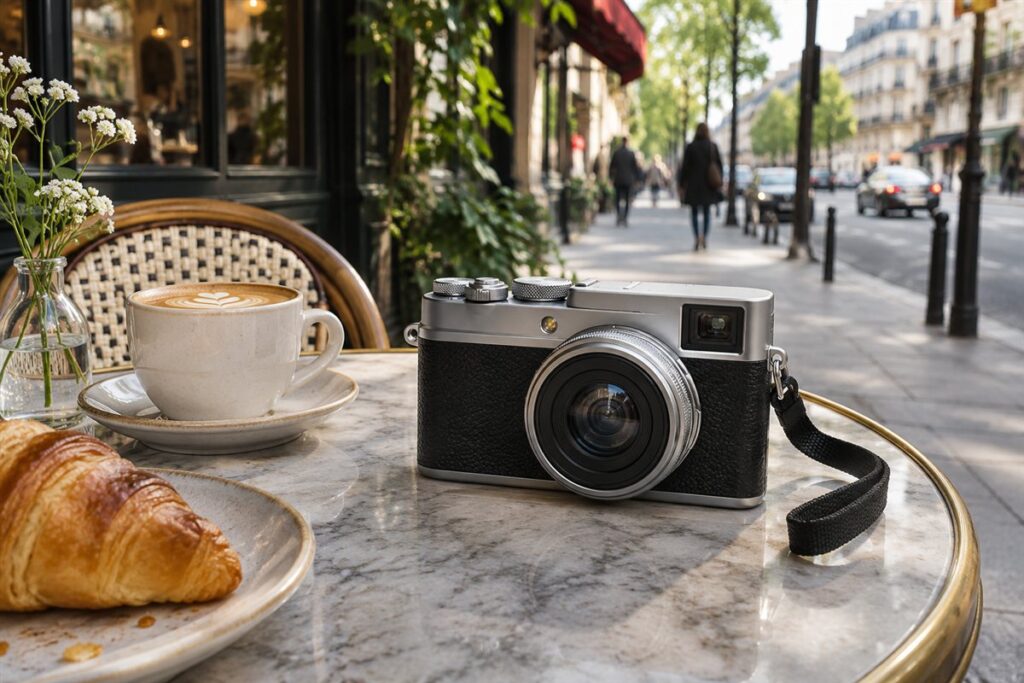
The Fujifilm X100 line is a family of compact cameras built around a fixed lens, a retro rangefinder style body and a large sensor. It suits people who want a small camera for street, travel and everyday photography and who are happy to work with one field of view. We have not used these cameras ourselves, so this guide covers general traits and tells you where to confirm details.
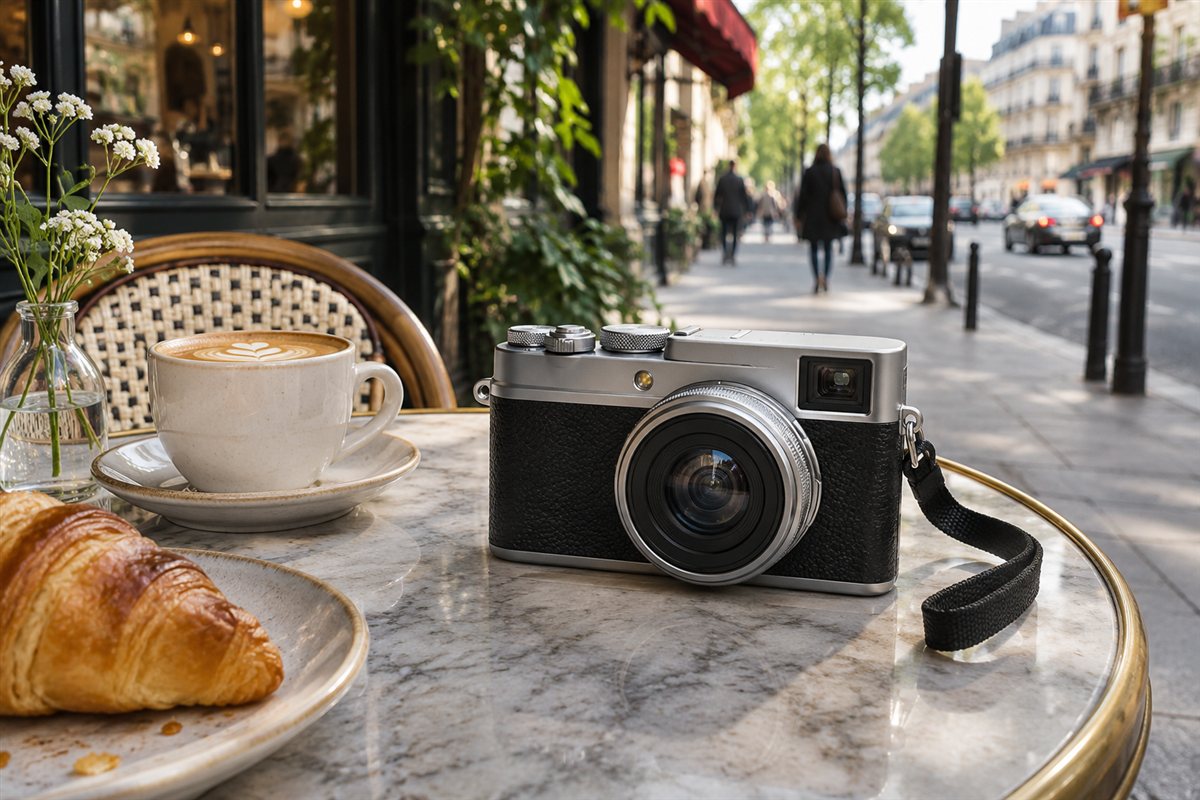
What Defines the Series
Every generation shares the same core idea, even as the sensor, processor and features have changed between models:
- A fixed 23mm lens, which gives a field of view close to 35mm on a full frame camera.
- An APS-C size sensor, larger than the sensors in most compact cameras and phones.
- A hybrid viewfinder in most models, letting you switch between an optical window and an electronic display.
- Physical dials for shutter speed, exposure compensation and often aperture on the lens ring.
- A built-in neutral density filter option on many generations.
Check the maker page for the exact features of each model, since details such as stabilization, weather sealing and screen design differ.
In this guide
Why People Like It
The fixed lens keeps the camera compact and the focal length encourages simple, honest framing. Photographers often describe the experience as closer to a film camera, because the dials sit where you can see them and the menu is rarely needed during a walk.
Fujifilm film simulations are another draw. These color profiles imitate classic film looks and let you produce attractive JPEG files straight from the camera with little editing.
Trade-offs to Weigh
- One focal length means you must move your feet. Portraits and distant wildlife are harder than with a zoom.
- Autofocus and burst performance vary between generations, so sports and fast action are not the strongest use.
- Demand has sometimes outpaced supply, so availability can differ by region and over time.
- Wide and tele conversion lenses are sold separately and add bulk.
Who Should Choose It
- Choose it if you want a pocketable second camera for walking, travel and documentary work.
- Choose it if you prefer shooting with dials and a viewfinder over touchscreen menus.
- Choose something with interchangeable lenses if you need long reach, shallow depth of field at a distance or flexible video work.
Compare the model you are considering with its predecessor on the maker page, particularly the sensor resolution, lens version and battery listings.
Shooting with a Single 23mm View
A fixed lens changes the way you work. Instead of zooming, you move your feet, and that tends to make you think about distance, foreground and background before you press the shutter. The 23mm lens on an APS-C sensor gives a field of view close to 35mm on full frame, which is a wide-normal view often used for street scenes, travel, friends and food.
To get the most from it, practice a few habits. Step closer than feels natural for people photos, because the lens includes a lot of the surroundings and a distant subject becomes small. Use the edges of the frame deliberately, looking for lines and shapes that hold the picture together. Place your subject against a clean background by shifting a few steps sideways. Look for layers: something near, something in the middle and something far.
- Spend a week using only one focal length and note how it shapes your framing.
- Use the viewfinder to check the edges of the frame before releasing the shutter.
- Take a series of the same scene from different distances to see how perspective changes.
Many owners find that the limit becomes a creative aid. Others miss the flexibility of a zoom, which is a fair reason to choose a different system. Neither response is wrong, and trying the focal length on your own subjects is the best way to find out which camp you belong to.
Understanding the Hybrid Viewfinder
The hybrid viewfinder, found in most generations, combines an optical window with an electronic display. In optical mode, you look through a glass window with frame lines that show approximately what the lens will capture. In electronic mode, you see the actual image from the sensor, with exposure preview and menus. Many models also offer a small electronic inset in the optical view for checking focus.
Each mode suits different uses. The optical view is bright, lag-free and lets you see outside the frame, which helps you anticipate people stepping into the shot. The electronic view shows exposure, white balance and film simulation effects before you shoot, which helps in tricky light. The optical frame lines are an approximation, and at close distances the framing differs from what the lens captures because the viewfinder sits to the side of the lens. This is called parallax, and the camera usually adjusts the lines in some way, but you should check the manual for how it works on your model.
Spend time with both modes. Switch between them using the lever on the front, and learn which situations suit each. If the camera you are considering lacks the hybrid design, check what it offers in its place, and how that fits your habits.
Film Simulations and JPEG Workflow
Film simulations are color and tone presets that imitate the look of classic film. Fujifilm cameras provide a selection, and the list varies by generation. They affect color, contrast and tonal rendering, and many photographers use them as a starting point for JPEG files that need little editing.
A simple workflow can save time. Choose a simulation you like, set the white balance to match the light, and shoot raw plus JPEG so that you can return to the original if needed. Compare the JPEG to the raw file in your editing software to understand what the camera does. Adjust parameters such as contrast, highlights, shadows and grain effect in the camera menu if you want a consistent look.
- Save favorite combinations as custom settings so you can recall them quickly.
- Test the same scene with different simulations to see how they treat skin tones and skies.
- Use a monochrome option to judge shapes and contrast without color.
Not everyone wants to shoot JPEG. If you prefer raw files, you can still use the simulation as a guide in the viewfinder and apply a similar look in editing. Check the maker’s page for the specific list of simulations on your model, as it differs between versions.
Buying New or Used and Comparing Generations
Because the line has run through several generations, buyers face a choice of newer and older models. Start by listing what you need: resolution, autofocus behavior, screen design, video options, weather protection and battery type. Then compare the models on the maker’s pages, and read about changes between the generations in neutral sources.
Availability can be uneven, so be patient and cautious about sellers. If you buy used, ask about the shutter count where relevant, check the lens for dust, haze and scratches, and test the aperture ring and dials for smooth movement. Look inside the lens for dust spots or marks, test the leaf shutter and make sure the camera powers on and focuses properly. Check the viewfinder and screen for damage, and test the battery, charger and any accessories included.
Be careful with offers that seem too good, as scams exist in markets where supply is limited. Use a reputable seller with a return policy, pay by a method that offers protection, and avoid sending money to strangers. Keep the box and papers if you can, since they help with resale. For a new purchase, buy from an authorized seller, and read the warranty terms to see what is covered and for how long.
Accessories, Care and Everyday Carry
The camera is small, but a few accessories improve daily use. A lens hood or adapter ring lets you attach filters, which protect the front or control light. A spare battery is useful, since compact cameras often have modest battery capacity. A comfortable strap, a wrist strap or a small pouch keeps the camera safe in a pocket or bag. Some owners add a thumb grip or a half case for a better hold, so check that any accessory fits your specific model.
For care, keep the lens and screen clean with a blower and a microfiber cloth. Because the lens is fixed, dust on the sensor can be harder to deal with than on an interchangeable-lens camera, so avoid dusty environments and consult the manual or a service center before trying any sensor cleaning. Store the camera in a dry, padded space away from heat.
Think about weather. Check the maker’s page for any statement about sealing on your model, and do not assume protection that is not stated. In rain, use a cover or put the camera away. Update the firmware from time to time, since updates can improve behavior and fix problems. Finally, learn the controls until they are second nature, so you can adjust settings by feel while keeping your eye on the scene.
Learning the Physical Controls
One reason this camera line has such a loyal following is that exposure is handled by real dials and rings instead of menus. Across the series you generally find a shutter speed dial on top, an exposure compensation dial next to it, and an aperture ring around the lens barrel. Once you know where each control sits, you can read the camera’s settings at a glance, even with the power off. Exact layouts vary between generations, so look at the maker’s manual for the model you own or plan to buy.
The easiest way to build muscle memory is to give yourself small exercises. Spend one outing using only aperture and exposure compensation, leaving the shutter speed on its automatic position. On another outing, fix the shutter speed for movement and let the aperture ring do the creative work. By the third or fourth outing, you stop thinking about the dials and begin thinking about the scene, which is the whole point of this style of camera.
| Control | What it changes | Good habit |
|---|---|---|
| Aperture ring | Depth of field and light amount | Set it before you raise the camera |
| Shutter dial | Motion blur and exposure | Pick a safe speed for handheld shots |
| Exposure compensation | Brightness bias in automatic modes | Return it to zero after each scene |
| Command dials and buttons | ISO, menus, quick settings | Assign the ones you use most |
The Leaf Shutter and Flash
A leaf shutter sits inside the lens rather than in front of the sensor, and it is a defining feature of this family. Because of that design, the camera can usually synchronise with flash at much higher shutter speeds than many ordinary cameras allow. That matters outdoors, where you may want a fast shutter speed and a wide aperture in bright light while still using fill flash on a face. It also tends to make the shutter quiet, which is helpful in restaurants, ceremonies and street scenes where a loud click would draw attention.
There are a few things to keep in mind. The limits of the shutter, the built-in flash (where one is fitted) and any external flash all depend on the model, so confirm those details on the product listing or in the manual. Also remember that very fast shutter speeds and wide apertures in daylight can exceed the camera’s limits, which is where the built-in neutral density filter on some models becomes useful.
Everyday Street and Travel Habits
Because the lens is fixed, you move your feet instead of zooming. That sounds limiting, yet it often improves your photographs. You learn to step closer, wait for a gesture, and include foreground elements to build depth. A few habits make the experience smoother.
- Pre-focus on a spot where you expect action, such as a doorway or a market stall, and wait for someone to enter the frame.
- Keep the camera at chest height and look through the finder only when needed, so you appear less intrusive.
- Check the corners of the frame before you press the button; with a single focal length, stray objects at the edges are easy to miss.
- Shoot a mix of horizontal and vertical frames so you have choices later.
On trips, pair the camera with a small strap, a spare battery and a card or two. It is light enough to carry all day, which is often the reason people end up taking more photographs with it than with a larger kit.
Common Buying Mistakes
Newcomers sometimes buy on reputation alone and then feel disappointed. Avoid these traps.
- Expecting a zoom. If you often need a longer or wider view, a single fixed lens will frustrate you. Think about your usual subjects honestly.
- Ignoring the wait. Popular models have at times been hard to find, so a listing that looks suspiciously easy deserves a second look at the seller and condition.
- Skipping accessories planning. A lens hood, filter adapter or spare battery may not be included, so check what comes in the box.
- Overlooking handling. The body is small, and some people find it too small for large hands. If you can, hold one in a shop first.
- Buying every generation upgrade. Each new model improves some things, but the core experience of a fixed lens and dials stays the same.
Building a Simple Workflow
A good workflow keeps the fun in the process. Many owners shoot raw plus JPEG, which lets them share quick files and still keep room for edits on favourites. Copy cards to your computer after each outing, rename the folder with a date and place, and back up to a second drive before clearing the card.
When you edit, begin with a light touch. Straighten horizons, adjust exposure, and see whether the built-in colour already works for the picture. If it does, leave it. Over time you will find which scenes need more contrast, a cooler white balance or a crop to a different shape. Keep notes about what you liked, and use them to guide your next outing.
Light, Exposure and Compensation in Practice
A compact camera with a bright, fixed lens invites you to shoot in the soft hours of the day and in dim interiors alike. Learn how the exposure compensation dial behaves in each situation. In a scene with a lot of bright sky, the meter may darken the subject, so a small positive adjustment can bring back shadow detail. In a dark room with a few small lights, the meter may brighten everything, so a small negative adjustment helps keep the mood. Treat these as habits to try rather than strict rules, and check your results on the screen as you go.
It also helps to watch the histogram when you can. A histogram bunched against the right edge warns you about lost highlights, while a graph crowded on the left shows underexposure. Photographers who shoot raw files can recover a fair amount, but good exposure in the camera always gives you cleaner files and less editing work later.
Portraits and People With a Single Field of View
Many owners use the camera for candid portraits of friends and family. The moderate wide view means you work close, which can create a friendly, involved feeling in the picture, though it is easy to exaggerate features if you stand too near the face. Aim to frame from the waist or chest up for flattering results, and save very tight shots for when you have room to step back and crop in editing.
- Use a wider aperture to separate your subject from the background, but remember that focus accuracy matters more as the depth of field gets thinner.
- Look for window light or open shade, which gives soft and even illumination.
- Talk with your subject while shooting; the small, quiet camera lets people relax, and relaxed people photograph better.
- Take a few frames of the surroundings too, so the set tells a story of the place.
Care for Long Term Use
A fixed-lens camera has no lens cap to swap or lens to change, which reduces dust exposure but means the front glass is always the part you must protect. Use a soft blower first, then a clean microfibre cloth for fingerprints, and avoid pressing hard on the glass. If you add a protective filter, choose one that matches the thread size listed by the maker.
Store the camera in a dry bag, away from heat and humidity, and keep the battery charged to a moderate level if you will not use it for weeks. When travelling in cold or damp weather, let the camera adjust to room temperature before opening a bag so that condensation does not form. For anything beyond basic cleaning, contact the maker’s service channels rather than opening the body yourself.
Quick Checklist Before You Commit
- Do I enjoy shooting at one fixed field of view?
- Have I handled the camera or watched trustworthy handling videos?
- Do I know which generation I want and why?
- Have I confirmed what is included with the listing?
- Do I have a plan for batteries, cards and a carrying strap?
If you can answer yes to most of these, you are likely to be happy with the purchase, and if not, the list tells you exactly what to investigate next.
Living With a Fixed Lens: The Real Adjustment
Every buyer of this camera family weighs the same question, so it deserves a direct treatment: what does it actually feel like when the lens cannot zoom and cannot be changed? The first week feels restrictive, especially if you arrive from a zoom-heavy kit. You notice the shots you cannot take, the distant detail, the wide interior, and you compose with your feet while grumbling. Somewhere in the second week, for most owners, the feeling inverts. You begin seeing in the camera’s field of view before you raise it, you position yourself as you approach a scene rather than after, and the absence of choices starts to feel like the absence of friction.
The honest limitations remain and should be planned for rather than denied. Wildlife, sports and tight headshots are not this camera’s work, and architectural interiors will sometimes want a wider view than it has. Owners solve this in one of three ways: accepting the boundary as the price of the camera’s size and simplicity, using the maker’s conversion lenses for occasional wider or tighter needs, or keeping a second system for the genres the fixed lens cannot serve. All three are respectable; the mistake is buying the camera while secretly expecting it to be a system camera.
What the fixed lens gives in return is mastery of one view. Photographers who spend a year at a single focal length develop an instinct for distance and framing that transfers to every other camera they will ever use. That education is a large part of what owners are actually buying, whether they know it at the checkout or not.
The Generations Problem: Choosing Among Versions
A long-running series creates a pleasant problem: several generations, all recognizably the same idea, at different prices and with different refinements. The way through is to list what actually changed between generations and match those changes to your habits. Sensor and processing improvements matter if you print large or shoot in dim light often. Autofocus improvements matter if your subjects move, children and street scenes especially. Viewfinder, screen and control refinements matter to everyone daily, because they are the camera’s interface with your hands and eyes.
Equally, name what did not change, because it defines the experience across all versions: the fixed lens concept, the direct control layout, the size and the general character of the files. If the concept itself does not appeal, no generation will fix that. If it does appeal, an earlier generation at a lower price may deliver most of the joy, leaving budget for travel, printing and the accessories that complete the kit.
Used examples of earlier generations are plentiful, which makes condition the deciding skill. Check the lens for dust and marks, the dials for firm detents, the screen and viewfinder for damage, and the shutter and controls through a full test session. A well-kept older model beats a neglected newer one, and the savings can fund the case, strap and spare batteries that make the camera a daily companion.
Settings That Suit the Camera’s Character
This camera rewards a simple, stable configuration rather than constant menu diving. Choose one or two film simulations that match your taste and learn how they behave in different light instead of cycling through all of them. Set the aperture ring and shutter dial as your primary controls, since reaching for them is the tactile pleasure the design exists to provide, and let sensitivity ride automatically within a ceiling you choose for your quality standards.
Configure the few custom buttons for the things you truly change: drive mode, focus mode, simulation bracketing if you use it. Everything else can stay in the quick menu. The goal is a camera you can operate by feel while looking at the scene, because the scenes this camera is for, street, travel, family, do not wait for menu navigation.
Spend one session on focus settings alone. Learn how the camera behaves in single point, zone and wide tracking with your typical subjects, and how face detection helps or interferes with your style. A fixed lens camera lives or dies by focus confidence, since there is no zoom to rescue a poorly framed attempt and moments are its whole subject matter.
Printing and Sharing Work From a Small Camera
Owners often find this camera rekindles printing, because its files have a finished quality straight from the camera that invites paper. The JPEG workflow, chosen deliberately with a simulation you love, shortens the distance between making a photograph and holding it, and small prints, books and zines suit the intimate scale of the subjects the camera gathers. A home printer or a good lab turns a year of daily carrying into a shelf of tangible work.
Sharing benefits from the same directness. Files that need little editing get shared while the day is still warm, and the camera’s modest profile means the photographs were gathered unobtrusively in the first place. For photographers whose main audience is family and friends, that pipeline, see it, shoot it simply, print or share it the same week, is the entire point, and it is where larger systems often quietly fail through sheer friction.
Consider a simple annual project to give the carrying a shape: a book of the year, a print for each month, a series on one street or one person’s growth. The camera’s consistency gives such projects a unified look without effort, and the project gives you a reason to carry it on the ordinary days when the best photographs tend to happen.
A First Month Owner’s Plan
Week one: defaults and dials
Carry the camera daily, shoot everything at the settings it came with plus one simulation of your choice, and learn the dials by touch. Review nightly and note which control you reached for and could not find.
Week two: the focal length
Deliberately practice distance: portraits at the closest respectful range, scenes at the far side of the street, interiors from the corner. Notice where your feet now go automatically before you raise the camera.
Week three: light and flash
Explore the leaf shutter’s party trick, flash that syncs at speeds other cameras cannot use, and the built-in filtration for bright days. Photograph the same portrait at noon with and without flash to see the difference in your own files.
Week four: print and judge
Print the month’s best dozen at a modest size and live with them on a wall or desk for a few days. Judge the camera by those prints, not by screen magnification, and write down what the next month should practice.
The Camera as a Daily Object
Some cameras are tools you fetch; this one is an object you live with, and that distinction explains much of its following. It sits on a desk rather than in a cupboard, goes into a jacket pocket or a small bag without negotiation, and appears at breakfast tables and on walks without changing the nature of the occasion. Photographs accumulate not from expeditions but from presence, and presence compounds: the camera that is there for a thousand ordinary moments builds a record of a life that no occasional, superior instrument can match.
Living with an object also means its design is judged daily. The feel of the dials, the sound of the shutter, the way the finish wears at the edges, these become part of the pleasure or the irritation of ownership in a way that specification comparisons never capture. This is why owners speak about the camera with unusual affection and why detractors find the affection puzzling; both are reporting honestly on different relationships, one with an object, the other with a specification.
If you are deciding, borrow that lens on ownership for a moment: imagine the camera on your own desk, in your own bag, at your own table. If the picture pleases you, the camera will probably be used constantly, and constant use is the strongest predictor of satisfaction in this entire comparison. If the picture leaves you cold and the specifications leave you wanting, believe both signals and choose a system camera instead, in peace.
Accessories That Earn Their Place
A fixed-lens camera invites a short, honest accessory list, and restraint is the theme. A comfortable strap that suits how you actually carry, wrist for grab-and-go days or neck for long walks, changes the camera’s daily life more than any electronic addition. A simple case or half-case protects the finish in bags full of keys and cables, and a screen protector is cheap peace of mind for a camera that lives unsheltered. Spare batteries matter because the camera’s small size means small batteries; two in rotation is the working minimum for a full day.
The maker’s conversion lenses deserve a clear-eyed word. They widen or narrow the fixed view by attaching over the built-in lens, and they are optically serious, not toys. They suit owners who love the camera and occasionally need the other view, a wide for interiors and architecture on a trip, a modest tele for portraits. They do not turn the camera into a system, and buying both plus the camera approaches the cost of other solutions, so purchase them for specific, recurring needs rather than for completeness.
Filters follow the same rule. The adapter ring that lets the camera take standard filters opens creative doors, a polarizer for travel skies and water, neutral density for long exposures that the built-in filter does not cover, but each addition erodes the simplicity that is the camera’s reason to exist. Buy one at a time, for a named purpose, and let the kit stay as small as the camera promises.
The Secondhand Market and What to Pay Attention To
Because this series is beloved, its used market is active and mostly honest, but a few checks protect the buyer. Shutter counts matter less than general condition: examine the lens glass under a bright light for cleaning marks and internal dust, work every dial and button through its function, and check the hybrid viewfinder in both modes, since its mechanism is the camera’s most complex part. Test autofocus on near and far subjects, and take a frame at the smallest aperture against a plain sky to reveal sensor dust that a clean at the shop can solve.
Accessories included change the value equation. The lens hood, adapter ring, original strap and box are worth real money to replace separately, so a complete kit at a fair price often beats a bare camera at a tempting one. Batteries age; budget for a fresh pair regardless of the seller’s assurances, and treat any third-party battery of unknown origin as a spare for emergencies rather than a mainstay.
Buy from sellers who allow returns, and use the window actively: carry the camera daily for a week, shoot the subjects you actually shoot, and judge by the prints or files of your own life. A camera this personal cannot be evaluated from a doorstep inspection, and reputable sellers of such cameras understand that.
If You Decide Against It: Honest Alternatives in Spirit
A fair guide admits the readers it should turn away. If your photography is built on changing lenses, on reach, or on the fastest possible autofocus for sport and wildlife, this camera will not become your main tool no matter how charming it is, and its price buys serious system equipment. If you need video as a first-class citizen, with the stabilization, autofocus and audio provisions of a modern hybrid body, look there instead and let this camera be the stills companion it wants to be, or not part of the kit at all.
For those who love the concept but not the price, the used earlier generations and the secondhand market described above are the honorable route, delivering most of the experience for considerably less. For those who love the concept and want it new, the current generation’s refinements in focus and processing are real, and the camera holds value well enough that the experiment is rarely a financial disaster if the fit proves wrong.
What no alternative quite replicates is the specific combination: the direct dials, the hybrid finder, the leaf shutter’s quiet and the fixed view that teaches. If that combination is the appeal, it is this camera or its siblings, and the decision simplifies to generation and condition. If the appeal was only a fine small camera, the market is full of them, and you should buy the one whose compromises you will never notice.
The Owner’s Year: What Satisfaction Actually Looks Like
Satisfaction with this camera rarely announces itself as excitement; it looks like statistics of use. The camera’s frames outnumber every other camera’s in the annual archive. It appears in the metadata of the year’s favorite dozen photographs out of proportion to its specifications. It is the camera that went on the trip where the big kit stayed home, the one in the bag at the family events that turned out to matter, the one whose dials your fingers know in the dark. Owners who measure satisfaction that way stop wondering whether they chose correctly, because the archive answers the question in the only terms that were ever relevant.
Dissatisfaction has a signature too, and it is worth naming for buyers still deciding. The camera sits charged but uncarried; its frames cluster in the first month and thin to nothing; its owner speaks of it as a beautiful object and reaches, daily, for a phone or a system camera instead. That pattern is not a verdict on the camera, which delights thousands, but on the fit between a fixed-lens life and a particular photographer’s habits, and it is exactly the outcome the honest self-examination in this guide exists to prevent.
So decide by simulating your own statistics. Look at last year’s archive and ask what share of its frames a fixed, moderate wide view, carried everywhere, would have captured, and what share genuinely needed something else. If the first share is the large one, this camera is not a compromise in your life; it is a portrait of it. Buy it, carry it for the year, and let the next archive deliver the verdict.
The Quiet Economics of the One-Camera Life
There is a financial argument for this camera that its admirers rarely make because the emotional one is louder, but it deserves a hearing. A photographer who commits to one fixed-lens camera exits the lens market entirely: no second body to feed, no mount ecosystem to maintain, no annual temptation dressed as an upgrade path. The money that a system quietly consumes across a decade, in lenses bought for completeness and sold at a loss, in bags sized for kits that grew by accretion, stays in the photographer’s life, available for the things that actually improve photographs: travel to interesting light, time off to use it, printing, books and education. Judged across ten years rather than at the checkout, the one-camera life is not the expensive indulgence it appears; for many photographers it is the cheapest serious way to photograph ever devised.
The counterweight is honesty about resale and replacement: a premium compact is a single point of failure, and its repair or replacement is a single large event rather than a gradual one. Insurance, a modest sinking fund or simply a clear-eyed acceptance of the risk covers it. Weighed whole, the economics favor the committed, as they usually do, and punish only the dabbler who pays the premium, keeps the system as well, and gains the simplicity of neither. Choose the life or do not, but let the choosing be conscious, and the camera will reward the consciousness.
A Last Word on Enough
Enough lens for the day, enough camera for the decade, enough simplicity for the photography to stay about the photographed: this camera family’s entire argument fits in that sentence, and the readers it suits recognize themselves in it immediately, the way you recognize a coat that was cut for you. The readers it does not suit feel the sentence as a limitation, and they are right too, about themselves. Between those two recognitions there is nothing left for a guide to decide, only the practicalities of generation, condition and price that this one has laid out. Trust the recognition, run the checks, and if the coat fits, wear it daily and in all weathers of your life, which is the only review of this camera that has ever finally mattered.
The Hands Remember: Ergonomics as Destiny
A final practical subject deserves its place, because with a camera carried daily it quietly decides everything else: how the object feels in the hands across a year of mornings. The dials’ resistance, the shutter’s sound and travel, the way the body settles into a one-handed grip while the other hand opens a gate or holds a coffee, these are the terms on which the camera will be loved or merely respected, and they cannot be read from a specification sheet. Owners speak of this camera’s controls the way musicians speak of an instrument’s action, and the comparison is apt, because both are interfaces practiced until they vanish. If you test one thing in a shop, test that vanishing: raise the camera, change the aperture and shutter by touch, focus, fire, and notice whether your attention stayed on the imaginary subject or fell into the machinery. A camera whose controls keep your attention outward, on the world it exists to photograph, has passed the only examination that a year of daily carrying will ever set it.
FAQ
Can I use it as my only camera?
Many photographers do, especially for street and travel. If your work needs several focal lengths, it works better as a companion to a system camera.
Is it good for video?
Video features differ by generation. Look at the maker specifications for resolution and frame rates, and consider whether a fixed lens suits the kind of clips you shoot.
What does the leaf shutter do?
Where fitted, it lets the camera sync with flash at higher shutter speeds than many cameras allow. Check the maker's page to see whether your model has it and what limits apply.
Do I need the built-in ND filter?
It helps when you want a wide aperture or a slow shutter in bright light. If you shoot mostly in shade or indoors, you may rarely use it.
How do I learn the dials quickly?
Practice changing shutter speed, aperture and exposure compensation without looking. Set the camera to a mode you like and shoot for a week with it before changing anything.
Are conversion lenses worth it?
They change the field of view, but they add bulk and may need adapters. Check the maker's compatibility notes for your model, and try them before relying on them.
Is it good for portraits?
It can work for environmental portraits and candid photos. For tight head shots or very shallow depth of field, a longer lens on an interchangeable-lens camera is more suitable.
How should I back up my photos on a trip?
Copy files to a laptop or a portable drive each evening, and keep a second copy somewhere separate. A spare memory card is also wise.
What is the best way to carry it?
A wrist strap or a small bag keeps the camera ready without weighing you down. Avoid leaving it in a hot car or exposed to rain.
Will I miss having a zoom for family events?
For group photographs and candid moments in ordinary rooms, most owners adapt within a few outings by moving closer and embracing wider, livelier frames. For ceremonies viewed from fixed seats and for stage performances, the fixed lens genuinely limits you, and a seat near the front or a second camera is the honest solution rather than a regret.
How weatherproof is the camera for daily carry?
Treat it as well built rather than invulnerable. It shrugs off the dust and brief damp of normal daily life, but it is not a camera to use unprotected in sustained rain. A small pouch, a lens cloth and the habit of drying it after a wet outing are proportionate care for a premium compact.
Is it a good camera for learning photography?
It is one of the best teachers available, precisely because it removes variables. The direct dials make aperture, shutter speed and exposure compensation physical and visible, and the fixed lens forces the foundational skill of positioning. Beginners should still learn on whatever they own, but a learner who chooses this camera will build unusually sound habits.
The Short Version
The Fujifilm X100 line offers a large sensor, a 23mm lens and tactile controls in a small body. Choose it for simple, portable photography, and choose a different system if you need lens flexibility.
