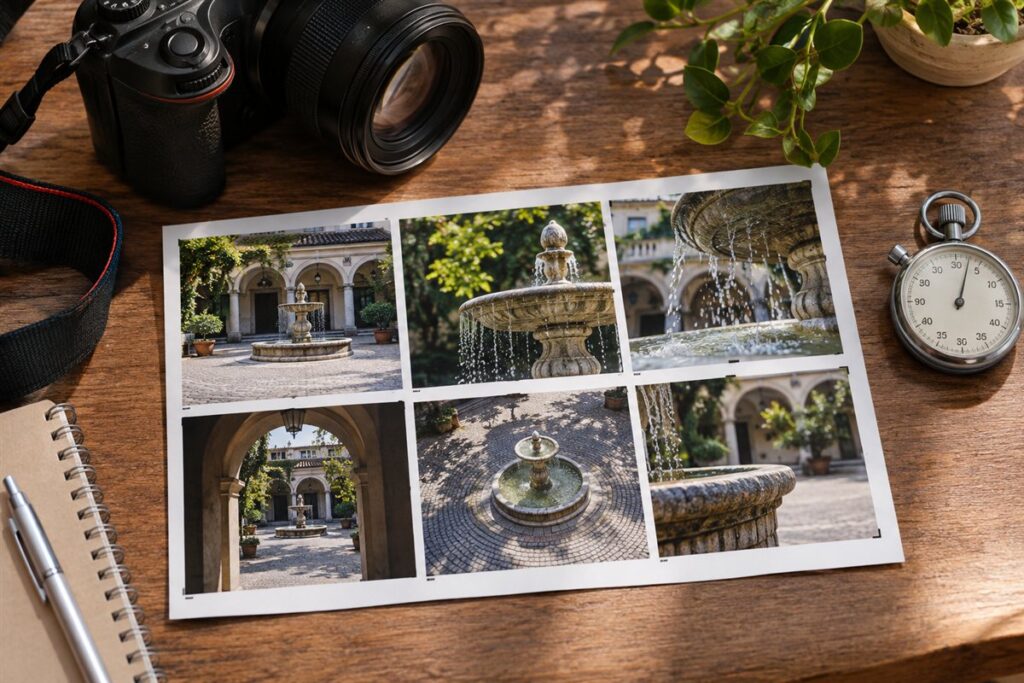
The one location challenge is simple: choose a single small spot, set a timer for 30 minutes and make 30 different photographs without leaving it. The limit removes the pressure of finding the perfect place and forces you to look for new angles, light and details instead of waiting for inspiration.
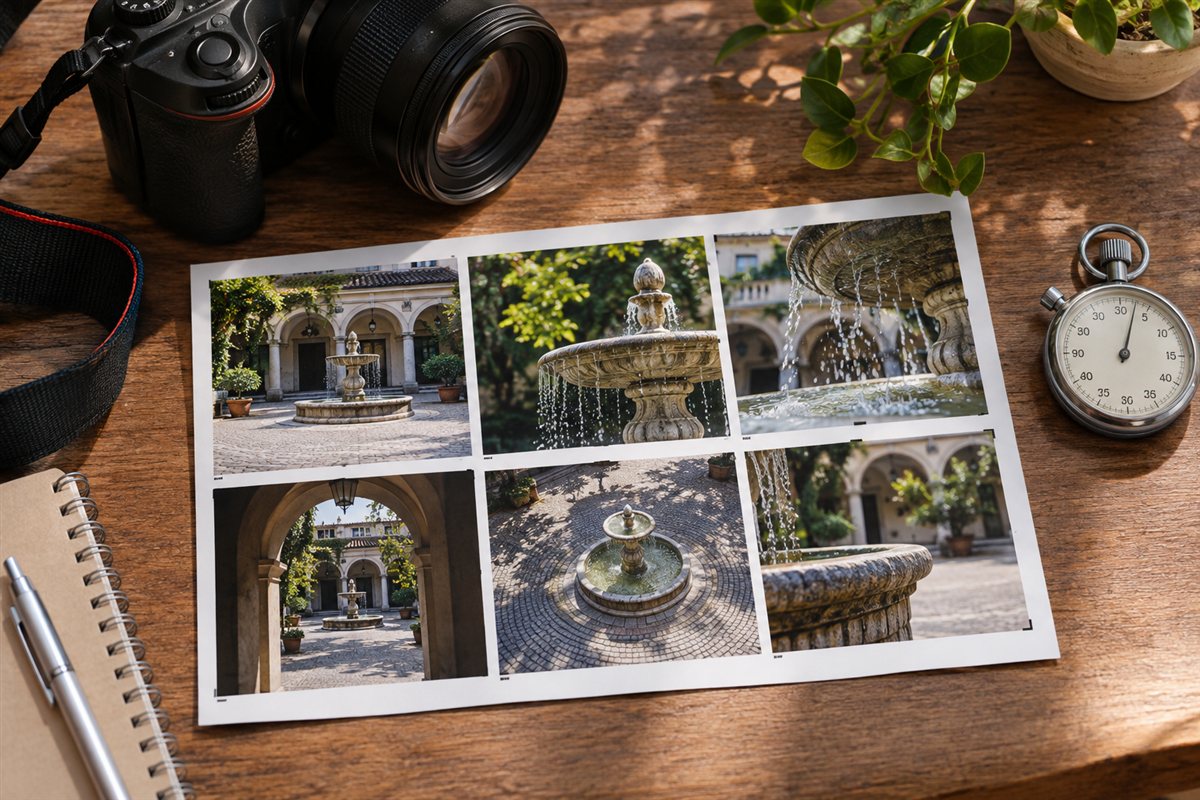
Why Limits Help
When ideas dry up, the usual response is to travel somewhere more exciting. The opposite often works better. A tight boundary and a short clock leave no room for second guessing, and you quickly run out of obvious pictures, which is exactly when the more interesting ones appear.
In this guide
How to Run the Challenge
- Pick a spot you can see in one glance, such as a kitchen corner, a bus stop, a stairwell, a market stall or a patch of garden.
- Choose one camera and one lens. A fixed focal length such as 35mm or 50mm in full frame terms works well because you must move your feet.
- Set a timer for 30 minutes and decide that you will not leave the area.
- Aim for 30 frames you would actually keep, not 300 near-duplicates. Count only photos that differ in some clear way.
- Do not delete anything during the session. Judging the set comes later.
Prompts for When You Run Out of Ideas
Around photo ten, most people stall. Use these prompts to keep going:
- Shoot from knee height, then from as high as you can reach.
- Find three textures and fill the frame with each.
- Look for repeating shapes, lines or colors.
- Use shadows or reflections as the main subject.
- Make a picture with a foreground object slightly out of focus.
- Photograph the same object at wide aperture, then at a small one.
- Wait for a person or vehicle to enter a framed spot, then press the shutter.
- Turn the camera vertical for every frame in one stretch.
What to Do Afterward
Look through the set the same day or the next. Pick the five images you like most and write one sentence on why each works. Patterns show up quickly: maybe you favor low angles, quiet corners or strong shadows. Those preferences are the beginnings of a personal style.
Repeat the exercise weekly in a different place, or return to the same spot at another time of day and compare how the light changes the options.
Choosing a Spot With Hidden Potential
The challenge works with almost any small location, but some places give you more to work with than others. The qualities to look for are variety in a small area: different distances, different surfaces and some change in light. A bare white room offers little. A corner of a kitchen with a window, a plant, a bowl of fruit and a worn counter offers a great deal.
Look for layers. A good spot has something close to the camera for a foreground, something in the middle that can be the subject and something farther away for a background. Doorways, stairwells, bus shelters, market stalls and gardens often have these layers. Also look for texture, such as brick, peeling paint, fabric, leaves or rusted metal, and for sources of light that you can use, such as a window, a streetlamp or a gap between buildings.
Check practical points before you begin. If the spot is public, make sure you are allowed to photograph there and that you are not blocking anyone. Be respectful of people who happen to be present, and ask permission if you want to include a recognizable person, particularly in private or sensitive places. Avoid unsafe places, such as roadsides, narrow ledges or areas with moving machinery. Choose somewhere you can stay comfortably for half an hour, with a place to rest your bag.
- Do a one-minute scan before starting and note three things you could photograph.
- Prefer places you know well, because the challenge teaches you to see them as new.
- Keep your gear light so you can move quickly.
An ordinary spot is usually better than an impressive one, since the constraint then does its job.
Composition Moves for Making 30 Different Frames
The most common reason people stall is that their frames look alike. The solution is to change one variable at a time, so each photograph is clearly different. Think of a short list of moves and cycle through them.
Change your distance. Take a wide shot that shows the whole space, a medium shot of a smaller area and a close-up of a detail. Change your height: crouch, stand on tiptoe, or hold the camera at arm’s length above your head. Change your angle: shoot from the left, the right, straight on, and from a corner. Even a small shift of a few steps can create a different background.
Use framing devices. Shoot through a doorway, a window, leaves or a gap between objects to create a frame within the frame. Use leading lines, such as railings, edges of buildings or cracks, to guide the eye. Look for symmetry, repetition and contrast, such as a smooth object against a rough surface. Isolate a single color and move around until it fills most of the frame.
Include time. Wait for a gesture, a passing cloud, a shadow moving across a wall or a person walking through a clean part of the frame. A frame that includes movement is different from one that does not.
- Distance, height, angle, frame, moment: five variables that can give you many pictures.
- Count only different frames: if two pictures feel the same, move on.
- Vertical and horizontal: switching orientation changes the whole composition.
Working With Light in a Small Area
With a single location, light becomes your main variable. The time of day, the direction of the light and the weather will change what the place looks like, and learning to read it is one of the biggest benefits of the challenge.
Start by noticing the direction. Light from the side shows texture and shape, while light from behind the subject can make edges glow or create silhouettes. Light from behind you is flat, but it makes colors clear. A window gives soft, directional light, and a shaded area under a roof gives a gentle, even look. Harsh midday sun makes strong shadows, which can be used as shapes in the picture instead of being avoided.
Expose carefully. In high-contrast scenes, decide whether you want detail in the highlights or in the shadows. Check the screen and adjust exposure compensation. For silhouettes, expose for the bright background. For soft portraits of objects, expose for the lit surface and let the background fall dark. If you use a phone, tap on the area you want to expose correctly and slide to adjust brightness.
Do not rely on flash unless you know how to use it. Natural light changes quickly and gives you a good reason to work fast.
- Use a reflector substitute, such as a white sheet of paper or a wall, to bounce soft light into shadows.
- Watch the light change during the half hour, and photograph the same corner more than once if it does.
- Try both low and high ISO to see what the scene needs.
Light often explains why a picture works, so make a habit of looking for it first.
Variations to Keep the Challenge Fresh
Once you have run the basic version a few times, you can add rules to keep it interesting. A new constraint pushes you into new habits, so choose variations that match what you want to improve.
Try a theme. Photograph only one color, one shape, one texture or one kind of light. A theme such as “circles” or “things that are worn” gives your eye a job and cuts out many of the obvious choices. Try a story constraint, where the 30 frames must tell a tiny story with a beginning, middle and end, or where you include a single character, such as a coffee cup or a pet, in every frame.
Try a technical constraint. Use only one aperture, and see how different the pictures can be. Use only manual focus. Use a slow shutter speed to show movement. Shoot in black and white so you must think about tone and contrast instead of color. Use a vintage or inexpensive lens if you have one, since limitations teach you more than a perfect tool.
Try a time variation. Shorten the clock to fifteen minutes for fifteen frames, or lengthen it to an hour for a deeper exploration. Return to the same spot in different seasons or at different times of day and compare.
- Change one rule at a time so you can tell what helped.
- Challenge a friend to use the same spot, then compare your different results.
- Keep a list of variations to pick from when you feel stuck.
Turning One Session Into a Habit and Reviewing the Results
The value of the exercise builds with repetition, so it helps to make it easy to repeat. Choose a regular time, such as a weekend morning or a lunch break, and keep the camera or phone ready. Short sessions are easier to keep than ambitious ones.
When you review the set, do it in stages. First, look at the whole set quickly and mark the frames that stand out. Second, pick your top five and write one sentence on why each works, such as “the shadow creates a strong diagonal” or “the foreground object gives depth”. Third, pick one frame that failed and note why. This kind of note-taking is more useful than rating the pictures with stars.
Look for patterns across sessions. Maybe you favor low angles, quiet colors or tight crops. Maybe you always forget the background. These patterns point to strengths to build on and habits to correct. Keep the best images in a folder and, after a few sessions, look at them together to see what ties them. That is the beginning of a personal style.
If you want to share, choose a small group of images that belong together and leave out near duplicates. Posting five strong images tells a clearer story than posting thirty.
- Keep a simple log of date, place and one lesson.
- Do light editing only, such as cropping and exposure, so you learn from the camera work.
- Back up the files so your progress is safe.
What to Bring for a Thirty-Minute Session
The beauty of this challenge is that it asks for almost nothing. You do not need a bag full of lenses, and in fact carrying less makes the exercise work better. Choose one camera and one lens, preferably a lens you know well, and leave the rest at home. A phone is a perfectly good choice if that is what you shoot with every day.
- A camera with a charged battery and an empty memory card.
- A single lens, ideally a standard zoom or a simple prime.
- A timer on your phone, set to thirty minutes.
- A small notebook or a notes app to jot down ideas.
- A lens cloth, since you will be moving around a lot.
- Comfortable shoes and, if needed, a layer for the weather.
Tell yourself that the goal is not thirty perfect photos, but thirty honest attempts. That mindset removes pressure and lets you try ideas you would normally skip.
A Table of Quick Prompts to Keep You Moving
When you hit a wall at minute fifteen, a prompt can break the loop. Keep this table on your phone and glance at it when you stall. Each prompt asks you to change one thing about how you see the place.
| Prompt | What to try |
|---|---|
| Get low | Crouch or lie down and shoot upward or across the ground |
| Get high | Climb a step, a wall or a staircase for a new angle |
| Frame within a frame | Use a window, a doorway or an archway around your subject |
| Chase one color | Photograph only things that share a color |
| Look for shadows | Make the shadow the subject, not the object |
| Go very close | Fill the frame with texture or a small detail |
| Go wide | Show the whole place and where you stand in it |
| Wait for a person | Compose first, then wait for someone to walk into the scene |
You do not have to use every prompt. Pick the ones that make you curious, and ignore the rest.
Respecting People and Places While You Shoot
Because you will stay in one spot for a while, you may attract attention. Be considerate. If you are in a public place, follow any posted rules about photography. In private spaces, such as a shop, a cafe or a museum, ask for permission first. When people appear in your frame, think about their privacy and comfort. A friendly smile or a quick word usually settles any curiosity.
Do not block pathways, climb on structures that are not meant for it, or enter areas marked as closed. If a location is crowded, choose a quieter corner. Keep your gear close to you and stay aware of your surroundings. Good photography should never come at the cost of safety or courtesy.
Turning Thirty Frames Into One Strong Set
Once the timer ends, sit down with your pictures and give them a fair look. Do not delete anything at first. Scroll through quickly and mark the frames that give you a small jolt of interest. Then look at those again and ask what they have in common. It might be a color, an angle or a mood.
- Pick your top five and place them side by side.
- Identify the one that surprised you most, and note what you did differently.
- Choose a single image to edit fully, and treat it as a finished piece.
- Write two sentences about what you learned from the session.
This reflection is where the challenge turns into growth. The goal is to notice your own habits and to find new ones.
Making the Challenge a Regular Habit
Repeat the exercise weekly or monthly, always at a new spot or at a familiar spot at a different hour. A park bench, a bus stop, your own kitchen or a market stall all give you something to work with. Vary the lens, the time of day and the weather to give yourself fresh limits each time.
Keep a simple log with the date, the place and one lesson learned. After a few sessions, you will see a pattern in what attracts you, and you will gain confidence that ideas are always available, even in the most ordinary places. Share your favorite frames with a friend or a small group, and invite others to try the same challenge, then compare how differently each person saw the same space.
Troubleshooting a Session That Feels Stuck
Some days the ideas simply will not come. If you reach the middle of the timer and your frames all look the same, change something physical. Walk to the opposite side of the location, swap to a different focal length if your lens zooms, or turn the camera to a vertical format. Try shooting with an unusual setting, such as a very small aperture, or a slow shutter speed with the camera braced on a wall.
It also helps to let go of the result. Take pictures of things you would normally dismiss, like a bin, a puddle or a peeling sign. Often the least promising subject gives the most original frame once you commit to treating it seriously. When the timer ends, accept the session for what it is. A day with a few usable frames and a lesson learned counts as success.
Adapting the Challenge for Different Genres
The same structure can be used for portraits, still life, street, landscape or macro work. For portraits, invite a friend to sit for thirty minutes and explore light, angle and expression within a small space. For still life, choose a table and a few objects. For macro, stay within a single square meter of garden. The principle is always the same: a limited place, a limited time and a limited tool set produce a surprising range of ideas.
Designing Your Thirty Minutes
The challenge works best when the constraints are set before the clock starts. Choose one location you can stand in without moving more than a few steps: a café table, a market stall frontage, a street corner, a garden bench, a single room at home. Decide the rules that will govern the half hour: one lens, one focal length if it is a zoom, no deleting in camera, and every frame must be a deliberate composition rather than a hopeful burst. Then set a timer and begin, because the mild pressure of the clock is part of the design; it stops the perfectionism that makes photographers circle a subject for ten minutes and leave with two frames.
Pace the half hour in phases rather than treating it as an undifferentiated scramble. The first minutes belong to the obvious photographs, the ones you saw when you chose the spot; take them and get them out of the way. The middle belongs to exploration, changing height, distance and orientation, working details and relationships. The final minutes, when the location feels exhausted, are where the exercise earns its reputation, because that is when you start seeing light, gesture and coincidence instead of subjects, and the frames from those minutes are often the ones that surprise you in the evening review.
Choose the location with a little strategy. Places with layered activity, foreground and background moving independently, reward staying still: transit stops, playgrounds, harbors, workshops. Quiet places reward a different attention, to texture, shadow and small change. Either works; what fails is a location chosen for a single famous view, because one view gives you one photograph and twenty-nine variations of disappointment.
A Shot List That Unfolds in Place
The establishing frame and its opposite
Begin with the widest honest view of the place, then immediately find its opposite: the smallest detail that still says where you are, a worn handle, a ticket stub, a pattern of tiles. Moving between those poles early teaches your eye the scale range the location offers.
People, gesture and waiting
If the place has people, let them provide the life. Pick a background you like and wait for someone to enter it, rather than chasing passers-by. Hands, silhouettes and reflections count fully; the challenge is about seeing, not about collecting faces, and it respects the people sharing the space with you.
Light as the subject
Reserve several frames for light itself: the shadow of a railing, sun striking dust, a reflection doing something the real scene is not. In a fixed spot, the light moves even when you cannot, and across thirty minutes it will offer you at least one small event worth a frame.
Frames within frames
Doorways, windows, mirrors, gaps in a fence: a fixed position usually contains more internal frames than you notice at first. Each one is a ready-made composition and a way to photograph the same view at a different depth.
Reviewing the Thirty: Where the Learning Lives
The exercise is only half finished when the timer ends. Review the full set the same day, in order, without deleting, and look for the story of your own attention: what you noticed first, when you started repeating yourself, and what changed in the final minutes. Most photographers find a visible dip in the middle, where the obvious ran out, followed by the most original frames at the end. Seeing that pattern in your own work teaches you to push through the dip on ordinary shoots, where no timer forces you to stay.
Select ruthlessly but kindly. Choose the three strongest frames and articulate, in one sentence each, why they work. Then choose the three most instructive failures and name what you would change. That short written review, kept with the images, converts a pleasant half hour into training data, and repeating the exercise monthly in different places builds a map of your habits that no tutorial can give you.
Share the contact sheet, not just the winners, if you do the exercise with friends or a camera club. Comparing how different photographers spend the same thirty minutes in the same spot is one of the fastest ways to expand your own seeing, because it proves viscerally that the limitation was never the location.
Variations to Keep It Fresh
Once the basic form is familiar, vary one rule at a time. Limit yourself to a single aperture, or to vertical frames only, or to photographs made from one exact standing position without stepping at all. Shoot the same location at a different hour and compare what the light changed. Shoot it in black and white only, forcing attention onto tone and shape. Invite a theme, hands, red objects, reflections, the number three, and let the theme hunt for you when inspiration stalls.
Raise the difficulty by shrinking the location: a single chair, a desk, a car interior. The smaller the stage, the more the exercise becomes about detail and light, and the more transferable the skill to product, still life and home documentary work. Lower the difficulty, when you need a win, by choosing the richest location you know at its best hour; the exercise should stretch you, not defeat you.
Keep a simple log across attempts: date, place, lens, best frame, main lesson. Over a year, that log becomes a personal curriculum, and returning to early locations shows your progress more honestly than any new equipment purchase.
Why Constraints Beat New Gear for Creative Blocks
Creative block in photography is rarely a shortage of subjects; it is a surplus of options and a habit of repeating the last successful formula. A tight, timed constraint removes the options and interrupts the formula at the same time. You cannot wait for the perfect subject, travel to a better place or buy your way out; you can only look harder at what is in front of you, which is the entire skill of photography in miniature.
The exercise also rebuilds trust in your own eye. Thirty frames in a place you judged ordinary, with several you genuinely like, is evidence that material is everywhere and that your seeing, not your surroundings, was the bottleneck. Photographers who internalize that lesson stop postponing their photography to trips and events, and start making work in the daily places where most of life actually happens.
Treat the challenge as a practice you return to, like scales for a musician. It costs nothing, takes half an hour and reliably returns more than it asks. On the days when photography feels flat, that reliability is worth more than inspiration.
Doing the Challenge With Others
The exercise multiplies in value when it is shared. Take a friend or a camera club to one location, set the same thirty minutes, and scatter. Nobody may watch anyone else work; the point is independent seeing under identical conditions. When the timer ends, compare full sequences over coffee, in the order they were shot, and resist the urge to show only highlights. The full sequences reveal process: who settled early, who wandered in approach while standing still in place, who found the location’s small drama and who waited for one that never came.
Groups also expose the myth of the exhausted location more completely than solo work ever can. Five photographers in one café will produce five different cafés, and the member who swore the place had nothing in it will watch four colleagues prove otherwise, gently and permanently. That lesson, administered by friends, sticks for years and quietly changes every future shoot: the problem is redefined from finding places to seeing them.
Make it a standing ritual if your group enjoys it: one location a month, chosen in rotation, with the host picking somewhere they consider ordinary. Ordinary is the requirement, because the exercise exists to defeat the belief that photography happens somewhere else. Over a year, the ritual builds a shared map of your own town seen twelve ways, which is a finer souvenir than any single winning frame.
The Psychology of the Half Hour
Why should a timer and a boundary change what a photographer sees? Part of the answer is attention economics. Given unlimited range, attention spreads thin and defaults to the greatest hits: the famous view, the obvious subject, photographed the obvious way. Confined to one spot, attention has nowhere to spend itself except deeper, and depth is where unphotographed things live: the pattern of wear on a step, the choreography of a bus stop, the exact minute when light enters a room like a guest.
Another part is permission. The exercise’s rules quietly license failure, because twenty-nine of the thirty frames are allowed to be experiments, and photographers who fear wasting frames on a paying or precious outing discover, in this cheap half hour, how much caution was costing them. The keeper rate of the final minutes, when caution is exhausted, is the standing rebuke to that fear, and many photographers report carrying the lesson into their serious work: shoot the safe frame, then keep shooting.
There is also the simple matter of familiarity. Places reveal themselves in layers over time, and thirty stationary minutes compress the first layers of that revelation into a single sitting. You leave knowing the location the way you know a room in your own house, and that knowing, not any individual frame, is the exercise’s deepest product. It is why the same challenge in the same place, repeated after months, produces entirely different photographs: the place did not change, but the seeing did.
Turning the Exercise Into a Body of Work
Repeated challenges accumulate into something larger than practice. A photographer who runs the exercise monthly in the places of their ordinary life, the commute stop, the market, the school gate, the garden, builds, almost without intending to, a portrait of their own world in a particular year. Such accidental archives become precious in a way planned projects rarely match, because they record life at its actual scale rather than at its ceremonial one.
Give the accumulation a shape early. Keep the sequences intact and dated, select the monthly best three into a running folder, and at the year’s end, make the small book or the wall of prints. The form matters less than the finishing; unfinished practice evaporates, while a modest finished artifact anchors the habit and shows you, concretely, how your seeing grew.
Share the artifact with the people who appear in it. The market trader, the neighbor, the family members at the kitchen table are the work’s first audience and its reason. Photography practiced in one’s own places, and returned to them as prints, completes a circle that the solitary pursuit of portfolio images never quite closes, and it may be the most satisfying destination this simple half-hour exercise can lead to.
Adapting the Challenge for Beginners and Children
The exercise is a near-perfect teaching tool because its rules are simple and its feedback is immediate. With beginners, shorten the clock, widen the location slightly and replace critique with a single question afterward: which frame surprised you? Surprise is the sensation of seeing something unplanned, and teaching a beginner to hunt that sensation teaches more than any lecture on composition. Review their full sequence kindly and in order, and point out the moment their frames changed from recording to noticing, because naming that moment makes it repeatable.
Children take to the challenge with an ease that embarrasses adults. Their locations are smaller, a chair, a garden corner, a car’s back seat, and their subjects are the ones adults step over: insects, textures, the world at knee height. Photograph alongside them at their location rather than supervising from yours, and compare sequences as equals. Families who make the half hour a ritual, one Sunday place a month, build an album of a childhood seen from inside it.
For the teacher, the exercise’s gift is diagnostic. A student’s thirty frames show their habits without any need for interrogation: what they notice, what they avoid, when they give up. Teach to the sequence you see, and the next half hour becomes the lesson plan.
Failure Modes and Their Antidotes
Every honest guide to this exercise should name the ways it goes wrong, because each failure mode is common and curable. The first is the victory lap: the photographer shoots the five obvious frames, feels the location is finished, and spends the remaining minutes resentful and repetitive. The antidote is structural: reserve subjects deliberately, photographing no people until the middle phase, no details until late, so the half hour always has an unopened door. The second failure is the technical spiral, where a setting problem eats the session; the antidote is to set the camera simply before the clock starts and to forbid menu archaeology during it, because the exercise is about seeing, and a frame at imperfect settings beats a perfect setting with no frame.
The third failure is judging during the shoot: deleting, zooming into previews, mourning frames while the light moves on. The antidote is the rule of no deletion and a screen taped or turned off for photographers who cannot resist it, returning the half hour to its proper business of attention. The fourth is choosing a location as a boast, the famous viewpoint at the famous hour, where one canonical photograph exists and twenty-nine frames of disappointment follow; the antidote is the ordinary place, chosen with humility, where the exercise’s real curriculum lives.
Notice that none of the antidotes involves equipment, travel or talent. The exercise fails in the mind and is repaired in the mind, which is why it scales from a child’s first camera to a professional’s slump without changing its rules. Keep the list somewhere you will see it before a session, forgive the failures as tuition when they happen anyway, and let the timer, that cheapest of teachers, do its work.
The Half Hour as a Way of Life
Stay with this exercise long enough and it stops being an exercise. The habits it installs, staying, looking past the obvious, letting a place unfold in layers, refusing to believe that the photograph must be somewhere else, migrate quietly into all of your photography and then, photographers often report, into the rest of the day as well. The parent who has practiced the half hour at a bus stop starts seeing the kitchen the same way. The traveler who has exhausted a café corner in thirty frames stops rushing the great locations, knowing that depth is a decision rather than a destination. A creative block technique becomes, almost accidentally, a small philosophy of attention, and its tuition was only ever thirty minutes and the willingness to stand still.
That is the right note on which to leave the challenge: not as a trick for uninspired weekends, though it is excellent for those, but as a practice in the old sense, something repeated not because it is finished but because it works. Set the timer in a place you think you know. Take the obvious frames and wave them goodbye. Work through the dry middle without checking the clock. And in the last minutes, when the place finally starts talking, be there with a ready camera and the patience the half hour has taught you, and take the photographs that were the point all along.
A Last Word on Standing Still
Standing still is the most undervalued skill in a medium that celebrates the decisive moment, because the moment, examined closely, usually arrives for the photographer who was already there, positioned and patient, when it happened. This half-hour exercise is standing still, formalized and made friendly: a timer, a boundary and a promise to keep looking after the looking gets difficult. Its thirty frames are almost beside the point, except as evidence. The point is the stance it teaches, toward places, toward subjects and toward your own restlessness, and the stance transfers to every photograph you will ever make, including the ones taken at the ends of the earth, which turn out, on arrival, to reward exactly the same patience as the corner of your own street.
What the Contact Sheet Teaches That Nothing Else Can
There is a reason this guide keeps returning to the full sequence rather than the selected frames, and it deserves to be stated as the exercise’s central doctrine. A photographer’s contact sheet, or its digital equivalent, the unedited sequence in shooting order, is the only honest record of how they actually see: what they notice first, what they repeat, what they walk past a dozen times before it registers, and the exact moment when their seeing changes gear. Portfolios lie by selection, telling the story of a photographer who only ever makes strong frames; the sequence tells the truth, and the truth is where teaching lives. Photographers who learn to read their own sequences with curiosity instead of shame acquire a self-knowledge that no workshop can install, because they can watch their own attention the way a coach watches game film, frame by frame, habit by habit.
The thirty-frame challenge is simply the shortest useful film of that kind that a photographer can shoot. Keep the sequences, date them, and review them in batches across a year, and patterns will emerge that no single session could show: the subjects you are quietly obsessed with, the compositions you reach for when tired, the exact number of frames you need before you start seeing properly. That last number alone, known and planned for, is worth the whole practice, because it converts the warm-up from a mystery into a schedule, on every shoot for the rest of your life.
One More Consideration: Keeping the Habit Alive
A small, practical matter closes this guide: how the practice survives contact with a busy life. The answer is to make it embarrassingly easy to begin. Keep the camera where the door is, keep the list of locations, the café, the corner, the garden bench, on the phone you already carry, and let the half hour attach itself to journeys you already make: the wait, the commute’s end, the lunch hour’s remainder. A practice that needs an expedition will be postponed; a practice that fits inside a wait will be repeated for years, and repetition, as every section of this guide has argued, is where its real curriculum hides. Protect the smallness of the thing, thirty minutes, one place, no stakes, and it will still be teaching you when grander photographic resolutions have been forgotten.
FAQ
Can I do this with a phone?
Yes. A phone is a good fit because it is always with you. Try to stay with one lens option on the phone rather than switching constantly, since limits are the point.
What if I only get 15 good photos?
That is still a useful session. Extend the clock by ten minutes or run it again the next day. The goal is practice and seeing, not hitting a number.
What is the best place to start the challenge?
Choose a small, familiar place with some variety, such as a kitchen corner, a stairwell or a garden bench. It should have layers of foreground and background and some interesting light. Ordinary places often work best.
Do I need a special camera?
No. A phone or any camera works. The point is to practice seeing, so a simple setup with one lens is enough.
What if I feel self-conscious photographing in public?
Choose a quiet place and a time of day when fewer people are around, and keep your gear small. Be polite, and move on if someone objects. A private spot at home is also a good choice.
Should I edit the photographs afterward?
Light editing, such as cropping and exposure, is fine. Heavy editing can hide what the camera work taught you. Review the originals first and decide what you want to change.
How often should I do the challenge?
Once a week is a good rhythm for many people, and shorter sessions work too. Consistency matters more than length.
How do I avoid taking 30 similar pictures?
Change one variable at a time: distance, height, angle, framing or moment. If a new frame looks like the last one, do not count it and move.
Can I run the challenge indoors in bad weather?
Yes. Indoor spots offer window light, household objects and textures. Bad weather can even help by providing soft, even light.
What if I run out of ideas before the timer ends?
Change a physical variable rather than searching for a new subject: crouch, stand on a step, turn around and photograph what was behind you, move the camera to waist level or shoot the same scene at your widest and tightest framing. Running dry in the middle is the designed difficulty of the exercise, and the frames after the dry spell are usually the point of the whole half hour.
Should I use a prime lens or a zoom?
Either works, but a prime, or a zoom taped at one setting, deepens the lesson because your feet and your position do the framing. If you use a zoom freely, review the focal lengths afterward; most photographers discover they used two settings and can simplify next time.
How often should I repeat the challenge?
Monthly is a good rhythm for steady growth, and weekly during a real creative slump. Alternate rich and plain locations so the exercise trains both opportunity spotting and invention. Keep the reviews written and brief, and revisit the same location after a few months to measure how your seeing has changed.
The Short Version
Choose one spot, one lens and one timer, then work through angles, textures, light and shapes until you reach 30 frames. The constraint turns a blocked afternoon into a quick lesson in seeing.
