Disclosure: As an Amazon Associate, reviewstook.com earns from qualifying purchases. Links on this page are affiliate links; they cost you nothing extra. Prices and availability change often, so check the current Amazon listing before you buy.
This jbl go 4 review starts with the only question an ultra-portable speaker really has to answer: is the sound worth carrying at all? A speaker this small — a squared-off puck that disappears into a jacket pocket, a bike bottle cage’s neighbour, the corner of a wash bag — competes not with other speakers but with your phone’s built-in speakers and with silence. The Go 4’s case is that for a modest outlay you get JBL Pro Sound with genuinely punchy bass for the size, a waterproof and dustproof body, seven hours of battery, and a loop that clips to whatever your day already involves. After working through its sound, its limits and its newer Go 5 sibling, this review’s verdict is that the Go 4 remains the easiest speaker in the world to say yes to — provided you understand that its parish is personal listening, not parties.
Key takeaways
- The Go 4 is a personal speaker: arms-length listening, desks, showers, tents and balconies are its home turf.
- Claimed battery is up to 7 hours — the honest price of the tiny body, and the spec to plan around.
- Waterproof and dustproof construction plus a carry loop make it the most casually tough speaker JBL sells.
- Multi-speaker connection via Auracast means a pair of Go 4s, or a Go 4 grouped with bigger JBLs, is a real upgrade path.
- The newer Go 5 adds battery, a higher protection rating and ambient lighting; the Go 4 counters with simplicity and, typically, the friendlier position in the range.

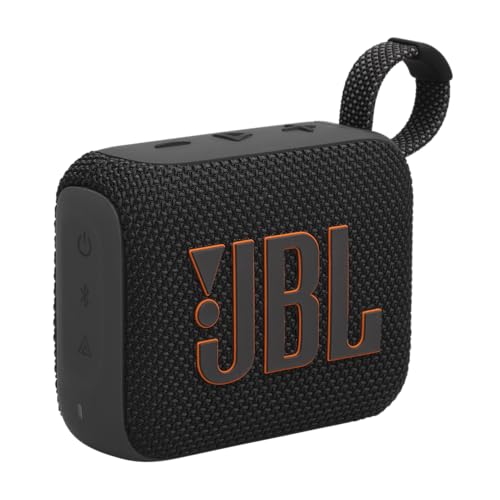
JBL Go 4 — the pocket speaker, reviewed on its own terms
Badge: Best ultra-portable for everyday carry
- Sound: JBL Pro Sound with punchy bass for the size
- Claimed playtime: up to 7 hours
- Build: waterproof and dustproof, integrated loop
- Materials: made in part with recycled materials
- Connectivity: Bluetooth, Auracast multi-speaker
Hold the Go 4 and the design intent is obvious in a second: everything is in service of being taken. The squared shape sits stably on a shelf or a rock rather than rolling like a cylinder; the fabric-and-rubber body shrugs at knocks; the loop invites a carabiner, a backpack strap, a shower hook. There is no single dramatic feature — the drama is that a real speaker with real weatherproofing has been compressed into an object you will carry on days when you would never carry “a speaker”. That behavioural difference, not any specification, is why the Go line has been a perennial best-seller and why reviewing the Go 4 against bigger speakers’ standards would miss its point entirely.
Sound first, then, at the distances it is for. At arm’s length to a few metres, the Go 4 produces a presentation that embarrasses phone speakers in every dimension: voices are forward and intelligible, acoustic music has body, and the bass — “punchy” is JBL’s word and for once it is the accurate one — arrives as a satisfying thump in miniature rather than the deep foundation a larger cabinet gives. Electronic and pop production, mastered loud and bright, suits it best. What it cannot do is scale: across a garden it becomes a pleasant radio in the distance, and at its volume ceiling the composure thins. Judged as a personal bubble of sound, it is excellent; judged as a party device, it is out of its category, and this review will keep returning to that distinction because nearly every disappointed Go owner bought it for the second job.
Battery is the deliberate trade. Up to seven hours claimed means a workday of desk listening at moderate volume, a long beach session, or a weekend of showers and breakfasts — but not a festival day without a top-up, and real figures at high volume will land lower. The honest framing is that JBL spent the size budget on sound and sealing rather than on cells, and the Go 4’s buyer is someone whose listening comes in hours-long chapters rather than day-long marathons. A pocket powerbank or any USB-C source refills it; the discipline is simply to charge it with your phone at night and never think about it again.
Strengths
- Size and loop make it the speaker you actually have with you — the first virtue of portable audio.
- Sound quality per cubic centimetre is remarkable, with clear voices and genuinely enjoyable bass at personal distances.
- Weatherproofing is total enough to end all anxiety about where it sits.
Trade-offs
- Seven-hour claimed battery is the shortest in JBL’s portable family and demands a charging habit.
- It cannot fill a room for a group or a garden for a party — physics, not a flaw in execution.
- No powerbank function and no speakerphone ambitions; it is a focused tool.
Best for: commuters, students, travellers, shower-and-kitchen listeners, cyclists, and anyone buying a first portable speaker. / Not suited for: party hosts, large-room listening, or multi-day off-grid trips without charging access.
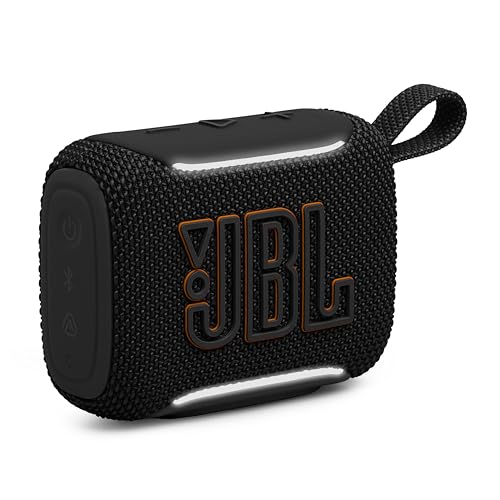
JBL Go 5 — the newer sibling, as an alternative
Badge: Best if you want the longest list of features in the smallest body
- Sound: JBL sound with ambient edge lighting
- Claimed playtime: up to 10 hours
- Build: IP68 waterproof and drop-proof
- Connectivity: Auracast, AirTouch instant stereo pairing
The Go 5 exists, so an honest Go 4 review must address it — as an alternative, not as the subject. JBL’s newer generation stretches claimed playtime to ten hours, raises the protection story to IP68 with drop-proofing, adds ambient edge lighting, and introduces AirTouch pairing for quick stereo linking with another unit. If those specifics map onto your frustrations with the Go 4’s brief — chiefly the battery — the Go 5 is the considered step within the same pocketable idea. What it does not change is the category: it remains a personal speaker with a personal speaker’s physics. Choose between them on battery needs, on whether lighting and the newer pairing conveniences matter to you, and on the current listings’ positions in the range; do not let the newer number talk you out of a Go 4 that fits your days at a friendlier point in the line-up.
Strengths
- Longer claimed playtime answers the Go 4’s main compromise.
- Higher protection rating and drop-proofing for rougher carry.
- AirTouch makes the two-speaker stereo trick effortless.
Trade-offs
- Newer-generation positioning usually costs more within the range.
- Lighting is ambience, not audio — value it as such.
- Still a personal speaker; the party ceiling has not moved.
Best for: buyers who love the Go concept and want its most complete current form. / Not suited for: anyone expecting a category change — that requires a bigger speaker, not a newer small one.
In this guide
JBL Go 4 Review: where it earns its keep, in detail
The shower, the bath and the kitchen
Waterproofing turns the Go 4 into the speaker of wet rooms, and wet rooms are where small speakers quietly accumulate most of their lifetime hours. Morning news in the shower, a podcast while cooking, music for a long bath — the Go 4’s loop hangs it from a hook, its body ignores steam and splashes, and its voice-forward tuning is exactly right for spoken content against running water. Rinse it if it meets shampoo or cooking splashes, dry it before charging, and it will out-serve speakers three times its price that were never allowed into these rooms.
The desk and the study
As a desk speaker for a laptop, the Go 4 solves the thin-audio problem of ultraportable computers at the distance that matters — yours. Video calls gain intelligibility (playback only; it is not a conference microphone), focus playlists gain body, and the speaker’s footprint is smaller than the laptop’s power brick it sits beside. Students in shared houses should note the social virtue of a personal speaker: it fills a room-mate-respecting bubble rather than contesting the whole flat.
Travel, tents and two wheels
In a wash bag or a rucksack’s top pocket the Go 4 is effectively weightless, which makes it the speaker that survives packing triage when bigger ones get left. Hotel rooms, hostel bunks (at considerate volumes), tents and picnic stops are its circuit. Cyclists have adopted the Go shape for bottle-cage-adjacent and strap-on mounting over generations; the loop and the sealing make the habit rational. For multi-day wild camping, its battery means it is a chapter speaker — an evening’s music — unless a powerbank is already in the kit for the phone, in which case the Go simply shares the phone’s supply chain.
Buying guide: is the Go 4 the right small speaker for you?
Question one: how far away will your ears be?
Everything follows from distance. Within three metres, the Go 4 is complete. Across a room with a group listening, you want the Flip or Charge class. Across a garden with a crowd, you want more again. Buy for your true listening distance and the Go 4 stops being a compromise and becomes the correct instrument — most small-speaker disappointment is a distance error made at the checkout.
Question two: how long are your listening days?
If your sessions run past a claimed seven hours without a socket — festival days, long work shifts away from power, multi-day trips — either plan top-ups or step up a class for battery. If your listening is chapters (commutes, showers, evenings), the Go 4’s battery is a non-issue wearing a spec sheet’s disguise.
Question three: one speaker, or a pair in waiting?
Auracast grouping means the Go 4 can be the first half of a stereo pair or a citizen of a larger JBL gathering. If a desk or a porch is your main stage, two small speakers in stereo can outperform one larger mono speaker for actual listening pleasure — a path worth pricing before defaulting to a single bigger box.
How to set up and care for the Go 4
Step 1: Pair once, properly
Charge it fully on arrival, pair it to your phone, and run the firmware check in JBL’s app before the first outing — pairing refinements and battery reporting arrive through updates, and the first week is when they matter most.
Step 2: Place it like a small speaker, not a big one
Near a wall or in a corner, a small speaker gains free low-end support; on a hard surface it projects better than on a towel or a bed; at ear height when seated, its personal bubble covers you instead of the ceiling. In the shower, hang it by the loop away from the direct stream — waterproof is not an invitation to pressure-wash it daily.
Step 3: Build the charging habit
Pair the speaker’s charge with your phone’s overnight charge and the seven-hour figure stops existing as a concern. Between seasons of heavy use, avoid storing it empty; a mid-level charge in a drawer keeps the cell healthy for the summers ahead.
Step 4: Clean it like outdoor gear
Fresh-water rinse after salt, sand or sunscreen contact; a soft brush for the grille; full drying before the cable goes in. The recycled-content fabrics are tough, but they are still fabric — treat them as you would a good jacket.
Common mistakes with ultra-portable speakers
The classic mistake is the party purchase: expecting a pocket speaker to soundtrack a gathering, then judging it harshly for a job description it never applied for. The second is ignoring the loop — owners who clip the Go 4 to their lives carry it ten times as often as owners who leave it on a shelf, and carried is the entire point. The third is storing it flat over winter and meeting a tired battery in spring. The fourth is comparing it to a phone speaker in a quiet room and concluding the difference is small; take both to a beach, a kitchen with an extractor fan, or a tent in wind, and the speaker’s weatherproofing, volume headroom and placement freedom become the difference between music and a suggestion of music.
Go 4 vs the rest of the JBL ladder
Against the Flip class, the Go 4 trades output and battery for a body half the travel burden — the Flip is the smallest JBL that should host a small gathering, the Go is the largest that vanishes into a pocket. Against the Charge class, the trade sharpens: the Charge adds the powerbank, the long battery and genuine room-filling ability, at the price of being luggage rather than clothing. Against its own Go 5 successor, covered above, the Go 4’s argument is simplicity and range position. The ladder is unusually honest — each rung is a size, and the sizes are the features — which makes the Go 4 easy to recommend precisely: it is the right speaker for the life lived within a few metres of your music.
Frequently asked questions
How long does the JBL Go 4 battery really last?
Up to seven hours is the claimed figure at moderate listening levels; at high volume expect less, at background levels expect the claim to be realistic. Plan it as a day-of-chapters speaker with a nightly charge and it will never strand you mid-song.
Is the Go 4 waterproof enough for the shower and pool?
Yes — waterproof and dustproof construction is central to its design, and showers, rain and poolside splashes are its natural habitat. Follow the standard discipline: rinse after salt or chlorine, and let the port dry completely before charging.
Can I pair two Go 4 speakers?
Yes — JBL’s Auracast multi-speaker connection supports grouping compatible speakers, and two Go 4s can give you a wider, stereo-style presentation for a desk or porch. Confirm the exact pairing mode on the current listing, and remember a pair of small speakers still serves personal distances best.
Go 4 or Go 5 — which should I buy?
The Go 5 if its longer claimed battery, higher protection rating and pairing conveniences answer your specific needs; the Go 4 if you want the same pocketable idea in its simpler form. Neither changes category — both are personal speakers — so decide on battery and features rather than on expectations of scale.
Does the Go 4 work for podcasts and audiobooks?
It is arguably at its best there: the voice-forward tuning keeps narration clear against kitchen and shower noise, and the loop puts it exactly where you are working or washing. For spoken content at personal distances, it is one of the most satisfying small speakers in its class.
Can the Go 4 charge my phone?
No — the powerbank feature belongs to the Charge line. The Go 4’s battery serves its own music only, which is part of how it stays this small.
Why does my Go 4 sound thin or harsh in some places and fine in others?
Because at this size, placement is half the product. A small driver firing into open air from the middle of a large room has nothing to work with, while the same speaker near a wall, in a corner or on a hollow surface that can resonate gains warmth and volume for free. Hard, bare rooms add a second problem: reflections off tile and glass arrive almost as loud as the direct sound, which reads as harshness at higher volumes. Three habits fix most complaints. Move the speaker closer to you rather than turning it up from across the room, give it a surface and a boundary to lean on acoustically, and keep the volume a notch below maximum, where a driver this small stays composed instead of straining. Judge the Go 4 only after that experiment, because a badly placed one is a different, worse speaker than a well placed one.
Can I take calls on the Go 4, and what is the workaround when I need to speak?
Only halfway, and it helps to know that before a call starts. The Go 4 has no microphone, so it will play the other side of a conversation clearly and pleasantly, but your voice has to reach a microphone somewhere else. The workable setups are simple. Keep your phone or laptop within speaking distance and let its microphone carry your side while the Go handles playback, which suits a desk, a kitchen counter or a workshop bench where the phone already lives nearby. For a moving conversation, walking between rooms or working in a garden, switch to earbuds or the phone itself rather than shouting at a handset across the space. Treat the Go as the listening layer of a call, not the whole call, and it stops disappointing people who expected a conference speaker in a puck.
The bottom line
The JBL Go 4 is a small speaker that understands its assignment completely: be present. It sounds far better than its size suggests at the distances it is designed for, survives the wet and dusty places music actually happens, and costs its owner almost nothing in carrying effort. Its battery asks for a nightly habit and its physics decline all party invitations — accept those terms and it is one of the easiest recommendations in portable audio. The speaker you have with you beats the speaker you left at home, and no speaker is easier to have with you than this one.
A week with the Go 4: the diary test
Monday, it lives on the kitchen counter through breakfast radio and a podcast while lunch is made, then rides in a coat pocket to a friend’s flat where it plays dinner music from a bookshelf — unremarkable, which is the compliment: no bag was packed for it, no decision was made about it. Tuesday is a workday; it sits beside a laptop for six hours of low-volume focus music and two video calls’ worth of playback, and the laptop’s own speakers are not missed for a single minute. Wednesday it hangs in the shower in the morning and from a backpack strap in the afternoon on a walk where a phone speaker would have been inaudible against traffic. Thursday is its hardest day: a garden evening with five people, where it is asked to be a party speaker and politely declines by physics — pleasant at the table, absent at the fence — and the diary records the article’s recurring lesson in the owner’s own handwriting. Friday it charges overnight without ceremony. The weekend takes it to a tent, where an hour of music at dusk is exactly the chapter its battery was sized for. Total deliberate decisions about the speaker across seven days: one (the Thursday misassignment). Total hours of use: more than speakers costing five times as much typically log in a month. That ratio — hours per decision — is the Go 4’s real specification.
Sound in detail: what the little driver does with different music
Acoustic and vocal material flatters the Go 4 most. A singer with a guitar sits naturally in its tuning, voices occupy the front, and the absence of deep bass is barely mourned because the arrangements themselves are midrange stories. Pop and electronic production, built to survive small speakers, arrives punchy and complete at personal distance — the thump is a suggestion with rhythm rather than a physical event, but rhythm is most of what a personal listener is dancing to. Rock exposes the ceiling sooner: dense guitars at volume compress into effort, and the honest response is to turn it down a notch, whereupon the Go 4 recovers its composure and the song recovers its shape. Classical listeners should set expectations by repertoire — solo piano and string quartets are intimate and lovely at a desk; a full orchestra’s loudest passages are a postcard of a cathedral rather than the cathedral. Jazz trios, perhaps surprisingly, are a sweet spot: brushed drums, upright bass lines rendered as articulate pluck rather than depth, and horns that stay civilised. None of this is criticism. It is a map of a small speaker’s physics, and the map’s legend reads the same for every speaker this size ever made: intimacy yes, scale no.
The loop, the shape and other small design decisions that matter
Product design at this size is a game of centimetres, and the Go 4’s choices repay attention. The squared body with its flattened faces stands where cylinders roll — on a boat deck edge, a tent groundsheet’s slope, a bathroom shelf — and stability is a feature owners feel weekly. The fabric wrap over most of the body gives grip with wet hands and hides scuffs that glossy plastic would advertise. The buttons are raised and few, findable by thumb in the dark of a tent. The loop is integrated rather than a strap accessory, which means it cannot be lost, left behind or sold separately — a small integrity that defines the product’s character. Even the choice to keep the port sealed and simple reflects the brief: this speaker expects to be rinsed, hung, dropped into bags and generally treated as kit rather than as electronics. Competitors at this size often chase thinness or novelty shapes; the Go 4 chases being grabbed, and wins its market on that instinct.
For children, grandparents and other non-spec-sheet humans
The Go 4 may be the most giftable object in portable audio precisely because it asks nothing of its owner. There is no app requirement for basic joy, no pairing ritual beyond the ordinary Bluetooth one, no fragility to manage, and no size that needs a home to be found for it. For a child it is a first speaker that survives childhood’s handling and keeps volume within a personal bubble that parents can live with. For an older listener it is a radio-era idea with modern sound — set it beside a chair, pair it once with a phone or tablet (a younger relative can perform this one-time sacrament), and it returns voices and music at a clarity that television speakers across a room cannot match, which matters more for speech intelligibility than any specification in this review. For a student it is a room’s worth of audio that fits the move-out box’s last corner. Reviewers reach for performance language; households reach for objects that fit their people, and the Go 4 fits an unusual breadth of people.
Environmental and value notes
JBL builds the Go 4 in part with recycled materials, and the deeper sustainability fact is the familiar one: a durable, repairable-by-replacement-of-nothing, long-serving small speaker is a light footprint per year of music. Its battery will age over years of nightly charges; the care habits described earlier (avoid long storage empty, avoid permanent full-and-hot storage) stretch that ageing considerably. On value, the Go line’s traditional position in the range makes it the rare branded product that undercuts most of the anonymous competition on total ownership happiness, if not always on sticker: the anonymous rivals compete on claimed watts and battery hours that their drivers and cells rarely honour, while the Go 4’s claims are the conservative kind that owners verify accidentally over years. If the budget is truly tight, a previous Go generation on clearance is the value play of the whole family — the concept has been right for years, and the fourth generation’s refinements are polish rather than reinvention.
When to step up instead: the honest exits
Leave the Go 4 on the shelf if your primary listening is a room with other people in it — buy the Flip or Charge class and accept the luggage. Leave it if your days are long and socketless — battery is a design decision here, not an oversight, and it will not negotiate. Leave it if you want stereo from a single box or a powerbank for your phone; those are other products’ purposes. And leave it if your music is primarily orchestral or bass-led at volume, because no EQ setting persuades a driver this size to move air it cannot move. These exits are not hedges; they are the review’s respect for your money. The Go 4 bought for its actual job is a delight with no asterisk. The Go 4 bought against its job becomes a drawer object with a famous logo, and drawers are where good products go to be misjudged.
Accessories and companions worth considering
The Go 4 needs almost nothing, which is part of its charm, but three companions earn mention. A small carabiner upgrades the loop from hanging to clipping — backpacks, belt loops, tent lines — and costs less than a coffee. A short USB-C cable dedicated to the speaker’s charging spot ends the nightly hunt that breaks charging habits. And a second Go 4 (or its Go 5 sibling, per the pairing rules on the listings) is the one big companion: as a stereo pair for a desk, a van or a porch, two Gos deliver a listening geometry that a single larger speaker cannot, at a combined travel weight that still vanishes into a bag. Everything else — cases, stands, mounts — is the accessory industry inventing needs for a product whose genius is needing nothing.
Bluetooth behaviour, range and multi-device life
Small speakers live or die by connection manners, and the Go 4’s are good household manners. Pairing is remembered, reconnection on power-up is prompt, and range in open air comfortably covers a garden’s personal zone; through interior walls, expect the usual physics — one wall is a shrug, two are a negotiation — and the practical habit is to keep the phone in the room the music is in, or accept that the speaker follows the phone’s room rather than yours. Households with several phones will find the speaker’s allegiance goes to the last device that played, which causes the classic kitchen standoff until someone uses the app or simply presses play and claims it. None of this is a defect; it is Bluetooth’s social contract, and the Go 4 honours it without quirks worth warning about. For laptop users, note that video playback over Bluetooth carries a small delay on many computers — for films watched alone it can be noticeable on close dialogue shots, and a wired or native solution serves dedicated movie setups better; for music, podcasts and casual viewing, the Go 4’s convenience buries the caveat.
The shower-speaker championship: why this category matters more than it looks
It is easy to smile at the idea of a shower speaker until the hours are counted. Twenty minutes a day is over a hundred hours a year — more listening than many households give their main system — and it is listening of a particular kind: news at dawn, podcasts in steam, singing that the waterproofing politely keeps private. The Go 4’s claim on this championship rests on the loop (hangs where suction cups fail), the sealed body (steam and shampoo are non-events), the voice tuning (narration survives water noise), and a battery rhythm that matches the room’s own — charge it where the phone charges, hang it where the towel hangs. Rival shower speakers compete on price and lose on the two things that matter over years: seals that stay sealed and sound that stays clear. If your household’s real music room has tiles, this section is not a joke sidebar; it is the review’s centre of gravity, and the Go 4 is built for the centre.
Work-from-home and study: the concentration companion
Low-volume listening is a distinct discipline that big speakers often fail — many sound thin and gutless at the bottom of their range, where their drivers barely move. The Go 4, designed to live its whole life in the near field, is composed at whisper levels, which makes it a genuine concentration tool: lo-fi, classical or ambient playlists at the edge of hearing, close enough to mask a house’s noises without becoming a noise itself. Students revising in shared accommodation get the same benefit with a social dividend — a personal bubble respects a roommate’s silence in a way even a modest room speaker cannot. The absence of a microphone is the one WFH caveat: it plays your calls beautifully but does not carry your voice, so keep the laptop’s mic or a headset for the speaking half, or treat the Go as the listening layer of a hybrid setup.
Travelling with the Go 4: a packing-list perspective
Every gram on a packing list must argue for its place, and the Go 4’s argument is that it replaces three inferior solutions at once: the phone speaker for hotel-room music, the laptop speaker for evening films in a bunk or a berth, and the silence of foreign bathrooms during morning routines. It packs flat against a wash bag, survives being sat on in a soft case’s company, and its battery rhythm syncs with the phone charger’s nightly round. For air travellers it sits comfortably within the personal-electronics norms that govern batteries in cabin bags — always confirm the current carrier rules for your specific trip, as with any lithium device. For festival campers it is the speaker whose loss or damage would sting least and whose presence is felt most, a combination that expensive gear cannot offer. And for the growing class of van and boat travellers, its sealing and size solve the two problems of small moving homes — moisture and space — in a single object. Travel gear earns loyalty by disappearing until needed; the Go 4 disappears better than any speaker in this review series.
Durability diaries: what actually wears out
Long-term owners of Go-series speakers report a consistent ageing story, and it informs what to watch on the fourth generation. The fabric can fade in sun-heavy lives — cosmetic, and arguably a patina. The loop’s stitching and the port cover are the mechanical watch-points; both reward the rinse-and-dry discipline by simply not becoming stories. The battery is the true clock: hundreds of nightly charges will eventually shorten the chapters, at which point the speaker graduates to permanently-plugged desk duty, a retirement it handles gracefully since its near-field job never needed the battery’s best years. Buttons rarely die; Bluetooth never becomes obsolete at this product’s pace; the driver has nothing to wear but its surround, which sealed indoor-outdoor life treats kindly. In short, the Go 4 ages like outdoor kit rather than like a phone — slowly, visibly and without sudden death — which is precisely what a buy-it-once product should do.
The competition outside JBL’s walls
The ultra-portable shelf is crowded with rivals from speaker specialists and phone-accessory brands, and the Go 4’s defence against them is worth articulating because it is not a spec. Rivals frequently claim more hours, more watts or lower prices — sometimes all three — and the claims share a pattern: battery figures measured at volumes nobody uses, wattage numbers with no standard behind them, and weatherproofing that turns out to describe a splash rather than a sealing. JBL’s figures in this class are comparatively conservative and its sealing is a lineage, refined over four generations of exactly this product. The second defence is the ecosystem: Auracast grouping ties the Go 4 to the larger JBL speakers a household may already own, a compounding value no isolated rival can match. The third is resale and hand-me-down reality — a used Go is a known quantity with a working app and available support, while the anonymous puck is a lottery ticket. None of this means rivals are never worth it; a genuinely tight budget is a real constraint and some specialist rivals (climbing-focused, or with specific mount systems) serve niches well. It means the Go 4’s premium over the anonymous shelf is buying verification, ecosystem and time — the three things spec sheets cannot print.
Sound checks you can run in the first ten minutes
New owners can verify they got the speaker this review describes with three quick tests. First, a spoken-word test: a familiar podcast at shower distance — narration should be effortless, with consonants intact, at a volume your household calls reasonable. Second, a bass-honesty test: a track you know well with a simple, tuneful bass line — you should hear the line’s notes as notes at arm’s length, accepting that you will feel little of it in your chest. Third, a ceiling test: raise the volume slowly in your largest room and note where composure ends; that point is your speaker’s honest party limit, and knowing it prevents the disappointment of discovering it mid-gathering. A Go 4 that passes the first two and teaches you the third is the product working as designed. One that fails the first — muffled voices at close range — is a unit to exchange, because voice clarity is this model’s birthright and its absence is a defect, not a character trait.
Colour, editions and the personalisation angle
JBL sells the Go line in a rotating wardrobe of colours and occasional special editions, and the choice is more functional than it appears. A bright colour is findability — in a tent, a tote bag or a teenager’s floor, the speaker that can be seen is the speaker that gets used and does not get lost. A dark colour is discretion for desks and professional settings. The fabrics handle both lives equally; there is no performance difference to agonise over, which makes colour one of the few pure-pleasure decisions in tech buying. Households with two Gos (the stereo pair of earlier sections) sometimes buy different colours to settle ownership and left-right channel identity at a glance — a small domestic hack worth stealing. Limited editions change nothing sonically and should be bought, if at all, for the joy of the object itself, which for a product designed to be carried everywhere is a legitimate line item.
The Go 4 as a second speaker: households that already own big audio
Owners of serious home systems sometimes dismiss pocket speakers, and then quietly become their heaviest users, because the big system cannot follow them to the bath, the shed, the allotment or the hotel. The Go 4’s role in such households is the away team: every context where the main system is absent, overkill or forbidden by the hour. It also serves as the household’s diplomatic speaker — the one lent without anxiety, taken by children without negotiation, and left at a friend’s by accident without a rescue mission. Judged as a component, it is modest; judged as coverage for the eighty percent of listening that happens away from the listening room, it is the hardest-working audio product in the house. If your home already has its cathedral, buy the Go 4 as your chapel-on-wheels and do not let anyone talk you into a second cathedral.
Final scoring, in words rather than numbers
Sound for its size: excellent, with the size clause doing honest work. Portability: effectively perfect — the category’s reference. Battery: adequate by design, short by spec sheet, and the one figure a buyer must consciously accept. Durability: as good as portable audio gets, contingent on rinsing and drying like you mean it. Value: strong, because the product’s promises are the kind that survive contact with years. Overall: the Go 4 is not the best speaker JBL makes; it is the best answer to the most common speaker question — what should I carry? — and reviews exist to match questions to answers.
Outdoor work, sport and the speaker as equipment
Some Go 4s will live working lives: clipped to a scaffolder’s belt pouch zone (safely, and where site rules allow), riding in a gardener’s tool tote, hanging in a stable or a workshop where dust is a climate. The dustproof half of its rating earns its keep in these postings, and the rinse-clean body is a genuine industrial virtue — a speaker that can be washed is a speaker that can be kept. Coaches and instructors form another constituency: a voice-and-whistle-led session needs music for warm-ups at personal-group distance, not stadium coverage, and the Go delivers it from a fence post or a kit bag without a mains hunt. Outdoor fitness instructors should check their venue’s music licensing and volume courtesies as with any speaker, but as hardware the Go 4’s combination of sealing, loop and near-field clarity is close to a job specification written by the work itself. When equipment reviewers talk about “use cases”, this unglamorous durability-in-dirt is the one that decides whether a product is still owned in year three.
What to do when something seems wrong
Most Go 4 complaints resolve into four checks, in this order. If it sounds thin, move it — a corner or a wall restores the low end that open air steals, and a hard surface under it beats a cushion every time. If it will not pair, forget it on the phone and re-pair from a full charge; Bluetooth amnesia is a phone-side disease more often than a speaker-side one. If battery life disappoints, audit volume honestly for a day — the claimed figure assumes moderation, and a speaker living at maximum is living a different spec. If it will not charge, dry the port thoroughly and try a known-good cable before concluding anything darker; moisture and mystery cables account for most charging mysteries in sealed devices. A speaker that still fails after those checks, especially on voice clarity at close range, is a warranty conversation — and JBL’s support infrastructure, unglamorous as it sounds, is another of the things the brand premium buys over the anonymous shelf.
The philosophy of enough: why the Go 4 keeps winning its category
There is a temptation in audio to treat every purchase as a step on a ladder toward a perfect system, and the Go 4 refutes it by being complete at the bottom. It does one job — personal music, anywhere, without thought — at a level where further spending buys different jobs rather than a better version of this one. Owners sense this, which is why Go speakers are so rarely upgraded and so often replaced like-for-like when they finally tire: the product is not a compromise on the way to something else but a settled answer. In a review series full of flagships and step-ups, that settledness deserves explicit respect. If your question is the one the Go 4 answers, let it answer, keep the change, and spend your deliberation budget on the parts of your audio life that are genuinely undecided.
Reading the spec sheet like a sceptic: a short field lesson
The Go 4’s listing is a good classroom for small-speaker literacy, because its claims are the honest kind and the category’s dishonest kind differ in recognisable ways. Battery hours: ask “at what volume?” of every speaker, and treat answers measured at half volume as the industry norm rather than a scandal — then compare like with like. Waterproofing: look for an actual IP rating and read its terms, rather than the word “waterproof” floating alone; the Go 4’s rated, dust-inclusive sealing is what the real thing looks like. Wattage: in this class, treat it as decoration unless a standard is named; your ears at one metre are the only wattmeter that matters. Recycled materials: a genuine but secondary virtue — welcome it, and still buy on sound, sealing and size. A buyer who can read one listing this way can read them all, and will notice that the Go 4 survives the sceptical reading with its reputation intact, which is rarer on this shelf than it should be.
One speaker, many households: the lending-library effect
Ask owners where their Go has been and the answers read like a lending library’s ledger: borrowed by a sister for a holiday, by a colleague for a site visit, by a parent for a hospital stay where its bedside voice clarity and simple buttons were exactly the right technology. Products that get lent are products whose loss would be survivable and whose usefulness is universal — a social niche no flagship occupies. There is a buying insight in that ledger: if you are choosing between the Go 4 and a larger speaker as a gift for a household rather than a person, the Go’s lendability and room-agnostic size make it the gift that circulates and is thanked for repeatedly, while a big speaker is thanked once and then becomes furniture. Circulation is a form of value that spec sheets cannot hold, and the Go line has quietly monopolised it for years.
The last hesitation: “is it too small to be worth it?”
Every Go 4 buyer has the moment — holding a speaker that fits a palm, wondering whether something this small can justify existing beside a phone that also plays music. The answer arrives in the first wet, loud or distant environment: the first shower where the phone stays dry outside, the first kitchen where the extractor fan loses, the first tent where the phone’s battery is being saved for maps and its speaker faces the groundsheet. The Go 4 is not competing with your phone’s existence; it is competing with your phone’s compromises, and it wins each of those small contests by being sealed, loud enough, placeable and expendable in ways a phone must never be. Buy it, carry it for a fortnight, and the hesitation will read like a question about whether pockets are too small to be worth having.