Disclosure: As an Amazon Associate, reviewstook.com earns from qualifying purchases. Links on this page are affiliate links; they cost you nothing extra. Prices and availability change often, so check the current Amazon listing before you buy.
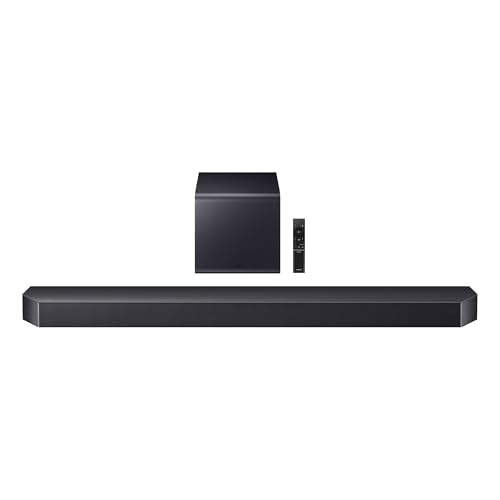
The hw qs90h is Samsung’s answer to a very specific and very common problem: the room that needs serious television sound but cannot host a separate subwoofer, let alone rear speakers. It is an all-in-one soundbar with built-in woofers, rated as a true 7.1.2-channel design in a single cabinet, with wireless Dolby Atmos, Q-Symphony for compatible Samsung televisions, SpaceFit Sound Pro room tuning, Alexa built in, and a convertible-fit design intended to adapt to different furniture arrangements. This guide examines what a single bar can honestly achieve in 2026, where the built-in-woofer approach wins, where physics still collects its debt, and how this model compares with Samsung’s slimmer and simpler all-in-one alternatives for buyers whose rooms rule out multi-box systems entirely.
All-in-one soundbars used to be the compromise you apologised for. The category has changed because three things improved at once: driver design squeezed more low-frequency output from small cabinets, room calibration software learned to compensate for some of what a small cabinet cannot do, and television audio processing started passing proper Atmos bitstreams that a capable bar can decode into a convincing height image from up-firing drivers. None of that repeals physics — a built-in woofer inside a bar will never move the air a separate subwoofer moves — but the gap between a good all-in-one and a bar-plus-sub system has narrowed to the point where room constraints, not sound quality snobbery, should make the decision. The QS90H sits at the ambitious end of the all-in-one idea: more channels, more processing, and a design meant to disappear under the television rather than dominate the wall.
The convertible-fit idea deserves attention early because it shapes who this bar is for. Samsung designs this class of bar to work in more than one physical arrangement — sitting on a bench in front of the television, or mounted — and to keep its sound coherent in each. That flexibility matters in rented flats, in rooms where the television sits on a low stand that leaves little clearance, and in second rooms — bedrooms, studies, snug corners — where a main system’s leftovers usually end up. This guide therefore spends as much time on placement, television compatibility, and the honest bass question as on the channel count, because those are the topics that decide whether an all-in-one bar delights or disappoints. If your room can take rear speakers and a subwoofer, a multi-box system remains the fuller answer, and the guide says so plainly where relevant; if it cannot, this is the class of product that deserves your shortlist.
Key takeaways
- One cabinet, no subwoofer, no rears: the entire system is the bar, which is the point and the limit
- Built-in woofers give real bass presence for dialogue, drama, and moderate film levels, but not subwoofer-grade low effects
- 7.1.2 processing with up-firing drivers creates a convincing front height image from Atmos content
- SpaceFit Sound Pro matters more in this class than in any other, because the bar must adapt to rooms it cannot fill with speakers
- Measure your stand clearance first: all-in-one bars live or die by the gap under the television
Where to buy the Hw Qs90h
Each linked product in this guide is sold through Amazon, and each product section carries a plain link so you can check price on Amazon and confirm the listing details before ordering. For this model the confirmation step has a particular focus: the QS90H is a 2026-model listing in Samsung’s range, and Samsung’s all-in-one line contains several visually similar bars — the S60D and the ultra-slim S801D appear later in this guide as alternatives — whose listings are easy to confuse at a glance. Check the model code in the listing title, check that the description matches the built-in-woofer, convertible-fit design discussed here, and be wary of bundles assembled by third-party sellers that pair the bar with unrelated accessories at a markup. If the exact model is unavailable in your region, the alternatives section explains what you give up and keep with each substitute, so a substitution can be a decision rather than an accident.
In this guide
Quick picks at a glance
| Product | Design | Best for |
|---|---|---|
| Samsung HW-QS90H | All-in-one, built-in woofers, 7.1.2 | The subject of this guide: the fullest single-bar Samsung for TV-first rooms |
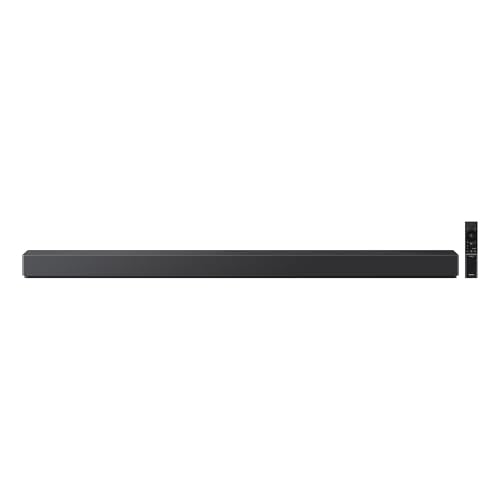
| Samsung HW-S60D | All-in-one, 5.0 channel | Smaller rooms and simpler needs with the same one-cabinet idea |
| Samsung HW-S801D | Ultra-slim all-in-one, 3.1.2 | Wall-mounted televisions where depth is the constraint |
How these picks were chosen
Every linked bar in this guide was verified against Amazon’s catalogue data before drafting: the listing title had to name the exact model, the channel configuration and design described in the title had to match the product under discussion, and an official product image had to be available for that listing. Samsung’s naming makes this discipline essential rather than bureaucratic. The Q, S, and B series overlap in appearance and price, model years recycle designs, and a search for any one of these bars returns the others as sponsored neighbours. The three bars chosen form a deliberate ladder inside one idea — the all-in-one — so the comparison later in this guide is about size, slimness, and channel ambition within a shared philosophy, not a scatter of unrelated products. Anything that could not be verified to that standard was left out entirely rather than linked on trust.
The honest bass question
Every all-in-one bar review eventually arrives at the same cross-examination: what about the bass? The truthful answer for the QS90H’s class is that built-in woofers have become genuinely capable at the frequencies that carry most perceived bass — the thump of a kick drum, the weight under a film score, the rumble that tells you a scene is dangerous — while remaining physically incapable of the lowest effects octave that a separate subwoofer reproduces, the sub-40Hz region you feel in your sternum during an explosion or a spacecraft pass. In practice, the dividing line is content and volume. Drama, comedy, sport, news, and most streaming series never ask for that lowest octave, and at ordinary evening volumes the built-in woofers sound complete. Action films at enthusiastic volumes are where the missing subwoofer announces itself, not as bad sound but as a ceiling on physical impact. Buyers should therefore interrogate their own viewing honestly: a household whose centre of gravity is prestige drama and football will never miss the sub; a household that measures film night in sofa vibration should buy a system with one.
There is a second, quieter bass advantage to the all-in-one design that rarely gets mentioned: neighbour relations and household peace. A separate subwoofer couples energy into floors and walls in a way a bar’s built-in woofers simply do not, and in flats, terraced houses, and homes with sleeping children, the all-in-one’s bass ceiling is not a limitation but a feature you would have paid for separately. Many owners of big subwoofer systems spend their evenings with the sub trimmed so far down that they are effectively listening to an expensive all-in-one with extra furniture. Starting with the bar that matches your actual living situation is not settling; it is the rare case of the honest product also being the cheaper one.

Samsung HW-QS90H All-in-One Soundbar with Built-in Woofers
Badge: The main pick — Samsung’s fullest single-bar design
- Configuration: True 7.1.2 channels in one cabinet, built-in woofers, no separate subwoofer
- Formats: Wireless Dolby Atmos
- Television integration: Q-Symphony with compatible Samsung TVs, SpaceFit Sound Pro room tuning
- Design: Convertible Fit, intended to adapt to different furniture arrangements
- Smart features: Alexa built in; generation: 2026 model, per the verified listing title
Start with what the channel count means inside a single bar, because 7.1.2 without rear speakers requires explanation rather than faith. The front three channels are conventional. The side and surround information is produced by angled drivers that use the room’s walls as reflectors, steering effects outward and partially around the listening position, while the two height channels fire upward and return from the ceiling. The result is not the discrete placement of real surround speakers — a sound mixed to sit directly behind you will arrive as a broad presence to your sides — but it is a genuinely spacious soundstage that makes television speakers and basic stereo bars feel flat by comparison. The effect strengthens in enclosed rooms with reflective side walls at sensible distances and weakens in open-plan spaces, which is why this guide keeps tying expectations to room shape: the walls are, in a literal sense, part of this product’s speaker system.
SpaceFit Sound Pro is the feature that turns that wall-dependence from a gamble into something managed. The bar measures its acoustic environment and adjusts its output to compensate — taming the boom of a bar pushed into an alcove, filling out a bar sitting in open space, and balancing the reflected channels against the direct ones. For an all-in-one, calibration is not a garnish; it is the mechanism by which one fixed product adapts to thousands of different rooms, and owners should run it after final placement and re-run it after any furniture change that alters the room’s reflective surfaces. Combined with Samsung’s adaptive sound processing, which continuously weights dialogue against effects, the QS90H aims at the thing all-in-one buyers actually want: speech they can follow at civilised volumes, wrapped in enough space and weight that films still feel like events.
The convertible-fit design is best understood as permission to stop contorting your furniture around a soundbar. Where a low television stand leaves a shallow gap, or a wall mount dictates a particular profile, the bar is designed to sit coherently in the arrangement you have. That sounds like a small thing until you have owned a bar that blocked the television’s remote sensor, or that only sounded right in the one position your room forbade. Practical elegance of that kind — one cable to the television over eARC, one power lead, no other boxes, no other chargers, nothing to pair — is the all-in-one proposition at its best, and it is why this category keeps winning households that auditioned bigger systems and then looked at their room again.
Strengths
- A single cabinet with a single signal cable is the tidiest possible installation in this performance class
- Room calibration and adaptive dialogue processing target exactly what television-first households need
- Built-in woofers keep bass neighbour-friendly while covering the frequencies most content actually uses
Trade-offs
- No upgrade path: you cannot add a subwoofer or rears later if your room or tastes change
- Surround effects depend on wall reflections, so very open rooms get a narrower benefit
- The lowest effects octave in action films is absent by design, not by tuning
Best for: flats, second rooms, rented homes, and television-first households that want one tidy bar with genuine Atmos height and clear dialogue. Not suited for: buyers who want physical subwoofer impact, or rooms where rear speakers are practical and a full system is affordable.

Samsung S60D 5.0ch All-in-One Soundbar
Badge: The simpler all-in-one
- Configuration: 5.0 channels, all-in-one design with wireless Dolby Atmos
- Features: Q-Symphony, SpaceFit Sound Pro, Adaptive Sound, Game Mode Pro, Alexa built in
- Role in this guide: the smaller-room, simpler-needs step down within the same idea
The S60D is what the all-in-one concept looks like with the ambition dial turned one notch down, and for many rooms that notch is exactly right. Its 5.0-channel arrangement drops the dedicated height-and-width theatrics toward a cleaner, centre-focused sound: dialogue clarity, a solid front stage, and Atmos height presented more modestly. In a bedroom, a small lounge, or a study, the listening distance is short, the walls are close, and the difference between 5.0 and 7.1.2 processing narrows to the point where the simpler bar’s virtues — smaller footprint, simpler setup, lower cost — dominate the decision. It shares the important household features with the main pick: the same room-tuning idea, the same television integration with Samsung sets, voice-assistant support, and a game mode for console players. Buyers choosing between the two should measure their room before their ambitions: under roughly fifteen square metres, the S60D is not the budget compromise, it is the correctly sized tool.
Strengths
- Compact all-in-one design suits bedrooms and small lounges
- Keeps the calibration, Q-Symphony, and voice features of the bigger bar
- Centre-focused sound flatters dialogue-heavy viewing
Trade-offs
- Less width and height ambition than the QS90H in larger rooms
- Same no-subwoofer bass ceiling, reached sooner at high volume
- Fewer channels means big film mixes are folded down more aggressively
Best for: smaller rooms, second televisions, and buyers whose viewing is dialogue-led. Not suited for: the main film room of a house, where the QS90H’s extra ambition earns its keep.

Samsung HW-S801D 3.1.2ch Ultra Slim Soundbar
Badge: The design-first alternative
- Configuration: 3.1.2 channels in an ultra-slim cabinet, wireless Dolby Atmos
- Features: Q-Symphony, SpaceFit Sound Pro, Adaptive Sound, Game Mode Pro, Alexa built in
- Role in this guide: the option when the television is wall-mounted and depth is the binding constraint
The S801D answers a different question from the other two bars in this guide. Its question is not how much sound fits in one cabinet but how little cabinet can still deliver a real upgrade — a bar slim enough to sit under a wall-mounted television without visually competing with it, shallow enough for narrow mantels and media walls, and still carrying a centre channel, a built-in low-frequency section (the .1 in its configuration), and up-firing drivers for Atmos height. The sound is correspondingly more modest: this is a clarity-and-presence product, the one you buy when television speakers are the enemy and furniture depth is non-negotiable. In design-led rooms — and in the many homes where the television hangs over a fireplace or a low sideboard — it is frequently the only bar of the three that fits at all, which settles the comparison before it starts.
Strengths
- Ultra-slim profile pairs with wall-mounted televisions without visual bulk
- Still delivers a dedicated centre channel and Atmos height, the two upgrades that matter most
- Same calibration and Samsung television integration as its larger siblings
Trade-offs
- The slimmest cabinet gives up the most bass and width of the three bars here
- Best at moderate volumes in modest rooms; it is not a film-night powerhouse
- Its premium is for design, so value-focused buyers should compare carefully
Best for: wall-mounted televisions, narrow furniture, and rooms where the bar must nearly disappear. Not suited for: buyers whose priority is maximum sound per pound in a room that can fit the QS90H.
The three Samsung all-in-one bars compared
| Bar | Channels | Separate subwoofer | Choose it when |
|---|---|---|---|
| HW-QS90H | 7.1.2 | No — built-in woofers | You want the fullest single-bar sound for a main television |
| HW-S60D | 5.0 | No | The room is small or the television is a second screen |
| HW-S801D | 3.1.2 | No | The television is wall-mounted and depth is the constraint |
Read that table as a sizing exercise rather than a league table. All three bars share a design philosophy, a calibration approach, and a television ecosystem; they differ in how much air they can move and how much cabinet they need to do it. The most common buying error in this family is purchasing the slim bar for a large room because it looked elegant in a showroom, then running it at volumes its drivers were never meant to sustain. The second most common error is the mirror image: forcing the largest bar into a bedroom where its width crowds the stand and its output overwhelms the space at a quarter volume. Match the bar to the room’s dimensions and the television’s mounting, and any of the three will feel like the right answer.
Buying guide: choosing an all-in-one bar without regrets
Begin with a tape measure, not a review. The gap between your television’s lower edge and the furniture below it is the hardest constraint in this category: the bar must fit without blocking the screen or the set’s remote sensor, and its up-firing drivers need clear air above them, so a bar wedged into a tight media-unit shelf loses its height channels no matter what the box promises. Measure the television’s width too — a bar noticeably wider than the screen looks wrong and can overhang furniture ends, while one around the same width or slightly narrower sits naturally. If the television is wall-mounted, decide now whether the bar will mount beneath it or sit on furniture below, because that choice points directly at the slim model or the standard-depth models respectively.
Then check the television’s audio output, as with any soundbar purchase. An HDMI eARC socket lets the television pass full Atmos bitstreams to the bar and lets one remote run the system; older ARC connections still work for everyday audio but cap the formats. While you are in the television’s menus, look for the audio passthrough setting and note where it lives — you will need it during setup. Buyers with a Samsung television of recent vintage gain the Q-Symphony option, where the TV’s speakers work alongside the bar; buyers with other brands lose nothing essential, because the bar is designed to perform alone. Console players should confirm their television can pass game audio without adding delay, and anyone whose television lacks eARC entirely should weigh whether a television upgrade is already on the horizon before spending flagship money on a bar the set cannot feed properly.
Finally, audit your room’s reflectivity honestly. The surround illusion of a single bar is built from wall reflections, so a room with a wall a sensible distance to each side of the television is the ideal stage. A television placed in a corner, or a room that opens entirely to one side, will still get excellent front sound, dialogue, and height — but the wrap-around effects will be gentler, and expectations should be set by the room rather than by a demonstration video recorded in a perfect box of a room. None of this is a reason to avoid the category; it is a reason to buy the bar whose strengths match the room you have, which for most enclosed living rooms is precisely what the QS90H was built for. Readers whose rooms can stretch further may want to compare against the multi-box approach in the full surround system reviewed in this cluster before deciding.
How to set up the Hw Qs90h step by step
Step 1: Place the bar with its drivers in mind
Centre the bar under the television, as close to the front edge of the furniture as is stable, so the forward drivers are not firing into a shelf lip and the up-firing drivers have an unobstructed path to the ceiling. Nothing goes on top of the bar, ever — no ornaments, no games console, no television remote collection — because the top surface is a working part of the speaker system.
Step 2: Connect eARC and enable passthrough
Connect the HDMI cable between the television’s eARC socket and the bar. In the television’s sound menu, select the bar as output, enable eARC, and set digital output to passthrough so Atmos arrives intact. Confirm the television remote now controls the bar’s volume; this single-remote outcome is the household test the whole setup should be judged by.
Step 3: Run SpaceFit Sound Pro in the room’s normal state
With curtains, doors, and furniture as they will be during viewing, run the room calibration and stay quiet while it measures. If you later move the bar — even to the other end of the same sideboard — run it again. Calibration is cheap to repeat and expensive to skip, because every judgement the bar makes about reflections and bass depends on it.
Step 4: Set dialogue and night levels you will actually use
Play a dialogue-heavy scene at your normal evening volume and adjust the voice-focused settings until speech is effortless to follow without raising overall volume. Then try a loud action scene and find the subwoofer-equivalent bass level — on an all-in-one this is a bass control rather than a separate unit — at which effects have weight without thickening voices. Save yourself the nightly fiddle by settling these two scenes now.
Step 5: Test Atmos, broadcast, and a game
Confirm the chain end-to-end with three sources: an Atmos film for height and space, ordinary broadcast television for upmixed everyday sound, and a console game if you play, listening for delay between action and audio. Fix any lip-sync issue in the television’s passthrough settings first, the bar’s sync adjustment second. Readers still deciding between bar styles can cross-check soundbars chosen for dialogue clarity and the wider best soundbars roundup.
Common mistakes with all-in-one bars
The classic mistake is hiding the bar inside a cabinet or behind a television bezel to keep the room tidy, which muffles exactly the drivers the design depends on; an all-in-one must sit in open air. The second is judging bass in a showroom or in the first action scene and returning a bar that would have been perfect for the household’s real viewing — set the decision by your dominant content, not by a demo explosion. Third, buyers leave the television outputting PCM stereo from a previous setup and never hear the bar decode anything better for months; the passthrough setting is a five-minute fix with a category-sized payoff. Fourth, placing the bar far back on a deep sideboard so the front drivers fire across a reflective wooden surface colours the sound in ways calibration only partly repairs — front edge placement costs nothing. Finally, expecting a single bar to be upgraded later with a subwoofer or rears leads to disappointment in this specific family: if future expansion matters to you, choose a system designed for it now, rather than assuming an accessory exists.
Living with one bar: sport, series, games, and music
Week to week, the QS90H’s class earns its place in unglamorous ways. Morning news is intelligible without volume. A Sunday match gets commentary anchored to the screen and crowd noise spread wide enough to feel like attendance without swamping the room. A three-episode drama binge never once sends anyone hunting for subtitles, which is the single most common reason households buy a soundbar at all. Games benefit from the low-latency path through a modern television and from the bar’s game-oriented processing, which keeps effects directional enough to be useful in competitive titles played on the sofa. Music, streamed over the bar’s wireless connections, fills a room evenly for cooking, working, or a gathering — it will not replace a cherished stereo system for dedicated listening, but it retires the tinny Bluetooth speaker most kitchens rely on. The through-line is absence of friction: no subwoofer to trip over, no rears to power, no second remote, nothing for guests to get wrong. For a great many households that absence is not a compromise at all; it is the product.
All-in-one versus bar-and-subwoofer versus full system
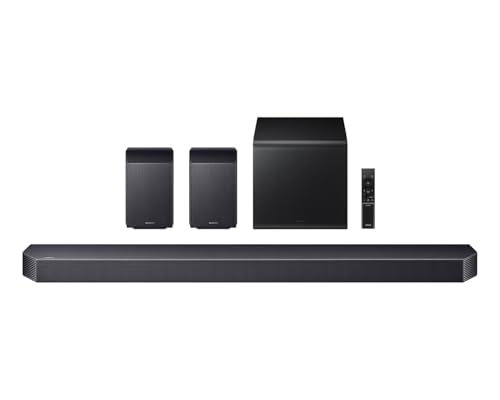
It helps to state the category ladder plainly, because marketing blurs it deliberately. A bar-and-subwoofer package adds the lowest octave and lets you place the bass source where the room likes it, at the cost of a second box, a second power point, and a visible piece of floor furniture. A full system like the 9.1.4 package elsewhere in this cluster adds real rear channels and rear height, at the cost of four boxes and the room geometry to host them. The all-in-one gives up both of those additions and keeps everything else that matters for television: centre clarity, front width, height from above, calibration, and one-cable simplicity. Buyers should choose by elimination — if rears are impossible and a subwoofer is impractical, the all-in-one is not what remains after compromise; it is the category designed for your room, and the QS90H is its most ambitious Samsung expression in this guide. If, on honest reflection, a subwoofer could live beside the sofa after all, then soundbars with wireless subwoofers is the comparison worth your next half hour.
How reflected sound actually works — and when it fails
The QS90H’s surround and height channels are an exercise in applied psychoacoustics, and understanding the mechanism helps you set the room up to cooperate with it. Your ears locate sounds largely by timing and level differences between them, and a reflection arriving from a side wall a few milliseconds after the direct sound is interpreted by the brain as a sound originating near that wall. Angled drivers exploit this deliberately: they fire the surround channels at the side walls so the reflections arrive from plausible surround positions. The height channels do the same vertically, bouncing from the ceiling so effects appear to originate overhead. Three conditions make the trick convincing. The reflective surfaces need to be reasonably hard and flat — plasterboard and painted walls are ideal, heavy curtains and bookcases absorb rather than reflect. The distances need to be moderate and roughly symmetrical, so the reflections arrive at matched levels. And the listening position needs to sit inside the reflection geometry, which is why a sofa centred on the television hears a different product from an armchair parked in a corner.
When the trick fails, it fails gracefully, which is the category’s saving grace. In a room with one open side, the surround image simply leans toward the walled side and narrows; in a room with a very high or vaulted ceiling, height effects soften into a general sense of spaciousness rather than discrete overhead events. Neither failure touches the centre channel, the front stage, or the bass, which between them carry ninety percent of what you watch. This is why experienced reviewers judge all-in-one bars in two layers: the guaranteed layer of clarity, weight, and width that works in every room, and the conditional layer of surround and height that the room co-authors. The QS90H’s guaranteed layer is strong enough to justify it alone in most homes; the conditional layer is a dividend your room pays when it can.
The second-room and small-home case
A use pattern worth naming separately is the second television: the bedroom set, the kitchen-diner screen, the snug or study television that inherits whatever audio the household has spare. These screens are typically watched closer, quieter, and with more dialogue-led content than the main set — exactly the profile an all-in-one bar flatters. There is no subwoofer to vibrate a bedroom floor at midnight, no rear speakers to wire around a bed, and the bar’s low-volume dialogue clarity is worth more in a bedroom than any amount of cinematic headroom. Households upgrading their main room sometimes cascade an older all-in-one to a second room and discover it is better suited there than the main system ever was. If you are buying specifically for a second room, the S60D in this guide will usually be the proportionate choice; if the bar might graduate to main-room duty later — a flat’s only television, a first home — the QS90H’s extra ambition is the safer long-term buy.
Small homes make a related case on space economics alone. In a studio or one-bedroom flat, every additional box competes with living space, and a subwoofer is a piece of floor furniture the size of a small side table. The all-in-one’s claim on zero additional floor area is not a trivial convenience in that context; it can be the difference between a sound upgrade being possible and being absurd. Add the rental reality — no drilling, no cable runs, everything removable in an afternoon when you move — and the category’s popularity in cities explains itself without any reference to sound quality at all. The sound, in the QS90H’s case, is simply good enough that the space argument does not have to carry the decision alone.
Care, updates, and realistic lifespan
An all-in-one bar asks little of its owner over its life. Keep the top surface’s upward drivers dust-free, since a layer of household dust and a stack of magazines are equally effective at muting the height channels. Keep the front grille clear of obstructions and resist placing the television’s streaming sticks or a games console directly against the bar’s vents during long sessions. Firmware updates arrive through the network connection and occasionally adjust tuning; re-running the room calibration after an audio-related update takes minutes and keeps the bar’s model of your room honest. The realistic failure points over a long life are mundane — a tired remote, a worn HDMI cable, a television replaced with one whose eARC behaviour differs — and all are cheap or free to remedy. There are no batteries to degrade in the bar itself, no subwoofer amplifier idling in a corner, and no wireless rear links to age out of pairing, which makes the all-in-one the lowest-maintenance serious sound option you can own. Buyers who keep televisions for seven or eight years should expect a bar of this class to span that whole period without asking for anything but dusting.
What to listen for in the first week
New owners tend to judge a bar by its most spectacular moment, but the more useful first-week audit is a checklist of ordinary ones. In a news bulletin, is the presenter’s voice located at the screen and intelligible at the volume you would choose for morning viewing? In a drama, can you follow a two-person conversation in a reverberant location — a station, a church hall — without subtitles, since location reverb is where weak centre channels dissolve into mush? In a nature documentary, does the narration sit calmly in front of a wide, detailed soundscape rather than competing with it? In a football broadcast, does the crowd feel like a place you are inside, while the commentary remains a voice in your room? And in one deliberately chosen action sequence, is the excitement carried by clarity and dynamics rather than by raw loudness — can you turn it down two notches and lose nothing but volume? A bar that passes those five ordinary tests has integrated into your viewing; a bar that only impresses in the fifth has been bought for the wrong five percent of your watching. The QS90H’s design priorities — centre clarity, calibration, controlled built-in bass — are aimed squarely at the first four tests, which is the correct set of priorities for its category.
Reading all-in-one specifications without being misled
Channel counts in single bars need translation, because a 7.1.2 bar and a 7.1.2 separates system share a label and little else. In the bar, the number describes the signals it can decode and the virtual positions it attempts, produced by a fixed set of drivers and a great deal of processing. That is not dishonest — the decoding is real, and the spatial attempt is often convincing — but it means channel count cannot be compared across categories, only within them. Compare this bar’s 7.1.2 with the S60D’s 5.0 as a statement about processing ambition inside one brand’s all-in-one family, and it is meaningful; compare it with a receiver system’s 7.1.2 and it is not. Wattage figures deserve the same discount here as everywhere in audio: they are measured under incomparable conditions and predict almost nothing about how a bar will sound in your room at your volumes. The specifications that do predict your experience are the verifiable ones — format decoding, eARC, the presence of room calibration, the physical dimensions against your furniture gap, and whether a centre channel is genuinely discrete. On those checkable facts, the three bars in this guide separate cleanly, and they are the facts the buying sections are built on.
A short decision framework
Four questions settle this purchase. First, can your room host extra boxes — a subwoofer with floor space and power, rears behind the seat? If yes and your budget allows, at least audition the full-system route before choosing any all-in-one. Second, what is the gap under your television and how is the set mounted? That measurement routes you among the three bars in this guide more reliably than any review score. Third, what do you actually watch at volume — dialogue-led series and sport, or action films played loud? The former is this bar’s home ground; the latter is where its bass ceiling lives. Fourth, how long will this television and this room arrangement last? An all-in-one bought for a room you are about to renovate or a television about to be replaced should be bought after those changes, because its calibration, its fit, and its feature value all depend on the set and the space around it. Answer those four in order and the QS90H either selects itself or eliminates itself cleanly — which is all a buying guide can honestly promise.
It is also worth saying who should skip this entire family without further reading. If you already own a good stereo system you love for music and watch films through it happily, a soundbar of any kind is a sidegrade in convenience rather than an upgrade in sound. If your television is very small and viewed from very close, even the S60D may be more bar than the geometry needs. And if your household’s viewing is dominated by one listener in one chair with headphones tolerated, the headphone route will outperform every bar in this guide for that listener — a point this site’s headphone coverage makes in detail elsewhere. The all-in-one bar is a household product: shared seating, shared volume compromises, shared remote. Judged as that, on the content households actually watch, the QS90H is a strong and honest piece of engineering.
One further placement scenario deserves a sentence of its own, because it is increasingly the default in new homes: the media wall, where the television sits in a panelled recess with joinery around it. A bar in a recess is effectively in a shallow box, and its side-firing and up-firing drivers need the recess to be open at the front and not too deep, or the reflections the design depends on are swallowed by the joinery itself. If your media wall has a dedicated soundbar shelf that sits proud of the panelling, the bar will behave almost as if it were on open furniture. If the shelf is deep and enclosed, expect the guaranteed layer — clarity, weight, centre focus — and a muted version of the spacious layer, and let calibration do what it can. Measuring the recess depth before ordering is the work of a minute and prevents the one disappointment this design cannot tune its way out of.
Guests and family members provide an underrated test of any television sound purchase: can someone who has never seen the system use it without instruction? The all-in-one passes this test more completely than any multi-box alternative, because there is nothing to explain — the television remote raises the volume, the bar wakes with the screen, and no mode needs selecting for ordinary viewing. When grandparents, babysitters, or visiting friends are part of your household’s real usage, that transparency has a value that never appears on a specification sheet and is remembered long after the first film’s height effects are forgotten. It is, in the end, the deepest argument for this entire product category, and the QS90H makes it as well as any bar in this guide.
Finally, a word on timing a purchase in an annually refreshed range. Samsung’s soundbar line turns over on a yearly rhythm, which means the outgoing generation is regularly discounted as the new one arrives, and the differences between adjacent years in the all-in-one family are usually refinements — processing updates, feature additions, design adjustments — rather than reinventions. A buyer who finds the previous year’s equivalent of this bar at a substantial saving is not buying a different product in any way that matters for the rooms discussed here. A buyer paying full launch pricing for the current model is paying for the longest support runway and the newest processing. Both decisions are defensible; the indefensible one is paying current-model money for an older model because a listing was vague, which is why every section of this guide returns to reading the model code in the listing title as the final authority.
Keep the packaging point in mind as well: a single bar is the easiest sound purchase to return, exchange, or resell if the room disagrees with it, because there is one box, one cable, and no installed infrastructure to undo. That reversibility is a genuine part of the value proposition for renters and first-time buyers alike.
Final recommendation
The QS90H is the right purchase for the room it was designed for: an enclosed living space, a main television, a household that values dialogue clarity and cinematic space, and furniture that cannot absorb extra boxes. Its built-in woofers cover the bass that most viewing actually contains, its calibration adapts it to your walls, and its single-cable installation respects your time. Choose the S60D instead if the room is small or the screen secondary; choose the S801D if the television hangs on a wall and depth is everything. Choose a different category altogether if your film nights demand physical subwoofer impact — but decide that from your content and your room, not from a specification sheet’s implication that more boxes always means more happiness.
Frequently asked questions
Can I add a subwoofer or rear speakers to the Hw Qs90h later?
Treat the answer as no for planning purposes: this all-in-one family is designed as a complete single-cabinet system, not as the starter piece of an expanding one. If the possibility of adding rears later genuinely matters to you, buy a system built around that path from the start. Most all-in-one owners, surveyed by their own behaviour, never miss the option — the room that forbade the extra boxes on day one usually still forbids them in year three.
How good is the bass without a subwoofer, honestly?
Good enough that drama, sport, comedy, and series viewing sound complete, with real weight under scores and effects at normal volumes. The honest limit is the lowest octave of big action mixes at high volume, where a separate subwoofer produces physical pressure a bar cabinet cannot. If your viewing is mostly the former, you will not feel the absence; if it is mostly the latter, buy the system with the subwoofer.
Does the surround effect work in an open-plan room?
Partially. The front stage, centre clarity, and height effects work anywhere, but the side and surround illusion leans on wall reflections, and an open side gives those reflections nowhere to come from. Calibration compensates to a degree, and the result remains a large upgrade over television speakers — just expect spaciousness rather than wrap-around, and weight that honestly if envelopment is your main goal.
Will it work with a television that is not a Samsung?
Yes, fully, as a soundbar: connect over HDMI eARC, set the television to passthrough, and the bar decodes and performs on its own. The only feature reserved for compatible Samsung televisions is Q-Symphony, which blends the TV’s speakers with the bar. Everything else — Atmos decoding, calibration, adaptive sound, voice control — is brand-independent.
Where should the bar sit if my television is on a low stand?
In front of the stand on the same furniture surface, centred, at the front edge, provided it does not block the screen’s lower edge or the remote sensor. If the bar is taller than the gap between the stand’s surface and the screen’s bottom edge, options are raising the television on a riser, wall-mounting the television, or choosing the ultra-slim S801D from this guide, which exists for precisely this geometry problem.
Is one bar enough for a large living room?
It depends on volume expectations more than floor area. A large room used at moderate levels for series and sport is served well. A large room expected to deliver cinema-level action volume will find the all-in-one working at its limits, and that is the scenario where the multi-box systems in this cluster justify their extra furniture. Measure your ambitions by your loudest regular use, not your average one.
How does it handle music compared with films?
Competently and without fuss. Stereo music is presented as a wide, clear front image with the built-in woofers providing foundation, and the bar’s room tuning keeps it from sounding boxy in the way television speakers do. It is a room-filling, sociable sound rather than a critical-listening one: podcasts and radio are excellent, background listening is pleasant, and a party will be well served. Listeners with a serious record collection and established tastes will keep their hi-fi for dedicated sessions and still use the bar for everything else, which is the normal and sensible division of labour in homes that own both.
Does it need Wi-Fi to work?
No. The bar’s core job — television sound over HDMI eARC — works with no network at all. Wi-Fi and Bluetooth matter for music streaming, voice-assistant features, app control, and firmware updates, all of which are additions to the core function rather than requirements for it. A household that prefers its television setup offline loses the streaming conveniences and nothing about film and broadcast sound, though connecting occasionally for updates is still worthwhile.
Related guides
Continue with the best soundbars overall, the full wireless surround system in this cluster, and Samsung’s 2026 flagship bar with subwoofer.