Where to Buy
Every pick in this guide is sold on Amazon during Amazon Black Friday Week. Use the “Check on Amazon” links in each deal section to see the live price, the seller behind the listing, stock and the delivery estimate for your address before you order — prices move hourly during the event, and the seller on a listing can change when the first batch of deal stock sells through.
Disclosure: reviewstook.com is a participant in the Amazon Services LLC Associates Program, an affiliate advertising program designed to provide a means for sites to earn advertising fees by advertising and linking to Amazon.com. If you buy through links on this page we may earn a commission at no extra cost to you. Every price in this guide is a dated sighting recorded during research for Black Friday Week 2026, not a promise — always check the live price at checkout.
Graphics cards are where Black Friday 2026 demands the most honesty, so this guide starts with it: GPU prices climbed through the autumn, every current-generation card in this guide is trading above its launch MSRP, and a struck-through ‘deal’ price on a GPU listing this year usually means a discount from an inflated anchor, not from the price the card launched at. Amazon Black Friday Week runs from November 19 to November 30, 2026, with Black Friday itself on November 27 and Cyber Monday following on November 30. What the event can still do — and what this guide is built to catch — is pull individual listings back toward the lowest prices tracked through October and November. Each card below therefore gets two numbers that matter: the dated sighting, and the buy-below target it should be judged against.
The six cards cover the decisions real builders face. The RTX 5060 is the cheapest current NVIDIA card Amazon itself sells, with an 8GB caveat this guide states in full. The RTX 5060 Ti 16GB appears twice, on PNY and ASUS boards, because the correct way to buy that GPU this week is whichever board is cheaper when you check. AMD’s RX 9070 and RX 9070 XT offer 16GB on a wider bus for less than their NVIDIA rivals, at the cost of CUDA. And the RTX 5070 Ti closes the guide as a watch pick: superb hardware whose current street price this guide explicitly advises you not to pay.
Specifications here are verified the way this site’s readers verify them: architecture, VRAM size and memory type (GDDR6 and GDDR7 are not interchangeable details), bus width and bandwidth, board power and encoder support, checked against manufacturer and board-partner data. One generational note that matters for streamers comparing against older stock: AV1 encode begins with the RTX 40-series Ada NVENC and continues through Blackwell; the desktop RTX 3050 is Ampere and has no AV1 encoder, whatever a listing implies. Check the live price on every card before buying — GPU listings were the most volatile prices of the autumn, moving in both directions within a single day.
In this guide
Quick Picks
| Pick | Best for | Dated sighting | Deal |
|---|---|---|---|
| ASUS Prime GeForce RTX 5060 8GB GDDR7 OC | Cheapest current-gen NVIDIA card sold by Amazon | Spotted at $534.99 on Nov 19, 2026 (launch MSRP $299 — still well above it) | Check on Amazon |
| PNY GeForce RTX 5060 Ti 16GB OC Dual Fan | Best value 16GB NVIDIA card | Spotted at $799.99 on Nov 19, 2026 (launch MSRP $429 — buy-below target $780) | Check on Amazon |
| ASUS Prime GeForce RTX 5060 Ti 16GB GDDR7 OC | Best 5060 Ti 16GB alternative board | Spotted at $829.99 on Nov 19, 2026 (launch MSRP $429) | Check on Amazon |
| XFX Swift Radeon RX 9070 OC Triple Fan | Best value 16GB card overall | Spotted at $859.99 on Nov 19, 2026 (launch MSRP $549 — good BF target $739) | Check on Amazon |
| XFX Swift Radeon RX 9070 XT Triple Fan | Best high-end gaming value | Spotted at $959.99 on Nov 19, 2026 (launch MSRP $599 — good BF target $790) | Check on Amazon |
| MSI GeForce RTX 5070 Ti 16G Ventus 3X OC | Fastest NVIDIA card worth watching | Spotted at $1,749.99 on Nov 19, 2026 (launch MSRP $749 — wait for $1,190 or below) | Check on Amazon |
How These Deals Were Chosen
This guide was assembled under a rule stricter than most deal coverage: no card appears without a verified ASIN tied to a specific board-partner model, and no price appears without a date and a source class — Amazon-sold listings and ASIN-level price tracking, cross-checked across independent snapshots taken through October and November 2026. Where two snapshots disagreed, the guide used the fresher one and said what the older one showed. Marketplace-only listings at extreme markups were excluded from the picks and are discussed only as market context.
The benchmark for every judgement is launch MSRP, because it is the one fixed number in a market of moving anchors. Each section states the card’s MSRP, its spotted price and the percentage relationship between them, plus a buy-below target drawn from the lowest prices tracked across three autumn snapshots. That framework produces conclusions a normal deals page would avoid: the cheapest card here is 79% over its MSRP, and the most powerful card here is recommended as a watch, not a buy. Both statements are what the data supports, and a guide for readers who check specs should be willing to print them.
Finally, the picks were chosen to cover distinct jobs rather than to fill price slots: 1080p entry, 1440p NVIDIA value in two boards, 1440p AMD value, high-end gaming value, and the CUDA performance tier. VRAM capacity was treated as a first-class specification throughout — in 2026, the difference between an 8GB and a 16GB card is the difference between a card that runs next year’s games at your monitor’s resolution and one that negotiates with them.
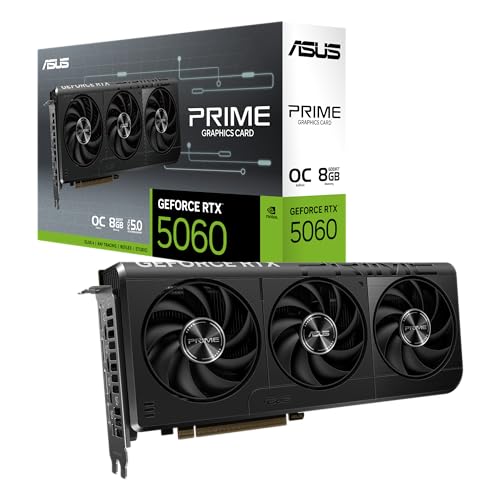
1. ASUS Prime GeForce RTX 5060 8GB GDDR7 OC — the entry point to Blackwell, priced like it is not
The RTX 5060 is NVIDIA’s entry Blackwell card: GB206 silicon with 3,840 CUDA cores, built for 1080p gaming with DLSS 4, including Multi Frame Generation, doing the heavy lifting in supported titles. This ASUS Prime OC model (PRIME-RTX5060-O8G) carries 8GB of GDDR7 on a 128-bit bus for 448 GB/s of bandwidth, draws about 145 W through a single 8-pin connector, and fits small cases under ASUS’s SFF-Ready sizing with a 2.5-slot cooler. For creators it carries the Blackwell NVENC block with AV1 encode — a genuine generational step, and one worth contrasting with older budget stock still floating around the market: the desktop RTX 3050, for example, is Ampere silicon and has no AV1 encoder at all.
Now the caveat this site will not soften: 8GB of VRAM makes this a 1080p card. At 1080p with sensible texture settings it is fast and efficient, and DLSS upscaling stretches it further. At 1440p, modern titles will push past 8GB with high textures, and no amount of frame generation fixes a VRAM wall — frame generation consumes memory rather than creating it. If your monitor is 1440p, the honest picks in this guide start at the 16GB cards below, and this section exists so that the cheapest card here is also the most clearly labelled.
Who it suits: 1080p players building or upgrading on a strict budget who need a card now, in a case or on a power supply that cannot take more. Who should skip it: 1440p monitor owners, anyone planning to keep the card through the next console cycle, and anyone who can wait — because the price discussion below is the least cheerful in this guide.
Deal details: Spotted at $534.99 on Nov 19, 2026 (ASIN B0F76KGH6B) for the ASUS Prime OC sold by Amazon.com, against a $299 launch MSRP. There is no honest percentage-off to print: the card is trading far above the price NVIDIA launched it at, in a market where every current card is. The useful numbers are the targets: this guide’s price tracking puts a good Black Friday price for any RTX 5060 at $469 and a great one at $329. At $534.99 you are paying the need-it-now price. Check the live price — if the event pulls this listing toward $469, the recommendation changes with it.
Honest limitation: 8GB of VRAM caps it at 1080p for modern games, full stop, and the street price is roughly 79% above launch MSRP. It is the right card for a narrow job at a price the market, not the discount badge, is responsible for.
Check on Amazon · See the live Black Friday price · View this deal on Amazon
2. PNY GeForce RTX 5060 Ti 16GB OC Dual Fan — the cheapest 16GB CUDA card, and the guide’s default NVIDIA pick
The RTX 5060 Ti 16GB is the same GB206 silicon as the 5060 above with more of it switched on — 4,608 CUDA cores — and, decisively, twice the memory: 16GB of GDDR7 on the same 128-bit bus, still 448 GB/s of bandwidth. That memory is the entire argument for the card. It is what makes 1440p with high textures a non-event, what lets local AI models in the 7B–14B class load fully onto the card, and what will keep this GPU useful years after the 8GB version is being apologised for. This PNY OC model (VCG5060T16DFXPB1-O) is a compact dual-fan, 2-slot, SFF-Ready design at 180 W on a single 8-pin connector, so it drops into almost any existing desktop without a power supply upgrade.
Two specification traps surround this card, and both are called out because this site’s readers check. First, the RTX 5060 Ti is sold in 8GB and 16GB versions under the same name at very different prices; the ASIN in this guide is the 16GB card, and you should confirm ’16GB’ in the listing title before checkout. Second, the 128-bit bus means bandwidth, not capacity, is the ceiling: for gaming that is a fair trade at 1440p, and for AI token generation it is why the wider 5070 Ti below generates text roughly two-thirds faster despite holding the same 16GB.
Who it suits: 1440p gamers who want NVIDIA features (DLSS 4, AV1 encode, CUDA) with memory headroom, and local-AI tinkerers on a three-figure budget. Who should skip it: 1080p-only players, for whom the premium buys memory they will not touch, and anyone whose workload is pure raster gaming with no CUDA need — the Radeons below give the same 16GB for a different price structure.
Deal details: Spotted at $799.99 on Nov 19, 2026 (ASIN B0F4Y6N6PW), sold by Amazon, against a $429 launch MSRP — about 86% above launch, in line with every independent price snapshot of this card through the autumn. This guide’s buy-below line is $780: under it, this is the cheapest new 16GB CUDA card on Amazon beating every tracked reading. Nobody should call $799.99 a discount, and this guide does not; it is the going rate for the most sensible NVIDIA card of this generation, and the Black Friday question is whether the event finally bends it. Check the live price before buying.
Honest limitation: The price is the limitation: 16GB of GDDR7 is exactly the component the 2026 market charges for, and the 128-bit bus caps bandwidth at half the 5070 Ti’s. You are buying capacity and compatibility, not speed per dollar.

Check on Amazon · See the live Black Friday price · View this deal on Amazon
3. ASUS Prime GeForce RTX 5060 Ti 16GB GDDR7 OC — the same GPU as the PNY, on ASUS’s SFF-Ready board
This section exists for one practical reason: during Black Friday Week, the smart way to buy an RTX 5060 Ti 16GB is to shortlist two or three boards carrying the same GPU and buy whichever is cheapest at the moment you check out, because board-partner prices for identical silicon move independently. The ASUS Prime (PRIME-RTX5060TI-O16G) is the obvious second board: the same GB206 GPU with 4,608 CUDA cores, the same 16GB of GDDR7 on a 128-bit bus at 448 GB/s, the same DLSS 4 and AV1 encode support, in a 2.5-slot SFF-Ready cooler with axial-tech fans and a dual BIOS switch.
What differs from the PNY above is execution, not performance: a slightly larger cooler, ASUS’s BIOS toggle between performance and quiet modes, and ASUS’s support and warranty channel. In games, the two cards will land within noise of each other, because the GPU, memory configuration and power class are the same. Anyone who tells you one 5060 Ti 16GB board is meaningfully faster than another at stock settings is selling something. Buy on price, availability and which box you would rather deal with on a warranty claim.
Who it suits: exactly the same buyers as the PNY pick — 1440p gamers and CUDA users who need 16GB — at the moment this board happens to be the cheaper or the in-stock one. Who should skip it: anyone for whom the PNY above is in stock at a lower live price, which at this guide’s sightings it is. This section is a comparison tool, and it knows it.
Deal details: Spotted at $829.99 on Nov 19, 2026 (ASIN B0F4RVCY79) from Amazon.com, against the same $429 launch MSRP as every 5060 Ti 16GB — $30 above the PNY sighting for the identical GPU and memory. The deal instruction is therefore unusually simple: check the live price on both listings. If this board is cheaper when you look, buy this one; if the PNY is, buy that. Black Friday Week is twelve days long, and the lead between these two listings has changed hands before. What neither listing currently offers is a price near MSRP, and the guide will not pretend otherwise.
Honest limitation: You pay a $30 premium at sighting prices for a badge and a BIOS switch, on the same silicon. And it inherits the family limitation in full: 128-bit bandwidth and a market price roughly double the launch MSRP.
Check on Amazon · See the live Black Friday price · View this deal on Amazon
4. XFX Swift Radeon RX 9070 OC Triple Fan — 16GB on a 256-bit bus for 5070 money, without the 5070 price
The Radeon RX 9070 is AMD’s RDNA 4 card built on Navi 48, with 56 compute units and the configuration this guide keeps recommending in 2026: 16GB of GDDR6 on a full 256-bit bus, for 640 GB/s of bandwidth. Note the memory type, because it is the honest trade in this comparison: GDDR6, not the GDDR7 of the RTX 50 cards — and the wider bus more than compensates in bandwidth terms, which is why this card trades blows with NVIDIA’s RTX 5070 class in raster gaming while holding 4GB more memory than the 5070’s 12GB. This XFX Swift OC (RX-97SWFT3BA) is a triple-fan design rated around the card’s 220 W board power, so it wants a decent mid-tower and a 650 W-class power supply.
For gaming, RDNA 4 brings FSR 4 upscaling and a much-improved ray tracing step over the previous Radeon generation, plus AV1 encode in its media engine for streamers. The boundary is software, stated plainly: there is no CUDA. If your non-gaming work is local AI with CUDA-only tooling, video pipelines built on NVIDIA’s stack, or Blender CUDA rendering, this card is the wrong purchase at any discount, and the 5060 Ti 16GB above is your floor. If your machine is a gaming machine, the Radeon’s price-per-frame and memory configuration are the strongest in this guide.
Who it suits: 1440p gamers who want 16GB without paying the GDDR7 premium, and high-refresh 1080p players who want headroom. Who should skip it: CUDA-dependent creators and AI users, and small-case builders — a triple-fan Swift is a long card, so measure before you buy.
Deal details: Spotted at $859.99 on Nov 19, 2026 (ASIN B0F1GFKD47) from Amazon.com, against a $549 launch MSRP — about 57% above launch, the smallest markup over MSRP of any current-generation card in this guide, which in November 2026 counts as a relative bargain. The targets from this guide’s tracking: $739 is a good Black Friday price for this card and anything near $604 would be exceptional. At the sighting it is a buy-if-you-need-it price on the best-value 16GB hardware here. Check the live price, and check the seller — Radeon stock rotates to marketplace sellers quickly during the event.
Honest limitation: No CUDA shuts it out of a real class of creator and AI software, GDDR6 will age less gracefully than GDDR7 at the same capacity, and it is still priced well above the MSRP AMD launched it at. The value is relative to a distorted market, and the guide says so.
Check on Amazon · See the live Black Friday price · View this deal on Amazon
5. XFX Swift Radeon RX 9070 XT Triple Fan — the fastest raster card in this guide, for 5070 Ti money minus $600
The RX 9070 XT is the full Navi 48 die: 64 compute units against the 9070’s 56, with the same memory system — 16GB of GDDR6 on a 256-bit bus at 640 GB/s — and a board power of about 304 W. That power figure is a real planning input: AMD’s recommendation class is a 750 W power supply, and this XFX Swift Triple Fan (RX-97TSWF3BA) is a large triple-fan card that needs the case length and the PSU headroom to match. In return you get the strongest raster gaming performance in this guide, in the class of NVIDIA’s RTX 5070 Ti for raw frame rates, with FSR 4 for upscaling and RDNA 4’s improved ray tracing — improved, not class-leading, and the guide keeps that distinction.
The comparison that defines this card’s Black Friday case is against the MSI 5070 Ti below: the same 16GB capacity class, broadly comparable gaming speed, and a spotted price roughly $790 lower. What the NVIDIA premium buys is CUDA, DLSS 4’s wider game support and stronger ray tracing; what it does not buy is more memory or a faster bus in any way that matters at 1440p. For a pure gaming build, that arithmetic is why the XT is this guide’s high-end recommendation despite sitting fifth in price order.
Who it suits: 1440p high-refresh and entry 4K gamers building a gaming-first PC, especially anyone upgrading from an RX 6000 or RTX 30-series card. Who should skip it: CUDA users (the same warning as the 9070, with more money at stake), owners of 550–650 W power supplies unwilling to upgrade them, and compact cases.
Deal details: Spotted at $959.99 on Nov 19, 2026 (ASIN B0DW4FRCQR) from Amazon.com, against a $599 launch MSRP — about 60% above launch. This guide’s good Black Friday target for the XT is $790, so the sighting is a fair market price rather than an event bargain, and the honest advice mirrors the 9070’s: buy it if you are building now, and know that a drop toward $790 during the event is the outcome worth watching for. Check the live price before ordering — of the six cards here, the XT’s Amazon stock depth is among the healthiest, which makes its price the most likely to be cut competitively as the week goes on.
Honest limitation: 304 W is a genuine power and heat commitment, ray tracing still trails NVIDIA’s equivalent tier, and there is no CUDA. It is also, like everything in this guide, priced far above its launch MSRP — the deal is comparative, not absolute.

Check on Amazon · See the live Black Friday price · View this deal on Amazon
6. MSI GeForce RTX 5070 Ti 16G Ventus 3X OC — a superb GPU at a price this guide will not endorse buying yet
The RTX 5070 Ti is the strongest NVIDIA card in this guide on hardware: GB203 Blackwell silicon with 8,960 CUDA cores, 16GB of GDDR7 on a 256-bit bus for 896 GB/s of bandwidth — double the 5060 Ti’s — DLSS 4 with Multi Frame Generation, AV1 encode, and a 300 W board power on a recommended 750 W system. This MSI Ventus 3X OC (G507T16V3C) is the range’s workhorse triple-fan board: no lighting theatre, a functional cooler, and the full GPU underneath. For gaming it is a genuine 1440p high-refresh and credible 4K card; for AI and creation it is the fastest CUDA option here by a wide margin, and its bandwidth advantage over the 5060 Ti shows up directly in token generation speed.
So why is the guide’s tone different in this section? Because a deals guide that recommends everything recommends nothing. The 5070 Ti’s street price through the autumn has detached from its $749 launch MSRP more completely than any other card in this guide, and the freshest tracking before Black Friday Week still had this MSI board at the level recorded below. The hardware earns an enthusiastic paragraph; the price earns a warning label. Both are in this section because both are true.
Who it suits, at the right price: 4K and high-refresh 1440p gamers who need NVIDIA features, and CUDA creators for whom time is literally money. Who should skip it at the current price: everyone else, including most of the people it suits — the RX 9070 XT above delivers comparable gaming for dramatically less, and this card’s own autumn history contains far lower prices than today’s.
Deal details: Spotted at $1,749.99 on Nov 19, 2026 (ASIN B0DWHHSZH1), against a $749 launch MSRP — roughly 134% above launch, per the tracking record for this model in the week before Black Friday Week. This guide’s buy-below line, from its own autumn price log, is $1,190. The recommendation is therefore explicit: do not buy this listing at the sighting price. Bookmark it, check the live price across the event — 5070 Ti listings were among the most volatile of the autumn, moving hundreds of dollars in a day — and buy only if the event produces the cut the hardware deserves. A deals guide’s job includes telling you which deal to refuse.
Honest limitation: The price, entirely: at the sighting it costs more than the 9070 XT and a 5060 Ti 16GB combined, for one card. It is also a 300 W, triple-fan card that needs a 750 W-class PSU and a case with real airflow, and its Ventus cooler is tuned for value rather than silence.
Check on Amazon · See the live Black Friday price · View this deal on Amazon
Comparison Table
Read this table the way this guide was researched: capacity and bandwidth together, price against launch MSRP, and one card — the fastest NVIDIA here — flagged as a watch rather than a buy. The full sections explain each target and each caveat before you check any live price.
| Model | Key specs | Dated sighting | Buy if |
|---|---|---|---|
| ASUS Prime RTX 5060 | Blackwell, 8GB GDDR7, 128-bit, 448 GB/s, 145 W | $534.99 spotted Nov 19, 2026 | 1080p only — see the VRAM caveat |
| PNY RTX 5060 Ti 16GB | Blackwell, 16GB GDDR7, 128-bit, 448 GB/s, 180 W | $799.99 spotted Nov 19, 2026 | 1440p + CUDA value pick |
| ASUS Prime RTX 5060 Ti 16GB | Blackwell, 16GB GDDR7, 128-bit, 448 GB/s, 180 W | $829.99 spotted Nov 19, 2026 | Buy whichever 5060 Ti 16GB is cheaper live |
| XFX Swift RX 9070 | RDNA 4, 16GB GDDR6, 256-bit, 640 GB/s, 220 W | $859.99 spotted Nov 19, 2026 | Best 16GB value for pure gaming |
| XFX Swift RX 9070 XT | RDNA 4, 16GB GDDR6, 256-bit, 640 GB/s, 304 W | $959.99 spotted Nov 19, 2026 | High-end gaming recommendation |
| MSI RTX 5070 Ti Ventus 3X OC | Blackwell, 16GB GDDR7, 256-bit, 896 GB/s, 300 W | $1,749.99 spotted Nov 19, 2026 | Watch only — buy below $1,190 |
How to Shop Black Friday Without Overpaying
Judge every GPU deal against MSRP and the tracked low, never the struck-through price. Amazon’s list prices on graphics cards this year are routinely hundreds of dollars above launch MSRP, so a ‘15% saving’ can still leave a card 50% over the price its manufacturer announced. This guide gives you the MSRP and a buy-below target for each card; a deal that does not beat the target is not a deal, whatever colour the badge is.
Check the seller before the price. During the event, Amazon-sold stock sells through and marketplace sellers rotate onto the same listings at higher prices, with different shipping times and return handling. The sightings in this guide are for Amazon.com or manufacturer-store listings. If the live listing shows a third-party seller, a future shipping date instead of stock, or a ‘Renewed’ or ‘Used’ condition line, you are no longer looking at the deal that was researched — back away and re-check.
Verify VRAM in the title, especially on split-memory cards. The RTX 5060 Ti and RX 9060 XT families sell the same GPU name with 8GB or 16GB. The price gap between the two versions of the 5060 Ti reached $300 in November tracking. Read the full listing title, match the ASIN to this guide, and never assume a suspiciously cheap ‘5060 Ti’ is the 16GB card.
Use the full twelve days, and plan the whole build. GPU stock during Black Friday Week refreshes in waves, and this autumn’s listings moved by hundreds of dollars in a day in both directions — patience is a pricing strategy, not a delay. While you wait, confirm the unglamorous compatibility items: power supply wattage and connectors (the 9070 XT and 5070 Ti want 750 W-class PSUs), case length for triple-fan cards, and PCIe slot generation. A bargain card that needs a new PSU is a bundle; price it as one.
Common Mistakes
Trusting the discount percentage on a GPU listing. With list prices set far above MSRP across the 2026 market, percentage-off is the least informative number on the page. The informative numbers are the absolute price, the launch MSRP and the card’s tracked low — all three are in every section of this guide.
Buying an 8GB card for a 1440p monitor. The RTX 5060 is a good 1080p card and this guide recommends it for exactly that. At 1440p with high textures, 8GB is a hard wall in current titles, and frame generation makes the memory problem worse, not better. Match the card to the monitor you own, not the one the marketing renders.
Confusing GDDR generations and bus widths. 16GB of GDDR6 on a 256-bit bus (the Radeons here) and 16GB of GDDR7 on a 128-bit bus (the 5060 Ti) deliver very different bandwidth — 640 GB/s against 448 GB/s. Capacity decides what fits; bandwidth decides how fast it runs. Listings that print only the capacity are telling you half the specification.
Assuming last-gen budget cards encode AV1. The desktop RTX 3050 is Ampere silicon with no AV1 encode; AV1 encoding starts with RTX 40-series Ada NVENC. Streamers and Plex/Jellyfin builders comparing cheap older stock against the Blackwell cards in this guide need that line drawn clearly, because listings rarely draw it.
Paying a panic price on the flagship tier. The 5070 Ti section is this guide’s standing example: when a card trades at more than double its MSRP, the correct Black Friday move is usually to buy the tier below at a sane price, or to wait. Event pressure is manufactured; your build will run for years.
Final Recommendation
For a gaming-first build, the recommendation is the XFX Swift RX 9070 XT, spotted at $959.99 on Nov 19, 2026: the fastest raster performance in this guide, 16GB on a 256-bit bus, and a price roughly $790 below the NVIDIA tier it competes with. If the budget will not stretch that far, its sibling the RX 9070 at $859.99 spotted carries the same memory configuration and the smallest markup over MSRP of any card here.
Builders who need NVIDIA — for CUDA, for DLSS 4’s support list, or for creator software — should buy the PNY RTX 5060 Ti 16GB at its spotted $799.99, checking the ASUS Prime 5060 Ti 16GB listing at the same moment and taking whichever is cheaper live. And the guide’s clearest advice costs nothing: do not pay the current street price for the 5070 Ti. Watch it through November 30, buy below $1,190 if the event delivers, and let someone else fund the markup if it does not.
Whichever card you choose, check the live price and the seller at checkout, confirm the VRAM in the listing title matches the ASIN you researched, and verify your power supply before the box arrives. Black Friday Week runs until November 30, GPU prices this year reward the patient, and the right card at a tracked, understood price is worth more than a badge on a listing you did not check.
FAQ
When is Amazon Black Friday Week 2026?
Amazon Black Friday Week runs from November 19 to November 30, 2026. Black Friday is November 27 and Cyber Monday is November 30. GPU listings refresh in waves across the whole window, and this autumn’s prices moved significantly within single days, so a card priced badly today can be priced well by Black Friday — and the reverse is also true.
Why are GPU ‘deals’ priced above MSRP this year?
Because street prices climbed through 2026 on memory costs and demand, and Black Friday discounts are calculated from current list prices, not launch prices. A card can honestly show a discount badge while sitting 50–100% above the MSRP its manufacturer announced. That is why every section of this guide benchmarks its sighting against launch MSRP and a tracked buy-below target instead of repeating the badge.
Is 8GB of VRAM enough in 2026?
For 1080p gaming with sensible texture settings, yes — the RTX 5060 in this guide is a good card for exactly that job. For 1440p, increasingly no: current titles exceed 8GB with high textures, and neither upscaling nor frame generation adds memory. If you own or plan a 1440p monitor, treat 16GB as the starting point, which is why four of this guide’s six cards carry it.
GDDR6 or GDDR7 — does the memory type matter?
What matters is the bandwidth the full configuration delivers. The Radeons here pair GDDR6 with a 256-bit bus for 640 GB/s; the 5060 Ti pairs faster GDDR7 chips with a 128-bit bus for 448 GB/s; the 5070 Ti pairs GDDR7 with 256-bit for 896 GB/s. Judge the combination, not the generation label, and be suspicious of any listing that hides the bus width.
Do these cards support AV1 encoding for streaming?
The RTX 50-series cards here do, through Blackwell’s NVENC block, as do the RDNA 4 Radeons through AMD’s media engine. For context when shopping older stock: AV1 encode starts at NVIDIA’s RTX 40-series; the desktop RTX 3050 is an Ampere card and cannot encode AV1, and RTX 30-series cards generally should not be bought for that feature.
Which card should I buy for local AI models?
VRAM first, bandwidth second. The 16GB cards are the floor for 14B-class models at useful quantisations: the 5060 Ti 16GB is the cheapest CUDA route, the 5070 Ti generates considerably faster on the same memory thanks to its 896 GB/s bandwidth, and the Radeons suit Vulkan/SYCL-based tooling such as llama.cpp but not CUDA-only stacks. An 8GB card will spill larger models into system RAM and slow to a crawl.
Keep Reading
Best Gaming PC Under $1500 Rtx 5060 Ti Vs Rx 9070 Buying Guides Best Rtx 50 Series Gaming Laptops Best 1440p Gaming PC Under $700