Disclosure: As an Amazon Associate, reviewstook.com earns from qualifying purchases. Links to Amazon on this page are affiliate links; they cost you nothing extra.
A business laptop is judged on reliability, security and comfort over long workdays. Raw speed matters less than keyboard quality, battery life, ports and support. This guide explains what separates a business laptop from a consumer one and how to choose, whether you are buying for yourself or a small team.
This guide draws on product listings and manufacturer information, not our own testing, so check each model’s specification on its product page.
By the Reviewstook Editorial Team. Last updated: October 31, 2026.
What Makes a Laptop “Business Class”
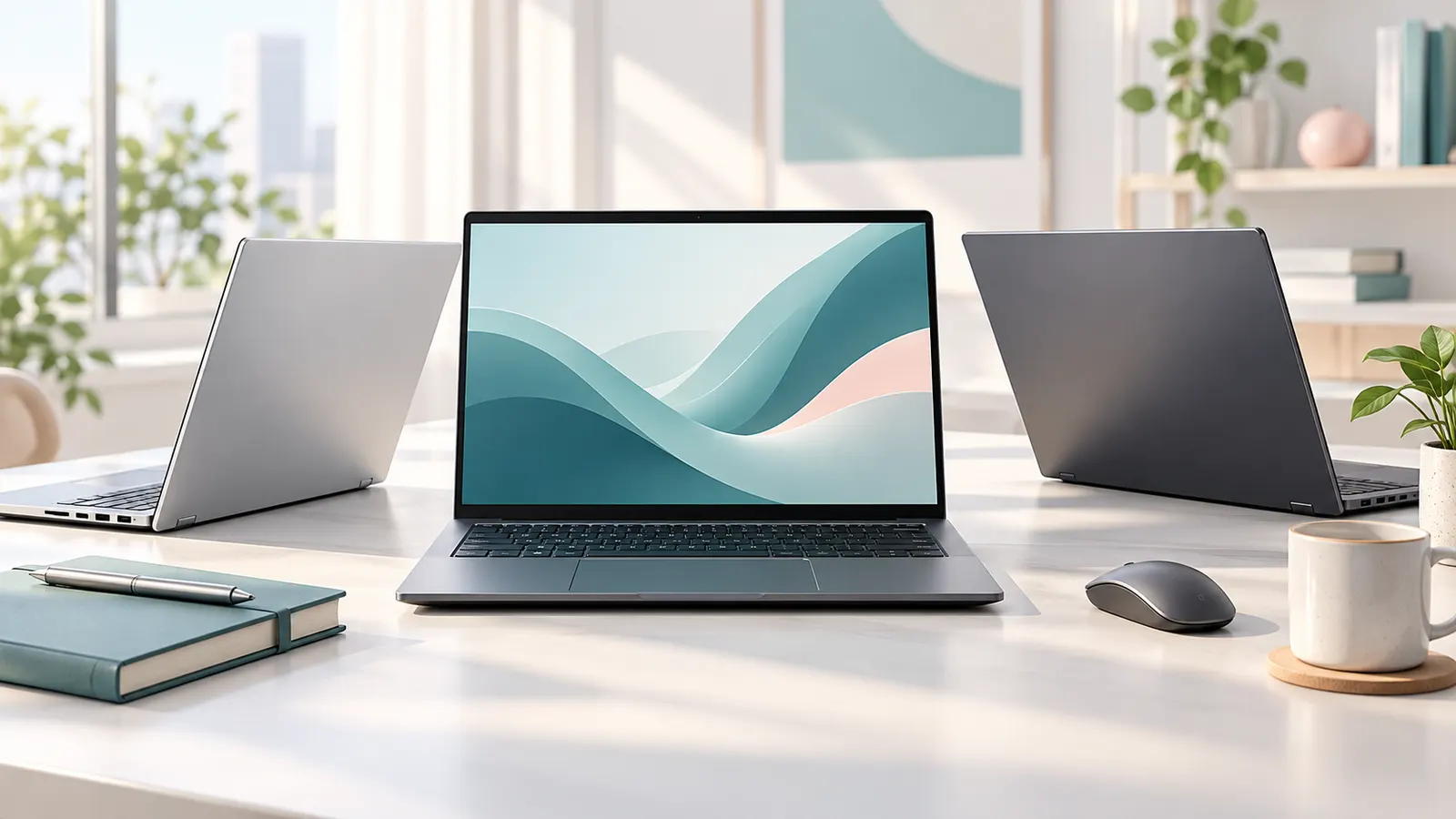
Business lines typically emphasize a sturdier build, a better keyboard, security features such as a fingerprint reader or an IR camera for face sign-in, a webcam privacy shutter, and longer warranties and support options. These features cost more but save time and risk for people who depend on their laptop for work.
In this guide
Performance
Most office work, video calls and spreadsheets run well on a recent mid-range processor with 16 GB of RAM. Choose more if you run virtual machines, large datasets or design tools. An SSD of 512 GB is a good baseline.
Keyboard, Trackpad and Screen
You will use these for hours, so they matter. A comfortable keyboard with good key travel and a precise trackpad reduce fatigue. A bright, anti-glare Full HD or higher screen is easier on the eyes, and a taller aspect ratio such as 16:10 shows more of a document.
Battery and Weight
If you travel, choose a light model with strong battery life and USB-C charging. Lightweight business laptops are often thin and use premium materials. Check real-world battery reviews, since listed hours are best-case numbers.
Security and Management
Look for hardware security such as a TPM chip, fingerprint or face sign-in, and support for full-disk encryption. For teams, check support for device-management tools and the length of firmware updates. Keep the system updated.
Ports and Docking
Business users often connect monitors, wired networks and projectors. Check for Thunderbolt or USB-C with display output, HDMI and Ethernet or a dock. A docking station turns a laptop into a desktop setup in one cable; see our docking station picks.
Warranty and Support
Check on-site or next-business-day repair options if downtime costs you money. Business lines often offer extended warranties and accidental damage cover that consumer lines lack.
Choosing by Budget
Premium business laptops carry higher prices for build and support. Mid-range models offer solid performance and often the same keyboard quality. See our business laptops under $1000 and premium business laptops.
Windows Pro Versus Home Editions
The title of this guide mentions Windows Pro, and the edition really does matter for work. Pro versions of Windows typically add business-oriented features that Home editions leave out, such as the ability to join a company domain, stronger options for managing and encrypting the drive, remote desktop hosting and group policy controls. Which features are included can change between releases, so check Microsoft’s edition comparison and the listing.
If you work alone and only use cloud services, Home may be enough, and you can often upgrade later for a fee. If an employer, school or client expects a managed device, Pro is the safer purchase, since your IT team may need those features before they enroll the laptop. Ask them directly what they require, because some organizations provide their own images or licenses.
Look at the product page to confirm the edition that ships with the laptop, since models with similar names sometimes ship with different versions. Also check whether the machine comes with a licensed version of Windows or is sold without one. Keep your license information and recovery media options in a safe place, and note whether the maker offers a clean reinstall tool. If you are buying for a team, ask the reseller whether the edition can be changed after purchase and what documentation comes with the order, since managers often need proof of license for audits.
Choosing Ports for Your Actual Desk
The earlier ports section covers the basics. Here the point is to plan from your own desk. List every device you connect: monitors, a keyboard, a mouse, a headset, a printer, a card reader, a phone charger and any wired network. Then count how many ports of each type you need at once, and check them against the laptop’s specifications.
Pay attention to what each USB-C port actually does. Some carry only data, some also handle charging, and some also output video. Look for notes about display output, charging power input and data speed in the manual or listing. Thunderbolt and USB4 ports offer the most flexibility, but they are not on every model, and the logo on the port is worth checking.
If you travel, consider carrying a small hub or adapter, or choose a laptop with the full-size ports you use often. Thin models sometimes leave out HDMI or Ethernet, so decide in advance whether you want to carry an adapter. Think about which side the ports are on, since a charging cable on the wrong side can be awkward. A dock can solve many of these problems, but it adds cost. Before you buy, check whether the charger supplied can power a dock as well, because some docks need their own adapter, and a mismatch can leave the laptop charging slowly when it is connected.
Video Calls: Camera, Microphone and Speakers
For many workers, the laptop is a meeting room. A good webcam, clear microphones and decent speakers can make calls easier. Check the camera resolution on the listing and whether it has a physical privacy shutter. Resolution is only part of the story, as sensor quality and software processing also affect how you look in a dim room.
Microphones with noise reduction help in busy spaces, and many laptops use multiple microphones. Reviews that include recorded samples are more informative than a spec line. If you often join calls in public places or open offices, a headset may beat any built-in microphone, so make sure the laptop has a suitable audio jack or Bluetooth.
Speakers vary widely. Thin laptops can sound tinny, and while this rarely matters for spreadsheets, it affects presentations and long calls. Also think about the position of the camera: a webcam at the top of the screen is typical, but some compact models place it in awkward spots. If video presence matters to your job, consider an external webcam, and make sure the laptop has enough ports for it. If you sit near a window, remember that a tilted lid can make the camera see a bright background, so a small tilt or lamp adjustment can improve how you look more than a better webcam.
Durability, Serviceability and Upgrades
A work laptop spends years in bags, on desks and on trains. Look for descriptions of the chassis material, hinge design and any testing the maker says it performed, and be careful not to treat marketing claims as guarantees. Keyboards that resist small spills, reinforced corners and a firm hinge are sensible features for frequent travelers.
Serviceability can lower the long-term cost. Check whether the memory and storage can be upgraded or whether they are soldered or fixed in place. If memory is fixed, buy the amount you will need for the life of the laptop. If the battery is replaceable by a technician, that can extend its life considerably. The manual or service documentation often describes what can be changed.
Ask about spare parts and repair services. Some makers publish repair guides and sell parts, while others limit service to authorized centers. If you manage several laptops, standard parts and a common model across the team can simplify repairs. A protective sleeve or padded backpack, and a screen cover for transit, are low-cost ways to keep a laptop looking and working well. Keep screws and small parts in a labeled container if you ever open the case, and follow the manual, since opening a laptop without care may affect the warranty.
Setting Up a New Work Laptop Safely
A good setup protects you from the first day. Install all pending system and firmware updates, create a standard user account for daily use in addition to an administrator account where your policy allows, and turn on drive encryption if the laptop supports it. Save your recovery key in a safe place that is not on the laptop itself.
Enable sign-in with a fingerprint or face recognition if available, backed by a strong passphrase. Remove trial software you do not need, set up automatic backups to a work-approved location and check the firewall and antivirus settings. Review the privacy settings on the camera and microphone, and learn how to lock the screen quickly with a shortcut.
Keep a record of the serial number, the warranty information and the support contact. Create a recovery drive or note how to reset the system. For team laptops, document the setup so you can repeat it, and plan the replacement of aging devices before they fail. Signs it is time to replace include batteries that no longer last a workday, slowdowns that updates and cleanup cannot fix, a loose hinge, keyboard failures and the end of security update support. Record the setup steps in a short checklist so a replacement laptop can be brought to the same state quickly, which cuts downtime when hardware fails.

Ready to Buy? Start Here
If this guide helped you decide what to look for, these products are a place to start.

As an Amazon Associate we earn from qualifying purchases. Prices and availability are shown on Amazon.
Matching a Laptop to Your Job Role
Business laptops are not all alike, because the work they support is not alike. Think first about what you do all day, and let the tasks guide the choice. A person who lives in email, documents and video calls needs different strengths from someone who edits large files or runs specialist software.
| Role | What to prioritize | What to deprioritize |
|---|---|---|
| Office and admin | Comfortable keyboard, reliable battery, decent webcam | High-end graphics |
| Sales and travel | Light weight, strong battery, solid build | Large screens |
| Finance and data work | Memory, processing power, number pad | Thinness at any cost |
| Creative and design | Display quality, graphics, memory | Very low weight |
| IT and development | Ports, memory, upgradeability | Fancy finishes |
| Executive and client-facing | Polished design, quiet fans, good speakers | Unneeded extras |
If your role mixes tasks, aim for balance and avoid paying for power you will rarely use.
Memory, Storage and Future-Proofing Without Guessing
Two specifications decide how a laptop ages: memory and storage. Memory affects how many programs and browser tabs you can run at once, and storage affects how many files you can keep on the machine. A laptop with too little of either can feel slow within a year or two.
- Check whether the memory can be upgraded later, or whether it is fixed to the board.
- Look at the type of storage and whether a second drive slot is available.
- Think about cloud storage for files, which can reduce local space needs.
- Consider the system software version and the length of maker support.
- Read the maker description for any limits on upgrade options.
Buying a bit more memory than you need today often extends the useful life of the machine.
Meetings, Cameras and Microphones
Video calls are part of daily work, and the camera and audio can affect how you come across. Look for a camera with a clear description of its resolution, and check whether there is a physical shutter or privacy switch. Microphones and speakers vary widely, so see what the listing says about noise reduction and audio quality.
For frequent calls, a separate headset or external camera may be a better choice than built-in parts. Position the laptop at eye level with a stand, use good lighting, and test your setup before an important call. If you work in an open office, consider a headset with a boom microphone for clearer sound.
Fleet Buying and IT Support Questions
If you are buying for a team or a small business, think beyond a single machine. Standardizing on one or two models makes support easier, since the same parts, docks and chargers work for everyone. Ask whether the maker offers business support plans, on-site service, or advance replacement for faulty units.
- Does the model have long-term availability, so you can add more of the same later?
- What management tools does the maker offer for security and updates?
- How easy is it to service the laptop, for instance to replace a battery?
- Are spare chargers and docks compatible across models?
- What are the warranty and service terms for business use?
Talk with whoever manages your IT before deciding, because company policy may limit the options.
Looking After a Work Laptop
Basic habits protect your investment. Keep the laptop updated, use a screen lock and back up your files regularly. Use a padded sleeve or bag, and avoid leaving the machine in a hot car. Clean the screen and keyboard gently with a soft cloth, and follow the maker advice on cleaning products. Charge the battery as the maker recommends, and replace a worn battery when needed. When you retire a laptop, wipe it securely according to company policy.
Screen Size, Weight and Carrying Habits
The screen decides how comfortable long days feel. A smaller display is easy to carry, but it can feel cramped when you work with spreadsheets or several windows. A larger display gives space to work but adds weight and bulk. Look at screen size, resolution, brightness and how well it handles glare, and think about whether you often work near windows or outdoors.
Weight matters more than it seems if you commute or travel often. Add the charger, a mouse and any adapters to the laptop weight, then picture carrying the bag for an entire day. If your desk setup includes an external monitor, a lighter laptop may be the better choice, since you will rely on the big screen at your desk. Check the thickness and corner design if you slide the laptop into a slim bag.
Security Features Worth Asking About
Business data deserves protection. Many business laptops offer fingerprint readers, face recognition, hardware encryption chips and privacy shutters. Ask which features are present and how they work with your company systems. Check whether the laptop supports secure boot and firmware updates, and whether the maker publishes security bulletins.
- A fingerprint reader or camera login saves time and avoids weak passwords.
- A privacy shutter on the camera gives peace of mind.
- A security lock slot allows you to secure the laptop in shared spaces.
- Encryption options protect files if the laptop is lost.
Follow your company IT rules for passwords, updates and remote wipe tools. Features only help when they are turned on and used properly.
Matching the Choice to Real Life
Abstract criteria become concrete when they are tested against real routines. The three situations below are drawn from the readers this guide was written for, and each one changes which of the business laptops above is the right answer, sometimes in ways the specification table would never predict.
The solo professional buying their own machine
When the laptop is both a business expense and your only computer, the buying guide logic in this article applies with one twist: you are also your own IT department. That argues for the boring virtues: a model line with good documentation, parts you can replace yourself, and a warranty you can actually use without a corporate account manager. It also argues for buying the configuration you need for the next three years now, because upgrading a sealed machine later is either expensive or impossible.
The small team buying five to twenty machines
Small fleets live or die on consistency. Standardising on one or two configurations from this guide’s class of machines means one dock type, one charger type, one set of drivers and one spare unit that can cover any desk. The temptation to chase individual deals per employee usually costs more in support time than it saves in purchase price. Keep one cold spare, image it the same as the rest, and the day someone’s screen dies becomes an inconvenience instead of a crisis.
The employee choosing from a company catalogue
If your employer offers a shortlist, this guide helps you choose within it rather than relitigate it. Read the catalogue the way this article teaches: compare keyboards and screens first because those are what you touch, check weight against your actual commute, and take the larger memory option whenever the catalogue offers it, because memory is the specification that decides how old a laptop feels in year three. Decline exotic upgrades you cannot describe a use for.
A Deeper Look at the Criteria
Specifications are the beginning of the decision rather than the decision itself, and business laptops reward buyers who read past the first line of the listing.
Memory headroom over headline speed
For office workloads the processor rarely decides how fast a machine feels after the first year; memory does. A laptop that can keep your browser, documents, chat tools and a video call resident without swapping will feel younger for longer. When two configurations compete for the same money, the one with more memory usually wins the long game, because storage can be supplemented externally and memory, on most slim business models, cannot be changed at all after purchase.
The keyboard and screen you will actually live with
Specifications are easy to compare and comfort is not, which is why buyers overweight the numbers. You will press the keyboard thousands of times a week and look at the screen for most of your working life, so key travel, layout sanity, panel brightness and glare behaviour deserve the same scrutiny as the processor. A slightly slower machine with a keyboard you love will be remembered fondly; the reverse pairing is remembered as a mistake.
Ports as a daily tax or a daily gift
Every missing port is a recurring tax paid in adapters, forgotten dongles and meeting-room improvisation. Count the connections in your real week: the monitor at your desk, the projector or TV in meeting rooms, the headset, the occasional USB drive from a client. A machine that covers those natively saves small frictions hundreds of times a year, and those frictions, not benchmark scores, are what colleagues actually complain about.
Serviceability and the second half of ownership
The purchase is the first half of the story; the second half is a tired battery in year three, a fan that starts to grumble, a cracked keycap before a big presentation. Business lines earn their premium partly in how gracefully they age: batteries and storage that can be replaced, parts that stay available, documentation a local technician can follow. Ask those questions while you still have a choice of models, because they cannot be retrofitted later.
Troubleshooting Common Problems
Troubleshooting is a skill of elimination: change one thing, test, and only then move on. These are the faults readers of this guide meet most often with business laptops.
The laptop runs hot and loud in meetings
Sustained heat during calls usually traces back to a blocked vent, a dust-loaded fan or a background process working harder than the meeting itself. Check that vents are clear of the desk surface and soft furnishings, close the forgotten browser windows and updaters before the call, and confirm the power mode is not locked to maximum performance while on battery. If one program consistently drives the fans, updating or replacing it fixes more than any setting.
Battery life has fallen off a cliff
A sudden drop is more often a software change than a dying battery: a new sync tool, an indexer rebuilding, or an update that reset power settings. Look at which applications the system blames for recent energy use before concluding the hardware is at fault. A gradual decline over years is normal chemistry; the remedy then is a battery service or a change of habits, such as avoiding permanent full charge where the manufacturer offers a conservation mode.
The dock works, except when it does not
Intermittent docking faults, where monitors flicker or the network drops, are classically cable and firmware problems rather than dock failures. Use the cable supplied for the connection, update the dock and laptop firmware in that order, and change one variable at a time when testing. A dock that misbehaves only with one laptop points at that laptop’s port or drivers; a dock that misbehaves with everything earns its replacement.
Wi-Fi drops in one place but not others
Location-specific wireless trouble usually belongs to the location: a congested channel, a thick wall, a router placed inside a metal cabinet. Test the laptop near the router to separate machine faults from room faults, forget and rejoin the network to clear a corrupted profile, and check whether the problem follows a particular band. Roaming between home, office and client networks also exposes aggressive power saving on the wireless adapter, which can be relaxed in settings.
Living With It Long-Term
Ownership of a business laptop rewards small, regular habits over occasional heroics. Keep the operating system and firmware updated, but do it on your schedule, ideally not the night before a deadline or a trip, so an unwelcome change never strands you mid-task. Restart the machine properly every week or so rather than living in permanent sleep; it clears the slow accumulation of half-finished updates and memory oddities that make a healthy laptop feel haunted.
Heat and batteries decide how long the machine stays pleasant. Use it on surfaces that let the vents breathe, blow dust out of the intakes a few times a year, and avoid leaving it baking in a car or a sunny window ledge. If it lives docked at a desk, check whether the manufacturer offers a charge limit for desk-bound machines; holding a battery away from permanent full charge is one of the few habits that measurably slows its ageing.
Finally, protect the data before you protect the hardware. A business laptop can be replaced in a week; the documents, photos and local files on it cannot. Keep an automatic backup running to somewhere that is not the laptop itself, know your sign-in and recovery details for the accounts the machine holds, and record the serial number and purchase details somewhere separate. Owners who do these unglamorous things are the ones for whom a failure is an inconvenience instead of a catastrophe.
A useful final check before ordering is the thirty-day test in your head: imagine the machine on an ordinary bad day, with a heavy inbox, a long call, a file that will not sync and a deadline moving towards you. The right choice from this guide is the one whose strengths cover that day, not the one with the most impressive single specification. If two picks still tie, choose the one whose weaknesses you mind least, because you will meet the weaknesses weekly and the strengths will quietly become invisible.
It is also worth deciding, at purchase time, what the machine’s second life will be. A business laptop bought well can hand down to a family member, become a spare for the team, or serve as a dedicated machine for one task when its front-line years end. That prospect argues for the configuration with a little headroom and against the absolute cheapest variant of a good model, whose compromises are exactly the ones a second owner will feel first.
Accessories deserve a small, deliberate budget rather than whatever is left over. A sleeve or case that fits properly, a second charger for the place you work most, and a backup habit for your files protect the investment better than an extended specification you will never notice. Buy the machine first, live with it for a fortnight, and then buy only the accessories your actual routine asks for; the drawer of hopeful gadgets in most offices is proof of the other approach.
From Shortlist to Setup: A Step-by-Step Walkthrough
Advice becomes useful when it is turned into an order of operations. This walkthrough takes the criteria, comparisons and warnings in this guide and arranges them into the sequence experienced buyers actually follow when choosing a business laptop, from the first questions to the first week of ownership. Work through it with your own routine in mind, and let each step eliminate options rather than merely rank them.
Step one: write the job description for the laptop
Before comparing models, write five lines describing the job: the programs used daily, where the machine will work, how it travels, what it connects to, and how long it must last. This sounds like homework and functions like a filter, because most wrong purchases happen when a buyer compares laptops against each other instead of against a job. Hold every pick in this guide up against your five lines, and eliminate any model that fails one outright, however attractive its other qualities are.
Step two: fix the configuration, not just the model
A model name is a family, not a machine: the same laptop with different memory, storage and screen options is effectively several different products. Decide your non-negotiables first, particularly memory and the display, then find the configuration of your chosen pick that meets them, and confirm that exact configuration on the listing before ordering. Many disappointed buyers chose the right model and the wrong variant of it, and the difference only announced itself months later.
Step three: plan the desk and the bag
While the laptop is in transit, settle its ecosystem: the dock or hub if it will drive external monitors, the sleeve or bag it will travel in, the second charger for its other home. Ordering these after a week of improvisation is normal; ordering them in the same week as the laptop is better, because the first week’s habits tend to become permanent. Check port positions on your pick so the desk layout you imagine is the one its cables actually allow.
Step four: set it up like you mean to keep it
In the first session, do the unglamorous work: run the updates, turn on the backup, set up sign-in security and recovery, install only the software you use, and remove the trial clutter. Then use the machine hard inside the returns window, with your real files, your real calls and your real commute, because that window is the last cheap opportunity to discover that a keyboard, a screen or a fan note disagrees with you.
The Final Decision Checklist
Before you order, run your chosen business laptop against this short list. It collects the checks scattered through this guide into one pass, and it is deliberately unglamorous: every item on it is something a real buyer, somewhere, discovered the week after delivery instead. If your pick passes all five, order with confidence. If it fails one, that failure, rather than the headline specification, is what your ownership will actually feel like.
- Memory and display configuration confirmed for the exact variant, not just the model name
- Keyboard layout checked for your language and any keys your work depends on
- Ports counted against your desk, meeting rooms and travel kit
- Warranty route and service availability confirmed for your country
- Dock, sleeve and second charger planned rather than improvised later
Keep the completed checklist with your purchase records. If the business laptop ever disappoints, the list tells you whether the disappointment was a wrong choice or a wrong expectation, and that distinction is what makes the next purchase better than this one.
One more consideration separates satisfied owners from restless ones: how the machine fits the rhythm of a working week rather than the highlight moments. The highlight moments, the big presentation, the deadline sprint, are rare and every pick in this guide survives them. The week is made of smaller things: the lid opened twenty times, the charger hunted at two desks, the fan during the quiet call, the update that arrives at the wrong hour. Judge the shortlist by those repetitions, because ownership is mostly repetition, and a business laptop chosen for its Tuesdays will also handle its rare Fridays without drama.
It is worth being honest, too, about what changing machines cannot fix. A new business laptop will not repair a chaotic filing system, a calendar with no gaps, or a desk that hurts to sit at, and buyers sometimes ask hardware to solve workflow problems because hardware is the part that can be bought. If your current frustrations are mostly organisational, spend the first fortnight with the new machine fixing them while the setup is fresh, and the laptop will get the credit for improvements that were really yours. That is not a reason to delay a needed purchase; it is a way to make the purchase pay twice.
There is also a calendar hiding inside every laptop purchase: the point, usually in the second or third year, when colleagues’ machines refresh and yours must justify itself. The business laptops in this guide that age best are the ones bought with that moment in mind, with the memory, screen and build to still feel deliberate when the novelty has gone. If you intend to keep the machine through that moment, and most business buyers should, let it influence the configuration you choose today, because the cheapest time to buy longevity is at the original order, and the most expensive is eighteen months later, one compromise at a time.
One habit ties this whole guide together: revisit the decision once, a month after purchase, with the same checklist you bought by. Note what the machine does better than expected and where it still nags, and fix the nagging item while it is small, a setting, a dock cable, a bag that fits better. Business laptops serve for years, and the owners who stay satisfied are rarely the ones who chose perfectly on day one; they are the ones who adjusted deliberately in month one and then got on with the work the machine was bought to do.
Frequently Asked Questions
Is a business laptop better than a consumer laptop?
Not always faster, but often sturdier, more secure and better supported.
How much RAM do I need for business?
16 GB suits most office work; more for virtual machines or large data.
Do I need a fingerprint reader?
It speeds up sign-in and adds security. Many business models include one.
Should I buy a docking station?
If you use external monitors and wired accessories, a dock simplifies your setup.
Is Windows Pro necessary for a business laptop?
Not always. It matters if you need features such as joining a company domain or advanced management and encryption options. Check with your employer or IT team, and compare the edition on the listing.
How long should a business laptop last?
It depends on use and care, and no fixed figure is reliable. Plan around the warranty, the availability of security updates and whether the battery and performance still meet your workday.
Should I choose a laptop with replaceable memory?
It gives you room to upgrade later, which can extend its life. If memory is fixed, buy more than you think you need now.
Is a privacy shutter on the webcam worthwhile?
Many people like the peace of mind of physically covering the camera. It does not affect microphones, so also review your audio privacy settings.
What should I ask IT before buying for work?
Ask which Windows edition, security features and management software they require, and whether they have approved models or a purchasing process. Also ask who handles repairs and warranty claims.
Do I need a laptop with a numeric keypad?
Only if you enter a lot of numbers. Compact models without one are lighter, and a separate USB keypad can be added when needed.
How can I make a laptop battery last longer?
Use the maker's battery or power-saving settings, avoid constant exposure to heat and lower screen brightness when possible. Follow the manual for charging guidance.
When is the best time to buy a business laptop?
Business lines refresh on steadier cycles than consumer models, and the practical answer is to buy when a need is real rather than gaming the calendar. That said, the outgoing generation of a business line often becomes very good value when its replacement launches, and because business models change incrementally, last year’s version rarely feels old. If your current machine is failing, buy now; a week of lost work costs more than any seasonal saving.
Should a small business buy extended warranty coverage?
For machines that travel or earn revenue directly, extended cover with accidental damage protection is usually easier to justify than for a desk-bound spare. Run the simple maths: compare the cover’s cost against a single screen or mainboard repair plus the downtime, and against how long you plan to keep the machine. This guide’s advice is to cover the machines whose absence would stop work, and self-insure the ones it would merely inconvenience.
What should I do with the old laptop when I upgrade?
First, migrate properly: confirm your backup is complete and readable before wiping anything, and keep the old machine untouched for a few weeks as an insurance policy. Then remove it from your accounts, sign out of services, and use the manufacturer’s reset or secure erase tools before selling, donating or recycling it. Business machines often hold client data, so treat disposal as a data task first and a hardware task second.
What is the first thing to set up on a new work laptop?
Security and recovery, before the machine accumulates anything worth losing: sign-in protection, the backup running and verified, updates applied, and the recovery options for your accounts recorded somewhere that is not the laptop. Then install your working software and migrate your files. Owners who reverse that order spend their first week enjoying the machine and their second week, if anything goes wrong, rebuilding it. An hour of setup order is the cheapest insurance in this entire guide.
Should I buy the laptop or the warranty first when money is tight?
Buy the right laptop with its standard cover, and add extended protection later if the maker allows it within a window, rather than buying a lesser machine to afford the longer warranty today. The machine’s keyboard, screen and memory are with you every hour; the warranty is with you only on the bad days. The exception is a machine that travels constantly for revenue work, where accidental damage cover protects income rather than hardware, and earns its place in the first order.
Bottom Line
Prioritize keyboard comfort, a bright screen, 16 GB of RAM, security features and a warranty that matches your tolerance for downtime. See our best business laptops for current picks.
Related Reading
- Laptop Buying Guide: RAM, CPU, Storage, Screen
- 6 Best Laptops: Windows, Touch and Copilot+ Picks
- Gaming Laptop Buying Guide: GPU, RAM, Screen, Cooling
- Student Laptop Buying Guide
- Touch Screen Laptop Buying Guide: Touch vs Non-Touch
More Business Laptop Guides
- Best Business Laptops
- Best Business Laptops Under $1000
- Best Premium Business Laptops
- Best Lightweight Business Laptops
- Best Rugged Laptops
- Best Laptops for Writers
- Best Thunderbolt Docking Stations for Laptops
- Best Business Laptop Backpacks
- Best Numeric Keypads for Laptops
- All laptop guides


