Disclosure: As an Amazon Associate, reviewstook.com earns from qualifying purchases. Links on this page are affiliate links at no extra cost to you; prices and availability change frequently, so check Amazon for the latest.
Where to Buy the Best Document Organizer for Home Office Under $20
Every pick in this guide to the best document organizer for home office under $20 links to the same verified Amazon listing from both its name and its check link, so you can confirm dimensions and pocket counts against your desk before ordering. Purchases made through links on reviewstook.com support our testing and writing at no extra cost to you.
- Best Overall: Marbrasse 6 Tier Paper Organizer Letter Tray — Check on Amazon
- Best Portable File: Amazon Basics Expanding Accordion File Organizer — Check on Amazon
- Best for Monthly Bills: Sooez Accordion File Organizer, 13-Pocket — Check on Amazon
- Best Compact Tray: SUPEASY 5 Trays Paper Organizer Letter Tray — Check on Amazon
- Best for Big Categories: Sooez 24 Pockets Expanding File Folder — Check on Amazon
- Best Grab-and-Go: SKYDUE Expanding File Organizer with 8 Pockets — Check on Amazon
Building a Home Office Paper System Around the Best Document Organizer for Home Office Under $20
A home office fails on paper long before it fails on technology. The laptop is backed up, the calendar is synced, and yet the desk slowly disappears under printed contracts, delivery notes, school letters that migrated in from the kitchen, and the one utility bill that must be kept because the account number lives on it. Shopping for the best document organizer for home office under $20 is really shopping for a traffic system for that paper: a visible place for documents still being worked on, and a closed place for documents that are finished but must be findable. This guide builds that system from two mesh desk trays and four accordion folders, all in the basic, honest price class where a home office organizer belongs when the documents are working papers rather than originals.
The working-from-home context changes what “good” means. Your desk is also a dining table, a homework station or the corner of a bedroom, so the organizer must be movable, presentable and quick to clear. Paper arrives in bursts — a printer run, a delivery, a week of post — and leaves in bursts too, when you file, scan or shred in one session. The picks below were chosen for that rhythm. The trays keep today’s burst visible and sorted; the folders absorb the finished burst into labelled pockets and then stand on a shelf or slide into a cupboard, returning the desk to the other lives it leads. Readers setting up a dedicated office corner may also want the scanning workflow in How To Scan Documents To Your Computer, because the best home office systems pair a paper in-tray with a scan-and-file habit.
Notice what this budget does not attempt. Nothing here locks, and none of these products is a fire product; the listing titles for this tier describe mesh, plastic and expanding pockets, and we describe them exactly that way. Employment contracts you signed in ink, property paperwork and passports belong in the lockable tier we cover in Best Document Organizer For Home Office Under $150. What the under-$20 tier does superbly is the other ninety percent of home office paper: the active, the recent and the reference material you reach for weekly. Organize that ninety percent properly and the desk stays clear enough to work at, which is the outcome that actually matters on a Tuesday morning.
In this guide
Quick Picks
- Best Overall: Marbrasse 6 Tier Paper Organizer Letter Tray — Six visible tiers turn a home office desk pile into a sorted queue you can clear in minutes.
- Best Portable File: Amazon Basics Expanding Accordion File Organizer — Thirteen waterproof-covered compartments for the household-admin half of a home office.
- Best for Monthly Bills: Sooez Accordion File Organizer, 13-Pocket — Monthly divider tabs with deeper pockets that keep the labels readable above the paper.
- Best Compact Tray: SUPEASY 5 Trays Paper Organizer Letter Tray — Five trays and a handle for small desks that double as dining tables.
- Best for Big Categories: Sooez 24 Pockets Expanding File Folder — Twenty-four pockets for home offices juggling work projects plus household administration.
- Best Grab-and-Go: SKYDUE Expanding File Organizer with 8 Pockets — A slim eight-pocket folder for taking the essential file to meetings, school or the accountant.
How These Picks Were Chosen
Each product in this guide was verified against the cluster’s Creators API sheet before it could be linked: brand, ASIN and the full listing title had to agree, and colour variants of one model counted as a single product, never as two recommendations. That discipline removed several near-identical folders from contention and is why the six survivors each occupy a genuinely different job on a home office desk. Products whose titles described locking boxes, fire-oriented construction or binder folio systems were reserved for the higher tiers where their class belongs; a temporary discount does not move a product down a tier in these guides, because the tier is a statement about construction class, not about this week’s price tag.
Home office suitability then decided the order. We weighted visibility first: in a workspace, an organizer that hides paper away completely will hide deadlines with it, so the two open trays lead this guide. Portability came second, because home offices get dismantled for guests, cleaners and weekends, and every pick here can be lifted, carried or shelved as one unit. Label quality came third — a folder whose tabs vanish behind its own contents fails in exactly the moment of stress it was bought for — and raw capacity last, because a home office generates less paper than people fear once a tray system is catching it daily. If your home office doubles as a small business base, the neighbouring guide at Best Document Organizer For Small Business Under $20 applies the same budget to invoices and client files instead.
Detailed Reviews: Trays and Folders for a Working Desk

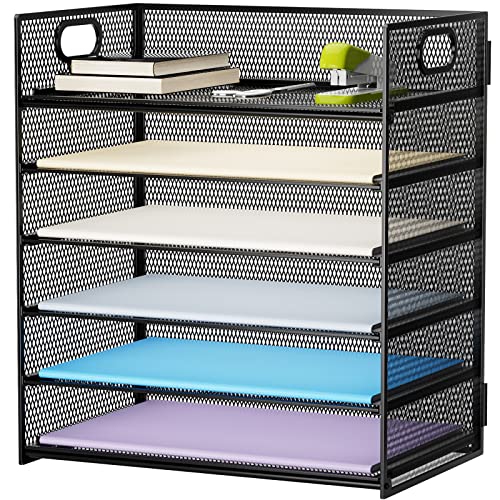
Best Overall — Marbrasse 6 Tier Paper Organizer Letter Tray, Mesh Desk File Organizer with Handle
Strengths
- Six tiers give a home office a complete visible workflow: inbox, action, waiting, file, pay and shred
- Mesh tiers let you read the top sheet of each stack without lifting anything, speeding up the daily desk reset
- The handle turns the whole workflow into one lift when the desk must become a table again
Trade-offs
- Open storage shows your paperwork to anyone in the room, so sensitive items must live elsewhere
- The footprint is that of a letter tray six times over; very small desks should take the five-tray pick instead
- Tiers collect dust in a way closed folders do not, and need an occasional wipe
| Format | Mesh desk letter tray / paper sorter |
|---|---|
| Tiers | 6 |
| Paper size | Letter / A4 |
| Carrying | Handle, per listing title |
| Colour in title | Black |
In a home office, the Marbrasse tray earns the top spot because it matches how desk work actually flows. Documents are rarely “filed” or “not filed”; they are waiting for a signature, waiting for a payment run, waiting for a colleague’s reply, or waiting for you to scan them. Six open tiers give each of those waiting states a physical address, and the address is visible from your chair. That visibility quietly replaces the sticky notes and mental reminders most home workers run on, and it makes the end-of-day reset a two-minute job: glance down the tiers, move what finished, and leave the rest exactly where tomorrow’s work expects it to be.
The mesh construction suits a workspace in practical ways. It is rigid enough that tiers do not bow under a ream’s worth of printouts, it tolerates the desk lamp’s warmth and the window’s sunlight without warping, and spilled coffee wipes off instead of soaking in. The handle is more than a convenience in a multi-use room: the entire sorting station lifts onto a shelf or the floor in one motion, documents undisturbed, which is the difference between a system that survives living in a shared home and one that gets dismantled in frustration and never rebuilt.
Its limits are the limits of openness. Client-confidential printouts, anything with account numbers, and anything you would not leave on a café table should pass through the tray quickly and into closed storage. The tray is the airport, not the vault: planes land, are processed, and depart into folders. Run it that way — nothing lives in a tier for more than a week — and it is the single most effective purchase in this guide. Let tiers become permanent storage and you have rebuilt the original pile at a slight vertical angle.
Best for: home workers who process paper in visible workflow stages / Not suited for: confidential documents or desks that need enclosed storage

Best Portable File — Amazon Basics Expanding Accordion File Organizer, Letter Size, 13 Compartments
Strengths
- Thirteen compartments absorb the household-admin paperwork that shares every home office desk
- Waterproof cover protects contents in kitchens and multi-use rooms where desks attract spills
- Stands upright on a shelf, so the office can be packed away visually at the end of the day
Trade-offs
- Utilitarian black styling will not elevate a carefully designed workspace
- No handle is named in the title, making it a shelf piece rather than a carry piece
- Household and work paper share one folder unless you discipline the labelling
| Format | Expanding accordion file organizer |
|---|---|
| Compartments | 13 |
| Paper size | Letter size |
| Cover | Waterproof, per listing title |
| Colour in title | Black, 1-pack |
Every home office runs two offices at once: the job, and the household that surrounds it. The Amazon Basics folder is the natural home for the second office — the insurance renewals, appliance warranties, tenancy or mortgage statements, school and medical letters that arrive at the same address and land on the same desk. Thirteen compartments take a twelve-month layout with one spare for standing documents, and the folder’s ability to stand upright means the household office can occupy fifteen centimetres of shelf while looking like a book rather than a pile, a small aesthetic mercy in a room you also live in.
The waterproof cover earns its keep in multi-use spaces. Home office desks host coffee, children’s drinks, watering cans for the desk plant and the occasional leaking pen, and a wipe-clean cover converts each of those from a paperwork disaster into a shrug. Capacity is honestly large: the expansion takes a fat month of statements in several sections at once while still closing, which matters because a folder that will not close gets left open, and a folder left open becomes a tray with delusions.
Keep work and household paper apart inside it with a simple rule: months run front to back for household bills, and the spare rear compartment holds the current work project only until it is scanned or filed with your employer’s systems. Blurring that boundary is how personal tax documents end up in a work audit trail and work printouts end up in a home insurance claim, both avoidable with one labelled divider’s worth of discipline.
Best for: the household-admin side of a home office desk / Not suited for: carrying between locations or storing originals securely

Best for Monthly Bills — Sooez Accordion File Organizer, 13-Pocket Expanding File Folders, Letter A4
Strengths
- Monthly divider tabs match the rhythm of bills, statements and payslips exactly
- Deeper pockets keep tab labels visible, so retrieval does not mean fanning every section
- Thickened cover gives the folder structure on an open shelf beside reference books
Trade-offs
- The calendar layout needs relabelling if you file by project rather than by month
- It duplicates much of the Amazon Basics pick’s role; most desks need one, not both
- Thirteen pockets cap out for households running a business from the same desk
| Format | Accordion file organizer, expanding |
|---|---|
| Pockets | 13 |
| Paper size | Letter / A4 |
| Dividers | Monthly divider tabs, per listing title |
| Cover | Thickened cover, per listing title |
Home office finances run on a monthly drumbeat — salary or client payments in, utilities and subscriptions out, statements reconciled at month end — and this Sooez folder is built on that exact drumbeat. The monthly divider tabs remove the one setup decision that stops people using a folder at all, and the deeper pockets solve the visibility flaw that undermines cheaper accordions: labels stay readable above the paper line, so “the October statement” is a five-second retrieval instead of a desk excavation. In a workspace where interruptions are constant, that difference decides whether filing happens in the moment or in a mythical later.
Freelancers and remote employees with expense claims will feel the benefit most. Keep receipts in the current month’s pocket as they occur, photograph them during the weekly reset described later in this guide, and month-end reporting becomes transcription rather than archaeology. The thickened cover helps the folder live open on the desk during busy weeks without collapsing, then stand tidily when the desk must look like a room again. Letter and A4 compatibility covers the payslips and contracts that arrive in both formats from international employers and clients.
Choose between this folder and the Amazon Basics on filing logic alone. Month-driven paperwork belongs here; category-driven paperwork belongs there. A home office with both patterns should put the monthly flow here and let the twenty-four-pocket pick below carry the standing categories, rather than buying two thirteen-pocket folders and splitting every habit across both.
Best for: monthly bills, statements and expense receipts in a home office / Not suited for: purely project-based filing without relabelling

Best Compact Tray — SUPEASY 5 Trays Paper Organizer Letter Tray with Handle
Strengths
- Five-tray footprint leaves working room on the small desks typical of spare-room offices
- Handle makes the daily pack-away of a multi-use desk genuinely one-handed
- Mesh trays suit shared home offices where two people’s paper must stay visibly separate
Trade-offs
- Five trays mean one workflow stage fewer than the six-tier alternative
- Open trays offer no privacy between household members sharing the desk
- Full trays of mixed letter and A4 can look scruffy on a video call background
| Format | Mesh desk letter tray with handle |
|---|---|
| Trays | 5 |
| Paper size | Letter |
| Settings named in title | Office, home, classroom, school |
Not every home office is a room. For the desk-in-the-bedroom, the kitchen-table workstation and the landing nook, the SUPEASY’s five trays are the realistic version of the tray idea: enough stages for inbox, action, waiting, file and shred, in a footprint that still leaves space for a laptop, a notebook and a mug. The handle is the detail that makes the concept work in a multi-use home, because the entire paper workflow can be lifted to a shelf at dinner time and returned, undisturbed, in the morning — a ritual that takes seconds and therefore actually happens.
Couples sharing one home office desk get particular value from the open format. Assign trays by person for the household layers — two trays each and one shared inbox — and the chronic “have you seen the letter from…” conversation mostly disappears, because the answer becomes a place rather than a search. The mesh build tolerates the shared-desk environment well: it wipes clean, does not crack when knocked off a crowded desk, and its contents can be assessed at a glance by either user without opening the other person’s storage.
Video-call tidiness is its one cosmetic caveat. Open trays in frame behind you display the spines of your paperwork life to colleagues; position the unit to the side of the desk rather than behind your chair, keep the top tray for blank paper or a notebook, and the problem is solved. Like its six-tier sibling, it is a processing station, not storage: the weekly habit of graduating finished paper into a folder is what keeps five trays sufficient month after month.
Best for: small or shared home office desks that pack away daily / Not suited for: private documents or anyone wanting six distinct workflow stages

Best for Big Categories — Sooez 24 Pockets Expanding File Folder, Letter/A4
Strengths
- Twenty-four pockets hold work projects and household categories in one shelf-standing unit
- Expandable cover accommodates uneven filling, so fat project pockets do not distort the rest
- Letter and A4 sizing covers international contracts, certificates and employer paperwork
Trade-offs
- Too wide and heavy when full to serve as a carry folder between rooms daily
- Demands a complete labelling session up front; half-labelled, it underperforms smaller folders
- Desktop format slumps if used nearly empty, so it suits established paper loads
| Format | Expanding accordion file folder |
|---|---|
| Pockets | 24 |
| Paper size | Letter / A4 |
| Cover | Expandable cover, per listing title |
| Colour in title | Black |
Some home offices outgrow the monthly pattern: a portfolio career, a renovation project, a property being sold, children in different schools, a parent whose paperwork you administer. Twenty-four pockets let you stop choosing between the calendar and categories and run both in one unit — months down one side, standing categories down the other — with the folder living permanently on the office shelf as a small, soft filing cabinet. The listing describes a desktop accordion format, and that permanence is the point: this is infrastructure, not luggage.
For home workers administering more than their own paper — a partner’s business receipts, an elderly parent’s medical and insurance letters, a family trust’s correspondence — the extra pockets convert directly into fewer “miscellaneous” sections, and miscellaneous is where retrieval goes to die. Give each responsibility its own labelled pocket, keep an index card in the first pocket listing what lives where, and another adult can operate the system in your absence, which is a genuine resilience feature for a household, not a nicety. Our guide to keeping digital copies alongside paper, How To Back Up Scanned Documents, pairs naturally with this pick for exactly those administered files.
The investment it asks is one honest hour of setup. Label all twenty-four pockets before filing a single sheet, in the plain words your household uses, and run one complete sort of the existing backlog into it. Skipping that hour is the only way to make this pick fail, because a wide folder with vague labels simply stores confusion more efficiently. Do the hour, and this is the last budget folder a complex household needs to buy.
Best for: complex households and portfolio home workers / Not suited for: light paper loads or daily portability
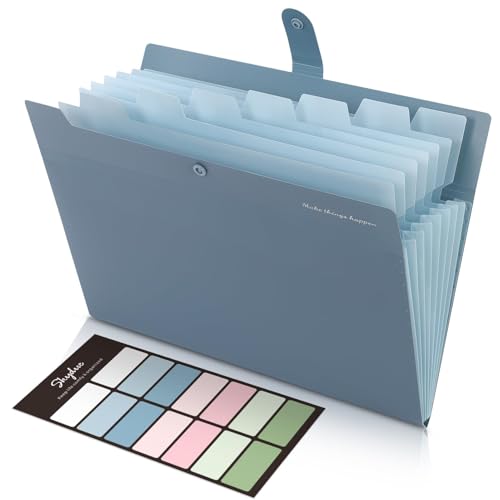
Best Grab-and-Go — SKYDUE Expanding File Organizer with 8 Pockets, Letter Size
Strengths
- Slim eight-pocket format slips into a laptop bag for meetings, site visits and appointments
- Included labels make it a complete carry file the day it arrives
- Small capacity enforces a ruthless “essentials only” selection that travellers benefit from
Trade-offs
- Cannot serve as the home office’s main archive; it is a satellite, not the base
- Eight pockets fill fast if you add projects instead of swapping them
- Single colourway in our verified sheet limits style choice
| Format | Expanding accordion file organizer |
|---|---|
| Pockets | 8 |
| Paper size | Letter size |
| Included | Labels, per listing title |
| Colour in title | Blue |
The SKYDUE’s role in a home office is to leave it. Hybrid workers who spend two days a week elsewhere, home-based professionals who visit clients, and anyone facing a season of appointments — solicitors, schools, hospitals, accountants — need a carry file that holds the essential documents for life outside the desk without becoming a second archive. Eight pockets is the right constraint for that job: identity copies, insurance summary, the current project’s key papers, the forms for the current errand, and room for what the day hands back to you.
Run it as a satellite with a docking habit. The folder lives in your bag or by the door; when you return, its contents are emptied into the tray system or the main folder the same evening, and the folder is restocked for its next outing. That empty-and-restock rhythm prevents the classic travel-file failure, where last month’s appointment letters, old tickets and three versions of the same form accumulate until the essential document hides among them. The blue colourway helps here in an unglamorous way: a distinctly coloured folder is harder to leave behind in a meeting room than another black rectangle.
Do not ask it to be more. It will not hold a year of anything, and pairing it with a desk system is the entire concept. As the portable edge of the under-$20 home office setup — tray for processing, big folder for storage, this for movement — it completes a system that covers how paper actually behaves in a working home.
Best for: hybrid workers and appointment-heavy seasons of life / Not suited for: main archive duties
Comparison Table
| Pick | Format | Capacity | Paper | Link |
|---|---|---|---|---|
| Marbrasse Letter Tray | Desk sorter | 6 tiers | Letter / A4 | Check on Amazon |
| Amazon Basics Accordion | Portable folder | 13 compartments | Letter | Check on Amazon |
| Sooez 13-Pocket | Portable folder | 13 pockets, monthly tabs | Letter / A4 | Check on Amazon |
| SUPEASY Letter Tray | Desk sorter | 5 trays | Letter | |
| Sooez 24-Pocket | Desktop folder | 24 pockets | Letter / A4 | |
| SKYDUE 8-Pocket | Portable folder | 8 pockets | Letter |
How to Choose the Best Document Organizer for a Home Office on This Budget
Map your desk’s paper traffic before you map products. For three days, notice where paper enters the workspace, where it waits, and where it ends up. Most home offices discover the same geography: entry at the printer and the door, waiting on the desk surface itself, and ending in a drawer that functions as a guilt repository. Buy for the waiting stage first — that is the tray — because unmanaged waiting is what makes a desk unusable. Then buy for the ending stage — the folder — sized to the categories you counted, not the categories you imagine. Entry takes care of itself once the other two stages exist, because paper with somewhere to go stops accumulating at the door.
Desk size is the second filter, and it is unforgiving. Measure the footprint you can genuinely surrender, remembering that a home office desk must also hold a laptop, a drink and the work itself. Six tiers suit a dedicated desk; five trays suit a shared or part-time one; a standing folder suits a desk that must clear completely every night. Choosing one size too large does not give you spare capacity — it gives you a reason to move the organizer off the desk, and an organizer off the desk is a system abandoned. The general version of this guide, Best Document Organizer Under $20, covers the same budget for whole-home filing if your desk turns out to need less than you feared.
Finally, separate the security question early. List the documents in your home office whose loss or exposure would cause real harm — signed originals, identity documents, confidential client material. None of them belongs in this tier, and designing the cheap system as if they do will distort every choice. Give those documents their own lockable home from a higher tier and let the trays and folders here do the high-volume, low-risk work they are genuinely excellent at.
What Does a $20 Home Office Organizer Need to Survive?
It needs to survive behaviour, not accidents. The threats to a home office organizer are a toddler treating tiers as stairs, a cat evicting a folder from its shelf, a partner “tidying” your waiting paper into a single mysterious stack, and your own Friday-afternoon urge to clear the desk by sweeping everything into the nearest drawer. Mesh trays survive the physical side of that list indefinitely; accordion folders survive it for years. The behavioural side is survived by placement and labelling: trays labelled by workflow stage resist being tidied into oblivion, because the labels explain the system to the tidier, and a folder that stands visibly on the shelf resists becoming the drawer’s hidden shame.
There is also a quieter survival test: the system must survive your busiest week, not your tidiest one. During a deadline crunch, a house move or a family emergency, nobody files beautifully — paper gets thrown at the organizer from a standing position, mid-task, with one hand. A tray catches that throw and holds it visibly for later; a folder with labelled pockets forgives it at the next reset. An organizer that only works when you have time to be careful is a hobby, not a tool, and the picks in this guide were chosen because they degrade gracefully under real pressure and recover in a single fifteen-minute session when the pressure passes.
Expect to replace folders eventually and trays almost never. That asymmetry argues for spending the folder half of the budget on the design whose labels stay visible and whose cover wipes clean, since those are the features that will still matter in year three, and treating the tray as permanent furniture from day one. A home office set up on that basis costs less over five years than a sequence of fashionable organizers bought annually in the hope that the next one will finally impose the discipline that only a weekly reset can impose.
How Do You Run a Weekly Paper Reset in a Home Office?
Pick a fixed slot — Friday’s last fifteen minutes of work is ideal — and work the system in one direction only. Start at the tray: anything in the inbox tier gets actioned, filed or shredded on the spot; the action tier gets reviewed and honestly re-dated rather than merely re-stacked; the waiting tier gets a chase message sent for anything older than a week. Then open the folder and file what the tray released, moving last month’s completed section into the archive envelope and photographing or scanning anything that needs a digital copy. Problem: the tray’s action tier never empties — fix by splitting it into “action by me” and “action by someone else”, because the second pile was never yours to clear. Problem: scanning keeps being postponed — fix by pairing the reset with the scanner workflow in How To Scan A Document With A Printer, so paper and digital filing finish in the same sitting.
Close the reset by returning the desk to its neutral state: tray tiers holding only live paper, folder standing on the shelf, shredding bag emptied. The neutral state is the product. A home office that returns to neutral weekly never develops the archaeological layers that make people dread their own desks, and the organizer — tray, folder, or the pair — earns its money in the meetings that start on time because the document was exactly where the system said it would be.
How Do You Organize a Home Office Desk That Your Family Shares?
A shared desk adds a political problem to the paper problem: your workflow stages are someone else’s clutter, and their important letters are your visual noise. The workable settlement is territorial and visible. Divide the tray by person rather than by task for the household layers — the top two tiers belong to one adult, the next two to the other, the bottom tier is the shared inbox where anything unaddressed or joint lands — and keep work paper in the folder system rather than the family tray wherever confidentiality allows. Territory removes negotiation: nobody has to ask where a document goes, and nobody’s “tidy” impulse can legally cross into another person’s tiers.
Children require a simpler treaty. School paper should never enter the office tray at all, because it arrives daily, multiplies silently and belongs to a rhythm the office does not share. Give it a tray or folder of its own in the room where school bags are emptied, and let the office system stay adult. The same logic applies to the household’s shared printer, which is the secret source of half the paper in most home offices: printouts that nobody claims should have a standing rule — unclaimed after forty-eight hours, they are recycled — enforced by the tray’s bottom tier acting as a visible countdown. A rule everyone can see is a rule nobody has to police.
Protect the settlement with one shared index. A single card, kept in the shared inbox tier, listing where the household’s categories live — which folder, which pocket, which shelf — means any adult can file or retrieve without interrogating the system’s inventor. That card is also the household’s quiet insurance policy: if the person who built the system is travelling, ill or simply out, the paperwork of the home continues to function. Home offices built by one person and understood by one person fail at exactly the moments a household can least afford.
Where Do Printer Paper, Cables and Supplies Fit in the System?
Blank paper is a document organizer’s silent partner, and it deserves a deliberate home rather than the printer’s own tray plus a ream balanced on a shelf. Keep the current ream in the bottom tier of the desk tray or standing in the largest folder’s rear pocket if your printer sits away from the desk; the point is that blank stock, printed output and filed documents form one visible circuit on the desk instead of three unrelated piles. Envelopes, labels and stamps belong in the same circuit — one tray tier or one folder pocket labelled “post” — because the moment a finished letter must wait for an envelope hunt, it becomes a resident of the desk rather than a traveller through it.
Supplies that generate paper deserve the same thinking. The shredder, even a small one, should live within arm’s reach of the tray’s shred tier; a shredder in another room converts every shred decision into a postponement, and postponed shredding is how sensitive paper ends up in household recycling. Scissors, a stapler and a hole punch are not documents, but they are the tools that decide whether paper enters the system neatly, and a single small drawer or tray tier for them keeps the reset ritual frictionless. Friction, in the end, is the true subject of this entire guide: every pick and every habit recommended here exists to remove one small reason why a document might be put down unsorted, one more time, on a desk that deserved better.
What If Your Home Office Is Temporary, Rented or Moving Soon?
Home offices in rented homes and short lets have one extra constraint: nothing can be fixed to walls, and everything may need to move at a few months’ notice. The tray-and-folder system in this guide is unusually well suited to that life, because none of it installs, drills or adheres to anything. The whole paper infrastructure of a household — tray, folders, archive envelopes — packs into a single moving box, and the index card that maps the system travels on top, so the office can be rebuilt in a new room in one evening, identical to how it worked in the old one. Compare that with fitted shelving or a heavy filing cabinet, which either stays behind or dominates the moving van, and the budget tier’s portability stops looking like a compromise.
Frequent movers should weight the picks slightly differently. Favour the folders over the trays, since folders protect their contents in transit while trays must be emptied into something for a move; favour the waterproof cover, because boxes ride in vans and garages where weather and spills are real; and keep the travel folder stocked as a documents-in-hand file, so passports’ copies, tenancy agreements, insurance details and medical summaries move with you personally rather than in the truck. A household that moves often learns to keep its paper system small enough to carry and clear enough to rebuild — exactly the virtues this tier was chosen for.
Common Mistakes
Home office buyers most often mistake storage for workflow, buying a big closed folder to hide a problem that was actually about processing, and discovering that hidden paper misses deadlines just as thoroughly as visible paper. The second mistake is mixing household and work documents in one unlabelled run of pockets, which creates real risk when an employer’s audit, a tax query or a house move asks for one set and not the other. Third comes the video-call shelf: open trays placed in camera view, displaying confidential spines to colleagues. Fourth is buying the tray and the folder in the wrong order — folder first, so the desk pile persists while the archive looks lovely. Fifth is letting the pack-away ritual die: a multi-use desk whose organizer cannot be lifted away intact will be cleared by hand exactly once, into a bag, forever.
Final Recommendation
Start with the Marbrasse six-tier tray if your desk is dedicated, or the SUPEASY five-tray version if it is shared, because visible workflow is the home office problem. Add the Sooez thirteen-pocket folder for monthly financial paper, or the twenty-four-pocket version if your household’s categories overflow a calendar, and keep the SKYDUE as the travel satellite if your work leaves the house. That combination, honestly labelled and reset weekly, is a complete home office paper system for the price of a team lunch. When you are ready to give the originals inside it a lockable home, step up to Best Document Organizer For Home Office Under $50, where folio and fire-oriented folders enter the picture. Until then, resist upgrading the working layer out of restlessness: a clearer desk, a findable statement and a calm Friday reset are the returns this tier promises, and by those measures the system above is already complete.
Frequently Asked Questions
Should a home office organizer be open or closed?
Both, in sequence. Open trays handle paper that still needs decisions, because visibility prevents missed deadlines. Closed folders handle finished paper, because they protect it and clear the desk. A system with only one of the two either hides deadlines or drowns the workspace.
How do I keep work and household documents separate?
Give them different physical homes: a tray workflow for work-in-progress, a folder with monthly pockets for household finance, and a strict rule that the spare compartment is the only crossover. If you run a business from home, use the dedicated small-business guide rather than stretching a household system.
Can these organizers hold confidential work documents?
They can hold them physically but not securely. Nothing in this tier locks. Confidential client material and signed originals should pass through the tray quickly and live in lockable storage; the budget system is for working copies and everyday administration.
What if my desk has to be cleared every night?
Choose the five-tray SUPEASY with its handle, or a standing accordion folder, and make the pack-away a single lift onto a shelf. Systems that require dismantling get dismantled once and never rebuilt; systems that lift away intact survive for years in multi-use rooms.
Do I need a scanner as well as an organizer?
For most home offices, yes as a habit rather than a purchase: photograph or scan documents during the weekly reset so the paper folder is never the only copy of anything important. The organizer manages the physical originals; the scans insure them.
How many folders does a home office need?
Usually one working folder plus one travel folder at most. Resist the urge to give every project its own folder at this scale: projects belong in labelled pockets inside the working folder, where they share one home and one index, and only a project that will genuinely leave the house — to an accountant, a solicitor or a site — earns the travel folder for the duration of that trip. A monthly folder for finance and household administration covers the bulk; add the twenty-four-pocket design only when standing categories — projects, properties, administered relatives — genuinely exceed what monthly pockets can hold.
When is it worth spending more than $20?
When the documents change, not when the desk does. If you begin holding signed originals, client-confidential files or identity documents at home, the lockable and fire-oriented tiers become worth it. For working paper, this tier’s trays and folders remain the right tool at any income.