Disclosure: As an Amazon Associate, reviewstook.com earns from qualifying purchases. Links on this page are affiliate links at no extra cost to you; prices and availability change frequently, so check Amazon for the latest.
Where to Buy the Best Document Organizer Under $20
Use the links below to check the latest price on Amazon for every pick in this guide to the best document organizer under $20. Each name link and each check link goes to the same verified listing, so you can confirm pocket counts, sizes and colour options before you decide. Purchases made through links on reviewstook.com support our testing and writing at no extra cost to you.
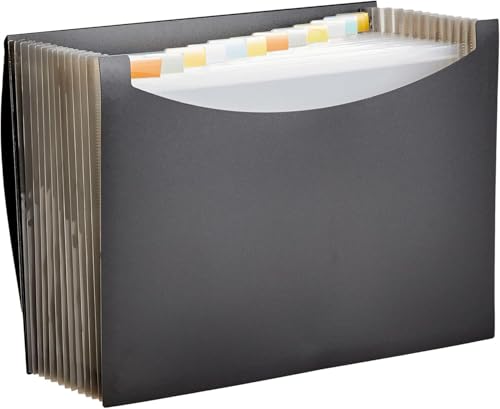
- Best Overall: Amazon Basics Expanding Accordion File Organizer — Check on Amazon
- Best Budget: SKYDUE Expanding File Organizer with 8 Pockets — Check on Amazon
- Best for Large Collections: Sooez 24 Pockets Expanding File Folder — Check on Amazon
- Best for Label Visibility: Sooez Accordion File Organizer, 13-Pocket — Check on Amazon
- Best Desk Sorter: Marbrasse 6 Tier Paper Organizer Letter Tray — Check on Amazon
- Best Compact Desk Tray: SUPEASY 5 Trays Paper Organizer Letter Tray — Check on Amazon
Finding the Best Document Organizer Under $20 Without Buying Twice
If you are shopping for the best document organizer under $20, you are probably not trying to build an archive. You are trying to stop one specific pile — the tax forms on the kitchen counter, the school letters in a tote bag, the receipts multiplying inside a drawer — from swallowing documents you will need on a specific day. That modest goal is exactly what this price tier does well, provided you match the format to the job. Under twenty dollars the honest choice is between portable accordion folders that travel and stand on a shelf, and open desk trays that sort paper you touch every day. Nothing in this tier locks, nothing here is a fire product, and we will not pretend otherwise anywhere in this guide.
The six picks below split deliberately across those two jobs. Four are expanding accordion folders with labelled pockets, sized for letter and A4 paper, that close up and move with you. Two are mesh desk trays that stay put and turn an incoming-paper problem into a visible, sorted queue. Many households genuinely need one of each: the tray catches paper the day it arrives, and the accordion folder is where finished categories go to live. Buying both still fits the spirit of this budget tier far better than buying one expensive-feeling folder that does neither job especially well, and the detailed reviews explain which half of that system each pick serves.
One more framing note before the picks. Paper organization fails for predictable reasons that have nothing to do with build quality: too few pockets for the number of categories in your life, labels you cannot read at a glance, and a folder that lives somewhere inconvenient, so paper gets stacked on top of it instead of filed inside it. Every review below therefore talks about pocket count, label visibility and where the organizer will physically sit in a real home, because those three things — not plastic thickness — decide whether a cheap organizer is still being used in six months. If your documents include originals you could not replace, such as deeds or passports, also read our companion guidance on protecting paperwork at home, and consider stepping up to the fire-oriented options in Best Document Organizer Under $50 once the basic system is working.
In this guide
Quick Picks
- Best Overall: Amazon Basics Expanding Accordion File Organizer — Thirteen compartments, waterproof cover and the simplest possible labelling system for a household starter file.
- Best Budget: SKYDUE Expanding File Organizer with 8 Pockets — Eight pockets is the right size for one person’s bills, school or medical paperwork, with labels included.
- Best for Large Collections: Sooez 24 Pockets Expanding File Folder — Twenty-four pockets swallow a full year of monthly categories without doubling up sections.
- Best for Label Visibility: Sooez Accordion File Organizer, 13-Pocket — Deeper pockets keep the monthly divider tabs visible instead of buried behind paper.
- Best Desk Sorter: Marbrasse 6 Tier Paper Organizer Letter Tray — Six open mesh tiers sort incoming paper by person or project on the desk itself.
- Best Compact Desk Tray: SUPEASY 5 Trays Paper Organizer Letter Tray — Five trays with a carry handle for smaller desks, classrooms and shared workspaces.
How These Picks Were Chosen
Every candidate for this guide was checked against the site’s Creators API verification sheet for this cluster: the brand, the exact listing title and the ASIN all had to match before a product could be linked here. That process matters at this price point more than shoppers expect, because the budget accordion market is full of near-identical listings. Colour variants of the same folder were treated as one product, not as separate picks, so you will never see the same model recommended twice in this guide wearing a different colour. Where a listing’s title described a different product class entirely — a locking box, a fire product, a piece of furniture — it was excluded from this tier no matter how attractive it looked, because recommending it here would break the budget promise in the title of this article.
The class filter for the under-$20 tier was strict. Eligible products were basic expanding accordion folders for portable storage, and mesh letter trays for desk sorting, because those are the two document organizer formats that genuinely live at this level. Fireproof folders, locking document boxes and binder folio systems were all pushed up to the tiers where their construction belongs, rather than being squeezed into a budget list on the strength of a temporary discount. Prices move constantly, and this site never prints a fixed price for a product; the tier describes the class of product you should be shopping, and the links let you confirm today’s figure yourself.
Within the eligible class, we ranked by usable capacity rather than headline capacity. A pocket count only helps if the pockets expand enough to hold real paper without the folder refusing to close, and a tray only helps if letter paper sits flat without curling over the edges. Label systems were weighted heavily, because an unlabelled accordion folder becomes a junk drawer with dividers within a month. Finally, we favoured designs a first-time organizer buyer cannot really misuse: no assembly beyond clipping on a handle, no proprietary refill ecosystem required, and nothing that needs a specific brand of hanging folder to work as described.
Detailed Reviews: Six Organizers That Earn a Sub-$20 Budget

Best Overall — Amazon Basics Expanding Accordion File Organizer, Letter Size, 13 Compartments
Strengths
- Thirteen compartments map cleanly onto twelve months plus a miscellaneous section, the labelling scheme most households actually maintain
- Waterproof cover shrugs off the coffee spills and counter splashes that kill cardboard and fabric folders
- Large capacity expansion means the folder still closes when several sections hold a fat month of statements
Trade-offs
- Plain black styling is purely functional; it will not be the prettiest object on an open shelf
- No handle is mentioned in the listing title, so carrying it by hand is a two-finger pinch rather than a proper grip
- Thirteen sections can feel like too many for a single person with simple paperwork, tempting you to invent categories you do not need
| Format | Expanding accordion file organizer |
|---|---|
| Compartments | 13 |
| Paper size | Letter size |
| Cover | Waterproof, per listing title |
| Colour in title | Black, 1-pack |
The Amazon Basics accordion folder is the pick we hand to someone who has never owned a document organizer and wants the decision to be over. Its thirteen compartments are not a marketing flourish; they correspond to the way household paper actually accumulates, which is monthly, with a residue of documents — warranties, insurance summaries, lease copies — that belong to no month at all. Set the tabs up once, in January order with the last pocket reserved for that residue, and the system explains itself to anyone else in the house who needs to file or find something. That self-explaining quality is what separates an organizer that gets used from one that gets admired for a week.
In daily use the waterproof cover is the quiet hero. Budget folders live in kitchens, entryways and car footwells, all places where a splash is a matter of time, and a cover that wipes clean keeps the contents safe from the minor accidents that ruin paper long before fire or flood enter the picture. The expansion is generous enough that the folder stands upright on a shelf when moderately filled, which matters because a folder that must lie flat ends up under other things, and a folder under other things stops being filed into. Standing storage, visible at eye level, is a behavioural feature disguised as a physical one.
The honest limitation is ambition. This is a sorting tool, not a security product: it has no lock, no fire-oriented construction and no structure that would protect originals you cannot replace. Treat it as the working layer of a home paper system — the place current-year documents live while they are active — and let genuinely irreplaceable papers graduate to a higher tier of storage, the route we map in Best Document Organizer Under $150. For renters, first apartments and anyone digitizing gradually while keeping paper backups, it is the most sensible first purchase in this entire cluster of guides.
Best for: households setting up their first monthly filing system / Not suited for: originals that need lockable or fire-oriented storage
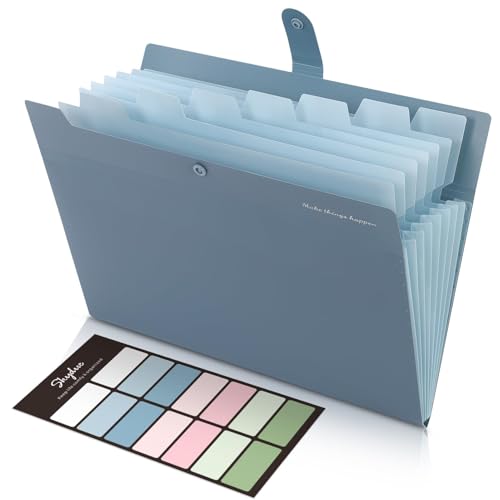
Best Budget — SKYDUE Expanding File Organizer with 8 Pockets, Letter Size
Strengths
- Eight pockets force a short, honest category list, which is the single best predictor of a filing system surviving the year
- Labels are included, so the folder is a working system the day it arrives rather than after a second purchase
- Compact expansion makes it genuinely portable between home, school and office bags
Trade-offs
- Eight sections will not stretch to a twelve-month scheme; monthly filers should step up to a thirteen-pocket design
- The smaller capacity fills quickly if you file bulky items such as thick insurance booklets
- One colourway is listed for this model in our verified sheet, so style choice is limited
| Format | Expanding accordion file organizer |
|---|---|
| Pockets | 8 |
| Paper size | Letter size |
| Included | Labels, per listing title |
| Colour in title | Blue |
The SKYDUE eight-pocket folder makes a case that most organizing advice gets backwards: fewer sections, honestly used, beat many sections, vaguely used. Eight pockets suit a category system — bills, bank, medical, school, work, home, vehicles, miscellaneous — far better than they suit a calendar system, and category filing is what most single adults and students actually maintain. Because the folder is small, it lives where paper arrives: in a backpack, on a hall table, in the passenger footwell during a move. Proximity is everything. A document organizer that is in the room where mail gets opened will be used; one stored in a closet across the apartment will be visited monthly at best, with a stack of unsorted paper carried to it like a chore.
Receipts are this folder’s second natural job. The listing title names bills and receipts explicitly, and the pocket depth handles the small-paper problem better than a big folder does, because narrow expansion keeps slips from sliding sideways and vanishing between sections. Sort receipts by month within two pockets if you track spending, or by store if you mostly need them for returns and warranties. Either way, the end-of-year tax envelope becomes a transfer job rather than an archaeology project, which is the moment a budget organizer pays for itself in an evening not spent on the floor surrounded by paper.
Its ceiling is equally clear. A family with children in two schools, a rental property or a side business will outgrow eight pockets before spring, and cramming two categories into one pocket is where filing systems go to die. Buy this folder for one person’s paperwork or one defined project — a house purchase, a visa application, a school year — and it is close to perfect. Ask it to be a whole household archive and you will be shopping again, probably for the thirteen- or twenty-four-pocket designs reviewed alongside it here.
Best for: one person’s category filing, receipts and school paperwork / Not suited for: twelve-month household archives or multi-person filing

Best for Large Collections — Sooez 24 Pockets Expanding File Folder, Letter/A4
Strengths
- Twenty-four pockets allow a month-plus-category hybrid system without any pocket doing double duty
- Expandable cover design keeps the folder’s footprint shelf-friendly even as sections fill unevenly
- Letter and A4 compatibility suits households with mixed US and international paperwork
Trade-offs
- A fully loaded twenty-four-pocket folder is heavy and wide; it is a shelf resident, not a daily carry
- More pockets mean more labelling discipline required on day one, or the advantage evaporates
- The desktop accordion format stands best when reasonably full, so a nearly empty one can slump
| Format | Expanding accordion file folder |
|---|---|
| Pockets | 24 |
| Paper size | Letter / A4 |
| Cover | Expandable cover, per listing title |
| Colour in title | Black |
Twenty-four pockets change the kind of system you can run. Instead of choosing between months and categories, you can have both: twelve pockets for the monthly flow of statements and bills, and twelve for standing categories such as medical records, school documents, vehicle papers, insurance, tax returns by year, warranties, and the household’s identity-document copies. The Sooez folder’s listing describes a desktop accordion format, and that is the right mental image — this is a small filing cabinet that happens to be made of flexible material, designed to live open or upright on a desk or shelf where its full width is an asset rather than an inconvenience.
The A4 compatibility deserves a mention because it is easy to overlook until it matters. Households with any international dimension — immigration paperwork, overseas school or employer documents, foreign property or banking records — routinely hold A4 sheets that are slightly taller than US letter. In a letter-only folder those sheets peek above the dividers, catch on everything and get their corners folded. A folder that swallows both sizes without complaint removes a small, constant friction that otherwise trains people to leave the international paperwork in a separate, unsorted pile, which is precisely how important documents get lost.
Discipline is the price of admission. Label all twenty-four pockets before the first sheet goes in, write the labels in the vocabulary you actually use — the folder should say “Car” if that is what your family calls it, not “Automobile” because it looks tidier — and resist creating a pocket for anything that arrives less than twice a year. Follow those rules and this is the closest thing in the budget tier to a permanent system. Ignore them and you have bought a wider junk drawer. The folder cannot tell the difference; only the labelling session can.
Best for: hybrid month-and-category systems and mixed letter/A4 households / Not suited for: daily carrying or buyers who will not label pockets up front

Best for Label Visibility — Sooez Accordion File Organizer, 13-Pocket Expanding File Folders, Letter A4
Strengths
- Deeper pockets keep labels visible, solving the most common complaint about accordion folders in one design decision
- Monthly divider tabs are built into the concept, so the twelve-month system needs no separate tab purchase
- Thickened cover gives the folder more shelf presence and structure than flimsy budget rivals
Trade-offs
- The monthly framing is a nudge toward calendar filing; category filers will relabel some tabs
- Deeper pockets add a little bulk compared with the slimmest eight-pocket designs
- It overlaps heavily with the Amazon Basics pick, so choose on label visibility rather than buying both
| Format | Accordion file organizer, expanding |
|---|---|
| Pockets | 13 |
| Paper size | Letter / A4 |
| Dividers | Monthly divider tabs, per listing title |
| Cover | Thickened cover, per listing title |
There is a specific, maddening failure mode in cheap accordion folders: you file a document, close the folder, and later cannot tell which pocket holds it because the paper inside sits higher than the labels, hiding them completely. You end up fanning through every section like a deck of cards, and after the third time you stop filing altogether. This Sooez design attacks exactly that failure. The listing title calls out deeper pockets that keep labels visible, and that single specification is worth more in real use than an extra handful of pockets, because a filing system you can read at a glance is a filing system you will actually consult.
The monthly divider tabs reinforce the same point. Bills, statements and school letters are retrieved by date far more often than by any other key — “the March electric bill”, “last term’s report” — and a folder whose skeleton is the calendar matches that retrieval habit without any setup thought at all. The thickened cover helps the folder stand and keep its shape on a shelf, which again is about behaviour: a folder that looks like a fixture gets treated like a fixture, while one that flops gets moved, stacked on and forgotten.
Choose between this and the Amazon Basics folder on one question: how will you file? If your household runs on months, this is the better buy. If your household runs on categories and you want the plainest possible large-capacity folder, the Basics design is the better buy. Buying both to “have options” is the classic budget-tier mistake, because two half-used systems are worse than one fully used system, and the second folder’s pockets will quietly become the new junk drawer.
Best for: monthly filers who retrieve documents by date / Not suited for: buyers who want the absolute slimmest carry folder

Best Desk Sorter — Marbrasse 6 Tier Paper Organizer Letter Tray, Mesh Desk File Organizer with Handle
Strengths
- Six open tiers make the state of your paperwork visible at a glance, which is the entire point of a desk sorter
- Mesh construction is rigid, wipe-clean and indifferent to the sunlight that warps cheap plastic trays
- A handle lets the whole sorting station move between desk, table and shelf as a unit
Trade-offs
- Open tiers protect nothing: no privacy, no dust cover, no security for sensitive documents
- It sorts paper on a desk but stores nothing portably, so it complements rather than replaces a folder
- Six tiers invite six vague piles unless you label the tiers as strictly as folder pockets
| Format | Mesh desk letter tray / paper sorter |
|---|---|
| Tiers | 6 |
| Paper size | Letter / A4 |
| Carrying | Handle, per listing title |
| Colour in title | Black |
The Marbrasse tray solves the opposite problem from the folders above. Folders hide paper away in finished categories; this tray manages paper that is still in motion — the mail that arrived today, the form awaiting a signature, the printouts for tomorrow’s meeting. Six tiers is enough for a genuinely useful desk taxonomy: act now, file this week, awaiting someone else, bills to pay, one tier per household member, or one tier per project for anyone juggling several. Because the tiers are open and visible, the tray functions as a to-do list you can see from across the room, and an empty tier is a small, repeatable victory that a closed folder can never give you.
Placement advice for this pick is specific: it belongs on the desk where paper first lands in your home, not in a study you visit twice a week. In most homes that means a kitchen worktop edge, a hall console or the corner of a dining table that has become the household’s informal office. The handle matters here more than it first appears, because a sorting station that can be lifted away intact when the table is needed for dinner will survive in a shared home, while one that must be dismantled will be dismantled exactly once. Label the front edge of each tier with tape or a label maker; unlabelled tiers collapse into “top pile, second pile” within days.
Be clear about what it is not. A mesh tray is the wrong home for anything private, anything original and anything that must survive the month, let alone an emergency. Its job in a complete system is the first forty-eight hours of a document’s life. After that, paper graduates into an accordion folder for the year and, for the small set of documents that truly matter, onward into the lockable storage discussed in Best Document Organizer Under $75. Judged as that front door, the Marbrasse is the strongest desk pick in this tier.
Best for: visible sorting of incoming paper for a household or small desk / Not suited for: private, original or long-term document storage

Best Compact Desk Tray — SUPEASY 5 Trays Paper Organizer Letter Tray with Handle
Strengths
- Five trays fit smaller desks where a six-tier unit crowds out working space
- Mesh build with a handle suits classrooms and shared desks where the sorter gets moved and wiped often
- Open design lets teachers, parents and housemates see whose paper is waiting without opening anything
Trade-offs
- One fewer tray than the Marbrasse means one fewer live category on the desk
- Like all open trays it offers no privacy or protection for the documents it holds
- Letter-size trays hold A4 per the listing’s classroom framing, but very full trays of mixed sizes look untidy fast
| Format | Mesh desk letter tray with handle |
|---|---|
| Trays | 5 |
| Paper size | Letter |
| Settings named in title | Office, home, classroom, school |
The SUPEASY tray is the Marbrasse idea tuned for tighter spaces and shared settings. Five trays map neatly onto the rhythms of a school or classroom — one per weekday, one per class, one per child in a homeschool setup — and the listing title names classrooms and schools explicitly, which matches the design: mesh that wipes clean, a handle for moving the whole unit between rooms, and open trays that let thirty small people find their own worksheet without a lesson in filing. At home it suits the small desk in a bedroom corner, the student desk in a shared flat and the kitchen command corner where space is measured in centimetres.
Compared directly with the six-tier pick, the trade is honest: you lose one live category and gain a footprint that leaves room to actually work beside the sorter. For most single-desk households that is the right trade, because a sorter that consumes the desk becomes the desk’s problem rather than its solution. Set the trays up as a flow rather than as storage — in, in progress, done and awaiting filing, to pay, to shred — and empty the “done” tray into a folder weekly. A tray used as flow stays useful; a tray used as storage becomes five horizontal junk drawers stacked in the open.
Parents managing school paper will get the most from this pick. Permission slips, reading logs and report cards each get a visible home, children can be taught to use the top tray as the family inbox, and the Friday clear-out takes minutes because everything awaiting action is already separated from everything merely awaiting filing. Pair it with the SKYDUE folder for each child’s finished school year and you have a complete, genuinely cheap school-paper system — the combination we recommend again in the student-focused guide at Best Document Organizer For Students Under $20.
Best for: small desks, classrooms and family school-paper stations / Not suited for: anyone needing enclosed or private document storage
Comparison Table
| Pick | Format | Capacity | Paper | Link |
|---|---|---|---|---|
| Amazon Basics Accordion | Portable folder | 13 compartments | Letter | Check on Amazon |
| SKYDUE 8-Pocket | Portable folder | 8 pockets | Letter | Check on Amazon |
| Sooez 24-Pocket | Desktop folder | 24 pockets | Letter / A4 | Check on Amazon |
| Sooez 13-Pocket | Portable folder | 13 pockets, monthly tabs | Letter / A4 | |
| Marbrasse Letter Tray | Desk sorter | 6 tiers | Letter / A4 | |
| SUPEASY Letter Tray | Desk sorter | 5 trays | Letter |
How to Choose the Best Document Organizer Under $20 for Your Paper Habits
Start with movement, not capacity. Ask where your unsorted paper physically appears — a kitchen counter, a backpack, a desk, a car — and buy the organizer that lives at that exact spot. Paper that must travel to its organizer will not be filed; it will be stacked, and the stack will become the system. Portable accordion folders win when paper arrives in several places or must move between home and somewhere else. Desk trays win when paper arrives in one place and needs decisions more than it needs storage. Households with both patterns, which is most households, should split the budget across one of each rather than doubling down on a single format and wondering why half their paper still ends up in a pile.
Next, count your real categories before you count pockets. Write down, honestly, the groups of paper you kept last year and needed again. Most single adults land between six and nine; most families land between twelve and twenty. Buy the pocket count that covers your list with one spare pocket for the category you forgot, and no more. Excess pockets do not create capacity, they create ambiguity, and ambiguity is where documents go to be lost politely. The same arithmetic applies to trays: a tier per live workflow, not a tier per vague intention. If you cannot name a tier’s job in three words, you do not need the tier.
Finally, decide what this purchase is not doing. A sub-$20 organizer does not lock, does not protect originals from fire or water beyond a splash-resistant cover, and does not substitute for scanning. The healthiest budget setup treats this tier as the working layer of a three-layer system: trays and folders for active paper, scans for backup, and a higher tier of storage — explored in Best Document Organizer Under $200 — for the short list of originals whose loss would genuinely hurt. Buying the working layer well, and knowing its limits, is what this budget is for.
What Does a $20 Budget Actually Buy in Document Storage?
It buys honest plastic, mesh and card, assembled into shapes that impose order — and nothing beyond that. There is no meaningful security at this level, no verified fire performance, and no hardware that will survive being stood on. What there is, used well, is a surprising amount of behavioural leverage. A labelled pocket is a decision made once instead of monthly. An open tray is a reminder that works without batteries or notifications. The return on a cheap organizer is measured in evenings not spent searching, and that return is available in full at this price, which is why we resist the upsell for working paper while insisting on it for irreplaceable originals.
Durability expectations should be set accordingly. An accordion folder in daily service will typically serve a few school or tax years before its expansion gussets tire; a mesh tray will outlast several folders because it has no moving parts at all. Neither outcome is a failure. Plan to treat folders as consumables with a multi-year life, transfer the labels and the system to the replacement, and keep the tray as the permanent furniture of the system. That rhythm — permanent sorter, renewable folders — is the cheapest stable configuration we know for household paper.
How Do You Set Up a Filing System That Survives the Year?
Set the system up in one sitting, before any paper goes in. Label every pocket or tier, using the words your household actually says, and write a one-line index on the inside cover or a card in the top tray: which pocket holds what, and what never belongs here at all. Then run a single sorting session with every loose document you own, filing each one or consciously discarding it, so the system starts complete rather than aspirational. A system that begins half-empty invites the old pile to persist beside it, and two competing systems guarantee that the document you need is always in the other one.
Maintain it with a weekly ten-minute pass, ideally attached to an existing habit — after the weekly shop, during a Sunday reset, while a regular call runs. Move tray paper into folders, move finished folder categories into the year’s archive envelope, and shred the true junk while it is still obviously junk. Problem: a pocket is overflowing while others sit empty — fix by splitting that category by year or by person, not by cramming harder. Problem: documents are landing on top of the folder again — fix by moving the folder to where the documents land, not by resolving to try harder. Every filing failure we have seen is a placement or labelling failure wearing a discipline costume.
How Do You Organize Paperwork for Taxes, School and Medical Records on a Budget?
Taxes are the annual stress test of any cheap system, and the trick is to stop treating tax paperwork as a January problem. Keep one pocket — in a thirteen-pocket folder, the spare pocket you did not assign to a month is perfect — labelled for the current tax year, and drop every relevant arrival into it as it lands: the wage statements in January, yes, but also the charity receipts in June, the childcare invoices in September and the property documents whenever they appear. When filing season arrives, that pocket is the return, already sorted by arrival rather than by panic. The previous year’s pocket graduates into a labelled envelope in a drawer, and the folder simply rolls forward. Nothing about this requires software, an app or a second product; it requires only that the tax pocket exist before the first document for it arrives.
School paperwork rewards a per-child rather than per-subject split. One folder, or a defined run of pockets, per child keeps report cards, permission histories, health forms and achievement certificates in the single place you will look when a school office asks for any of them, usually with one day’s notice. At the end of each school year, spend ten minutes thinning that child’s section: keep the final report, the health record and anything sentimental enough to survive an honest look, and recycle the worksheets and routine notices without guilt. A school archive that grows by one slim layer a year stays findable; one that keeps everything becomes a box you dread opening, and dread is the enemy of every filing system ever sold.
Medical paperwork is the third load a budget organizer carries surprisingly well, provided it is organized by person and then by provider rather than by date alone. Insurance summaries, explanation-of-benefits letters and prescription records are retrieved when a bill is disputed, and disputes are always about a specific person and a specific provider. Two pockets per person — insurance in one, bills and statements in the other — will resolve most disputes from the folder alone. Keep genuinely sensitive originals, such as medical power-of-attorney documents, out of this working layer entirely and in the lockable storage your household uses for originals; the budget folder should hold the copies you consult, not the instruments you would need a lawyer to replace.
The thread connecting all three loads is rhythm. Taxes are annual, school is termly, medical is episodic, and a cheap organizer handles all of them if paper enters the system when it arrives and leaves on the schedule of its own category. Set those three rhythms up on day one — tax pocket, per-child sections, per-person medical pockets — and the sub-$20 system described in this guide will carry a household further than most people expect, reserving higher tiers of spending for the one job this tier cannot do: protecting originals.
Common Mistakes
The first mistake is buying capacity instead of fit: the biggest folder on the shelf, filled with categories invented to justify its pockets, abandoned by March. The second is filing originals — deeds, titles, certificates — in the same open or flimsy storage as everyday paper, because the system was convenient; convenience is not protection, and those documents deserve the lockable tier. The third is skipping labels on the theory that you will remember the order, a theory that survives exactly until another person needs to find something, or you return from a holiday. The fourth is letting a desk tray become storage: trays are for paper in motion, and a tray that has not moved in a month is a shelf with worse protection. The fifth is buying a second organizer instead of finishing the setup of the first — labels, index card, one full sorting session — which is where the value was hiding all along.
Final Recommendation
For most readers, the Amazon Basics thirteen-compartment accordion folder is the right single purchase: the monthly-plus-miscellaneous scheme fits ordinary household paper, the waterproof cover forgives real kitchens, and the capacity is large enough to matter without demanding a labelling marathon. Add the Marbrasse six-tier tray if your problem is incoming paper rather than stored paper, or choose the Sooez twenty-four-pocket folder if your categories genuinely outnumber a calendar. Students and single-category filers should save the difference and take the SKYDUE. Whichever you choose, spend the saved money and the first evening on labels and one complete sorting session — that session, not the plastic, is the product. A year from now you will not remember which folder you bought, but you will feel the difference every time a document takes ten seconds to find instead of ten minutes, and that feeling, repeated weekly, is the entire return on this small and sensible purchase. When the system is running and you are ready to protect the originals inside it properly, the next step up is mapped in Best Document Organizer For Home Office Under $50.
Frequently Asked Questions
Is an accordion folder or a desk tray better for a first organizer?
They do different jobs. A folder stores finished categories and travels; a tray sorts paper that still needs decisions and stays on the desk. If your paper problem is a pile that needs sorting daily, start with a tray. If it is documents you cannot find later, start with a folder. Many homes end up with one of each.
How many pockets do I actually need?
Count the categories of paper you kept and needed again last year, then add one spare. Most single adults need eight to thirteen; most families need thirteen to twenty-four. Extra pockets beyond your real list create ambiguity rather than capacity, so resist buying the largest folder by default.
Can a budget organizer protect important originals?
No. This tier offers sorting and, in one pick, a splash-resistant waterproof cover. It offers no lock and no fire-oriented construction. Keep deeds, titles, passports and certificates in lockable storage from a higher tier, and keep scans of them as a backup layer.
Will letter-size organizers hold A4 paper?
Some will. Two folder picks in this guide are listed for letter and A4, and the Marbrasse tray is listed for letter and A4 as well. A4 is slightly taller than US letter, so in letter-only products it will peek above dividers. If your household holds international paperwork, choose an A4-listed pick.
How do I stop my filing system being abandoned?
Place the organizer where paper actually lands, label every section in your household’s own words before filing anything, and run a ten-minute weekly pass to move paper from tray to folder and folder to archive. Abandoned systems are almost always placement or labelling failures, not motivation failures.
Should students buy a tray or a folder?
Most students should start with a compact folder that travels between room, library and home, then add a small tray only if a fixed desk collects course paper. The student-focused version of this guide, Best Document Organizer For Students Under $50, works through dorm and shared-flat setups in detail.
When should I replace an accordion folder?
When the expansion gussets no longer close over a normal month’s paper, when pockets tear at the base, or when your category list has changed enough that the labels no longer match your life. Transfer the system — labels and index — to the replacement rather than redesigning from scratch.