reviewstook.com is reader-supported. When you buy through links on our site, we may earn an affiliate commission.
Where to buy
Four picks in this guide to the best cinematic video cameras under 500.00 carry links confirmed against our verified pool. Two do not, for opposite reasons the guide will state plainly: one is a step-up camera that honestly sits above the five-hundred line and is labelled as such, and one is an interchangeable-lens body our pool does not carry, included because the used market makes it a real under-500 route. Buy the linked action cameras from authorised sellers — counterfeit and grey versions of budget action cameras are common enough that the saving is rarely worth the risk — and treat any listing far below the usual street level as a question, not a bargain.
Under five hundred, the word “cinematic” needs defending before it needs shopping. This is not the budget of our thousand-dollar guide, where APS-C sensors and interchangeable mounts enter; nor is it a smaller version of the same argument. It is a different discipline: video-first cameras, mostly fixed-lens and action-bodied, judged on whether their footage can be shaped — frame rate discipline, a flat colour option or a gradeable file, stabilisation that survives walking, and enough dynamic range to hold a sky and a face in the same frame. The sensor will be small. The craft must therefore be larger. Readers who hold that bargain clearly will find this the most enjoyable budget in the whole camera market, because every improvement in the footage is visibly earned by the operator rather than bought.
What this money buys, spent well, is a genuine start: short films, music videos, travel pieces and client teasers whose limitations read as style because the operator understood them. What it must not buy is a stills camera with a video mode bolted on, or a no-name action camera whose advertised specifications dissolve on contact with real light. The six routes below are the honest map — four verified and linked, one step-up clearly flagged, one used-market path described without a link.
Key Takeaways
- Under five hundred, cinematic means video-first design and operator discipline, not sensor size.
- The AKASO Brave 7 LE is the most complete all-round package inside the frame.
- DJI’s Osmo Action 3 brings the strongest image pipeline of the linked picks.
- The GoPro HERO is the simple, trusted brand route; the AKASO EK7000 is the minimal-spend experiment.
- The Sony ZV-1F is labelled a step-up: it lives above the line and is here for buyers who can stretch.
- A used interchangeable-lens route exists and is described prose-only, because no verified listing backs it.
In this guide
Quick Picks
| Camera | Badge | Why it is here |
|---|---|---|
| AKASO Brave 7 LE | Best all-round under 500 | Touchscreen, stabilisation, dual-screen thinking and a complete accessory bundle in one honest package. |
| DJI Osmo Action 3 | Best image pipeline | DJI colour science, a wide dynamic range mode and magnetic mounting that speeds every setup. |
| GoPro HERO | Best simple brand route | The compact GoPro with the ecosystem, reliability and resale that budget no-names cannot offer. |
| AKASO EK7000 | Best minimal spend | The experiment camera: learn framing, movement and editing while risking the least possible money. |
| Sony ZV-1F | Step-up pick (prose-only) | Above the five-hundred line, named honestly for buyers whose budget can stretch to a one-inch sensor. |
| Panasonic LUMIX G100 (used route) | Best interchangeable path (prose-only) | A Micro Four Thirds body the used market brings into this frame, with real lenses and real controls. |
How did we judge video cameras this inexpensive?
The first filter was intent. A cinematic video camera at this level must be designed video-first: frame rates that include the filmic standards, exposure control that can be locked, and a colour path — flat profile, ten-bit recording, or at minimum an unsharpened natural mode — that survives a grade. Stills cameras with incidental video and action cameras tuned purely for oversaturated holiday clips were cut, however loudly their boxes advertised resolution.
Stabilisation formed the second filter, because under-500 footage lives or dies on movement. Electronic stabilisation has become genuinely good in this class, and the linked picks use it well, but it crops and it warps at the edges in poor light, so bodies were judged on how gracefully their stabilisation degrades rather than on a daylight showreel. The third filter was the complete-kit question: what does the camera still need — case, mounts, media, a microphone solution — before it can shoot a scene, and does the honest total stay inside the frame the keyword promises?
Finally, the step-up and used routes were held to a labelling standard rather than excluded. Budgets in real life are elastic at the edges, and a guide that hides the camera sitting just above the line — or the used body that undercuts it — serves its links instead of its readers. Both appear here clearly marked, without links, so the comparison stays honest.
What can “cinematic” footage from a small sensor actually look like?
Better than sceptics expect, when the operator works with the sensor instead of against it. Small sensors deepen focus, which punishes the blurry-background shortcut and rewards composition, staging and light — the older cinematic virtues. Footage from these cameras looks filmic when scenes are lit deliberately, when the camera moves smoothly or not at all, and when the grade adds contrast and colour intention rather than trying to manufacture detail the sensor never captured.
The failure modes are equally predictable: dusk footage pushed beyond the sensor’s comfort dissolves into noise and smeared detail, backlit faces go muddy when the exposure is left to averages, and electronic stabilisation in low light produces a watery wobble that no edit can save. Every technique section in this guide exists to route around those three cliffs, because at this budget the cliffs are always nearby.
What is the minimum kit that makes these cameras production-ready?
Less than marketing suggests, more than the box contains. Media first: fast cards from known brands, plural, because a day of 4K fills small capacities and a failed no-name card costs a scene. A protective case or housing for the environments these cameras are bought for. Two batteries minimum, three for a full day away from power. A mini tripod that doubles as a grip, one or two mounts matched to your subjects, and a lens-cleaning habit, because small lenses near the action collect spray and fingerprints that read as fog.
Audio is the kit’s honest gap, and the guide will not pretend otherwise: action-camera microphones record reference sound and atmosphere, not dialogue. The minimum viable dialogue solution is a small separate recorder or a phone in the actor’s pocket running a voice app, synced in the edit — inelegant, effective, and used by more micro-budget films than any microphone at this level. Budget for it as part of the camera decision, not as an afterthought.
How do you expose correctly when the dynamic range is thin?
Small sensors forgive nothing about exposure, so the technique is defensive. Decide what the shot is about — a face, a rider, a doorway of light — and expose for that, accepting that skies may blow or shadows may close. Use exposure lock once the framing is set, so the camera stops re-deciding mid-take as bright objects cross the frame. Shoot the flattest colour settings available, not because flat footage looks good — it looks unfinished — but because it keeps the most information alive for the grade.
Bracketing habits from stills photography translate surprisingly well: on a static scene, record a few seconds at a slightly lower exposure before the real take, and compare in the edit. The version with intact highlights almost always grades into the better shot. These are humble techniques, and they are precisely what separates footage that looks expensive from footage that merely was not.
What does the grade do to small-sensor footage?
Less than beginners hope and more than sceptics allow. A gentle grade — contrast shaped into an S, saturation guided rather than boosted, highlights rolled off, shadows tinted with intention — gives action-camera files a finished, deliberate quality that audiences read as cinematic. A violent grade shatters them: noise blooms in the shadows, skies band into stripes, skin goes waxy. The rule is to grade like the file is made of glass, because at this sensor size it nearly is.
Consistency matters more than ambition. A short film whose shots share one restrained look feels authored; a film where every clip received a different experimental treatment feels assembled. Build one look for the project, apply it with minor per-shot adjustments, and let the sameness do the storytelling. Every pick here can sustain that discipline; none can sustain a different miracle per shot.

AKASO Brave 7 LE — Best all-round under 500
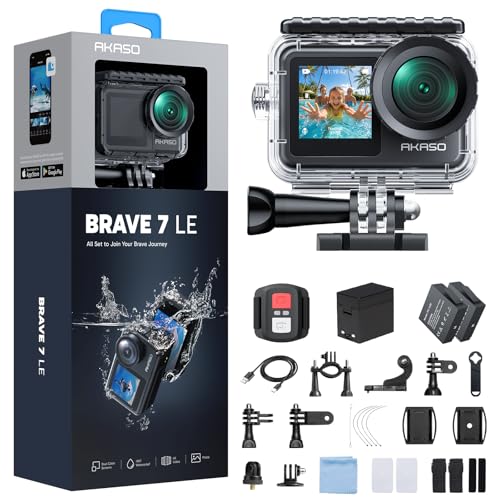
The Brave 7 LE is the budget action camera grown up into a video tool. Where its cheaper siblings chase specifications, the LE adds the features filmmakers actually touch: a front-facing screen for framing yourself, a rear touchscreen that makes settings changes civilised, electronic stabilisation that holds walking shots together, and weather sealing that removes the housing debate for rain and spray. Its 4K footage, given light and a restrained grade, cuts convincingly into short-form work, and the bundled accessory kit — mounts, remote, spare power — means the box price is close to the real price, a rare honesty in this class.
Its colour needs the operator’s help, and the guide says so plainly: shoot the flattest available settings, expose for the subject rather than the sky, and grade gently. Treated that way, the LE’s files behave far beyond their price. Treated as a point-and-shoot, they look like what they are. That dependence on the operator is the theme of this entire budget, and the LE rewards the lesson better than any rival here because its controls actually let you apply it.
For the filmmaker whose subjects include themselves — travel pieces, location vlogs that aspire to cinema, solo documentary work — the dual-screen design is the deciding convenience. Framing a piece to camera stops being guesswork, and the time saved across a shooting day is real production value.
Durability in this class deserves a direct word, because these cameras are bought to be used hard. The LE’s sealed body handles the rain scene and the dusty trail without the housing ritual, its lens sits behind a replaceable protector, and its mount points are the standard the accessory world is built around. A camera that invites use in bad weather will simply appear in more of its owner’s films, and presence in the film is the only specification that finally counts.
- Design: weather-sealed action camera, dual screens
- Sensor: action-class
- Recording highlight: 4K video with electronic stabilisation
- Control: rear touchscreen plus remote in the bundle
- Role: all-round main camera inside the frame
Strengths
- Most complete package here; the bundle closes most accessory gaps.
- Front screen transforms solo framing and pieces to camera.
- Stabilisation keeps walking and handheld footage usable.
Trade-offs
- Small-sensor low-light limits arrive early at dusk.
- Colour needs flat settings and a grade to look its best.
- Onboard audio is reference quality, not dialogue quality.
Best for: solo filmmakers wanting one complete, honest package under the line. Not suited for: night-heavy shooting or dialogue recorded on the camera alone.

DJI Osmo Action 3 — Best image pipeline
DJI’s action line carries the company’s colour and processing pedigree, and the Action 3 is where that pedigree meets this budget. Its sensor and image pipeline produce the most gradeable footage of the linked picks: a wide dynamic range mode that protects skies, colour that stays composed in mixed light, and detail that survives a contrast curve without crumbling into mush. The magnetic quick-release mounting system sounds like a convenience feature until a shooting day proves otherwise — moving the camera between chest, tripod and handheld in seconds changes how many setups a small crew attempts.
The Action 3 also respects cold and heat better than most of its class, a production trait that matters on the winter exterior and the summer car interior alike. Its front screen serves self-framing, its stabilisation is mature, and DJI’s accessory ecosystem means the mount you need exists rather than being improvised. As a pure imaging instrument inside five hundred, it is the connoisseur’s choice among the action bodies.
Where it asks compromise is familiarity: DJI’s menus and colour modes reward a learning session before the shoot, and the best-looking footage comes from its wider dynamic range settings rather than the default punch. Filmmakers willing to spend that hour get the closest thing this budget offers to a small cinema camera’s file discipline.
It is also the strongest of the four as a deliberate B-camera in a larger future kit. Its colour pipeline was designed to sit beside DJI’s bigger imaging products and grades toward other cameras’ looks with less fighting than budget rivals, so the filmmaker who later adds a mirrorless main camera keeps the Action 3 in meaningful service rather than in a drawer. Longevity of role is a value this guide prices in wherever it appears.
- Design: action camera with magnetic quick-release mounts
- Sensor: action-class, wide dynamic range mode
- Recording highlight: 4K with DJI colour pipeline
- Stabilisation: mature electronic system
- Role: image-quality-first main or B-camera
Strengths
- Most gradeable footage of the linked picks.
- Quick-release mounting multiplies setups per hour.
- Temperature tolerance suits real location abuse.
Trade-offs
- Best results need its less obvious colour modes learned.
- Accessory ecosystem spending can creep past the frame.
- Fixed action perspective, like every action body here.
Best for: image-led filmmakers who grade everything and move fast between mounts. Not suited for: buyers wanting the gentlest possible learning curve.

GoPro HERO — Best simple brand route
The compact HERO is GoPro’s answer to a fair question: what if the camera were simply the essentials, done properly? It trims the flagship line to a small, light, waterproof body with the company’s stabilisation and colour, a touchscreen, and compatibility with the deepest accessory ecosystem in action cameras. For cinematic purposes its virtue is trust — predictable files, predictable behaviour, an app and editing path that work, and resale value when the upgrade day comes. Budget no-name cameras compete on specification lists; this competes on the footage reliably coming home.
Its simplicity is also its ceiling, and the guide respects buyers enough to name it: fewer manual controls than enthusiasts want, a fixed ultra-wide view, and low-light manners bounded by its sensor class. Within daylight and lit interiors — the honest territory of this budget — it produces clean, stabilised, eminently editable footage with the least friction of any pick here.
For filmmakers adding a companion viewpoint to a phone or mirrorless main camera, the HERO’s size is a creative feature: it tapes, clamps and pockets into places the Brave and the DJI also reach, but its brand ecosystem means the specialised mount for the weird shot already exists in a drawer somewhere. Reliability is a look, in the end — the look of footage that exists.
- Design: compact waterproof action camera
- Sensor: action-class
- Recording highlight: stabilised 4K in a minimal body
- Ecosystem: full GoPro mount and accessory compatibility
- Role: simple main camera or trusted companion camera
Strengths
- Brand reliability, support and resale at a budget point.
- Least-friction operation of any pick here.
- Accessory ecosystem depth no rival matches.
Trade-offs
- Trimmed controls frustrate manual shooters.
- Low light remains small-sensor territory.
- Ultra-wide perspective is the only perspective.
Best for: buyers who value dependability and simplicity over control depth. Not suited for: manual-exposure purists building technique.

AKASO EK7000 — Best minimal spend
The EK7000 is the camera this guide recommends with the clearest conscience about what it is: the cheapest respectable way to start. It records 4K video, ships with a waterproof housing, a remote and mounts, and costs so little of the frame that the rest can buy the card, the mini tripod and the separate audio recorder that together make a real kit. Its footage in good light is genuinely usable — the secret of its long popularity — and its limitations are the curriculum: fixed focus thinking, modest dynamic range, stabilisation that asks the operator to walk like they mean it.
Think of it as tuition with a sensor. A beginner can learn framing, movement, exposure discipline and editing on the EK7000 while risking almost nothing, and every habit transfers upward when the budget grows. Films have been finished on less. What it cannot do is rescue bad light or produce shallow depth, and buyers expecting either will blame the camera for a misunderstanding the guide has now warned them about twice.
There is a community dimension to choosing the popular teacher, too: mounts, settings advice, spare parts and honest user footage for the EK7000 exist in abundance, because a generation of beginners started exactly here. A new owner is never troubleshooting alone, and at this level that support network is worth as much as a specification.
It also earns a permanent second life: when a better main camera arrives, the EK7000 becomes the risk camera — the one taped to the skateboard, sunk in the stream, mounted where loss is acceptable. Kits at every level need a camera whose destruction would be a story rather than a disaster, and this is the natural candidate.
- Design: action camera with waterproof housing included
- Sensor: entry action-class
- Recording highlight: 4K video at the lowest commitment here
- Bundle: remote, mounts and housing in the box
- Role: first camera, experiment camera, risk camera
Strengths
- Leaves most of the frame for the kit around the camera.
- Complete bundle teaches the whole workflow immediately.
- Becomes the expendable second camera after any upgrade.
Trade-offs
- Dynamic range and low light are the class floor.
- Stabilisation needs operator technique to shine.
- Files need gentle grading; push them and they break.
Best for: absolute beginners and second-camera risk duties. Not suited for: anyone whose first project is a low-light dialogue film.
Sony ZV-1F — Step-up pick, above the frame (prose-only)
Honesty section. The ZV-1F does not belong under five hundred, and this guide will not pretend otherwise: it is included, unlinked and clearly labelled, because it is the camera many readers of this keyword actually end up buying once they see what the step buys. A one-inch sensor — several times the area of the action sensors above — transforms exactly the areas where this budget hurts: dusk footage holds together, skin renders with subtlety, backgrounds soften enough to suggest depth, and the fixed wide lens is a real photographic lens rather than an action optic.
The step-up logic is strongest for people-centred work. If your films are interviews, family stories, community portraits or vlog-led pieces, the ZV-1F’s sensor and directional microphone capsule address your actual problems, while the action bodies address problems — water, impact, mounting — you may not have. Stretching for it is rational when the subject list says so; it is waste when your films are bikes, boats and weather.
It appears prose-only for two stacked reasons: it sits above the keyword’s frame, and intellectual honesty about that matters more than the link. Buyers who stretch should buy it knowingly, from the same authorised channels as any pick here, and should read its fuller treatment in our thousand-dollar guide where it competes inside its proper frame.
- Lens: fixed wide-angle
- Sensor: one-inch class — the step-up’s whole argument
- Recording highlight: 4K with creator-first controls
- Status: above the 500 frame, labelled deliberately
- Role: the stretch purchase for people-centred films
Strengths
- Sensor size fixes this budget’s real weaknesses.
- People footage gains depth, subtlety and low-light reach.
- Directional microphone serves dialogue-adjacent work.
Trade-offs
- It breaks the frame — the label is the warning.
- No link here; it is context, not a pick inside the budget.
- Not rugged or mountable like the action bodies.
Best for: people-centred filmmakers able to stretch honestly. Not suited for: strict budgets or action subjects.
Panasonic LUMIX G100 (used route) — Best interchangeable path (prose-only)
The second prose-only entry exists because the used market rewrites this keyword. A LUMIX G100 — Panasonic’s compact Micro Four Thirds vlogging body — bought used from a reputable dealer can land inside five hundred with a kit lens, and it brings what no action camera can: interchangeable lenses, a proper sensor for stills and video, real manual control and an upgrade path through one of photography’s deepest lens ecosystems. For a filmmaker whose ambitions point toward system cameras, this used route is the on-ramp.
The caveats are the used market’s own, stated rather than hidden: condition varies, warranties shrink to the dealer’s return window, and the body’s video has known compromises — a crop in its highest-resolution mode and autofocus that trails the class leaders — which is partly why it trades where it does. Buy where returns exist, test the sensor and ports during the window, and the arithmetic is compelling.
No link is offered because our verified pool carries no listing for it, and the guide’s rule does not bend for good arguments. Consider the route a standing suggestion: price it at the reputable used dealers, compare the complete total against the Brave 7 LE’s bundle, and let the lens question — do you want to change lenses within a year? — cast the deciding vote.
- Mount: Micro Four Thirds, deep lens ecosystem
- Sensor: Micro Four Thirds
- Recording highlight: 4K video with real manual control
- Status: used-market route into the frame
- Role: on-ramp to system filmmaking
Strengths
- Interchangeable lenses inside a five-hundred total, used.
- Real controls teach transferable craft.
- Lens ecosystem gives the longest runway in this guide.
Trade-offs
- Used condition and warranty require dealer discipline.
- Video compromises explain its used price.
- No verified listing here, so no link.
Best for: system-bound filmmakers comfortable buying used carefully. Not suited for: buyers who need a new camera’s warranty and simplicity.
How do the six routes compare?
| Camera | Type | Cinematic strength | Watch out for |
|---|---|---|---|
| AKASO Brave 7 LE | Action, dual screen | Complete package, solo framing | Dusk limits, onboard audio |
| DJI Osmo Action 3 | Action | Most gradeable files here | Learning curve for best modes |
| GoPro HERO | Action, compact | Reliability and ecosystem | Trimmed manual control |
| AKASO EK7000 | Action, entry | Minimal spend, full bundle | Class-floor dynamic range |
| Sony ZV-1F | One-inch compact | Sensor quality for people | Step-up: above the frame |
| Panasonic LUMIX G100 | Mirrorless (used) | Lenses and real controls | Used-market discipline needed |
Four cameras compete inside the frame; two stand at its borders with labels on. That shape is deliberate. The inside-frame contest is about packages and pipelines — AKASO’s completeness against DJI’s files against GoPro’s trust against the EK7000’s price. The border picks answer the two questions readers actually ask next: what does a little more buy, and what does the used market change?
How do you light a scene when the sensor is small?
Light is the tax small sensors levy, and paying it well is the whole craft at this budget. Work with the day’s architecture: windows as key lights, subjects placed near them, scenes scheduled so the sun is an ally rather than an opponent. Add one inexpensive LED panel for interiors and treat it as the sun’s understudy — close, soft and motivated by a window or a lamp in the frame. Expose for faces, let backgrounds fall where they fall, and never ask the sensor to lift a murky room in the grade.
Night exteriors demand honesty: choose pools of existing light — shopfronts, street lamps, signs — and stage the action inside them. The resulting look, contrasty and local, has a name in cinematography and a long pedigree; the failed alternative, a uniformly grey noise field, has neither. Every pick here can shoot the first version tonight.
How should movement be handled on a small budget?
Slowly, and with intent. Electronic stabilisation rewards smooth, deliberate motion and punishes nervous hands, so the technique is physical: elbows in, steps softened, pans begun and ended with a breath of stillness. A mini tripod used as a grip steadies more than beginners expect, and a simple gimbal — a legitimate second purchase after the first finished piece — transforms the action bodies into tracking instruments. What never works is wandering: movement without motivation reads as restlessness at any budget, and at this one it also spends the stabilisation’s limited grace.
How does a phone compare with these cameras?
Honestly, and the answer explains why this guide exists. A current phone is a formidable video device with computational tricks these cameras lack. What it does not offer is the discipline and durability of a dedicated tool: it rings, it overheats in the sun, its storage is shared with a life, and it cannot be taped to a bicycle or sunk in a stream with a shrug. Filmmakers who shoot on phones well are real filmmakers; the cameras here serve those who want a separate instrument, a waterproof one, or an angle the phone cannot survive. Buy for those reasons, not from a superstition that phones cannot film.
How do you keep footage safe on a small production?
The two-copy rule from larger productions applies unchanged, scaled to a laptop and a portable drive. Offload every card the day it is shot, verify the copies open, and keep the drive in a different bag from the camera — theft and loss take bags, not files, and separation is the whole defence. Format cards only in the camera and only after verification, and keep one untouched card as the day’s emergency reserve rather than filling every card you own because they are there.
Naming is the quiet half of safety. Folders by date and project, cards numbered, a one-line log per card in a notebook or phone note. Three weeks later, matching a pickup shot or finding the good take depends entirely on whether past-you spent those ninety seconds. Small cameras generate footage at a rate that punishes casual housekeeping, and the punishment always arrives at the edit, where it is most expensive.
How do you shoot people well with a wide fixed lens?
Wide lenses are honest about distance: they show the room, the relationship and the space between people, which is why documentary cinema loves them and portrait photographers fear them. The technique is to embrace the geography — place subjects in environments that mean something, let the frame carry context, and move closer rather than wishing for reach, because wide-lens intimacy is earned by proximity. Faces near the edges distort, so keep the important ones toward the middle of the frame and let the edges hold the world.
Interviews on these cameras work when the setting is allowed to speak. A baker filmed in the bakery at working distance tells more than a tight crop against a blank wall, and the small camera’s unobtrusiveness keeps the conversation natural. Light the face from the side, record the audio separately as this guide keeps insisting, and the humble action body becomes a documentary instrument with a long and honourable lineage.
What should be checked in the first week with an action camera?
The waterproofing, before anything irreplaceable depends on it: housing seals inspected, the empty case sunk in a sink, every button worked underwater. Then the stabilisation in genuinely low light, so its limits are learned at home rather than at the location. Then a full card recorded at working settings and played through the whole edit chain, because a codec surprise discovered during the return window is an inconvenience and the same surprise a month later is a characteristic you now own.
Register what can be registered, photograph serial numbers, and store the small accessories — lens caps, mount adapters, the spare door — in one labelled pouch. Action cameras shed their small parts like trees shed leaves, and the discipline of one pouch is the difference between a kit and a collection of almost-kits.
How do weather and water change the choice?
Action bodies dominate this guide partly because the under-500 filmmaker’s locations are rarely studios. Rain on a travel piece, spray on a boat, dust on a trail — the sealed and housed picks here treat those as working conditions, while the step-up compact and the used mirrorless demand shelter and worry. If your shot list is written by the weather, the action cameras are not a compromise at all; they are the only professional answer at the price, and their small sensors are simply the cost of admission to places delicate cameras cannot go.
Water deserves its own sentence because it ends more cameras than drops do. Housings must be tested empty before they are trusted loaded, seals cleaned of the grit that defeats them, and buttons practised with cold fingers before the real take. The picks differ in how much of that ritual they demand — native sealing beats add-on housing for simplicity — but none exempts the owner from the empty test.
What separates a finished film from footage at this level?
Editing, mostly — and editing begins on the shoot. Coverage is the editor’s raw material: the wide that establishes, the close that feels, the insert that explains, the reaction that lands the joke. Small cameras make coverage cheap, because they can be everywhere, so the discipline is to shoot it deliberately rather than hopefully. Five planned angles of a scene will cut into cinema; fifty wandering clips will cut into a montage of regret.
Sound design is the other separator, and it loops back to the audio honesty running through this guide. Room tone recorded for a minute after every scene, wild lines captured while the actor is present, atmosphere gathered at every location — these cost nothing and transform the edit. The filmmaker who collects them on an EK7000 will finish a more cinematic piece than the one who ignores them on a camera ten times the price.
How do you plan a shooting day around battery and media limits?
By counting honestly before the day begins. Action cameras sip or gulp power depending on resolution, stabilisation and screen use, and cold weather shortens every estimate — so the working rule is to carry twice the power the plan consumes and media for three times the footage you expect to keep. Label batteries as they deplete, rotate cards in a numbered order, and offload at lunch rather than at midnight: the midday copy is the one that saves the film when an evening goes wrong.
Power banks have quietly changed this budget class for the better. Several picks here can run or recharge from USB power, which turns a long static shot — the interview, the performance, the time-lapse of a location changing — from a battery gamble into a cable decision. Plan the cable, tape it down, and the smallest camera on this page can hold a scene longer than the flagship action bodies of a few years ago.
Which settings should be locked before the first take?
Frame rate and shutter first, because they define the motion character of the whole piece and must not wander between shots. White balance second, set to a fixed value matched to the light rather than left to an auto system that will drift as framing changes — drifting white balance is the invisible flaw that makes edits feel restless. Exposure mode third: manual or locked wherever the camera allows, so a bright window crossing the frame does not darken the subject mid-line.
Stabilisation and field of view come last and are creative rather than technical: choose the widest view only when the geography matters, the narrower views when faces do, and remember that the least-cropped stabilisation mode preserves the most image on several of these bodies. Write the chosen settings on the slate or in the shoot notes. Future-you, matching a pickup shot in three weeks, will be grateful.
How do these cameras serve a beginner’s second year?
By graduating rather than expiring. The action bodies become B-cameras and risk cameras beside any later system purchase; the techniques they taught — exposure defence, lighting humility, movement discipline — transfer completely. Even the EK7000, the humblest object in this guide, retains a job forever as the camera that can be endangered. A purchase that keeps working after it is outgrown is never the waste that a replaced-and-shelved camera becomes.
The step-up and used routes frame the same second year from the other side: buyers who stretched to the ZV-1F often find no second-year itch at all for people-centred work, and G100 owners spend year two buying lenses instead of bodies. Every path in this guide was chosen to have a year two, which is more than can be said for most electronics at this price.
How should a beginner practise with a camera this small?
With constraints that turn the limitations into exercises. One location, one hour, no zooming and no cropping later: compose with feet and find out how much geography a fixed wide lens can hold. One scene shot three times — locked off, handheld with discipline, mounted and moving — to learn which motion the story wanted. One dialogue scene recorded with the microphone trick described earlier, synced by hand once, so the workflow is understood before it matters. A weekend of such exercises teaches more cinematography than a month of specification comparison, and every pick here is ready for that weekend today.
Finish each exercise into a thirty-second piece with a beginning and an end. The finishing is the education: titles, a grade, sound laid under picture, an export watched on a television rather than a phone. Cameras at this price are often bought as beginnings and abandoned as beginnings; the owners who finish small things are the ones whose second year this guide keeps describing.
What does ownership cost after the purchase?
Less than the mirrorless world, more than the box suggests. Cards wear and should be retired on suspicion rather than on failure. Batteries lose capacity across a couple of hard years and are cheapest bought before the trip, not during it. Housings and seals need occasional replacement parts; mounts multiply if the owner lets them. None of this threatens the frame if it is anticipated, and all of it argues for the bundled completeness of the Brave 7 LE and EK7000, whose boxes quietly include what other brands sell back to you piece by piece.
Resale closes the account kindly. Brand-name action cameras hold a meaningful share of their value; the AKASO pair sell to the next beginner without drama; even a well-kept EK7000 finds a buyer who wants exactly the teacher you are done with. Budget cameras bought honestly are rarely sunk costs — they are deposits on the next stage, recoverable in cash or in second-camera service.
How do slow motion and time-lapse fit a cinematic plan?
Both are seasoning at this budget, and both are genuinely available. Slow motion flatters action subjects — water, wheels, athletes — and every linked pick offers higher frame rates at reduced resolutions that remain perfectly usable for short inserts. The craft rule is motivation: slow the moment the story wants to savour, not every moment the camera can. Time-lapse is the small camera’s secret epic shot, compressing a location’s whole day into the establishing footage a micro-budget production could never otherwise afford; it needs only a stable mount, power patience and the discipline to leave the camera alone.
Plan both in the shot list rather than discovering them in the edit. A production that knows its slow-motion insert is coming can light and stage for it; one that hopes to manufacture emphasis later from ordinary footage will find the ordinary footage unwilling. The tools are in the box — the intention has to be in the plan.
How do you choose between the four linked action bodies?
By the shape of your shooting days. If most days are solo and self-framed, the Brave 7 LE’s dual screens end arguments the others cannot answer. If most days are fast, mounted and remounted, the DJI’s quick-release system and superior files compound across every setup. If the camera will be borrowed, lent, dropped and generally lived with hard, the GoPro’s dependability and resale protect the money best. If the honest situation is a first experiment with filmmaking itself, the EK7000’s price is the argument — the remaining budget buys the light, the recorder and the patience to learn.
Notice that image quality alone does not decide it, because at this level the files are closer than the workflows. Choose the workflow you will actually enjoy repeating, because the camera used weekly at eighty percent of its potential outproduces the theoretically better camera used monthly at fifty. That is the closest thing to a universal law this budget offers.
What does travelling with this class of camera teach?
That small is a strategy, not a compromise. A kit that fits under an airline seat, clears security without theatre and can be carried all day without negotiation gets used in the hours when larger kits stay at the hotel — and those hours, the dawn market and the last light on the harbour, are when travel films are actually made. The action bodies here were born for that life; the step-up compact joins it willingly; even the used mirrorless route stays carryable in a way full-frame systems do not.
Travel also teaches redundancy cheaply: two small cameras that overlap in capability beat one precious camera, because the second is simultaneously the backup, the B-angle and the one that can be risked. Travellers assembling a kit from this page should seriously consider the EK7000-plus-Brave pairing, whose combined cost still respects the frame and whose combined courage exceeds either alone.
Why does this budget reward finishing over collecting?
Because the gap between these cameras is smaller than the gap between finished and unfinished work. Every pick here has carried real films to real audiences; the limiting factor named in every production diary at this level is never the sensor — it is the scene not lit, the audio not captured, the edit not completed. A guide can rank cameras, and this one has, but its most useful sentence may be the simplest: the best under-500 cinematic camera is the one whose owner shoots the second piece, and the third, because by then the camera has stopped being the subject of the work and become its instrument.
Buy accordingly. Choose the pick whose handling invites you to carry it, whose files your computer edits happily, whose compromises match the subjects you actually film. Then close the comparison tabs. The frame you have is enough; the films are the upgrade.
What mistakes do under-500 buyers repeat?
- Believing resolution figures from no-name listings that no sensor inside could honour.
- Shooting everything at dusk because the camera advertised low-light prowess.
- Recording dialogue on the action camera’s microphone and blaming the edit.
- Pushing small-sensor files hard in the grade until they crumble, instead of exposing correctly.
- Ignoring the step-up and used routes, then replacing the camera within a year.
- Buying mounts and accessories before finishing one piece with the basic kit.
Final Recommendation
Start with the AKASO Brave 7 LE if you want one complete, capable package inside the frame today; choose the DJI Osmo Action 3 if your eye is already on the grade and your sets change by the minute; take the GoPro HERO for frictionless reliability, and the EK7000 when the wisest purchase is the cheapest teacher. Stretch to the Sony ZV-1F only when your subjects are people and your honesty about the budget allows it, and investigate the used LUMIX G100 route if lenses are your future. Under five hundred, the camera is the smallest part of the cinema — light, sound and patience are the rest, and they are all, fortunately, free to practise.
Buy from a seller you trust, test the camera through its return window using the checks described above, and then make something short before the month turns. The filmmakers this budget produces are not the ones who chose perfectly; they are the ones who chose adequately and finished repeatedly.
Related guides
- Best Drones with Cameras Under 500: The Step Up From Toy Drones to Gimbals, Sensors and Safe Flying
- Best Digital Cameras Under 10000 Rs (₹10,000): Honest New, Used and Step-Up Options
- Best Compact Photography Cameras Under 500: Stills-First Picks Inside the Frame
Frequently Asked Questions
Can footage from these cameras really look cinematic?
Yes, within the physics stated throughout: lit scenes, disciplined movement, correct exposure and a gentle grade. The look fails when the sensor is asked to perform miracles at dusk, which is an operator decision, not a camera verdict.
Why is a camera above the budget included at all?
Because readers deserve the map, not just the territory we can link. The Sony ZV-1F is labelled a step-up in its heading, its table row and this answer, so nobody is misled — and buyers who can stretch make that decision with open eyes.
Is buying the used Panasonic risky?
Only if bought carelessly. Reputable used dealers state condition, allow returns and test what they sell. Follow that channel, verify during the return window, and the risk is managed rather than gambled.
Do these cameras record good enough audio for dialogue?
No — and any guide claiming otherwise at this level is selling. Use a separate recorder or a phone in a pocket for dialogue, sync in the edit, and let the camera’s microphone carry atmosphere and reference.
Which pick suits a first music video?
The DJI Osmo Action 3 for its gradeable files and fast remounting between setups, with the Brave 7 LE close behind when the artist must self-frame. Music videos reward movement and colour discipline, both covered in the technique sections above.
Should I wait and save for the thousand-dollar class instead?
If your project can wait and your subjects need interchangeable lenses, the thousand-dollar guide is the better destination. If you are filming this season, a camera in hand teaches more than a fund growing — and every pick here resells or graduates to second-camera duty.
Are the mounts and accessories interchangeable between these brands?
Largely, yes: the action-camera world converged on a common mounting standard, so clamps, poles and chest harnesses generally serve any of the linked bodies, with DJI’s quick-release plates the notable proprietary pleasure. That compatibility is one more reason the second-camera graduation path in this guide works without rebuying the shelf.
Related Guides
The natural step up from this page is our cinematic cameras around a thousand, where interchangeable mounts and larger sensors change the argument. Readers planning a full narrative production should continue to cinema cameras for narrative work under ten thousand. And for the calls and collaborations that surround any production, our clip-on webcams for laptops covers the humble camera that handles them.


