Disclosure: this article contains affiliate links, and if you buy through them we may earn an affiliate commission.
Almost every home runs on a quiet fleet of rechargeable cells. AA batteries turn inside game controllers, TV remotes, flashlights, wall clocks, wireless mice, kids’ toys and holiday string lights. AAA cells power headlamps and laser pointers. And the 18650 lithium-ion cell — once a laptop part — now shows up in high-output flashlights, fans, doorbell cameras, vaping-free power banks and cordless tools. The charger you feed those cells with matters far more than most people realize. A crude timer-based charger slowly cooks NiMH cells until they lose capacity, while a proper smart charger watches each cell individually, stops at exactly the right moment, and can even tell you when a battery is worn out and lying about its health.
This guide covers chargers for the three formats most households actually own: AA, AAA and 18650, spanning both NiMH (nickel-metal hydride) and Li-ion (lithium-ion) chemistries. We looked for the things that separate a charger you keep for a decade from one you replace in frustration: independent charging channels, honest capacity analysis, sensible charge rates that do not trade battery lifespan for speed, cool and safe operation, and clear feedback about what is happening inside each slot. Six chargers made the cut, ranging from a simple two-bay travel unit to a laboratory-grade analyzer that can recondition tired cells back to useful life.
One safety note before we begin, because it shapes everything below. NiMH and Li-ion cells are charged with completely different methods. NiMH charging ends by detecting a tiny voltage drop at full charge; Li-ion charging follows a constant-current, constant-voltage curve and must never be trickle charged. A charger that handles both chemistries has to identify what you inserted and apply the right algorithm, every time, without you thinking about it. Every pick in this guide does that job properly, and the “what to look for” section explains how to spot a charger that does not.
What to look for in a battery charger
Chemistry support: NiMH and Li-ion are different animals
The first filter is chemistry. If your home only uses AA and AAA NiMH cells — eneloop-style low-self-discharge batteries — a NiMH-only charger is fine and often cheaper. The moment an 18650 enters the house, you need a charger that also speaks Li-ion, and ideally one that detects chemistry automatically rather than asking you to flip a switch you will eventually forget. Automatic detection matters because pushing a NiMH charge profile into a lithium cell, or the reverse, ranges from useless to genuinely dangerous. Every dual-chemistry pick below detects chemistry automatically, so the right algorithm is applied without you thinking about it; the NiMH-only picks never face the question at all.
Also check the size list, not just the chemistry list. A charger that accepts 18650 cells usually also fits 14500, 16340 and 21700 lithium cells and C or D NiMH cells with spacers or wide bays, which future-proofs it as your devices change. Flat-top and button-top 18650s both need to make contact, so look for sliding rails with firm spring tension rather than fixed posts.
Independent channels: the single most important feature
Cheap chargers often charge cells in pairs, which means two batteries share one circuit and the charger stops when the pair’s combined voltage looks right. The problem is that real batteries are never identical. One cell reaches full charge while its partner is still hungry, so the full one gets overcharged and hot while the other never quite fills. Repeat that a few dozen times and the weaker cell drags every device it powers down early.
Independent channels fix this completely. Each slot has its own circuit, its own termination decision and ideally its own display readout. You can charge one cell or four, mix AA with 18650, pull a finished cell out mid-session, and top up a single flashlight battery without finding it a partner. Every charger in this guide charges each slot independently — we treated paired charging as an automatic disqualification, because in 2026 there is no reason to accept it at any price tier.
Capacity analysis: knowing when a battery is lying
Rechargeable batteries age. A NiMH cell rated at 2,000 mAh when new might deliver 1,400 mAh after three years of abuse, and it will still light a remote control while quietly ruining a camera flash’s recycle time. A charger with a discharge-and-measure mode (often called test, nor-test, capacity or refresh mode) drains the cell at a known rate, counts what comes out, then refills it and reports the real number. That one feature transforms battery management: you can sort cells into matched sets for multi-cell devices, retire the genuinely dead ones, and recondition borderline cells with a few break-in cycles.
Not everyone needs full analysis. If you only charge remote-control batteries, a simple charger with per-slot status lights is enough. But if you run flashlights, RC gear, photography flashes or anything that eats a matched set of four, an analyzing charger pays for itself by extending the useful life of every cell you own.
Charge rate and heat: fast is not free
Charge rate, measured in milliamps, decides both speed and stress. A gentle 500 mA charge of a 2,000 mAh AA takes about four hours and barely warms the cell. Slamming the same cell at 2,000 mA fills it in an hour but generates real heat, and heat is the enemy of NiMH lifespan — it accelerates the internal degradation that permanently shrinks capacity. Lithium cells tolerate faster charging better, but even they age faster when habitually charged hot and fast.
The sweet spot is a charger with selectable rates. Use a moderate default for everyday top-ups, drop to a gentle rate for overnight conditioning, and reserve the fast rate for genuine emergencies. Chargers that only offer one very fast rate are quietly taxing every battery you own. Also pay attention to where the heat goes: metal-bodied chargers and designs with ventilation slots or a small fan keep both the electronics and the cells cooler than sealed plastic boxes.
Safety protections that actually matter
A trustworthy charger layers several protections. Reverse-polarity protection refuses to charge a cell inserted backwards instead of destroying it. Short-circuit and overcharge protection cut power when something is wrong. Temperature monitoring pauses charging if a cell gets dangerously warm — especially important for lithium. For Li-ion specifically, the charger must terminate at 4.2 volts and never apply a maintenance trickle afterward; floating a lithium cell at full voltage is how cells get damaged.
Two household realities deserve mention. First, buy chargers from brands with engineering reputations and certifications rather than unbranded units with copied designs; the price gap is small and the downside of a charging fault is a fire, not an inconvenience. Second, charge on a hard, non-flammable surface away from bedding and paper, and never leave lithium charging completely unattended overnight if you can avoid it. Good chargers make these habits easy to keep because they run cool and finish predictably.
Certifications are worth thirty seconds of your attention before buying. Look for a genuine listing from a recognized testing laboratory — UL, ETL or TÜV marks with a verifiable file number — rather than a bare “CE” printed on the box, which is a manufacturer’s self-declaration and carries far less weight. The picks in this guide come from brands that submit to that scrutiny as a matter of course. It is an unglamorous criterion, and no review video will ever lead with it, but the charger is the one product in your home whose entire job is pushing energy into small chemical storage devices while you are in another room; boring, certified competence is precisely what you are paying for.
Display and feedback: lights, screens and honesty
Feedback ranges from a single red-green LED per slot to full LCD panels showing voltage, current, elapsed time, internal resistance and accumulated capacity per cell. LEDs are fine for a bedside charger. But a screen earns its place the first time it shows you that one of your four “identical” AAs is delivering half the capacity of the others, or that an 18650’s internal resistance has climbed into the danger zone. Internal resistance measurement, offered by a few picks below, is the fastest health check there is: high resistance means a cell that will sag under load no matter what its capacity says.
Power input and portability
Most home chargers run from a wall adapter, but USB-C powered models add flexibility: they work from a laptop port, a car adapter or a power bank during an outage. If you travel with flashlights or camera gear, a compact two-bay USB charger that lives in your bag beats hauling the big desktop unit. Several picks below are USB-powered for exactly this reason, while the desktop analyzers stick with dedicated adapters that can sustain higher total power.
In this guide
Quick comparison: the six picks at a glance
| Charger | Bays | Chemistries | Capacity testing | Best for |
|---|---|---|---|---|
| Panasonic eneloop pro charger (BQ-CC63) | 8 | NiMH only | No, LED indicators | Eneloop households that want it simple |
| XTAR VC4SL | 4 | NiMH + Li-ion | Yes, grading mode | Mixed AA/18650 homes, best all-rounder |
| Nitecore D4 | 4 | NiMH + Li-ion + LiFePO4 | No, voltage display only | Flashlight users, set-and-forget charging |
| EBL Universal Charger | 8 | NiMH only | No | Big families charging many AA/AAA at once |
| Opus BT-C3100 | 4 | NiMH + Li-ion | Yes, full analyzer | Enthusiasts who test and match cells |
| XTAR VC2SL | 2 | NiMH + Li-ion | Yes, grading mode | Travel and small 18650 collections |
The table is a map, not a verdict. The right choice depends on whether your home is a NiMH-only household, a mixed flashlight-and-remote household, or a battery laboratory in the making. The individual reviews below explain who each charger genuinely suits — and, just as importantly, who should skip it.
The best battery chargers, reviewed

1. Panasonic eneloop pro charger (BQ-CC63) — the set-and-forget NiMH charger
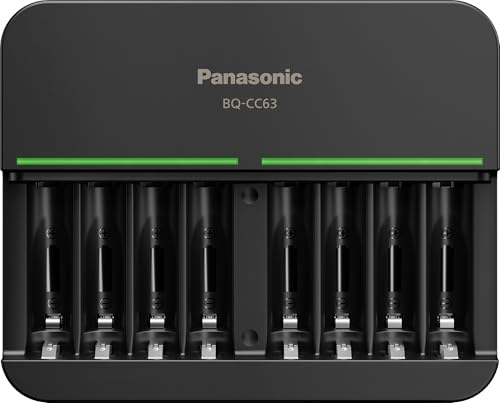
Panasonic makes the batteries most people trust, and the BQ-CC63 is the charger it designed to feed them properly. It is an eight-position NiMH charger for AA and AAA cells, and every position charges independently: each cell gets its own circuit, its own termination decision and its own LED charge indicator, so a finished cell can come out while its neighbours keep charging. That individual treatment is exactly what eneloop and eneloop pro cells reward, because cells that are never force-fed in pairs and never left cooking on a timer hold their capacity for far more cycles.
Strengths. The standout feature is capacity of a different kind: eight cells at once, each watched separately, with eight LED indicators that make the state of every slot readable from across the room. There is nothing to configure and nothing to mis-set, which makes it the easiest unit here to hand to a family member. A full load of high-capacity AAs finishes in roughly six hours, and the unit runs cool and silent on a counter while it works. Build quality feels like a kitchen appliance from a company that expects warranty claims to be rare, and because it comes from the maker of the cells themselves, its charge profile is tuned to eneloop chemistry rather than approximated for it.
Trade-offs. This is a NiMH-only charger; your 18650s need a different home. The LEDs report progress and completion rather than numbers, so there is no voltage readout and no measured milliamp-hour figure — hobbyists who want exact capacity data should look at the XTAR or Opus picks below. Eight positions also means a wide footprint on the counter, and a full load of deeply drained cells still takes hours rather than minutes, because gentle charging is the entire point of the design.
Who it suits. Households standardized on eneloop or other quality NiMH cells for remotes, controllers, toys and clocks, who want the manufacturer’s own gentle charging in enough slots that the charger is never the bottleneck. It sits in the mid-range tier and earns it through longevity rather than features. If that sounds like your drawer full of AAs, check price on Amazon.
Worth knowing in daily use: the BQ-CC63 accepts cells in any combination — one AAA beside seven AAs, a half-empty cell beside a flat one — and simply handles each on its own terms, which is exactly the behavior that makes a household charger disappear into the routine. The individual indicators remove the last piece of guesswork: glance at the row of lights and you know which cells are ready to go back into service and which are still drinking, with no menus or interpretation required.

2. XTAR VC4SL — the best all-rounder for mixed NiMH and 18650 homes
The VC4SL is the charger we would hand to most people, because most modern homes are mixed-chemistry homes: AA and AAA NiMH for the everyday stuff, 18650 lithium cells for flashlights and gadgets. It charges four bays independently, auto-detects NiMH versus Li-ion the moment a cell lands in a slot, and its large color display shows voltage, current, capacity charged and internal resistance for every bay at once. It runs from USB-C, so a decent wall adapter, a laptop or a power bank can all drive it.
Strengths. The grading (capacity test) mode discharges and measures cells, then refills them and shows the real capacity — the single most useful diagnostic a home charger can offer. Internal resistance readings flag dying cells in seconds. Selectable charge currents let you baby a small AAA or push an 18650 when you are in a hurry, and the wide bays accept everything from 10440 lithium cells up to 21700s and even C-size NiMH. A storage mode brings lithium cells to their happy half-charge voltage for long-term keeping, a thoughtful touch almost nobody else at this tier bothers with.
Trade-offs. USB power is a blessing and a limit: with a weak adapter, four bays share power and charge more slowly, so feed it a capable USB-C supply. The display packs in a lot of information and takes a day to learn to read fluently. It has no fan, so at maximum rates with four big lithium cells it gets warm, though never alarmingly so.
Who it suits. Anyone whose battery drawer mixes AA/AAA with 18650s — flashlight owners, parents, gadget households — and who wants one charger that also grades and babysits the collection. It is a mid-range purchase that replaces two or three lesser chargers. For most readers, this is the one to check price on Amazon.
In practice, the VC4SL’s grading mode changes how a household treats batteries within a month of ownership. Cells stop being anonymous: the strong ones get marked for flashlights and flashes, the middling ones go to remotes, and the weak ones leave the drawer entirely instead of ambushing devices at random. That sorting habit, more than any single charge cycle, is what a charger with honest measurement actually sells.

3. Nitecore D4 — the flashlight crowd’s reliable workhorse
Nitecore built its name on flashlights, and the D4 Digicharger reflects that world: four wide bays that swallow 18650s, 26650s and even C cells, automatic detection across Li-ion, NiMH and the less common LiFePO4 chemistry, and a clear LCD reporting voltage, current and elapsed time per slot. It is a desktop unit with a proper wall plug (and a 12V car cord option), designed to sit on a workbench and charge whatever the day’s lights used up.
Strengths. Simplicity under pressure. There is essentially nothing to configure: insert cells in any mix, and the D4 picks safe currents, favoring gentler rates that keep cells cool and long-lived. The bays’ sliding rails are smooth and grip both flat-top and button-top cells securely, and the fire-retardant housing and temperature monitoring suit a charger that may run in a garage or workshop. Its low-current mode handles tiny cells like 10440s and worn AAA cells without overwhelming them.
Trade-offs. There is no capacity test mode — the screen shows what is going in, not what a cell can truly deliver. Default currents are conservative, so a full set of high-capacity 18650s takes a while. And while it accepts a huge range of sizes, it will not analyze or recondition anything; it charges, well and safely, and that is all.
Who it suits. Flashlight and outdoor-gear owners with several 18650s in rotation plus household NiMH, who value a rugged plug-and-charge unit over lab features. It sits in the mid-range tier. If your charging happens on a workbench rather than a desk, check price on Amazon.
The D4 also earns quiet points for its manners around the house: the display dims for overnight use, the unit can run from a vehicle’s 12V socket for camp and job-site charging, and its gentle default currents make it the pick least likely to punish a forgotten cell left in a slot over a weekend. It is the charger equivalent of a good work truck — not the most analytical tool in this guide, and very hard to misuse.

4. EBL Universal Charger — eight bays for busy family households
Some homes do not have a battery hobby; they have a battery logistics problem. Dozens of AA and AAA cells cycle through toys, game controllers, baby monitors, flameless candles and remotes, and a four-bay charger becomes the bottleneck. EBL’s eight-bay universal charger attacks exactly that problem: eight independent slots that accept AA, AAA, C, D and even 9V NiMH batteries, with an LCD display reporting what each slot is doing, in a footprint not much larger than a paperback book.
Strengths. Throughput. Eight cells charge at once, independently, so a weekend toy reset takes one session instead of three. The display is foolproof for family members who will never read a manual: each slot’s state is shown plainly, and a problem cell announces itself instead of silently cooking. It is firmly in the budget tier, and EBL sells matched bundles with its own cells that make stocking a whole house painless. The C, D and 9V support is a quiet bonus for flashlight, smoke-detector and guitar-pickup households, and a discharge function lets you cycle tired cells rather than only ever topping them up.
Trade-offs. NiMH and Ni-CD only — no 18650s, no lithium of any kind. The display is informational rather than analytical: the discharge function cycles cells, but there is no true measured capacity testing and no rate selection, and charge currents are modest, so eight deeply drained high-capacity AAs take their time. The light plastic build does the job but does not inspire the decade-long confidence of the Panasonic or Opus.
Who it suits. Families and shared houses burning through AA and AAA cells in volume, where the best charger is the one that is never full when you need it. Keep it in a kitchen drawer as the household charging station and check price on Amazon.
The honest way to judge the EBL is by the problem it removes: the Sunday-evening discovery that four controller batteries are dead and the charger is occupied. With eight independent slots, that queue simply stops forming, and because each slot decides for itself, a half-used cell can be topped up beside seven empty ones without penalty. For a household measuring chargers in arguments avoided rather than milliamp-hours reported, that is the whole review.
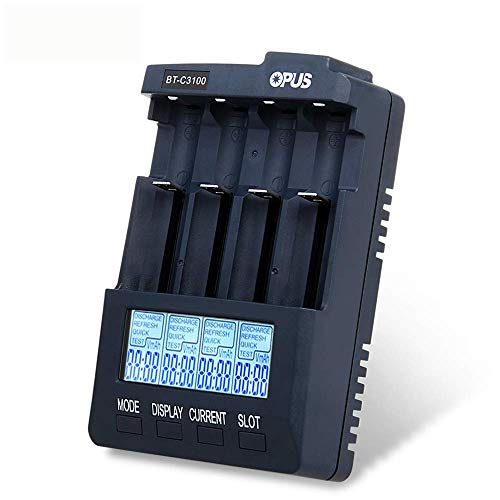
5. Opus BT-C3100 — the analyzer for people who manage their cells
The BT-C3100 is less a charger than a battery laboratory that also charges. This four-bay analyzer handles NiMH and Li-ion alike — AA and AAA household cells on one day, 18650 flashlight cells the next — and offers modes most chargers never attempt: straightforward charging, discharge, a charge-test that measures real capacity in milliamp-hours, a quick internal-resistance test, and a refresh mode that cycles tired cells to coax them back toward honest capacity. Every slot is independent, charge rates are selectable, and the LCD reports voltage, current, elapsed time and accumulated capacity for each cell as it works.
Strengths. Data. Photographers running sets of four AAs in a flash can match cells within a few percent of each other, which visibly improves recycle times and prevents one weak cell from shutting the flash down early. The resistance quick test is the fastest health check in this guide: a cell whose internal resistance has climbed will sag under load no matter what its label claims, and the Opus names it in seconds. Refresh cycles revive cells that sat in a drawer for two years, and because the same unit speaks lithium, one analyzer covers the household fleet instead of forcing you to own two.
Trade-offs. The interface rewards reading the manual; the buttons step through modes and rates that casual users will only partly explore. It is a premium-tier instrument with a wall adapter to match, and its cooling fan can be audible during high-rate lithium charging in a quiet room. If all you charge is remote batteries, this is glorious overkill — the Panasonic above exists precisely for you.
Who it suits. Photographers, RC hobbyists, audio techs and anyone who treats cells as managed equipment rather than consumables. If matching, measuring and reviving cells sounds like satisfaction rather than chore, check price on Amazon.
One workflow shows what the premium buys: a wedding photographer arrives home with sixteen AAs of unknown history, runs the charge-test mode overnight, and by morning owns four matched sets with known capacities, labeled and ready — a result no amount of careful guessing with a basic charger can reproduce. For users whose work depends on that certainty, the BT-C3100 is not an extravagance but infrastructure.
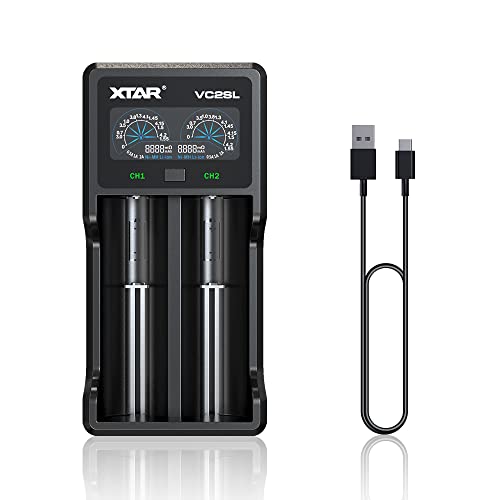
6. XTAR VC2SL — the compact travel charger that still tests capacity
The VC2SL shrinks the VC4SL’s formula into a two-bay, pocketable unit for people whose battery needs travel with them. It charges NiMH and Li-ion independently, auto-detects chemistry, shows per-bay voltage, current and capacity on a tidy LCD, and includes the same grading mode for capacity testing and a storage mode for lithium cells. USB-C power means the same cable that charges your phone can run it from a hotel outlet, a car or a power bank at a campsite.
Strengths. Portability without the usual compromises: most travel chargers drop the screen and the test functions, and this one keeps both. It doubles as a power bank in a pinch, discharging an 18650 out through its USB port to top up a phone — a genuinely useful trick on a trail or in an outage. Two bays are enough for a flashlight user carrying a light and a spare, and the build quality matches its bigger sibling.
Trade-offs. Two bays is a hard ceiling; households charging sets of four will queue. Shared USB power means two large lithium cells charge slower than the headline rate suggests. There is no support for the largest 26650 cells in some configurations, so check your biggest cell’s diameter if you run oversized formats.
Who it suits. Travelers, hikers, photographers and everyday-carry flashlight users who want one small charger that handles AA spares and 18650s and can audit a cell’s health on the road. It is a budget-to-mid-range purchase with premium manners — check price on Amazon.
There is a quiet second audience for the VC2SL: apartment dwellers and students whose entire battery fleet is a handful of cells. For them a four-bay desktop unit is furniture they do not need, while this two-bay unit lives in a drawer, runs from the same USB-C brick as everything else they own, and still tells them the truth about their batteries. This is the least expensive way in this guide to give a small fleet that same honesty.
How smart charging actually works
Understanding two charging curves explains nearly every difference between the chargers above. NiMH cells charge at a steady current while their voltage climbs; as they approach full, the voltage peaks and dips very slightly — a signal called negative delta V — and the cell begins turning extra energy into heat. A smart NiMH charger watches for that dip, backs it up with temperature sensing and a safety timer, and stops. A dumb charger just runs its timer and hopes your cells were exactly as empty as it assumed. That hope is why timer chargers murder batteries slowly.
Li-ion charging is a two-act play. First the charger pushes constant current while voltage rises toward 4.2 volts; then it holds 4.2 volts steady while the current naturally tapers down, ending when the trickle of current falls to a small fraction of the starting rate. After that, a proper lithium charger does nothing — no float, no trickle. If a charger advertises “trickle charging for lithium,” walk away. The XTAR and Nitecore picks above implement both curves correctly and choose between them automatically, which is the entire technical case for buying a named-brand smart charger over a no-name one.
Charging speed versus battery lifespan
Every charger advertises speed; few advertise gentleness, yet gentleness is what your wallet feels over three years. NiMH cells charged at moderate rates — roughly a third to half of their capacity per hour — routinely outlast cells habitually fast-charged, because heat generated inside the cell during rapid charging degrades the electrode materials a little more each cycle. The practical routine most experienced users settle on: charge at a moderate default rate for daily needs, use the slow rate when the charger will sit overnight anyway, and treat maximum rate as the exception for genuine rush jobs. Lithium cells are hardier about speed but share the heat rule, and they strongly prefer being stored half-charged rather than full — which is why the storage mode on the XTAR chargers is more than a gimmick for anyone keeping spare 18650s in a drawer.
Matching matters as much as speed. Devices that use several cells in series — camera flashes, RC packs, big flashlights — are only as strong as their weakest cell, and a weak cell in a series set gets driven into reverse polarity at the end of discharge, which can kill it outright. Capacity testing, offered by the XTAR pair and the Opus, lets you group cells of genuinely similar capacity and retire the outliers to remote-control duty, where a tired cell can live out its days harmlessly.
best home wifi routers
best smartwatches with calling function
Setting up a home charging station that stays safe
A good charger deserves a good setup. Choose a hard, flat, non-flammable surface — a kitchen counter corner or a metal tray on a shelf — with a little air space around the unit. Keep charged and uncharged cells in separate small boxes or a battery case so a loose 18650 never rattles around against keys or coins, which is a real short-circuit hazard with unprotected cells. Label cells with a paint pen: purchase month on every cell, and a set letter (A, B, C) on cells you keep matched. When a device dies suspiciously early, swap in a labeled known-good set before blaming the device; half the time the “broken” gadget is just running on one exhausted cell, and a capacity test will show you exactly which one.
Troubleshooting follows from the same logic. A cell that gets hot while charging, finishes suspiciously fast, or shows climbing internal resistance on the XTAR displays is telling you it is done — recycle it rather than nursing it. A charger that refuses a cell entirely is usually detecting a cell discharged below safe recovery voltage; lithium cells in that state should be recycled, not forced. And if all four slots suddenly behave oddly, suspect the power supply first: USB chargers are only as strong as the adapter feeding them.
One more routine separates careful households from frustrated ones: the monthly top-up. NiMH cells in standby devices — emergency flashlights, the spare remote, the weather radio — slowly self-discharge and, worse, can drift out of balance with their set-mates. A monthly session on an independent-channel charger levels every cell back to genuinely full, and a quick glance at the per-slot readouts while you do it doubles as a health check on the whole fleet. It takes five minutes of attention, and it is the difference between an emergency light that works in year three and one that flickers out during the outage you bought it for. Lithium spares deserve the opposite discipline: check them every few months, and if a stored 18650 has drifted well below its storage voltage, bring it back to half charge rather than to full.
Know your cells: a short field guide to what is in your drawer
Chargers only make sense once you know what you are feeding them. The dominant AA and AAA chemistry in homes today is low-self-discharge NiMH, the type Panasonic’s eneloop line made famous: it arrives pre-charged, holds most of its charge for a year on a shelf, and survives hundreds to thousands of cycles. Older standard NiMH cells are still around and behave the same on the charger, but they self-discharge in weeks, which is why a drawer of them always seems dead. If a cell’s wrapper says “ready to use” or “low self-discharge,” it is the modern kind; either way, every NiMH pick in this guide treats both correctly.
The 18650 is a lithium-ion cell named for its size — 18 millimeters across, 65 long — and it comes in protected and unprotected versions. Protected cells carry a tiny circuit board that guards against over-discharge and short circuits, at the cost of a few millimeters of extra length; unprotected cells rely on the device and the charger for safety, which is one more reason the charger’s own protections matter. Button-top versus flat-top refers to the positive terminal’s shape, and a good sliding-rail charger accepts both. A quick household audit — count the devices, note the sizes, check whether any lithium cells are in play — takes ten minutes and tells you exactly which tier of this guide you are shopping in.
Charging through seasons, outages and emergencies
A charging setup proves itself at inconvenient moments. During a power outage, the USB-powered picks here keep working from a power bank or a car, topping up the 18650s that run your lanterns and the AAs in your weather radio, while a wall-only desktop unit waits for the grid. In winter, cells stored in an unheated garage charge sluggishly and read oddly until they warm up, so bring the charging station indoors for the cold months. In summer, the same garage is a heat trap that ages stored lithium cells; half-charge them with a storage mode and keep them inside.
Households in storm or wildfire country often keep a dedicated go-bag of charged cells, and the analyzers earn their keep there too: a capacity test each spring confirms the emergency stash is genuinely ready rather than quietly decayed. Holiday seasons are the other stress test — strings of flameless candles, relatives’ toys, camera flashes at gatherings — and they are when an eight-bay charger or a second small unit stops sounding like an indulgence. None of this requires buying the most expensive charger; it requires owning one whose feedback you trust before the moment you depend on it.
Reading a charger’s spec sheet without getting fooled
Charger listings are dense with numbers, and a few of them matter far more than the rest. The headline rate — “2A fast charging!” — usually describes what a single bay can do when it is the only bay occupied. Put four cells in and the total power budget gets divided, so the honest figure to look for is the per-slot rate with all slots full. A charger that sustains 1A per slot across four bays is genuinely quicker in real family use than a “3A” charger that only achieves that figure with one cell installed.
Next, check the termination language. For NiMH you want to see negative delta V detection, ideally backed by temperature sensing and a safety timer; “timer control” alone means the charger guesses. For lithium, look for a stated 4.2V termination with current cut-off and no trickle. Input power deserves a glance too: a USB charger fed by a 5V/2A adapter cannot deliver laboratory-grade power to four bays at once, no matter what the box promises, which is why the XTAR units reward a strong USB-C supply. Finally, treat capacity claims for bundled batteries with suspicion and trust the analyzers: a test mode that reports measured milliamp-hours is the only number in this entire product category that cannot be exaggerated, because you watch it happen.
Which charger type fits your household?
It helps to sort homes into three profiles. The first is the NiMH-only household: remotes, clocks, controllers, toys. If that is you, the decision is about volume and care. Eight individually managed positions (the Panasonic BQ-CC63) suit a household standardized on eneloop cells; a multi-size universal unit (the EBL) suits a house where the toy shelf alone eats a dozen AAs a week and the flashlights take C and D cells besides. Neither household needs to pay for lithium support it will never use.
The second profile is the mixed household, the most common one in 2026: NiMH for the everyday fleet plus a handful of 18650s for flashlights, lanterns and gadgets. This is the XTAR VC4SL’s home turf, and the Nitecore D4’s if your charging happens in a workshop. The deciding factors are bay width (will your largest cells fit?), whether you want capacity testing, and whether USB power matters to you.
The third profile is the manager: photographers, RC pilots, audio engineers, serious flashlight collectors — anyone whose gear depends on matched, verified cells. These users should budget for analysis first and charging second: the Opus BT-C3100, which analyzes AA/AAA cells and lithium in the same four bays, or the VC4SL when you want its grading mode in a friendlier package. Everyone else can safely ignore this tier, the same way a home cook can ignore a commercial kitchen.
Battery care habits that double a cell’s useful life
The charger does half the work; your habits do the other half. Store NiMH cells charged and Li-ion cells half-charged, as noted earlier, but also rotate stock: use the oldest cells first so no cell sits for two years, because even low-self-discharge NiMH slowly loses its edge when ignored, and a break-in or refresh cycle is the polite way to wake it. Keep cells in sets for multi-cell devices and never mix a fresh cell with tired ones in the same gadget — the tired cell will be dragged below safe voltage and may leak or die.
Temperature discipline matters quietly. Do not charge cells straight off a freezing porch or a hot car dashboard; let them reach room temperature first. Do not leave cells baking on top of a warm charger for days after charging finishes — pull them when the charger says done, or at least within the day. And keep contacts clean: a pencil eraser across a cell’s terminals and a dry cloth in the charger’s bays a few times a year prevents the mysterious “this slot never finishes” problem that is usually just grime adding resistance.
Finally, retire cells without sentimentality. A NiMH cell delivering under roughly 80 percent of its rated capacity after a refresh cycle, or a lithium cell whose internal resistance has climbed well past its siblings, is no longer saving you money — it is borrowing reliability from every device it touches. Recycling points at most electronics retailers take them free, and your analyzers will tell you exactly when the time has come.
Common charging mistakes we see in real homes
The classic mistake is the paired-slot charger inherited from a camera bundle, quietly unbalancing every set of batteries it touches for years. The second is mixing chemistries in a charger that cannot tell them apart — an alkaline AA tossed into a NiMH charger by a helpful guest can leak or burst, which is why the charging station should live somewhere deliberate, with a small “rechargeables only” tray beside it. The third is charging by the clock: pulling cells after an arbitrary hour because “that’s probably enough,” which chronically undercharges NiMH and leaves flashlights dim.
Lithium has its own error list. Charging a visibly swollen, dented or torn-wrapper 18650 is never acceptable; damaged cells get recycled, full stop. Using a phone’s bargain-bin USB brick to power a four-bay charger and then blaming the charger for slow sessions is another favorite. And leaving lithium cells at full charge in a hot garage for a summer quietly ages them faster than a year of normal use — the storage mode exists precisely to prevent that.
A note on 9V, C, D and other less common sizes
Most homes eventually meet a size outside the AA/AAA/18650 trio. NiMH 9V batteries run smoke detectors, wireless guitar systems and multimeters; the EBL pick above is the only unit in this guide that charges them, which is one more reason it earns its place in family homes. C and D NiMH cells still serve big flashlights, radios and baby swings; the Nitecore D4’s wide bays accept them natively, while narrower chargers need plastic spacer adapters that work but add fiddliness. On the lithium side, 21700 cells have become the flashlight standard’s bigger sibling and fit both XTAR picks, while tiny 10440 and 16340 cells need chargers with a genuinely low minimum current — the D4’s low mode and the XTARs’ selectable rates both handle them without cooking them. If your household’s odd sizes are multiplying, let bay width and minimum current, not headline speed, drive your choice.
How we chose these six chargers
Our filters were practical. Every pick charges each slot independently — paired charging was disqualifying. Every pick terminates NiMH charging by detection rather than by timer alone, and terminates lithium at 4.2 volts with no trickle. We favored brands with a track record in charging specifically, not general electronics brands renting a logo. We then spread the six across the real decision space: a manufacturer-matched NiMH charger, two mixed-chemistry all-rounders at different sizes, an eight-bay family unit, a professional analyzer, and a travel unit, so that whichever profile your household matches, one pick was chosen with you in mind. Where a pick has a real weakness — a missing test mode, a chemistry it cannot touch, a size ceiling — we said so in its review rather than letting the comparison table flatter it.
What about the charger that came bundled with your batteries?
Most rechargeable batteries are sold with a charger in the blister pack, and most of those chargers are the weakest link in the whole system. The typical bundle unit charges in pairs, terminates on a timer, offers one fixed rate, and shows you a single light for the whole batch. It will work — for a while, and at a cost measured in quietly shortened battery life. The cells it came with will fade a little faster than they should, and because the decline is gradual, owners usually blame the batteries rather than the charger that mistreated them.
There are exceptions. Manufacturer bundles built around a genuinely smart unit — Panasonic’s better eneloop kits are the obvious example — are a legitimate way to buy, because the charger inside is the same independent-channel design sold on its own. The test is simple: if the bundled charger names its termination method, charges slots independently and shows per-cell status, keep it and spend your money on more cells. If the packaging brags only about how fast it charges and says nothing about how it decides a battery is full, treat the unit as a spare for the guest room and put a real charger from this guide on the counter. Your batteries will repay the decision every cycle for years.
The economics: what good charging actually saves
The arithmetic of rechargeables is usually told in the batteries’ favor — a quality NiMH AA costs a few times a disposable and lasts hundreds of cycles — but the charger quietly decides how much of that theoretical saving you actually collect. A set of four premium AAs mistreated by a timer charger might deliver a third of its rated lifespan before fading; the same set on an independent-channel smart charger, refreshed occasionally and retired from series duty when it weakens, can serve for years across a cascade of ever-easier jobs, from camera flash to wall clock. Multiply that difference across the two or three dozen cells a typical home owns and the “expensive” charger becomes the cheapest component in the system.
There is also a waste argument that needs no spreadsheet. Every rechargeable cell that dies early from bad charging is a disposable battery habit sneaking back in through the side door, along with the packaging, the trips and the drawer full of maybes. A charger with capacity testing keeps the fleet honest: cells that still measure well stay in service, cells that do not get recycled promptly instead of lingering. Good charging is, in the end, mostly a measurement habit — and measurement is exactly what separates the six picks above from the unit that came free in a blister pack.
Frequently asked questions
Can one charger really handle both NiMH and Li-ion batteries?
Yes, provided it detects chemistry automatically and applies the correct charging curve to each slot, as the XTAR VC4SL, Nitecore D4 and XTAR VC2SL do. The two chemistries need different termination methods, so never use a charger that asks you to select chemistry manually unless you are certain you will never flip it wrong — and never charge lithium cells in a NiMH-only charger.
Why do my AA batteries die so much faster than they used to?
Usually because they were charged in pairs or on a timer, so one cell was repeatedly overcharged while the other undercharged, or because the set contains one worn cell dragging the rest down. A charger with independent channels plus a capacity test mode will identify the culprit in one session; reconditioning modes like the Opus’s refresh cycle or the EBL’s discharge function can recover borderline cells, but a cell measuring far below its rated capacity belongs in light duty or the recycling bin.
Is fast charging bad for rechargeable batteries?
It is a trade, not a sin. Occasional fast charging costs little, but habitual maximum-rate charging generates heat that permanently shrinks NiMH capacity over time and ages lithium cells faster too. Use selectable rates: moderate for routine charging, slow overnight, fast only when you genuinely need a cell within the hour.
How should I store spare 18650 batteries?
Store lithium cells at roughly half charge, in a plastic battery case, at room temperature, away from metal objects. The storage mode on the XTAR VC4SL and VC2SL sets that voltage automatically. Storing them full for months accelerates capacity loss, and storing them loose in a drawer risks a short circuit against keys or coins.
Do I need a charger with a screen, or are LED lights enough?
Lights are enough if you only top up remote and toy batteries. A screen pays off the moment you manage matched sets or lithium cells: voltage, internal resistance and measured capacity tell you a battery’s real health in seconds, turning guesswork (“this flashlight seems dim lately”) into a decision you can act on. There is a middle path worth knowing about, too: several LED-only chargers still terminate each slot independently and safely, so if your fleet is small and entirely NiMH, a simple unit from a reputable brand is a rational buy — you give up diagnosis, not safety, and you can always add an analyzing charger later when the fleet grows.
Whatever mix of cells your home runs on, the right charger quietly protects every battery you own — so pick the one above that matches your drawer, and let it turn charging from a small recurring frustration into a background task you never think about again.