Disclosure: As an Amazon Associate, reviewstook.com earns from qualifying purchases. Links on this page are affiliate links; they cost you nothing extra. Prices and availability change often, so check the current Amazon listing before you buy.
The premise of this jbl tour pro 3 review is that JBL’s flagship earbuds are really two products arguing with each other: a pair of dual-driver, hi-res true wireless earbuds with serious noise cancelling, and a smart charging case with its own screen that wants to be the remote control for your entire audio life. The earbuds are excellent in ways that will surprise nobody who knows JBL’s tuning. The case is the gamble — genuinely useful for some listeners, a delightful gimmick for others, and the feature that decides whether the Tour Pro 3 is your flagship or an over-specified curiosity. This review separates the two, tests the claims that matter (cancelling, calls, sound, battery discipline), and places the Live Beam 3 alongside as the in-family alternative for buyers who want JBL’s smarts without the flagship’s theatre.
Key takeaways
- Sound is the headline that should be: dual drivers and hi-res codec support give the Tour Pro 3 a scale and detail smaller single-driver buds cannot match.
- The smart case’s screen controls settings, playback and more without your phone — most valuable to travellers, gym users and anyone whose phone lives in another room or bag.
- Spatial audio with head tracking is immersive for video and a matter of taste for music; it can be switched off without penalty.
- Noise cancelling is flagship-class for travel and offices, provided the fit seals — tips and fit checks matter more than the algorithm’s name.
- The Live Beam 3 keeps the smart-case idea with a stick-style fit, long total playtime and multipoint, for listeners who prefer that shape or budget.
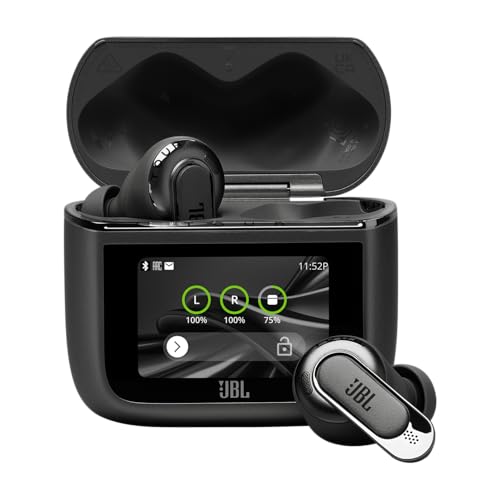
JBL Tour Pro 3 — the flagship with a screen in its pocket
Badge: Best JBL earbuds for travellers and feature maximalists
- Drivers: dual-driver design
- Audio: hi-res sound support, spatial audio with head tracking
- Noise control: smart adaptive noise cancelling
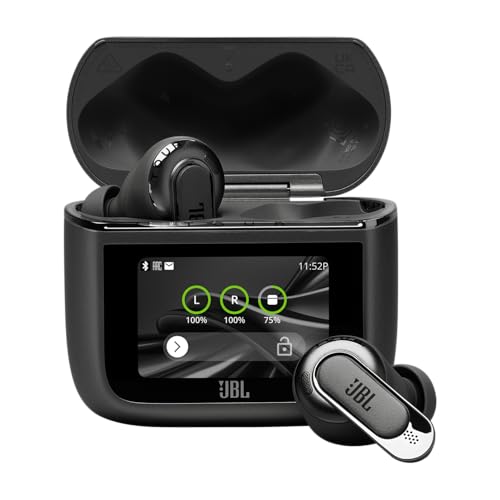
- Case: smart charging case with display
- Bluetooth: 5.3, water resistant buds
Start with the earbuds themselves, because they would justify attention with a plain case. The dual-driver architecture — splitting the frequency range between specialised drivers rather than asking one diaphragm to do everything — pays its clearest dividend in separation: bass lines stay articulate under dense arrangements, and treble detail does not collapse when the low end gets busy. JBL’s house tuning leans lively rather than neutral, with low-end presence that flatters electronic and pop production, and the app’s equaliser lets more restrained listeners pull the presentation toward balance without fighting the drivers’ nature. Hi-res codec support means listeners with capable phones and lossless libraries have a wireless path that respects their files; everyone else still benefits from the driver hardware, which is the part no codec can substitute for.
Noise cancelling on the Tour Pro 3 plays in the flagship league: aircraft cabins and train rumble are its home fixtures, office chatter is reduced to a murmur, and the adaptive element adjusts to environments without the user conducting it. Two honest qualifiers apply to every cancelling earbud and are stated here once for the category: the seal is the system, so spend the first evening trying tip sizes until the fit test in the app blesses you; and wind remains the natural enemy of all ANC, handled better by fit and by transparency discipline than by any algorithm yet shipped. Call quality benefits from the multi-microphone arrays this class carries, with voices holding up respectably in street noise — good enough that callers stop asking where you are, which is the practical threshold for business use.
Then there is the case. The screen lets you adjust noise control, EQ presets, spatial audio, find-my-buds and playback without touching your phone, and it doubles as a window into battery status with unusual precision. Its killer applications are specific: the traveller whose phone is in a seat pocket or overhead bin, the gym user whose phone is in a locker-adjacent bag, the desk worker whose phone is face-down in a drawer during focus hours. For those listeners the case is not a gimmick but a second control surface that respects their routines. For the listener whose phone is always in hand, the case is a beautifully made answer to a question they never ask — and they should price it as decoration and decide whether the earbuds alone carry the flagship cost. The case can also act as a transmitter bridge for sources without Bluetooth in some setups (check the current listing for the exact implementation), which rescues in-flight entertainment systems and older gear — the traveller’s argument again, and it is a strong one.
Strengths
- Dual-driver sound with genuine separation and scale for the size class.
- Flagship cancelling and call performance for travel and open offices.
- The smart case is a real workflow upgrade for phone-far listening lives.
Trade-offs
- The case is larger than minimalist rivals’ — pocket discipline is required.
- Spatial audio with head tracking divides listeners; budget it as a bonus, not a reason.
- Flagship pricing demands flagship usage — occasional listeners will not amortise it.
Best for: frequent travellers, commuters, open-plan workers, and JBL loyalists who want the top of the line. / Not suited for: minimalists, small-pocket carriers, and anyone whose phone is permanently in hand and whose budget prefers sound-only spending.

JBL Live Beam 3 — the smart-case idea in stick form
Badge: Best alternative for stick-fit fans and multipoint workers
- Playtime: up to 48 hours total with case
- Case: smart case, wireless charging
- Calls: 6-microphone array
- Connectivity: multipoint connection, IP55 water and dust resistance
The Live Beam 3 is the Tour Pro 3’s stablemate for listeners who prefer a stick-style earbud and a slightly different balance of virtues. It keeps the smart-case concept — screen and all — and adds the working features that define a daily-driver pair: multipoint connection for the laptop-and-phone shuffle, a six-microphone array aimed squarely at call quality, wireless charging for the case, and a headline 48 hours of total playtime across buds and case that makes charging a weekly rather than nightly thought. Its sound is a single-driver presentation tuned in the same lively family style — less separation than the flagship’s dual drivers at the extremes of dense music, entirely satisfying for the mixed diet of calls, podcasts and playlists that define most working days.
Choose the Live Beam 3 when your day is calls-first and your ears prefer the stick fit; choose the Tour Pro 3 when music quality and travel cancelling lead your list. The existence of both is JBL quietly admitting that “flagship” is a job description rather than a shape, and buyers are better served by picking their job than by climbing a ladder.
Strengths
- Multipoint and call hardware make it the better office tool of the pair.
- Total playtime figure removes charging from the daily routine.
- Smart case included — the family’s signature trick, at a step down the range.
Trade-offs
- Single-driver sound concedes the flagship’s separation in complex music.
- Stick fit is a preference, not a universal — some ears seal better with the Tour’s shape.
- IP55 is splash-class discipline, not the full sealed treatment of sport-specific buds.
Best for: hybrid workers, call-heavy days, stick-fit loyalists. / Not suited for: listeners whose priority is maximum musical separation and flagship cancelling.
In this guide
JBL Tour Pro 3 Review buying guide: flagship earbuds without the regret
Fit is the first specification
Every other feature in this review is downstream of the seal. Cancelling depth, bass response and comfort over a four-hour flight are all fit wearing different names. Budget your first evening for tip experiments, use the app’s fit tools, and be honest about asymmetry — many listeners need different sizes per ear, and the correct response is to use them, not to average. If your ears have historically rejected in-ear buds entirely, no flagship’s feature list will save the relationship; consider the stick fit of the Live Beam 3 or an over-ear alternative instead of forcing the category.
Decide what the case is worth to you
List your phone-far moments honestly: flights per year, gym sessions per week, desk hours with the phone elsewhere. If the list is long, the Tour Pro 3’s case is a feature you will touch daily and its size is a fair trade. If the list is empty, the same money buys more elsewhere — including, within this article, the Live Beam 3’s working virtues or a step toward over-ear cancelling for travel. The case is the rare feature whose value is entirely biographical; no benchmark can price it for you.
Codecs and sources: match the chain
Hi-res support rewards listeners whose phones and services can feed it. Check your phone’s Bluetooth codec support and your streaming service’s quality settings before counting hi-res as a reason to buy; the drivers will still serve you well on ordinary streams, but the flagship premium should be bought with open eyes about which of its talents your chain can actually reach.
How to get the most from the Tour Pro 3
Step 1: Fit, then firmware
Run the fit process, then update firmware through the app before judging anything — cancelling behaviour and case features both evolve through updates, and first impressions formed on launch firmware are a known source of unfair reviews across the category.
Step 2: Build two listening profiles
Create a music profile (your EQ preference, spatial off or on by taste) and a travel profile (maximum cancelling, voice-forward EQ for announcements and calls). Switching profiles beats re-tuning sliders in an airport queue, and the case’s screen makes the switch a thumb’s work.
Step 3: Learn the transparency discipline
Adaptive transparency is for announcements, platforms and traffic awareness — moments when the world needs a vote. Practise the quick toggle until it is reflex; the safety value of these buds in cities is mostly in how fast you can let the world back in.
Step 4: Case care
The smart case is a small computer with a screen: treat it to the gentler pocket, keep its contacts clean and dry, and charge it on the same rhythm as your phone so the whole system is always a known quantity before travel days.
Common mistakes with flagship earbuds
The first is judging cancelling in a quiet room, where there is nothing to cancel and everything sounds similar; judge it on a train or not at all. The second is leaving spatial audio on for all music because it shipped that way — it is a per-content choice, glorious for film, debatable for a string quartet. The third is ignoring the equaliser because the stock tuning is lively; five minutes of EQ is the cheapest sound upgrade in audio. The fourth is losing a bud through pocket habits the case was designed to prevent — the case is the home; buds live there or in ears, nowhere else, and find-my features are a safety net, not a lifestyle.
Tour Pro 3 in the wider flagship field
Against the flagship earbuds of the phone-platform giants, the Tour Pro 3’s identity is audio-first plus the case: rivals lean on ecosystem integration with their own phones, while JBL leans on driver hardware and a control surface that works regardless of whose phone is in your pocket. For listeners inside one phone ecosystem who value its specific integrations above all, the platform pair will always tempt; for listeners who cross platforms, travel hard, or simply prioritise the sound-and-cancelling core, the JBL flagship is the more portable investment — it does not care what phone you buy next year, and neither does its case.
Frequently asked questions
Is the smart case worth it on the Tour Pro 3?
For travellers and phone-far listeners, yes — it becomes a daily control surface and a travel bridge for awkward sources. For phone-in-hand listeners it is elegant surplus, and they should weigh the earbuds’ sound and cancelling as the purchase, with the case as a bonus they may grow into.
How good is the noise cancelling for flights?
Flagship-class: engine and cabin rumble are its strongest suit, given a proper seal. Spend the fit evening before your first flight, download your media, and set a travel profile in advance; the combination is as close as earbuds get to business-class quiet.
Does spatial audio with head tracking improve music?
It depends on the recording and the listener. Film and video benefit most consistently; for music it ranges from spacious to distracting, sometimes within one album. Treat it as a per-content switch, not a default, and let your own ears vote track by track.
Tour Pro 3 or Live Beam 3?
Tour Pro 3 for sound separation, travel cancelling and the fullest flagship brief. Live Beam 3 for call-heavy working days, multipoint convenience, stick fit and long total playtime. Both carry the smart-case idea; the choice is about your day’s centre of gravity.
Are the Tour Pro 3 good for calls?
Yes — the microphone system holds voices together respectably in street and station noise, which is the real-world test. In very high wind, every earbud struggles and a handset still wins; for ordinary business life, callers will hear you clearly.
Can I use one bud at a time?
Like most modern true wireless buds, single-bud use for calls and awareness listening is supported — confirm the exact behaviour on the current listing, and note that the case’s controls make one-bud working days unusually manageable.
How do I know whether the Tour Pro 3 are sealing properly in my ears?
Use the consequences, not the feeling. A correct seal delivers full, unforced bass at moderate volume and noise cancelling that removes the low, steady rumble of a room rather than merely muffling it. If the sound is thin, the cancelling seems weak and one side drifts when you smile or chew, the seal is broken, and no setting will compensate. Work through the included tip sizes methodically, one ear at a time, since ears are commonly asymmetric, seat each bud with a slight twist, then run the fit check where the current listing and app provide one. Retest after a week as well: tips soften, your insertion technique improves, and the size that felt tight on day one is often the size that seals best once you stop being tentative about fitting it.
Can the smart case help with in-flight entertainment and other wired sources?
That is one of its most defensible tricks. Where the current listing’s transmitter implementation applies, the case can act as a bridge between a source without Bluetooth and the buds, which turns a seat-back entertainment screen or an older piece of audio gear from a disposable-headphone compromise into your own fitted, noise-cancelled listening. Check the exact implementation and any cable requirements on the current listing before you travel, pack whatever lead it needs in your hand luggage rather than a checked bag, and test the pairing at home first. Discovering the sequence at cruising altitude, in the dark, with a film already chosen, is how a genuinely useful feature gets misjudged as a gimmick.
The bottom line
The Tour Pro 3 is JBL’s flagship argument that earbuds can be both an audiophile-leaning instrument and a traveller’s tool: dual-driver sound that respects complex music, cancelling that respects long journeys, and a case that respects the moments your phone is somewhere else. Buy it for those three respects and it will feel worth its flagship position. Buy it as a spec-sheet trophy and its best features will sit unused — the one failure mode no manufacturer can design away.
Sound in detail: living with dual drivers
The dual-driver difference announces itself in busy music. Play a dense electronic track where sub-bass, a vocal and bright percussion compete, and single-driver buds often smear the contest into a loud middle; the Tour Pro 3 keeps the lanes separate, so the vocal stays intelligible without turning anything down. Jazz benefits differently: a double bass walks with pitch definition rather than thump, and cymbal work has the shimmer that tells you a ride from a crash at conversational volume. Classical listeners get string sections with internal texture — though the soundstage of any earbud remains an intimate, in-head affair compared with speakers, and spatial mode is JBL’s answer for those who want the image pushed outward. Podcasts and audiobooks are effortless, as they should be at this level, with voices rendered at a size that feels like a person rather than a broadcast. The tuning’s low-end enthusiasm is the one editorial choice to manage: bass-led listeners will smile immediately, while acoustic purists should spend their EQ minutes early, because the drivers have the resolution to reward a flatter curve if that is your taste.
The case, week two: when novelty becomes routine
Smart-case scepticism usually melts on a schedule. In week one the screen is a toy — settings are twiddled for the pleasure of twiddling them. By week two, specific routines form: the pre-flight check of both buds’ charge without waking a phone in a dark cabin; the gym-bag EQ change performed with the phone still in a locker; the find-my-buds ping after a sofa incident. What survives novelty is not the screen’s existence but its position: it is the only control surface in your pocket when your hands are full of boarding passes, towels or luggage. Owners who never form those routines are equally consistent — the case becomes simply the (larger) box the buds live in, and their reviews read baffled. Both experiences are accurate reports of different lives, which is why this review priced the case biographically from the start. If your life has phone-far chapters, forecast them honestly; the case’s value is hiding in your calendar, not in its display specifications.
Battery discipline for flagship buds
Flagship features spend battery: cancelling at full strength, spatial audio and hi-res codecs all draw more than plain playback, and the honest way to read any flagship’s playtime claims is as a range whose top end assumes a gentler feature set than yours. The Tour Pro 3’s case is the mitigation — top-ups are fast and frequent in real life because the case is always with you — but travel days deserve a plan: charge the system the night before, treat the case as a power reserve rather than a home, and know which features you will shed first if a long day demands it (spatial audio is the usual volunteer). Wireless-charging convenience on this class of case means hotel nightstands and office desks quietly refill the reserve; build the habit and battery anxiety, the flagship category’s ambient noise, mostly evaporates.
Comfort over distance: the four-hour test
Earbuds pass or fail on the flight, not the first song. The Tour Pro 3’s shape distributes its (feature-rich, therefore not featherweight) body across the ear’s bowl rather than hanging from the canal alone, which is the correct engineering for long wear — provided the tip size is right, because a seal achieved by jamming is a seal that aches by hour two. Rotate tips before judging comfort, wear them for a full work session before a flight depends on them, and remember that ears swell slightly in cabin pressure and heat; the tip that was perfect at the gate may want a size’s grace at altitude. Listeners with smaller ears should audition carefully in the return window — flagship money deserves a fit that disappears, and if this shape will not disappear for you, the Live Beam 3’s stick geometry is the in-family second chance rather than a compromise.
Exercise, weather and the water-resistance fine print
The buds are water resistant, which covers sweat, rain and the indignities of outdoor training; it does not cover swimming, showers under pressure, or the washing machine — the last of which remains, anecdotally, the leading cause of earbud death worldwide, and the case’s find-my and the laundry-check habit are your only defences. For runners, fit security matters more than any rating: test the seal with the head-shakes and jaw movements of real running before trusting a road session, and use transparency discipline at crossings, because cancelling plus traffic is a combination this review will not endorse at any price. Gym users are the case’s happiest constituency — phone in bag, controls on the case, cancelling against the clang — and also its most likely losers-of-buds, since benches and lockers eat small objects; the case-as-home rule applies with double force. Cyclists should check local rules and their own judgement about earbuds in traffic; where they are used, one-bud transparency working is the only sane configuration.
Software, updates and the two-year view
Flagship earbuds are software products wearing hardware costumes, and JBL’s app is where the Tour Pro 3 will age — equaliser refinements, cancelling adjustments, case features and codec behaviour all arrive or improve there. The two-year view therefore depends on update cadence, and JBL’s flagship line has historically been maintained rather than abandoned; still, buy for the product as it is today, treat updates as interest rather than principal, and re-run your fit and EQ after major updates, because changed defaults have embarrassed more listeners than changed hardware ever will. Battery ageing is the other two-year fact: buds cycled daily will hold less by year three, and the case’s top-up rhythm disguises the decline gracefully. None of this is a warning against the product; it is the standard physics of the category, priced into a flagship purchase made with open eyes.
Who should buy something else entirely
Three buyers should walk past the Tour Pro 3 without regret. The ecosystem loyalist whose phone, watch and laptop all speak one brand’s dialect will feel the absence of that dialect’s tricks more than the presence of JBL’s drivers — buy the platform pair. The pure audiophile with a wired library and a quiet room is buying cancelling and casework they will never use; a wired in-ear monitor and a small DAC serve that life better (and this site’s coverage of Sony’s IER line is the relevant detour). The minimalist who wants buds that vanish into a coin pocket should look down the range, not up it. Everyone else — the traveller, the commuter, the open-plan survivor, the gym regular with a locker — is the Tour Pro 3’s intended citizen, and for them the flagship premium purchases things their weeks will actually use.
The travel chapter in full: airports, cabins and strange sockets
Travel is where every Tour Pro 3 feature fires at once, so it deserves a consolidated account. At the airport, cancelling takes the terminal’s roar down to a manageable hush while transparency discipline keeps announcements audible — set the travel profile before the taxi, not at the gate. In the cabin, the case earns its screen: battery states checked in the dark, EQ adjusted without a phone’s glare, and (where the listing’s transmitter function applies) the seat-back entertainment system becomes listenable on your own buds instead of the airline’s disposable pair — a small luxury that frequent flyers rank absurdly highly. Battery strategy for long-haul is the case-as-reserve rhythm described earlier, plus one refinement: land with something in the buds, because arrival halls and transfers are where directions, calls and podcasts matter most. At the destination, the buds’ water resistance handles runs in strange weather and their fit handles walking tours of podcast length. It is a coherent travel system in a way that buds-plus-dumb-case never quite achieves, and if your year contains a dozen flights, this chapter alone can carry the flagship premium.
Calls in the real world: stations, streets and open-plan offices
Call quality claims deserve scenario language rather than adjectives. In an open-plan office, the Tour Pro 3’s microphones and processing keep your voice in front of the room’s murmur well enough that meetings stop commenting on your audio — the threshold that matters. On a station platform, announcements and wind conspire; your voice survives, with the occasional gust reminding callers that you are outdoors. In a car (parked, or as a passenger), road hush is handled gracefully. The pattern is the flagship pattern: not magic, but the consistent removal of friction, so that taking a call on the move stops being an apology. Listeners whose work is calls — recruiters, salespeople, support leads — should still compare the Live Beam 3’s six-microphone pitch directly, because that model’s brief is calls-first; the Tour Pro 3’s calls are excellent, but excellence arranged around music is a different priority from excellence arranged around your voice.
Pairing, multipoint expectations and device juggling
Modern flagship buyers live on at least two devices, and the daily dance between phone and laptop is where earbuds earn trust or generate profanity. Set expectations from the current listing’s stated connection features, then establish a household rule for which device owns the buds during work hours and how handover happens; most connection “bugs” reported in this category are two devices politely fighting by design. The case’s screen helps here more than expected — connection status is visible at a glance rather than buried in a phone’s Bluetooth menu — and that small transparency prevents the classic meeting-start scramble. If your workflow is three devices deep, consider making one of them (usually the phone) the permanent primary and treating the others as guests; flagship earbuds reward a constitution, not an anarchy.
Value analysis: what the flagship premium actually purchases
Itemize the premium over mid-range earbuds and the Tour Pro 3’s bill reads: driver hardware you can hear in dense music; cancelling depth you can feel in a cabin; a case that functions as equipment rather than packaging; codec headroom for listeners equipped to use it; and build that expects travel rather than a desk drawer. Each item is real, and each is wasted on a specific non-buyer — the home-only listener wastes the travel items, the phone-in-hand listener wastes the case, the casual listener wastes the drivers. This is why flagship earbuds generate such polarised owner reviews: the product is a bundle, and satisfaction tracks how much of the bundle your life redeems. Redeem most of it and the Tour Pro 3 is fairly priced against its flagship peers; redeem a third and the mid-range was your product wearing this one’s price tag. The review’s recurring advice applies with full force: audit your week before your wallet.
Small ears, glasses wearers and other fit minorities
Fit minorities deserve direct address because flagship reviews are written for the median ear. Smaller ears should start with the smallest tips and judge the Tour Pro 3 over a long session, not a song; pressure that is charming for ten minutes is a verdict by hour three. Glasses wearers generally fare well with earbuds (no headband to fight the arms), but in-ear pressure plus glasses plus a mask strap is a crowd some ears decline — another argument for using the return window as a fitting room. Listeners with one ear more sensitive or differently shaped should exploit the per-ear reality of true wireless: different tip sizes per side are normal, and mono use of the easier bud for calls is a legitimate lifestyle, not a failure state. The Live Beam 3’s stick shape redistributes all of these pressures differently, which is why having both shapes in one family is a genuine consumer service rather than line-up clutter.
Troubleshooting the first week
Most first-week Tour Pro 3 troubles are rituals not yet learned. If cancelling seems weak, the seal is the suspect — re-run the fit process with a different tip size before doubting the electronics, because a leaking seal can halve perceived performance. If one bud drains faster, check that both are seating and charging in the case (a pocket-lint film on a contact is the classic culprit) and that single-bud use has not simply made the drain asymmetric by lifestyle. If the case screen seems to offer a feature your phone’s app phrases differently, update both — app and firmware versions explain most vocabulary mismatches. If spatial audio makes a favourite album sound like it is being performed in a stairwell, that is taste, not a fault — switch it off for music and keep it for film, which is what the switch is for. And if pairing fights between devices, impose the one-primary constitution described earlier. A flagship that still misbehaves after these checks is a support case, and JBL’s flagship support is part of what the premium funds.
The upgrade question for Tour Pro 2 owners
Owners of the previous generation face the standard flagship dilemma in a specific form: the smart case idea was theirs first, so the upgrade case rests on the buds themselves — driver refinement, codec and cancelling evolution, and the general freshness of a new battery. If your Pro 2’s batteries still serve your longest days and its cancelling still silences your commute, the rational move is to keep it and let this generation pass; earbuds age by battery more than by fashion. If the battery has faded to case-dependence or the fit has never quite settled, the Pro 3 is a legitimate renewal within a ecosystem you already know — your EQ tastes, your app habits and your case routines all transfer. Upgrading for the screen alone, from a Pro 2 that already has one, is the one motive this review cannot support.
Music, film and games: three different Tour Pro 3s
For music, the Tour Pro 3 is a detail instrument with a lively house curve, best judged on the recordings you love rather than on test tones — bring your densest track and your most delicate one, and let the drivers argue their case across both. For film, it becomes a private cinema of surprising conviction: spatial audio with head tracking was designed for exactly this, dialogue stays centred as your head moves on a train or a sofa, and cancelling removes the room so the film’s own room can exist. Download films in the app’s quality you actually pay for, because earbuds this resolving will audit your streaming settings without mercy. For gaming, the calculus is latency and awareness: casual and single-player gaming on the move is well served, while competitive players at a desk will prefer dedicated low-latency gear — a division of labour this review recommends respecting rather than resenting. Three media, three verdicts, one product: the Tour Pro 3 is a flagship because it can hold all three conversations without embarrassing itself in any.
Gifting and household diplomacy
As a gift, the Tour Pro 3 is a statement purchase whose success depends on the recipient’s life matching the travel-and-features brief — for the frequent-flying partner it lands as genuine thoughtfulness, complete with a case they will show people. For a student or a first-earbuds buyer it is magnificent overkill whose case will be loved and whose drivers will be wasted on a diet of lectures and lo-fi; the Live Beam 3 or below serves that recipient better and leaves budget for the textbooks. Within households, one more diplomacy note: earbuds are personal in a way speakers are not — fit is individual, tips are hygienic boundaries, and the household that buys per-person rather than to share will have both better fit and fewer arguments. The case’s find-my feature, incidentally, ends the era of the household’s lost-bud archaeology more effectively than any family meeting on the subject.
The sceptic’s corner: three challenges, answered
Challenge one: “a screen on a case is a solution looking for a problem.” For phone-in-hand listeners, sustained — which is why this review never sold the case to them. For the traveller mid-boarding, the gym member mid-session and the worker mid-focus, the problem exists and predates the solution; the screen simply meets it. Challenge two: “dual drivers are spec-sheet jewellery.” The separation in dense music is audible to untrained ears in a back-to-back comparison, which is the only test that matters; jewellery does not survive blind listening, and these drivers do. Challenge three: “flagship earbuds are obsolete in two years.” Their batteries age, certainly, and their codecs date slowly — but the category’s fundamentals (fit, drivers, cancelling) have longer half-lives than phones, and a flagship bought for a life that redeems its bundle will still be serving that life when its launch headlines are forgotten. Scepticism is welcome in this review; it simply has to aim at the buyer’s life as precisely as the product aims at it.
Final scoring, in words rather than numbers
Sound: the strongest in JBL’s earbud line, with separation that justifies the driver story. Cancelling: flagship-grade, fit permitting. Calls: thoroughly business-capable. Case: a genuine second control surface for the lives that need one, elegant surplus for the lives that do not. Comfort: long-haul capable with correct tips, shape-dependent as all earbuds are. Value: fair for the traveller-feature-musician it was designed for, poor for anyone buying a trophy. The Tour Pro 3 does not ask to be admired; it asks to be used in airports, gyms, offices and cabins — and in those places, it is very easy to admire.
How the Tour Pro 3 ages across a working year
Month one is calibration: tips settle, EQ preferences form, the case’s routines either embed or are quietly abandoned, and the owner’s verdict is really a verdict on fit. Months two to six are the product’s prime — commute cancelling becomes invisible infrastructure, the travel profile pays its rent, and the buds disappear into the day’s machinery, which is the highest praise personal audio can earn. The second half of the year tests habits: cases accumulate micro-scratches that change nothing, tips want replacing as their foam and silicone tire (a cheap renewal that restores the seal and therefore the cancelling — budget it as maintenance, not failure), and firmware updates occasionally rearrange a setting you loved, teaching the final flagship skill of re-checking your profiles after updates. Owners who run that small maintenance rhythm report a product that feels new far longer than its launch date suggests; owners who do not are reviewing their own neglect in the comments sections of the internet. The Tour Pro 3 rewards the rhythm-keepers — as, to be fair, does every flagship in this category, which is why the maintenance paragraphs in reviews like this one are not filler but the actual ownership manual.
Listening sessions: three records, three impressions
Bring a densely produced modern pop record first, the kind with layered vocals over sub-heavy production, and the Tour Pro 3’s party trick is immediate: the sub stays a foundation instead of becoming the whole building, and the stacked harmonies separate into people. Follow with a small-ensemble jazz recording and the mood changes — the buds’ resolution turns to intimacy, brushes and string bass rendered at a scale that feels like the front table rather than the arena, and the lively stock tuning may invite a gentle EQ restraint that the app makes painless. Finish with a large orchestral recording and accept the earbud condition: the image is a detailed miniature, every section audible, the hall suggested by spatial mode if you invite it, and the experience closer to a superb radio drama than to a concert seat. A flagship earbud is not trying to be a concert hall; it is trying to make the miniature so complete that you stop mourning the hall on a train. Across these three records, the Tour Pro 3 makes that case about as well as the format allows.
Sleep, focus and the quieter uses of cancelling
An unadvertised constituency for flagship cancelling buds is the focus-and-rest crowd: open-plan workers who use cancelling with no music at all as a concentration tool, light sleepers who use it against hotel corridors and early aircraft, and readers who want a café’s murmur reduced to weather. The Tour Pro 3 serves these uses well precisely because its cancelling is strong with content paused — but two disciplines apply. For sleep, in-ear buds are a side-sleeper’s negotiation and a hygiene commitment; many users are better served by dedicated sleep audio, and this review says so because a flagship’s versatility has edges. For focus, set a timer culture: cancelling plus music at moderate volume for long stretches is still long exposure, and the hearing-health rule of comfortable levels applies with extra force to tools this isolating — if you must raise volume to overcome your own cancelling, something in the setup (usually the seal) is wrong. Used with those disciplines, the quiet features of the Tour Pro 3 may justify it to buyers who barely think of themselves as music listeners at all.
The decision in one sitting: a worksheet
Sit with five prompts and answer in writing, because flagship regret is usually a skipped worksheet. One: my three most common listening places are — and does cancelling matter in each? Two: my phone is out of reach during listening for roughly — hours per week (the case’s salary). Three: my music includes dense, layered recordings I care about — often or rarely (the drivers’ salary). Four: my ears have historically tolerated in-ear buds for — hours at a stretch (the fit’s veto). Five: if these buds vanished in month two, I would feel the loss of — which feature first (your true reason for buying). Score your answers against the Tour Pro 3’s bundle and the decision usually makes itself, in either direction, without a single benchmark being consulted. That is not anti-technical; it is the recognition that flagship earbuds are bought by biographies, and yours is the only dataset that generalises to your life.
A note on hearing care at flagship volumes
Great cancelling creates a temptation with a twist: because the world is quiet, listeners feel safe turning music up to levels that would have seemed loud in a noisy street — but the ear receives the music’s level, not the ratio, and the twist is that cancelling should be used to turn volume down, not up. The entire health case for flagship ANC is that it lets you listen at moderate levels in loud places; honour that case. Use your phone’s volume-limiting and exposure-tracking features if it offers them, treat ringing or muffling after a session as data rather than as a badge, and give long listening days the same breaks you would give your eyes at a screen. The Tour Pro 3’s clarity at moderate volume is one of its genuine virtues — it never needs to shout to be understood — and owners who exploit that virtue will keep both the buds and their hearing in service for years.
What the Tour Pro 3 says about where earbuds are going
Step back and the Tour Pro 3 is a thesis about the category: the earbuds themselves are approaching a plateau of excellence where drivers, cancelling and codecs improve by refinement, so the frontier has moved to the case — the one part of the system with room to become a computer. JBL’s bet is that the case becomes a controller, a bridge and a status surface; rival bets put that intelligence in the phone or the watch instead. Which bet wins matters less to today’s buyer than the fact that the buds underneath are already excellent by any era’s standard. Buy the Tour Pro 3 and you are buying both the plateau (superb earbuds) and a ticket on one plausible future (the smart case) — priced, fairly, as exactly that combination. If the future goes the other way, you will still own superb earbuds with a pleasantly overqualified box, which is among the safest technology bets a traveller can make.
Retail reality: trying, returning and the fit window
Because fit is destiny and cannot be judged from a listing, buy flagship earbuds — these included — from a seller whose return terms treat the first fortnight as a fitting room, and use that window deliberately: long sessions, a commute, a call in wind, your three test records. Keep tips and packaging pristine until the verdict is in, because a returned flagship in perfect order is a kindness to the next listener and usually a condition of the terms. If the fit fails, fail fast and move to the other shape in the family rather than enduring a flagship that hurts; endurance is not a feature, and no amount of driver quality compensates an ear that dreads its earbuds. The Tour Pro 3 bought this way is a low-risk flagship: its merits are verifiable in your own life within days, which is more than can be said for most premium audio.
The one-sentence version, for the reader at the gate
If you travel for a living, listen to layered music like you mean it, and regularly wish your earbuds could be adjusted without excavating your phone, the Tour Pro 3 was designed by people who had met you — and everyone else should buy it only after checking that at least two of those three sentences are true.
A closing note on expectations
Flagship earbuds suffer from a review culture that grades them against perfection rather than against the journey to work. The Tour Pro 3 will not make a bad recording good, a noisy mind quiet, or a short flight shorter; what it does — measurably, daily — is remove friction and add detail to the hours you already spend listening, in the places those hours actually happen. Judged on that contract, it is an easy flagship to recommend to its intended reader, and this review has spent its length making sure you know whether that reader is you.