Disclosure: As an Amazon Associate, reviewstook.com earns from qualifying purchases. Links on this page are affiliate links; they cost you nothing extra. Prices and availability change often, so check the current Amazon listing before you buy.
This ifi go pod max review covers a product built for a very particular frustration: you own wired in-ear monitors you love, and the world has gone wireless around them. The Go Pod Max is iFi’s wearable Bluetooth DAC and amplifier system — a pair of ear hooks, each carrying its own digital-to-analogue conversion and amplification, that plug into the detachable connectors of your existing IEMs and turn them into true wireless earphones without giving up the sound you chose them for. The original Go Pod, covered here as the alternative, established the idea with high-resolution LDAC support, interchangeable IEM connectors, and a charging case offering long total playtime. The Max is the concept’s bigger statement. This review examines who the idea serves, what the wireless conversion genuinely costs in sound and convenience, and how to decide between the two generations.
The problem the Go Pod family solves is real and growing. The IEM market spent a decade producing superb wired earphones with detachable cables — MMCX and two-pin connectors everywhere — while phones deleted their headphone jacks and listeners reorganised their lives around wireless convenience. The result, in thousands of desk drawers, is a collection of excellent earphones exiled from daily use by a cable. Adapter cables with a Bluetooth receiver were the first answer, and they work, but they leave a wire between your ears and a pod in your pocket. The Go Pod approach removes the wire entirely: each ear gets its own self-contained DAC, amplifier, Bluetooth receiver, and battery, shaped as a hook that sits behind the ear exactly where an IEM cable used to loop. Your earphones keep their drivers, their tuning, and their fit. Everything upstream of them is replaced by iFi’s electronics, a company whose reputation was built on DACs and amplifiers rather than on earphones — which is precisely the expertise this product category needs.
Expectations need setting in both directions. The Go Pod Max cannot make a Bluetooth connection carry more than Bluetooth carries, and listeners who believe wired is sacred will find the codec conversation below either reassuring or disqualifying depending on their standards. Equally, true wireless earbuds cannot be upgraded, retuned, or repaired the way an IEM-plus-Pods system can, and they lock you into one tuning chosen by a product manager. The Go Pod proposition is modularity: buy the wireless platform once, keep it across several IEMs, and let each earphone you own take its turn being wireless. Whether that proposition is worth its price depends almost entirely on what is already in your drawer — which is why this review keeps returning to the IEMs you own as the real subject of the purchase.
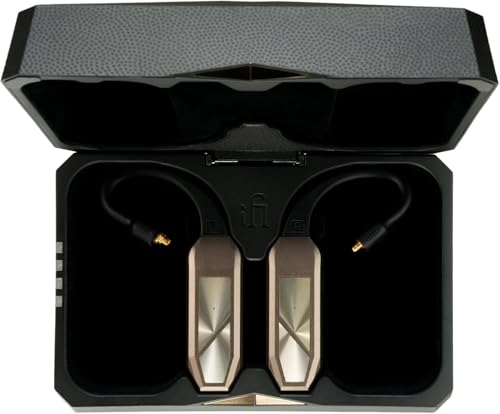
Key takeaways
- The Go Pod Max converts your existing detachable-cable IEMs into true wireless earphones, one DAC/amp hook per ear
- Your IEMs keep their tuning and fit; the Pods replace only the cable and the source
- Interchangeable connectors are the critical compatibility check — confirm your IEM’s connector type before buying
- Bluetooth codec support on your phone decides the sound-quality ceiling, so check both ends of the link
- The original Go Pod remains the value route into the same idea; the Max is the flagship expression of it
Where to buy the Go Pod Max
The linked listings in this review go to Amazon, where each product section carries a plain link so you can check price on Amazon and confirm exactly what is in the box before ordering. For this product the box contents deserve unusual attention: the pair of hooks, the charging case, and the connector set are the product, and the interchangeable connector system is only as useful as the connectors included for your IEMs. Check the listing’s description of included connector types against the IEMs you intend to convert, and be careful with marketplace listings that photograph the case prominently and the hooks vaguely. If the Max is unavailable in your region, the original Go Pod section explains precisely what carries over and what does not, so the substitution can be informed rather than hopeful.
In this guide
Quick picks at a glance
| Product | Role | Best for |
|---|---|---|
| iFi Go Pod Max | Flagship Bluetooth DAC/amp hooks | The subject of this review: IEM owners who want the fullest version of the wireless conversion |
| iFi GO Pod | Original Bluetooth DAC/amp hooks | The same conversion idea at a lower commitment, with LDAC and a long-playtime case |
How these picks were chosen
Both products were verified against Amazon’s catalogue data before this review was drafted: each listing title had to name the exact model, describe the Bluetooth DAC/amplifier function the review discusses, and carry an official product image. The comparison is intentionally a two-horse race inside one idea, because that is the actual decision facing a buyer. Nobody cross-shops a Go Pod against a random pair of wireless earbuds in a meaningful way — the earbuds are a different purchase for a different person — while the choice between the original Go Pod and the Max is the genuine fork in this road: same conversion, same connector philosophy, different levels of investment and refinement. Other wireless adapters are mentioned in prose where they clarify the category, but they are not linked, because they could not be verified to the standard this review requires.
The conversion idea, examined honestly
Start with what changes when your IEMs go wireless this way, because the changes are more interesting than the marketing suggests. The cable disappears, and with it goes cable noise — the rustling microphonics that wired IEMs transmit from clothing — along with the pocket tangle and the desk snag. In their place arrives a new physical reality: each ear now carries a hook with electronics and a battery behind it, so the total weight on the ear rises, the fit of your IEM is joined by the fit of the hook, and a charging case joins your daily carry. For most IEMs and most ears the hooks are comfortable for hours, because the weight sits where a cable’s over-ear loop already taught your ear to expect something. For small ears and for IEMs with unusual shell shapes, the combination needs a trial, and this review’s buying guide treats that trial as a planned step rather than an afterthought.
The sound question deserves the same honesty. A wired IEM driven by a good source is the reference, and no Bluetooth link is literally lossless in the way a cable is. What modern high-resolution codecs — LDAC in the original Go Pod’s specification, at up to 96kHz/24-bit — achieve is a ceiling high enough that, in mobile listening environments with mobile noise floors, the practical difference collapses for the overwhelming majority of listeners and recordings. iFi’s contribution is what happens after the codec: proper DAC conversion and amplification designed by a company that makes dedicated DACs, rather than the afterthought electronics inside a typical adapter. The result is that your IEM sounds like itself — its tuning, its character, its strengths — driven competently, in the environments where wireless actually gets used. Listeners whose use is a silent room and a reference chain should stay wired and consider this product a travel accessory. Listeners whose use is the world will hear their own earphones, freed.

iFi Go Pod Max Wearable Bluetooth DAC/Amp
Badge: The main review subject — the flagship wireless conversion for IEMs
- Function per the verified listing: wearable Bluetooth DAC and amplifier system for IEMs
- Design: one hook per ear, carrying its own conversion and amplification
- Compatibility model: detachable-cable IEMs via interchangeable connectors
- Position: the Max generation of iFi’s Go Pod family
The daily experience of the Max is best understood as a ritual replacement. The wired ritual — untangle, plug, route cables over ears, manage the slack — is exchanged for the wireless ritual: case out of pocket, hooks onto IEMs, IEMs into ears, music. The exchange favours the wireless side in every environment except the listening chair, and it compounds across a day of small uses: the train, the desk, the walk to lunch, the gym session where a cable was always a negotiation with the equipment. Because each hook amplifies its own channel, the system also scales gracefully across IEMs of different appetites; efficient monitors and more demanding designs are both driven with an authority that phone outputs and cheap adapters often lack, so the IEM you convert keeps its composure at volume rather than thinning out. That drive authority is the least glamorous and most consequential part of iFi’s execution, and it is where the company’s amplifier heritage stops being a biography note and becomes the product.
Calls and controls follow the true-wireless pattern: the hooks carry the microphones and the touch or button controls the category has standardised on, and call quality is governed by the same physics as every earbud — fine in a quiet room, challenged by wind, which is a property of microphones near ears rather than of this product. Battery life should be judged as a system: the hooks for a day’s listening sessions, the case as the reservoir that refills them, and the honest question is whether the combined total matches your longest day away from a charger, a question the original model’s specification — a case rated for 35 hours of total playtime — shows the family takes seriously. Owners of multiple IEMs will find the deepest satisfaction here is rotational: the stage monitors for the commute, the warm fun set for the evening walk, the reference set for the hotel room, all wireless through one platform, each keeping its own voice.
Strengths
- Converts IEMs you already own and love instead of replacing them with fixed-tuning earbuds
- Proper per-ear DAC and amplification from a company whose core craft is exactly that
- Modular value compounds with every detachable-cable IEM you own or buy later
Trade-offs
- The price only makes sense if your IEM collection justifies a platform purchase
- Hook fit over your specific IEM shells and ears needs a real-world trial
- Bluetooth remains Bluetooth: critical listening at a desk still belongs to a cable
Best for: IEM owners with two or more detachable-cable sets who want them wireless without surrendering their sound. Not suited for: listeners who own one budget IEM, for whom good true wireless earbuds are the simpler and cheaper answer.

iFi GO Pod HD Bluetooth DAC and Headphone Amp for IEMs
Badge: The original — the value route into the same idea
- Function: HD Bluetooth DAC and headphone amp for IEMs
- Codec support per the verified listing: high-resolution 96kHz/24-bit LDAC
- Connectors: interchangeable IEM connectors
- Case: 35 hours of total playtime, Qi wireless and USB-C fast charging
The original Go Pod is not a compromised Max; it is the product that proved the category, and its specification still reads like a manifesto. High-resolution LDAC support means the wireless link is not the bottleneck for most listeners. Interchangeable connectors mean the platform follows you across IEM brands rather than locking you to one. A case carrying 35 hours of total playtime, rechargeable by USB-C or Qi wireless, means the system fits a travel life rather than a desk-bound one. For a buyer whose IEMs are mid-priced and whose curiosity about the concept is genuine but unproven, the original is the rational entry: it delivers the conversion experience entire — the freedom, the sound character, the ritual — and the Max’s refinements can be evaluated later with knowledge. For a buyer whose IEMs are flagships and whose standards are set by a serious wired chain, the Max exists because that buyer will hear and value the flagship execution. Neither choice is the other’s failure; they are the same idea at two levels of commitment, priced accordingly.
Strengths
- The complete conversion concept with high-resolution codec support
- Interchangeable connectors keep it IEM-agnostic like its bigger sibling
- Long total playtime from the case suits travel and commuting rhythms
Trade-offs
- The Max generation exists above it for buyers who want the fullest execution
- Shares the platform economics: value depends on the IEMs you bring to it
- Hook-and-shell fit still needs the same real-world trial
Best for: first-time converters with a good mid-range IEM collection. Not suited for: buyers who know they want the flagship version and would only be delaying the purchase.
Go Pod Max versus the original Go Pod
| Product | Position | Codec headline | Choose it when |
|---|---|---|---|
| Go Pod Max | Flagship generation | High-resolution Bluetooth via iFi’s current platform | Your IEMs and standards justify the fullest execution |
| GO Pod | Original generation | LDAC up to 96kHz/24-bit per its listing | You want the concept proven at a lower commitment |
The comparison that matters is not really between these two products but between two buyers. The platform economics are identical: both purchases are bets that your future listening is IEM-shaped, and both pay off across every compatible set you own. The difference is the ceiling of execution and the price of reaching it. A useful discipline is to price the decision against your most expensive IEM: converting a flagship monitor with the value platform is a mismatch of ambitions, while buying the flagship platform for a single modest IEM spends the money where your ears will never find it. Match the platform to the collection, and both products become easy to place. Readers arriving from the stage-monitor world may want to read Sony’s IER-M500 stage monitor guide alongside this review, since those earphones are exactly the kind the Pods exist to liberate.
Buying guide: before you convert your IEMs
The compatibility census comes first, and it is non-negotiable. List every IEM you intend to convert and identify its connector: MMCX and the two-pin family cover most of the detachable-cable world, but two-pin itself has variations in pin diameter and socket recess that decide whether a connector seats securely or wobbles its way to an intermittent channel. Confirm that the Go Pod’s interchangeable connector set covers your IEMs’ types, and treat any IEM with a proprietary or recessed connector as a question to resolve before purchase, not after. An IEM with a fixed cable cannot be converted at all — the Pods need the socket the cable leaves behind — so a collection of fixed-cable earphones is a reason to stop and reconsider the entire purchase.
Second, audit your phone’s Bluetooth codecs, because the link’s ceiling is set by whichever end supports less. An Android phone with LDAC support lets the high-resolution path breathe; a phone limited to basic codecs still works perfectly well and sounds good, but the experience is then defined by convenience more than by fidelity, and the buying case should be made on those honest terms. Third, think about your listening environments as a proportion: the more of your listening that happens in motion, in noise, and in fragments across a day, the more the conversion returns; the more that happens in one quiet chair with a good wired source, the more the Pods are an accessory for the minority of your listening, and should be priced in your head accordingly. Finally, plan the fit trial. Order with the intention of testing hooks over your most-used IEMs for a full day — ears, glasses if you wear them, a hat if you wear one — because the platform’s comfort is a property of your specific combination, and discovering a conflict in week one is a return; discovering it in month two is a regret.
How to set up the Go Pod Max with your IEMs
Step 1: Charge everything before pairing anything
Start with the case and hooks fully charged. Wireless audio products generate more false first impressions from low batteries — reduced volume, connection oddities, one hook asleep — than from any genuine fault. A full charge also teaches you the case’s charge indicators while nothing else is going on, which you will appreciate the first time you check it in a hurry.
Step 2: Fit the correct connectors to your IEMs
Select the connector type matching your IEMs and attach the hooks with the care you would give any IEM connector: aligned, straight, and seated fully, never forced at an angle. MMCX connectors rotate by design and click home; two-pin connectors push straight and must be oriented for polarity. A connector that is not fully seated is the cause of nearly every early report of a channel cutting out, so make the seating check a ritual whenever you swap IEMs.
Step 3: Pair, then set the codec deliberately
Pair the hooks with your phone following the product’s pairing mode, then visit your phone’s Bluetooth settings for the connection and confirm which codec is in use. On phones that offer a choice, select the highest-quality option your listening supports and note the battery trade it carries. Test with a recording you know intimately — the point of this step is a reference impression you can compare against your wired baseline while the comparison is still fresh.
Step 4: Tune the fit with your glasses, hats, and day
Wear the combination through a normal day rather than a careful hour. Check that spectacle arms and the hooks coexist, that the hooks stay comfortable past the two-hour mark, and that the IEM seal you rely on wired has survived the conversion — the hook’s weight changes the mechanics slightly, and a tip size that was perfect on a cable can occasionally want revisiting. These are five-minute adjustments now and daily irritations if skipped.
Step 5: Build your rotation and your spares
Decide which IEMs live on the hooks and which stay wired, store the unused connectors where you can find them, and keep the charging case in the bag you actually carry. The platform rewards a small amount of organisation out of all proportion to its cost, because its entire pleasure is spontaneity — an IEM swapped in a minute, music in your ears on the platform — and spontaneity dies when a connector is in a drawer in another postcode. Owners of gaming in-ears might also compare Sony’s wired gaming in-ear monitor for the stay-wired alternative.
Common mistakes with IEM Bluetooth adapters
The first mistake is buying the platform for IEMs it cannot convert — fixed cables, exotic connectors, recessed sockets — which is why the census precedes everything in this guide. The second is judging the sound in the first hour against a wired reference in a silent room, the single environment where the comparison is least representative of how the product will actually be used; judge it across a week of real listening instead. Third, owners swap IEMs carelessly and bend connector pins with angled insertions, converting a robust system into an intermittent one; straight, aligned, unforced is the whole technique. Fourth, forgetting that two hooks are two batteries — running one flat by using a single hook for calls all day and then wondering at the imbalance in the evening. Fifth, expecting noise cancellation that the product never claimed: your IEM’s passive isolation does that job, and its quality is a property of your fit and tips, exactly as it was when the IEM was wired.
Go Pod Max versus simply buying true wireless earbuds
The comparison deserves a direct answer because it is the one every buyer asks. A good pair of true wireless earbuds is cheaper than this platform, smaller in the pocket, richer in features like active noise cancellation and wireless charging ecosystems, and utterly disposable in design: when its batteries fade, the product is finished. The Go Pod system is the opposite bet. It costs more, carries bigger, and offers no noise cancellation of its own — and it lets you keep the earphones you already chose, upgrade them independently, replace a cable-era IEM without replacing the wireless platform, and never throw away a battery-sealed earbud again. The deciding question is embarrassingly personal: do you have IEMs you love? If yes, the Pods are one of the few products in modern audio that respect that attachment instead of asking you to abandon it. If no — if your drawer holds one forgotten bundled earphone — the earbuds are the honest purchase and this platform is a solution shopping for a problem. This review’s enthusiasm is conditional, and the condition is your collection.
Codec literacy: the five-minute version that decides your sound
Bluetooth audio is not one thing, and the Go Pod conversation is meaningless without separating its layers. Every Bluetooth audio connection negotiates a codec — a compression language both ends must speak. The baseline codec every device speaks is the oldest and most compressed; it sounds acceptable and is nobody’s reason to buy this product. Above it sit progressively better languages, with LDAC — named in the original Go Pod’s specification at up to 96kHz/24-bit — among the most capable widely supported, carrying several times the baseline’s data rate. The practical consequences sort listeners into three groups. If your phone and your ears and your environments are all mainstream, codec differences will be the smallest variable in your day, behind fit, tips, and the recording itself. If you listen in quiet places to good recordings, the high-resolution path is worth configuring deliberately, because it removes the link as a suspect. And if your phone cannot speak the better codecs at all, no adapter can teach it — the ceiling is set at the phone end, and your purchase should be justified by freedom and drive quality rather than by resolution you cannot receive. Checking your phone’s codec support takes two minutes in its specifications and is the highest-value research in this entire buying process.
Drive authority: why amplification is the sleeper specification
Ask owners of cheap Bluetooth adapters what disappointed them and few will say resolution; they will say their IEMs sounded thin, quiet, or lifeless at the volumes their day required. That is an amplification failure, not a codec failure. An IEM’s rated sensitivity hides wide variation in how much voltage and current a design wants to deliver its full dynamic range, and an underpowered output compresses exactly the qualities — bass control, dynamic swing, composure at volume — that made the IEM worth converting. iFi’s background is the relevant credential here: this is a company whose dedicated headphone amplifiers are its core business, and the Go Pod concept only makes sense executed at that standard. When this review says the IEM sounds like itself through the Pods, the mechanism is mostly this: conversion done properly and amplification done with headroom. It is also why the platform flatters demanding IEMs that embarrass phone outputs, and why the comparison against generic adapters is not close in the direction that matters. Specifications pages will always lead with codecs because codecs are countable; your ears will judge the amplification because it is audible.
The economics of a collection, worked through
Run the numbers the way an owner actually experiences them. A listener with three detachable-cable IEMs — a stage set, a warm set, a reference set — faces three separate replacements if they chase wireless through earbuds, each with its own battery clock ticking toward disposal. The platform route costs one purchase, after which all three sets are wireless, each retaining the tuning that earned its place, and any fourth set bought later is wireless from the day it arrives at no extra platform cost. The break-even is therefore not really about price; it is about whether your listening identity is invested in IEMs you selected. There is also a sustainability argument that audio buyers increasingly make without prompting: a system whose wear parts are tips and whose platform survives across earphones generates a fraction of the e-waste of sealed earbuds replaced on a battery schedule. None of this rescues the purchase for the one-cheap-IEM owner, for whom the maths runs the other way just as clearly. The product is honest about its audience; the review’s job is to make sure you know which side of the line your drawer is on.
Travel, work, and the shape of a wireless day
The product’s value is easiest to see across one ordinary working day. The commute is the obvious win — no cable between phone and ears means no snagging on bag straps, ticket gates, or the person squeezing past you — but the desk hours are where the conversion quietly compounds. A wired IEM at a desk is a tether measured in how often you stand up forgetting it; a converted IEM lets you fetch coffee during a long call, water the plants during a podcast, and pace during the meeting that needs pacing, all without an audio interruption or a phone carried in the hand. Video calls benefit in a subtler way: you hear colleagues through earphones you find comfortable for hours, and your own voice reaches the hooks’ microphones at ear distance, which is a kinder arrangement than a laptop microphone across a desk. Flights reward the case’s role as reservoir and the system’s indifference to seat-back entertainment sockets. None of these moments is dramatic, and that is the point: the product’s return is distributed across hundreds of small frictions removed, which is why owners describe it as life-changing in aggregate and unremarkable in any single hour.
Latency, video, and gaming through the Pods
Every Bluetooth link carries delay, and honest reviewing requires placing the Go Pod family inside that reality rather than above it. For music, delay is meaningless. For video, modern phones and apps compensate by delaying the picture to match, so films and streaming feel synchronised in normal use. For gaming, the picture splits: casual and single-player titles are untroubled, while competitive players chasing frame-perfect audio cues will find any Bluetooth link a compromise against a wire, and should treat the Pods as their everything-else solution while keeping a cable for ranked sessions. That division is not a defect of this product but a property of the technology it rides on, and it is stated here because the IEM audience overlaps heavily with the gaming audience. The correct mental model is a division of labour across your day: wireless for the ninety percent of listening where freedom dominates, wired for the ten percent where microseconds do — with the same IEMs serving both, which is, once again, the entire idea.
Long-term ownership: batteries, connectors, and care
A platform purchase is a long-term relationship, so its ageing deserves the same scrutiny as its first week. The batteries in the hooks are the system’s clock: like every lithium cell they will hold less charge in year three than in year one, and the case’s reservoir role means the system degrades gracefully — sessions shorten before anything fails outright. The honest mitigation is behavioural: the hooks live in their case, charged and ready, rather than being deep-discharged daily. The connectors are the mechanical wear point, and their enemy is angled force; owners who swap IEMs weekly with the straight, aligned technique from the setup section will get years from them, while owners who wrench will not, and no warranty philosophy changes that physics. Keep the case’s charging contacts clean, keep the hooks’ contacts free of pocket lint, and the system asks almost nothing else. Compare that maintenance list with the wired alternative — cables replaced as they fatigue — and the platform’s ownership burden is genuinely lighter, which matters for a product whose whole pitch is removing friction from an IEM habit.
There is also a resale and continuity point that platform products earn and earbuds do not. A Go Pod system sold on, or kept through two generations of phones, retains its function because its function is defined by standards — Bluetooth and IEM connectors — that change slowly and compatibly. The history of audio is littered with proprietary wireless schemes orphaned by their makers; a platform built on the industry’s two most durable interfaces is about as future-proof as consumer electronics gets. Buyers tired of re-buying their accessories with every phone generation are the natural constituency, and they tend to recognise this product immediately.
Which IEMs convert best: a pairing guide in prose
Not every IEM gains equally from conversion, and pairing sense separates delighted owners from indifferent ones. Compact, light shells convert best, because the hook adds its own presence behind the ear and a bulky shell plus a hook can overwhelm smaller ears; the classic stage-monitor shapes, designed for over-ear cables, are naturals here since their ergonomics already assume something looping behind the ear. Very heavy flagship shells deserve a trial before commitment. Tuning interacts too: an IEM whose wired life was spent on a warm, powerful desktop amplifier will reveal any shortfall in a lesser adapter, which is why this platform’s amplification matters — through the Go Pods, demanding sets keep their character instead of being quietly demoted. Highly sensitive IEMs, the kind that hiss on noisy sources, are the other test case: they expose an output’s noise floor mercilessly, and a platform from a serious DAC maker is precisely the answer to that sensitivity. If your collection includes one demanding set and one sensitive set, you own the two hardest tests in the category, and a platform that passes both has earned its place across everything else you will ever plug into it.
Singers and stage users form a special pairing case worth a paragraph of caution and encouragement. A converted stage monitor is not a stage monitoring system — the Bluetooth link’s latency rules it out for live performance, where the wired path or a dedicated wireless IEM system remains mandatory. What conversion does for performers is everything around the performance: rehearsing parts on the train, learning harmonies on a walk, reviewing the desk recording on the way home, all through the same monitors whose sound they trust on stage. That continuity of reference is genuinely valuable to a working musician, and it is a use the earbuds market cannot serve at any price, because no earbud is the monitor you perform in.
A word for the sceptical audiophile reader who has followed this far with arms folded, because the review owes them a direct paragraph. Your objections are correct in their own terms: the link is not bit-perfect against a cable, the amplification is not your desktop stack, and the listening environments this product serves are not your listening room. The product does not dispute any of that. Its claim is narrower and, for most owners, larger: that the best earphones are the ones in your ears, and that a drawer of superb IEMs exiled by a cable is a worse outcome than those same IEMs carried by an excellent wireless platform into the whole of your day. If your listening genuinely happens in one chair, keep the cable and spend the money on recordings. If it happens everywhere else as well, the conversion is not a compromise of your standards; it is their extension into the rest of your life.
Gift-givers should approach this one with a diagnostic question rather than enthusiasm: does the recipient own good IEMs and complain about cables? If the answer is a clear yes, few gifts in audio land as precisely — it is the rare present that makes possessions someone already loves more useful. If the answer is vague, the same money buys excellent complete earbuds that need no collection to justify them. The product rewards knowledge of its owner, which is another way of saying it is a platform for enthusiasts, bought best by the enthusiast themselves.
Podcast and audiobook listeners, a constituency audio reviews routinely forget, may actually be this platform’s happiest users. Spoken word is merciless about comfort over three-hour stretches and indifferent to the last degree of musical resolution, while being exquisitely sensitive to the freedom of moving around a house with a story in your ears. A comfortable IEM you already own, converted, will out-serve any earbud for that life — and your spoken-word library will never once ask about codecs.
Commuters by bicycle and on foot should weigh one safety note that has nothing to do with the Pods and everything to do with sealed IEMs: total isolation in traffic is a hazard whatever carries the signal. Many owners use one hook only, or a transparency-friendly earbud, for the road portion of a journey and convert fully at the office or the train. The platform makes that mixing easy because the IEMs themselves never change — only how they are driven does.
Home workers with a standing desk will find a benefit nobody advertises: the converted IEM is the only listening setup that survives the sit-stand transition without a cable length negotiation. The phone stays on the desk, the desk moves, you move, and the music simply continues — a small mercy that, repeated daily, explains a surprising amount of owner loyalty to this category.
Finally, consider the platform as the answer to a question the earbud industry prefers you not to ask: why should the wireless electronics and the earphone share one lifespan, one battery clock, and one grave? Separating them is an older, hi-fi way of thinking — source, amplification, and transducer as independent choices — applied to the most modern listening habit there is. Listeners raised on component systems will find the philosophy familiar and the execution convincing; listeners raised on sealed gadgets may find it quietly revelatory. Either way, it is the idea this review is really recommending, with the Max as its current best instrument.
Students of audio history will enjoy one last resonance: the component hi-fi era separated turntable, amplifier, and speakers so each could be chosen on merit, and the all-in-one era collapsed them for convenience at the cost of exactly that freedom. The Go Pod family is the component instinct returning at earphone scale, with Bluetooth standing where the interconnect cable used to be. Judged in that lineage, the Max is not an accessory at all. It is the amplifier shelf of a separates system, shrunk to two hooks and a case.
Practical shoppers should also note the returns-window strategy this category invites: because fit is a property of your ears plus your shells, buy from a listing whose returns terms you have actually read, test the combination across several real days inside that window, and let the trial — not the unboxing — make the final decision. A platform that fits your life will prove it within a week; one that fights your ears will prove that too, and both answers are worth the small effort of a disciplined trial.
And if your collection is still young — one good IEM today, ambitions for more — the platform decision can reasonably wait until the second set arrives. The original Go Pod will still be there, the Max will still be the flagship, and you will make the choice with the knowledge of which connector family your taste has settled into, rather than betting on it in advance.
One closing practicality: label your connector sets by IEM if you own several, with a dot of tape or a note in the case. Swaps take a minute when the right connector is in your hand and ten when it is not, and the platform’s whole pleasure is that the swap is casual. Small systems of organisation are what keep modular products feeling modular rather than fiddly.
Frequent flyers get the last specific word, because the case-based system suits cabin life unusually well: the reservoir covers a long-haul day without a cable hunt, the hooks have no wire to tangle in a seat pocket, and your own IEMs’ passive isolation — chosen by you, fitted to you — does the noise work that makes a cabin bearable, without depending on an earbud’s battery-hungry cancellation for a ten-hour stretch.
That combination — your earphones, your fit, your tuning, carried everywhere by a platform that asks only to be kept charged — is the complete case for the product, and it is enough.
Beyond that, the only remaining step is the trial itself, in your ears, with your music, across your own ordinary week.
Final recommendation
The Go Pod Max is the fullest expression of an idea whose time has genuinely come: separating the wireless platform from the earphone, so each can be chosen, kept, and upgraded on its own merits. For the IEM-rich listener it is not an accessory but an emancipation — every detachable-cable set you own becomes a true wireless set, driven properly, with its own voice intact. Buy the Max if your collection and your standards sit at the level where its execution will be heard. Buy the original Go Pod if you are proving the concept to yourself with mid-range IEMs. And stay wired without a backward glance if your listening life is lived in one chair with a good source — the cable was never your problem. For everyone in between, whose great earphones have been gathering dust since their phone lost its jack, this is the product that gives them back.
Frequently asked questions
Will the Go Pod Max work with my IEMs?
If your IEMs have detachable cables with a supported connector type — the interchangeable system covers the common MMCX and two-pin families — then yes, subject to the socket variations discussed in the buying guide. Recessed or proprietary sockets are the cases to verify individually before buying. Fixed-cable earphones cannot be converted by any product of this type, because there is no socket for the hook to occupy.
Does Bluetooth conversion change how my IEMs sound?
The IEM’s tuning — its balance, character, and fit — is unchanged, because the drivers and housings are untouched. What changes is the source: conversion and amplification now happen in the hooks, and the signal arrives over a Bluetooth codec rather than a wire. With a high-resolution codec and iFi’s electronics, the practical difference in real listening environments is small; in a silent room against a reference wired chain, an exacting listener can identify the link. Judge it by your environments, not by the laboratory case.
Can I still use my IEMs wired afterwards?
Yes, and this reversibility is one of the platform’s quiet virtues. The hooks detach and the original cable — or any upgrade cable — reattaches, returning the IEM to its wired life in a minute. Owners commonly keep favourite sets wired at the desk and rotate the hooks across the rest of the collection, or convert everything and keep one cable in the case for flights and flat batteries.
How does battery life work across hooks and case?
Each hook carries its own battery for a day’s worth of listening sessions, and the charging case is the reservoir that refills them between uses — the family’s original model rates its case at 35 hours of total playtime, which indicates the design philosophy. Your real-world figure depends on codec choice and volume, both of which trade against battery. The habit that makes the system effortless is returning the hooks to the case whenever they leave your ears, so charging is a by-product of storage.
Is it suitable for exercise?
For gym training, generally yes: the over-ear hook form is secure, and your IEM’s fit does the rest, though sweat management and the absence of any claimed water resistance argue for using a set of IEMs you do not mind training in. For running outdoors, weigh the isolation question as with any sealed IEM — traffic awareness matters more than equipment — and consider whether your most precious monitors belong in a gym bag at all when a mid-range set converts just as happily.
Why not just use a Bluetooth receiver cable instead?
Receiver cables and neckband adapters are cheaper and perfectly functional, and for a single IEM they are a rational choice. The Go Pod removes the last wire — nothing connects the two ears, nothing hangs on your neck or sits in a pocket — and replaces generic adapter electronics with a dedicated per-ear DAC and amplifier. Whether that final step of freedom and that level of electronics justify the price is the same collection-dependent question as the earbuds comparison: the more IEMs and the more listening, the stronger the case.
Do the hooks work independently for calls?
Like most true-wireless systems, a single hook can serve for a call while the other rests in the case, which is handy for long phone days — with the caveat from the mistakes section in mind: one-sided use all day leaves the pair unbalanced in charge by evening. Alternating ears across calls is the small habit that keeps both hooks ageing together, and it rests each ear in turn, which your comfort will thank you for independently of the batteries.
What happens if I lose one hook?
You have a mono system and a problem worth solving through the manufacturer’s support rather than the second-hand market, because hooks are paired and configured as a system. The practical defence is the case habit this review keeps recommending: hooks that are either in your ears or in their case are almost impossible to lose, while hooks placed loose on desks, dashboards, and café tables are how single-hook ownership happens. Prevention is unglamorous and completely effective.
Related guides
Continue with the Sony stage monitors these adapters liberate, gaming headsets for listeners who prefer over-ears, and the wired Cloud II headset review in this cluster.