Disclosure: As an Amazon Associate, reviewstook.com earns from qualifying purchases. Links on this page are affiliate links; they cost you nothing extra. Prices and availability change often, so check the current Amazon listing before you buy.
Two of the most recommended noise-cancelling headphones of their generation meet in bose quietcomfort 45 vs sony wh 1000xm4, and the contest is closer than either fan base admits. Bose built the QuietComfort 45 around a single promise kept extremely well: silence and comfort for long stretches, with controls a tired traveller can work without looking. Sony’s WH-1000XM4 answers with the longer feature list — adaptive cancelling, a fuller app, more codecs, smarter sensors — and dares you to find the traveller who would trade those for simplicity.
This bose quietcomfort 45 vs sony wh 1000xm4 comparison works through cancelling, sound, comfort, calls, controls, and battery in the order real owners feel them, and it names a winner per category instead of hiding behind balance. Both models are verified below with current listings, because both remain on sale as value picks now that newer flagships carry the headlines. If your shortlist has narrowed to these two, the deciding factor is almost certainly your travel pattern, not the spec sheet.
Key takeaways
- Bose wins long-haul comfort and physical-button simplicity; Sony wins features, app depth, and codec choice
- Noise cancelling is elite on both, with Bose steadier on low rumble and Sony smarter about changing environments
- Sony folds flat and smaller; Bose feels lighter over four hours
- Both are verified current listings, linked below with official images
In this guide
Bose Quietcomfort 45 Vs Sony Wh 1000xm4: the short verdict
Buy the Sony if your headphones serve a varied life — office, commute, calls, films, a phone that supports its better codecs — and you enjoy tuning a product to your habits. Buy the Bose if your headphones exist mainly to erase aeroplane cabins and open-plan offices for hours at a time, and you want the controls to be buttons you can find with gloves on. Neither answer is a consolation prize; these are two different philosophies executed well, which is why the comparison has survived several newer launches on both sides.
Price history makes the pair even more interesting, because both now sell as the value tier beneath their successors. That reframes the question from which is best to which discount is wiser, and the answer still follows the same split: features age, comfort does not. A traveller who flies weekly will feel the Bose advantage on every sector; a hybrid worker will spend the Sony’s features daily. Choose for the life you actually repeat, not the trip you imagine.
Noise cancelling, in cabins and offices
Bose’s cancelling is the steady kind: a deep, even suppression of low-frequency rumble that does not waver as you move your head, and that consistency is what frequent flyers describe as restful. The QC45 offers its Quiet and Aware modes with no granular adjustment, a limitation that reads as simplicity once you realise the Quiet mode is simply set where most people would set it. Voices and keyboard clatter are reduced rather than erased, as with every system, but the floor of the world drops away convincingly.
Sony counters with adaptivity. The XM4 adjusts its cancelling to pressure and activity, offers fine-grained levels in the app, and can learn locations — gentler at the desk, stronger on the train. At its best it matches or edges the Bose on raw suppression, particularly across the midrange where office noise lives. The trade is that adaptivity occasionally makes decisions you can hear, a faint recalibration as environments change. Some owners love the intelligence; others prefer the Bose’s set-and-forget steadiness. Both reactions are rational.
Sound signatures and codec support
Out of the box, the Bose sounds like Bose: smooth, slightly warm, vocals forward, nothing spiky anywhere, tuned to offend nobody across a six-hour listen. It plays only the baseline codecs plus AAC, which covers Apple users fully and leaves Android owners on the standard path. There is no equaliser in Bose’s app beyond the basics on this model, so the signature you audition is the signature you keep — audition honestly, because there is little rescue available later.
Sony ships a bass-forward excitement that flatters pop and film, then hands you a proper equaliser to pull it toward neutral if you prefer. Crucially, the XM4 supports LDAC for high-resolution streaming from compatible Android phones and players, which the Bose cannot answer. For listeners with an LDAC source and the ears to care, this single line may settle the comparison. For listeners on iPhones or streaming compressed music in noisy places, it settles nothing, and the Bose’s restraint may suit better.
Comfort over real durations
Comfort is where the Bose quietly builds its case. The QC45’s clamping force is gentle, its ear cups are roomy, and the whole headset disappears during long wear in a way that has made the QuietComfort line the default recommendation for sensitive heads and glasses wearers. The Sony is comfortable by any normal standard — soft pads, sensible weight — but its clamp is firmer and its cups slightly shallower, and across a four-hour flight those small differences compound into the adjustment fidgets the Bose never provokes.
Heat follows the same pattern. Both are closed over-ears and both warm the ears in summer, but the Bose’s lighter touch traps marginally less. If your use is ninety-minute commutes, call this category a draw and move on. If your use is long-haul aviation or full workdays of wear, weight this category double, because it is the one you will feel in your body rather than merely notice in a menu.
Controls, sensors, and daily manners
Bose kept physical buttons: volume, play, a mode switch, all findable by touch, all functional with gloves, none prone to the accidental brush that touch panels invite. Sony bet on a touch surface plus wear detection that pauses when you lift a cup, and a speak-to-chat feature that drops the music when you talk. When Sony’s automation guesses right, it feels like the future; when it pauses your song because you sang along, it feels like being managed by your own headphones.
Neither approach is objectively correct, which is why this category splits owners so cleanly. Decide by temperament and context: gloves, winter commutes, and a preference for certainty favour buttons; desk work, frequent quick conversations, and a love of automation favour Sony’s sensors. Both headsets handle multipoint connections to two devices, and both do it competently, which removes one potential tiebreaker and returns the decision to fit and sound, where it belongs.
Calls, battery, and travel practicalities
For calls, the Sony’s microphone array and processing give it the edge outdoors, where its wind handling keeps voices intelligible a notch longer. Indoors, both are perfectly serviceable and neither will fool anyone into thinking you are on a studio microphone. Battery life favours Sony on paper and in practice for mixed use, particularly with cancelling on all day, while the Bose counters with a wired mode that keeps working — with cancelling — when the battery is spent, a traveller’s detail that has rescued many a red-eye.
Portability splits the other way: the Sony folds flat and into a smaller case, slipping into laptop bags that the Bose’s larger fold cannot. Frequent travellers with tight carry-ons feel that difference weekly. Both charge over USB-C, both include a cable for seatback screens, and both have apps that behave. The practical ledger, added up, is why this comparison refuses to die: each model wins the categories the other loses, in an almost elegant alternation.

The products worth a closer look
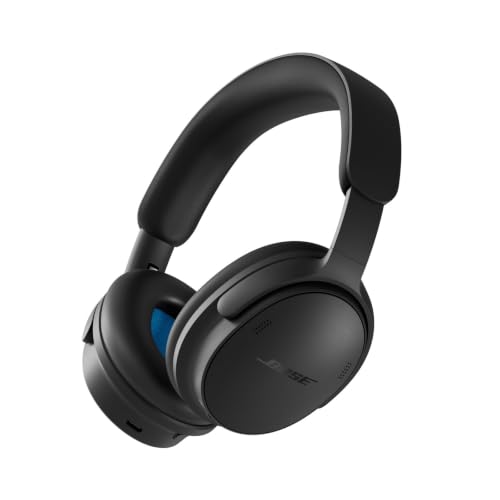
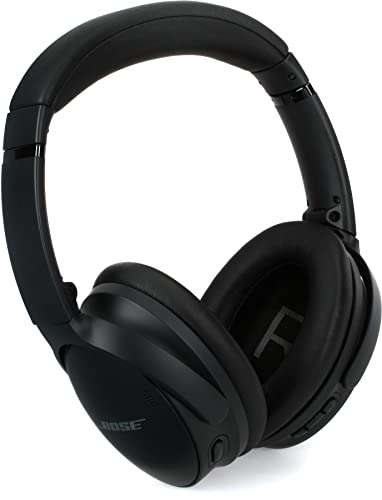
Bose QuietComfort 45
Best for long-haul comfort
The QuietComfort 45 is Bose’s argument that a travel headphone should above all disappear: deep, steady cancelling, a gentle clamp, roomy cups, and buttons your fingers find unaided. Its Triple Black listing here is the standard retail model, verified against the maker’s own catalogue entry, and it remains the version of this headset that frequent flyers recommend to each other in departure lounges.
What you give up is customisation. There is no equaliser to speak of and no high-resolution codec, so the smooth factory tuning is the whole offer. For the listener who wants exactly that — silence, comfort, music presented without fuss — the restraint is the product. Everyone else should read the Sony’s entry below before deciding.
- Over-ear closed-back design with active noise cancelling
- Bluetooth multipoint for two simultaneous connections
- Physical button controls on the ear cup
- USB-C charging and a wired listening mode
Strengths
- Cancelling that stays steady as you move
- Comfort that survives full workdays and long flights
- Buttons that work with gloves and under blankets
Trade-offs
- No equaliser for reshaping the sound
- No high-resolution Bluetooth codec support
- Larger folded size than its Sony rival
Best for: frequent flyers and long-wear listeners who value calm over features / Not suited for: tinkerers who want an equaliser and LDAC

Sony WH-1000XM4
Best for features and codecs
The WH-1000XM4 is the maximalist answer: adaptive cancelling that reads your environment, wear detection, a proper equaliser, and LDAC for listeners whose phones and libraries can feed it. The black model linked here is the canonical listing, and years after launch it remains the benchmark against which value noise-cancelling headphones are measured, because its feature set has no obvious hole.
Its compromises are temperament rather than quality. The touch controls and speak-to-chat automation delight until they misfire, and the firmer clamp asks more of sensitive heads on long days. Buyers who enjoy configuring a product to their habits will extract more from this headset than from any rival of its era.
- Over-ear design with adaptive noise cancelling
- LDAC, AAC, and SBC codec support
- Touch controls with wear detection
- Multipoint Bluetooth connection for two devices
Strengths
- The deepest feature set of its generation
- Equaliser and LDAC for listeners who use them
- Folds flatter into a smaller travel case
Trade-offs
- Touch controls can trigger accidentally
- Firmer clamp than the Bose on long wear
- Automation features occasionally guess wrong
Best for: feature-driven listeners and Android users with high-resolution libraries / Not suited for: glove-wearing travellers who want only buttons
Living with each: a month of small moments
Specifications decide shortlists; small moments decide satisfaction. The Bose’s moments are absences: the fourth hour of a flight with no urge to adjust the cups, the gloved hand finding the volume button first time, the battery dying over the ocean and the cable keeping the silence alive. The Sony’s moments are presences: the music pausing itself as you lift a cup to hear an announcement, the equaliser rescuing a podcast recorded in a tin can, the case sliding into a bag that the Bose’s would not enter. Neither list is longer; they are lists for different lives, which is the whole review in miniature.
Owners’ long-term reports follow the same split with eerie consistency. Bose owners replace ear pads and keep travelling; Sony owners explore features for a month, settle into three they love, and keep those. Complaints are equally loyal to type: Bose owners wish for an equaliser exactly as often as Sony owners wish the automation would stop guessing. A comparison that ends by telling you which temperament you have has done its job, because these two headphones are, in the end, temperament made audible.
The successors question, answered honestly
Both models have newer siblings, and a buyer in a shop will be steered toward them. The steering deserves one fair paragraph: the successors improve details — cancelling by increments, codecs, comfort by degrees — at prices that reframe these two as the value tier. Nothing in the newer models invalidates the comparison you have just read, because the philosophies did not change: Bose still builds the calm traveller, Sony still builds the maximalist instrument. What changed is the price of admission to each philosophy, and it fell.
So the successors question answers itself by budget. If the newer models cost little more on the day, their increments are worth collecting. If these two sit at the substantial discounts their age usually commands, they are among the safest purchases in audio — mature firmware, known failure modes, a decade of collective ownership experience — and the money saved buys the travel they were built for. Old flagships do not become bad headphones when new ones launch; they become bargains with documentation.
Living with each headphone for a month: the details reviews rush past
Week one is about fit, and fit is about time
Both of these headphones feel comfortable in a ten-minute shop test, which is precisely why shop tests mislead. The differences that matter emerge at hour three of a working day: how the clamp distributes across the jaw, whether the earcup depth lets your ears touch the driver cloth, and how the headband’s pressure point behaves when you lean back. Bose built its reputation on exactly this long-session kindness, with a lighter touch and a headband that disappears; the Sony counters with deeper cups and a fit that stays planted when you move around the house. Neither answer is wrong, but your day chooses between them more honestly than your ears do in a store.
The case, the fold, and the bag you actually carry
Travel exposes design philosophy in the smallest ways. One of these folds flatter for a laptop bag’s slim pocket; the other folds into a ball that suits a backpack’s main compartment. The cases differ in how much they forgive being sat on, how the cables and adapters are corralled inside, and whether the headphone can be grabbed one-handed while the other hand holds a passport. Commuters should weigh these paragraphs as heavily as any sound signature paragraph, because the headphone that travels badly gets left at home, and a headphone at home has no sound signature at all.
Controls under real conditions: gloves, rain, and haste
Physical buttons and touch surfaces divide owners more sharply than any frequency graph. Buttons can be found blind, pressed with gloves, and trusted in rain; touch panels offer swipes and speed but ask for bare fingers and dry weather. Think about your actual journeys: the winter platform, the gym, the kitchen with wet hands. The control scheme you can operate in your worst conditions is the one you will praise in month six, long after the novelty of either has faded.
Sound character in the genres people actually play
| Listening diet | Where the Bose character helps | Where the Sony character helps |
|---|---|---|
| Podcasts and audiobooks all day | A calm, voice-forward presentation that stays easy at low volume for hours | Strong isolation of the voice from room noise when the room is loud |
| Electronic and hip-hop | Controlled low end that keeps kick drums tidy rather than enormous | A deeper bass shelf for listeners who want physical weight in the low notes |
| Rock and live recordings | Even-handed guitars and vocals that sit naturally in the mix | Energy and separation that flatter busy arrangements at higher volumes |
| Classical and acoustic | A relaxed stage that suits long, quiet listening | Detail retrieval that rewards attentive listening in silent rooms |
| Films and late-night TV | Dialogue clarity at modest volumes when the house is asleep | Dynamics that make effects feel cinematic through a small driver |
The honest summary of that table is that tuning taste is personal in a way specifications cannot settle, and both makers know their houses’ sounds well. What the table does settle is the shape of the choice: pick the presentation that flatters your dominant genre, because the headphone that wins your most-played category wins your year, even if it concedes a category you visit monthly.
Equaliser access changes the calculation slightly. An app with a real equaliser lets the flexible listener bend one headphone toward the other’s territory, within limits set by driver behaviour and distortion. If you are the kind of owner who enjoys that bending, weight the app’s quality and the headphone’s willingness to be tuned; if you will never open the equaliser, judge only the stock tuning and let the tweakers’ advantages go.
Calls, meetings, and the microphone reality
Both headphones contain microphones tuned by companies that also make professional audio gear, and both are humbled by the same physics: the microphone sits by your ear, far from your mouth, in whatever wind and room noise your day provides. In a quiet home office, either will carry a meeting perfectly well and your colleagues will not know which you chose. On a windy street, both will ask you to repeat yourself, and the difference between them is smaller than the difference made by turning your back to the wind.
- For all-day meeting schedules, comfort outranks microphone nuance. A headphone you remove between calls because it aches will miss the surprise call that matters. Fit for eight hours first; the microphones are closer than the marketing suggests.
- For recorded voice work, neither replaces a desk microphone. Podcast guests and narrators should treat any headphone microphone as a backup. This is not a flaw in these models; it is geometry, and geometry does not negotiate.
- Multipoint behaviour matters more than call quality here. The daily meeting pain is the headset that stays married to the phone while the laptop begs. Both models offer multipoint; how gracefully each handles the laptop-phone handover deserves a test in your own first week, inside the return window.
- Wind handling separates them outdoors more than indoors. If your calls happen on platforms and pavements, prioritise the model whose wind behaviour reviewers and owners consistently describe as calmer, and test with a desk fan before your first commute if you can.
The mature conclusion is that call quality should break ties, not make decisions, between these two. Buy for fit, sound character, and noise cancelling in your loudest regular environment, and the calls will take care of themselves in all but the windiest lives.
Ownership economics: batteries, parts, and the second-hand market
Premium headphones are long-lived goods, and their ownership costs hide in consumables. Earpads flatten and crack across two or three years of daily use; batteries lose capacity on a similar horizon; headbands and hinges accumulate the fatigue of a thousand folds. Both of these models benefit from large user bases, which means pads, cases, and cables are easy to source, and repair knowledge is a search away. That ecosystem is an unglamorous reason these two specific models remain recommendable years after launch: the internet has already solved their common problems in public.
The second-hand market deserves a paragraph of its own, because both models circulate widely and the price gap between a careful used pair and a new successor is where value hunters live. Buying used, inspect the pads and the headband cushion first, since those are the parts your skin meets and the previous owner’s sweat met; test the noise cancelling in a genuinely loud place, because a failing microphone in the cancelling array announces itself there; and confirm the battery across a full day rather than a hopeful half hour. A used pair that passes those three checks delivers most of this comparison’s pleasures for a fraction of the original stakes.
Finally, consider the household maths: these are headphones people keep until something breaks, often five years or more. Spread across that life, the difference between the two at purchase matters less than choosing the one whose fit and controls you will not tire of, because the expensive headphone is the one replaced early out of daily irritation.
Noise cancelling in the environments that actually test it
Noise cancelling is usually demonstrated against a steady drone, because drones are where the technology is strongest and demonstrations prefer strength. Real life supplies a richer exam: the drone of a train layered with a crying child, the office’s hum interrupted by a colleague’s laugh, the café’s clatter that arrives as a thousand small transients. Both of these headphones were engineered by teams who understand that exam, and their results divide by frequency and by steadiness in ways a single demonstration cannot show.
| Environment | What dominates the noise | What to listen for when comparing |
|---|---|---|
| Airliner cabin | Low, steady engine and airflow drone | How much of the roar’s body disappears, and whether pressure-like discomfort appears at hour two |
| Train or bus | Drone plus rhythmic transients and announcements | Whether the transients poke through as isolated events once the drone is gone |
| Open-plan office | Voices, keyboards, HVAC hum | Voice attenuation, the hardest test, and how natural the remaining hush feels across a workday |
| City street | Traffic wash, wind at the earcups | Wind behaviour, which is a fit and microphone-array question as much as a cancelling one |
| Home with children or pets | Unpredictable, beloved chaos | Whether you want isolation at all, or awareness; transparency modes enter the decision here |
The office row deserves expansion, because it is where expectations are most often injured. Cancelling erases steady sounds superbly and voices only partially, by physics rather than by anyone’s incompetence: voices are irregular, information-dense, and exactly what human hearing evolved to extract. A buyer whose dream is silence in a chatty office should calibrate that dream now: these headphones will lower the room’s volume and remove its hum, and the colleague will remain audible, reduced, and considerably easier to ignore behind music. That is a large real benefit and a smaller advertised one, and knowing the difference is the whole point of a comparison like this.
Transparency behaviour belongs in the same conversation, because a headphone you must remove for every conversation is a headphone you stop wearing. Both models let the world back in on demand; the differences are in how natural that world sounds and how quickly the mode engages when a flight attendant, a barista, or a child requires you. Test it in the first week with real interruptions, not in the shop’s quiet, because this feature’s quality is measured in the seconds of your life it returns to you daily.
The app ecosystems and the decade of small decisions
Modern premium headphones are partly software products, and the companion app is where the ownership relationship lives after the first week. Equaliser presets and custom curves, control customisation, firmware updates, find-my-headphones courtesies, and the multipoint management discussed elsewhere in this guide all arrive through two apps with different philosophies. One maker’s app leans toward simplicity and a smaller set of decisions presented cleanly; the other’s leans toward depth, with more granular control for owners who enjoy tuning. Neither philosophy is a defect, but they suit different temperaments, and temperament mismatches are a quiet source of returns.
Firmware is the app’s most consequential cargo. Both of these models received meaningful updates across their lives, refining cancelling behaviour, call handling, and connection manners after purchase, which is a form of value that never appears on a specification sheet. It also introduces the owner’s one real obligation: keeping the app installed and the firmware current, because a headphone frozen at its launch software is only most of the product you paid for.
- Equaliser depth decides the tuning argument. If you plan to bend one headphone toward the other’s sound, as the genre section suggested, the app’s equaliser quality and whether settings persist on the headphone itself, across devices, are the details that determine whether the plan survives contact with your phone and laptop both.
- Control customisation is accessibility in disguise. Reassigning a button or a gesture matters to owners with limited dexterity, gloved commutes, and strong habits from a previous brand. Check what each app lets you move before assuming your hands must relearn everything.
- Account requirements are a legitimate preference. Some ecosystems ask for sign-in to unlock full features; others work signed-out with reduced courtesies. There is no wrong answer, but there is your answer, and it is cheaper to know it before the box is open.
Judged across a five-year ownership, these software considerations rival the sound signature in daily influence, because sound is judged in sessions while software is touched in moments, dozens of times a week. The comparison’s honest advice is to spend ten minutes inside each app’s screenshots and settings lists with the same seriousness you give the frequency graphs.
Durability field notes: hinges, pads, and the parts that age
Premium headphones rarely die electronically; they retire mechanically. The hinge that folds ten thousand times, the headband slider that holds its detents, the pad whose foam remembers a thousand afternoons: these are the components with biographies, and the two models here have large enough owner populations that their biographies are public knowledge. The pattern across both is reassuring with specific footnotes. Pads are consumables on both, replaceable in minutes, and should be budgeted as a two-to-three-year refresh rather than mourned as a failure. Hinges and sliders on both have proven fundamentally sound, with failures concentrating in units that lived hard travelling lives in soft cases or no cases.
The case, again, is destiny: headphones that travel in their hard case age at a fraction of the rate of headphones that travel loose in a gym bag, and the difference shows first at the hinges and the headband finish. Both makers supply a proper case in the box, which removes every excuse. The second destiny is storage humidity and heat: a car glovebox in summer is a battery and pad ageing chamber, and premium headphones deserve the same indoor courtesy as the phones they pair with.
Battery ageing deserves the final note because it is the one decline no care prevents entirely. Across a heavy-use life, expect the interval between charges to shorten gradually, and expect both models to remain usable long after the figure on the box is a memory. When the battery eventually governs your day, both models’ wired modes keep them in service as excellent passive headphones, which is a graceful retirement path that sealed, wire-free designs cannot offer, and one more reason this particular generation remains easy to recommend.
The verdict framework: scoring the comparison against your own weights
Comparisons end with verdicts, and verdicts mislead when they smuggle in the reviewer’s weights disguised as conclusions. This comparison’s honest ending is a framework: the categories in which these two headphones genuinely differ, with the direction of each difference, so that your own weights, which only you know, can produce your verdict. Fit and long-session comfort favour the Bose approach of lightness and gentle clamp for most heads. Feature depth, codec support, and app configurability favour the Sony. Noise cancelling is a near-draw decided by environment, with the Sony’s configurability helping in varied noise and the Bose’s simplicity helping everywhere else.
| Category | Direction of the difference | How much it should weigh |
|---|---|---|
| Long-session comfort | Bose-leaning for most, head-shape dependent | Enormously, if you wear them for workdays or long flights |
| Sound signature | Different tunings, neither objectively superior | By your dominant genres, per the table earlier in this guide |
| Noise cancelling | Near-draw, environment decides | By your loudest regular environment, tested in the return window |
| Features and codecs | Sony-leaning, including its broader codec and sensor set | If your sources and habits use them; worthless if they do not |
| Controls | Buttons versus touch, a temperament question | By your climate, gloves, and patience for gestures |
| Ownership ecosystem | Both strong; parts and knowledge are plentiful | A reassurance rather than a separator |
Run your own weights down that table and a winner usually emerges without any further argument, which is the sign the framework worked. Where the table produces a tie, the tie-breakers are the unglamorous ones this guide has kept recommending: the return window experience, the fit at hour three, and the price on the day, because a tie in the categories is genuinely a tie, and it should be broken by the terms of ownership rather than by a reviewer’s coin flip.
What owners of each say a year later: the satisfaction patterns
Owner satisfaction with these two models follows recognisable patterns that reviews written at launch cannot see. Bose owners praise, with unusual consistency, the disappearing comfort and the simplicity of a headphone that asks nothing of them; their complaints concentrate on the app’s restraint and on features they discovered rival owners enjoying. Sony owners praise the configurability and the sense of a product that keeps revealing capabilities; their complaints concentrate on touch controls in winter and on the discipline of managing settings they themselves enabled. Neither pattern reads as regret. Both read as temperaments correctly or incorrectly matched, which is the deepest reason this guide has treated temperament as a specification.
The year-later evidence also settles the durability question more calmly than launch coverage did. Both models have accumulated large, documented owner histories in which pads are replaced, cases are lost and re-bought, and the headphones themselves keep working. The second-hand market’s pricing reflects that record: good examples of both hold value because buyers trust the biography. A comparison that began with specifications ends, properly, with biographies, because a headphone is not the week you research it but the years you wear it.
If there is a single sentence to carry away, it is this: choose the headphone whose daily manners match your daily life, because at this level the sound will please you either way, and manners are forever. The Bose is the quiet professional; the Sony is the configurable instrument. Your calendar, your climate, and your curiosity already know which colleague you want.
Buying logistics: prices cycles, bundles, and warranty notes
- Both models live on a mature pricing curve. Discounts are frequent and seasonal rather than rare, so patience of a few weeks is usually rewarded; launch-era urgency pricing no longer applies to either.
- Bundles deserve arithmetic, not excitement. Cases, cables, and spare pads have real values if you would buy them anyway and none if you would not. Price the headphone alone across sellers before pricing any bundle.
- Refurbished channels from the makers themselves are the value hunter’s friend. Both ecosystems circulate manufacturer-refurbished units with warranties, which for models with this track record is a rational route to the lower price.
- Register the warranty and keep the receipt digitally. Premium headphones are exactly the products whose second-year claims happen, and the owner with paperwork experiences a different support conversation from the owner without.
Logistics are the comparison’s least romantic section and its most financial one. The difference between a well-bought and a casually bought example of the same headphone can approach the price of the accessories the well-bought owner gets free, which is a fitting final lesson for a guide that has argued throughout that ownership, not specification, is where value lives.
Headphone comparison terms, translated
| Term | Plain meaning | Relevance to this pairing |
|---|---|---|
| ANC (active noise cancelling) | Microphones and processing that generate anti-noise against steady sounds | Both are exemplars; environment and fit decide the lived difference |
| Transparency mode | The world let back in through the microphones, on demand | Judged by naturalness and speed, in real interruptions |
| Codec support | The audio languages the headphone can speak with a source | A genuine separator in this pairing for owners whose sources speak the extra languages |
| Multipoint | Two simultaneous connections with priority switching | Both offer it; the handover manners are a first-week test |
| Clamp force | How firmly the headband presses the cups to the head | The comfort variable that decides hour three, invisible in specifications |
| Driver | The small loudspeaker in each cup | Its tuning is the house sound; its size alone predicts little |
| Passive isolation | Noise blocked by pads and seal alone, electronics off | The foundation under the active system, and a fit property |
| Firmware | The headphone’s updatable software | Both models improved after launch through it; keep it current |
With that vocabulary, the comparison’s marketing fog lifts: every claim either company makes can be assigned to a term, and every term can be tested in a shop, a return window, or a first week at home. That assignability, more than any verdict, is what a buyer should take from a comparison at this level.
The travel kit and the daily carry: living out of the case
Both headphones ship with cases that reveal their makers’ travel philosophies, and the daily-carry details accumulate into satisfaction more than any single journey suggests. How the case opens with one hand, whether the cable and any adapter have a home or rattle loose, whether the headphone emerges ready or tangled in its own fold, and how the whole package rides in the bag you actually own: these are the interactions you will perform a thousand times, and they deserve a place in the decision beside the interactions, sound and silence, that you will perform while wearing them.
The aeroplane adapter question belongs here as a period detail that still matters on older aircraft and some long-haul fleets: a wired fallback and the right adapter turn an incompatible seatback screen from a frustration into a film. Both models’ wired modes make them good citizens of other people’s entertainment systems, which is a travel virtue that purely wireless successors have begun to surrender, and one more reason this generation remains the traveller’s rational purchase long after its launch season.
Gift, hand-me-down, and household fleet considerations
Premium headphones at this maturity enter a second economy: they are bought as gifts, handed down to teenagers and parents, and standardised across households that buy two pairs so that either can be grabbed. In that economy, different virtues lead. Simplicity of operation becomes a gift virtue, because the recipient did not read the comparison; durability and parts availability become fleet virtues, because a household standardising on one model can share pads, cases, and knowledge; and the app’s account demands become a friction to weigh, because a gift that requires the recipient to create accounts before it fully works gives a small chore wrapped inside the present.
- For a gift, weight the simpler operation and the forgiving fit, and include the first set of replacement pads in the box if the relationship allows the practical joke of foresight.
- For a household fleet, weight the shared ecosystem: one app learned once, accessories that interchange, and a colour difference so the pairs can be told apart at the charging shelf.
- For a hand-me-down, refresh the consumables before passing it on. New pads and a full charge transform a used premium headphone into what feels, honestly, like a new one, at a few percent of the price.
That second economy is, in the end, the strongest testimony either model can offer. Products that households standardise on, gift without anxiety, and hand down with pride have passed an examination no laboratory administers, and both of these headphones pass it in numbers their makers could not have bought with advertising.
The second-hand and refurbished route, specified
Because both models are mature, the smartest purchase of either is increasingly the refurbished or carefully used one, and that route deserves its own specification. Buy the refurbishment from the maker or a retailer who warrants it, because the warranty converts the used market’s information problem into the seller’s. Inspect, in order: the pads, which are the previous owner’s biography written in foam; the headband’s cushion and the hinges’ smoothness; the battery across a real day rather than a hopeful hour; and the cancelling in a genuinely loud place, where a tired microphone in the array announces itself. A unit passing those four inspections is, for every purpose this comparison cares about, the headphone its specification describes.
Price the route against the new successors with clear eyes. The used example of this generation, plus a fresh set of pads, delivers the overwhelming majority of the experience at a fraction of the successor’s launch price, and the difference buys the travel, the music service’s year, or the second pair for the household fleet this guide described. Value conclusions are personal, but arithmetic is communal, and the arithmetic here has made these two models the used market’s reference class for a reason.
A note on successors, and why this comparison remains the one to read
Both makers have moved on to newer flagships, and a reader may fairly ask why this comparison, between two veterans, still earns its length. The answer is that comparisons between mature products are the only ones whose evidence is complete: the durability record is written, the firmware has finished its major chapters, the owner patterns are documented, and the prices have settled to what the products are actually worth in the market’s long judgement. A launch comparison is a promise; this one is a record, and records are what buying decisions should be made from when the products remain this capable.
The successors refine, in the directions this guide identified as the brands’ characters: fit and configurability, codec breadth and sensor garnish. A reader who has absorbed this comparison can price those refinements precisely, because they now know which categories their own weights load heavily. That is the final service a mature comparison performs: it converts the next launch from a temptation into a calculation, and it leaves the reader owning, whichever headphone they chose, the one thing no successor can sell them, which is a decision they understand.
One last test: the week-one exchange protocol
If the decision remains genuinely tied after this whole comparison, there is a protocol that settles it with evidence instead of argument, and it requires only a retailer with a fair return policy and a week of honesty. Buy the one your weights favour by a nose. Wear it for the three longest sessions of your normal week: the workday, the journey, the evening. Note, in writing, the moment you become aware of wearing it, because that moment, its timing and its cause, is the comfort verdict in its purest form. Then, if the notes complain, exchange it for the other and repeat, and let the second week’s notes close the case.
The protocol works because it replaces the shop’s ten minutes, in which every premium headphone is comfortable and every tuning is impressive, with the only laboratory that has ever mattered: your own head, your own rooms, your own week. Comparisons like this one exist to get you to the protocol with the right two candidates and the right questions. The final answer was never going to be printed here, because it is printed, uniquely, on the inside of your own week.
Questions readers ask about this topic
Which cancels aeroplane noise better?
Both are elite, with different characters. The Bose suppresses low cabin rumble with a steadiness that long-haul passengers tend to describe as more restful, while the Sony adapts its cancelling to changing pressure and surroundings and can edge ahead in mixed environments like stations and offices. On a typical flight, either will transform the journey; choose on comfort and features rather than chasing a cancelling gap that is smaller than the marketing suggests.
Which is better for long flights?
For most travellers, the Bose. Its gentler clamp and roomier cups stay comfortable across the hours where small pressures compound, its physical buttons work under a blanket without looking, and its wired mode keeps the cancelling alive if the battery fades mid-ocean. The Sony fights back with a smaller folded case and longer battery. If you fly long sectors monthly, comfort should outrank the feature list.
Does the Sony sound better than the Bose?
It can, for the right listener and source. Sony’s LDAC support and full equaliser let Android users with high-resolution libraries extract more, and its stock tuning is livelier. The Bose offers a smoother, more relaxed signature with no meaningful adjustment, which many listeners prefer for long sessions. With an iPhone or standard streaming, the gap narrows to taste: audition both signatures if you can, because you will live inside one of them.
Which handles phone calls better?
The Sony, modestly. Its microphone processing holds voices together better in wind and street noise, which matters if your calls happen outdoors or on platforms. In a quiet room the two are close enough that nobody on the other end will comment either way. Neither replaces a dedicated call headset for all-day professional use, but both are entirely respectable for the calls most people actually take.
Can both connect to two devices at once?
Yes. Both models support multipoint connections, holding a phone and a laptop simultaneously and switching as calls arrive. Behaviour is mature on both, with the usual rule that calls take priority over media. If your workday is a laptop-plus-phone rhythm, neither headset will embarrass you, and this category should not drive the decision.
Which should I buy now that both are older models?
Whichever matches your pattern at the better current price. Both remain on sale as value alternatives to their successors, and both are verified in the listings below. Feature-driven and Android listeners should lean Sony; comfort-driven travellers should lean Bose. What neither purchase is, in 2026, is a mistake — the flagships that replaced them improved details, not the fundamentals these two already nailed.
Which is better for long-haul flights specifically?
For flights, weight the decision toward the noise cancelling in low, droning cabin noise and toward long-session comfort, since a flight is the longest single wearing session most owners ever do. Both models were designed with exactly this journey in mind and both perform admirably; the separators are personal: how the headband treats your head at hour six, whether you sleep against a headrest that displaces one design more than the other, and whether your bag prefers a flat fold or a compact ball. If you fly monthly, those ergonomic details outrank every sound-signature argument in this comparison.
Should I buy one of these or save for the newer successors?
Buy one of these if the price gap is wide and your needs are the classic trio of cancelling, comfort, and sound, because this generation solved those problems thoroughly and the successors refine rather than reinvent them. Save for the newer models if their specific additions, such as newer codecs, revised fit, or updated multipoint behaviour, map onto a frustration you already feel with current gear. The mistake is paying successor money for a specification list you cannot translate into a daily difference; the virtue of these two is that their daily differences are known, documented, and priced accordingly.
Related guides
how multipoint connections work
Bluetooth audio latency explained
fixing a headset that keeps cutting out
Bluetooth 5.0 versus 5.3 compared