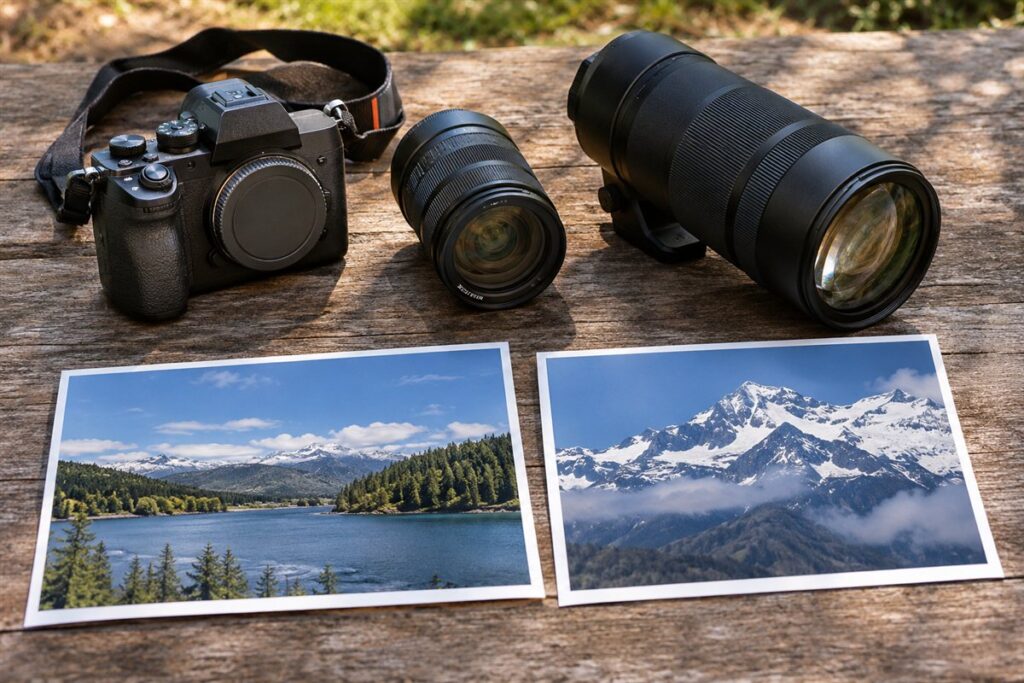
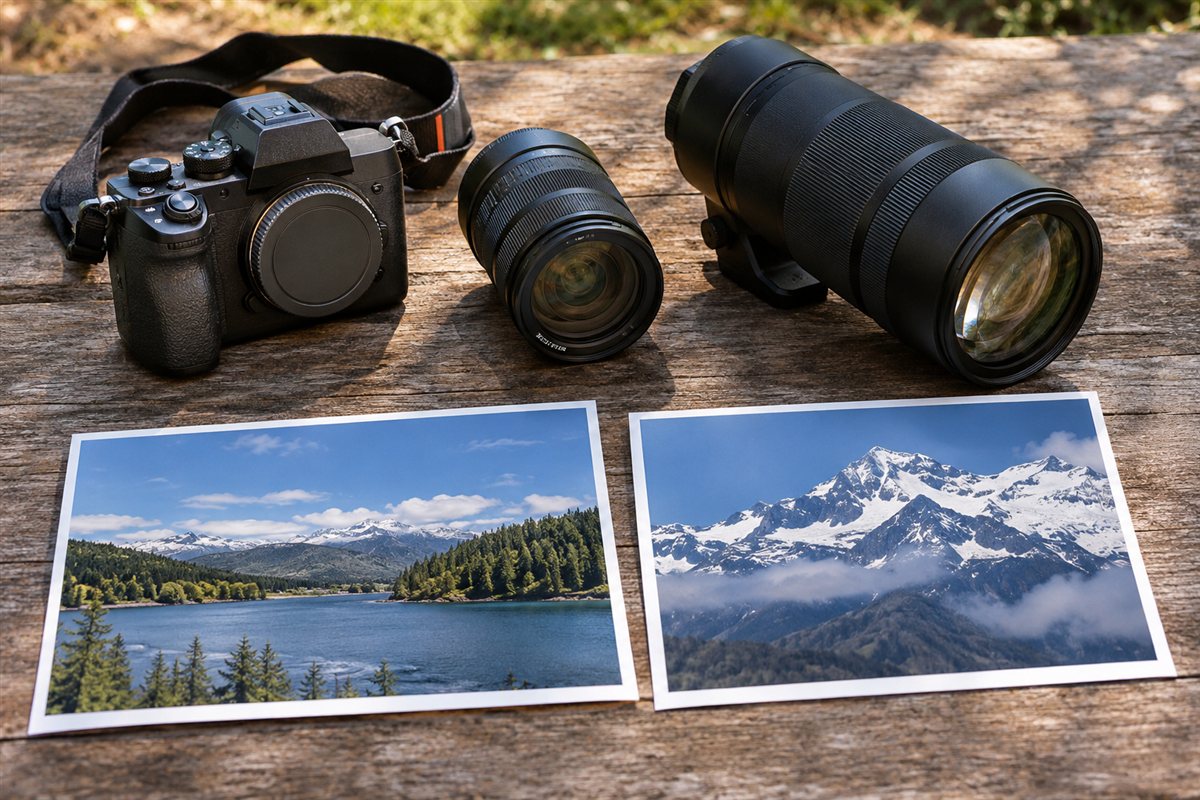
A zoom lens can change its focal length, while a telephoto lens has a long focal length that magnifies distant subjects. They are not opposites, because many telephoto lenses are zooms and many zooms do not reach telephoto lengths. The real question is whether you need flexibility, reach or both.
What Each Term Means
Zoom describes how a lens works: you turn or push a ring to change the focal length, such as from 24mm to 70mm. Telephoto describes how far a lens sees: long focal lengths, often 70mm and above on a full frame camera, which narrow the view and bring subjects closer. A 70-200mm lens is both a zoom and a telephoto.
In this guide
Comparing the Types
| Lens type | Focal length | Best for |
|---|---|---|
| Standard zoom | Wide to short tele | Everyday, travel, events |
| Telephoto zoom | A range of long lengths | Sport, wildlife, stage |
| Telephoto prime | One long length | Portraits, wildlife, detail |
| Wide prime | One short length | Landscape, street |
What Telephoto Does to Your Photos
- It magnifies the subject so you can stay far away.
- It compresses perspective, making backgrounds look closer to the subject.
- It makes backgrounds blurrier at the same aperture, which helps portraits.
- It shows camera shake more, so you need faster shutter speeds or stabilization.
What Zoom Does for You
- It lets you reframe without walking.
- It replaces several prime lenses, which saves weight and lens changes.
- It helps when subjects move toward or away from you.
Zoom lenses also suit video, where smooth framing changes matter. The trade-offs can include a smaller maximum aperture or more size and weight than a prime at the same focal length.
How to Choose
- List the subjects you shoot most, such as people, sport, birds or landscapes.
- Note how far you usually stand from them.
- If you need to frame quickly, lean toward a zoom.
- If you need reach and the best low-light ability, look at telephoto lenses with wide maximum apertures, and be ready for size and weight.
- Check the maker page for focal range, aperture, weight and stabilization before buying.
- Assuming a longer lens always gives a better photo.
- Forgetting that a long lens needs a faster shutter speed.
- Buying a huge zoom range without checking its aperture at the long end.
Crop Sensors, Full Frame and Effective Reach
Focal length numbers describe the lens, but the field of view you get depends on the size of your camera sensor. On a camera with a smaller sensor, the same lens shows a narrower view than on a full frame camera, which behaves as though it has a longer focal length. This is often called the crop factor. It means that a lens that feels moderate on a full frame body may feel distinctly telephoto on a smaller sensor.
This is useful for subjects that are far away, since a smaller sensor effectively extends your reach without a bigger lens. It also means that the labels “wide”, “standard” and “telephoto” shift depending on your camera. A lens sold as a standard zoom for full frame may act as a short telephoto zoom on a smaller sensor.
Check your camera’s sensor size and look at the maker’s information on the equivalent field of view. Do not assume that a smaller sensor gives other optical benefits. Depth of field, light gathering and image quality behave differently, and the details vary between models.
When comparing lenses, make sure you are comparing the same thing. A listing may give the actual focal length, an equivalent value, or both. Read the description carefully to avoid mismatches.
Aperture and the Cost of Reach
Telephoto lenses and zoom lenses share an awkward trade-off with aperture. A wide maximum aperture lets in more light, supports faster shutter speeds and gives a shallower depth of field, but it requires larger glass elements, so the lens becomes bigger, heavier and costlier. The longer the focal length, the more pronounced this effect.
Many zoom lenses have a variable maximum aperture, meaning the widest opening gets smaller as you zoom in. A lens may offer a wide aperture at its short end and a narrower one at the long end. Other zooms hold a constant maximum aperture across the range, which is convenient for consistent exposure but usually makes the lens larger. Check the lens description for both values.
The practical effect shows up in poor light. At the long end of a variable-aperture zoom, you may need a higher ISO or a slower shutter speed to get a good exposure, which increases noise or blur. For indoor sports, stage events or dusk wildlife, a lens with a wide, constant aperture is often preferred.
Think about how often you shoot in dim light. If you mainly shoot in daylight, a lighter lens with a narrower aperture may serve you well.
Read the listed minimum focus distance too.
Stabilization and Shutter Speed Habits
Longer focal lengths exaggerate small movements, so technique matters more at telephoto. A traditional guideline is to use a shutter speed at least as fast as one over the focal length, and faster is safer, especially with dense sensors. If your subject is moving, you will need a faster speed to freeze it.
Image stabilization can help. Some lenses and camera bodies include it, and it allows slower shutter speeds for still subjects. It does not freeze moving subjects, and it may not help when panning unless the system has a mode for it. Read the manual to learn how to use the settings.
Good habits add to stabilization. Hold the camera close to your body, support the lens with your left hand underneath, and breathe out gently as you press. Lean on a wall, post or railing where possible. A monopod adds support without much bulk.
Take several frames of an important shot, since sharpness varies between frames. Check results at full size on your screen to see whether your technique is working, and adjust shutter speed accordingly.
Check whether your lens needs a special mount adapter or firmware for full function, and read the maker’s compatibility notes before ordering. Mixed-brand setups may lose features such as stabilization or fast autofocus, so confirm exactly what works with your camera body.
Size, Weight and Carrying Comfort
A lens you leave at home takes no pictures. Size and weight are practical limits, and they affect how often you will carry and use a lens. Long telephoto lenses and wide-range zooms can be heavy, particularly those with wide apertures. Before buying, check weight on the maker’s page and think about how long you will hold it.
Consider the balance of the setup. A heavy lens on a small camera body can feel front-heavy and uncomfortable. Try the combination in a shop if you can. Look at the lens length when zoomed, too, since some zooms extend as you change focal length, which shifts balance and changes how the lens feels.
Think about your bag. A large lens may need a dedicated compartment or case. Plan for protective gear such as a lens hood, rain cover and strap.
If weight is a concern, consider a lighter, narrower-aperture zoom for travel and day hikes, and keep a larger lens for specific outings. Many photographers own two options for this reason. Honest answers about how and where you shoot lead to better decisions than chasing specification sheets.
Keep a compact lens in the bag as a backup, since it will be there when the large one stays home, and shooting with whatever you have is better than regretting the gear you left behind.
Used Lenses and What to Inspect
Buying used can stretch a budget, but lenses need careful inspection. Start by looking through the glass against a bright light. Check for scratches, haze, fungus (thin web-like patterns) and dust. A little dust is common and usually harmless, while fungus and haze can affect image quality and may spread.
Test the zoom ring and focus ring through their full range. They should move smoothly without grinding or sticking. On a zoom, extend and retract it slowly and listen for noises. Check the aperture blades by looking into the rear of the lens while changing the aperture, if the lens allows it. They should move crisply and not leave oil on the blades.
Mount the lens on a camera and take test shots at several focal lengths and apertures. Check that autofocus works, that stabilization operates if present, and that images are sharp across the frame. Look for decentering, where one side of the image is softer than the other.
Ask about the lens history and check the return policy. Verify mount compatibility with your camera, and read the maker’s information about which bodies support all features.
Ask the seller for sample images at the extremes of the zoom range, and compare them to your own tests to see whether the lens behaves as claimed.
Understanding Compression and Perspective
A common belief is that telephoto lenses squash distances, but the real cause is camera position. When you step back to frame a subject with a longer focal length, the relative sizes of near and far objects change, and the background seems closer. That is what we call compression. A zoom lens that reaches the same focal length will produce the same effect from the same spot. Knowing this helps you choose lenses by what you want to show rather than by labels, and it explains why portraits taken from a distance feel flattering and calm.
To see the effect for yourself, photograph a friend in front of a row of trees at a short and then a long focal length, adjusting your position so the face stays the same size. Compare the background in both.
Prime Telephoto Versus Telephoto Zoom
A prime telephoto lens offers one focal length and often a wider maximum aperture, a lighter body at a given aperture and excellent sharpness. A telephoto zoom provides flexibility, allowing you to frame precisely without changing position. For sports or wildlife, where you cannot always move closer, a zoom is often the practical option. For portraits in a controlled setting, a prime can be a delight. Consider how much you value framing flexibility against the benefits of simplicity.
| Aspect | Telephoto prime | Telephoto zoom |
|---|---|---|
| Framing | Move your feet | Adjust the ring |
| Weight | Often lighter per aperture | Often heavier |
| Aperture | Usually wider | Often fixed or variable |
| Best use | Controlled shoots | Unpredictable action |
Using Longer Focal Lengths Creatively
Telephoto lenses are not only for distant subjects. Use them to isolate details in a busy scene, stack layers of a landscape, or flatten patterns in a city skyline. Look for light falling on a small part of a scene and frame tightly around it. At longer lengths, small movements of the camera shift the frame dramatically, so slow down and compose carefully. Let the compressed backgrounds create abstract colors that support the subject.
Stability Techniques at Long Focal Lengths
Camera shake becomes more visible as focal length grows. Hold the lens with your left hand under the barrel, tuck your elbows into your body and exhale gently before pressing the shutter. Lean against a wall or a post if one is available. A monopod provides a quick boost, and a tripod provides the most stability for static subjects. Stabilization in the lens or body helps, but good technique adds to it, and a fast enough shutter speed remains the best protection against blur.
- Use a shutter speed that suits the focal length and the subject.
- Brace your body against solid objects.
- Press the shutter smoothly rather than jabbing.
Autofocus and Subject Tracking
Long lenses magnify focus errors, so use autofocus modes wisely. For moving subjects, select continuous focus and a tracking area. For still subjects, use a single point and focus on the most important detail, such as an eye. Learn how your camera handles obstacles that pass between you and the subject, and consider limiting the focus range on the lens if it offers a switch, which speeds up acquisition on distant subjects.
Atmospheric Effects and Heat Haze
Distance exposes the air itself. Heat shimmer over warm ground, mist and dust reduce contrast and sharpness in long-range pictures. Shoot early in the morning when the air is cooler and calmer, climb higher to look over the haze, and avoid shooting across hot tarmac. Do not blame the lens for softness caused by the atmosphere. Learning to read conditions saves you from fruitless frustration.
Zoom Lenses for Everyday Convenience
For travel and family occasions, a versatile zoom saves time and avoids lens changes in dusty places. Choose a range that covers the situations you meet most often, and check size and weight. Remember that a wide range often involves compromises in aperture and corner sharpness. Decide whether convenience or maximum quality is more important for you, and be honest about how often you will really need the extremes of the range.
Practical Buying Checklist
- List the subjects and distances you shoot most often.
- Decide whether you need a wide maximum aperture.
- Check weight and balance with your camera body.
- Confirm the mount, stabilization and filter size.
- Test sharpness at the focal lengths you use most.
Using Teleconverters and Crop to Extend Reach
When you need more reach than your lens provides, you have two main options. A teleconverter sits between the lens and the camera and multiplies the focal length, at the cost of some light and sometimes autofocus speed. Cropping the image later also gives extra reach, and a high-resolution sensor makes that practical. Compare both approaches for your own work. A converter keeps more pixels on the subject, but cropping avoids the loss of light and the extra weight. Check the maker compatibility information before buying a converter, because not all lenses accept one.
Weather, Dust and Handling in the Field
Telephoto lenses are long and exposed, so protect them. A hood keeps rain off the glass and reduces flare. Use a cover in wet weather, and wipe condensation gently when moving from cold to warm. Avoid changing lenses in dusty or windy places. When the lens extends as you zoom, dust can be drawn in over time, so store it with the zoom ring at its shortest setting and keep it in a clean bag.
- Carry a microfiber cloth and a blower.
- Keep caps on the lens whenever you are not shooting.
- Allow cold lenses to warm slowly in a sealed bag.
Specialized Uses: Sport, Birds and Events
Sports call for fast autofocus, a wide aperture for faster shutter speeds and good stabilization. Birds demand reach, steady technique and plenty of patience, plus fieldcraft skills such as approaching slowly and understanding behavior. Events benefit from zooms that let you frame precisely from a fixed position at the edge of a room. For each, learn the particular habits of the subject and practise anticipating their movements. A moderate lens used with great timing beats a bigger lens used without a plan.
Learning to Anticipate Moments
Great telephoto images often come from anticipation. Watch the subject, notice patterns, and prepare the framing before the action arrives. At a football match, observe where plays develop; at a pond, notice where birds return. Focus on the likely spot, keep both eyes open to see what is happening beyond the frame, and release the shutter at the peak. Anticipation turns a lens into a precise instrument rather than a random net.
Weighing Cost Against Real Need
Long lenses can be expensive, heavy and awkward to carry. Ask yourself how often you will use the reach. If only a few times a year, renting for those occasions may make more sense than buying. If you use it weekly, buying a good used lens can be a wise investment. Think carefully about lens quality, support gear such as a monopod, and travel needs before committing to a big purchase.
Comparing a Zoom and a Prime in a Real Scene
Imagine photographing a school football match from the sideline. With a telephoto zoom, you can follow a player running toward you, reframing from a full-length view to a tight headshot without moving. With a prime of similar reach, you would need to wait for the play to come to you, or crop later. At a quiet portrait session in a garden, the situation reverses: you can move freely, so a prime may give you a wider aperture and a softer background with less weight. Matching the tool to the scene is far more useful than arguing about which is best in general.
Learning Focal Lengths by Doing
A simple exercise builds your feel for focal length. Choose a single subject, such as a parked bicycle, and photograph it at several zoom settings while moving to keep the subject the same size. Compare how the background changes. Then keep your position fixed and photograph the same subject at different focal lengths to see how framing changes. Doing this once teaches the difference between perspective and cropping better than any explanation. Save the images in a folder for later reference.
- Pick a subject with a distinct background.
- Photograph it at wide, medium and long settings from one place.
- Move to keep the subject size equal and repeat.
- Compare the sets side by side.
Final Thoughts on Choosing
There is no universal winner. Think about your usual subjects, your physical comfort with carrying gear, and how you like to work. A zoom rewards flexibility, a fixed telephoto rewards focus on craft. Whichever you choose, practice will do more for your pictures than the lens alone.
Seeing the Difference in Your Own Photographs
The distinction between a zoom and a telephoto stops being abstract the moment you sort your own archive with it in mind. Look through a year of your photographs and ask two questions of each frame: did the lens change focal length to make this picture, and did the picture depend on a long focal length’s way of seeing? You will find photographs that needed the zoom’s flexibility — a sequence at an event where subjects came and went at different distances — and photographs that needed telephoto character: layers compressed into a graphic stack, a distant subject isolated against a melted background, a wary animal photographed from beyond its comfort. Most photographers discover their archive leans clearly one way, and that lean is the best buying advice available anywhere.
Run the same audit on the photographs you admire. When you save another photographer’s image to study, note what made it work. If your saved folder fills with compressed landscapes, distant wildlife and candid portraits shot from across a square, your eye is a telephoto eye, and it deserves glass that serves it. If it fills with immersive scenes shot close and wide, or with fast-changing documentary sequences, your needs point elsewhere. Buying for the eye you have, rather than the eye a marketing category assumes, is the whole secret of satisfying lens purchases.
Exercises That Teach Focal Length Faster Than Reading
Two afternoons of exercises will teach your hands what these terms mean. First, take a zoom lens to one spot — a bridge, a viewpoint, a busy corner — and photograph the same scene at every marked focal length without moving your feet. Study the series at home: watch backgrounds grow, layers stack, and the scene’s story change even though nothing in it moved. Second, pick one focal length and forbid yourself the zoom for a full outing, moving your feet instead. The first exercise teaches what telephoto reach does; the second teaches what a fixed telephoto demands of your positioning, and between them they cover most of what this guide explains in words.
A third exercise sharpens judgement about compression. Photograph a subject with a background feature — a building, a tree, a sign — first from close with a wide setting, then from far away with a long setting, framing the subject the same size both times. The background feature will loom dramatically larger in the distant, long-lens version. Once you have made that pair of photographs yourself, you will never again read the phrase perspective compression as jargon; it will be a tool you reach for deliberately.
How the Two Ideas Combine in Real Lens Line-Ups
Manufacturers’ catalogues become easier to read once the two terms are separated in your mind. A standard zoom earns its name from its range, which straddles everyday subjects; nothing about it is telephoto until its long end. A telephoto zoom is a lens whose whole range lives in the long region, built for reach at every setting. A superzoom is a range statement taken to an extreme. And a prime telephoto is the opposite philosophy: no range at all, in exchange for speed, size or optical refinement at one chosen reach. None of these is a rank ordering. Each is a different answer to the question of what you will photograph and what you are willing to carry.
This is also why comparing lenses by a single number misleads. The biggest zoom range is not the best lens, and the longest reach is not the most telephoto in character if its aperture and size keep it at home. When you read any lens description, translate it into the two questions this guide has used throughout: how much can the focal length change, and how long is the focal length, in absolute terms, at the settings where you will use it? Those two answers predict your experience far better than the category label on the box.
Renting and Borrowing as Research
If the choice between a flexible zoom and a dedicated telephoto remains unclear after reading, experience is available cheaply. Renting a long telephoto zoom for one weekend of the photography you actually dream about — a match, a bird reserve, a mountain trip — will tell you whether the weight, the attention from bystanders and the working distances suit your life. Many photographers discover the dream survives contact with reality; some discover they prefer the lighter, nearer world, which is equally valuable knowledge bought at rental prices rather than purchase prices.
Borrowing from a friend serves the same purpose with an added benefit: you can ask what they stopped using it for. Owners are candid about the gap between a lens’s promise and its place in their bag in a way that product pages never are. Listen especially for the sentence that begins with the words I mostly use it for — whatever follows is the lens’s true job description, and you can judge directly whether that job exists in your photography.
Common Buying Mistakes This Distinction Prevents
The most expensive mistake in this territory is buying reach you cannot use: a very long lens purchased for a holiday, discovered to need a tripod, a hide and a level of patience the holiday never offered, and retired to a shelf. The second is buying range you do not need — a lens covering everything, chosen for reassurance, that is larger and slower than the narrower lens your actual subjects required. Both mistakes come from shopping by category label instead of by the two honest questions: how far, and how flexible.
A quieter mistake is ignoring the camera end of the partnership. Long focal lengths magnify everything, including the consequences of a small sensor’s noise at high sensitivities and a body’s autofocus limitations with distant, moving subjects. A lens and body should be judged as a system for telephoto work: the finest long lens cannot rescue focus the body cannot achieve, and reach that forces very high sensitivity settings in your usual light may deliver less real detail than a shorter, faster combination. When you plan a telephoto purchase, plan the pairing, not just the glass.
Second-Hand Telephotos: Where the Value Hides
Long lenses hold their value and their performance well, which makes the used market genuinely attractive for telephoto purchases in particular. Older professional telephotos, built for heavy use, often outlast several generations of consumer bodies and can be found at prices that undercut new mid-range glass while outperforming it. The inspection rules from earlier in this guide apply with extra force: check the focus and zoom actions through their full travel, look for fungus and internal dust against a bright light, test autofocus on your own body, and confirm that any stabilisation settles quietly rather than hunting. A careful hour of inspection converts the used market from a gamble into the smartest shelf in the shop.
Putting the Two Words to Work
Language shapes shopping more than we admit. Once zoom and telephoto are separate ideas in your mind, product descriptions become transparent, advice from other photographers becomes easier to weigh, and your own brief for your next lens writes itself: the distances you work at, the flexibility you truly use, the weight you will genuinely carry. That brief, carried into any shop or listing, protects you from both overspending and undershooting. And when you explain the distinction to the next beginner — as photographers reliably do, usually while pointing at a landscape stacked into layers by a long lens — you will find the explanation has become a way of seeing, which is what it was all along.
A Worked Example: One Afternoon, Both Ideas
Consider a single ordinary afternoon — a walk along a river with a heron working the far bank, children racing on the near path, and the town’s roofs stacked on the hill behind. The zoom idea serves the afternoon’s variety: one lens changes from the wide view of the whole scene to the children’s race to a nearer study of a moored boat, without a pause or a bag opened. The telephoto idea serves the afternoon’s depth: from one position, the long lens isolates the heron against water that melts into colour, stacks the roofs into a pattern no wide view could find, and picks two figures out of the crowd on the bridge as if they were alone in the world. Neither afternoon is better. They are different harvests from the same field, gathered by different ways of seeing — which is why the two words at the heart of this guide name tools for the eye before they name categories in a catalogue.
Now notice what the experienced photographer does with that afternoon: both, in sequence, from the same lens if it happens to be a telephoto zoom, or by changing position and intention if it is not. The vocabulary matters because it lets you plan the harvest rather than merely receive it. Decide, before you set out, whether the afternoon is for variety or for depth, and you will come home with a coherent set instead of a miscellany. That decision — small, free, repeatable — is the practical dividend of understanding the distinction this guide has drawn.
The Vocabulary in the Shop
Carry the two questions into any shop or listing and watch the conversation improve. Ask how far a lens reaches in absolute terms, and how much of that reach you will actually use at the apertures your light allows. Ask what the lens weighs at the end of a day rather than in the hand for a minute. Ask what it is like at the focal length you will use most, not at its most impressive extreme. Sellers respond well to buyers who know their own brief, and the answers come back in the same honest currency. The distinction between zoom and telephoto, which began as pedantry, ends as the most useful shopping tool you own: two questions that cannot be dazzled.
Closing: Two Words, One Eye
Every technical term in photography is finally a way of paying attention, and these two are among the most useful. Zoom names freedom — the freedom to reframe without moving, to answer a changing scene at its own speed. Telephoto names commitment — the commitment to distance, compression and selection, to the picture within the picture. A complete photographer needs both freedoms at different hours, and the lenses that offer them, singly or combined, are all honourable tools. Choose by the afternoons you actually live, carry what you chose without apology, and let the words do their quiet work: reminding you, each time you raise the camera, to ask whether this moment wants range or reach — and to know that you are choosing a way of seeing, not just a setting on a barrel.
Glossary in Plain Language
A short glossary gathers the working vocabulary in one place, in the plain forms this guide has used. Focal length: the number, in millimetres, that describes how strongly a lens magnifies and how narrow its view is — small numbers see widely, large numbers see narrowly and far. Zoom: a lens whose focal length can change, giving many views in one barrel. Telephoto: a lens, zoom or fixed, whose focal length is long, giving that narrow, compressed, reaching view. Prime: a lens of one fixed focal length, trading flexibility for speed, size or refinement. Compression: the telephoto effect that makes distant layers appear stacked close together. Equivalent view: the view a lens gives on your particular camera, which depends on the sensor’s size as well as the number on the barrel. Keep those six definitions and every lens description you meet, in any shop or catalogue, becomes readable at sight.
The Question to Ask About Any Lens, Forever
If this guide leaves you with one habit, let it be the pair of questions that dissolve most lens confusion on contact. First: how long is it — what view, what reach, what compression will this give me on my camera? Second: how flexible is it — how much can that view change without moving my feet or changing the lens? Every category name in photography is a compressed answer to those two questions, and every buying mistake in this territory comes from answering one and forgetting the other. Ask both, in shops and in your own head, and the vocabulary will never mislead you again — because you will no longer be shopping for words. You will be shopping for ways of seeing, which is what lenses were always selling.
Your Next Photograph, Seen Two Ways
Try the distinction one final time, on the next photograph you take. Before you press the shutter, see the scene both ways in your mind: the version that embraces the whole of it, context and all, and the version that reaches in and isolates the one relationship that matters. Notice that both photographs are present in almost every scene, waiting for different tools and different intentions. The photographer who can see both, and choose deliberately, has understood everything this guide set out to explain — and has gained something no purchase provides, which is a second picture hiding inside every first one, available for the rest of a photographic life.
Teaching the Distinction to a Child With a Camera
The surest test of understanding is teaching, and this distinction passes it beautifully, because a child with a basic camera grasps it in one outing. Show them the wide view of the playground, then the long view that makes the climbing frame’s top rung fill the screen from the same bench, and ask what changed: we did not move, but the far things came close and crowded together. That sentence, in a child’s words, contains the whole of this guide — reach, compression and the difference between changing your view and changing your position. Photographers who can explain their tools at that level of simplicity own them at a depth that specification fluency never reaches, and teaching is how that depth is built. If you have a young photographer in your life, lend them this distinction early; it will organise every lens they meet afterwards.
And if you have no pupil handy, teach it to yourself in the same spirit: plainly, with examples, in the field. The vocabulary of photography is full of terms that survive as fog because nobody made them stand in a playground and be simple. Zoom and telephoto need never be fog again — not after you have watched a distant roof stack itself against a nearer one through your own viewfinder and known, precisely, which of the two ideas you were looking at.
The Shelf You Are Really Building
Every lens decision is, in the long run, a decision about the shelf of photographs you are building across a life. The zoom serves the shelf’s breadth: the record of everything, kept fluently as it happened. The telephoto serves its depth: the studies, the isolations, the views nobody else at the viewpoint noticed. A complete shelf needs both kinds of attention, in proportions that only your own eye can set. Set them honestly, buy accordingly, and let the two words — which began this guide as a confusion — end it as what they always were: the names of the two directions in which a photographer’s attention can travel.
How Sensor Size and Format Change the Conversation
The same focal length tells different stories on different cameras, and keeping that straight prevents a common confusion in this whole discussion. A lens’s focal length is a physical property and never changes, but the view it delivers depends on how much of its image the sensor records. On a smaller sensor, a moderate lens frames like a longer one, which is why compact-system photographers can reach telephoto views with smaller, lighter glass — one of the genuine advantages of those systems for travel and wildlife. On a large sensor, the same reach demands the full-size lens, with its full-size weight, in exchange for its low-light and depth qualities. Neither is a trick or a cheat; they are different bargains with physics, and your choice of system quietly decides how heavy your telephoto life will be.
This is also why advice about focal lengths must always be translated before it is applied. When a photographer praises a particular focal length for portraits or street work, ask what camera it was on before borrowing the number. The view is what matters — the framing, the working distance, the background behaviour — and the view can be reproduced on your system once you know the translation. Photographers who internalise this stop collecting incompatible numbers and start collecting understanding, which transfers between every camera they will ever own.
Depth of Field: The Telephoto Illusion
Long lenses are famous for melting backgrounds, and the mechanism is worth understanding precisely because it is widely misunderstood. A telephoto does not inherently produce shallower depth of field at the same aperture and framing; rather, its narrow view excludes most of the background and magnifies what remains, so the blur that exists is enlarged into those smooth washes photographers love. The practical lesson is encouraging: background control is available through distance and framing choices as well as through expensive fast glass. Move closer to your subject, increase the distance between subject and background, and choose the longest focal length your position allows, and even a modest telephoto zoom will deliver that separated, professional look that beginners assume requires exotic equipment.
Telephoto Thinking in Everyday Scenes
Telephoto vision is a habit, not a purchase. Train it by looking for the picture within the picture: the pattern in a distant facade, two figures isolated on a long path, the layered ridges of an ordinary hill, a detail of hands at a market stall photographed from across the square. Photographers who develop this eye find telephoto subjects everywhere, including in scenes they once dismissed as empty, because compression and selection manufacture interest out of relationships between things rather than out of the things themselves. A week of deliberately shooting only at your longest focal length — however modest — will teach this faster than any essay, and many photographers emerge from such a week permanently converted.
The same habit improves wide photography when you return to it, because you have learned to see arrangements instead of vistas. That transfer is the deepest argument for owning and using a genuine telephoto for a season, even if your heart belongs to wider views: each way of seeing educates the other, and the zoom lens on your camera — the flexibility this guide began with — becomes the instrument that lets you choose between them moment by moment, which is the whole of photographic judgement in a single sentence.
Safety, Courtesy and Long Lenses in Public
A practical note belongs here: long lenses attract notice, and in public places they can attract suspicion, because their purpose — photographing distant people who may not notice — reads uncomfortably to bystanders. Work openly, be ready to explain yourself cheerfully, photograph scenes rather than singling out strangers at length, and accept questions as the price of the tool. The telephoto photographer who behaves like a guest in public space rarely has trouble; the one who behaves like a surveillance operation invites it. Courtesy is not a limitation on this kind of photography — it is what keeps it welcome.
FAQ
Is a telephoto lens always a zoom?
No. Telephoto primes have one fixed focal length and are often sharp and fast.
Is a bigger zoom range always better?
Not necessarily. Very wide ranges are convenient but can compromise sharpness or aperture compared with narrower ones.
Does a smaller sensor make a lens act more telephoto?
A smaller sensor shows a narrower view with the same lens, so it behaves as though the focal length were longer. Check your camera's sensor size and the equivalent field of view.
What does variable aperture mean on a zoom?
The widest aperture gets smaller as you zoom in. Check the lens description for the values at both ends.
Does image stabilization replace a fast shutter speed?
It helps with still subjects at slower speeds, but it does not freeze subject movement. Use a faster shutter speed for moving subjects.
Is a zoom lens always heavier than a prime?
Often, but not always. Zooms contain more elements and mechanisms, so they tend to be larger than a prime at one of their focal lengths. Compare actual weights on the maker's pages.
What should I check on a used zoom?
Look for glass scratches, haze and fungus, test both rings, and shoot sample images across the range. Ask for a return window.
Should I buy one lens that covers everything?
A wide-range zoom is convenient, but it may compromise aperture or sharpness. Consider your priorities before choosing.
Can I use a telephoto lens for portraits?
Yes. Many photographers like it for flattering perspective and background blur. Make sure you have enough space to stand at the needed distance.
The Short Version
Zoom is about changing focal length, and telephoto is about reach. Choose a zoom for flexibility, a telephoto for distant subjects, and a telephoto zoom when you need both.