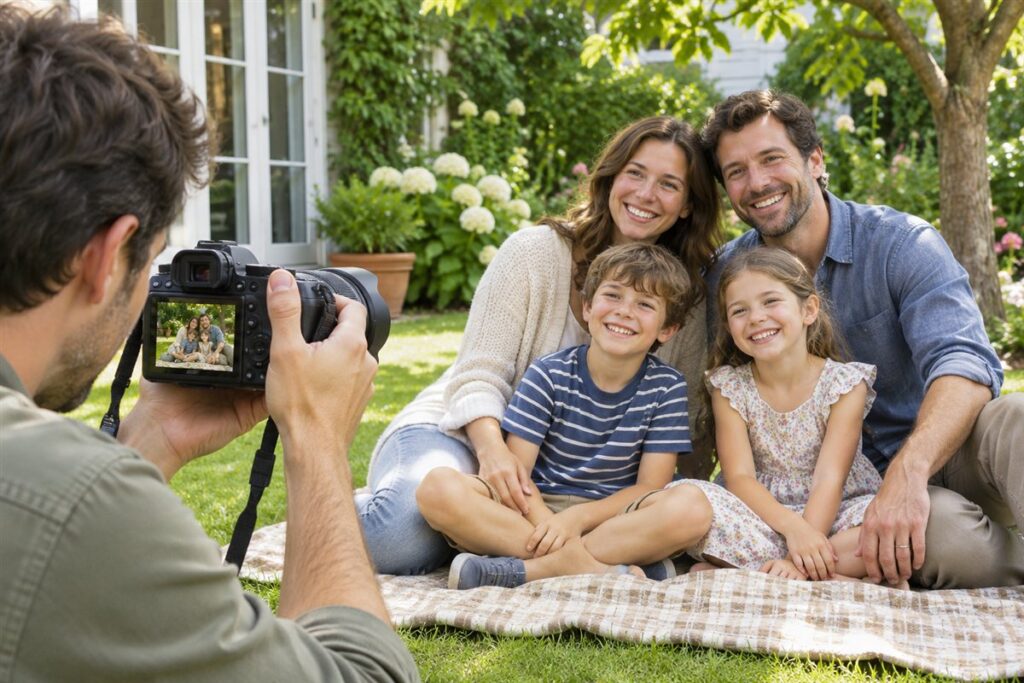
For family photos, a standard zoom is the easiest all round choice, and a fast normal prime is a great second lens. Children move quickly and rooms are often small, so you want something versatile, light and quick to focus. The sections below cover the main lens roles, settings, scenarios and habits that help you capture natural moments.
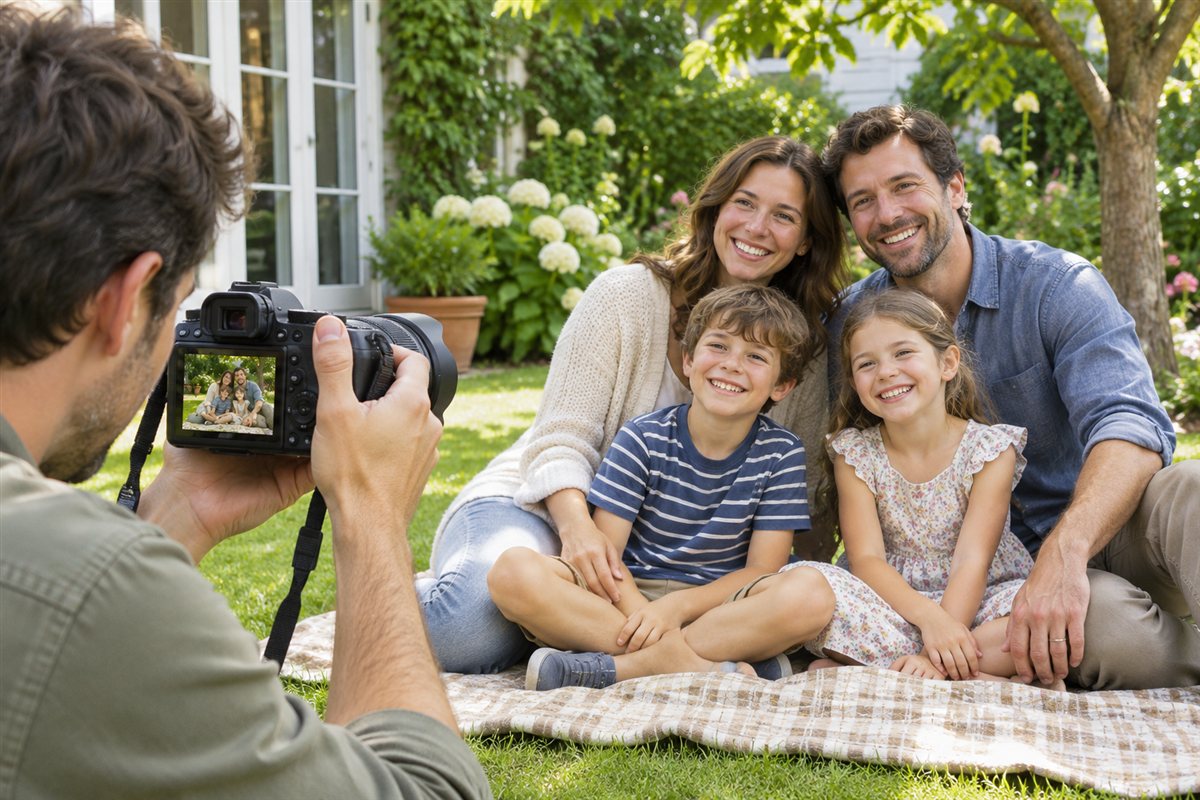
What Family Photography Asks For
You shoot in living rooms, parks, kitchens and at birthday tables, usually without time to change lenses. Subjects range from a sleeping baby to a running toddler. A lens that handles all this without fuss will get used more than a specialist tool.
In this guide
Begin With a Standard Zoom
A zoom that covers wide to short telephoto lets you capture a whole group, then move in on a face. It works indoors and out, and for travel days it saves you from carrying several lenses. Many cameras are sold with a similar lens, so you may already own one.
Add a Fast Prime for Indoors
Homes are dimmer than they feel. A prime with a wide aperture lets you use faster shutter speeds, so children stay sharp, and it gives pleasing blur behind them. A normal length is flexible, and a short telephoto helps for portraits from across the room.
Making the Choice
- List where you take most photos: home, school events, trips.
- Choose a standard zoom first and use it for a few weeks.
- Note what you wish you had, such as more light or more reach.
- Add a prime or a longer zoom to address that gap.
Lens Roles
| Lens | Good for | Consideration |
|---|---|---|
| Standard zoom | Everyday and travel | Slower aperture indoors |
| Normal prime | Indoor light, portraits | Fixed framing |
| Short telephoto zoom | Sports, school events | Heavier |
Technique helps as much as equipment. Get down to the eye level of the child, shoot in open shade or near a window, and take many frames, because expressions change fast. Use continuous autofocus and a shutter speed fast enough to freeze play. Do not worry about perfect poses. The moments that families treasure are usually natural ones, such as laughter at the table or a quiet cuddle. A lens that is easy to carry, always on your camera and ready when the moment happens will give you more keepers than a bag full of specialist gear.
A Worked Walkthrough: A Birthday Afternoon
Imagine a small party in a living room with a window on one side. Before guests arrive, mount the standard zoom and take a few frames of the room to check exposure. As a general range, a shutter speed of 1/125 second or faster suits calm moments, and 1/250 second or faster helps with running children. Open the aperture to its widest setting in dim light, or close it a stop or two outdoors for more depth. Set ISO to auto with a limit you like. Switch to continuous autofocus. Begin with a wide shot of the room and the table, then move to medium shots of groups, then close portraits when the cake appears. Stand with the window beside you so faces are lit softly, and avoid pointing the camera into the glass. Capture hands, candles and small gestures between the big moments. Glance at the screen briefly during a quiet moment, not while the action is happening, so you do not miss the next laugh.
Plan around the time of day too. Early evening light through a window is warm and soft, while midday sun creates harsh shadows on faces and squinting eyes, so move children to open shade. Bring a small cloth to wipe sticky fingerprints from the front glass, since family events are rarely clean. Keep a spare memory card and a charged battery in a pocket, because busy days drain both faster than you expect. Finally, set aside a few minutes at the end of the day to back up your pictures and delete obvious misses, while the memories are still fresh.
Common Scenarios
Newborn and baby portraits
A normal prime in soft window light works well. Keep the room warm, avoid flash near a baby’s eyes, and be patient with natural expressions.
School concerts and sports
Distance and rules may limit what you can do. A short telephoto zoom reaches the stage or field, and a monopod can ease the weight. Respect any restrictions the school sets.
Travel days
One versatile zoom keeps your bag light and your hands free for children and bags. Add a small prime for evening restaurants if space allows.
Large group portraits
Step back and use a moderate wide focal length, with an aperture closed a few stops so everyone is sharp. Take several frames, since someone often blinks.
Mistakes to Avoid
- Using a long lens at a tiny distance. You end up stepping back through furniture, so a normal or wide lens fits small rooms better.
- Shooting at a low shutter speed to keep ISO down. Moving children blur easily, and a bit of noise is easier to accept than a blurred face.
- Relying only on the pop-up flash. It flattens faces and can surprise babies, so window light or a bounced source looks gentler.
- Changing lenses constantly. Moments pass during the swap, and dust can reach the sensor.
- Waiting for everyone to look at the camera. Candid pictures often become the favorites, so keep shooting.
Quick Troubleshooting
| Symptom | Likely cause | What to try |
|---|---|---|
| Blurry children | Shutter speed too slow indoors | Raise shutter speed and allow a higher ISO |
| Dark faces against a window | Backlight confuses the meter | Turn faces toward the light or use exposure compensation |
| Orange skin tones | Warm room lamps mixed with daylight | Switch off lamps or adjust white balance |
| Missed focus on moving child | Single-shot autofocus mode | Switch to continuous autofocus and track the face |
| Only one person sharp in a group | Aperture too wide | Close the aperture and keep everyone at similar distance |
Short Glossary
- Standard zoom: a lens covering wide to short telephoto views.
- Normal prime: a fixed focal length lens with a view close to human vision.
- Continuous autofocus: a mode that keeps updating focus on a moving subject.
- Open shade: shaded outdoor light that is soft but bright.
- Bounce light: light reflected off a wall or ceiling to soften shadows.
- Candid: an unposed photo taken without arranging the subject.
Reading a Lens Description Without Getting Lost
Lens names are packed with numbers and abbreviations, and a few of them matter far more than others for family photography. Knowing how to read them keeps you from paying for features you will not use.
Focal length
Focal length, written in millimeters, controls how much of the scene fits in the frame. On a full-frame camera, roughly 24 to 35 mm is wide enough for a room or a group, 50 mm looks close to how the eye sees, and 70 to 135 mm is useful for portraits and for photographing children from a distance. Cameras with smaller sensors crop the view, so the same lens looks tighter. Check the maker’s crop factor for your camera before comparing numbers.
Maximum aperture
The aperture number, such as f/1.8 or f/4, shows how much light the lens can gather. Smaller numbers mean more light and softer backgrounds. A zoom that opens to f/3.5 at the wide end and f/5.6 at the long end is lighter and cheaper but struggles in dim rooms. A prime at f/1.8 or f/2 can use faster shutter speeds indoors. For family use, the difference between f/1.8 and f/1.4 matters far less than the difference between f/1.8 and f/5.6.
Stabilization and focus motor
Some lenses carry optical stabilization, which steadies the image at slower shutter speeds. It helps with still subjects such as a sleeping baby but does not stop a running child from blurring. A quiet, quick focus motor matters more for children. Look for wording such as stepping or ultrasonic motors in the product listing, and read how quickly and quietly the lens focuses in independent sources.
Weight and size
A lens you leave at home takes no photos. If you carry the camera for a whole day at a park or theme park, weight matters. Compare the stated weight on the product page and think about how long you will hold it.
Matching Lenses to Different Ages
Children change fast, and the lens that works for a newborn is not always right for a school-age athlete. Here is how to think about each stage.
Newborns and infants
Babies sleep a lot and move slowly, so you can use slower shutter speeds and focus carefully. A normal prime or standard zoom lets you work close without crowding the baby. A wide aperture helps in dim nurseries. Avoid flash directly at a newborn, and use window light whenever possible.
Toddlers
Toddlers are the hardest subject because they are small, fast and unpredictable. Continuous autofocus, a quick motor and a fast shutter speed matter more than anything else. A short telephoto lets you stay back so they act naturally, while a standard zoom lets you adapt when they run toward you.
School-age children
As children grow, you will photograph recitals, matches and playground games. A longer zoom reaches across a field or an auditorium. Check how bright the lens is at its long end, since a dim lens struggles in a school gym.
Teens and family portraits
Older children often dislike posing and the camera. A short telephoto lets you photograph them casually from a distance. For group portraits, a standard zoom at the wide end keeps everyone in frame without distortion at the edges.
Planning a Budget and a Buying Order
Lenses are a long-term purchase, so plan the order. Many families spend too much on one specialist lens and then lack a general tool.
- Step one: a standard zoom, either the kit lens that came with the camera or a better one if you can afford it.
- Step two: a normal prime with a wide aperture, which often costs less than a premium zoom.
- Step three: a short telephoto or longer zoom if you often shoot from a distance.
- Step four: a wide lens only if you photograph cramped rooms or large group scenes.
Used lenses from reputable sellers can save money, but check the return policy and inspect for fungus, haze and scratches. Confirm the mount matches your camera. A lens made for another system needs an adapter, which can limit autofocus.
Third-party or brand lenses
Camera makers and independent lens makers both sell good options. Independent lenses can cost less and offer wide apertures, though autofocus behavior and firmware support vary by camera. Check compatibility lists and recent reviews for your exact camera body before ordering.
Technique That Helps Whatever Lens You Own
Gear is only part of the picture. These habits improve results with any lens.
- Get to the child’s eye level. A photo taken from adult height looks like a view of the top of a head.
- Use window light. Place the subject near a window and stand so the light falls across the face.
- Turn on continuous autofocus and, if your camera has it, face or eye detection.
- Raise the ISO before you accept a slow shutter speed. A little noise is easier to live with than blur.
- Shoot in bursts when the action is fast, then choose the best frame later.
- Keep the lens clean. Fingerprints and smudges make photos look hazy.
Capturing candid moments
Children relax when the camera is a normal part of the day. Let them look at the photos on the screen, and give them a little job such as choosing a favorite. Stay close in time rather than in distance. If you use a longer lens, you can photograph them playing without interrupting.
Making Sure the Lens Works With Your Camera
Before you order, verify a few details.
- Mount type: the lens must match your camera system, or you need a suitable adapter.
- Sensor coverage: lenses designed for smaller sensors may vignette on a full-frame body.
- Autofocus and stabilization compatibility: some features only work with certain bodies.
- Filter thread size: matters if you plan to use protective filters.
- Seller reputation and return window: lets you test the lens at home.
Try the lens at home right away. Photograph a person indoors at the aperture and shutter speeds you expect to use, and check focus accuracy across several frames. If results seem soft, test again with a tripod to separate camera shake from a focus problem, and return the lens within the allowed period if it does not perform as the maker describes.
Ready to Buy? Start Here
If this guide helped you decide what to look for, these links take you to the next step.
Gear for this guide
- 35mm prime lenses on Amazon
- 50mm prime lenses on Amazon
- Standard zoom lenses on Amazon
- Camera bags on Amazon
As an Amazon Associate we earn from qualifying purchases. Prices and availability are shown on Amazon.
A Family Photographer Checklist Before Buying
Family photos happen fast and in all kinds of rooms, so the best lens is the one that matches your usual moments. Answer these points before you compare models.
- Do you mostly shoot indoors, outdoors, or both?
- How far are you usually from the people you photograph?
- Are your subjects still, or running around?
- Do you need one lens for everything, or can you carry two?
- Will other family members use the camera, and can they handle the weight?
- Does your camera body have stabilisation, or does the lens need it?
- What do you want from the background: sharp, or softly blurred?
Your answers show whether a flexible zoom or a simple wide aperture lens is the better match. Think about the weight you will carry on days out, as a heavy lens often stays at home. Consider the budget for a protective filter, a hood and a comfortable strap, because these small items make a lens more pleasant to use. If you buy used, ask about the condition of the glass and the focus ring, and check the return terms.
Zoom Lens Versus Fixed Lens for Home Use
| Type | Strength | Limit |
|---|---|---|
| Standard zoom | Covers group shots and close portraits | Aperture may be narrower in dim rooms |
| Fixed lens with wide aperture | Lets in more light, softer backgrounds | You move your feet instead of zooming |
Many families keep one of each. The zoom comes out for days away from home, and the fixed lens suits evenings and birthdays at the table. Whichever you choose, try a few test shots at home in the rooms where you usually take pictures. Check how the lens focuses in dim light, how quickly it follows a moving child, and whether the background looks pleasing at the widest aperture. These small trials tell you far more than a specification sheet.
Practical Habits That Help Whatever Lens You Own
Gear matters less than habit. Turn on a window and sit your subject near it for soft light. Get down to the eye level of children, which usually gives a more natural result than shooting from above. Keep a fast shutter speed when they move, and take several frames of each moment. Clean the front glass with a lens cloth so that fingerprints do not soften your pictures. Keep a small bag packed with a spare battery and card so you are ready when something happens. Look through the pictures a few days later and note which lens focal length produced your favourites, which will guide future purchases.
Judging A lens for family photos by How It Behaves in Real Use
Specifications and feature lists are a starting point, not a verdict. What follows digs into the qualities of a lens for family photos that only become visible in ordinary, repeated use, and explains how to weigh each one against your own routine before you commit to a particular model, format or style.
Whether It Keeps Up With Children Who Never Sit Still
It is worth slowing down here, because this factor affects almost every session that follows, it is hard to judge from a photograph alone, and it is one of the few things you cannot easily change later without starting the whole search again. Family photography is a sport disguised as a hobby. Focus speed and tracking decide whether you catch the laugh or the moment just after it, and a lens that dawdles politely will miss the exact expressions you bought it to keep. A simple test is to picture your most typical session and ask honestly whether this point would help it along or get in the way, because that ordinary day, repeated many times, is what you are really buying for.
How It Behaves in Ordinary Living-Room Light
This rarely gets the headline treatment in product descriptions, but experienced users tend to raise it early when they explain why one option worked better for them than another that looked nearly identical on the day they ordered it. Most family life happens under lamps, not studio lights. A lens that gathers light generously lets your camera use calmer settings indoors, so birthday candles, bath time and bedtime stories all stay photographable without a flash flattening them. Before deciding, compare two or three candidates on this point alone and notice which one you would still trust on a tired, busy day when you have no patience left for workarounds, workarounds being where enthusiasm usually goes to die.
Whether Its Framing Suits Small Rooms
This is one of the points where a quick glance at a listing tells you very little, because the difference only shows up once you are using it week after week, in ordinary conditions rather than in a showroom or a screenshot. Homes are tight: kitchens, hallways and bedrooms leave little room to step back. A lens that can frame a scene from within it, rather than demanding distance you do not have, will be used daily instead of only on outings. If you are torn between two close options, let this be one of the tie-breakers, since small frictions in this area repeat every single time you sit down to use the thing, while small conveniences quietly add up in your favour.
How Intimidating It Looks to Its Subjects
On paper this can look like a minor detail, yet in everyday use it often decides whether the choice feels easy and natural or quietly frustrating, and it is usually the first thing owners mention when they describe living with their purchase. Children perform for big lenses and relax for small ones. A modest lens on the camera keeps you a parent with a camera rather than a photographer with a family, and the difference shows in every unguarded expression you manage to keep. Write down what good looks like for you on this point before you order, in one plain sentence, then check the delivered item against that note during the first week, while returning or exchanging is still a realistic option.
Whether It Survives Family Life Itself
Many buyers skim past this point, then discover its importance during the first few sessions, when habits are still forming and small problems feel bigger than they really are, so it pays to think it through before any money changes hands. Sticky fingers, sandy picnics and being grabbed by curious toddlers are part of the job description. A lens that can be wiped clean without ceremony and carried without anxiety suits the assignment better than a delicate masterpiece kept in a cabinet. When in doubt, favour the option that stays comfortable and predictable over weeks of use, rather than the one that merely looks impressive at first, because first impressions fade quickly and the daily experience is what remains.
From Shortlist to Decision: A Step-by-Step Routine
Once you have two or three serious candidates, this short routine turns a vague preference into a decision you can defend. Work through it in order, and give each step a few honest minutes rather than treating the whole thing as a formality to rush through on the way to checkout.
- Review your phone photographs from the last year. Count how many were indoors, how many were groups, and how many were one child doing something fleeting; that honest census, not aspiration, should write your shortlist Note what you decided and why, even if only in a few words on your phone, because that small record becomes surprisingly valuable when you review the choice a few weeks later.
- Decide whether you move or your subjects do. Parents of toddlers chase; parents of teenagers wait and watch. Chasers need framing flexibility, watchers benefit from speed and a little reach, and confusing the two leads to the wrong lens Do not skip ahead even if you feel confident, as confidence at this stage often comes from familiarity with similar tasks rather than from having actually checked the thing in front of you.
- Handle the lens on your camera at home distance. Shops are spacious and deceptive; if you can, test in a room the size of your kitchen, framing a person across a table, because that is where the lens will earn its keep If you are helping someone else through this, talk them through your reasoning out loud, since hearing the logic spoken tends to expose weak assumptions that silent reading lets slip past.
- Check close focusing for small details. Newborn feet, a lost tooth, a drawing held up proudly: family treasures are often small and near, so confirm the lens focuses close enough without forcing you backwards Take your time over this stage, because rushing it tends to store up confusion that resurfaces later, when it is harder to tell which early decision caused the problem you are now trying to fix.
- Plan for one lens to live on the camera. Family moments do not announce themselves; the lens fitted by default is the lens that takes the pictures, so choose the default deliberately rather than by accident If anything here is unclear, pause and resolve it now rather than pressing on hopefully, since each later step quietly assumes that this one was done properly and checked at least once.
- Give the lens a full family month before judging. Birthdays, rainy Sundays and ordinary Tuesdays together reveal whether the choice fits your life; a single outing proves almost nothing about family equipment This step looks simple, and it is, but doing it deliberately rather than casually is what separates a smooth first month from a frustrating one full of small, avoidable corrections.
Everyday Situations, Worked Through in Detail
Abstract advice only goes so far. The situations below are the ones readers describe most often, and each one shows how the same decision about a lens for family photos plays out differently depending on the constraint that matters most on the day.
A newborn’s first weeks at home
Everything is close, quiet and lit by windows. A gentle, fast lens at arm’s length captures feeding, sleeping and the tiny details everyone forgets, without flashes or fuss disturbing the household’s fragile new rhythm. It also helps to accept the small compromise in advance. Naming it beforehand turns it from a disappointment into a planned trade, and planned trades are far easier to live with afterwards.
A toddler’s birthday with six small guests
Chaos at knee height, mixed light and no posing whatsoever. Flexible framing and fast focus earn their keep, and the winning strategy is to kneel down, join the party and shoot from inside the fun rather than directing it. Finally, review how it went while the details are fresh. One short note about what worked and what did not is worth more than an hour of general reading before the next attempt.
A multigenerational portrait in the garden
Here the challenge is arranging, not equipment: get everyone on one plane, choose open shade, and use a moderate aperture so every face is kind and sharp. The lens’s job is simply to not complicate a rare gathering. The lesson from this situation is that preparation matters more than perfection: a sensible choice made calmly, with the main trade-off understood, copes well even when conditions on the day are not ideal.
A family holiday in an unfamiliar city
One versatile lens keeps the camera light enough to carry all day, which is when the real holiday pictures happen: breakfast arguments, map confusion, tired children on shoulders. The lens you carry beats the lens you packed hopefully. Notice how little of this outcome depended on luck. Most of it came from matching the choice to the situation honestly, instead of hoping a general-purpose option would somehow stretch to fit.
When Things Do Not Feel Right: Checks Before You Give Up
Most disappointments with a lens for family photos arrive in the first few weeks, and most of them have ordinary causes. Work through the relevant check below before concluding that you chose badly, because a small correction at this stage often rescues the whole purchase.
Every indoor picture is slightly blurred
Before blaming the equipment or the product, check the basics around it, because a surprising share of these problems trace back to setup, surroundings or habit rather than to the item itself. Children move faster than living-room shutter speeds. Raise sensitivity more boldly, open the aperture, and shoot in short bursts during the peak of the action. Chasing sharpness with settings meant for landscapes is the most common family photography frustration of all.
Your children freeze and grimace when the camera appears
This is a common complaint, and it is usually fixable without spending anything, so work through the checks in order before assuming the purchase itself was a mistake. The lens is not the problem; the ritual is. Keep the camera around during ordinary life without always using it, photograph activities rather than faces on demand, and let children see and laugh at the pictures immediately afterwards.
Group pictures always cut someone off
When this happens, resist the urge to change everything at once. Alter one thing, test the result, and only move on if the problem survives that first, simplest correction. Small rooms punish long focal lengths. Step into a doorway, use the widest framing you have, and arrange the group in a shallow arc rather than a line, so everyone fits without the lens needing a bigger room.
Skin tones look orange in evening pictures
Treat this as information rather than failure. The pattern of when it happens, and when it does not, normally points straight at the cause if you give it a little attention. Household bulbs are warm and camera automation guesses badly. Set white balance for the room’s light, or shoot in a format you can correct later, and favour window light earlier in the day when you have the choice.
Looking After Your Choice and Getting More From It
Family lenses live in the middle of family life, so their care routine must be quick, forgiving and realistic. None of this takes long, and that is the point: small, regular attention prevents the slow build-up of little problems that eventually make a good purchase feel like a bad one.
- Keep a lens cloth in the room where the camera lives, because fingerprints arrive weekly and mostly from small hands.
- Store the camera out of toddler reach but within adult grab range; moments do not wait for cupboard expeditions.
- Wipe the front element gently after beach, picnic and birthday-cake duty, before grit gets ground in.
- Use a simple strap you trust, since family cameras get set down on sofas, cars and café tables constantly.
- Back up the pictures the lens makes with the same diligence as cleaning it; the files are the actual treasure.
A family lens looked after this lightly will serve from a child’s first steps to their graduation, and the continuity shows: a decade of pictures sharing one gentle look becomes a family visual style. That long service is the real return on choosing and keeping a lens that fits your home.
Two Habits That Make Any Choice Work Better
A family lens quietly becomes a witness. The photographs it makes across years, birthdays, illnesses, new siblings, lost teeth, first days of school, form a record no one planned and everyone treasures. Choosing a lens you will actually carry through ordinary life is therefore not a technical decision at all; it is a decision about how much of your family’s story gets kept, and in what quality of light.
It is also worth lowering your standards in the healthiest way. The slightly blurred picture of a real laugh outranks the technically perfect picture of a posed one, every time, in every family album ever made. A lens serves you best when it helps you be quick, present and forgiving, rather than when it tempts you to direct the life you meant to record.
Make one small tradition with the new lens: a photograph in the same doorway, chair or garden spot every few months. Children grow almost invisibly day to day, and a repeated frame turns that invisible growth into the most moving sequence in the family archive, while also giving you a gentle, regular test of how your skill with the lens is maturing.
Print a few of your family pictures properly, even cheaply, a few times a year. Prints reveal what screens forgive, about focus, colour and framing, and they teach you what your lens and your habits actually deliver. They also remind everyone, including you, why the camera keeps appearing at breakfast, which is a useful thing for a family to remember.
FAQ
Which lens is best for babies and toddlers?
A fast normal prime works well indoors, and a short telephoto helps you keep a respectful distance and capture natural expressions.
Should I worry about weight?
Yes. A lighter lens goes with you more often, and the camera you have with you takes the photo. Keep the camera within reach, because the best moments rarely announce themselves.
Do I need image stabilization for family photos?
It helps when light is low and subjects are still, such as a sleeping child. It cannot freeze a running toddler, so shutter speed remains the main tool for action.
How do I keep photos from looking stiff?
Give children something to do, such as a game or a snack, and shoot while they play. Talk quietly, get down to their level and take many frames so you can choose the relaxed ones.
Is a zoom or a prime better for a first family lens?
A standard zoom suits most beginners because it adapts to rooms and outings. Add a prime later if you find yourself needing more light or softer backgrounds.
What focal length is best for photographing toddlers?
A range from about 35 mm to 85 mm on a full-frame camera is popular. The shorter end suits indoor play and the longer end lets you stand back. A zoom that covers this range lets you adapt quickly as a toddler moves around.
Is a kit lens good enough for family photos?
Yes, for many everyday uses, especially outdoors or near windows. Its main limit is a smaller aperture, which struggles in dim rooms. If indoor photos look dark or blurry, a prime with a wide aperture is the usual next step.
Do I need an expensive lens to get good family pictures?
No. Light, timing and eye level often matter more than price. A modest standard zoom or an affordable prime can produce lovely results. Consider more costly lenses only if you keep running into a specific limit, such as dim light or distance.
What aperture should I use for children indoors?
Use the widest aperture your lens offers that still keeps the face sharp, often around f/2 to f/2.8 with a prime. In low light, that lets you keep a faster shutter speed. For groups, close down a little so everyone is in focus.
Can I use an old film-camera lens on my digital camera?
Sometimes, with the right adapter, but autofocus and metering may not work and you may need to focus by hand. That is harder with moving children. Check your camera maker’s guidance and compatibility notes before buying an adapter.
Should I photograph family events or just enjoy them?
Both, in sequence. Photograph deliberately for a short stretch, the cake, the group, the key chaos, then put the camera down and be in the day. Families notice the difference, and your pictures improve when the photographer is also a participant. When friends give you opposite advice on this, remember they are describing their own routines. Your space, your schedule and your subjects are the evidence that matters, so weigh those first.
How do I get natural pictures of teenagers?
Ask less, wait more. Photograph them doing things they care about, share the results for their approval before posting anywhere, and respect a no without argument. Trust buys access, and access is the whole secret of photographing older children well. If you are still unsure, start with the simpler version of the decision, live with it for a few weeks, and let real use tell you whether the more elaborate option would actually earn its place.
Is a lens hood worth using indoors?
Yes, mostly as protection. Indoors the hood guards the front element from knocks, furniture and small fingers far more than it shades light, and it costs nothing in convenience once fitted. Many family photographers simply never take it off. Most people find the doubt fades after two or three ordinary sessions, because the question answers itself in practice far more clearly than it ever does while you are reading about it.
What is the best way to practise with a new family lens?
Photograph one ordinary week without deleting anything in camera, then review it all at the weekend. Ordinary weeks contain every family challenge in miniature, and reviewing honestly teaches you the lens’s strengths in your own home’s light. There is no penalty for taking the cautious route first. Skills, space and confidence all grow with use, and a choice that suits you now can be revisited when your needs have genuinely changed.
Should grandparents get the same lens recommendation?
Often a simpler one. Grandparents photographing visiting grandchildren usually value light weight, easy handling and forgiving automation over ultimate speed. The best lens for them is the one that gets carried to the park without a second thought. When friends give you opposite advice on this, remember they are describing their own routines. Your space, your schedule and your subjects are the evidence that matters, so weigh those first.
The Short Version
Begin with a versatile standard zoom, then add a fast prime for dim rooms. Focus on light weight, quick focusing and the places you actually shoot. Use window light, a fast shutter speed and plenty of frames to capture the relaxed moments.
Related Guides
- How to Choose a Tilt Shift Lens for Architecture and Product
- How to Back Up Photos Simply with the 3-2-1 Method
- Wedding Photography Lenses: What to Choose and Why