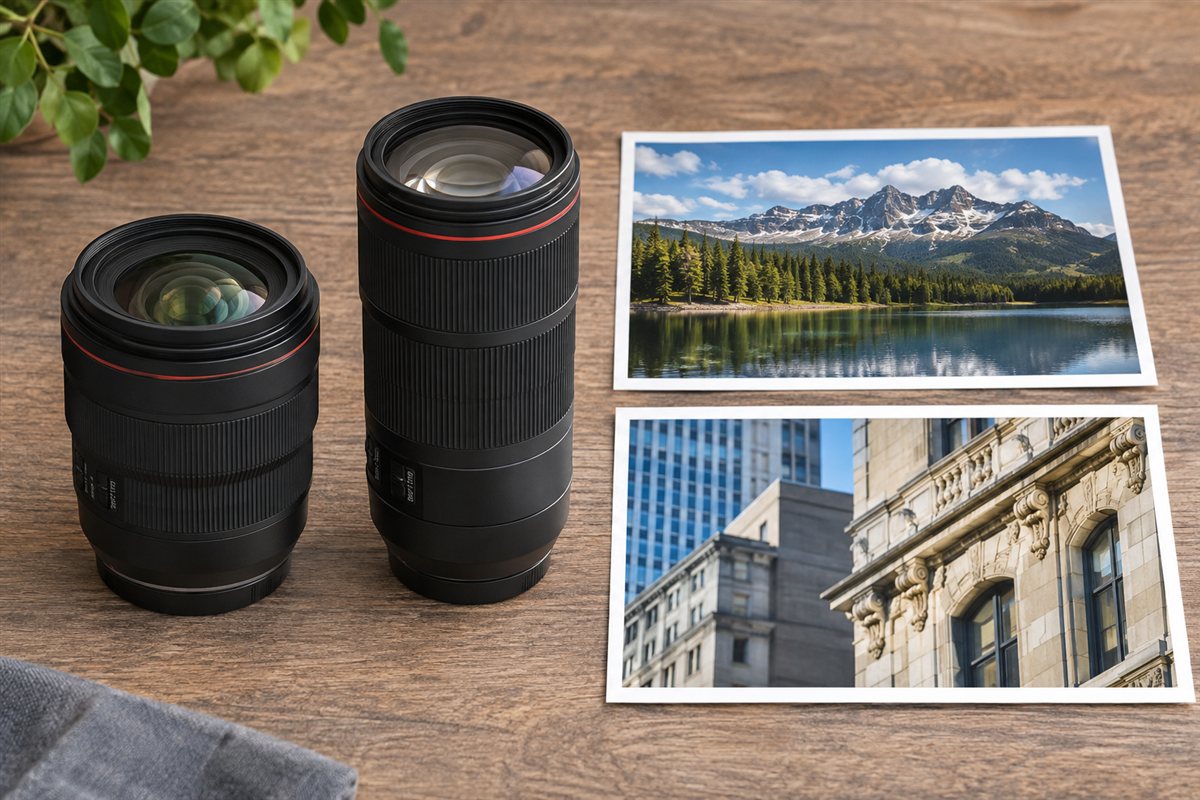
The Tamron 17-50mm f/4 Di III VXD and the Sony FE 24-105mm f/4 G OSS are both constant-aperture f/4 zooms for Sony full-frame cameras, but they cover different ranges. The Tamron goes wider and stays compact, while the Sony reaches much further into telephoto. Choose based on whether you want width or reach, and confirm specs on each maker’s page.
What Each Lens Is Built For
The Tamron 17-50mm f/4 is a compact standard zoom that begins at a true wide angle. That makes it handy for interiors, travel, street scenes and landscapes where you want to include more of the surroundings.
The Sony FE 24-105mm f/4 G OSS is a longer-reaching all-purpose zoom from Sony’s G line. It begins less wide but extends to 105mm, which covers portraits, details and distant subjects without a lens change.
In this guide
Where They Differ
| Trait | Tamron 17-50mm f/4 | Sony 24-105mm f/4 G OSS |
|---|---|---|
| Focal range | 17-50mm, wide to normal | 24-105mm, standard to short telephoto |
| Aperture | Constant f/4 | Constant f/4 |
| Size class | Compact | Larger, longer barrel |
| Stabilization | Check the maker’s page; your body may help | Optical stabilization (OSS) in the lens |
| Best for | Wide scenes, travel, interiors | One-lens trips, portraits, events |
How to Choose
- Look at your last hundred photos. If many are cropped tight or you wished for more reach, the 105mm end of the Sony helps.
- If you frequently feel you cannot fit everything in, the 17mm end of the Tamron solves that.
- Think about carrying weight. A smaller lens is easier to take everywhere, particularly on a small mirrorless body.
- Consider stabilization. Many Sony bodies include in-body stabilization, but a lens with optical stabilization can add to it, especially at longer focal lengths.
- Check how you shoot video. Focus behavior and breathing differ between lenses, so look at the maker details and sample footage.
Things to Remember
- Neither lens is a very fast portrait lens; f/4 is moderately bright.
- A wide opening range helps for architecture and groups.
- Longer reach helps for events, travel details and wildlife at modest distances.
- Both mount to Sony E bodies, but confirm the version.
How the Range Plays Out in Real Situations
Spec sheets list focal lengths, but what matters is what you do with them on an ordinary day. Picture a city walk. With 17mm you can stand in a narrow street and still fit a whole building front into the frame, step into a small cafe and capture the room, or photograph a friend with the scenery behind them. At the long end of 50mm you can frame a waist-up portrait or isolate a doorway or sign.
With 24-105mm the starting view is tighter, so tight interiors and cramped lanes can feel restrictive, but the reach is large. You can shoot a street scene at 24mm, zoom to 70mm for a seated portrait, and go to 105mm to pull in a distant detail on a facade or a performer on a stage. That spread is why this kind of lens is often described as a one-lens travel option.
A useful exercise is to sort a few days of your own photos by focal length, which most photo browsers can do from the file details. If most of your keepers sit below 30mm, a lens that starts at 17mm is giving you something you use. If a large share sit above 60mm, you are probably cropping to fake reach. Let your own habits, not the headline range, make the call.
Keep in mind that range is only part of the story. A lens you can hold comfortably all day and that you are happy to bring along will produce more pictures than one that stays in the bag because it feels like a chore.
Handheld Stability and Working at f/4
Both lenses keep a constant f/4 maximum aperture, which means the brightest setting does not shrink as you zoom. That is convenient because your exposure stays predictable when you change framing. It is also a moderate aperture, so in dim rooms you will lean on a higher ISO or a slower shutter speed.
Stabilization matters most when light drops. The Sony lens includes optical stabilization, and many Sony bodies also stabilize the sensor. For the Tamron, check the maker’s page and your camera manual to see whether the body stabilization covers the focal lengths you use. As a general guide, wider focal lengths tolerate slower shutter speeds than longer ones, so a 17mm lens is naturally easier to hold steady than a 105mm one.
- Use a shutter speed at least as fast as one over the focal length as a starting point, then add margin if you see blur.
- Raise ISO before you accept a shaky frame; modern editing tools handle moderate noise well.
- Brace your elbows against your body, or lean on a wall, for slow shots.
- For video, test a short handheld walking clip to judge how smooth it looks with your body settings.
If you shoot a lot of evening events, remember that neither lens is a fast prime. A small, bright prime in the bag can cover portraits at night while the zoom handles everything else.
Size, Weight and Carry Comfort
A compact lens changes how you shoot. On a small mirrorless body, a light zoom feels balanced and draws less attention. A longer, heavier zoom may tip the front of the camera forward, which tires your wrist over several hours and can make you reach for a strap or a harness.
Look up the weight, length and filter thread on each maker’s page, then compare against what you already carry. If you travel with a small bag, ask whether the lens fits upright or needs to be placed sideways. If you hike, think about whether you want a lens that stays collapsed on the body or one whose barrel extends when zoomed. Extending barrels can pull in dust over time, so some people prefer designs that change length less.
Filter size is another practical point. If you plan to use a polarizer or neutral density filters, a lens with a different thread than your existing filters means buying new ones or using step-up rings. Check this before you buy, not after.
Finally, think about handling. Zoom ring tension, switch placement and whether a hood clips on securely all affect daily use. If you can, hold both lenses on your own camera in a shop.
Pairing Either Lens With a Second Lens
Most people end up owning more than one lens, so consider what each choice leaves uncovered. The wide-to-normal zoom stops at 50mm, which means anything beyond a head-and-shoulders portrait needs a second lens. A short telephoto zoom or a fast portrait prime would fill that gap nicely. The longer zoom starts at 24mm, so very wide scenes, tight interiors and dramatic architecture need an ultra-wide partner.
Think about which gap bothers you more. Missing a wide shot usually means you cannot take it at all, because stepping back is not always possible. Missing reach can often be handled by walking closer or cropping in editing, as long as your sensor resolution is generous. That logic favors width for some people and reach for others, depending on where you shoot.
- Landscape and interiors: lean toward the wider range.
- Family events and travel details: lean toward the longer range.
- Mixed use: pick the one you would hate to be without, and plan a cheap second lens for the other end.
Avoid buying a lens only to overlap with one you already own. Spend the money on range you do not have.
Checks Before You Buy, New or Used
Confirm the mount and the exact version name. Names with similar numbers can describe different generations, and a used listing may be vague. Match the full model name against the maker’s page, and ask the seller for the serial number if you need to verify it.
Update your camera firmware before testing, since some bodies add support for lenses or improve autofocus through updates. Check whether your camera applies automatic corrections for vignetting and distortion for that lens, because zooms that begin at a wide angle often rely on software correction for a clean result. Shoot a brick wall or a tiled floor and see how straight the lines look.
For used copies, inspect these points:
- Front and rear glass for scratches, haze or fungus; shine a small light through the lens.
- Zoom and focus rings for smooth, even movement with no grinding.
- Mount contacts and rubber gasket for wear or cracks.
- Autofocus at both ends of the zoom range, and the stabilization switch if there is one.
Finally, check the return policy and warranty region. A return window lets you compare real photos from your own camera against what you expected.
Which Lens Should You Buy: Tamron 17-50mm f/4 or Sony FE 24-105mm f/4 G OSS?
Buy the Tamron 17-50mm f/4 Di III VXD if you shoot wide scenes and want a compact lens, and buy the Sony FE 24-105mm f/4 G OSS if you want reach and a one-lens kit. Match the lens to the pictures you take most.
- If you photograph interiors, real estate or architecture, go for the Tamron. Starting at 17mm lets you fit more of a room or building into the frame.
- If you travel light and walk all day, choose the Tamron for its compact size, or the Sony if you prefer to leave other lenses at home.
- If you shoot events, family gatherings or portraits, the Sony’s longer end reaches farther, so you can frame tighter without moving.
- If you want a single lens for a trip, the Sony covers more situations, from street scenes to distant details.
- If you value lens-based stabilization, the Sony includes optical stabilization, while the Tamron’s setup should be checked on the maker’s page.
- If you shoot landscapes with sweeping views, the Tamron’s wider start is easier to use.
If you cannot decide, go back to the focal length test described earlier in this comparison: check where most of your keepers sit and let that guide you. After that, use the buttons above to view each current listing.
What to Check on the Listing Before You Order a Sony E-Mount Zoom
Check the mount, the full model name, what is in the box and the return terms. A short review of the listing prevents most disappointments with a lens purchase.
- Mount and sensor: both lenses are made for Sony E-mount cameras. Confirm your body is compatible, and remember a smaller sensor crops the view.
- Exact model name: similar names can describe different versions or generations. Match the full name to the maker’s page.
- Included items: look for the lens hood, front and rear caps and a pouch or case.
- Filter thread: compare it with the filters you already own so you do not need a new set.
- Weight and length: compare both against your bag and your camera body, since balance affects comfort.
- Stabilization details: read how the lens and body stabilization work together on your camera.
- Warranty and region: confirm the warranty terms and whether they apply in your country.
- Return window: make sure you can return it if it does not suit your camera or style.
- Firmware: check whether your camera needs an update for best autofocus behavior with the lens.
Keep the listing details and take a few test shots in the first days. If anything looks off, such as soft corners at a specific focal length, contact the seller while the return window is open.
Is the 24-105mm Worth the Extra Size and Weight?
It is worth it if you regularly use the reach, and not worth it if most of your pictures sit in the wide range. The trade-off is simple: more range in exchange for a larger lens.
The advantages of the Sony are clear. It covers a wide stretch of everyday situations, which means fewer lens changes at crowded events or on walking trips. Its built-in optical stabilization helps in dim light and at longer focal lengths, and the constant f/4 aperture keeps exposure steady as you zoom.
The downsides are equally clear. A longer, larger lens is more noticeable and can tire your wrist during a long day. It starts at 24mm, so tight interiors and dramatic wide shots are harder, and you may eventually want a separate wide lens.
The Tamron flips these points. It is easier to carry and goes wide, but it stops at 50mm, so portraits at a distance and far details need cropping or another lens. Neither choice is wrong; each one fits a different habit.
Who should skip each? If you rarely shoot below 24mm, you may not need the Tamron’s wide end. If you hate carrying weight, or rarely use the long end, the Sony may be more lens than you need.
Common Mistakes When Choosing a Standard Zoom Lens
The biggest mistake is choosing by specifications alone without thinking about how you shoot. A zoom with the longest range or the widest start is not automatically the best fit.
- Buying range you will not use. If you never shoot beyond a mid-range focal length, the extra reach adds weight but no benefit.
- Ignoring the wide end. Many people underestimate how often they need more width until they step back into a wall.
- Expecting portrait-style blur from f/4. It is a moderate aperture, so background separation depends on distance and focal length.
- Skipping the filter check. Different thread sizes can mean buying new filters.
- Not testing autofocus. Try moving subjects, low light and video before the return window closes.
- Judging sharpness from a small screen. Check images at full size, including the corners, at several focal lengths.
- Forgetting the second lens. Plan what will cover the end of the range your lens does not.
A better method is to write down the three types of photos you take most, then check which lens serves all three. Choose the lens that handles your most frequent situations well, not the one that wins on a spec sheet.
How Do You Test a New Zoom During the Return Window?
Test it with a short, repeatable routine in the first few days, using scenes you actually shoot. A planned test tells you more than casual snapping and lets you decide while returns are still possible.
- Shoot the same scene at each end of the range. Photograph a building or a bookshelf at the widest and longest settings, then compare sharpness at full size.
- Check the corners. Wide zooms can look softer at the edges at some focal lengths and apertures, so view the corners, not just the center.
- Look for straight lines. Photograph a tiled wall or door frame and see whether lines curve. Check whether your camera applies automatic corrections.
- Test autofocus in your usual conditions. Try a moving child or pet, a dim room and a backlit window.
- Handle it for a full outing. Carry the lens for a few hours to learn whether its size and balance suit you.
- Record a short clip. If you shoot video, check focus smoothness and how stable a handheld walk looks.
Keep your notes simple: what you liked, what annoyed you and which shots you could not take. If the list of annoyances is longer than the list of keepers, that is a sign to return the lens and try the other one.
How Do These Two f/4 Zooms Compare for Video and Low Light?
Both give steady exposure while zooming, but neither is a fast lens, so low light and shallow depth of field are limited. For video, the main differences come down to stabilization, focus behavior and size on a gimbal or handheld rig.
For handheld video, stabilization is the first thing to compare. The Sony has optical stabilization, and many Sony bodies add sensor stabilization, so the combination can smooth gentle walking shots. For the Tamron, read the maker’s page and your camera manual to see how the body covers the focal lengths you use. A short test clip walking down a street shows more than a spec sheet.
Focus behavior also matters. Look at current sample footage and the maker’s details for focus noise, focus breathing, and how smoothly the lens refocuses. A lens that hunts in video is annoying, even if still photos look fine.
In low light, both lenses need you to raise ISO or slow the shutter. Wider focal lengths are easier to hold steady, which helps the Tamron indoors. The Sony’s lens stabilization helps still subjects at longer settings, but it cannot freeze moving people.
If you often film or shoot in dim venues, treat a bright prime as a companion lens. Either zoom then handles daytime and general use, while the prime handles the dark.
Your next step is to compare the picks above, check the current listing for compatibility, size and what is included, then choose the one that matches the focal lengths you use most.

Ready to Buy? Start Here
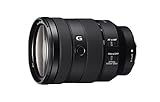
If this guide helped you decide what to look for, these products are a place to start.
As an Amazon Associate we earn from qualifying purchases. Prices and availability are shown on Amazon.
Range Versus Range: Reading the Two Zooms as Maps
It helps to picture these lenses as maps of the same territory drawn from different ends. The Tamron’s map starts wide — 17mm, wide enough for interiors, architecture and sweeping landscapes — and walks to 50mm, the classic standard view. The Sony’s map starts at 24mm, a moderate wide view, and keeps walking to 105mm, into short-telephoto territory where portraits, details and compressed landscapes live. They overlap between 24mm and 50mm, and in that overlap either can take the same picture. The decision is therefore about which extension you will use more: the Tamron’s wide rooms or the Sony’s longer reach.
Count your own pictures to answer that. If your archive is full of interiors, group shots in small spaces, street scenes and landscapes with strong foregrounds, the wide extension is your working tool. If it is full of faces, details, layers of hills and subjects you could not approach, the long extension is. Photographers who genuinely shoot both should note that a wide view cannot be recovered by stepping back when a wall is behind you, while a longer view can sometimes be recovered by cropping a high-resolution file — an asymmetry that quietly favours the Tamron for mixed shooting, unless portraits dominate.
Constant Aperture and the Internal-Zoom Question
Both lenses hold f/4 across their ranges, which keeps exposure behaviour predictable and video-friendly. The Tamron adds a party trick worth understanding: it covers its range within a fixed external length, so the lens does not grow as you zoom. That matters for gimbal balance in video work, for weather sealing consistency, and for the simple feel of a lens that handles the same at every setting. The Sony extends in the conventional way as it zooms towards 105mm, which is no hardship for stills but is a real consideration for gimbal users and for anyone who shoots in dusty or wet conditions where a moving barrel pumps air.
Neither design is fragile, but the ownership experience differs: a fixed-length lens packs to the same size every day and slips into the same bag slot; an extending lens is shorter at rest and longer at work. Think about your bag and your balance habits, especially if video is a large part of your use. For pure stills photography, treat this as a minor point and let range and handling lead.
Stabilisation: In-Lens, In-Body and the Combination
The Sony carries its own optical stabilisation; the Tamron relies on the camera body’s stabilisation where the body provides it. On a modern Sony body with in-body stabilisation, both lenses end up stabilised in practice, and the working difference is smaller than the specification suggests. On an older or entry body without in-body stabilisation, the Sony’s built-in system becomes a significant advantage for handheld stills of static subjects. Check which body you actually own before weighing this point, because it flips the conclusion for some buyers.
For video, stabilisation behaviour is worth a personal test: walk slowly with each lens if you can borrow them, and compare the footage for smoothness and for the corner behaviour that wide lenses show when stabilisation works hard. The Tamron at 17mm on a gimbal is a compelling walkthrough tool; the Sony’s own stabilisation helps handheld clips at its longer settings where shake is more visible. Your dominant use — wide walkthroughs or long handheld clips — points to the answer.
Building a Kit Around Either Choice
Whichever lens you choose becomes the centre of a kit, and the natural partners differ. Behind the Tamron, the gap is at the long end, so a modest telephoto zoom or a fast portrait prime completes the set for faces and details. Behind the Sony, the gap is at the wide end, so an ultra-wide zoom or a fast wide prime completes it for interiors and drama. Neither lens pretends to be a whole kit; both are honest centres. Budget for the partner you will want within a year, and the total cost of each path — not just the first lens — becomes part of a fair comparison.
Filters and accessories follow the same logic. Confirm the filter thread of the lens you choose on the maker’s page and standardise your filters where you can. A lens that shares a thread size with your other lenses saves money and bag space over years, a small compounding advantage that experienced kit builders check before they buy rather than after.
Handling Notes From the Middle of the Range
Because the lenses overlap between 24mm and 50mm, many owners will live in that shared zone and judge the lenses by their manners there. Zoom feel, the placement of the focus ring and the general balance on a Sony body become daily qualities rather than specifications. The Tamron’s fixed length means its balance never changes; the Sony grows as you zoom, which some shooters find natural and others notice on a strap over a long day. If you can handle both in a shop, spend your minutes in the overlap zone doing ordinary things — framing a shelf, focusing near then far — rather than only testing the extremes, because the extremes sell lenses while the middle is where they are used.
Autofocus manners matter in the same zone: both lenses use modern drive systems suited to Sony bodies, including eye autofocus workflows, but confirm on your own body that focus is prompt and quiet enough for your video habits. A short test clip recorded in a quiet room tells you more about focus noise than any written description, and it takes two minutes.
Real Rooms, Real Distances: A Buyer’s Measuring Exercise
Before choosing, run a measuring exercise in your own life. Stand where you would stand to photograph your living room and note whether the whole room would fit if you could step back no further; that is the Tamron’s question. Then stand where you sit at a school concert or a family dinner and consider the face across the room; that is the Sony’s question. The lens that answers the question you meet weekly is the lens to buy, and the exercise takes five minutes with a tape measure replaced by your own two feet. Specification debates dissolve surprisingly fast when a real room is allowed to vote.
Do the same with your bag and your shoulder: wear the camera with a lens of similar size for a day if you can borrow one, and notice whether the outfit’s presence fades or accumulates. A standard zoom is the most-carried lens you will own, and carry comfort compounds like interest — a small daily ease becomes a large yearly one.
Colour, Contrast and the Look of the Files
Modern lenses from major makers are more alike in rendering than their reputations suggest, and both of these produce clean, correctable files that respond well to editing. Where owners do develop preferences — a contrast character, a flare behaviour, a way with skin tones — those preferences come from weeks of living with files, not from a day of charts. If rendering matters deeply to you, download full-size sample files made with each lens on subjects like yours, process them the way you process your own work, and live with the results for a day before deciding. Your editing pipeline is part of the lens’s look, and only your pipeline can judge it.
FAQ
Can the Tamron replace the Sony for travel?
It can if you mostly shoot wide to normal scenes. If you want to photograph faraway details or tighter portraits, you may miss the longer reach of the 24-105mm.
Which lens suits video better?
Both can work. A lens with built-in stabilization and well-known focus behavior is helpful for handheld video, but compare the current feature lists to see which fits your recording style.
Is f/4 bright enough for indoor photos?
It works in well-lit rooms and near windows, but in dim spaces you will need a higher ISO or a slower shutter. Stabilization helps with still subjects, though not with moving people. A fast prime is a better tool for dark venues.
Do I need lens stabilization if my camera has it built in?
Not always. Body stabilization can be enough for wide focal lengths, but lens stabilization can add help at longer ones. Check your camera manual for how the two work together.
Which lens is easier to use for landscapes?
The wider range is generally easier for sweeping scenes because 17mm includes more of the view. The longer zoom can still pick out distant details, so it suits layered landscapes in a different way.
Will either lens fit a smaller sensor Sony body?
Both are made for the E mount, so they usually attach, but a smaller sensor crops the view. Check the maker details and your camera's sensor size before assuming the framing will match.
Should I buy the lens that covers more range or the one I will carry more often?
Carry matters. A lens that stays at home takes no pictures, so weigh size and comfort as seriously as range. Many people find the lighter option gets used more.
How do I test a lens in the first few days?
Shoot the same scenes at the widest and longest settings, at f/4 and one stop smaller, and check the corners and edges at full size. Also try autofocus on moving subjects and video clips if you record.
Can a zoom like this replace several primes?
It can for convenience, since you can frame without changing lenses. It will not give the shallow depth of field or low light ability of a bright prime, so decide what you need most.
Is the Tamron 17-50mm f/4 a full-frame lens?
The post describes both lenses as zooms for Sony full-frame cameras. Always confirm coverage and compatibility on Tamron's official page and your camera manual. If you use a smaller sensor body, expect the view to be cropped.
Which lens is better for travel, the Tamron or the Sony?
It depends on what you shoot while traveling. The Tamron suits wide scenes, interiors and compact packing, while the Sony covers more distance with one lens. Think about whether you would miss width or reach more.
Does the Sony FE 24-105mm f/4 G OSS have image stabilization?
Yes, OSS stands for optical stabilization, which is built into the lens. Many Sony bodies also have sensor stabilization, so the two can work together. Check your camera manual for how they combine.
Is f/4 enough for portraits?
It can make decent portraits, especially at longer focal lengths with the subject away from the background. It will not give the very soft backgrounds of a brighter prime. Distance between subject and background helps more than aperture alone.
Do I need a second lens if I buy one of these zooms?
Many people add one eventually. The Tamron stops at 50mm, so a telephoto or portrait lens fills that gap, while the Sony starts at 24mm, so an ultra-wide covers tighter spaces. You can start with one and add another only if you feel limited.
Which lens is easier to carry all day?
The Tamron is described as the more compact option, so most people find it easier to carry. Check the weight and length listed by each maker. Comfort matters, since a lens left at home takes no pictures.
Should I buy a used copy of either lens?
A used lens can be a sensible choice if you inspect the glass, rings, mount and autofocus, and confirm the exact version. Ask about the return policy. Test it at both ends of the zoom range soon after receiving it.
Will filters from my other lenses fit?
Only if the filter thread sizes match. Look up the thread on each maker's page and compare it with your filters. If it differs, a step-up ring or new filters may be needed.
Which lens is better for photographing my home to sell it?
The Tamron, and it is not close: at 17mm it shows whole rooms in a single frame, which is what buyers scroll through, while the Sony’s 24mm start will cut off the corners of smaller rooms. Keep the camera level and at about chest height or a little lower, turn on every light, and shoot from doorways and corners to maximise the sense of space. The Sony can still photograph the exterior and the garden handsomely. If the sale matters, borrow or rent a wide option for the interior set even if the Sony is your everyday lens.
Can the Sony 24-105mm be my only lens for a round-the-world trip?
It is one of the most credible single-lens answers to that question: the range covers street scenes, landscapes, portraits and details, the aperture is constant, and stabilisation helps in museums and at dusk. What you give up is the true wide view for interiors and grand architecture, and some low-light ability compared with faster glass. Many travellers accept exactly that trade and come home with complete coverage. If your trip is heavy on old towns, temples and interiors, the Tamron’s width, possibly with a fast prime for the evenings, may serve the story better.
Does the Tamron’s fixed length really help on a gimbal?
Yes, in a specific and practical way: a lens that does not extend keeps its centre of gravity still while you zoom, so a gimbal balanced at one focal length stays balanced at all of them. With an extending lens, zooming shifts the balance and can make the gimbal work harder or drift. If you rarely zoom during a take, the point fades; if you plan walking shots with reframing, it is a genuine working advantage. Always confirm the total weight of body, lens and accessories against your gimbal’s payload.
Which lens focuses closer for detail shots?
Check the current specification pages for the exact figures, because close-focus ability is a designed feature that varies between models, then think about what it means: a standard zoom that focuses reasonably close can photograph food, flowers, products and details without a lens change, which is valuable for travel and for selling items online. Neither replaces a macro lens for frame-filling images of tiny subjects. In practice, test the lens you receive at its closest setting to learn its working distance and how its sharpness behaves there.
Is f/4 enough for indoor family photography?
On a modern full-frame body, generally yes: high-ISO performance carries f/4 indoors, and stabilisation or a sensible shutter speed handles static moments. The limit appears with fast-moving children in dim rooms, where you need a fast shutter speed and the ISO climbs. A fast prime is the traditional partner for exactly those moments. Between these two zooms, the Tamron’s wider view suits small rooms and group shots; the Sony’s longer end suits candid faces from across the room. Choose by your rooms and your subjects.
How do I decide if I can only afford one and shoot everything?
Write down your last month of photographs — or the month you wish you had taken — and sort them into wide scenes, standard views and long details. The category with the most entries chooses the lens: wide-heavy means the Tamron, long-heavy means the Sony, and a genuine tie means you should value the wide end, because walls prevent stepping back while cropping can substitute for reach on a modern sensor. Then buy the best-condition copy you can find and stop reading comparisons; either lens will make pictures the other cannot, and that is the nature of the choice.
Which lens is better for landscape photography?
For foreground-led landscapes — a rock, a stream, a path leading in — the Tamron’s 17mm end is the stronger tool, giving depth and drama the Sony cannot reach. For layered, compressed landscapes — ridges, mist, patterns in fields — the Sony’s reach to 105mm is the stronger tool. Many landscape photographers eventually own both a wide and a longer option for exactly this reason. Start with the style that fills your current portfolio, and let the other style be the argument for your second lens.
Can I use either lens on an APS-C Sony body?
Yes, both mount and work, with the field of view cropped by the smaller sensor: the Tamron behaves like a wide-to-standard zoom and the Sony like a standard-to-telephoto. That can be useful — the Sony becomes a portrait-friendly range — but if you are buying primarily for an APS-C body, weigh dedicated crop lenses too. If a full-frame body is in your future, either of these lenses carries forward, which is a fair argument for buying full-frame glass once.
What bag size suits a body plus one of these lenses?
A small shoulder bag or sling that takes the camera with the lens mounted is enough for either, which is part of their appeal as everyday lenses. Measure the mounted combination, hood reversed, against the bag’s interior rather than trusting litre ratings. Leave room for a cloth, a spare battery and a card wallet, and you have a complete day kit. If you add the partner lens discussed above, step up one bag size rather than forcing zips, because forced zips fail at the worst moments.
Which lens should a real-estate videographer choose?
The Tamron, for the combination of a true wide view and a fixed external length that keeps a gimbal balanced through a zoom. Walk slowly, keep the camera level, and let rooms open as you move rather than panning from a corner. The Sony can film exteriors, details and agent pieces to camera handsomely, but interiors are the core of the work and they belong to the wide lens. If property video is paid work, the Tamron’s suitability is a business case, not just a photographic one.
How do I avoid distortion on faces at the Tamron’s wide end?
Keep faces away from the corners and edges, where wide-angle stretching lives, and step back to use a longer setting for anything resembling a portrait. At 17mm, treat people as part of the environment — small in a big scene — rather than as subjects. If a group must be photographed wide, arrange them in a shallow arc near the centre of the frame. These habits cost nothing and they are the difference between a wide lens looking dramatic and looking unkind.
Is one of these lenses clearly better for resale later?
First-party lenses generally find buyers faster, which is a real if modest advantage for the Sony, while the Tamron’s lower starting price means the cash at risk is smaller. Condition, completeness and timing move resale values more than the badge in most individual sales. Buy the lens you will use for years and the resale question shrinks to its proper size; buy the lens you expect to sell soon and you have probably chosen the wrong lens for reasons that have nothing to do with money.
Which lens is kinder to a photographer’s shoulder on a long day?
Carry comfort is a combination of the lens’s weight, its length in the bag and how the outfit hangs, and it should be tested rather than assumed: wear the combination you are considering for a full hour of walking if a shop or a friend allows. Use a cross-body strap that takes the load on the shoulder and hip rather than the neck, and rest the outfit whenever you stop. Between these two, the deciding factor is usually the day’s shape — a shooting day forgives weight, a sightseeing day accumulates it. Choose for the days you actually have, and remember that a lens left in the hotel has no optical qualities at all.
Can I use either lens for photographing a school sports day?
Yes, from the sideline both cover the near action easily; the difference is the far side of the pitch, where the Sony’s 105mm end keeps players at a useful size while the Tamron asks you to crop or to move. In daylight, which is when school sport happens, f/4 is no hardship, and stabilisation helps the static moments between plays. Position yourself with the sun behind you and the background as plain as the ground allows. For most parents, either lens returns a complete record of the day; the Sony simply reaches the far touchline more gracefully.
The Short Version
The Tamron 17-50mm f/4 is the choice for width and portability, while the Sony FE 24-105mm f/4 G OSS is the choice for reach and one-lens flexibility. Decide which end of the range you miss most, then check current specs with Tamron and Sony.
