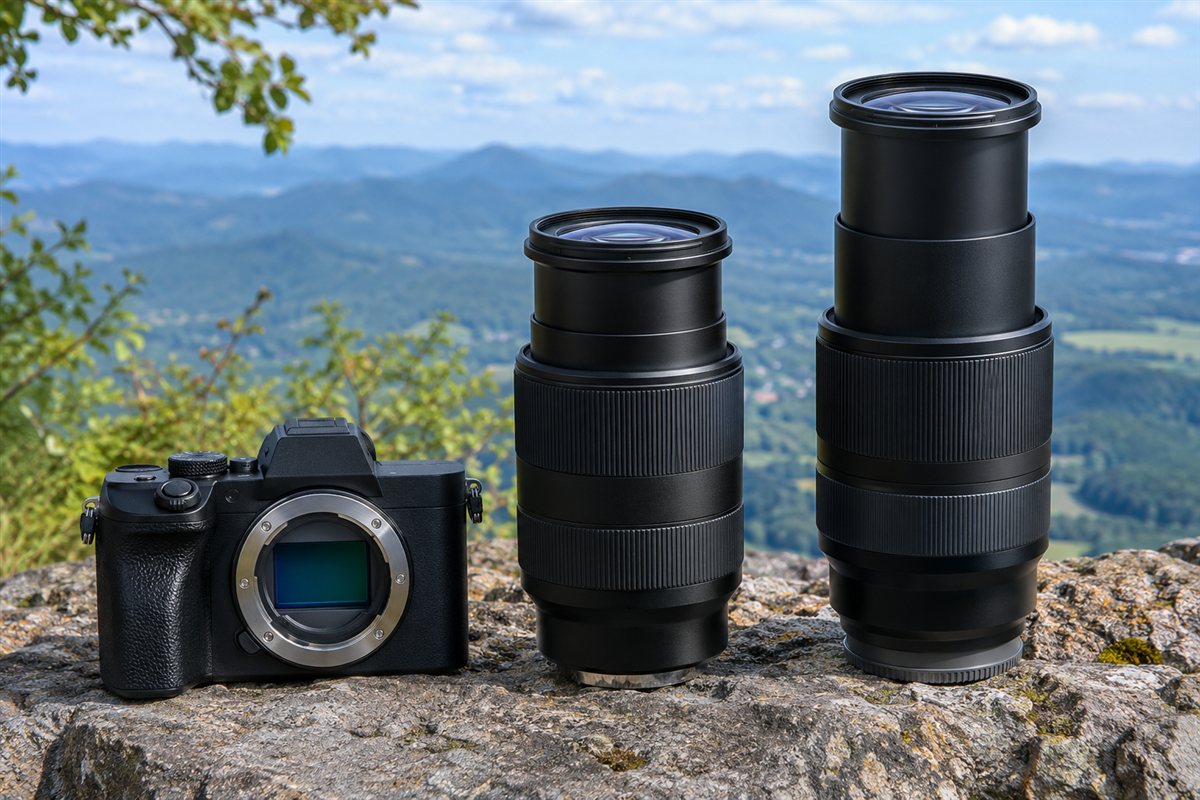
Both lenses are all-in-one zooms for Sony E mount mirrorless cameras, built so one lens covers wide angles to long telephoto. The Tamron’s name points to a brighter maximum aperture range, and the Sony’s name points to slightly more reach plus optical stabilization, so confirm weights, sizes and features on each maker’s page.
What Each Lens Is For
A superzoom is for travel and everyday photography when changing lenses is inconvenient. You trade some peak sharpness and light gathering for convenience.
- Tamron 25-200mm f/2.8-5.6 Di III VXD G2: a third-party zoom for full frame E mount, with the second generation label indicating an update to an earlier design.
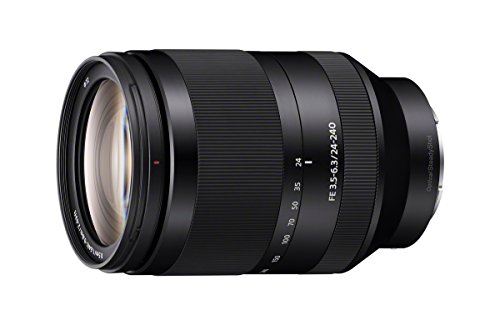
- Sony FE 24-240mm f/3.5-6.3 OSS: Sony’s own travel zoom for full frame E mount, with optical stabilization built in, as the OSS label shows.
In this guide
Key Differences From the Names
| Point | Tamron 25-200mm | Sony 24-240mm |
|---|---|---|
| Zoom range | 25 to 200mm | 24 to 240mm |
| Widest aperture | f/2.8 at the wide end | f/3.5 at the wide end |
| Aperture at the long end | f/5.6 | f/6.3 |
| Maker | Third party | Camera maker |
| Stabilization | Confirm on the maker page | Optical, per the OSS label |
The faster aperture helps in dimmer scenes and gives a bit more background blur at the wide end. The Sony’s longer reach brings distant subjects closer, and its built-in stabilization helps handheld shots at long focal lengths. Note that many Sony bodies also offer in-body stabilization, which reduces the gap.
How to Decide
- Decide how often you shoot indoors or at dusk. If often, the brighter aperture range matters more.
- Decide how often you need the last bit of reach, such as for wildlife or events from a distance.
- Check which camera body you use and whether it has in-body stabilization.
- Compare weight and size on the makers’ pages, because a travel lens must be easy to carry.
- Check close focus and maximum magnification if you like small details.
Try borrowing or renting each option for a weekend if that is possible near you. A short real session shows weight, balance and handling quickly, and it is the most direct way to learn which one feels right for your own shooting style.
Remember that sample photos online are made under different conditions, so treat them as a rough guide only. If possible, handle each lens in a shop or rent it for a weekend, and shoot the kind of scene you care about most before you commit.
What Superzoom Compromises Mean
A superzoom packs a huge focal range into one barrel, and the optical design has to make trade-offs to do it. Typical compromises include softer corners at some focal lengths, more distortion at the wide end, a maximum aperture that narrows as you zoom, and more flare in strong backlight. Modern designs do a lot to reduce these effects, and software corrections inside the camera or editing programs help further, but the pattern is a good reason to treat sample images with some care.
The point of a superzoom is not that it matches a set of dedicated lenses. It is that it lets you capture a scene you would otherwise miss while changing lenses. If you value that, small optical compromises are often an acceptable price. If you make large prints or crop heavily, they may matter more.
To judge them fairly, decide what you will do with the images. Web sharing and photo books rarely reveal small flaws. Big wall prints and tight crops do. Look at sample images shot at the focal lengths you use most, not just at the extremes, and look at the edges of the frame as well as the center.
Aperture Across the Zoom Range
Both lens names show an aperture that changes as you zoom. A wide aperture at the short end helps with dim interiors, evening streets and background blur at close range. As you zoom in, the maximum aperture narrows, which means less light reaches the sensor, so you need a faster shutter speed, higher ISO or more light.
The practical effect is that the lens is happiest in daylight. In low light at the long end, you may end up at a high ISO or a slow shutter speed. Modern full-frame cameras handle noise well, but there is still a limit. Stabilization can help with still subjects, but not with moving ones.
- Indoors or at dusk, use the wide end where the aperture is widest.
- Outdoors in sunlight, the narrower aperture at the long end is rarely a problem.
- At events, plan for higher ISO values and keep shutter speeds high enough for moving people.
Check each maker’s page for the exact aperture at specific focal lengths, since the transition points differ between lenses. If low-light work is your priority, a brighter lens with a shorter range may be a better match than any superzoom.
Close Focus and Everyday Details
Travel photography is full of small things: a menu, a market stall, a carved door, a flower on a trail. How close a lens can focus, and how large it renders a small subject, is therefore worth checking. Different lenses allow different magnification at different focal lengths, and a superzoom may reach its best close-up ability only at certain settings.
Look at the minimum focus distance and the maximum magnification on each maker’s page. A shorter minimum distance lets you fill the frame with a small subject, though very close focus at a wide aperture gives a very thin zone of sharpness. Stopping down a bit usually helps. Also note that minimum focus distance is measured from the sensor plane, not from the front of the lens, so your actual working distance is shorter than the number suggests.
Background separation is also a factor. At longer focal lengths, even a modest aperture can blur the background nicely when the subject is near and the background is far away. Use that to isolate a detail without needing a macro lens, and get used to moving your feet as well as the zoom ring to find the best view.
Handling, Weight and Balance on the Body
A travel zoom must be comfortable to carry for a whole day. Compare the weight and size on each maker’s page, then think about how they affect your camera. A larger lens on a small body can feel front-heavy, and a lens that extends when zoomed can change the balance as you work.
Some lenses extend the barrel as you zoom, which can draw in dust and air, a behavior sometimes called the pump effect when a lens moves back and forth. Others keep a fixed length. Check the maker’s description and consider how much it matters to you. Look for a zoom lock switch, which stops the barrel from extending under its own weight when you carry the camera on a strap.
- Try each lens on your body in a shop to feel the balance.
- Check that the zoom ring has a comfortable amount of resistance.
- Look at the hood design and whether it fits easily into your bag.
- Consider the filter thread size for accessories.
Walk around with each lens for a few minutes, not just a quick hold. A lens that feels fine for ten seconds may be tiring after an hour.
When a Superzoom Is the Wrong Tool
A superzoom is excellent for travel days, family trips and any situation where changing lenses is difficult. It is a weaker choice when you need maximum image quality, shallow depth of field, or good performance in dim light. Portrait specialists, event photographers in dark venues, and landscape photographers making large prints will often do better with separate lenses.
Here are some signs that a superzoom is not meeting your needs. You always shoot at the same few focal lengths and rarely use the rest of the range. You find yourself at the maximum ISO most of the time. You see soft corners or flare in photos you care about. In those cases, a smaller range of lenses, or a pair of zooms plus a fast prime, may be more satisfying.
A sensible plan is to use a superzoom as a walk-around lens for a few weeks. Keep a note of which focal lengths you use most. If most shots fall into one part of the range, you can then pick a more specialized lens to match. This uses your own habits to guide the next purchase, instead of guessing from a specification list.
Why Long Zoom Lenses Appeal to Travelers
A single lens that covers wide landscapes, street scenes and distant details removes the need to carry a bag of glass. For many travelers, that simplicity is worth more than the last bit of sharpness. You can walk through a market, frame a distant church tower and photograph a close detail on a doorway without changing lenses or missing the moment. The trade-off is that a lens covering such a range cannot match a dedicated prime or a narrower zoom in every respect. Understanding where compromises appear lets you decide whether the convenience suits the way you shoot.
Think of the lens as a tool for flexible, spontaneous photography rather than for maximum image quality in a controlled setting. Used with that mindset, it can be an excellent companion.
Choosing the Right Focal Length for the Moment
Having a big range invites a habit of standing still and zooming. Resist it. Move your feet first to choose your viewpoint, then adjust the focal length to refine the framing. Use the wide end for environmental scenes and interiors, the middle for natural-looking perspective in street photography, and the long end for details and compressing layers. Remember that the longer settings often have a smaller maximum aperture, so you may need to raise the sensitivity or use a steadier hold.
| Focal range | Typical use | Tip |
|---|---|---|
| Wide end | Landscapes, interiors, architecture | Watch for edge distortion |
| Middle | Street, family, travel | Easy to compose naturally |
| Long end | Details, wildlife, sport | Use a faster shutter speed |
Low Light Strategies With Variable Apertures
When the maximum aperture shrinks as you zoom, indoor and evening shooting becomes harder. Use a slightly higher sensitivity, rest the camera on a wall or table, and rely on in-body or in-lens stabilization for still subjects. For moving subjects, accept a bit of noise rather than a blurred picture. Learn how your camera behaves at high sensitivity and process raw files with careful noise reduction. When the light is truly dim, move closer to the wide end where the aperture is largest.
Stabilization and Handheld Technique
Stabilization systems reduce the blur from small hand movements, which becomes more valuable at long focal lengths. Combine it with good technique: stand with your feet apart, elbows against your chest, and press the shutter smoothly. Use a monopod or lean on a solid object when possible. Remember that stabilization does not freeze a moving subject, so keep the shutter speed high enough to stop the action.
- Brace the lens with your left hand under the barrel.
- Breathe out slowly before pressing the shutter.
- Take two or three frames in case one is soft.
Image Quality Across the Zoom Range
No super-wide-range zoom is equally sharp everywhere. Edges and corners often soften at the extremes, and distortion may be present at both ends. Many cameras and editing programs correct distortion and vignetting automatically using lens profiles. Examine your own pictures at full size to see where the lens performs best, then choose those focal lengths for important shots. Stopping down a little from the maximum aperture usually improves sharpness.
Autofocus Speed and Reliability
Quiet, fast focusing motors help both with stills and video. Test how quickly the lens locks onto a subject, how it handles tracking and how it behaves in dim light. Check that focus breathing, the change of framing during focusing, is acceptable if you record video. Update the camera and lens firmware when the maker offers improvements, since these can change autofocus behavior.
Carrying and Daily Use
Long zoom lenses are bulky when extended. Check the weight on your body, and think about a strap that spreads the load. Many have a lock to keep the barrel from creeping out while hanging from a strap. Pack the lens with the zoom retracted and the hood reversed. Cover the front with a cap when you are not shooting, since the large front element attracts fingerprints and dust.
Video Considerations
For filming, look for smooth zooming, quiet focusing and good stabilization. Variable aperture can cause a visible exposure change as you zoom, so lock exposure or practise smooth adjustments. Use a gimbal for walking shots. Record a short clip with the built-in microphone to check for lens noise before you rely on the lens in a quiet setting.
Pairing a Superzoom With a Prime
A clever approach is to carry the superzoom as your main lens and add one small, fast prime for low light and portraits. The prime weighs little and provides a wide aperture and better sharpness, while the zoom handles everything else. This combination gives you flexibility and quality without a heavy bag, and it suits travel, family days and casual events.
Final Tips for Choosing
Consider how often you change lenses today and how often you miss shots because of it. If you often find yourself in the wrong lens, a long zoom may bring more pictures than a pair of better lenses. If you rarely miss, keep your current setup. Check compatibility with your camera, think about weight, and decide whether the extra reach matters for your subjects.
Building a Day-Trip Shot List
A long zoom shines on a day out when you want to cover many subjects. Plan a few shot types in advance: a wide establishing view of the place, a mid-range frame of people or activity, a tight detail of texture or signage, and a distant subject that you can only reach with the long end. Capturing each type gives your photo set variety and a story. Take a moment between shots to check the background, adjust your position and think about light. A simple list keeps you creative rather than just zooming at random.
- Wide view of the whole scene.
- Medium frame with a clear subject.
- Close detail that tells a small story.
- Distant subject framed at full zoom.
Editing Superzoom Pictures
When you edit, apply the lens profile if your software offers one, to correct distortion and vignetting. Add a little local contrast, check corners for softness and crop slightly if edges look weak. Sharpening can help, but keep it modest to avoid halos. Compare the results with a version from a prime lens if you own one, so you know what to expect from each. Knowing the lens character helps you decide when to rely on it.
Weather and Dust Considerations
Zoom lenses that extend can pull air in and out as the barrel moves, so dust and moisture may reach the inside over time. Avoid zooming in very dusty places, wipe the barrel after rain, and keep the lens in a bag when you are not using it. Follow the maker guidance on weather resistance, because sealing varies, and do not assume the lens is safe in heavy rain. A small rain cover is inexpensive insurance.
Cost of Ownership
Think about the total cost of owning a lens: purchase, accessories such as a hood and filter, a protective case and perhaps a service. A versatile lens can replace several others, which lowers the cost per picture. Keep the box and papers for resale. If you plan to resell, keep the lens clean and free of marks.
Troubleshooting Soft Pictures
If images look soft, work through the likely causes. Check the shutter speed against the focal length and subject movement. Confirm that the focus point sat on the subject and that the autofocus mode suited the scene. Look at the front element for smudges. Stop down a little from the widest aperture, and avoid the extreme ends of the zoom for critical work. Test the lens on a tripod to separate camera shake from lens performance. If the softness remains, contact the seller or maker about a possible fault.
- Clean the glass gently with a blower and cloth.
- Shoot a test chart or a textured wall on a tripod.
- Compare center and corner sharpness at several focal lengths.

Check Current Listings
As an Amazon Associate, Reviews Took earns from qualifying purchases.
Both options are sold on Amazon. Check the current listing, what is included in the box and the seller before you decide.
Tamron 25-200mm f/2.8-5.6

Sony FE 24-240mm f/3.5-6.3 OSS
How Superzooms Behave Across a Real Day of Shooting
Specification comparisons flatten the difference between two superzooms, because a real day of shooting is a sequence of changing problems rather than a single test. In the morning you are at the wide end for a street or a landscape, by midday you are somewhere in the middle for people and details, and by afternoon you are at full reach for a distant subject you cannot approach. A lens that covers that whole arc without a swap earns its keep in a way no sharper but narrower lens can match on a trip where changing glass means dust, delay and missed frames. When you compare the two lenses in this guide, keep that day in mind and ask which compromises you will actually meet, and how often.
The compromises cluster predictably. At the wide end, distortion and soft corners are the usual tax; in the middle range, most superzooms are at their most confident; at full reach, aperture narrows, shutter speeds become a negotiation, and autofocus works hardest. Knowing where your own photography lives on that range is the sharpest tool you have for choosing. A traveller whose frames are mostly wide and mid-range should weight wide-end behaviour heavily and treat the long end as a bonus. A photographer who haunts wetlands and sports fields should do the opposite, and may honestly conclude that neither superzoom is the main lens for the job.
Shutter Speed Discipline at Long Reach
More superzoom photographs are lost to camera movement than to optics, and the loss grows with focal length. Stabilisation helps greatly, but it has limits, and it does nothing for a moving subject. Build a personal floor for shutter speed at your longest focal length by testing: photograph a detailed static subject handheld at a descending series of speeds and find where your sharp results stop being consistent. That floor, whatever it turns out to be, should govern your exposure choices in the field more than any rule of thumb, because it describes your hands, your stance and your lens working together.
Technique raises the floor. A supported elbow, a fence or tree as a brace, a breath let halfway out as you fire, short bursts from which the steadiest frame is chosen — these habits regularly rescue a stop or more. They also explain why two photographers with the same lens bring home different results from the same viewpoint. Before concluding that a superzoom is soft at the long end, it is worth concluding first whether the photographer was steady, because the honest answer is frequently humbling and always cheaper than new glass.
Colour, Contrast and the Look of the Files
Beyond sharpness, lenses have a rendering character: how they handle contrast in harsh light, how colours separate, how out-of-focus backgrounds dissolve. Superzooms, with their many elements and coatings asked to perform across an enormous range, tend toward a practical, even rendering rather than a distinctive one, and differences between the two lenses here are more likely to appear in difficult light — shooting toward the sun, or in the flat glare of midday — than in gentle conditions. Flare resistance matters in travel photography more than its reputation suggests, because travel constantly presents backlit scenes you cannot reschedule: harbours at sunset, white villages at noon, windows and water everywhere.
A lens hood is part of this story and the cheapest optical upgrade in photography. Use it always outdoors. It shades the front element from stray light that washes contrast out of the whole frame, and it physically protects the glass. Many photographers who describe a lens as low in contrast have simply been photographing its flare. When you test either lens, test it hooded, and compare like with like before drawing conclusions about character.
Distortion and the Software Half of the Lens
Modern superzooms are designed as a partnership between glass and software: some distortion and vignetting are deliberately left for the camera or editing program to correct from a profile. This is not cheating; it is how such wide ranges are made practical at all. It does mean your results depend on the correction being applied, so check that your camera applies it for JPEG files and that your editing software has a profile for raw files. A superzoom photograph viewed without its correction can look oddly bent and dark-cornered, and more than one owner has judged a lens harshly for a software step that was simply switched off.
Carrying One Lens: The Packing Question
The superzoom promise is a smaller bag, and it is worth auditing what that promise is worth to you in practice. One lens on the camera, no second lens to protect, no changing in wind or dust, a bag that closes easily and a shoulder that lasts the day — for travel, event wandering and family days, that simplicity is a feature as real as any optical quality. Against it, set the occasions when the superzoom stays home because a faster, smaller lens suits an evening or an interior better. Many photographers end up owning both kinds, using the superzoom as the daylight explorer and a compact prime as the evening companion, and that pairing is one of the most satisfying two-lens arrangements in everyday photography.
Weather sealing and build enter the packing question too. A lens that will be carried daily, in all seasons, should be treated as equipment rather than as an ornament: check how it rides in your bag, whether the zoom action stays smooth after months of dust and use, and whether the lock — if it has one — prevents the barrel creeping out as you walk. Zoom creep sounds like a trivial annoyance until you have spent a day hiking with a lens that extends itself at every mile, quietly changing your composition and your temper.
Filters and Protection for a Lens That Goes Everywhere
A lens that travels everywhere meets more hazards than a studio lens, and a clear protective filter is a reasonable insurance for the front element, provided it is of decent quality so it does not become the weakest optical link. The filter thread size also decides the cost of any polariser you may want for water, glass and sky — a genuinely useful creative filter for travel that no software fully replaces. Check thread sizes when you compare the two lenses, not because the difference is decisive, but because filters you already own may fit one and not the other, and small compatibilities add up across a kit.
Making the Final Choice With Your Own Photographs
The most reliable comparison test uses your own subjects. If you can borrow, rent or handle either lens, photograph the same five scenes with both: a wide view with straight lines, a portrait distance subject, a backlit scene, a distant detail at full reach, and an indoor shot at the widest aperture available. Review the files at your normal output size, not magnified beyond it, and note which lens made each scene easier rather than only which file looks finer under extreme inspection. Ease compounds over a trip; pixel-level differences mostly do not.
Then decide with your diary open. Count your last season’s photographs by rough focal length if your software allows it, and look at where you truly shoot. The lens whose strengths cover your most common ground — and whose weaknesses fall where you rarely venture — is the right superzoom for you, whichever name is on the barrel. That is the quiet truth beneath this whole comparison: both lenses can take a traveller almost anywhere, and the better choice is the one matched to the travelling you actually do.
Reading Sample Images Without Being Misled
Sample photographs are the most persuasive and least reliable evidence in any lens comparison, and superzoom samples are the easiest of all to misread. A sample taken in golden light at mid-range tells you nothing about the grey morning at full reach where your own photography may live. Learn to interrogate samples the way you would interrogate a witness: at what focal length, at what aperture, in what light, processed how, and shown at what size? A photographer who posts full-size files with their settings visible is giving you evidence; a gallery of small, polished images is giving you advertising, however honest the photographer. Seek out the unglamorous samples — the dull-day, long-end, high-sensitivity ones — because they describe the floor of the lens’s performance, and it is the floor, not the ceiling, that you will live with most often.
Your own test files, made by the method described earlier in this guide, remain the gold standard, but samples have one advantage: they show you subjects you cannot arrange, in places you cannot visit, shot by people whose technique differs from yours. A lens that produces good files in many different hands is a safer bet than one that shines only in the hands of its most skilled advocate. Breadth of evidence is the reader’s defence against every kind of cherry-picking, including your own.
The One-Week Diary Test
If you are fortunate enough to borrow either lens, keep a one-week diary rather than forming an instant verdict. Note each day what you photographed, where the lens helped, where it argued with you, and how your shoulder felt by evening. Instant verdicts are captured by first impressions — usually the thrill of reach — while diaries capture ownership: the third day, when the novelty fades and the compromises clock in for work. Read the diary at the week’s end and count the entries in each column. That count, in your own handwriting about your own days, is the most trustworthy review of the lens that will ever be written for you.
Why This Choice Is Really About Your Next Year of Photographs
It is easy, deep in a comparison, to forget what is being decided. You are not choosing between two specification sheets; you are choosing the instrument through which next year’s journeys, family days and quiet walks will be photographed. The right lens is the one that will be on the camera for those days — carried without resentment, trusted without thought, equal to the light you actually meet. Both lenses in this guide can claim that role in the right life. Let your diary, your archive and your shoulder cast the deciding votes, and whichever barrel you choose, the photographs will be the better for the honesty of the choosing.
What to Pack Around a One-Lens Outfit
A superzoom simplifies the lens question and thereby clarifies every other packing decision, because the bag’s remaining space can serve the things that actually limit travel photography: power, support and weather. A compact travel tripod earns its place on the days the lens’s apertures ask for one. A small blower and cloth earn theirs on every dusty street. Spare batteries and a charger you trust matter more than a second lens you would rarely mount. Photographers switching to a one-lens outfit often discover their bag gets lighter and their photographs get better at the same time, because the weight they shed was option anxiety, and the space they gained went to the unglamorous equipment that quietly decides whether the day’s pictures exist at all.
Clothing and carry deserve a line too. A lens carried all day is carried against the body, and a strap arrangement that distributes that load — cross-body rather than around the neck — changes how the evening feels. Pockets that hold the lens cap you will otherwise lose, a rain cover that lives in the bag rather than in a drawer at home: these are the superzoom’s true accessories, and none of them appears in a lens comparison table, which is why experienced travellers read comparisons for the optics and then plan the rest from their own scar tissue.
Insurance and the Honest Inventory
A lens that travels everywhere should exist on paper somewhere: photograph it, note its serial number, and keep both with your documents. If you insure your equipment, confirm the superzoom is listed at a sensible value — owners routinely insure the exotic lens they rarely carry and forget the one that is actually at risk daily. The same inventory serves at resale and at the repair counter, and it takes five minutes on a quiet evening. Equipment that goes everywhere deserves administration that knows where it has been.
The Superzoom Habit: Shooting the Whole Range
End with a piece of practice that gets the most from whichever lens you choose. Owners of wide-range zooms commonly live at the two extremes and neglect the middle, which is a waste of the lens’s most confident territory. Set yourself the occasional exercise of a day shot entirely in the middle range — no widest, no longest — and discover the photographs that live there: environmental portraits, layered street scenes, landscapes with foregrounds that breathe. Then reverse it: a day at the long end only, hunting compression and isolation. A lens whose whole range you have deliberately inhabited becomes a different instrument from the same lens used at two settings, and the difference shows in the variety of the work you bring home from identical trips.
Lending, Borrowing and Second Bodies
A superzoom is the lens friends ask to borrow, because it promises to cover their trip, their match, their one weekend of need — and lending it is a decision to make with open eyes. It is your most versatile and often most valuable travelling glass, and its extending barrel and switches are exactly the parts a careless borrower can harm without noticing. If you lend, lend with the hood and cap fitted, the strap attached, and two minutes of instruction about supporting the barrel and keeping the lens out of sand. If you would rather not, the honest sentence — that it is the one lens you cannot replace before your own trip — is a complete answer between adults. Photographers ruin more friendships by lending resentfully than by declining clearly.
The mirror question is whether a superzoom makes sense as the lens on a second body at events. For the photographer covering a wedding or a match with two cameras, a superzoom on one body is insurance against every lens change the day tries to force, and many professionals quietly run exactly that arrangement while praising primes in interviews. Judge the idea by your own missed frames: if they cluster at the moments when the right focal length was in the bag rather than on a camera, the superzoom has a job waiting for it in your working life, whichever of the two you choose.
The Holiday Test That Settles Arguments
There is a thought experiment that cuts through months of comparison. Imagine the lens is already bought, the trip is tomorrow, and you may take one body and this lens and nothing else. Now ask whether you feel equipped or deprived. Equipped, with a list forming of what you will photograph, means the superzoom idea fits your travelling life and only the choice between the two remains. Deprived, with a specific other lens’s absence aching, tells you the truth about your priorities faster than any review — and the ache’s object is the lens you should be researching instead. Trust the experiment. It is your own photography, consulted directly.
Whichever verdict it returns, you will shop afterwards with a calm that comparison pages cannot give, because the question will have changed from which lens is better to which lens is mine. That is the only question either manufacturer can actually answer for you, and you already own the evidence needed to answer it.
Superzooms for Particular Subjects
Judged subject by subject, the superzoom case becomes clearer. For travel and family days, the lens is close to ideal: one barrel, every distance, no swaps on dusty streets, and quality that satisfies prints and albums comfortably. For landscapes, it is better than its reputation when used thoughtfully — stopped down a little, supported when the light falls, and kept away from its extremes where possible — though a dedicated landscape photographer will still prefer glass built for the purpose. For portraits, a superzoom works at its longer settings where backgrounds melt, provided the light allows the narrow apertures; in dim interiors it reaches its limit quickly, and a fast prime remains the honest tool.
For wildlife and sport, honesty matters most. A superzoom’s reach is real, and for zoo visits, park wildlife, school matches and the distant end of a beach it performs happily. For serious bird photography or professional sport, its autofocus pace, aperture and ultimate reach are outclassed by specialised lenses costing many times more, and pretending otherwise wastes a buyer’s season. The mature view is that a superzoom is a superb second lens for those subjects and a liberating only lens for almost everything else — which is why so many photographers who own exotic glass still keep one, and why choosing between the two here is really choosing the character of your everyday photography.
Video With a Superzoom
Video changes the weighting of several qualities. Zoom smoothness matters more than zoom range, because a jerky focal change is visible in every second of footage; focus breathing and the audibility of motors enter the judgement; and stabilisation must cooperate with movement rather than merely resist it. If video is a major part of your work, test both lenses recording the moves you actually make — a slow zoom during a pan, a focus pull between near and far subjects — and judge the footage, not the specifications. Many stills photographers are surprised by how different the ranking feels once the camera starts recording, and it is far better to be surprised in a shop or a rental than at an event that cannot be repeated.
Ownership Over Years: Wear, Service and Support
A lens with this many moving parts, extending barrels and switches lives a mechanical life, and ownership over years includes its maintenance. Zoom actions loosen or stiffen, rubber rings age, switches gather the dust of travel. Both makers support their lenses with service networks, but the practical questions are local: where would your lens go, how long would it be away, and does the maker still support this model fully? Asking those questions before purchase — particularly with older or discounted stock — is the mark of a buyer who has owned lenses before. A superzoom is often the most-used lens in a bag, which means its wear is earned honestly; buy the one whose support you trust to keep it earning.
Simple care extends the intervals between services. Keep the extending barrel clean, because grit drawn inside by a zooming action is the enemy of smooth operation; extend and wipe the barrel after dusty days. Store the lens unmounted or mounted, but always dry, capped and out of steamy rooms. Exercise the full zoom range occasionally in quiet months. None of this is elaborate, and together it is the difference between a lens that feels new at five years and one that feels tired at two.
The Resale and Hand-Me-Down View
Superzooms hold a healthy second-hand market because every new photographer eventually wants one, which makes either lens here a reasonably safe place to put money. Keeping the box, hood, caps and pouch matters at resale, as does honesty about condition. There is also a kinder destination than the marketplace: a superzoom is the ideal hand-me-down lens for a family member starting in photography, because it lets them try every kind of subject with one forgiving tool and discover what they love before spending anything. A lens that launches another photographer has earned its place in the family history, whichever name it carries.
FAQ
Will a superzoom match a prime lens?
Not usually. A single focal length lens tends to be sharper and brighter. A superzoom wins on convenience.
Do I need stabilization in the lens?
It helps at long focal lengths, but body stabilization can cover much of it. Check what your camera offers.
Is a superzoom good for video?
It can be convenient because you can change framing without changing lenses. The changing aperture means exposure shifts during zooms, so check focus breathing, stabilization and autofocus behavior on your camera.
Do I need to correct distortion in editing?
Many cameras and editing programs apply automatic corrections if the lens is supported. Check that the lens you choose has a profile in the software you use.
Will a superzoom replace my kit lenses?
For many people, yes, since it covers the same range and more. It may not match a dedicated lens in low light or at the edges of the frame, so judge by the shots you take.
Can I use these on a crop-sensor Sony body?
E-mount full-frame lenses fit crop bodies, but the view is narrower. Check each maker's page for notes on compatibility with your camera.
How should I clean a lens that has zoomed in and out in dusty places?
Use a blower first, then a soft brush, and finally a lens cloth with a drop of lens cleaner if needed. Avoid pressing on the glass, and keep the barrel clean with a dry cloth.
What shutter speed is safe at 200mm or more?
A common guide is a speed near the reciprocal of the focal length, with a faster one for moving subjects. Stabilization may let you go slower for still scenes.
Is a zoom lock useful?
Yes, if the lens extends under its own weight when hanging from a strap. If a lock is not included, be mindful of how you carry the camera.
The Short Version
Choose the Tamron if a brighter aperture range and a lighter feel to everyday shooting appeal to you. Choose the Sony if extra reach and lens-based stabilization matter more. Confirm exact specs on the makers’ pages.
