The most useful photography gift for a beginner is usually the one that makes practice easier, not the one that adds more to learn. Think about how the person already shoots, then choose something that solves one small annoyance. The ideas below are grouped by the kind of help they give, followed by a method for choosing, common scenarios and a few mistakes to avoid.
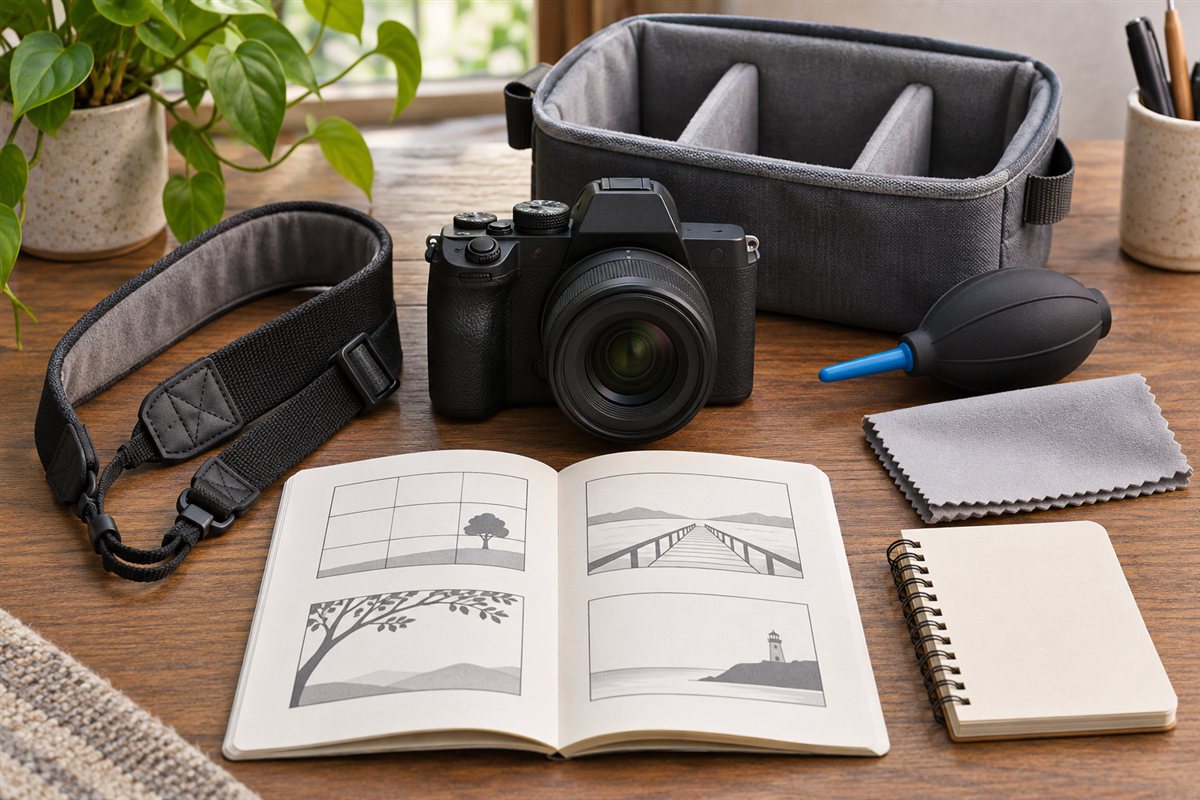
Gifts That Protect and Carry
New photographers often toss a camera into a backpack, which invites scratches and knocks. A little padding or a comfortable strap can change how often the camera actually comes along.
- A padded insert or small shoulder bag sized for the person’s camera and lens
- A soft neck strap or wrist strap that suits how they hold the camera
- A simple rain cover for outdoor days
- Microfiber cloths and a hand blower for dust
Check the size of the camera before you buy a bag, since bags are made for a wide range of bodies and lenses.
In this guide
Gifts That Build Skill
Learning tools turn a casual hobby into steady progress, and they rarely depend on which camera the person owns.
- A book on composition or on how light behaves
- A local class, walk or workshop, which also adds a social side
- A small tabletop tripod for steady close-ups and low-light practice
- A remote shutter release, if you have confirmed it works with their model
- A notebook or journal for shooting challenges and notes on settings
Gifts That Keep Them Shooting
Running out of space or power is the quickest way to end a good outing. Practical extras are easy to overlook, so they make welcome gifts.
- An extra memory card of the type the camera uses
- A spare battery that matches the exact camera model
- A card reader for moving files to a computer
- An external drive for backing up photos
- A frame or photo book to display their favorite shots
Memory cards and batteries are not interchangeable between all cameras, so look at the camera’s manual or ask the person quietly what they use.
Matching the Gift to the Person
| Type of beginner | Good direction | Why it fits |
|---|---|---|
| Travels often | Strap, cloths, spare battery | Light, easy to pack, useful on every trip |
| Loves learning | Book, class, journal | Feeds curiosity and builds habits |
| Shoots family moments | Memory card, backup drive, photo book | Protects and shows off memories |
| Just got a camera | Bag insert, cleaning kit | Protects the new gear |
A Worked Method for Choosing
- Notice how the person carries and uses the camera. Do they use a bag, a strap or their pockets?
- Look for a small repeating problem: a dead battery, a full card, a smudged lens, or blurry night pictures.
- Find the camera’s make and model on the body or the lens. Write it down so you can match accessories exactly.
- Choose a gift that solves the problem you noticed, and prefer items that work with many cameras.
- Keep the receipt details handy and tell the person that an exchange is welcome, so a wrong size or type is not a burden.
- Add a small personal touch, such as a handwritten challenge card with three photo ideas to try.
Common Scenarios
- You do not know their camera: choose cloths, a book, a class or a photo book, all of which work with any equipment.
- They have only a phone and are curious about cameras: a book on composition or a local walk is a good first step, since the principles apply everywhere.
- They already own many accessories: a framed print of their own best photo is personal and takes no storage space.
- They shoot mostly at night or indoors: a small tripod and a remote release help with steadier pictures.
- They are a teenager with a first camera: a durable strap, a padded pouch and an extra card make the hobby easier day to day.
Mistakes to Avoid When Giving
- Buying a lens without knowing the mount. Lenses only fit matching mounts, so a guess can leave a gift that cannot be used.
- Choosing complicated gear. A beginner who must learn a new tool before using it may set it aside, so keep it simple.
- Ignoring the person’s style. A bag that is too formal or a strap that is too bulky may not suit how they shoot.
- Buying in bulk. One useful item is better than a pile of small gadgets that clutter a bag.
- Forgetting wrapping and presentation. A short note about why you chose the gift makes it feel personal.
Care Tips to Share With the Recipient
A gift is even more helpful with a few care tips. Suggest that they use a blower before a cloth to move dust off lenses, keep caps on when gear is not in use, and store the camera in a dry place. Remind them to format new memory cards in the camera, and to copy photos to a second place regularly. A short card with these points costs nothing and helps a beginner avoid the most common mishaps.
Glossary
- Mount: the fitting that attaches a lens to a camera body.
- Remote release: a device that fires the shutter without touching the camera.
- Card reader: a small device that lets a computer read a memory card.
- Insert: a padded divider that turns an ordinary bag into a camera bag.
- Composition: the arrangement of elements within a frame.
- Backup: a second copy of files stored in a different place.
Quick Troubleshooting for New Photographers
| Symptom | Likely cause | What a gift could help with |
|---|---|---|
| Pictures look blurry at night | Slow shutter and shaky hands | A small tripod and a remote release |
| Camera runs out of power mid-outing | No spare battery | A matching spare battery |
| Smudges on photos | Dirty front lens | Microfiber cloths and a blower |
| Photos are lost or scattered | No routine for backups | A backup drive and a card reader |
Think About Where the Beginner Is Right Now
Beginners come in many forms. One person has just received their first camera and has no idea what the dials do. Another has used a phone for years and wants to try something more serious. Another has an older camera and wants to take better pictures with it. Before buying a gift, work out which kind of beginner you are shopping for, and what stands between them and the next level of enjoyment.
Often the answer is not another camera. It may be knowledge, practice time or something that protects what they already own. The most valued gifts tend to solve a problem the recipient has already noticed, or make an existing hobby feel more rewarding.
Learning Resources That Actually Get Used
Books, courses and guides can transform a beginner’s progress if they match the person’s learning style. Some people prefer picture-led books they can flip through, others prefer short video lessons, and others like live classes where they can ask questions. A gift certificate for a local workshop can be especially welcome, since it includes a chance to meet other enthusiasts.
When choosing a book, look for one that focuses on fundamentals such as light, composition and exposure, and that uses clear, friendly language. Avoid very technical books that assume previous knowledge. Check that the examples relate to the type of camera the person has, because instructions for different systems differ.
- Picture-led beginner books with exercises at the end of each chapter.
- Subscriptions to online lessons that include assignments.
- Gift certificates for local classes or walking tours.
- A printed cheat sheet of settings tucked into the card.
Practical Accessories That Protect and Support
A new camera represents an investment, and protecting it brings peace of mind. A padded bag or case, a clean cloth, a blower for dust and a lens cap keeper are modest gifts that prevent damage. A sturdy strap makes carrying more comfortable and secure. A small tripod invites experimentation with low light and self-portraits.
Think about the person’s environment. Someone who walks in damp climates may appreciate a rain cover. Someone who travels may enjoy a compact charger or an extra battery. Always check compatibility with their exact camera model before buying, since mounts, batteries and cables vary.
Memory Cards, Storage and Backup
New photographers often fill a card without a plan for storing pictures safely. A second memory card, a card case and a simple external drive for backups are helpful and practical. Make sure the card type matches the camera, and check that the speed class suits the camera’s features. Counterfeit cards exist, so buy from a reputable seller.
Attach a short note explaining the importance of copying pictures to a computer regularly. A gift that encourages good habits early prevents heartbreak later, when a card fails or a device is lost.
| Gift | What it solves | Check before buying |
|---|---|---|
| Extra memory card | Running out of space mid-outing | Card type and capacity supported |
| Card case | Lost or damaged cards | Size and number of slots |
| External drive | Safe backup | Connection type on their computer |
| Card reader | Easy file transfer | Card format and computer ports |
Gifts That Build Skill Through Fun Challenges
Many beginners lose motivation when they do not know what to photograph. A themed challenge can restore excitement. Offer a notebook with weekly prompts, such as shadows, reflections, hands or textures. Provide a small reflector or a piece of coloured card to experiment with light and background. A simple prime lens with a wide aperture, if compatible, opens a whole new world of background blur, though it is a bigger purchase.
Consider gifts that encourage printing and display. A small frame, a pin board or a set of prints from the recipient’s own pictures validates their efforts. Seeing their own work on the wall encourages them to take more pictures and judge them critically.
Lighting and Close-Up Tools for Curious Beginners
Basic lighting and close-up tools are inexpensive ways to widen creative range. A folding reflector bounces daylight into shadows. A small LED panel gives steady light for objects and portraits. A close-up filter or a simple extension accessory, if compatible, lets them explore small subjects. Each of these items encourages experimentation without a large investment.
Check the safety and compatibility of lights and chargers, and follow the maker’s guidance. For gifts involving flash or electrical equipment, include instructions and advise the recipient to read them carefully.
More on Matching the Gift to the Person
A thoughtful gift reflects the recipient’s interests. A traveller may enjoy a compact tripod and a travel journal. A pet lover might appreciate a lightweight camera strap and a few treats to practise with. A family-focused person may enjoy a photo book kit. Consider their age, patience and comfort with technology as well.
- Observe what they like to photograph.
- Note their frustrations with their current pictures.
- Choose a gift that addresses one of them.
- Add a card with a simple tip or challenge.
More on A Worked Method for Choosing
Imagine you are buying for a friend who recently got an entry-level camera. Ask yourself three questions: what does it lack, what do they enjoy shooting and how much do they want to spend on learning. Suppose the answers are a case, family pictures and a modest budget. A padded bag, a cleaning cloth and a book on portraits would suit well. Add a handwritten voucher for an afternoon walk together to practise.
Compare two or three options in the same category, read product details, and check return policies. If you remain unsure, choose a gift certificate to a shop or a class, which allows them to choose for themselves. Attach a note encouraging them to share their favourite pictures with you.
Common Scenarios and Smart Choices
For someone who has just unwrapped their first camera, the safest gifts are protective and practical: a case, a cloth and a card. For someone who has outgrown the kit lens and complains that backgrounds are never blurry, a fast prime lens could be exactly what they want, provided it matches their mount. For a person who loves travel, a compact tripod and a spare battery change what they can capture. For a beginner who feels lost, a class or mentor session might be the best present of all.
| Situation | Helpful gift | Note |
|---|---|---|
| Just received first camera | Case, cloth, extra card | Match to their exact model |
| Wants blurred backgrounds | Wide-aperture prime lens | Check mount and sensor size |
| Loves low light and night scenes | Small tripod and remote release | Check the camera supports a remote |
| Feels confused by menus | Course or one-to-one session | Offer to attend together |
| Wants to share work | Printing voucher or frame | Let them choose the pictures |
If you are unsure what size or model they have, ask a family member, or check the camera when you next visit. A quick look at the label on the lens or the base of the camera reveals the details you need.
More on Quick Troubleshooting for New Photographers
You can add real value by including a short troubleshooting note with your gift. Blurry pictures are usually caused by slow shutter speed or missed focus: suggest raising the speed or pressing the shutter halfway to focus. Dark pictures come from low light: suggest moving toward a window or using a wider aperture. Pictures with strange colours often come from the white balance setting: suggest trying the auto or daylight option. Pictures that look flat may need better light: suggest side light or golden hour.
- Blurry: faster shutter speed, steadier hold, check focus.
- Dark: more light, wider aperture, higher ISO.
- Odd colours: reset white balance.
- Flat: change the direction of light.
- Shaky video: hold with both hands or use support.
Glossary for the Absolute Beginner
- Aperture: the opening in the lens that lets in light.
- Shutter speed: how long the sensor is exposed.
- ISO: sensitivity to light.
- Focal length: how wide or narrow the view is.
- Composition: how things are arranged in the frame.
- Raw: a file that keeps maximum information for editing.
Pass on a printed copy with your gift, and invite the recipient to ask you about any term that remains unclear.
Budget Tiers and Where to Spend
You do not need a large budget to give a useful photography gift. Small gifts, such as a cloth, a strap or a card case, cost little but prevent common problems. Mid-sized gifts, such as a tripod, a bag or a book, give steady support for months. Larger gifts, such as a lens or a class, suit people who have shown steady interest. Spend most on the item that removes the biggest obstacle, and keep the rest modest. A thoughtful card with a personal note adds value to any tier, and a promise to go on a photo walk together costs nothing yet may be remembered the longest.
More on Mistakes to Avoid When Giving
- Buying equipment that is too advanced.
- Choosing accessories that do not fit their camera.
- Giving something that creates extra work or cost.
- Overlooking the value of learning time.
- Forgetting to include a receipt or return information.
The best gifts feel personal and easy to enjoy straight away.
Gifts That Keep Them Shooting Over the Long Term
The thrill of a new hobby can fade after a few weeks, so gifts that sustain motivation are valuable. A membership to a local camera club, a ticket to an exhibition, a book of work by a photographer they admire or a day trip to a scenic place give inspiration and social contact. Pair them with a promise to take pictures together, and the gift becomes an experience.
Printing is another motivator. A small portable printer, a monthly print service or a set of frames for their best pictures encourages them to look critically at their work and choose favourites. A simple online gallery or a private album shared with family gives them an audience, which often spurs a beginner to improve.
- Experiences: classes, exhibitions, photo walks.
- Inspiration: books and magazines about photographers.
- Output: frames, prints and albums.
- Community: clubs and online groups with friendly feedback.
Remind them that progress is gradual. Every experienced photographer began with blurry, badly framed pictures, and the willingness to keep going is what makes the difference.
More on Care Tips to Share With the Recipient
Include a few simple care tips with your gift. Keep the lens clean with a blower and soft cloth, avoid leaving the camera in hot cars, and keep it dry. Remove the battery if it will not be used for a long time, and store the camera in a padded bag. Back up pictures regularly. These small habits extend the life of the equipment and protect memories.
Encourage them to read the manual once, even briefly, and to keep it handy. A beginner who understands the basic controls gains confidence quickly.

Ready to Buy? Start Here
If this guide helped you decide what to look for, these products are a place to start.

As an Amazon Associate we earn from qualifying purchases. Prices and availability are shown on Amazon.
Going Deeper: Matching the Purchase to the Photographer
The most common reason a photography gift for a beginner disappoints has nothing to do with quality. It disappoints because it was chosen for an imaginary photographer — the one in the advertisement, with unlimited patience and a studio — instead of the real person who will unwrap it. Before anything else, picture that person’s actual week. Where do they shoot: school gates, hill paths, a kitchen table covered in craft projects? What do they carry already, and what do they leave at home because it annoys them? An honest answer to those two questions eliminates most wrong choices more reliably than any specification list, because usefulness is a property of a life, not of a product page.
Next, think about the gap the gift is meant to fill. Every photographer has a small set of recurring irritations: the strap that digs in, the card that fills at the worst moment, the lens that goes foggy and stays that way for an hour. A gift that removes a recurring irritation gets used weekly and remembered fondly, while a glamorous gift that solves a problem the person does not have becomes shelf decoration within a month. If you are unsure which irritation tops their list, listen to their complaints after a day of shooting; photographers announce their perfect gifts out loud, usually while packing up.
A Closer Look at How the Picks Differ
The recommendations in this guide were chosen to differ from each other in ways that matter, so it is worth slowing down over what separates them. One pick leans toward simplicity: fewer parts, fewer decisions, something that works the moment it is picked up. Another leans toward growing room, suiting a photographer whose ambitions are expanding faster than their kit. A third leans toward portability or toughness, for the person whose photography happens in weather, crowds and hurry. None of these directions is the correct one in the abstract. The right pick is the one whose strengths point at the recipient’s real habits, which is why the same shortlist can produce different winners for different people.
Consider a simple camera strap or wrist strap as a way of thinking about scale. A modest, well-chosen item that fits an existing routine will outperform an impressive item that demands a new routine, because routines are sticky and good intentions are not. Then consider a small cleaning kit with a blower and cloth: the value there lies in removing friction from something the photographer already does every single outing. Finally, a sturdy memory card case represents the thoughtful extra — the thing nobody buys for themselves because it feels like an indulgence, yet which quietly improves every session once it exists. A strong shortlist usually contains one candidate of each kind, and choosing between them is really choosing which kind of kindness to offer.
Questions to Ask Before You Buy
A few questions, answered honestly, will steer you better than an evening of comparison charts. First: does the recipient already own something that does this job, and if so, is it worn out, disliked, or quietly excellent? Replacing the quietly excellent is the classic gift-giving error in photography, because photographers bond with tools that behave predictably. Second: will this work with the camera and accessories they already own, without an adapter, an app they will hate, or a subscription they never asked for? Compatibility surprises are the leading cause of gifts that spend January in a drawer.
Third: how will the recipient feel about the size, weight and appearance of this in daily use? Photography gear lives in public — around necks, on tables, in other people’s photographs — and a gift that embarrasses its owner will be left at home no matter how capable it is. Fourth: if the guess is wrong, can it be exchanged easily, and does it keep its usefulness even if their interests drift toward video, travel or family pictures? A gift with a graceful fallback — useful to almost any photographer — is a safer act of generosity than a brilliant gift aimed at a single narrow target.
Presentation, Timing and the Thought Around the Gift
How a photography gift is given changes how it is received. A short note explaining why you chose it — you noticed their strap hurting on the coast walk, you remembered them wishing for this on the train home — turns an object into evidence that you pay attention, which is the part people actually keep. If the item needs a small companion to work on day one, such as charged batteries, a formatted card or the right cable, include it quietly so the first experience is shooting rather than shopping. First experiences set the emotional price of a tool for years.
Timing deserves a thought as well. A gift given just before a trip, a course or a family event gets used immediately, when enthusiasm is high and help is remembered. The same gift given at a busy moment may wait months for its first outing, by which time the thread of intention has gone cold. If you are giving something with a learning curve, offer the other half of the present as well: an afternoon shooting together while they try it. Shared time converts equipment into a memory, and memories are the one photographic accessory that never becomes obsolete.
Mistakes Gift Buyers Keep Making
The first classic mistake is buying for the photographer you wish they were. The ambitious upgrade, the serious-looking accessory, the thing that would suit the hobby at its most intense — these gifts quietly accuse the recipient of not taking photography seriously enough, and they gather dust with a faint air of guilt around them. Buy for the photographer as they are this year, shooting the subjects they actually shoot, at the pace they actually keep. Ambition, when it comes, prefers to choose its own tools.
The second mistake is trusting a single enthusiastic recommendation without checking the boring details: sizes, mounts, formats and versions. Photography is full of near-identical names separated by one letter and total incompatibility. Read the recipient’s existing gear names carefully — photographing their camera bag contents with your phone, with permission, beats guessing from memory — and match the wording exactly. The third mistake is forgetting the receipt’s quiet role: keeping the option of exchange open is not a lack of confidence, it is part of the gift, and saying so out loud frees the recipient to swap a near-miss for a perfect fit without feeling ungrateful.
Care, Setup and Getting Value After the Day
A thoughtful follow-through separates a good gift from a great one. Many photography items reward ten minutes of setup: straps adjusted to the wearer’s height, cases arranged around the gear actually carried, settings matched to the camera at hand. If you know the equipment, offer that ten minutes rather than assuming it happens. If you do not, a pointer to the maker’s own setup guide, saved or printed, is a small kindness that prevents the most common early frustrations, which are almost never the product’s fault and almost always a skipped first step.
Care habits matter because photography gear lives a rough life: pockets full of grit, bags dropped on wet grass, lenses breathed on in cold air. The recipient will get more years from any gift if the first month establishes gentle routines — wiping down after wet outings, storing things dry rather than sealed while damp, keeping small parts in one known place instead of scattered through coat pockets. You cannot install habits by lecture, but you can choose gifts that make the careful thing the easy thing: cases that close properly, cloths that live where the lens lives, storage that invites order rather than punishing it.
When the Budget Is Small — and When It Is Not
A small budget is not the handicap gift buyers fear. Photography is unusual in that some of its most-used items are genuinely inexpensive: the consumables and comforts that get consumed, worn and lost precisely because they are used daily. A modest gift chosen from that category signals attentiveness, and attentiveness is the currency recipients actually count. What a small budget cannot survive is being spread thin across several novelties; one right thing beats a bundle of almost-right things every time, in photography as in most of life.
A generous budget carries the opposite risk: the temptation to buy significance instead of usefulness. Expensive photography gifts fail in a particular way — they are admired, insured, worried over, and left at home on exactly the muddy, crowded, spontaneous days when photography happens. If the budget is large, consider whether the recipient would honestly rather have the one substantial thing they have been circling for months, named outright and chosen together. Jointly chosen gifts lose the surprise and gain everything else: certainty, fit, and a shared story about the choosing that lasts as long as the object does.
Questions Worth Asking Yourself at the Till
Before paying, run one final check against the person rather than the product. Will they reach for this on an ordinary Tuesday, or only on special occasions? Does it ask them to learn something, and is that learning a pleasure they would choose? If it vanished in a year, would they replace it with their own money — the surest test of a gift that landed? And does it leave their existing setup coherent, or does it quietly demand three more purchases before it makes sense? A gift that passes those questions rarely needs luck to be loved.
What if I do not know which model of camera they own?
Choose the gift that does not care. Whole categories of photography presents — comfort, protection, cleaning, storage, printing and learning — fit every camera ever made, because they serve the photographer rather than the mount. When a model-specific item is clearly the right idea, buy it with the exact model name confirmed from the camera body itself or from a photograph of it, keep the receipt, and choose a seller whose exchange process you have actually read. Uncertainty is manageable; guessing dressed as certainty is what fills drawers.
Is a voucher ever the better answer?
Sometimes, yes — and it is not the surrender it is rumoured to be. Photographers with strong, specific plans often prefer choosing the exact item themselves, and a voucher aimed at a named goal, given with a note saying what it is for, carries real thought. It works best paired with something small and physical to unwrap, so the day has both an object and an intention. Where a voucher fails is as a substitute for attention: an unconsidered voucher says the hobby itself went unnoticed, while a considered one says the plan was heard and is being backed.
How can I tell whether a recommendation is trustworthy?
Look for guidance that describes trade-offs in plain language: who a pick suits, who should skip it, and what it does less well. Recommendations that praise everything equally are usually selling rather than advising. Notice, too, whether the advice survives contact with the recipient’s actual life — their subjects, their bag, their weather. A trustworthy shortlist, like the one in this guide, gives you the reasoning as well as the names, so you can adapt it when your photographer’s situation differs slightly from the typical case the writer imagined.
Second-Hand, Refurbished and Open-Box Options
Photography gear holds up well to second-hand buying, because much of it is built to be handled for years and because photographers tend to sell for reasons of upgrade rather than failure. A used version of the right item can stretch a budget a long way, provided you buy from a seller who describes condition honestly, accepts returns, and shows the actual item rather than a catalogue photograph. For a gift, add one caution: check that everything the item needs to work is included, since the missing cable, mount or case that a keen photographer would shrug off can strand a recipient who does not yet own a drawer of spares.
Refurbished items from the maker sit between new and used in both price and peace of mind, and they make particularly good gifts because the recipient receives something checked, cleaned and warranted without the giver paying the full first-owner premium. Whichever route you take, keep the paperwork with the gift and mention it warmly rather than apologetically. A well-chosen refurbished present says the money went into the thing itself rather than into shrink-wrap, and most photographers — a practical tribe — respect exactly that priority.
Matching the Gift to the Season and the Calendar
Photography has seasons, and a gift that arrives in step with them gets used while the wrapping paper is still in the bin. Winter calls for comfort and protection: gloves that allow control, covers that keep drizzle off, lights and reflectors for long indoor evenings. Spring and summer call for carrying comfort, sun and dust protection, and anything that makes a long day outdoors easier on the neck and shoulders. Autumn belongs to family gatherings and school events; the new year, quietly, belongs to organisation — storage, printing and finally sorting the archive. None of this is a rule, but a gift tuned to the coming weeks has a head start over one tuned to the season just finished.
The recipient’s personal calendar matters more than the public one. A course starting, a baby expected, a trip booked, a house move that will empty the walls and beg for prints — each of these is a gift-giving signal clearer than any holiday. If you know one is coming, aim the present at it and say so in the note. A gift that visibly belongs to a real upcoming chapter of someone’s life is almost impossible to get wrong, because its usefulness has a date, a place and a cast of characters already attached.
What to Do When You Have Left It Late
Late buying is where photography gifts go wrong, because hurry favours the flashy and the generic. If time is short, narrow the field brutally: choose from the categories that fit every photographer — comfort, protection, cleaning, storage, printing, learning — and pick the best-made version you can find rather than the most unusual. These are not consolation prizes; they are the items experienced photographers replace with their own money, repeatedly, for their whole lives. A late gift chosen from the essentials list will beat an early gift chosen from the novelty shelf almost every time.
Delivery promises deserve suspicion in the final days. Prefer a seller who shows real stock and a real date over one who shows a hopeful estimate, and keep a simple backup plan: a printed card with a photograph of the item and a line about its journey reads, in practice, as part of the present rather than an apology for it — provided the item genuinely arrives within days. What recipients remember is not the logistics but whether the choice itself felt considered, and consideration can be communicated in a sentence even when the parcel cannot.
Should I ask the recipient directly what they want?
Asking is underrated. Photographers are specific people with specific setups, and many would rather be asked than surprised with an expensive near-miss. The graceful way to ask preserves most of the pleasure: offer a shortlist of two or three directions and let them steer, or ask what their current irritation is — the question every photographer answers instantly and honestly. You keep the choosing, the wrapping and the note; they keep the certainty. For modest gifts, surprise away. For anything that must fit a mount, a system or a strong preference, a question is not a failure of imagination but a sign of respect for the hobby’s particular nature.
What if the recipient is returning to photography after a break?
Choose for the photographer they are now, at the pace they are returning at. A break changes hands, habits and sometimes eyesight and mobility, so comfort and simplicity outrank ambition: lighter to carry, easier to hold, quick to reward. Avoid anything that assumes the old routine will resume unchanged, and favour gifts that make the first few outings feel successful, because returning photographers quit again at the first frustrating afternoon, not the tenth. A modest gift that produces one good day of shooting does more for the comeback than an impressive one that produces a cupboard of good intentions.
Reading the Recipient’s Existing Kit Like a Detective
If you can see the recipient’s current setup, it will tell you more than any wishlist. Look at what is worn: the strap frayed at one end, the case with the broken zip, the cloth that has cleaned a thousand lenses and shows it. Wear is a signature of love — those are the items in daily service, and their like-for-like renewal, in better quality, is among the safest gifts in all of photography. Look also at what is pristine. The untouched accessory in the corner of the bag is a warning label: whatever need it was meant to serve either never existed or is already served another way, and its newer cousin will join it in the corner.
Notice, too, the absences. A photographer who shoots outdoors in all weather but owns nothing to keep rain off the camera has told you something. A photographer whose cards, batteries and cables live loose in three different pockets has told you something else. Absences are harder to spot than wear, because the eye slides over empty space, but they are where the genuinely useful gift hides. One caution governs all this detective work: observe the gear, never reorganise it. Photographers keep their bags in personal systems that look like chaos and function like memory, and a tidied bag is a gift that gives its recipient a week of small searches.
Gifts That Grow With the Photographer
Some presents are right for a season; others quietly stay right for a decade, and the difference usually lies in whether the item serves a passing interest or a permanent feature of photography itself. Light, weather, carrying, cleaning and remembering are permanent. Fashions in subjects and gadgets are not. A gift anchored to a permanent feature — protecting the lens, carrying the kit in comfort, keeping the archive safe, putting pictures on walls — survives every change of taste, camera and subject, which is why experienced photographers, asked what they actually still use from years of presents, name the unglamorous anchors again and again.
There is also a middle path worth knowing: the gift that opens a door without pushing anyone through it. A first printing credit, an introductory workshop place, a simple frame waiting for a favourite picture — these invite a new pleasure while demanding nothing. If the invitation is declined by life for a while, nothing is wasted and nothing reproaches anyone from a shelf. Doors, unlike destinations, make gracious gifts, and photography is a hobby unusually rich in doors: new subjects, new formats, new ways of sharing. Choose the door that stands nearest to where the recipient already spends their happy hours, and it will be walked through sooner than you expect.
FAQ
Should I give a lens as a first gift?
Only if you know the exact mount and what the person already owns. A wrong lens is hard to use, so for most givers a skill or care item is the safer idea. A gift card for a camera shop lets them choose their own.
What if I know nothing about cameras?
Choose items that work with any camera, such as cloths, a book, a class or a photo book. If you can, glance at the camera and note its make and model so you can ask a shop assistant for matching accessories.
Is a tripod a good gift for a beginner?
A small, simple tripod is useful for low light, close-ups and self-timer shots. Check that its head and plate suit the camera and that it is easy to carry, since a heavy one tends to stay at home.
What is a good gift for someone who shoots on a phone?
A book, class or photo book works well, since the skills of composition and light apply to every device. A small phone tripod or a printed album of their favorite shots can also be welcome.
Should the gift match their level of experience?
Yes. Beginners benefit most from simple items that remove an obstacle, while advanced shooters usually have strong opinions about gear. When in doubt, choose a learning gift or a personal keepsake.
The Short Version
Choose gifts that help a beginner carry, learn or keep shooting, and avoid anything that depends on guessing their equipment. When in doubt, a class, a book or a nicely printed photo book is almost always welcome.
