A good gift for a traveling photographer is light, tough and useful on every trip, which usually points to protection, power and backup rather than extra gear. Space and weight matter most on the road, so the best ideas tend to be small. Here is how to think about it, with a packing example, scenarios and care tips.
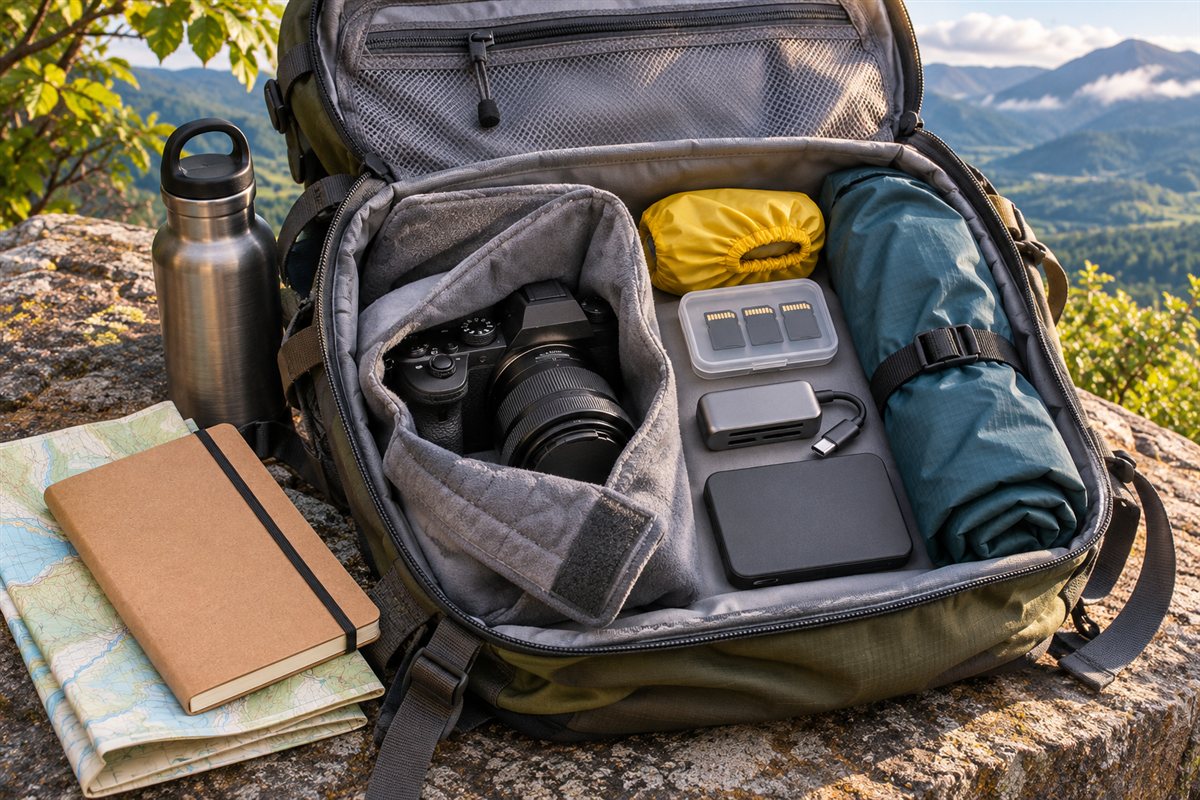
Think Small and Light First
Every item a traveler carries has to earn its place. Before you buy, picture it in a packed bag next to clothes, chargers and a passport. If it is bulky or needs its own case, it may stay at home.
- Folding or compact items beat rigid ones
- Multi-use gifts beat single-use ones
- Soft goods pack flatter than hard cases
In this guide
Protecting Gear on the Road
Travel exposes cameras to dust, damp, sand and bumps. Small protective gifts are often appreciated more than big ones.
- A padded wrap or cell-style pouch that turns any bag into a camera bag
- A rain sleeve that folds down to almost nothing
- Silica gel packs for humid climates
- A lens cloth, a soft brush and a small blower
- A plain strap that sits comfortably through a long day of walking
Power, Storage and Backup
A trip can produce thousands of images, and losing them is the biggest worry. Gifts that protect the pictures themselves are practical.
- Extra memory cards, kept in a small labeled case
- A spare battery that matches the camera model exactly
- A compact card reader that works with a phone or laptop
- A portable drive to hold a second copy of each day’s photos
- A universal plug adapter for the countries on the route
Always confirm battery and card types in the camera’s manual before you buy.
Gifts That Add a Little Joy
Not every gift has to be about gear. A printed photo book from a past trip, a travel journal for notes on locations and settings, or a map of the next destination can motivate more than any accessory.
Quick Comparison
| Gift type | Space it takes | Where it helps |
|---|---|---|
| Rain sleeve | Tiny | Wet climates and sudden showers |
| Spare battery | Tiny | Long days and cold weather |
| Portable drive | Small | Nightly backups |
| Photo book | Flat | Keeping memories after the trip |
A Worked Example: Packing a Travel Photo Kit
- Lay out the camera, one or two lenses and the gifts you are considering on a table.
- Pack them in the bag the traveler normally uses, with clothes and chargers nearby, and see how much room is left.
- Place frequently used items, such as the spare battery, cloth and card case, in outer pockets.
- Put the portable drive and the laptop or phone cable in a separate pocket, so backups can be made at the end of each day.
- Keep valuable items in carry-on luggage and keep the memory cards in a pocket close to the body.
- Check the total weight, and remove anything that does not earn its place.
Common Scenarios
- City break by train or plane: a padded wrap, a spare battery and a cloth are ideal, because they pack small and prevent common problems.
- Hiking and nature trips: a rain sleeve and a comfortable strap matter most, since weather and weight are the main concerns. Take care on uneven ground and watch the changing weather.
- Beach and desert holidays: sealed pouches, a blower and a cloth protect against sand and spray.
- Long journeys across many countries: a universal adapter and a portable drive for nightly backups are especially useful.
- Frequent business travelers who like photography: a slim pouch and a compact card reader fit into a work bag without extra weight.
Quick Troubleshooting for Travel Photography
| Symptom | Likely cause | What to try |
|---|---|---|
| Lens fogs up when going indoors | Sudden change from cold to warm air | Keep the lens in a bag for a while so it warms slowly |
| Battery dies early on cold days | Low temperature reduces output | Keep spares in an inner pocket close to the body |
| Camera will not charge abroad | Plug or voltage mismatch | Check the charger label and use a suitable adapter |
| Card full mid-trip | Large files and long days | Carry extra cards and back up each evening |
| Dust spots in every frame | Dust on the sensor from changing lenses | Change lenses in sheltered spots and use a blower |
Care and Courtesy on the Road
Travelers can keep their gear in good shape with simple habits. Dry the camera with a soft cloth after rain or spray, and let it air before packing it away. Avoid leaving cameras in hot vehicles or in direct sun. Keep gear close in crowded places, and use a bag that does not advertise what is inside. Be respectful when photographing people and sacred places: ask permission when appropriate, follow local rules about photography and tripods, and avoid blocking paths or viewpoints that others are sharing.
Glossary
- Rain sleeve: a thin cover that protects a camera from drizzle and spray.
- Silica gel: small packets that absorb moisture inside bags.
- Plug adapter: a connector that lets a charger fit a foreign wall socket.
- Portable drive: a small external storage device for backups.
- Card reader: a device that reads memory cards through a phone or laptop.
- Carry-on: luggage kept with you in the cabin.
Mistakes to Avoid When Giving
- Choosing heavy or bulky items. Weight limits and small bags make large gifts a burden on the road.
- Guessing battery or card types. Mismatched accessories are useless, so check the camera model first.
- Forgetting different power outlets. A charger without the right adapter will not work abroad.
- Ignoring the traveler’s style. A minimalist may prefer a single multi-use pouch over several separate gadgets.
Gift Ideas by Budget Level
You can give a useful travel photography gift at almost any budget, and a bigger spend does not always mean a better present. Think in tiers and ask what the traveler already owns before you pick.
- Small and inexpensive: lens cloths, a silica gel set, a card case, a luggage tag or a cable organizer. These pack flat and are rarely duplicated.
- Mid-range: a spare battery, extra memory cards, a compact card reader, a rain sleeve or a padded wrap. These solve real travel problems.
- Larger spends: a portable drive, a good camera strap, a compact travel bag insert or a printed photo book of a past trip.
The mid-range items are usually the safest, because they fix problems that every traveler meets. The larger gifts are best when you know the person’s gear and habits. If you are unsure, pick several small items and put them in a cloth pouch so the present feels complete without risking a poor fit.
Avoid spending heavily on something you cannot confirm will fit the camera. A well-chosen small gift that matches the camera exactly is worth more than an expensive one that sits in a drawer.
Matching the Gift to the Traveler
The same present can delight one person and annoy another, so match it to how they travel. A backpacker with a single bag counts every ounce, while someone who takes a few well-planned trips a year may be happy to carry a little more.
Look at what they use now. Do they shoot with a phone, a compact camera or an interchangeable-lens system? A phone user will enjoy a power bank, a cleaning cloth and a photo book, whereas a camera user may prefer storage and battery gifts. Ask a friend or family member, or look through their photos for clues about their style.
- Landscape lovers: weather protection, comfortable carrying and spare batteries for cold mornings.
- Street and city photographers: a slim strap, a small pouch and a card reader for quick sharing.
- Wildlife and trekking fans: rain protection and lens care items.
- Casual snapshooters: a photo book, a journal or a simple cleaning set.
A personal note inside the package, mentioning a trip they took, can make a small gift feel much larger.
Checking Compatibility Before You Buy
Many travel accessories are brand and model specific, and a wrong guess wastes the gift. Look at the camera itself, the manual or the maker’s support page for the exact model name. Batteries often look alike but differ by model, and a card that works in one camera may be too slow or the wrong type for another.
Memory cards come in a few physical sizes and different speed classes. Check what the manual says the camera accepts, then match the type exactly. Higher-resolution cameras and video need faster cards, and the manual often explains this.
- Note the camera model number from the body or the strap.
- Check the battery code printed on the existing battery.
- Check the card slot type, and whether there is a second slot.
- Check the charging method, since some cameras charge by USB and some need a separate charger.
Straps, wraps and pouches are more forgiving, because they work with most cameras. If you cannot confirm a technical fit, choose those or add a gift receipt so the traveler can exchange the item.
Planning for Airports and Security
Travel gifts must survive security checks and airline rules. Spare lithium batteries and power banks are usually restricted in the checked luggage and are often limited by size or number in the cabin. Rules differ between airlines and countries, so read the airline’s published guidance before the trip and carry batteries in a protective case.
Cameras and lenses should travel in carry-on bags. Expect to take the camera out for screening in some airports, and keep it easy to reach. A padded wrap or a pouch that opens quickly makes this less stressful. Keep memory cards with you instead of in checked luggage.
- Tape over or cover battery terminals, or use their cases.
- Keep a copy of key documents for expensive gear in case customs ask.
- Leave tripods and loose accessories where they are easy to inspect.
Choose gifts that fit in the cabin bag, and avoid items with odd shapes that attract attention at the scanner. This is general guidance, not legal advice, so check current rules before departure.
Making a Gift Feel Personal
A practical present becomes memorable when it carries a little thought. Pack a few small items in a reusable pouch, write a short note about the trip they are planning and add a small label with their name for the card case. The thought shows, even when the items are modest.
Printed memories do well. A photo book from a previous trip, a set of prints for a wall or a map marked with places they have been all give meaning beyond the gear. Consider asking friends who traveled with them for pictures to include.
- Build a themed set, such as a rainy-day kit or a long-haul kit.
- Add a handwritten checklist of things to pack for their next destination.
- Include a gift receipt for any item that depends on a model match.
If the traveler is just starting out, a simple guide to travel photography basics can be a thoughtful addition. Keep the presentation light and flat so it fits in their luggage.

Ready to Buy? Start Here
If this guide helped you decide what to look for, these products are a place to start.

As an Amazon Associate we earn from qualifying purchases. Prices and availability are shown on Amazon.
Questions to Ask Before You Pick a Photography Gift
A good travel photography gift fits the way the person already shoots. Spending a few minutes on these questions beats guessing from a product photo.
- What do they shoot with now: a phone, a compact camera, a mirrorless body or a bulky DSLR?
- Do they travel by backpack, carry-on only or road trip with plenty of space?
- Do they edit photos on a laptop or phone, or share straight from the camera?
- Are they more interested in landscapes, street scenes, food or family moments?
- Is there a piece of gear they have mentioned wanting, or complained about?
If you can answer even three of these, you are far less likely to buy something that sits in a drawer. When you cannot, a flexible and universal item, such as a small cleaning kit or a spare memory card holder, is a safer choice than a specialized accessory.
Giving Versus Guessing: A Decision Guide by Traveler Type
| Traveler | Safe gift direction | Avoid |
|---|---|---|
| Weekend city explorer | Compact strap, small pouch, pocket cleaning cloth | Large tripods or heavy bags |
| Long-haul backpacker | Weather protection, slim storage organizer | Fragile glass or bulky cases |
| Phone-only photographer | Grip, clip-on stand, compact light | Camera-specific items they cannot use |
| Serious hobbyist | Extra batteries, cards, a cleaning set | Lenses or bodies unless you know the exact mount |
| Family trip planner | Photo book supplies, a shared album plan | Anything that needs a steep learning curve |
The pattern is simple. The more specialized the item, the more you need to know. For a traveler whose kit you cannot see, choose things that work with nearly any setup.
How to Read a Product Listing for Compatibility
Many gift mistakes come down to a mismatch between a camera and a part. Read the listing for the exact model names it supports, not just the brand. Lens mounts, battery types, card formats and strap attachment points all vary even within one maker’s range.
Look at the photos for ports, threads and connectors, and compare them with the person’s gear if you have seen it. Check the size and thread information for filters and caps, which must match the lens exactly. If a listing says it is universal, find out what that really means, since it often covers a range of sizes but not every device.
Keep the box and the order details together, and tell the recipient that an exchange is possible if something does not fit. A short note with the gift that explains what it is for and where to adjust it also helps a lot, because it turns a puzzle into a pleasant surprise.
Building a Small Gift Bundle Around One Theme
If a single item feels too plain, group a few modest things around a shared idea. A bundle also lets you cover more than one guess, so a miss on one item does not sink the whole gift.
- The clean lens bundle: a blower, a soft brush and a few microfiber cloths in a small pouch.
- The backup bundle: a card case, a couple of spare memory cards and a small notebook for jotting locations.
- The comfort bundle: a padded strap, a lens cap keeper and a wrist loop for quick shots.
- The memory bundle: a blank travel journal, photo corners and a small printed album to fill after the trip.
Choose the theme that matches how the person treats their pictures. Someone who prints and shares will love the memory bundle, while a gear-focused friend will reach for the cleaning kit first. Pack everything in a reusable pouch or tin so the wrapping itself becomes useful, and include a line or two about what each piece is for.
Whatever you choose, think about weight and bulk. Travelers count every gram and every square inch of bag space, so a gift that is light, flat and easy to pack will be taken on the very next trip.
Going Deeper: Matching the Purchase to the Photographer
The most common reason a photography gift for a traveller disappoints has nothing to do with quality. It disappoints because it was chosen for an imaginary photographer — the one in the advertisement, with unlimited patience and a studio — instead of the real person who will unwrap it. Before anything else, picture that person’s actual week. Where do they shoot: school gates, hill paths, a kitchen table covered in craft projects? What do they carry already, and what do they leave at home because it annoys them? An honest answer to those two questions eliminates most wrong choices more reliably than any specification list, because usefulness is a property of a life, not of a product page.
Next, think about the gap the gift is meant to fill. Every photographer has a small set of recurring irritations: the strap that digs in, the card that fills at the worst moment, the lens that goes foggy and stays that way for an hour. A gift that removes a recurring irritation gets used weekly and remembered fondly, while a glamorous gift that solves a problem the person does not have becomes shelf decoration within a month. If you are unsure which irritation tops their list, listen to their complaints after a day of shooting; photographers announce their perfect gifts out loud, usually while packing up.
A Closer Look at How the Picks Differ
The recommendations in this guide were chosen to differ from each other in ways that matter, so it is worth slowing down over what separates them. One pick leans toward simplicity: fewer parts, fewer decisions, something that works the moment it is picked up. Another leans toward growing room, suiting a photographer whose ambitions are expanding faster than their kit. A third leans toward portability or toughness, for the person whose photography happens in weather, crowds and hurry. None of these directions is the correct one in the abstract. The right pick is the one whose strengths point at the recipient’s real habits, which is why the same shortlist can produce different winners for different people.
Consider a padded pouch for cables and chargers as a way of thinking about scale. A modest, well-chosen item that fits an existing routine will outperform an impressive item that demands a new routine, because routines are sticky and good intentions are not. Then consider a lightweight mini tripod: the value there lies in removing friction from something the photographer already does every single outing. Finally, a weather cover for a camera and lens represents the thoughtful extra — the thing nobody buys for themselves because it feels like an indulgence, yet which quietly improves every session once it exists. A strong shortlist usually contains one candidate of each kind, and choosing between them is really choosing which kind of kindness to offer.
Questions to Ask Before You Buy
A few questions, answered honestly, will steer you better than an evening of comparison charts. First: does the recipient already own something that does this job, and if so, is it worn out, disliked, or quietly excellent? Replacing the quietly excellent is the classic gift-giving error in photography, because photographers bond with tools that behave predictably. Second: will this work with the camera and accessories they already own, without an adapter, an app they will hate, or a subscription they never asked for? Compatibility surprises are the leading cause of gifts that spend January in a drawer.
Third: how will the recipient feel about the size, weight and appearance of this in daily use? Photography gear lives in public — around necks, on tables, in other people’s photographs — and a gift that embarrasses its owner will be left at home no matter how capable it is. Fourth: if the guess is wrong, can it be exchanged easily, and does it keep its usefulness even if their interests drift toward video, travel or family pictures? A gift with a graceful fallback — useful to almost any photographer — is a safer act of generosity than a brilliant gift aimed at a single narrow target.
Presentation, Timing and the Thought Around the Gift
How a photography gift is given changes how it is received. A short note explaining why you chose it — you noticed their strap hurting on the coast walk, you remembered them wishing for this on the train home — turns an object into evidence that you pay attention, which is the part people actually keep. If the item needs a small companion to work on day one, such as charged batteries, a formatted card or the right cable, include it quietly so the first experience is shooting rather than shopping. First experiences set the emotional price of a tool for years.
Timing deserves a thought as well. A gift given just before a trip, a course or a family event gets used immediately, when enthusiasm is high and help is remembered. The same gift given at a busy moment may wait months for its first outing, by which time the thread of intention has gone cold. If you are giving something with a learning curve, offer the other half of the present as well: an afternoon shooting together while they try it. Shared time converts equipment into a memory, and memories are the one photographic accessory that never becomes obsolete.
Mistakes Gift Buyers Keep Making
The first classic mistake is buying for the photographer you wish they were. The ambitious upgrade, the serious-looking accessory, the thing that would suit the hobby at its most intense — these gifts quietly accuse the recipient of not taking photography seriously enough, and they gather dust with a faint air of guilt around them. Buy for the photographer as they are this year, shooting the subjects they actually shoot, at the pace they actually keep. Ambition, when it comes, prefers to choose its own tools.
The second mistake is trusting a single enthusiastic recommendation without checking the boring details: sizes, mounts, formats and versions. Photography is full of near-identical names separated by one letter and total incompatibility. Read the recipient’s existing gear names carefully — photographing their camera bag contents with your phone, with permission, beats guessing from memory — and match the wording exactly. The third mistake is forgetting the receipt’s quiet role: keeping the option of exchange open is not a lack of confidence, it is part of the gift, and saying so out loud frees the recipient to swap a near-miss for a perfect fit without feeling ungrateful.
Care, Setup and Getting Value After the Day
A thoughtful follow-through separates a good gift from a great one. Many photography items reward ten minutes of setup: straps adjusted to the wearer’s height, cases arranged around the gear actually carried, settings matched to the camera at hand. If you know the equipment, offer that ten minutes rather than assuming it happens. If you do not, a pointer to the maker’s own setup guide, saved or printed, is a small kindness that prevents the most common early frustrations, which are almost never the product’s fault and almost always a skipped first step.
Care habits matter because photography gear lives a rough life: pockets full of grit, bags dropped on wet grass, lenses breathed on in cold air. The recipient will get more years from any gift if the first month establishes gentle routines — wiping down after wet outings, storing things dry rather than sealed while damp, keeping small parts in one known place instead of scattered through coat pockets. You cannot install habits by lecture, but you can choose gifts that make the careful thing the easy thing: cases that close properly, cloths that live where the lens lives, storage that invites order rather than punishing it.
When the Budget Is Small — and When It Is Not
A small budget is not the handicap gift buyers fear. Photography is unusual in that some of its most-used items are genuinely inexpensive: the consumables and comforts that get consumed, worn and lost precisely because they are used daily. A modest gift chosen from that category signals attentiveness, and attentiveness is the currency recipients actually count. What a small budget cannot survive is being spread thin across several novelties; one right thing beats a bundle of almost-right things every time, in photography as in most of life.
A generous budget carries the opposite risk: the temptation to buy significance instead of usefulness. Expensive photography gifts fail in a particular way — they are admired, insured, worried over, and left at home on exactly the muddy, crowded, spontaneous days when photography happens. If the budget is large, consider whether the recipient would honestly rather have the one substantial thing they have been circling for months, named outright and chosen together. Jointly chosen gifts lose the surprise and gain everything else: certainty, fit, and a shared story about the choosing that lasts as long as the object does.
Questions Worth Asking Yourself at the Till
Before paying, run one final check against the person rather than the product. Will they reach for this on an ordinary Tuesday, or only on special occasions? Does it ask them to learn something, and is that learning a pleasure they would choose? If it vanished in a year, would they replace it with their own money — the surest test of a gift that landed? And does it leave their existing setup coherent, or does it quietly demand three more purchases before it makes sense? A gift that passes those questions rarely needs luck to be loved.
What if I do not know which model of camera they own?
Choose the gift that does not care. Whole categories of photography presents — comfort, protection, cleaning, storage, printing and learning — fit every camera ever made, because they serve the photographer rather than the mount. When a model-specific item is clearly the right idea, buy it with the exact model name confirmed from the camera body itself or from a photograph of it, keep the receipt, and choose a seller whose exchange process you have actually read. Uncertainty is manageable; guessing dressed as certainty is what fills drawers.
Is a voucher ever the better answer?
Sometimes, yes — and it is not the surrender it is rumoured to be. Photographers with strong, specific plans often prefer choosing the exact item themselves, and a voucher aimed at a named goal, given with a note saying what it is for, carries real thought. It works best paired with something small and physical to unwrap, so the day has both an object and an intention. Where a voucher fails is as a substitute for attention: an unconsidered voucher says the hobby itself went unnoticed, while a considered one says the plan was heard and is being backed.
How can I tell whether a recommendation is trustworthy?
Look for guidance that describes trade-offs in plain language: who a pick suits, who should skip it, and what it does less well. Recommendations that praise everything equally are usually selling rather than advising. Notice, too, whether the advice survives contact with the recipient’s actual life — their subjects, their bag, their weather. A trustworthy shortlist, like the one in this guide, gives you the reasoning as well as the names, so you can adapt it when your photographer’s situation differs slightly from the typical case the writer imagined.
Second-Hand, Refurbished and Open-Box Options
Photography gear holds up well to second-hand buying, because much of it is built to be handled for years and because photographers tend to sell for reasons of upgrade rather than failure. A used version of the right item can stretch a budget a long way, provided you buy from a seller who describes condition honestly, accepts returns, and shows the actual item rather than a catalogue photograph. For a gift, add one caution: check that everything the item needs to work is included, since the missing cable, mount or case that a keen photographer would shrug off can strand a recipient who does not yet own a drawer of spares.
Refurbished items from the maker sit between new and used in both price and peace of mind, and they make particularly good gifts because the recipient receives something checked, cleaned and warranted without the giver paying the full first-owner premium. Whichever route you take, keep the paperwork with the gift and mention it warmly rather than apologetically. A well-chosen refurbished present says the money went into the thing itself rather than into shrink-wrap, and most photographers — a practical tribe — respect exactly that priority.
Matching the Gift to the Season and the Calendar
Photography has seasons, and a gift that arrives in step with them gets used while the wrapping paper is still in the bin. Winter calls for comfort and protection: gloves that allow control, covers that keep drizzle off, lights and reflectors for long indoor evenings. Spring and summer call for carrying comfort, sun and dust protection, and anything that makes a long day outdoors easier on the neck and shoulders. Autumn belongs to family gatherings and school events; the new year, quietly, belongs to organisation — storage, printing and finally sorting the archive. None of this is a rule, but a gift tuned to the coming weeks has a head start over one tuned to the season just finished.
The recipient’s personal calendar matters more than the public one. A course starting, a baby expected, a trip booked, a house move that will empty the walls and beg for prints — each of these is a gift-giving signal clearer than any holiday. If you know one is coming, aim the present at it and say so in the note. A gift that visibly belongs to a real upcoming chapter of someone’s life is almost impossible to get wrong, because its usefulness has a date, a place and a cast of characters already attached.
What to Do When You Have Left It Late
Late buying is where photography gifts go wrong, because hurry favours the flashy and the generic. If time is short, narrow the field brutally: choose from the categories that fit every photographer — comfort, protection, cleaning, storage, printing, learning — and pick the best-made version you can find rather than the most unusual. These are not consolation prizes; they are the items experienced photographers replace with their own money, repeatedly, for their whole lives. A late gift chosen from the essentials list will beat an early gift chosen from the novelty shelf almost every time.
Delivery promises deserve suspicion in the final days. Prefer a seller who shows real stock and a real date over one who shows a hopeful estimate, and keep a simple backup plan: a printed card with a photograph of the item and a line about its journey reads, in practice, as part of the present rather than an apology for it — provided the item genuinely arrives within days. What recipients remember is not the logistics but whether the choice itself felt considered, and consideration can be communicated in a sentence even when the parcel cannot.
Should I ask the recipient directly what they want?
Asking is underrated. Photographers are specific people with specific setups, and many would rather be asked than surprised with an expensive near-miss. The graceful way to ask preserves most of the pleasure: offer a shortlist of two or three directions and let them steer, or ask what their current irritation is — the question every photographer answers instantly and honestly. You keep the choosing, the wrapping and the note; they keep the certainty. For modest gifts, surprise away. For anything that must fit a mount, a system or a strong preference, a question is not a failure of imagination but a sign of respect for the hobby’s particular nature.
What if the recipient is returning to photography after a break?
Choose for the photographer they are now, at the pace they are returning at. A break changes hands, habits and sometimes eyesight and mobility, so comfort and simplicity outrank ambition: lighter to carry, easier to hold, quick to reward. Avoid anything that assumes the old routine will resume unchanged, and favour gifts that make the first few outings feel successful, because returning photographers quit again at the first frustrating afternoon, not the tenth. A modest gift that produces one good day of shooting does more for the comeback than an impressive one that produces a cupboard of good intentions.
Reading the Recipient’s Existing Kit Like a Detective
If you can see the recipient’s current setup, it will tell you more than any wishlist. Look at what is worn: the strap frayed at one end, the case with the broken zip, the cloth that has cleaned a thousand lenses and shows it. Wear is a signature of love — those are the items in daily service, and their like-for-like renewal, in better quality, is among the safest gifts in all of photography. Look also at what is pristine. The untouched accessory in the corner of the bag is a warning label: whatever need it was meant to serve either never existed or is already served another way, and its newer cousin will join it in the corner.
Notice, too, the absences. A photographer who shoots outdoors in all weather but owns nothing to keep rain off the camera has told you something. A photographer whose cards, batteries and cables live loose in three different pockets has told you something else. Absences are harder to spot than wear, because the eye slides over empty space, but they are where the genuinely useful gift hides. One caution governs all this detective work: observe the gear, never reorganise it. Photographers keep their bags in personal systems that look like chaos and function like memory, and a tidied bag is a gift that gives its recipient a week of small searches.
Gifts That Grow With the Photographer
Some presents are right for a season; others quietly stay right for a decade, and the difference usually lies in whether the item serves a passing interest or a permanent feature of photography itself. Light, weather, carrying, cleaning and remembering are permanent. Fashions in subjects and gadgets are not. A gift anchored to a permanent feature — protecting the lens, carrying the kit in comfort, keeping the archive safe, putting pictures on walls — survives every change of taste, camera and subject, which is why experienced photographers, asked what they actually still use from years of presents, name the unglamorous anchors again and again.
There is also a middle path worth knowing: the gift that opens a door without pushing anyone through it. A first printing credit, an introductory workshop place, a simple frame waiting for a favourite picture — these invite a new pleasure while demanding nothing. If the invitation is declined by life for a while, nothing is wasted and nothing reproaches anyone from a shelf. Doors, unlike destinations, make gracious gifts, and photography is a hobby unusually rich in doors: new subjects, new formats, new ways of sharing. Choose the door that stands nearest to where the recipient already spends their happy hours, and it will be walked through sooner than you expect.
FAQ
Is a travel tripod a good gift?
It can be, but it is the item most likely to be left behind because of weight. If you choose one, look for a folding model that fits in a suitcase and check the maker’s guide for its load limit against the traveler’s camera.
What is the safest bet if I am unsure?
A spare battery or an extra memory card that matches the camera is rarely wrong. Without that information, a soft pouch, cleaning cloths or a printed photo book work for nearly everyone.
Do voltage and plug type matter for chargers?
Yes, both matter. Many camera chargers accept a range of voltages, but the label on the charger will show the limits, and a plug adapter only changes the shape of the connection. Check the label before the trip.
Is it safe to back up photos on the road?
It is wise to make a second copy each evening, on a portable drive or online storage, and to keep the drive in a different bag from the camera. That way, loss or theft of one bag does not take every copy.
What is a good gift for someone who travels with only a phone?
A small phone tripod, a cleaning cloth, a power bank and a photo book from their trips are all light and useful. Check that the power bank is allowed by airline rules, which are published on airline websites.
What should I avoid giving a frequent flyer?
Avoid anything bulky, fragile or restricted on flights, such as large kits and loose batteries without cases. Check airline rules for batteries and power banks.
Is a camera strap a good gift?
Yes, if you choose a comfortable, simple design and check that it fits the camera's strap lugs. Some people already have a favorite, so ask first.
What about a waterproof bag for a beach trip?
A dry bag or sealed pouch can protect gear from spray and sand. Make sure it is sized for what the traveler actually carries.
Can I give a gift card instead?
It works if you cannot confirm the details. Choose a shop that sells photography and travel items so they can choose a fitting accessory.
How many memory cards are enough?
It depends on the camera and how many pictures the person takes. Several smaller cards are safer than one large one, since a single failure loses less.
Is a cleaning kit useful on the road?
A blower, a soft brush and a cloth are small and handle most dust and smudges. Avoid liquids that are not made for lenses and check the camera's care guide.
What is a good last-minute gift?
A printed photo, a lens cloth, a card case or a small journal can be found quickly and packs flat. Add a note to make it personal.
The Short Version
For travelers, choose small items that protect the camera, keep it powered and back up the photos. Add something personal, like a photo book or journal, and you have a gift that is useful and meaningful.
