
Selling stock photos means shooting images that buyers might license, preparing them carefully and uploading them to agencies or your own site. Results vary a great deal and nothing here promises earnings. This article focuses on workflow and what to research. Agency terms and local rules differ, so read each platform policy and consult a qualified adviser for tax or legal questions.
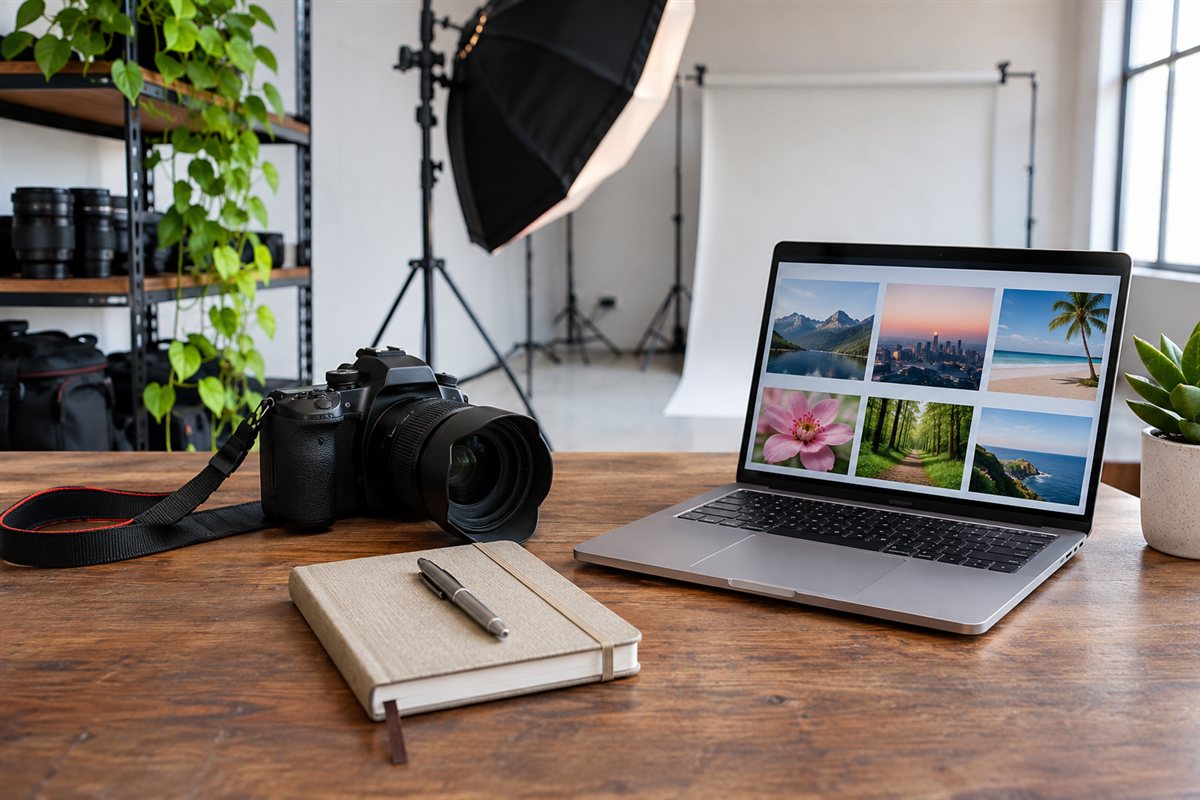
Understand What Buyers Look For
Stock images usually serve a practical purpose: supporting an article, a website, a campaign or a presentation. Useful images tend to be clear, well composed and flexible, with space for text and a subject that is easy to recognise.
- Everyday themes such as work, travel, food, family and technology
- Simple, uncluttered backgrounds
- Authentic scenes that avoid obvious posing
- Consistent technical quality in focus, exposure and colour
In this guide
A Beginner Workflow
- Study the categories on agency sites to see what is already common.
- Pick a niche you know well, where you have access and genuine interest.
- Shoot at the best quality your gear allows, with a clean lens and careful focus.
- Edit lightly, keep files natural and remove distractions or visible logos.
- Write a descriptive title and relevant keywords for each image.
- Upload a small batch, read the feedback and adjust.
- Keep an organised archive with notes on where each image is licensed.
Releases and Legal Housekeeping
Agencies often ask for model releases when identifiable people appear, and property releases for certain locations or private property. Trademarks, artwork and architecture can raise extra questions. Requirements differ by agency and country, so read each platform guide and ask a qualified professional if you are unsure. Never upload images you do not have the right to license.
What to Research Before Choosing Platforms
- Whether the agency is exclusive or non-exclusive, and what that means for your files
- Licence types offered to buyers and how contributors are paid
- Approval process, rejection reasons and technical requirements
- How reporting, payment thresholds and tax forms work
Compare several platforms and read community discussions, remembering that individual experiences vary.
Keeping It Sustainable
Treat the project as a long-term habit rather than a quick result. Set a modest routine, such as a small batch of edited images each week, and keep notes about which subjects get accepted and which do not. Follow trends in what businesses publish, but stay with subjects you can photograph honestly and well. Track your uploads, keywords and platform feedback in a simple spreadsheet so you can improve steadily.
Commercial and Editorial Images
Agencies commonly separate images into two broad uses, and knowing the difference early saves a lot of confusion. Commercial images may be used to promote products or services, so they usually need extra clearance: releases for recognizable people and for certain properties, and no visible protected logos or artwork. Editorial images document real events and places, such as news, public gatherings or travel scenes, and they tend to be used to illustrate stories instead of selling something. Each agency defines these categories in its own way, so read its contributor guide before you decide where an image belongs.
This difference affects how you shoot. If you want an image to work commercially, plan for it: use friends or family who agree to sign releases, choose locations where you have permission, and remove or avoid brand marks. If you are shooting a festival, a market or a street scene, you may be creating editorial material, and you should note the date, place and context in your caption, as agencies often expect accurate descriptions.
- Ask yourself whether anyone could recognize a person or a private property in the frame.
- Check for logos, packaging, artwork, tattoos and distinctive designs.
- Decide what the image is for before you upload, not after.
- If you are not sure how to categorize a picture, leave it out until you have checked the agency guidance or asked a qualified professional.
Rules differ by country and platform, so nothing here replaces the contributor guidance or professional advice for your situation.
Titles, Keywords and Metadata
A buyer cannot license a picture they cannot find. Descriptive text is the way search tools understand your images, so it deserves as much care as the photo. Write for a person who is looking for a specific idea, not for yourself.
- Start with a plain title or caption that says what is in the picture: who, what, where and what is happening.
- List keywords that describe the main subject, the setting, the action, the mood, and the possible concepts, such as teamwork or relaxation if they truly fit.
- Put the most important terms first, since many platforms give more weight to early keywords or limit the number shown.
- Use words buyers would actually type, and avoid vague or flowery phrases.
- Do not add misleading terms to attract searches. Irrelevant keywords can lead to rejections and annoy buyers.
- Be accurate about locations, dates and species, and use correct spelling.
Check how your chosen platform handles metadata. Some read titles and keywords embedded in the file, while others need you to type them into their form. Keep a master keyword list in a spreadsheet for recurring subjects, so you can reuse good terms and keep a consistent style. It also helps to reread your captions after a break, since mistakes are easier to see with fresh eyes. Good descriptions will not guarantee sales, but poor ones nearly guarantee that your work goes unseen.
Technical Checks Before You Upload
Many early rejections come from technical flaws that a careful review would catch. Build a short checklist and apply it to every file, at full size, on a good screen.
- Sharpness: zoom to 100 percent and check the main subject, particularly eyes and key edges. Slight camera shake that looks fine on a phone often shows at full size.
- Noise: inspect shadows and smooth areas such as skies. Reduce noise gently without smearing detail.
- Dust spots and sensor marks: look at clear skies and plain backgrounds, and remove spots with a healing tool.
- Exposure and color: avoid clipped highlights and crushed shadows, and keep colors natural. Heavy filters and extreme effects tend to date quickly.
- Horizons and verticals: straighten tilted lines unless the angle is intentional.
- Distracting items: remove stray litter, cables, reflections of the photographer and visible brand marks where permitted.
- Over-processing: excessive sharpening, halos and artificial skin smoothing are easy to spot.
Also confirm file requirements: format, color space, size and any limits that your chosen platform lists. Check them on the platform’s own page, because they can change. Keep your original files untouched and export a separate upload version, so you can revisit the edit later.
Learning From Rejections
Rejections are a normal part of stock photography, especially at the start. They feel personal, but they usually point to something specific. Treat each one as information instead of a verdict on your ability.
Read the reason given and compare it with the image at full size. Common categories include technical issues such as focus or noise, content issues such as missing releases or visible trademarks, and a lack of commercial value or too many similar images. If the reason is unclear, review the contributor guidelines again or look for the platform’s help pages. Some platforms allow you to resubmit after fixing a problem, but follow their stated rules for that.
- Keep a log of reasons for rejection, including the image, platform and date.
- Look for patterns. If many images fail for softness, the issue is your technique or your review process, not a single file.
- Fix the cause at the source. Adjust shutter speed, use a tripod, or clean the lens instead of only correcting in editing.
- Upload smaller batches so that feedback arrives while you can still apply it.
- Do not argue with a reviewer. Politely ask the platform for clarification if there is a way to do so.
A few rejected images are not a reason to stop. Over time, as your technical checks and keywords improve, the pattern of feedback usually becomes more useful. Results still vary and are never guaranteed.
Planning Shoots and Building a Portfolio
Random snapshots seldom make a useful collection. A plan helps you create images that fit together and meet real needs. Begin with a list of themes you can shoot well with the access you have: your own kitchen, your workplace with permission, your town, your hobbies, local seasonal events or travel.
For each theme, plan a small series with variety. Include wide, medium and close shots, horizontal and vertical orientations, and space for text in some frames. Shoot the same subject with different backgrounds, lighting, and actions, so a buyer has options. Avoid dozens of near-duplicates, as many platforms and buyers prefer a selection of your best frames.
- Schedule shoots around good light and seasonal timing, and think ahead for holidays and events.
- Prepare props, clothing and locations in advance, and have release forms ready when people are involved.
- Edit consistently, so your collection looks cohesive.
- Review your archive from time to time, retire weak images, and note gaps to fill.
Remember that the business side also needs attention. Keep records of income, expenses and platform statements, and ask a qualified adviser how reporting works in your country. A steady routine, honest self-review and respect for agency rules are far more useful than chasing trends.
Choosing a Niche Without Guessing Blindly
New contributors often upload whatever is on their memory card and hope something sells. A more reliable habit is to pick a small area where you can produce many consistent images over time. A niche might be local food markets, home offices, hobby crafts, seasonal scenes in your region, or simple objects on clean backgrounds. The goal is not to chase a trend but to become the person who has a deep supply of one kind of useful picture.
Begin your research by browsing the public search results of agencies and noticing what kinds of images fill the first pages. Ask yourself what is missing. Perhaps there are plenty of generic city skylines but few images of ordinary workplaces in your own country, or few photos of older people using everyday technology in a natural way. Gaps like these point to real needs, although nothing here promises that any particular subject will earn money.
Questions to ask about a niche
- Can I photograph this subject repeatedly without special permission?
- Would a business, a publisher or a blogger plausibly need it?
- Do I have access to enough variety in locations, light and props?
- Does the subject stay relevant beyond one season?
Composition Habits That Suit Buyers
Stock images serve designers, and designers need room to work. Leave areas of calm space where a headline or a button could sit. Shoot some frames with the subject on one side and open space on the other, and create both horizontal and vertical versions of the same scene when you can. A single moment photographed in several framings gives buyers choices and gives you more files from one setup.
Keep backgrounds tidy and remove visible logos, brand names and distracting signs where practical. Natural expressions usually look more convincing than stiff poses. Think about the story a buyer wants to tell: teamwork, planning, travel, a quiet morning, a healthy kitchen. Frame your subject so that story reads in a glance, even when the picture is small on a screen.
A Table of Shoot Types and What to Prepare
| Shoot type | Preparation | Typical pitfalls |
|---|---|---|
| Objects on clean backgrounds | Neutral surface, soft window light, tidy props | Dust, reflections and visible brand marks |
| Food and drink | Fresh ingredients, simple plates, natural light | Messy edges and flat color |
| Nature and landscapes | Scouting, weather checks, sturdy support | Dull light and cluttered foregrounds |
| People at work or at home | Signed releases, clear brief, relaxed setting | Forced smiles and missing paperwork |
| Urban scenes | Research on local rules for property and landmarks | Recognizable private property or artwork |
Making Your Own Simple Home Studio
You do not need a large budget to produce clean images. A window with soft daylight, a white foam board to bounce light back, a plain table and a few props can handle many product-style and lifestyle ideas. Place the subject near the window, put the board on the opposite side, and adjust until shadows look gentle. Use a steady support if your shutter speeds get slow, and keep the camera level so lines look straight.
Switch off lamps that cast a yellow tint if you rely on daylight, and set a consistent white balance for each series. Wipe every item before shooting, because small marks are very visible at full size. Over time, you can add a second board, a few backdrops and a basic light, but begin with what you have and learn how light behaves.
Building a Series Instead of Single Images
Stock contributors often discover that a series with a shared style, color range or concept sells better than scattered single shots, simply because a buyer who likes one image finds others from the same set. Plan five to ten variations of a single idea: different angles, close-ups, a version with a person and a version without. Keep the same light and color grading across the set so it feels cohesive.
Series also help your own workflow. You spend less time setting up, you gain speed in editing, and your keywords can be reused with small changes. Keep a notebook or spreadsheet of series ideas, and mark which have been completed, uploaded or rejected.
Editing for Consistency and Honesty
Editing for stock is conservative. Aim for accurate color, a clean exposure, sensible contrast and light noise control. Avoid heavy filters, strong vignettes or dramatic looks, since buyers want to apply their own style. Straighten horizons, crop with some breathing room and clean up dust spots.
If you remove an element, such as a stray sign or a bin, make sure it is done cleanly. Remember that agencies have rules about how much manipulation is acceptable, particularly for editorial content, which should present real events honestly. Read the contributor guidelines of each platform before you decide how far to go.
Working With Models and Locations Responsibly
Pictures that include recognizable people, private homes, artwork or branded items can need extra paperwork. Release forms are the usual way to document permission, and agencies often provide templates. Ask the person to read the form, answer their questions honestly and keep a signed copy with the matching image set. For children, a parent or guardian must sign, and local rules about minors can be strict.
Locations matter too. Some buildings, parks and attractions restrict commercial photography or require a permit. Check signs and websites, and ask when in doubt. If you cannot confirm that a place allows commercial use, consider framing the image so that the identifying features are not visible, or leave it for editorial use only where the platform permits.
Because laws vary widely, talk to a qualified professional about anything that feels unclear. A few minutes of caution before uploading can avoid trouble later and protect the people in your pictures.
Time Management and Realistic Expectations
Stock work is a slow build. It takes many hours to shoot, edit, title, tag and upload, and results depend on the number of images, their quality, the demand for the subjects and the agency’s search system. Treat it as a long-term hobby or side project, and measure progress by what you can control: the number of images submitted, the acceptance rate and the skills you are developing.
- Set a weekly shooting day and an editing day.
- Reserve a block of time for keywords and uploads.
- Track submissions and outcomes in a simple sheet.
- Look back at your results every few months and adjust your niche.
Tax, Records and Professional Advice
Income from licensing images may need to be reported where you live, and rules differ by country. Keep records of uploads, releases, payments and expenses from the first day. A simple folder with dated files will help when you or an accountant need to look back. For tax questions, legal terms or contract concerns, consult a qualified professional in your area rather than relying on a general article.
A Beginner Checklist for Your First Month
- Read the contributor guidelines for one or two platforms in full.
- Choose a niche and write ten shoot ideas.
- Prepare a simple home setup with natural light.
- Shoot, edit and check images at full size for flaws.
- Write clear titles and plain, honest keywords.
- Keep releases organized for any identifiable person or private property.
- Submit a small batch and study any feedback.
Patience matters more than gear here. Learn from each batch, improve one thing at a time and keep your archive tidy, and your portfolio will gradually become more useful to the people who search for pictures.
Choosing Your First Stock Subjects From Evidence, Not Enthusiasm
Beginners upload what they love; the photographers who start earning upload what buyers license. The gap between those two piles is the first lesson of stock. Spend your first research session inside the agencies themselves: search the subjects you shoot, sort by popularity, and study what the top results have in common — the concepts, the compositions, the empty space left for a designer’s text, the authenticity of the people. Then list the subjects where your own life gives you unfair access: a trade you know, a workplace you can enter, a community you belong to, a region whose seasons you can cover all year. Stock income grows at the intersection of proven demand and your access, because a thousand photographers can shoot a sunset but very few can shoot a working bakery at dawn, a specific therapy session, or a harvest in your county. Your first uploads should live in that intersection, even if they are less glamorous than the portfolio pieces you are proudest of.
Releases, Rights and the Upload Checklist
Stock is a rights business wearing a photography costume. Any recognizable person needs a model release for commercial licensing; recognizable private property, logos and artwork can need releases or removal for commercial use, while editorial licensing follows different rules that each agency states. Build the release habit into the shoot rather than the upload: carry release forms or a release app, photograph the signed form’s session alongside the images, and name your files so the release and the images stay connected in your archive forever. At upload, the checklist that saves accounts is consistency: accurate titles that describe rather than decorate, keywords a buyer would actually type — including the concept words, not only the object words — and honest categorization. Keyword stuffing with irrelevant popular terms is the fastest route to suppressed content and a damaged account, because agencies’ search systems and reviewers both punish it.
Reading Your Sales Data Like a Producer
After the first months, your download data becomes the most valuable business document you own. Read it for patterns, not for individual wins: which subjects sell repeatedly, which seasons they sell in — stock demand runs ahead of the calendar, with seasonal content bought months before the holiday it serves — and which of your series earn while their neighbors sit. Then produce toward the evidence. A subject that sells three times deserves a deeper series shot deliberately, with variations in orientation, copy space and demographic details that a designer might need. A subject that never sells despite good placement is information too: retire it from your production plan without rancor. This producer’s loop — upload, measure, produce toward demand — is what separates a growing stock income from a large, static archive, and it is available to a beginner with fifty files exactly as it is to a veteran with fifty thousand.
Technical Standards That Get Files Accepted and Found
Agencies reject more beginner files for fixable technical faults than for subject choice. The recurring list is short: noise and artifacts from over-processing, focus that misses at full magnification, clipped highlights in skies and skin, heavy-handed filters and effects baked in, and dust spots across skies. Shoot stock files clean and conservative — the buyer applies the look their design needs, and a file processed to your taste is a file they cannot use. Inspect every upload at full magnification before it goes, because reviewers do. Color space, file format and size requirements differ by agency; follow each one’s stated specification exactly rather than assuming your export preset travels. These standards sound clerical, and they are — stock is a supply business, and suppliers who deliver clean, correctly specified product get shelf space.
Series Thinking: Shooting Variations That Multiply a Session’s Value
A single good stock idea should rarely produce a single frame. Designers need options: the same scene horizontal and vertical, with the subject left and right to make room for text, closer and wider, with people and without, in the morning’s light and the evening’s. Shooting those variations deliberately while the set, the models and the light are already arranged is the closest thing stock photography has to free money — the session’s costs are fixed, and each variation is nearly pure addition. Plan the variation list before the shoot and work through it as a checklist. Over a year, series thinking is the difference between an archive of thousands of isolated frames and an archive of complete, licensable stories that buyers can build whole campaigns from — and agencies’ search systems reward the depth with visibility.
Pricing Your Time: When Stock Is and Is Not Worth It
Run the numbers on your own archive honestly after the first season. Total your stock income, then total the hours — shooting, processing, keywording, uploading, administering releases — and look at the rate without flinching. For some photographers the answer justifies expansion; for others it reveals that stock works only as a by-product, monetizing frames from shoots that were happening anyway, and that dedicated stock productions lose money against their client rates. Both conclusions are successes of measurement. The photographers who get trapped are the ones who never measure and keep producing on hope, or who measure a single month and abandon a portfolio just before its long tail began to pay. Stock income is famously back-loaded — files sell for years — so judge a season’s work across the following year before deciding what it earned.
Staying Motivated Through the Slow First Year
Stock’s feedback loop is slow, and the photographers who quit usually quit in the gap between effort and evidence. Structure the work so motivation does not depend on daily sales: set production goals you control — a series finished, a niche covered, a keywording backlog cleared — and review income monthly rather than hourly. Keep a simple record of what you uploaded and when, because the most encouraging document in a slow month is the proof that this month’s sales came from files uploaded across several past seasons, quietly compounding. And keep the work honest and interesting to yourself where you can: a niche you genuinely know produces better files than a trend you are chasing, and it sustains the years-long production rhythm that a stock archive rewards. The business pays for persistence organized as a system; build the system, and let the persistence be its output rather than its input.
From First Sales to a Sustainable Archive
The shape of a stock career is a long, slow compounding. Year one’s archive earns while you sleep and teaches while you work; year two’s production, aimed by year one’s data, earns at a better rate; by the time the archive holds several seasons of well-chosen, well-keyworded series, the income has a floor that does not depend on any single month’s shooting. Protect that compounding with boring administration: back up the archive and its releases as carefully as client work, keep the agency spreadsheet current, and review each agency’s terms when they change, because the archive is an asset whose value lives in its documentation as much as in its pixels. Photographers who treat stock as a lottery quit; photographers who treat it as a small publishing business — acquire good material, package it properly, distribute it widely, reinvest the returns — tend to still be earning from it a decade later.
Ethics and Authenticity in Stock Imagery
Stock photographs illustrate other people’s claims — in news, advertising, health, finance — which gives the stock photographer a quiet responsibility. Stage honestly within the conventions of the genre: a “candid office” scene is understood to be staged, but staging that misrepresents a product’s use, a medical outcome, or a real event crosses from convention into deception, and agencies’ rules and buyers’ trust both punish it. Diversity in casting deserves the same honesty — representing people as participants in ordinary professional and family life rather than as symbols is both the ethical choice and, the sales data increasingly shows, the commercial one. Your archive will be used in arguments you never see; making photographs that remain truthful when a stranger captions them is the professional standard, and it costs nothing but intention at the moment of the shoot.
Working With Models, Locations and Small Productions
Sooner or later stock outgrows candids of your own life and asks for small productions: a model or two, a location, a morning of planned series. Keep the productions small and the paperwork complete — releases signed on the day, location permissions where needed, and a shot list built from your variation discipline so the session yields whole series rather than scattered frames. Pay or trade fairly with the people who appear in your archive; their images may earn for years, and a reputation for treating models well is what gets you better collaborators for the next production. Direct for authenticity within the staging: real activities performed properly photograph better than mimed ones, so cast people who actually do the thing — the nurse, the carpenter, the cook — whenever the concept allows. Buyers can tell the difference, and so can the sales data.
Reviewing a Year of Stock: The Annual Audit
Once a year, audit the archive like a business asset. Which series earned, and what will you produce more of? Which agencies performed, and where does next year’s uploading effort belong? Are your releases, model records and metadata complete for everything live — an incomplete release discovered by a buyer’s lawyer is the kind of problem an audit exists to prevent. Are your best files present at every agency you use, in their best versions? An afternoon of this maintenance, done annually, is worth more than a week of speculative shooting, because it raises the yield of everything already in the archive. Stock rewards the photographers who treat the archive as a garden rather than a warehouse: tended, weeded, and planted each season from the evidence of the last.
FAQ
Do I need expensive equipment?
Not necessarily. Technical quality matters more than brand, but check each agency’s minimum requirements before you shoot.
Can I sell photos of people and places?
Often yes, with the right releases and permissions. Rules depend on the agency and location, so confirm the details first.
How many photos should I upload at first?
Start with a small batch of your strongest, carefully checked images. This lets you learn from the review process without repeating the same mistake dozens of times. Follow any limits the platform states.
Should I submit the same photos to several agencies?
It depends on each agency's terms, especially exclusivity rules. Read the contributor agreement before you upload so that you do not break a condition.
Do I need a model release for a photo of my own family?
Often agencies still ask for one when people are identifiable and the image is used commercially. Check the platform's guidance and keep signed releases where required. For minors, rules may require a guardian's signature.
Can I sell photos taken with a phone?
Some platforms accept them if the technical quality meets requirements, while others have size or quality standards that are harder to meet. Check the current rules on each platform.
What subjects are best for a beginner?
Pick subjects you know well and can photograph honestly, such as local places, food, hobbies or everyday work. Familiarity helps you notice details, though demand and results are never certain.
Is it worth adding captions to every photo?
Yes. Clear, accurate titles and keywords are how buyers find images. Reusing a good keyword list for similar subjects saves time.
What should I keep for my records?
Keep original files, signed releases, upload dates, platform statements and notes on where each image is licensed. A qualified adviser can tell you what else you need for tax or legal purposes.
How many images do I need before I can expect sales?
There is no threshold, but expectations should scale with portfolio size and focus. A small, tightly targeted portfolio in a niche with real demand can sell early; a large, scattered one may not. Treat the first phase as market research that occasionally pays, and judge your trajectory by whether each new batch performs better than the last — that trend, not any single month’s total, is the signal.
Should I upload the same images to several agencies?
Unless you have agreed to exclusivity with one agency — which sometimes pays a higher rate in exchange — non-exclusive distribution across agencies is the normal beginner strategy, because different agencies’ buyers want different things. Keep a spreadsheet of what lives where; if you later accept an exclusive arrangement, you need to know exactly what must come down.
Do I need to shoot differently for stock than for my portfolio?
In composition, often yes: buyers need copy space, clean backgrounds, horizontal and vertical versions, and subjects that remain legible at thumbnail size. In quality, no — the technical bar is the same or higher, because your file competes with thousands on a search page. Many stock photographers shoot the portfolio version and the stock version of a scene back to back; it costs a minute and serves both masters.
What resolution and quality do agencies expect?
Each agency publishes its own minimums, and they rise over time as cameras improve. Shoot at your camera’s full quality, deliver the largest clean file you have, and never upscale to meet a minimum — reviewers detect it, and a rejected file costs more than the shoot that would replace it. When in doubt, the agency’s contributor documentation is the authority, not forum advice.
Why was my image rejected for “similar content”?
Agencies limit near-duplicates because buyers dislike search results full of identical frames. The lesson is to vary submissions meaningfully — different composition, moment or treatment — rather than uploading every frame of a burst. Choose the strongest few from each sequence; a tighter, more varied portfolio outperforms a padded one in both acceptance and search placement.
Should I shoot stock on speculation or only from paid shoots?
Begin with the by-product model: license the suitable frames from work you are already doing, which makes your early stock income nearly pure addition and teaches you the market at no production cost. Graduate to dedicated productions only for subjects your sales data has already validated — that sequence keeps speculation disciplined and funded by evidence.
What is the difference between royalty-free and rights-managed licensing?
Royalty-free means the buyer pays once and uses the image within the license terms without per-use fees — it does not mean the image is free. Rights-managed licenses are priced by the specific use: size, placement, duration, territory. Most beginner stock is royalty-free; rights-managed survives in higher-value and exclusive contexts. Know which model each of your agencies applies, because it shapes what a sale is worth.
Should I keyword before or after uploading?
Keyword at the point where you can do it carefully and consistently — for most photographers that is in their catalog software before upload, where the terms live with the file forever and every agency receives the same considered set. Keywording hastily inside each agency’s web form produces thinner, inconsistent metadata that follows the file for years.
How do I come up with stock ideas week after week?
Keep a running list fed by three sources: your sales data, which names proven subjects; buyer-facing trend material the agencies publish, which names rising ones; and your own access, which names the subjects you can shoot better than the crowd. A list built from all three never really empties, because each shoot you complete suggests the adjacent series — the same location in another season, the same people in the next activity, the same concept from the buyer’s other side.
What should I do when an agency changes its terms or rates?
Read the change, run your numbers again, and decide as a business: stay, shift emphasis to other agencies, or negotiate where negotiation exists. Contributors who monitor their effective rate per download across agencies make this decision from evidence; contributors who react to headlines make it from mood. Your archive is portable in principle — keep your masters and metadata independent of any single agency so the decision is genuinely yours.
Can I sell the same shoot to stock and to a client?
Only within what your client agreement allows. Commissioned work often grants the client exclusivity in their market or outright ownership of the images, either of which excludes stock licensing. Outtakes and variations not delivered to the client may still be restricted. Read the agreement before the shoot, negotiate a carve-out for non-competing stock use if it matters to you, and never let an agency listing become the way a client discovers the arrangement.
How do I protect my stock income when an agency closes or is acquired?
Keep your masters, metadata and records independent of every agency, so your archive can be re-uploaded elsewhere without archaeology. Follow industry news about your agencies the way a shopkeeper follows a landlord’s fortunes, and when an agency’s future darkens, prioritize downloading your sales records and confirming your payment details while the systems still work. Contributors who treat agencies as distribution rather than as storage survive every transition in the industry.
Should beginners avoid trending topics in stock?
No, but they should enter trends through their own access rather than by imitating the top results. A trend tells you what buyers want this season; your version of it, shot in a place or with people the crowd cannot reach, is a contribution. A copy of the current bestseller is a late entry in a race already finished.
What is a realistic first-year goal for a stock beginner?
A complete, well-documented archive in one or two niches you can genuinely serve, a keywording and release system that runs without friction, and enough sales data to know which of your subjects the market wants more of. Income in year one is a by-product of building those three things; photographers who chase the income first usually end the year with neither.
How important are vertical and horizontal versions really?
More than beginners expect. Designers work in fixed layouts — a magazine cover, a phone screen, a billboard, a slide — and an image that exists in only one orientation is invisible to every layout that needs the other. Shooting both orientations of a strong scene is the cheapest portfolio expansion there is, because the set, the light and the subject are already paid for.
Do agencies prefer people or places in stock?
Both sell, in different rhythms: people carry concepts — work, health, family, emotion — that buyers license constantly, while places and objects serve steadier, narrower demand. The deciding factor is not the category but your access and the quality of your documentation, especially releases for people. A beginner with genuine access to a real workplace owns a stronger position than a beginner imitating generic lifestyle work.
How do I know if my keywording is working?
Watch the relationship between views and downloads at your agencies. Files that are found but not bought have a subject or execution question; files that are never found have a metadata question. When a well-shot file has no views, rewrite its title and keywords from the buyer’s chair — the words a designer types when they need that exact image — and give the change a season to prove itself.
Should I remove images that never sell?
Not reflexively. Stock’s long tail means a file can wait years for its buyer, and removal costs nothing to keep but everything to restore. Prune only what is genuinely weak or wrongly documented, and let patient files wait — the archive’s depth is part of what agencies’ search systems reward, and today’s unsold frame is occasionally next year’s best earner when a topic turns fashionable.
Is video worth adding to a stock portfolio?
For many contributors, yes — short clips serve the same buyers and often license at stronger rates than stills, and a photographer who already lights and composes scenes is most of the way to producing them. Start with clips from shoots you are already staging, keep them simple and clean, and apply the same release and keyword discipline. Judge the experiment after a season, as with everything in this business.
Where should a beginner keep their stock records?
In one spreadsheet or catalog that lists every file, where it is uploaded, its releases and its earnings — started with the first upload, because reconstructing records later is the chore that makes contributors abandon good archives.
The Short Version
Treat stock photography as a long-term project built on steady uploads, good keywords and careful paperwork. Research platforms, understand releases and avoid expecting a specific result.
