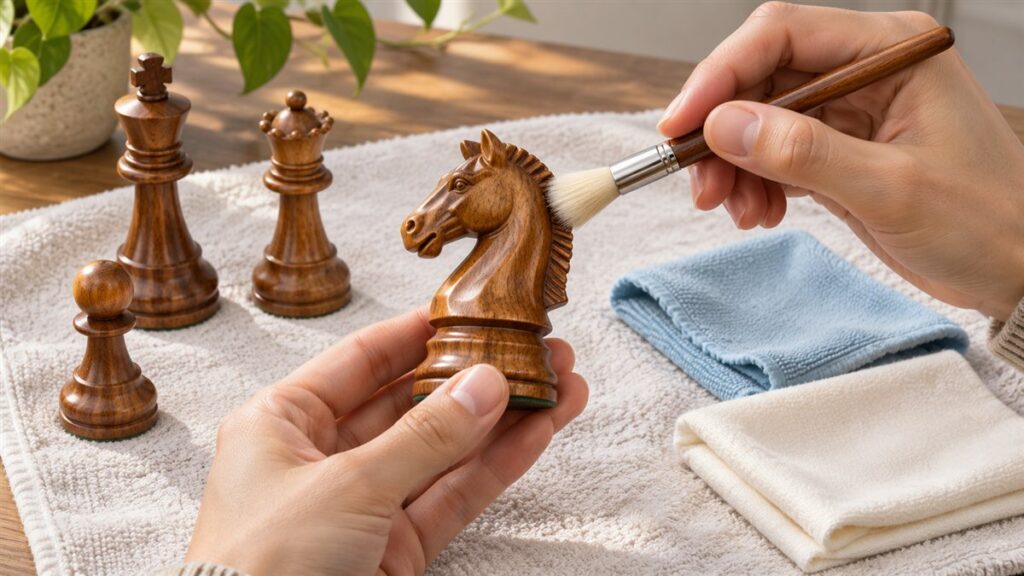
To clean a wooden chess set, dust it with a soft dry cloth, spot clean marks with a barely damp cloth and dry everything straight away. Avoid soaking, harsh cleaners and heat, because wood can swell, crack or lose its finish. The sections below cover the kit, a full routine, how to handle common marks and how to store a set so it stays smooth for years.
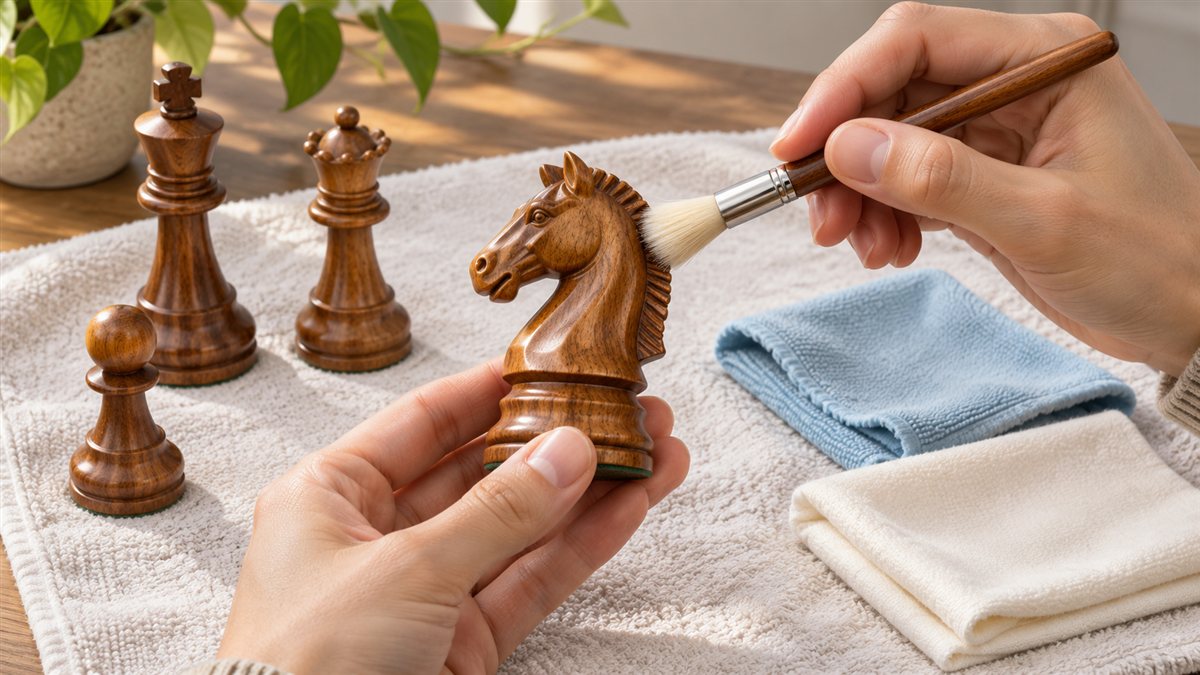
What You Need
- Two or three soft, lint-free cloths, such as cotton or microfibre.
- A soft brush, such as a clean makeup brush or small soft duster, for crevices.
- Mild soap, if the maker’s guide allows it.
- A furniture polish or wax that suits your set’s finish, only if the maker recommends one.
Always look at the maker’s care instructions first. Finishes vary, and some sets are not meant to be wiped with anything wet. Try any product on a hidden spot, such as the base of a piece, before using it more widely.
Cleaning Steps
- Clear the board and lay out a clean towel on a flat surface.
- Dust each piece with the dry cloth, using the soft brush for carved details.
- For fingerprints or light grime, dampen a cloth with water, then wring it until it is only slightly damp.
- Wipe each piece gently, following the grain of the wood where you can see it.
- Go over it at once with a dry cloth, and let the pieces air dry on the towel, away from heat and direct sun.
- Clean the board the same way, wiping squares lightly and drying immediately.
Things to Avoid
| Do not | Why |
|---|---|
| Soak or rinse the pieces | Water can swell the wood and lift the finish |
| Use strong chemicals or abrasive pads | They can strip or scratch the surface |
| Dry with a heater or hair dryer | Fast heat can cause cracks |
| Over-polish | Build-up can make pieces sticky or slippery |
Know Your Set’s Finish
Wooden sets are finished in several ways, and the finish decides how much moisture and polish is safe. A lacquered or varnished surface has a hard, shiny skin that resists light dampness, though it can show scratches. An oiled or waxed surface feels soft and warm, and it may need an occasional light recoat with a product the maker names. Some sets are left bare and only sanded, and these take in moisture and stains quickly, so use a dry cloth only. If the maker gave no information, assume the gentlest case: dry dusting and the barest dampness, followed by quick drying.
A Worked Walkthrough: A Seasonal Deep Clean
- Choose a bright table and spread a towel. Set up the board and pieces in two groups, light and dark, so you do not mix them up.
- Check each piece for loose parts, cracks or worn felt on the base. Put any that need repair to one side.
- Dust every piece with a dry cloth and brush the carved areas, such as knight manes and rook battlements. Work from the top of the piece down.
- Dampen a cloth with plain water and wring it out until it leaves no wet mark on your palm. Wipe one piece at a time and dry it at once with a second cloth.
- Look at the bases. If felt is peeling, remove the loose part and note it for replacement.
- Wipe the board squares in the direction of the grain, then dry. Do not leave a wet cloth lying on the board while you work.
- If the maker recommends a wax or oil, apply a very thin layer to a soft cloth, work it across the surface, and buff off the excess. Let it rest before play.
- Return the pieces to their box or tray in the standard opening arrangement, with the queens on their own colour, to make setting up easier next time.
Common Scenarios
Sticky fingerprints after a long club night
Wipe each piece with a nearly dry cloth, then dry it. Handling with clean hands afterwards reduces the build-up.
Dust in the carving
Use the soft brush in short strokes, moving dust out of the grooves. A damp cloth can push dust into crevices and turn it into paste.
Ring marks from a cup on the board
Wipe the mark gently and dry it. If it remains, it may be in the finish itself, so ask the maker or a woodworking specialist instead of scrubbing.
Set kept in a damp room
Move it somewhere dry, with steady temperature. Wood can swell and shrink with humidity, and pieces may stick in the box.
Mistakes to Avoid
- Using a wet cloth. Moisture soaks into end grain at the base of pieces and can lift the finish.
- Applying polish to the base. Slippery bases slide on the board and lose their grip.
- Storing pieces loose in a drawer. They knock together and chip the tops of tall pieces.
- Leaving the set in direct sunlight. Light fades wood and can make one side of a piece look different from the other.
- Pulling at a loose piece. Forcing it may split it, so ask for repair advice instead.
Keeping It Fresh
Handle pieces by their bases and wash your hands before long sessions, since oils from skin leave marks. Dust the set every few weeks, and store it in a cool, dry place. If the felt on the bases wears out, replace it with new felt so the board is not scratched. A deep clean once or twice a year is enough for most sets.
Work in good light so you notice sticky spots, and handle the tallest pieces gently, since slender necks and crowns can snap. If a piece is loose on its base, ask the maker about repair rather than forcing it.
Care and Upkeep Over Time
Store pieces in a lined box or tray where each sits in its own space, and keep the board flat, since a board stored on its edge can warp. Put the set away from radiators and window glass, where temperature changes are greatest. If the box is sealed, open it now and then so air can move. Keep the felt clean too; a quick pass with a soft brush stops grit from rubbing against the board. Check every year for small cracks along the grain and tiny spots that might mean insects, and ask a specialist if you see fine dust under pieces.
Quick Troubleshooting
| Symptom | Likely cause | What to try |
|---|---|---|
| Pieces feel tacky | Skin oils or too much polish | Wipe with a barely damp cloth, dry well, use less polish |
| Dull, cloudy finish | Dust film or worn finish | Dust and wipe, then ask the maker about refinishing |
| Board squares look uneven | Uneven wear or moisture | Dry gently, keep flat in a stable room |
| Bases scratch the board | Felt worn away | Replace the felt with new pieces |
Glossary
- Grain: the pattern of fibres running through the wood.
- Lacquer: a hard, clear coating on the surface of wood.
- Wax: a soft protective layer rubbed on and buffed off.
- Felt: the soft material on the base of each piece.
- End grain: the cut ends of wood fibres, which absorb moisture fast.
- Buffing: rubbing with a dry cloth to give an even shine.
Reading the Condition of Your Set Before You Start
A few minutes of inspection decides how much cleaning a set can safely take. Wood that looks dirty is sometimes simply worn, and no amount of wiping will fix wear. Pick up each piece under a bright lamp and tilt it so the light skims across the surface. Dust and skin oil show as a dull, uneven film. Worn finish shows as patches where the sheen is gone, usually on the tops of pawns, the crowns of kings and the edges of the board squares where fingers land most often.
Sort what you find into three groups. The first group is surface dirt, which is dust, light grime and fingerprints, and which a dry cloth or a barely damp cloth can handle. The second is sticky residue, such as dried drink, old polish build-up or food, which needs a slightly longer and gentler approach. The third is damage: chips, hairline cracks, lifted finish, loose crowns, stained wood or peeling felt. Damage should not be cleaned at all in the usual sense. Set those pieces aside and treat them separately, because moisture and rubbing make most damage worse.
Check the weights as well. Many sets have a weighted base, held in place by felt or a thin disc glued under the piece. If you feel a rattle or a base that moves, do not wipe that area with a damp cloth, since water can reach the glue line. Note it for repair instead.
Choosing Cloths, Brushes and Products with Care
The kit for a wooden chess set is short, and the quality of each item matters more than the number of items. A cloth should be soft, clean and free of loose threads. Cotton jersey from an old T-shirt that has been washed many times works well, as do microfibre cloths sold for glasses or screens. Avoid anything with a rough weave, a printed design that sheds, or a fabric softener smell, since softener can leave a film that transfers to the wood.
For brushes, a clean makeup brush or a soft paintbrush with fine, flexible bristles reaches into carved details without scratching. Keep one brush for the chess set only, so it never carries grit from other jobs. A cotton swab can reach tiny grooves, but use it dry or barely damp and replace it as soon as it picks up dirt.
Products deserve the most caution. Many household sprays contain solvents, ammonia or strong fragrance that can dull a lacquer, soften wax or darken bare wood. A drop of mild dish soap in water is often described as a gentle option for sealed surfaces, but the maker of your set is the best source on whether it is suitable. If you do use it, the cloth should be wrung out until it leaves no visible wetness, and the pieces should be dried straight away. When in doubt, skip the product and use only a dry cloth. That choice costs you nothing except a little extra time.
| Item | Good for | Use with care when |
|---|---|---|
| Dry cotton or microfibre cloth | Dust, light oil, routine upkeep | The cloth is gritty or has caught debris |
| Barely damp cloth | Fingerprints and light grime on sealed wood | The set is bare or oiled and the maker advises dry cleaning only |
| Soft brush | Carved crowns, manes and battlements | Bristles are stiff or have collected dirt |
| Wax or oil named by the maker | Restoring a soft sheen on waxed or oiled finishes | Applied thickly, or to bases and the playing surface |
| Household spray cleaner | Not recommended for wood sets | Almost always |
Looking After the Board, the Box and the Felt
Pieces get most of the attention, but the board and storage box affect how clean the pieces stay. A wooden board has two kinds of squares: light and dark, often made from different woods or stained differently. Dark squares can show dust and fingerprints more clearly, while light squares show stains and ring marks. Wipe the board along the direction of the grain whenever you can see it, using a dry cloth first and a barely damp cloth only for marks.
If the board has a raised border or a carved edge, dust tends to collect where the border meets the playing surface. A soft brush used in short strokes toward the edge, followed by a dry cloth, keeps this from turning into a gray line. Never let water pool in that corner, because it can run under the border and lift the join.
The box matters because it is where the set spends most of its life. A lined box can trap dust and old moisture, so empty it every few months, shake out loose grit and wipe the lining with a dry cloth. If the lining is felt or velvet, a soft brush works better than a cloth, which can pull the fibers. Leave the lid open for an hour or two in a dry room afterward so any trapped air can escape. If the box smells musty, that is a sign it has been stored in a damp place, and the better fix is to change where it is kept rather than to add scent or spray.
The felt on the base of each piece protects the board from scratches and gives the piece a quiet, stable feel. Over years it flattens, collects dust and sometimes peels at the edge. Brush it lightly during every cleaning. If it is peeling, trim away only the loose edge with small scissors, and plan to replace the felt when it no longer covers the base. Self-adhesive felt sold for furniture feet can be cut to size, though a thin, soft grade is better than a thick one so the piece does not become top-heavy.
Care Plans for Different Kinds of Owners
The occasional player
If the set comes out a few times a year, the main enemy is dust and slow, quiet storage damage rather than handling. A quick dry dusting before and after each use is plenty. Keep it in its box or covered with a clean cloth, and check the felt once a year.
The regular club or family set
A set that is played weekly collects skin oil on the tops of pieces and on the squares where hands rest. Wipe the pieces with a dry cloth after each long session, and plan a seasonal deep clean following the routine already described. Encourage players to touch pieces by the body or base, and to avoid eating or drinking over the board, since sticky spills are the hardest marks to remove from wood.
The display set or heirloom
A set that mostly sits on a shelf needs protection from light, heat and humidity swings more than from handling. Place it away from windows and radiators, dust it with a soft brush, and avoid wet cleaning altogether unless there is a specific need. If a set is old, has an unknown finish or has sentimental value, consider asking a woodworking or antiques specialist before using anything other than a dry cloth.
The travel or tournament set
A set that is carried around meets scratches, grit and sudden temperature changes. Keep each piece in a separate pouch or compartment, shake out the case after trips, and check the bases for grit that could scratch the board. Let the set sit at room temperature before opening a cold case in a warm room, since moisture can form on cool surfaces.
Repairs, Restoration and When to Stop
Cleaning is not repair, and it helps to know the point at which a job needs someone else. Wiping and dusting are safe for almost any set. Lightly re-waxing a waxed set is a reasonable owner task if the maker names a product. Anything involving glue, sanding, stripping, restaining or refinishing is a different level of work. Done badly, it can reduce the character and value of a piece, especially an older one.
For a loose crown or a base that has come away, a small amount of wood glue made for furniture is a common repair, but the surfaces need to be clean and the piece needs to be held still while it dries. If the break is at a thin neck, such as a knight head or a queen crown, the join is under stress and may fail again. A woodworker can pin or reinforce it. For a chipped corner on a board square, matching the color and grain is difficult, so leaving a small chip alone is often better than a visible patch.
Signs that call for professional advice include dark water stains that go through the finish, white clouding that does not wipe away, fine powdery dust under pieces that may mean wood-boring insects, a board that has cracked across several squares, and pieces that have warped enough to rock on a flat surface. In each case, stop cleaning, note what you see, and keep the set dry and separate from other wooden items until you have advice.
Making a Simple Annual Care Calendar
A routine is easier to keep when it is tied to something you already do. Many owners do a quick dust whenever they set the board up, a gentle wipe at the change of each season, and an inspection once a year. A short calendar might look like this.
- After every session: return pieces to their slots, wipe any marks with a dry cloth and close the box.
- Every month or two: dust the set with a soft brush and check that nothing has loosened.
- Every season: do the deeper clean with a barely damp cloth if the finish allows it, then dry the pieces thoroughly.
- Once a year: inspect felt, cracks, finish wear and the lining of the box, and decide whether anything needs repair or a new coat of the maker recommended wax.
Keep a small note with the set that records the maker, the finish if you know it, and anything you have done to it. When you come back a year later you will not need to guess what was used last time. This is especially helpful if the set is shared between family members or a club.
Finally, give the set room to breathe. Wood responds to the air around it. A stable room, a clean box and gentle hands do more for a wooden chess set than any product, and they keep the pieces pleasant to hold for as long as you play.
Ready to Buy? Start Here
If this guide helped you decide what to look for, these links take you to the next step.
Compare specific products
Gear for this guide
- Wood polish and cleaner on Amazon
- Microfiber cloths on Amazon
- Soft bristle brushes on Amazon
- Wooden chess sets on Amazon
As an Amazon Associate we earn from qualifying purchases. Prices and availability are shown on Amazon.
FAQ
Can I use wood polish on the pieces?
Only if the maker suggests it. Polish can leave a slippery layer that makes pieces harder to hold.
What about stains?
Try a gentle wipe first. For a deep stain or damaged finish, ask the maker or a woodworking specialist rather than scrubbing.
How should the pieces be stored?
Keep them in a lined box with separate slots, or wrapped in soft cloth. Avoid piling them, since tall pieces such as kings and queens can chip.
Can I clean the board and pieces together?
You can use the same method, but do the pieces first, then the board, with clean cloths. This keeps grit from the board from reaching the pieces.
How often should I clean the set?
Dust every few weeks if it is in regular use, and give it a gentle wipe when you see marks. A deeper clean once or twice a year is plenty.
Is it safe to use mineral oil or olive oil on a wooden chess set?
Only if the maker says so. Some oils stay tacky, attract dust or go rancid, and they can darken bare wood or leave bases slippery. A finish the maker names is a safer choice, and a dry cloth is always the lowest-risk option when you are unsure.
How do I get a sticky spill off the board?
Blot, do not rub, and use a cloth that is only slightly damp. Work along the grain, then dry at once. If the surface stays tacky after one or two gentle tries, stop and ask the maker or a woodworking specialist, because more scrubbing can strip the finish.
Why do my chess pieces stick together in the box?
Usually humidity or a finish that has not fully cured. Wood swells in damp air, and waxed or varnished surfaces can cling to each other. Move the box somewhere dry and stable, give each piece its own slot or wrap, and let the set air out before closing it.
Can I clean the felt bases without removing them?
Yes, for light dust. Use a soft brush with short strokes and avoid soaking the felt. If the felt is gritty, peeling or matted, replace it, since worn felt no longer protects the board and can hold dirt that scratches the squares.
When should a wooden chess set go to a specialist?
Consider one for deep stains, cracked boards, loose crowns that keep failing, signs of insects or a valuable antique set. Cleaning will not repair these problems, and the wrong treatment can lower the value or make the damage harder to fix.
The Short Version
Dust often, wipe with a barely damp cloth only when needed, and dry at once. Check the maker’s care advice, avoid harsh products, and your set will stay smooth and attractive. Store it dry, flat and away from strong light.