Disclosure: As an Amazon Associate, reviewstook.com earns from qualifying purchases. Links to Amazon on this page are affiliate links; they cost you nothing extra.
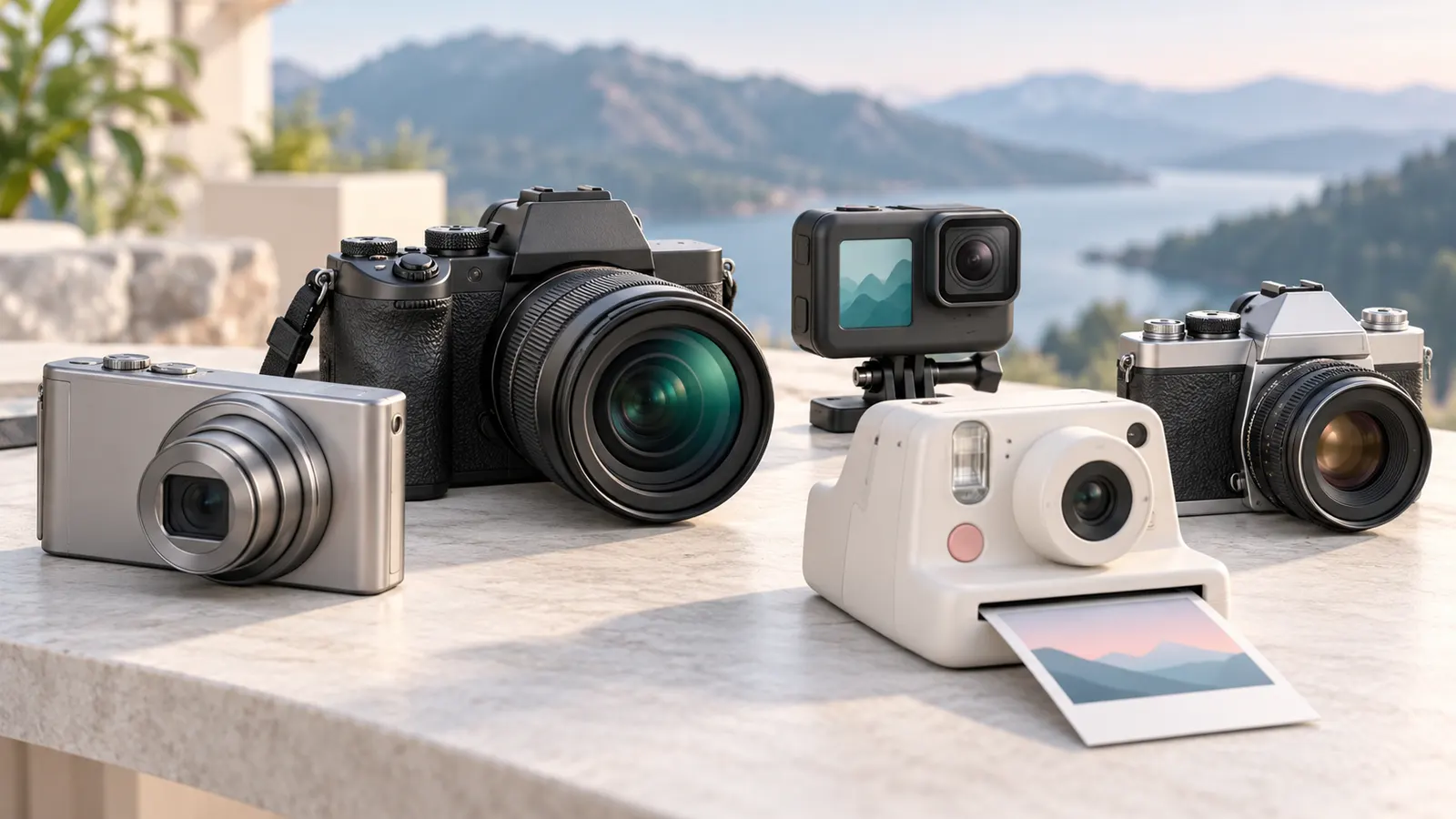
Different cameras fit different jobs.
Last updated: November 1, 2026.
Everyday
See compact cameras.
In this guide
Adventure
See action cameras.
Creative
See instant and film cameras.
Start With How You Will Actually Shoot
The best camera type is the one that matches the situations you will be in most. Ask yourself where you will use it, how much you want to carry, whether you shoot mostly still pictures or video, and how much control you want. A camera that does everything is rarely the best at any one thing, so decide on your main job first.
It also helps to think about what frustrates you with your current device. Is it low light? Zoom? Battery life? Speed? Each camera type solves some problems better than others. Writing down two or three priorities before you shop makes comparisons much simpler and protects you from paying for features you will not use.
Compact, Mirrorless and DSLR Compared
Among cameras for general photography, three families are common. Compacts are small and simple, with a lens that is built in. Mirrorless cameras take interchangeable lenses and are generally smaller than DSLRs. DSLRs also use interchangeable lenses and an optical viewfinder, and are typically larger.
- Compact: pocketable and easy; limited by the fixed lens and smaller controls.
- Mirrorless: flexible, with a wide range of lenses and electronic viewfinders; the system grows with you.
- DSLR: long-established with many lenses available, but bulkier.
Sensor size, lens options and the cost of building a kit all differ, so check the listing for what is included. An interchangeable-lens camera is a commitment to a lens mount, which is worth considering before buying.
Action, Waterproof and Rugged Cameras
Action cameras are small, tough and usually mounted on a helmet, bike or chest. They record wide-angle video and are often used for sport and travel. Some are water-resistant on their own, others need a housing; check the listing for depth ratings and what is required. Battery life is typically limited, so a spare is often wise.
Rugged compact cameras suit beaches, hikes and family trips where drops and splashes are likely. Their zoom and low-light performance may be modest compared with other types, but durability is the point. Match the camera to the conditions, and look at mounting options and stabilization if you plan to shoot while moving.
Instant and Film Cameras: What You Are Buying Into
Instant cameras print a picture within minutes, which makes them fun at parties and gifts. Film cameras need film purchased and developed, so there is an ongoing cost and a delay before you see results. Both offer a look and a process that digital cameras do not, with less control and fewer second chances.
Think about running costs: film packs, development, and storage. Check what film format the camera uses and that it is still available. These cameras suit people who enjoy the experience and results more than technical precision. If you want reliable photos in every situation, one of the digital types may serve better.
Accessories, Memory and Ongoing Costs
The camera body is only part of the cost. Plan for a memory card, a spare battery, a case or strap, and, for interchangeable-lens cameras, extra lenses. Check which card type the camera uses and what speed it needs for video. Confirm how it charges and whether a charger is included.
Think about the software side too: how will you transfer pictures, and does the camera connect to your phone? Read the listing for these details. A basic kit that you actually use is better than an advanced one that stays in a drawer, and you can add to it as your needs become clearer.
Sensor Size and What It Means for Your Photos
The sensor is the part that captures light, and its size is one of the biggest differences between camera types. As a general rule, a larger sensor can gather more light, which tends to help in dim rooms and gives more room to blur the background. Smaller sensors are common in compact and action cameras, and they let the camera body stay small. Neither is wrong; it is a trade between size and low-light ability.
Be careful with headline numbers. Megapixels describe how many pixels make up the image, not how good those pixels are. More megapixels can help if you crop or print large, but they do not guarantee better pictures. A camera with a modest pixel count and a good lens and sensor can beat one that advertises a huge number. Look at what the listing says about sensor size and read independent reviews that show sample images.
Think about the situations that matter to you:
- Indoor and evening shots: a larger sensor and a lens that lets in more light usually help.
- Bright outdoor scenes: almost any current camera copes well, so size matters less.
- Prints and cropping: a higher pixel count and good lens quality both play a part.
- Sharing on a phone or screen: modest resolution is usually enough.
If most of your photos are shared on screens and taken in good light, you may not need the largest sensor. If you love photographing family events indoors or at dusk, that is where a larger sensor tends to earn its place. Match the spec to your real habits rather than to the number of features in the listing.
Lenses, Zoom and Focal Range
A camera is only as capable as the lens in front of the sensor. In a compact, the lens is built in, so check how far it zooms and whether it stays usable at the long end. Some compact cameras have a long zoom that is handy for travel and wildlife, but they can be bulkier and may struggle in low light at full zoom. Others stick to a shorter range and stay small.
With interchangeable-lens cameras, you choose lenses for particular jobs. A general-purpose zoom is the usual starting point. Wide lenses suit landscapes and interiors, longer lenses bring distant subjects closer, and lenses that let in a lot of light help with dim scenes and blurred backgrounds. Many kits include one starter lens, and you can add more later.
Keep a few points in mind:
- Optical zoom uses the lens itself. Digital zoom crops the image and generally reduces quality, so look for the optical figure.
- A wider maximum aperture lets in more light, but such lenses can be larger and cost more.
- Lenses are tied to a mount. Check that the lenses you want exist for the camera you are considering.
- Image stabilization, whether in the lens or the body, helps with handheld shots at slow shutter speeds.
Before buying a system camera, think about the lens range you will realistically want in a year or two, and whether that range is available at a price you are comfortable with.
Video Features, Stabilization and Audio
If video matters, check more than the headline resolution. Frame rate options, how long the camera can record in one go, how it handles heat and how smooth handheld footage looks all affect the result. Read the listing and manual for recording limits and for which video modes are available at which settings.
Stabilization deserves special attention. Action cameras commonly rely on electronic stabilization to smooth out bumps while moving, and some cameras use sensor or lens stabilization instead. Each approach has trade-offs, such as a narrower view when electronic stabilization is switched on. Check what the listing says and how it applies to the video mode you plan to use.
Sound is easy to overlook. Built-in microphones are fine for casual clips, but wind noise can be a problem outdoors. If you plan to talk to the camera or record interviews, look at whether the camera has a microphone input or supports accessories. Check how it handles wind and whether a cover is available.
Finally, think about storage. Video fills memory cards quickly, and higher-quality modes may need faster cards and more space. Plan for more cards, a way to copy files to a computer and enough battery for long clips. A camera with great video specs is of limited use if you run out of power or space after a few minutes.
Size, Handling and How the Camera Feels
A camera you enjoy carrying gets used. The best way to judge handling is to hold the camera in a shop if possible, or to read what reviewers say about grip, button layout and menus. Large hands may find tiny buttons frustrating, while a heavy body can become a burden on a long day.
Consider the way you frame pictures. Some cameras have a viewfinder you hold to your eye, which is helpful in bright sunlight and steadies the camera against your face. Others rely on a rear screen only. A tilting or flip-out screen helps with low or high angles, selfies and video. A touchscreen can speed up menus, though some people prefer physical dials.
- Weight and bulk: think about how long you will carry it and in what bag.
- Controls: dedicated dials give quick access; menu-driven cameras can be simpler for beginners.
- Weather resistance: check what the listing says, and do not assume a camera is sealed unless it states so.
- Battery type: some cameras use removable batteries you can swap; others charge in the body.
Autofocus behavior also affects how the camera feels in use. Fast, reliable focus matters for children, pets and sport, while slower focus is acceptable for landscapes and still life. Read about how the camera tracks moving subjects if that is your main interest.
Budget Tiers, New Versus Used and Signs It Is Time to Upgrade
Describe your budget by what you want to do, and then look for the type that fits. At the lower end, simple compacts, basic action cameras and instant cameras give good value for casual use. In the middle, mirrorless and capable compacts offer more control and better image quality. At the upper end you are paying for larger sensors, faster focus, tougher bodies and a broader choice of lenses.
Buying used can stretch a budget, particularly with lenses and bodies for interchangeable-lens systems. Check the seller’s return policy, ask about the condition and look at how many shots the shutter has made if that information is available. Test the camera as soon as it arrives, and keep records of the purchase for warranty questions.
Whether new or used, spend a little of the budget on the basics: a memory card you trust, a spare battery and a protective case. These items protect the camera and the pictures you take with it.
Signs it is time to upgrade include frequently missing shots because focus is slow, struggling in low light, hitting the limit of your lens range or finding that the camera no longer fits the way you shoot. If you are only slightly frustrated, a better lens, a new card or a few lessons may help more than a new body. Upgrade for a clear reason, not because a newer model exists.



Ready to Buy? Start Here
If this guide helped you decide what to look for, these products are a place to start.


As an Amazon Associate we earn from qualifying purchases. Prices and availability are shown on Amazon.
A Decision Guide by Situation
Instead of comparing every spec, begin with the moments you want to capture. The table links common situations to the camera type that tends to suit them.
| Situation | Camera type to consider | Why |
|---|---|---|
| Family photos and travel snapshots | Compact or mirrorless with a zoom lens | Light to carry, quick to use |
| Sports, wildlife, fast action | Mirrorless or DSLR with a long lens | Fast focus and lens choice |
| Hiking, swimming, rough use | Action or rugged camera | Sealed body and a mounting system |
| Casual party fun and prints | Instant camera | Physical photo right away |
| Learning photography seriously | Mirrorless or DSLR | Full manual control and room to grow |
If two rows fit you, think about which situation happens more often and let that win.
Mistakes to Skip When Comparing Cameras
Shoppers often fixate on a single number. Megapixels are the classic example: beyond a modest count, more pixels do little for web sharing or standard prints. Lens quality, sensor size and focus performance usually shape the final image far more. Another trap is buying a body without thinking about the lens, since the lens decides reach, background blur and low-light ability.
- Do not buy more camera than you will carry; a camera left at home takes no pictures.
- Do not ignore the weight and grip, which you feel on every outing.
- Do not forget memory cards, a spare battery and a bag.
- Do not assume zoom numbers are comparable between types.
Handling Check Before You Commit
Specifications on paper cannot tell you whether a camera feels right. If you can, hold a few in a shop. See whether the grip fits your hand, whether the buttons are reachable with your thumb, and whether the screen and viewfinder are comfortable to use. Check that menus make sense, because a confusing interface slows you down at the moment you need speed.
If you buy online, look at the return window and the contents of the box, then take a short practice session within the first days. Try auto mode, a manual setting and video. A camera that feels natural during those first outings is the one you will keep using.
Words to Know When Reading Camera Listings
Product pages are full of shorthand. A short glossary makes them much easier to follow.
- Sensor size: the physical chip that collects light; larger sensors generally handle dim scenes better.
- Interchangeable lens: the lens can be removed and swapped, giving flexibility over time.
- Optical zoom: real magnification from the lens, unlike digital zoom, which simply crops the image.
- Image stabilization: a system that reduces blur from shaky hands or movement.
- Burst rate: how many frames per second the camera can capture in a row.
- Autofocus points: the spots the camera can lock onto; more coverage helps with moving subjects.
- Weather sealing: gaskets that resist dust and splashes, which differ from fully waterproof bodies.
Treat marketing phrases with care. Words like “pro” or “ultra” rarely mean anything specific, so look for the underlying feature and what the maker says it does. When a detail is unclear, the manual or the maker’s official specification page is the most reliable place to confirm it.
Trying Before You Buy: The Weekend Test That Settles It
Specifications narrow the field, but handling settles it, and the closest thing to a free trial is a deliberate weekend with a borrowed, rented or shop-handled camera of the type you are considering. Carry it the way you would carry your own: on the walk, at the family lunch, in the low light of the evening. Notice what your hands do without thinking. Do you reach for it or leave it in the bag? Do the controls fall where your fingers expect, or do you hunt for every setting while the moment walks away? A camera type that frustrates you in a weekend will not improve with ownership, and a type that disappears into the day is telling you something no review can.
Shoot the same small set of subjects with each type you test: a moving child or pet, a dim room, a landscape with bright sky, and something small and close. Then look at the results on a big screen, not the camera’s, and judge them by your standards rather than a reviewer’s. This simple discipline explains why two photographers can honestly recommend opposite cameras: they shoot different subjects, in different light, with different patience for editing. Your test aligns the choice with your photography instead of theirs.
The honest role of your phone in this decision
Your phone is the baseline every dedicated camera must beat, and it beats most cameras at being present. So the question is never whether a camera is better than a phone in the abstract; it is whether it is better at the specific thing your phone fails you at. If your phone fails at the zoo, at concerts and at sport, the answer is reach, and a long-zoom compact or a mirrorless camera with a telephoto lens is the honest fix. If it fails in dim rooms and at fast action, the answer is a bigger sensor and better autofocus. If it never really fails you at all, the honest purchase may be no camera — or an instant camera bought openly for fun, which is a perfectly good reason that needs no technical defence.
How the Types Age: Costs and Pleasure Over Five Years
A camera purchase is the start of a cost curve, not the end of one, and the types in this guide curve very differently. A compact or instant camera is nearly all upfront cost, plus film for the instant models, which adds up cheerfully and should be counted honestly if you shoot a lot. An interchangeable-lens camera spreads its cost over years: the second lens, the bag that fits the second lens, the spare battery, the tripod you swore you would not buy. None of that is a trap if you expect it; it becomes one only when the body price was treated as the whole price. Before choosing a system, price the two-lens kit you would realistically own in three years and compare that figure across brands, because that is the number you are really committing to.
Pleasure curves differ too. Fixed-lens cameras tend to be loved for their simplicity long after their specifications date, because there is nothing to upgrade and nothing to decide. System cameras reward the photographers who enjoy the deciding — the lens choices, the settings, the gradual mastery — and quietly punish those who do not, becoming expensive objects that stay home. Action cameras follow the activity: bought for a sport you keep up, they are bargains; bought for a sport you try twice, they are the most expensive footage you will ever shoot. Match the type to the photographer you have actually been for the last two years, not the one you intend to become, and the five-year picture usually chooses itself.
Repairs, support and the second-hand market
Practical ownership favours types with a living ecosystem. Popular mirrorless systems and well-known compacts are easy to repair, easy to buy used lenses and accessories for, and easy to sell when you upgrade, which lowers the real cost of owning them. Orphaned systems and obscure models can be excellent cameras and poor possessions, because a failed charger or a cracked screen becomes a research project. When you buy used — which this guide encourages for beginners — that ecosystem matters twice over, since you are relying on the previous popularity of the type to supply parts, batteries and honest listings. Buy the type the market still loves, and the market will look after you in return.
Matching Camera Types to Life Stages and Subjects
It may help to see the choice through the situations readers describe most. For young families, the winning trait is speed: a camera that is awake and focused before the moment ends, which points to a good compact or a mirrorless camera with reliable face detection, and away from anything that demands setup while a toddler escapes. For travellers, weight is a daily tax paid in enjoyment, and the honest question is what you will still be carrying happily on day nine; many travellers conclude that a premium compact or a small mirrorless with one versatile lens beats the full kit they optimistically packed on day one. For grandparents and occasional photographers, simplicity and a bright, forgiving automatic mode matter more than any creative control, and the best camera is the one a grandchild can be handed without a lesson.
For students of photography — the people who want to learn, not just to record — the calculus changes again. A camera with full manual control and a viewfinder teaches deliberately, because every setting is a decision you can see the result of. That can be a modest used mirrorless or DSLR, and the type matters less than the commitment to shoot regularly and review honestly. For wildlife and sports enthusiasts, the lens is the purchase and the body is its accessory, so choose the system whose long lenses you can realistically afford, new or used. And for the purely social photographer, whose pictures live on a phone screen and are shared within the hour, a dedicated camera only earns its place if it offers something the phone cannot: real zoom, real low-light ability, or the simple pleasure of a device that is only a camera.
More Questions Worth Asking
Is a more expensive camera always easier to use?
No — often the opposite. Higher-end cameras assume knowledge, offering deep menus and customisable buttons that delight experienced users and bewilder beginners, while mid-range and compact models invest in automatic modes that simply work. Ease of use comes from the match between the camera’s assumptions and your experience, not from the price. If you are starting out, a simpler camera you understand fully will produce better photographs than an advanced one you are fighting.
What camera type is best for photographing children and pets?
The type that focuses fastest and is already in your hand. In practice that means a compact with good face detection or a mirrorless camera with subject-tracking autofocus, both of which handle unpredictable movement far better than manual or slow systems. Burst shooting helps too, because the best expression in a sequence of ten frames beats the single frame you hoped for. Whatever you choose, practise on ordinary days so the camera is a reflex by the birthday, not a puzzle.
Do I need weather sealing on a camera?
Only your habits can answer that. If you shoot at the coast, in the hills, at winter sports or anywhere you would not willingly leave the camera at home because of the forecast, sealing is worth having — paired with a sealed lens, since the system is only as protected as its weakest joint. If your photography lives indoors and on fine days, sealing is money spent on a risk you never take, and a rain cover solves the rare exception. Be honest about the forecast you actually shoot in.
Can one camera do both family photos and serious landscapes?
Yes, and this is where interchangeable-lens cameras earn their reputation, because the same body that takes a portrait lens on Saturday can take a wide lens and a tripod on Sunday. A high-quality compact can also cover both happily for photographers who do not print very large. The real dividing line is not the subject but your expectations: family photos reward speed and forgiveness, landscapes reward patience and control, and a camera you enjoy using both ways is the one that will actually be used both ways.
How many lenses does a beginner actually need?
One, for longer than you expect. Start with the standard zoom or the single prime the camera comes with, and shoot with it until you can name, from experience, the specific photographs it prevents you from taking. That named frustration — not a review, not a sale — is the correct reason to buy a second lens, and it guarantees the second lens gets used. Many photographers discover the honest answer was a wider view; just as many discover it was reach. Both discoveries are cheaper after a season of shooting than before it.
A Short Decision Path if You Are Still Stuck
If you have read this far and still cannot choose, walk this path in order and stop at the first answer that fits. Do you mostly want better pictures of distant things — wildlife, sport, the stage? Then reach is your problem, and a long-zoom compact or a mirrorless system with a telephoto is your answer. Do you mostly shoot in dim places — homes, evenings, events? Then light is your problem, and a larger sensor in a compact or mirrorless body is your answer. Do you mostly want to learn photography itself? Then control is your answer, and an interchangeable-lens camera with manual settings, bought used without shame, will teach you more per pound or dollar than anything else on this page. Do you mostly want the fun of the thing — pictures as objects, shared on the spot? Then an instant camera is your answer, bought with open eyes about film costs. And if none of those problems sounds like yours, your phone is probably your camera already, and the wisest purchase in this entire guide is a small tripod and the time to learn the phone you own. There is no failure in that conclusion; there is only failure in buying a camera to solve a problem you do not have.
What to Do in the First Month With a New Camera Type
Whatever type you choose, the first month decides whether it becomes your camera or your shelf ornament, so spend it deliberately. Shoot every day, even briefly, because familiarity is built by repetition and not by occasions. Keep the camera where you will see it — by the door, on the desk — rather than stored correctly in a cupboard, because a camera that must be fetched is a camera that misses the unplanned photograph, which is most of the good ones. Review your pictures once a week and be specific in your criticism: not that a picture is bad, but that it is soft because you rushed the focus, or bright because you trusted the sky. Specific criticism is how a new camera turns into skill.
Resist two temptations in that month. The first is accessories: no second lens, no bag upgrade, no filter set until the camera itself is a habit, because accessories bought for a habit you have not formed are shelf ornaments of their own. The second is comparison: do not spend the month reading about the camera you did not buy. Every type in this guide involves a compromise you chose for a reason; the first month is for learning what your choice does well, and there will be time enough later — a season later, honestly — to decide whether the compromise still suits the photographer you have become. Most people who follow that simple discipline end the month surprised by how much the camera has disappeared, leaving only the pictures, which is the entire point of choosing well.
A Note on Gifts: Buying a Camera for Someone Else
Many cameras are bought as gifts, and the rules change slightly. Resist buying the camera you wish the recipient were ready for; buy the one that matches the photography they already do. A keen phone photographer who loves travel will use a good compact from the first morning, while an ambitious system camera may wait, admired and unused, for a confidence that has not arrived yet. Include the unglamorous essentials with the gift — a card, a case, a spare battery where the type needs one — because a camera that cannot be used on the day it is given loses its best first impression. And if you are genuinely unsure between two types, a voucher toward the recipient’s own choice is not a failure of imagination; in a decision this personal, it is often the most thoughtful option of all.
Why Handling Beats Specifications, One More Time
If this guide has a single argument, it is that cameras are held, not read. Two models can share a sensor, a resolution and a price and produce entirely different ownership experiences, because one fits your hand, your eyesight, your patience and your bag, and the other merely fits a comparison table. That is why the weekend test matters, why the shop visit matters, and why the advice of a friend whose photography resembles yours outweighs a stranger’s league table. Choose the type that fits your life, verify that the individual model fits your hands, and then commit to it for a full season before judging. Photography rewards the committed far more reliably than it rewards the well-equipped.
One Sentence to Remember
If everything else in this guide fades, keep this: the right camera type is the one that will be in your hand, switched on and understood, on the ordinary day when the unrepeatable photograph walks past — choose for that day, and the specifications will take care of themselves.
And a Last Word on Confidence
New photographers often wait to feel ready before taking a camera seriously, as if the right type were a permission slip. It is the other way round: the shooting creates the readiness, and the type merely needs to not stand in its way. Every photographer whose work you admire began with a camera that was, by the standards of their later career, the wrong one — too simple, too slow, too limited — and it did not matter, because they used it constantly and learned what its limits were teaching them. Choose the camera in this guide that fits your life today, use it until its limits are genuinely yours rather than a reviewer’s, and upgrade, if you ever need to, from knowledge. That is the only buying advice that has ever reliably worked.
A Closing Note on Keeping It Simple
And if the whole subject begins to feel heavy, remember what it is for. A camera is a way of paying attention: to children growing, to places changing, to light doing something brief and unrepeatable. The simplest type that lets you pay that attention, in the places your life actually happens, is not a compromise at all. It is the answer, and everything else in this guide is just the working shown.
Before You Spend Anything
Run the cheapest test in photography: for one week, shoot deliberately with the phone you already own, at the subjects you claim to need a camera for, and note every moment it genuinely failed you. That list of failures, written from your own week, is the most accurate buying brief in existence — take it to the types above, and the right one will identify itself.
Frequently Asked Questions
Phone vs camera?
Dedicated cameras win on zoom and lenses.
Cheap cameras?
Overstated specs.
Where to start?
Pick your use.
Do I need a dedicated camera if I have a phone?
Not always. Dedicated cameras can offer better zoom, lens choice and handling, while phones are convenient. Decide whether you need those specific advantages.
What is the difference between mirrorless and DSLR?
Both use interchangeable lenses. Mirrorless cameras generally have electronic viewfinders and smaller bodies, while DSLRs use an optical viewfinder and are usually bulkier.
Is an action camera good for everyday photos?
It is designed for wide-angle video and tough conditions, so it is less suited to portraits or zoom. Consider a compact for everyday use.
Are instant cameras worth buying?
They are fun and suit parties and gifts, but film costs add up and control is limited. Check film availability and running costs first.
What accessories do I need with a new camera?
At minimum a memory card and probably a spare battery. A case or strap is helpful, and interchangeable-lens cameras may need more lenses.
How do I check if a camera works with my memory card?
Look in the listing or manual for the supported card type and speed. Video modes may need faster cards.
Should beginners buy an interchangeable-lens camera?
It depends on your goals. If you want to learn and expand, it offers room to grow. If you want simplicity, a compact may be a better start.
Do more megapixels mean better pictures?
Not by themselves. Pixel count matters when you crop or print large, but sensor size, lens quality and processing also shape the result. Look at sample images and independent reviews.
What is the difference between optical and digital zoom?
Optical zoom uses the lens to bring the subject closer and keeps the quality. Digital zoom crops and enlarges the image, which usually lowers quality. Focus on the optical figure in the listing.
Do I need image stabilization?
It helps with handheld shots in dim light and with video. Check whether it is in the lens, the camera body or electronic, and how it works in the modes you plan to use.
Is a viewfinder important?
It can be, especially in bright sunlight, because a rear screen may be hard to see. Some people prefer a screen alone. Think about where and how you will shoot.
Should I buy a used camera?
It can be a good way to save money, especially for lenses and bodies. Check the return policy, condition and what is included, and test the camera right away.
How do I choose between a compact and a mirrorless camera?
Choose a compact for simplicity and pocket size. Choose mirrorless if you want interchangeable lenses and more control and do not mind the extra size. Think about how much you want to carry.
Will my camera record long videos?
Recording limits vary by model and by video mode, and heat can also matter. Check the listing and manual, and plan for extra batteries and cards.
When should I upgrade my camera?
When it regularly limits what you can shoot, such as slow focus or poor low-light results. Try cheaper fixes first, like a better lens or accessories, before buying a new body.
Bottom Line
Match camera type to your use.
More Cameras Guides
- Best Dual Dash Cams for Cars
- Best 4-Channel Dash Cams for Rideshare and Taxis
- Best Premium Dash Cams
- Best Truck Dash Cams
- Best Cellular Game Cameras for Remote Photos
- Best WiFi Game Cameras with Apps
- Best 4K Game Cameras for Hunting
- Best Instant Film Cameras for Gifts and Parties