Best wireless stereo speakers give you a true stereo pair for a room with no speaker wire between the boxes and no separate amplifier on the shelf. Each pick in this guide is a powered pair: one speaker holds the amplifier and the wireless receiver, the other connects to it, and your phone or TV sends music over Bluetooth or Wi-Fi. That powered pair design is the heart of this guide, and it is what sets these speakers apart from a single portable Bluetooth speaker.
The listings in this guide split into two kinds, and it helps to know the difference before you buy. Some picks are audiophile pairs, such as the KEF LSX II and the Edifier S1000MKII, which aim for a refined hi-fi sound on a desk or a shelf. Other picks are heritage powered pairs, such as the Klipsch The Fives II and The Sevens, which mix a classic look with modern wireless inputs. Both kinds belong here, because both are powered wireless stereo pairs, but they suit different rooms and different ears.
This guide compares published specs and design traits. We have not used these speakers ourselves, so every claim below traces to a spec printed in the listing title or to a basic design trait of the driver size, the wireless inputs, and the power handling. Use the comparison table to match a pick to your room, your source, and your budget.

In this guide
Quick picks: best wireless stereo speakers
| # | Product | Where to buy |
|---|---|---|
| 1 | Klipsch The Fives II | Check on Amazon |
| 2 | Klipsch The Sevens | Check on Amazon |
| 3 | KEF LSX II | Check on Amazon |
| 4 | KEF LSX II LT | Check on Amazon |
| 5 | Edifier S1000MKII | Check on Amazon |
| 6 | Edifier R1700BTs | Check on Amazon |
How the picks were chosen
We started with listings that name a wireless stereo pair in the title, then kept only the ones where the brand and every model code in the title match the product. A listing that sold a single portable Bluetooth speaker was dropped, and so were passive wired bookshelf speakers with no wireless input, mini stereo systems with a CD player, and computer speakers that are not a stereo pair for a room.
We favoured a spread of prices and uses: two Klipsch heritage powered pairs for a classic living room, two KEF wireless pairs for a refined desktop or shelf setup, and two Edifier pairs for a strong sound at a lower cost. That spread covers serious listeners, desk workers, and buyers who want a simple wireless pair for a TV or a turntable.
Driver size, power handling, and wireless inputs came straight from the listing titles. Where a title states a wattage figure, it is shown, and where it does not, the table says so plainly instead of guessing a number. The input list matters here, so the guide notes Bluetooth, HDMI ARC, USB, and optical inputs for each pick.
Best wireless stereo speakers: the picks in detail
Klipsch The Fives II Dolby Atmos 5.25 Inch Powered Speakers
The Klipsch The Fives II is a pair of 5.25 inch powered speakers in walnut, with Dolby Atmos support. The Fives II is the smaller of the two Klipsch heritage powered pairs in this guide, and it suits a desk, a shelf, or a small room where a larger pair would dominate the space. The walnut finish and the classic Klipsch look suit a living room far better than a black plastic box.
A powered design means the amplifier is built into the pair, so no separate amp is needed. The 5.25 inch woofer gives a full sound for nearfield listening, and the Dolby Atmos support adds a spatial sound mode for movies and shows. The pair format covers a stereo setup in one order, and the wireless inputs let a phone connect with no cable at all.
Key specs: Pair of 5.25 inch powered speakers; Dolby Atmos; walnut finish; Klipsch The Fives II.
Strengths:
- 5.25 inch size fits a desk, shelf, or small room.
- Walnut finish and heritage styling suit a living room.
- Powered design needs no separate amplifier.
Trade-offs:
- 5.25 inch woofer gives less deep bass than the larger Sevens.
- Dolby Atmos mode suits movies more than pure music listening.
- Title states no wattage, so plan from your room size.
Who it fits: Listeners who want a compact Klipsch heritage wireless pair for a desk or a small room.
Best for: a desk or small room with a classic walnut look. Not suited for: large rooms or deep bass without a subwoofer.
Check price on Amazon: Klipsch The Fives II

Klipsch The Sevens Heritage Inspired Powered Speakers
The Klipsch The Sevens is a heritage inspired pair of powered speakers in walnut, and the larger sibling of The Fives II in this guide. The Sevens name revives the classic Klipsch heritage line, with a bigger cabinet and a fuller sound for a mid-size room. The walnut finish matches The Fives II, so the two models share a look across a room.
A larger cabinet gives The Sevens more presence than The Fives II, and the pair format covers a stereo setup in one order. The powered design needs no separate amplifier, and the wireless inputs suit a phone, a TV, or a turntable with a built-in preamp. The Sevens is the Klipsch pick for a living room where the Fives II would run out of scale.
Key specs: Heritage inspired pair of powered speakers; walnut finish; Klipsch The Sevens.
Strengths:
- Larger cabinet gives more presence than The Fives II.
- Heritage styling with a walnut finish suits a living room.
- Powered design needs no separate amplifier.
Trade-offs:
- Larger size needs a sturdy shelf or a proper stand.
- Title states no driver size or wattage, so plan from your room size.
- Heritage pricing costs more than the Edifier pairs in this guide.
Who it fits: Listeners who want a larger Klipsch heritage wireless pair for a mid-size room.
Best for: a mid-size living room with a classic walnut look. Not suited for: a desk setup or a very small room.
Check price on Amazon: Klipsch The Sevens

KEF LSX II Wireless Active Bookshelf Speakers
The KEF LSX II is a pair of wireless active bookshelf speakers in carbon black, with Bluetooth, USB-C, HDMI ARC, AirPlay 2, and Chromecast. The input list is the widest in this guide: a TV connects over HDMI ARC, a computer connects over USB-C, and a phone streams over AirPlay 2, Chromecast, or Bluetooth. That range makes the LSX II the most flexible pick for a mixed desk and TV setup.
KEF is a long standing name in hi-fi, and the LSX II is its compact wireless system for a desk, a shelf, or a small room. The active design means the amplifier and the wireless receiver are built in, so the pair needs only power and a source. The carbon black finish is quiet and modern, and it suits a desk setup far better than a bold retro colour.
Key specs: Pair of wireless active bookshelf speakers; Bluetooth, USB-C, HDMI ARC, AirPlay 2, Chromecast; carbon black; KEF LSX II.
Strengths:
- Widest input list in this guide: HDMI ARC, USB-C, AirPlay 2, Chromecast, Bluetooth.
- Compact active design suits a desk, shelf, or small room.
- KEF hi-fi voicing suits refined listening at close range.
Trade-offs:
- Compact size gives limited deep bass without a subwoofer.
- Premium pricing costs more than the Edifier pairs.
- Small drivers suit nearfield listening more than a large room.
Who it fits: Desk workers and small room listeners who want the widest input list in a compact pair.
Best for: a desk or shelf with a TV, a computer, and a phone. Not suited for: large rooms or deep bass without a subwoofer.
Check price on Amazon: KEF LSX II
KEF LSX II LT Wireless HiFi Speakers
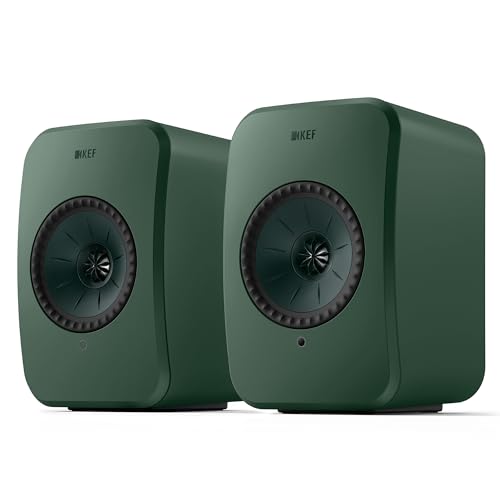
The KEF LSX II LT is a pair of wireless hi-fi speakers in sage green, and the streamlined sibling of the LSX II in this guide. The LT model keeps the wireless active design and the KEF voicing, with a simpler input set and a lower cost than the full LSX II. The sage green finish is a soft modern colour that suits a living room shelf or a bedroom desk.
A streamlined input set is the trade for the lower cost, so check the listing details against your sources before you buy. The pair format covers a stereo setup in one order, and the active design needs no separate amplifier. The LSX II LT is the KEF pick for a buyer who wants the KEF sound and the wireless design without paying for every input on the full LSX II.
Key specs: Pair of wireless hi-fi speakers; sage green finish; KEF LSX II LT.
Strengths:
- KEF wireless design at a lower cost than the full LSX II.
- Sage green finish suits a modern living room or bedroom.
- Active design needs no separate amplifier.
Trade-offs:
- Streamlined inputs may not cover every source the full LSX II covers.
- Compact size gives limited deep bass without a subwoofer.
- Title states no wattage or driver size, so plan from your room size.
Who it fits: Buyers who want the KEF wireless sound at a lower cost than the full LSX II.
Best for: a modern room with a phone or a computer as the main source. Not suited for: a setup that needs HDMI ARC or USB-C.
Check price on Amazon: KEF LSX II LT
Edifier S1000MKII Audiophile Active Bookshelf Speakers
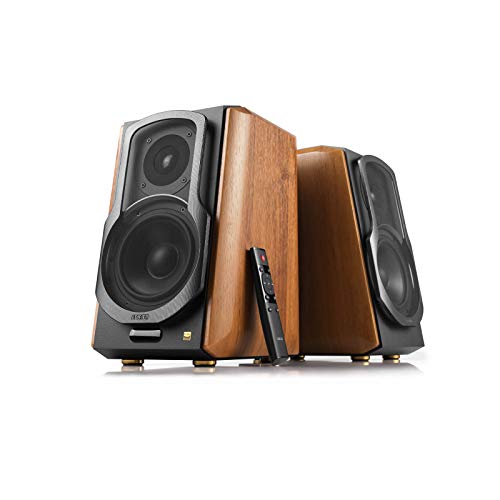
The Edifier S1000MKII is a pair of audiophile active bookshelf speakers with 120 watts of power and Bluetooth 5.0. The 120 watt figure is the highest power figure in this guide, and it suits a mid-size room where a compact pair would run out of output. Edifier is a familiar name in powered speakers, and the S1000MKII is its flagship active bookshelf pair.
Audiophile in the title signals a refined voicing aim, with a flat and detailed sound rather than a boosted bass. The Bluetooth 5.0 input adds wireless streaming from a phone, and the active design needs no separate amplifier. The S1000MKII is the Edifier pick for a listener who wants flagship power and a refined sound without heritage pricing.
Key specs: Pair of audiophile active bookshelf speakers; 120 watts; Bluetooth 5.0; Edifier S1000MKII.
Strengths:
- 120 watt figure is the highest power figure in this guide.
- Bluetooth 5.0 adds wireless streaming from a phone.
- Audiophile voicing suits refined listening in a mid-size room.
Trade-offs:
- Larger size and weight need a sturdy shelf or stand.
- Title states no driver size, so plan from your room size.
- Flagship Edifier pricing costs more than the R1700BTs.
Who it fits: Listeners who want flagship Edifier power and a refined sound for a mid-size room.
Best for: a mid-size room with a refined sound and strong output. Not suited for: a small desk where a compact pair fits better.
Check price on Amazon: Edifier S1000MKII
Edifier R1700BTs Active Bluetooth Bookshelf Speakers
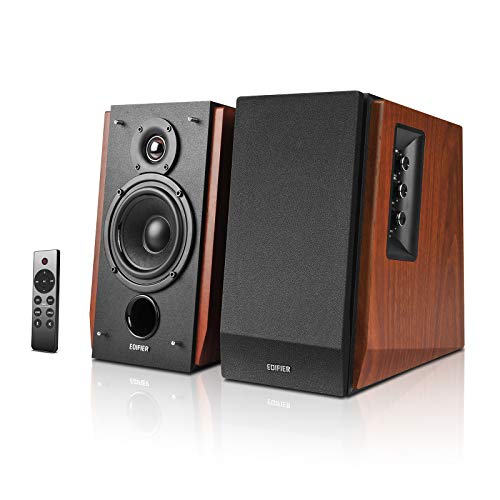
The Edifier R1700BTs is a pair of active Bluetooth bookshelf speakers with 66 watts RMS, a 2.0 wireless nearfield design, and a subwoofer line out. The 66 watt RMS figure is a steady power figure, not a peak claim, which makes it easy to plan around. The subwoofer line out is a useful detail: a subwoofer can be added later for deep bass without replacing the pair.
The nearfield design suits a desk or a shelf where the listener sits close, and the Bluetooth input adds wireless streaming from a phone. The R1700BTs is the affordable Edifier pick in this guide, and it is the best value for a buyer who wants a wireless stereo pair for a desk without heritage pricing.
Key specs: Pair of active Bluetooth bookshelf speakers; 66 watts RMS; 2.0 wireless nearfield; subwoofer line out; Edifier R1700BTs.
Strengths:
- 66 watts RMS is a steady figure that is easy to plan around.
- Subwoofer line out allows a later bass upgrade.
- Affordable cost for a wireless stereo pair on a desk.
Trade-offs:
- Nearfield design suits close listening more than a large room.
- 66 watts RMS gives less output than the 120 watt S1000MKII.
- Title states no driver size, so plan from your room size.
Who it fits: Desk listeners who want an affordable wireless stereo pair with a later subwoofer option.
Best for: a desk setup with wireless streaming and a later bass upgrade. Not suited for: large rooms or loud listening without a subwoofer.
Check price on Amazon: Edifier R1700BTs
Comparison table
| Model | Key feature | Power and size | Who it fits |
|---|---|---|---|
| Klipsch The Fives II | 5.25 inch powered pair, Atmos | Not listed, walnut | Desk or small room, heritage look |
| Klipsch The Sevens | Heritage powered pair | Not listed, walnut | Mid-size room, heritage look |
| KEF LSX II | Wireless active pair, many inputs | Not listed, carbon black | Desk and TV, widest input list |
| KEF LSX II LT | Wireless hi-fi pair | Not listed, sage green | Modern room, KEF sound, lower cost |
| Edifier S1000MKII | Audiophile active pair | 120 W, Bluetooth 5.0 | Mid-size room, flagship power |
| Edifier R1700BTs | Active Bluetooth pair, sub out | 66 W RMS | Desk setup, affordable, later bass |
Buying guide
Start with the source, not the speaker. A TV needs HDMI ARC, a computer needs USB-C or optical, and a phone needs Bluetooth, AirPlay 2, or Chromecast. The KEF LSX II in this guide covers the widest input list, while the KEF LSX II LT has a streamlined set that may not cover every source. List your sources first, then check each pick against the list.
Match the pair size to the room. A compact pair, such as the KEF LSX II or the Klipsch The Fives II, suits a desk or a small room, while a larger pair, such as the Edifier S1000MKII or the Klipsch The Sevens, suits a mid-size room. A pair that is too large for the room sounds boomy, and a pair that is too small for the room sounds thin. The room sets the size, not the other way around.
Check the power figure against your listening distance. The Edifier S1000MKII lists 120 watts, and the R1700BTs lists 66 watts RMS. A nearfield desk setup needs little power, because the listener sits close, while a mid-size room needs more headroom. The Klipsch and KEF titles in this guide print no wattage, so plan from your room size instead of a printed figure.
Decide whether you need a subwoofer output. The Edifier R1700BTs has a subwoofer line out, so a subwoofer can be added later for deep bass. The other picks in this guide have no subwoofer output in the title, so a bass upgrade would need a different route. If deep bass matters to you, a subwoofer output is worth having, because no compact wireless pair replaces a subwoofer for the deepest bass.
Read the listing title in full before you buy. Some wireless listings sell a single speaker, and a stereo setup needs a pair. The titles in this guide all name a pair, but a similar listing for the same model may sell one unit. The title also tells you the model code, the finish, and the inputs, so it is the most reliable source for matching a pair to your setup.
Use and care
Keep powered speakers ventilated and away from heat. The amplifier lives inside one speaker of the pair, and it needs airflow to stay cool. Do not stack books or boxes on a powered speaker, and do not push the pair against a wall with no gap behind it. A few centimetres of air behind the cabinet keeps the amp cool and the sound clear.
Use the right cable for the wired link between the speakers. The pair connects with a speaker cable or a link cable, and a loose or damaged cable causes dropouts or a dead channel. Check the link cable first if one speaker goes quiet, before you blame the wireless input or the amplifier.
Keep the wireless connection simple. Bluetooth works best with a clear line of sight and a short distance, and a crowded Wi-Fi network can slow a Wi-Fi stream. If a stream stutters, move the phone closer, switch off a nearby microwave, or use a wired input for a critical listening session. A wired input is the fallback when wireless acts up.
Clean the cabinets with a soft dry cloth, and keep drinks away from the pair. A spill into a powered speaker can damage the amplifier, and a wet cloth on a veneer finish can leave a mark. If a speaker starts to buzz or rattle, check the link cable first, then the cabinet, before you blame the driver itself.
Common mistakes
Buying a single portable speaker instead of a stereo pair is the first error. A portable Bluetooth speaker gives mono or pseudo-stereo sound from one box, while a wireless stereo pair gives a true left and right image from two boxes. Check that the title names a pair and that the listing shows two speakers. The portable models in our search, such as the JBL Charge 6, are single units, not stereo pairs.
Buying a passive wired pair by mistake is the second error. A passive bookshelf speaker needs a separate amplifier, and it has no wireless input at all. The Polk T15 in our search is a good example: a fine wired pair, but not a wireless stereo speaker. Check that the title says powered, active, or wireless before you order.
Ignoring the input list is the third error. A pair with Bluetooth only cannot take a TV over HDMI ARC, and a pair with no USB-C cannot take a computer over USB. List your sources first, then match the inputs. The KEF LSX II covers the widest list, while the simpler pairs cover fewer sources.
Expecting deep bass from a compact wireless pair is the fourth error. A small driver in a compact cabinet gives clear mids and highs, but deep bass needs cone area and cabinet volume. The Edifier R1700BTs has a subwoofer line out for a later bass upgrade, and the other picks need a different route. Pair a compact wireless speaker with a subwoofer if bass weight matters to you.
Final recommendation
For most rooms, the Edifier R1700BTs is the balanced starting point: an affordable wireless stereo pair with a steady 66 watt RMS figure, Bluetooth streaming, and a subwoofer line out for a later bass upgrade. If you want flagship power and a refined sound, step up to the Edifier S1000MKII, and if you want the widest input list, the KEF LSX II is the pick.
If you want a heritage look, the Klipsch The Fives II suits a desk or a small room, and The Sevens suits a mid-size living room. If you want the KEF sound at a lower cost, the LSX II LT is the pick, with a streamlined input set and a sage green finish.
Whichever pick you choose, list your sources first, match the pair size to your room, and check the model code in the listing title before you order. A wireless stereo speaker rewards careful matching more than a big budget, and the six picks above cover the main heritage, hi-fi, and value options without forcing you into a single portable speaker or a passive wired pair. The best wireless stereo speakers are the ones that fit your room, your sources, and your taste, not the ones with the biggest numbers on the listing.
Powered pairs vs passive pairs with an amp
A powered pair, such as every pick in this guide, has the amplifier built into one speaker, so the pair needs only power and a source. That layout saves a box, a cable, and a budget, and it suits a desk or a shelf where space is tight. The amplifier is matched to the drivers by the maker, so the sound is tuned as a system.
A passive pair with a separate amplifier gives more flexibility: the amp can be upgraded, the speakers can be moved to a new amp, and a better amp can lift the sound. The trade is space, cost, and complexity. A passive pair also has no wireless input on its own, so a streamer or a Bluetooth receiver must be added. The JBL L52 Classic in the vintage guide on this site is a passive pair, and it needs an amp to play at all.
Your choice comes down to simplicity against flexibility. A powered wireless pair is the simple path to stereo sound in a room, while a passive pair with an amp is the flexible path for a listener who wants to upgrade piece by piece. Neither path is wrong; they serve different rooms and different habits.
How wireless stereo actually works
A wireless stereo pair receives music over Bluetooth or Wi-Fi, then splits it into a left and a right channel across the two boxes. Bluetooth is the simplest route: a phone pairs with the main speaker, and the main speaker sends one channel to the second speaker over a wired link. Wi-Fi adds multiroom streaming through AirPlay 2 or Chromecast, which suits a home with more than one room of speakers.
The wired link between the two boxes matters more than most buyers expect. The main speaker holds the amplifier and the wireless receiver, and the second speaker connects to it with a speaker cable. A loose link cable causes dropouts or a dead channel, so check that cable first when a channel goes quiet. The link cable length also sets how far apart the pair can sit.
Latency is the other detail to know. Bluetooth adds a small delay, which is fine for music and usually fine for video, though some listeners notice lip sync drift on a TV. HDMI ARC, on the KEF LSX II, avoids that problem by taking the TV audio directly. If you plan to use the pair mainly for TV, an HDMI ARC input is worth having.
Where wireless stereo pairs shine
A wireless stereo pair shines on a desk, where a listener sits close and hears the stereo image clearly. The KEF LSX II and the Edifier R1700BTs in this guide are nearfield designs, and they give a wide and detailed sound at arm length. A desk pair also keeps the setup simple: two boxes, a power cable, and a phone, with no amplifier on the shelf.
The design also shines in a small living room, where a full hi-fi stack would dominate the space. The Klipsch The Sevens and the Edifier S1000MKII give a room-filling sound from two boxes, with a turntable or a TV as the source. The walnut finish on the Klipsch pairs suits a living room far better than a black plastic box.
A bedroom is a third home for a wireless stereo pair. The KEF LSX II LT in sage green suits a bedroom shelf, and the Bluetooth input lets a phone stream music at night with no cable across the room. In all three rooms the appeal is the same: a true stereo image with no speaker wire across the floor and no separate amplifier to find space for.
Frequently asked questions
What is a wireless stereo speaker?
A wireless stereo speaker is a powered pair of speakers that receives music over Bluetooth or Wi-Fi and plays it in true stereo, with a left and a right channel across two boxes. It differs from a single portable Bluetooth speaker, which plays from one box only.
Do wireless stereo speakers need an amplifier?
No, because the amplifier is built into the pair. Every pick in this guide is a powered or active pair, so it needs only power and a source such as a phone, a TV, or a turntable.
Can I use wireless stereo speakers with a TV?
Yes, if the pair has the right input. The KEF LSX II in this guide has HDMI ARC for a TV, while other pairs use optical or Aux. Check the input list against your TV outputs before you buy.
Can I use wireless stereo speakers with a turntable?
Yes, if the pair has an Aux or RCA input, or if the turntable has Bluetooth. The Electrohome Huntley in the vintage guide on this site has an RCA input built for a turntable, and the powered pairs in this guide take an Aux or optical feed from a turntable preamp.
Do wireless stereo speakers need Wi-Fi?
No. Bluetooth works with no Wi-Fi at all, and a phone pairs directly with the main speaker. Wi-Fi adds AirPlay 2 and Chromecast multiroom streaming, which the KEF LSX II supports, but it is not required for basic wireless playback.
Why do some wireless speakers sell as a single unit?
Some listings sell one speaker so a buyer can replace a damaged unit or add a second speaker later. A stereo setup needs a pair, so check whether the title says pair before you order. All six picks in this guide are pairs.
Can I add a subwoofer to a wireless stereo pair?
Yes, if the pair has a subwoofer line out, such as the Edifier R1700BTs in this guide. A subwoofer adds deep bass that a compact pair cannot give on its own. Pairs with no subwoofer output need a different route for a bass upgrade.
Are wireless stereo speakers good for a desk?
Yes, because the nearfield design of pairs such as the KEF LSX II and the Edifier R1700BTs gives a wide and detailed sound at close range. A desk pair keeps the setup simple, with two boxes and a phone as the source.
What is the difference between Bluetooth and Wi-Fi speakers?
Bluetooth pairs a phone directly with the main speaker, with no network needed, and it suits a single room. Wi-Fi adds multiroom streaming through AirPlay 2 or Chromecast, which the KEF LSX II in this guide supports, and it suits a home with speakers in more than one room. Bluetooth is simpler, while Wi-Fi is more flexible for a multiroom home.
How far apart can wireless stereo speakers sit?
The wired link cable between the two boxes sets the distance, because the main speaker sends one channel to the second speaker over that cable. A short cable suits a desk, while a longer cable suits a shelf or a TV stand. Check the link cable length in the listing details before you plan the layout, and keep the pair within the cable reach for a stable connection.
More from Reviewstook: Best Bluetooth Speakers, Best Bookshelf Speakers, Best Computer Speakers.