The best programmable thermostat without WiFi is for a home that wants automatic schedules without an app, an account, or a wireless connection. A programmable thermostat turns the heating down at night, warms the house before you wake, and saves energy while you are out, all from a schedule you set on the thermostat itself. No Wi-Fi means no app to update, no password to remember, no cloud service to fail, and no privacy worry about a connected device in your home. The six thermostats in this guide are all programmable models with no Wi-Fi at all, which means they work with a simple schedule and a clear display.
The six thermostats below cover every home and every heating system a buyer is likely to have. There is the Honeywell RTH2300B for a simple 5-2 day programmable thermostat, the Honeywell RTH221B for a basic programmable model at the lowest cost, the LuxPro PSP511LC for a 5/2-day programmable thermostat with a lighted display, the Honeywell T4 Pro for a professional-grade programmable thermostat, the White-Rodgers 1F80-0261 for a classic programmable thermostat with a blue display, and the Lux TX9600TS for a 7-day programmable thermostat with a large touchscreen. Every thermostat in this guide is a complete new thermostat, and every linked model was checked against its listing title for brand and model before it was included.
Before you buy, check three things: whether the thermostat matches your heating and cooling system, whether it needs a C-wire, and whether the programming matches your week. A thermostat that does not match the system will not work, a thermostat that needs a C-wire will not run without one, and a 5-2 day schedule suits a regular week while a 7-day schedule suits a changing one. The best programmable thermostat without WiFi in this guide was chosen for simple schedules, clear displays, and honest specifications from the listings.
In this guide
Quick picks: best programmable thermostat without wifi
| # | Product | Where to buy |
|---|---|---|
| 1 | Honeywell RTH2300B | Check on Amazon |
| 2 | Honeywell RTH221B | Check on Amazon |
| 3 | LuxPro PSP511LC | Check on Amazon |
| 4 | Honeywell T4 Pro TH4110U2005 | Check on Amazon |
| 5 | White-Rodgers 1F80-0261 | Check on Amazon |
| 6 | Lux TX9600TS | Check on Amazon |
How the picks were chosen for the best programmable thermostat without WiFi
No Wi-Fi at all came first, and it was a hard requirement. Every thermostat in this guide is a non-Wi-Fi model, which means it has no wireless radio, no app, and no cloud connection, and the schedule is set on the thermostat itself. Wi-Fi thermostats were excluded, no matter how good they are, because the whole point of this guide is a thermostat that works without a network. The connectivity was checked from each listing, so the comparison table reflects what the seller states, and buyers should confirm the current specifications on the product page before ordering.
A real programmable schedule came second, because a thermostat that only holds one temperature is not programmable. Every thermostat in this guide lets the owner set different temperatures for different times of day, with a 5-2 day schedule, a 5-1-1 day schedule, or a 7-day schedule, which means the heating follows the household routine automatically. Non-programmable thermostats were excluded, because they do not save energy or add comfort without manual changes. The schedule type was recorded from each listing, so buyers should confirm the current specifications on the product page before ordering.
Finally, we checked that every pick is a complete new thermostat sold as a new listing, with a brand and model that match the listing title exactly. Replacement parts, thermostat covers, and renewed listings were avoided in favour of complete new thermostats. The schedule type, the system compatibility, and the display were recorded from each listing, so the comparison table reflects what the seller states, and buyers should confirm the current specifications, including the system compatibility, on the product page before ordering.
Will a non-WiFi programmable thermostat work with your system?
Most homes use a low-voltage heating and cooling system, and the thermostats in this guide are built for exactly that: a single-stage system with one stage of heating and one stage of cooling, which covers most gas furnaces, air conditioners, and heat pumps. The Honeywell RTH2300B, the RTH221B, the LuxPro PSP511LC, and the T4 Pro in this guide all work with single-stage systems, and the Lux TX9600TS and the White-Rodgers 1F80-0261 cover multi-stage and heat pump systems as well. Before you buy, check the wires behind your current thermostat and match them to the compatibility in the listing.
The C-wire is the question most buyers ask, because many smart thermostats need one and many older homes do not have one. The good news is that most non-WiFi programmable thermostats run on batteries and do not need a C-wire, which means they work in older homes without any rewiring. The Honeywell RTH2300B and RTH221B run on batteries, the LuxPro PSP511LC runs on batteries, and the T4 Pro can run with or without a C-wire depending on the setup. Check the listing for the power requirements, and if your home has no C-wire, choose a battery-powered model.
For most buyers, the decision is simple: a 5-2 day programmable thermostat suits a household with a regular weekday and weekend routine, while a 7-day programmable thermostat suits a household where every day is different. The Honeywell RTH2300B, the RTH221B, and the LuxPro PSP511LC use a 5-2 day schedule, which is the simplest to set, while the Lux TX9600TS uses a 7-day schedule, which gives a different program for each day. If your week is regular, buy a 5-2 day model; if your week changes daily, buy the 7-day model.
5-2 day vs 7-day programming: which schedule do you need?
A 5-2 day schedule sets one program for the weekdays and a different program for the weekend, which suits a household where Monday to Friday look the same and Saturday and Sunday look different. The Honeywell RTH2300B, the RTH221B, and the LuxPro PSP511LC in this guide all use a 5-2 day schedule, and it is the easiest to set, because there are only two programs to enter. A 5-2 day thermostat is the right choice for a household with a regular work week and a regular weekend.
A 7-day schedule sets a different program for each day of the week, which suits a household where every day is different: a shift worker, a student with a changing timetable, or a family with activities on different days. The Lux TX9600TS in this guide uses a 7-day schedule, and it gives the most control, because each day can have its own temperatures and times. The trade-off is that a 7-day schedule takes longer to set up, because there are seven programs to enter instead of two.
For most buyers, a 5-2 day schedule is enough, because most weeks follow the same pattern, and a simpler schedule is easier to set and easier to change. A 7-day schedule is the right choice for a household with an irregular week, where the heating needs to follow a different routine each day. If you are not sure, buy a 5-2 day model: it is simpler, cheaper, and it covers the needs of most homes, and the savings from a programmed schedule are the same either way.
Saving energy with a programmed schedule
A programmed schedule saves energy by turning the heating down when nobody is home and at night, when the house does not need to be warm. A thermostat that drops the temperature by a few degrees for eight hours a day uses noticeably less energy than one that holds a constant temperature, and the savings add up over a heating season. The thermostats in this guide all do this automatically once the schedule is set, which means the savings happen without any daily effort from the owner.
The best schedule is one that matches the household routine: warm in the morning before everyone wakes, cooler during the day when the house is empty, warm again in the evening, and cooler overnight. Set the morning warm-up to finish half an hour before you wake, so the house is comfortable when you get up, and set the night setback to start an hour before bed, so the house cools gradually. A schedule that follows the routine saves energy without anyone noticing the temperature change.
For most buyers, the savings from a programmed thermostat pay for the thermostat itself within a single heating season, and the comfort is a bonus. A thermostat that is programmed well saves more than a thermostat that is set once and forgotten, and a thermostat that is never programmed saves nothing at all. Take the time to set the schedule when the thermostat is installed, check it after a week, and adjust it until the house is comfortable and the energy use is down.
Quick picks at a glance
| Product | Schedule and display | System compatibility | Best for |
|---|---|---|---|
| Honeywell RTH2300B | 5-2 day, simple display | Single-stage, battery powered | Simple schedule |
| Honeywell RTH221B | Programmable, basic display | Single-stage, battery powered | Lowest cost |
| LuxPro PSP511LC | 5/2-day, lighted display | Single-stage, contractor grade | Lighted display |
| Honeywell T4 Pro TH4110U2005 | Programmable, pro grade | 1H/1C, pro install | Professional quality |
| White-Rodgers 1F80-0261 | Programmable, blue display | Single-stage, 80 Series | Classic reliability |
| Lux TX9600TS | 7-day, large touchscreen | Heating and cooling | Most flexible |
The best programmable thermostats without WiFi
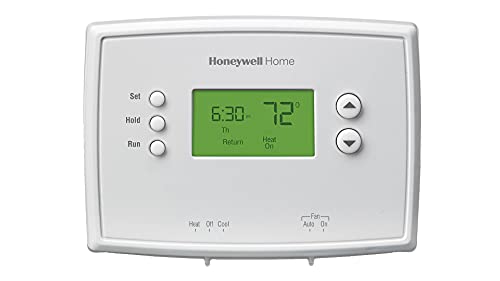
Honeywell Home RTH2300B1038 5-2 Day Programmable Thermostat, White
The Honeywell RTH2300B is the simple pick in this guide and the thermostat for a buyer who wants a straightforward 5-2 day programmable model from a trusted brand. The listing describes a 5-2 day programmable thermostat in white, with the model number RTH2300B1038, and Honeywell Home is one of the most trusted names in home heating controls. The 5-2 day schedule sets one program for weekdays and another for weekends, which covers the needs of most homes, and the simple display shows the temperature clearly. It is the thermostat for a buyer who wants a reliable, easy-to-use programmable model.
Where the RTH2300B earns its place is the simplicity. The 5-2 day schedule is easy to set, the display is clear, and the thermostat runs on batteries, which means it works in homes without a C-wire. The Honeywell name means a proper heating control brand behind the design, not a no-name thermostat, and the price means a buyer can afford to replace the thermostat in every zone of the house. For a first programmable thermostat, or a replacement for an old manual model, the Honeywell RTH2300B is the thermostat to buy.
Key specs:
- 5-2 day programmable schedule
- Honeywell Home RTH2300B1038 model
- White finish with a clear display
- Battery powered, no C-wire needed
- Single-stage heating and cooling
Strengths:
- Simple 5-2 day schedule is easy to set and use
- Battery powered, so it works without a C-wire
- Trusted Honeywell brand with a long history
Trade-offs:
- 5-2 day schedule is less flexible than a 7-day model
- Basic display without a touchscreen
- No Wi-Fi or app, by design
This thermostat fits buyers who want a simple, reliable 5-2 day programmable thermostat from a trusted brand, with no Wi-Fi and no C-wire needed.
Best for: a simple, reliable 5-2 day schedule
Not suited for: buyers who need a different program each day, or a touchscreen
Check price on Amazon: Honeywell RTH2300B
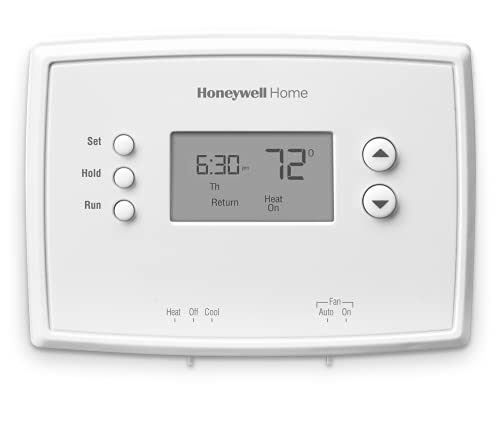
Honeywell Home RTH221B1039 RTH221B Programmable Thermostat, White
The Honeywell RTH221B is the budget pick in this guide and the thermostat for a buyer who wants the lowest-cost programmable model from a trusted brand. The listing describes a programmable thermostat in white, with the model number RTH221B1039, and it is one of Honeywell's most basic programmable models, which means it does the essential job without extra features. The programmable schedule turns the heating down at night and while the house is empty, which saves energy, and the simple controls mean anyone in the house can use it. It is the thermostat for a buyer who wants a programmable model at the lowest cost.
In daily use, the RTH221B is the thermostat that simply works. The programmable schedule runs automatically, the display shows the temperature clearly, and the battery power means it works in homes without a C-wire. The Honeywell name means a proper heating control brand, and the low cost means a buyer can afford to fit one in every room that needs it. For a budget upgrade, a rental property, or a first programmable thermostat, the Honeywell RTH221B is the thermostat to buy.
Key specs:
- Programmable thermostat schedule
- Honeywell Home RTH221B1039 model
- White finish with a clear display
- Battery powered, no C-wire needed
- Single-stage heating and cooling
Strengths:
- Lowest cost programmable thermostat in this guide
- Simple controls that anyone can use
- Battery powered, so it works without a C-wire
Trade-offs:
- Most basic features in this guide
- No touchscreen and no advanced schedule
- No Wi-Fi or app, by design
This thermostat fits budget buyers, rental properties, and anyone who wants the lowest-cost programmable thermostat from a trusted brand.
Best for: the lowest-cost programmable thermostat
Not suited for: buyers who need a 7-day schedule, or a touchscreen
Check price on Amazon: Honeywell RTH221B
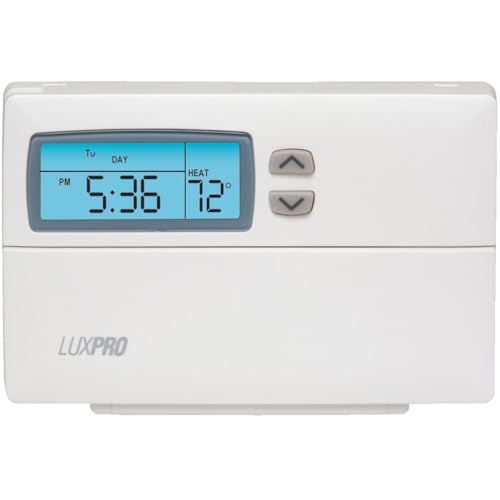
LuxPro PSP511LC Programmable Thermostat, 5/2-Day Programmable, Lighted, Contractor Thermostat
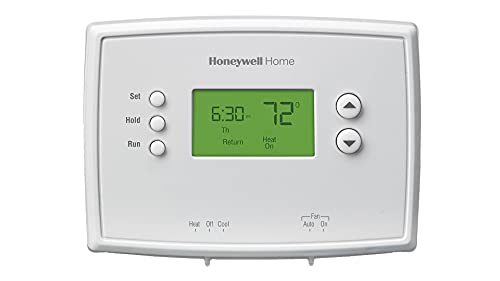
The LuxPro PSP511LC is the contractor pick in this guide and the thermostat for a buyer who wants a lighted, easy-to-read programmable model. The listing describes a 5/2-day programmable thermostat with a lighted display, sold as a contractor thermostat, which means it is the model heating professionals install in homes every day. The lighted display is easy to read in a dark hallway, the 5/2-day schedule covers weekdays and weekends, and the contractor grade means it is built to be installed and forgotten. It is the thermostat for a buyer who wants a professional-grade model with a readable display.
Where the PSP511LC earns its place is the readability. The lighted display shows the temperature clearly in any light, the 5/2-day schedule is easy to set, and the contractor design means the thermostat is straightforward to install and reliable in daily use. The LuxPro brand is a familiar name in heating controls, and the PSP511LC is a model that installers trust. For a hallway thermostat, a rental property, or a home where the display needs to be readable in the dark, the LuxPro PSP511LC is the thermostat to buy.
Key specs:
- 5/2-day programmable schedule
- Lighted display for easy reading
- Contractor thermostat design
- LuxPro PSP511LC model
- Single-stage heating and cooling
Strengths:
- Lighted display is easy to read in the dark
- Contractor-grade design trusted by installers
- Simple 5/2-day schedule is easy to set
Trade-offs:
- 5/2-day schedule is less flexible than a 7-day model
- Basic design without a touchscreen
- No Wi-Fi or app, by design
This thermostat fits hallways, rental properties, and buyers who want a lighted display and a contractor-grade programmable thermostat.
Best for: a lighted display and contractor quality
Not suited for: buyers who need a 7-day schedule, or a touchscreen
Check price on Amazon: LuxPro PSP511LC

Honeywell TH4110U2005/U T4 Pro Thermostat, Programmable or Non-Programmable, 1H/1C, White
The Honeywell T4 Pro is the professional pick in this guide and the thermostat for a buyer who wants a pro-grade model that can be programmable or non-programmable. The listing describes a T4 Pro thermostat with the model number TH4110U2005, for 1 heat and 1 cool systems, in white, and the T4 Pro is the thermostat that heating professionals install in homes and offices. The choice between programmable and non-programmable means the same thermostat can suit a household that wants a schedule and one that does not, and the pro build means it is made to last. It is the thermostat for a buyer who wants a professional model.
In daily use, the T4 Pro is the thermostat that feels solid. The controls are clear, the display is easy to read, and the programmable mode runs a schedule automatically, which saves energy without any daily effort. The 1 heat and 1 cool compatibility covers most homes, and the Honeywell Pro name means a proper heating control brand behind the design. For a home that needs a reliable, professional thermostat, or a buyer replacing a pro-installed model, the Honeywell T4 Pro is the thermostat to buy.
Key specs:
- T4 Pro thermostat, TH4110U2005 model
- Programmable or non-programmable modes
- 1 heat, 1 cool system compatibility
- White finish with a clear display
- Professional-grade Honeywell design
Strengths:
- Professional-grade build trusted by installers
- Programmable or non-programmable to suit the household
- Clear display and simple controls
Trade-offs:
- Costs more than the basic Honeywell models
- No touchscreen and no 7-day schedule
- No Wi-Fi or app, by design
This thermostat fits buyers who want a professional-grade thermostat, with a choice of programmable or non-programmable operation.
Best for: a professional-grade thermostat
Not suited for: buyers who need a 7-day schedule, or the lowest cost
Check price on Amazon: Honeywell T4 Pro TH4110U2005

White-Rodgers 80 Series Blue, Programmable Thermostat, 1F80-0261
The White-Rodgers 1F80-0261 is the classic pick in this guide and the thermostat for a buyer who wants a long-running programmable model with a blue display. The listing describes an 80 Series Blue programmable thermostat with the model number 1F80-0261, and White-Rodgers, now part of Emerson, has made heating controls for decades. The blue display is easy to read, the programmable schedule runs automatically, and the 80 Series is a familiar sight in homes across the country. It is the thermostat for a buyer who wants a proven, classic programmable model.
Where the 1F80-0261 earns its place is the track record. The 80 Series has been installed in homes for years, which means the design is proven, the controls are familiar, and replacement is straightforward for any heating technician. The programmable schedule saves energy, the blue display shows the temperature clearly, and the White-Rodgers name means a proper heating control brand. For a replacement thermostat, or a buyer who wants a classic model with a long history, the White-Rodgers 1F80-0261 is the thermostat to buy.
Key specs:
- 80 Series Blue programmable thermostat
- White-Rodgers 1F80-0261 model
- Blue display for easy reading
- Programmable schedule for energy saving
- Single-stage heating and cooling
Strengths:
- Long track record with a proven design
- Blue display is easy to read
- Familiar to heating technicians for easy replacement
Trade-offs:
- Classic design without a touchscreen
- Schedule is less flexible than a 7-day model
- No Wi-Fi or app, by design
This thermostat fits buyers replacing an older thermostat, and anyone who wants a classic programmable model with a long track record.
Best for: a classic programmable thermostat
Not suited for: buyers who need a 7-day schedule, or a modern touchscreen
Check price on Amazon: White-Rodgers 1F80-0261

Lux TX9600TS Programmable 7-Day Large Touchscreen Heating Cooling Thermostat, White
The Lux TX9600TS is the touchscreen pick in this guide and the thermostat for a buyer who wants a 7-day schedule with a large, easy-to-use touchscreen. The listing describes a programmable 7-day thermostat with a large touchscreen for heating and cooling, in white, and the 7-day schedule means each day of the week can have its own program. The large touchscreen makes setting the schedule easy, because the display is big enough to read and touch without squinting, and the 7-day flexibility suits a household where every day is different. It is the thermostat for a buyer who wants the most control without Wi-Fi.
In daily use, the TX9600TS is the thermostat that gives the most freedom. The 7-day schedule means Monday can differ from Tuesday, and the weekend can differ from the week, which is exactly what a shift worker or a family with a changing routine needs. The large touchscreen makes programming simple, the display shows the temperature clearly, and the Lux name means a familiar heating control brand. For a buyer who wants a touchscreen and a different schedule every day, the Lux TX9600TS is the thermostat to buy.
Key specs:
- Programmable 7-day schedule
- Large touchscreen display
- Heating and cooling thermostat
- White finish
- Lux TX9600TS model
Strengths:
- 7-day schedule gives a different program each day
- Large touchscreen is easy to read and use
- Most flexible schedule in this guide
Trade-offs:
- Costs more than the basic programmable models
- Touchscreen needs a power source, not just batteries
- No Wi-Fi or app, by design
This thermostat fits households with an irregular week, shift workers, and buyers who want a large touchscreen with a 7-day schedule.
Best for: a 7-day schedule with a touchscreen
Not suited for: buyers who want the lowest cost, or a battery-only thermostat
Check price on Amazon: Lux TX9600TS
Buying guide
Check your system compatibility first
Look at the wires behind your current thermostat and match them to the compatibility in the listing before you buy, because a thermostat that does not match the system will not work. Most homes use a single-stage system with one stage of heating and one of cooling, which the thermostats in this guide cover, but a multi-stage system or a heat pump needs a compatible model. If you are unsure, take a photo of the wires and ask a heating technician, because a wrong thermostat is a wasted purchase.
Turn off the power before you install
Switch off the power to the heating and cooling system at the breaker before you touch any wires, because the thermostat wires carry low voltage but a short can damage the system. Label each wire as you remove it from the old thermostat, so you know where it goes on the new one, and take a photo before you start. A careful install takes an hour, and a rushed install with the power on can damage the control board.
Set the schedule to match your routine
Program the thermostat to warm the house before you wake, cool it while you are out, warm it again in the evening, and cool it overnight, because a schedule that follows the routine saves energy without anyone noticing. Set the morning warm-up to finish half an hour before you wake, and set the night setback to start an hour before bed, so the temperature changes gradually. Check the schedule after a week, and adjust it until the house is comfortable.
Replace the batteries once a year
A battery-powered thermostat will warn you when the batteries are low, but a battery that dies completely can leave the heating off, which is a problem in winter. Replace the batteries once a year, at the start of the heating season, so the thermostat never runs out of power. Keep a spare set of batteries near the thermostat, and the heating will never stop because of a dead battery.
Give the thermostat a clear wall
Mount the thermostat on an inside wall, away from drafts, direct sunlight, and heat sources, because a thermostat that sits in a draft or in the sun will read the wrong temperature. A thermostat near a door, a window, or a lamp will turn the heating on and off at the wrong times, which wastes energy and makes the house uncomfortable. A clear, central wall gives the most accurate reading, and the most comfortable home.
Setting up and everyday care
Keep the thermostat clean and check it once a year for dust, because dust on the sensor can make the temperature reading inaccurate. Wipe the display with a soft cloth, vacuum gently around the vents, and check that the batteries are fresh at the start of the heating season. A thermostat that is kept clean and powered will give accurate readings for years, and a thermostat that is dusty or low on batteries will make the house too hot or too cold.
If the heating does not come on, check the thermostat settings before calling a technician, because the most common cause is a schedule that has turned the heating down, or a battery that has died. Check the mode is set to heat, check the temperature setting is above the room temperature, and check the batteries. If the thermostat is set correctly and the heating still does not come on, the problem is likely in the heating system itself, and a technician is the right call.
Common mistakes to avoid
Buying a thermostat that does not match the system
The most common mistake is buying a thermostat that does not match the heating and cooling system, because the buyer did not check the wires. A single-stage thermostat will not run a multi-stage system properly, and a thermostat for a heat pump will not work on a gas furnace without the right settings. Check the wires, match them to the listing, and buy the thermostat that fits your system.
Buying a Wi-Fi thermostat by mistake
A buyer who wants a non-Wi-Fi thermostat can easily buy a Wi-Fi model by mistake, because the listings look similar and the Wi-Fi models are often listed first. Check the listing for the words Wi-Fi, app, or smart, and choose a model that states clearly that it has no Wi-Fi, like the six in this guide. A thermostat with Wi-Fi needs an app and an account, which is exactly what a non-Wi-Fi buyer does not want.
Never programming the schedule
A programmable thermostat that is never programmed saves no energy, because it holds one temperature all day and night. Take the time to set the schedule when the thermostat is installed, with a warm morning, a cool day, a warm evening, and a cool night, and the savings will start immediately. A programmed thermostat pays for itself in a single heating season, while an unprogrammed one is just an expensive manual thermostat.
Mounting the thermostat in the wrong place
A thermostat mounted in a draft, in direct sunlight, or near a heat source will read the wrong temperature, which makes the house too hot or too cold. Mount it on an inside wall, away from doors, windows, and lamps, where the air is still and the temperature is representative of the house. A thermostat in the right place gives an accurate reading, and an accurate reading gives a comfortable home.
Our recommendation
For most buyers, the Honeywell RTH2300B is the thermostat to buy first, because it gives a simple 5-2 day schedule, battery power with no C-wire needed, and a trusted Honeywell name at a fair cost. If you want the lowest cost, buy the Honeywell RTH221B instead, because it does the essential job for less money. If your week changes every day, buy the Lux TX9600TS, because its 7-day schedule and large touchscreen give the most control without Wi-Fi.
Whatever you buy, check your system compatibility, turn off the power before you install, set the schedule to match your routine, and replace the batteries once a year. Those four steps matter more than the difference between any two thermostats in this guide, and they turn a thermostat into a device that saves energy and keeps the house comfortable. Buy the thermostat that fits your system and your week, and the heating will take care of itself.
Related reading on Reviewstook: best thermostat without C wire, best multi zone smart thermostat, and best place to hang smoke detectors
Frequently asked questions
What is the best programmable thermostat without WiFi?
For most buyers, the Honeywell RTH2300B is the best programmable thermostat without WiFi, because it gives a simple 5-2 day schedule, battery power with no C-wire needed, and a trusted Honeywell name. Buyers who need a different program each day should choose the Lux TX9600TS with its 7-day schedule and large touchscreen.
Do programmable thermostats without WiFi need a C-wire?
Most non-WiFi programmable thermostats run on batteries and do not need a C-wire, which means they work in older homes without any rewiring. The Honeywell RTH2300B, the RTH221B, and the LuxPro PSP511LC in this guide are all battery powered, so check the listing for the power requirements before you buy.
What is the difference between a 5-2 day and a 7-day thermostat?
A 5-2 day thermostat sets one program for weekdays and another for weekends, which suits a regular week, while a 7-day thermostat sets a different program for each day, which suits an irregular week. A 5-2 day schedule is simpler to set, and a 7-day schedule gives more control, so choose the one that matches your routine.
Can I install a programmable thermostat myself?
Yes, most homeowners can install a programmable thermostat in about an hour, by turning off the power at the breaker, labelling the wires, and connecting them to the new thermostat. Take a photo of the wires before you start, follow the instructions in the box, and call a heating technician if the wiring does not match the instructions.
How much energy does a programmable thermostat save?
A programmed schedule saves energy by turning the heating down when nobody is home and at night, and the savings usually pay for the thermostat within a single heating season. The exact saving depends on the house and the climate, but a schedule that drops the temperature for eight hours a day uses noticeably less energy than a constant temperature.
Why buy a thermostat without WiFi?
A thermostat without WiFi needs no app, no account, and no wireless connection, which means it cannot fail when the internet goes down, it has no privacy worry, and it is simpler to use. It suits homes without reliable Wi-Fi, buyers who prefer simple controls, and anyone who wants a thermostat that just works from the wall.