A premium tripod with a ball head gives you a steady platform and fast positioning. Better leg materials, smoother locks and a head with fine tension control are the usual upgrades over a basic kit. Whether you shoot landscapes, architecture or long lenses, the support under the camera shapes how sharp and repeatable your results are.
This guide shows how to compare the main features. We have not used these products ourselves, so the comparisons rely on listing information and general knowledge. Use it to narrow your list, then confirm the stated load capacity and folded size on each listing before you order.
As an Amazon Associate we earn from qualifying purchases. Links on this site are affiliate links, and they do not change the information we give.
In this guide
Quick Picks
| Pick | Product | Best For |
|---|---|---|
| Best Overall | Gitzo Traveler Series 2 Carbon Tripod Kit GK2545T-82QD | Premium travel support with a proper friction-controlled ball head |
| Best for Compact Travel | Peak Design Travel Tripod Carbon Fiber TT-CB-5-150-CF-1 | The smallest folded package in this class |
| Best for Macro and Overhead Work | Manfrotto Befree GT XPRO Carbon MKBFRC4GTXP-BH | A 90-degree column and a three-control center ball head |
| Best for Versatility | Vanguard VEO 3+ 263CB | A multi-angle column, monopod conversion and tall reach |
| Best Columnless Design | Sirui AM-324 with AM-40 Low Gravity Ball Head | Low, stable landscape work with no center column to flex |
Our Picks
1. Gitzo Traveler Series 2 Carbon Tripod Kit GK2545T-82QD — Best for premium travel support
The GK2545T-82QD is the strongest kit in Gitzo’s Traveler range, pairing the GT2545T carbon fiber legs with the GH1382QD Series 1 Center Ball Head. The legs use Gitzo’s 180-degree reverse-folding design, so they wrap around the center column and head and fold down to about 44.5 cm, yet the kit still reaches roughly 165 cm at full height. Gitzo rates the safety payload at 12 kg, which covers full-frame bodies with 200mm lenses and, at the maker’s stated maximum, lenses up to 300mm. The GH1382QD head hides its friction control knob inside the main ball locking knob, so you can set drag precisely without a separate dial cluttering the head, and it ships with the short GS5370SD plate, which is Arca-Swiss compatible like the rest of Gitzo’s D profile range. At 1.84 kg the kit is not the lightest here, but it is the pick for travelers who want professional smoothness, twist-lock legs and a head that stays exactly where it is locked.
View Gitzo Traveler Series 2 Carbon Tripod Kit GK2545T-82QD on Amazon
2. Peak Design Travel Tripod Carbon Fiber TT-CB-5-150-CF-1 — Best for compact travel
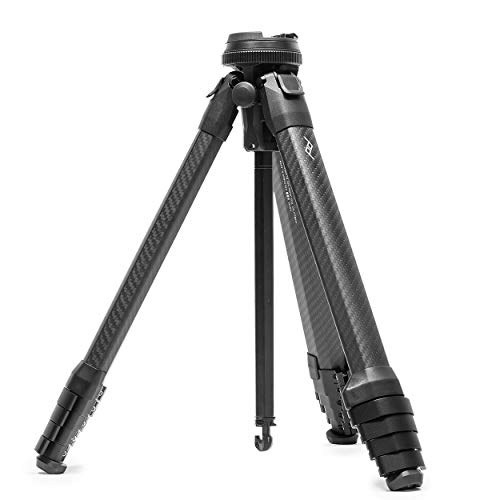
Peak Design rebuilt the travel tripod around packing size: the carbon fiber Travel Tripod folds down to just 15.5 inches long with a diameter closer to a water bottle than a traditional tripod, because the legs nest tightly against the center column with no protruding knobs. It weighs 2.81 lb yet is rated for a 20 lb load, which handles most mirrorless and DSLR setups with standard telephoto lenses. Height runs from about 5.5 inches in low mode up to 60 inches with the column raised. Instead of separate friction and pan controls, the integrated ball head uses a single adjustment ring for tension and locking, plus a quick-release clamp that accepts Arca-type plates and Peak Design’s own plates, and there is a mobile phone mount stowed in the center column. The cam-style leg locks deploy fast with gloves on. Choose this one if folded length and setup speed matter more to you than the fine, separate friction control of a conventional premium head.


3. Manfrotto Befree GT XPRO Carbon MKBFRC4GTXP-BH — Best for macro and overhead work
The Befree GT XPRO Carbon was designed for macro and overhead shooting: its center column swings to a full 90 degrees using a mechanism built into the top casting, so the camera can point straight down at a subject or flat lay without swapping heads. The four-section carbon legs use Manfrotto’s M-Lock twist locks, which unlock with a short 90-degree turn, and the kit reaches 162 cm while folding to 43 cm at 1.76 kg. The fitted 496 Center Ball Head is a step up from basic travel heads, with three independent controls — a main sphere lock, an integrated friction knob and a separate panoramic lock — so tension and panning can be set independently, exactly the control layout this guide recommends. Safety payload is 10 kg, and the supplied 200PL-PRO plate works with both Manfrotto RC2 and Arca-type clamps, which eases mixing this kit with other supports. Pick it if close-up, product or overhead work is a regular part of your shooting.

4. Vanguard VEO 3+ 263CB — Best for versatility
The VEO 3+ 263CB is built around Vanguard’s Multi-Angle Central Column, which can be moved to almost any angle and used horizontally for overhead or macro framing, or fitted with the included VEO+ MA1 adaptor as a multi-mount for a light or microphone. The three-section carbon fiber legs have a 26mm top diameter, extend to about 68 inches and fold to 29.9 inches, and one leg unscrews to convert the kit into a monopod. Vanguard rates the load capacity at 33 lb (15 kg). On top sits the VEO BH-160 ball head, an Arca-compatible head supplied with the QS-60 V2 quick release plate, and the legs set quickly at three angles (23, 50 and 80 degrees) with a push-button system. At about 4.7 lb it is a full-size rather than ultralight kit, but for studio, landscape and mixed photo-video work where one support must do everything, it covers more situations than the travel-focused picks above.
View Vanguard VEO 3+ 263CB on Amazon

5. Sirui AM-324 with AM-40 Low Gravity Ball Head — Best columnless design
The AM-324 kit takes the opposite approach to a travel tripod: there is no center column at all, which removes the main source of flex and lets the four-section carbon fiber legs (32mm maximum tube diameter) drop the camera to a minimum height of about 80mm for ground-level work. With the AM-40 head fitted, the kit reaches about 1534mm and retracts to 520mm, and Sirui rates the load capacity at 18 kg. The AM-40 is a low gravity ball head, meaning the 40mm ball sits lower in the body for a more stable center of gravity, with 360-degree panning and an Arca-type clamp. The legs weigh 1.4 kg and the head 0.5 kg, so the 1.9 kg kit is easy to carry despite the heavy-duty rating, and twist locks keep the profile clean for landscape use. Choose it if you mostly shoot landscapes or nature from low angles and value outright stability over the extra height a center column gives.

View Sirui AM-324 with AM-40 Low Gravity Ball Head on Amazon
What to Look For
| Factor | Why it matters | What to check |
|---|---|---|
| Leg material | Carbon fiber is lighter, while aluminum is often sturdier for the weight. | Compare the material, tube count and total weight. |
| Load capacity | A tripod should carry more than your heaviest setup. | Compare the maker figure with your camera and lens combined. |
| Ball head controls | Separate friction and lock knobs allow gentle adjustments. | Look for a tension control and a panning base. |
| Maximum and minimum height | Height decides comfort and low-angle options. | Check extended height and whether legs spread wide. |
| Folded length | Shorter folded legs fit better in bags and carry-on cases. | Read the folded length and check reversible leg designs. |
| Leg locks | Twist or lever locks differ in speed and upkeep. | Think about which style you find easier with gloves. |
| Plate system | A common quick-release plate speeds up setup. | Check plate type and whether a spare is included. |
Setup and Care Tips
- Extend the thicker upper leg sections first and use the thin lower sections only when you need the height.
- Level the legs before you adjust the head, then make small corrections on the ball.
- Tighten the plate screw and check it from time to time, since vibration can loosen it.
- Rinse off sand or salt residue after beach use and let the legs dry before storage.
- Clean and lightly maintain the locks as the maker suggests.
Mistakes to Avoid
- Choosing a head whose capacity sits close to the weight of your gear, which leaves no margin.
- Buying the lightest legs without thinking about stability in wind.
- Skipping the plate system check, which can leave you with mismatched parts.
- Raising the center column fully when the legs alone would be steadier.
- Ignoring folded length and finding the tripod will not fit your bag.
What makes a premium tripod ball head different from a basic one?
A premium ball head differs mainly in how precisely it lets you control movement and how reliably it holds a locked position under load. The sphere, the socket and the locking surfaces are machined more closely, so the camera does not creep or drop a fraction of a degree when you tighten the knob.
The feature to look for is independent friction control. It sets how much drag the ball has while the main lock is loose, so a heavy lens stays where you leave it instead of flopping forward. Basic heads often have only a single lock, which forces you to choose between fully free and fully locked.
A separate panning lock is the second feature. It lets you level the head once, then rotate the camera for panoramas or follow a subject without disturbing the horizon.
Other details are worth a look:
- Ball size: a larger ball gives a bigger contact area, which usually means smoother movement and firmer holding for the same type of design.
- Knob shape: large, textured knobs are easier to turn with cold or gloved hands.
- Clamp type: an Arca-type clamp is the most widely supported, so check that your plates match it.
- Bubble level: a built-in level saves time on landscape and architecture shots.
The picks above show the range: one hides friction control inside the main knob, another uses a three-control layout, and one uses a single ring for tension and locking. None is automatically better, so decide whether you want fine separate controls or a simpler, faster head.
How much load capacity do you need from a premium tripod?
You need a rated capacity comfortably above your heaviest camera, lens and accessories combined, because a rating describes a safe limit and not an ideal working weight. Treat the maker’s figure as a ceiling and keep your normal setup well under it.
Add up everything that sits on the head: the body, the longest lens you own, a flash or microphone, a plate and any rail or cage. If you use a long lens with a tripod collar, mount the collar rather than the camera body so the weight is balanced over the head.
Capacity also depends on how the load is arranged. A heavy lens extended far forward puts more leverage on the ball than the same weight held close to the center, so a head can struggle with a front-heavy setup even when the number looks sufficient.
Use this rough guide for margin:
- Light mirrorless setups: almost any premium kit has headroom, so choose on size and weight.
- Full-frame with mid-range telephoto: pick a kit whose rating clearly exceeds the total, and favor a larger ball.
- Long telephoto lenses: look at the head rating separately from the leg rating, since the head is often the limit.
Also note that the legs and the head carry separate ratings on some kits. The lower of the two is the number that matters, so read the listing for both before you compare.
Which premium tripod should you buy?
The right pick depends on how you shoot, because each kit in this guide solves a different problem. Use the list below to match your main need to a named product, then confirm the details on its listing.
- If you want premium travel support with a precise, friction-controlled head, go for the Gitzo Traveler Series 2 Carbon Tripod Kit GK2545T-82QD.
- If folded size and quick setup matter most, choose the Peak Design Travel Tripod Carbon Fiber TT-CB-5-150-CF-1.
- If you shoot macro, products or overhead flat lays, the Manfrotto Befree GT XPRO Carbon MKBFRC4GTXP-BH suits you, thanks to its 90-degree column and three separate head controls.
- If one support must cover photo, video, studio and walking around, pick the Vanguard VEO 3+ 263CB, which can also become a monopod.
- If you shoot low-angle landscapes and want maximum rigidity, choose the Sirui AM-324 with AM-40 Low Gravity Ball Head, which has no center column.
If you cannot decide between two, ask which compromise you can live with. A compact tripod you always carry beats a stronger one left at home. A columnless tripod is very steady but limits eye-level height unless the legs are fully extended. A versatile full-size kit is heavier on long walks.
Work from your most frequent shooting situation, not your rarest one, and the choice usually becomes clear.
What to check before you buy a tripod and ball head
Before you order, confirm that the kit fits your gear, your height and your bag. Most returns come from a mismatch that was visible on the listing.
- Working height: check the maximum height without raising the center column, then compare it with your eye level so you are not hunching over the viewfinder.
- Folded length: measure your bag or carry-on and compare it with the stated folded size.
- Plate compatibility: confirm that the supplied plate and clamp match the plates on your other gear, and whether a spare plate is included.
- What is included: some listings sell legs and head together, others sell them separately, so make sure you are ordering the complete kit.
- Leg lock style: decide between twist and lever locks based on how you work in cold, sand or rain.
- Weight on your back: read the total kit weight, not only the legs.
- Warranty and returns: read the terms on the listing, including who handles repairs and how long the coverage lasts.
- Care needs: check what the maker says about cleaning locks and rinsing after salt or sand.
Finally, confirm that the product on the page is the exact model name you intend to buy. Several tripod families share similar names, and the kit with a ball head can differ from the legs-only version.
Is a premium tripod worth paying more for?
A premium tripod is worth it if you use it often, carry heavy gear or care about repeatable sharp results, and it is harder to justify for occasional casual use. The gains are real but they are gains in stability, handling and durability, not in image quality by themselves.
Here is an honest look at the trade-offs:
- Upside: smoother head movement, firmer locking, lighter carbon legs and parts that can usually be serviced or replaced.
- Downside: higher cost, and some compact designs give up height or fine control to save space.
- Carbon fiber: reduces weight and tends to damp vibration, but a lighter tripod can need a hook weight in wind.
Who should skip it: if you shoot a light camera a few times a year, mostly in good light and from a table or wall, a simpler tripod may do the job. If you mostly shoot handheld at fast shutter speeds, you may not need one at all.
A tripod that is too tall, too heavy or too fiddly ends up unused, so judge it by whether you will actually carry it.
Your next step is simple. Compare the picks above, check the current listing for height, folded size and what is included, then choose the one that fits how you will use it.
Going Deeper: Tripods and Heads as a Working System
A tripod is not an accessory; it is half of the camera for any exposure longer than your hands can hold, and it deserves to be judged as a system: legs, head, quick-release, and the habits of the person carrying it. Premium tripods and ball heads earn their price in the field through stiffness you can feel, controls that work with cold hands, and a setup routine fast enough that you actually use the support instead of leaving it in the car. This section covers that working layer.
Stiffness is the specification nobody can print honestly. It depends on leg diameter, joint design, how many sections you extend, whether the centre column is raised, and the ground under the feet. The practical test is simple: mount your heaviest combination, extend the legs as you would for a real shot, tap the camera, and watch through a magnified live view how long the image takes to settle. A support that settles quickly in a breeze is worth more than a taller, heavier one that trembles, because height you cannot use in wind is not height at all.
Ball heads, plates and the details that decide daily use
A ball head lives or dies by its friction control. The ball should let you set a drag level where the camera stays where you leave it, yet moves with a deliberate push, so you are not fighting the lock knob for every small adjustment. Test this with your heaviest lens mounted, pointed slightly down, which is where weak heads creep. Creep that appears in the first week will not improve with age, and a head that cannot hold a long lens at an angle will quietly ruin long exposures and careful compositions.
Quick-release compatibility is a decision with a long tail. Plates, clamps and L-brackets form a small ecosystem across your cameras and lenses, and mixing incompatible systems leads to adapters stacked on adapters. If a pick in this guide uses a widely adopted plate standard, that is a genuine practical advantage, because spare plates, brackets and clamps stay available for years. Whatever you choose, standardise on it across your kit and keep one spare plate in the bag; a forgotten plate turns a tripod into dead weight.
Leg locks and feet deserve a cold-morning test. Twist locks and lever locks both work well when clean; they differ in how they behave with gloves, sand and ice. Feet matter as much: rubber for rock and interiors, spikes for soft ground where local rules allow them. Premium supports treat feet as replaceable wear parts, which they are. Check how the feet attach on any model you consider, because losing a foot in the field is a common and entirely preventable annoyance.
Height, weight and the carry equation
Buy height for your eye level, not for the specification sheet. A tripod that reaches your eye without the centre column raised is stable height; everything above that, achieved by extending a thin column, is borrowed height that costs stiffness. If you are tall, that requirement alone will narrow this guide to a few honest candidates, and that is fine. A slightly heavier tripod you can use at full stiffness beats a travel model you must over-extend for every shot.
Weight, meanwhile, must be judged against your real walks. The finest support ever made produces no photographs from a cupboard. Add the head, the plate and the bag to the leg weight, then compare the total with what you already carry without complaint. Photographers who hike far often accept one fewer leg section or a slightly shorter maximum height in exchange for a kit they take everywhere; studio and car-based photographers should take the stiffness and never apologise for the weight.
Use Cases, Worked Through Honestly
Landscape work at dawn and dusk is the classic tripod case: low light, filters, and compositions that reward patience. Here the support’s job is to disappear, holding the camera exactly where you put it through long exposures and bracketed sequences. Prioritise stiffness in wind, leg angles that let you work low for foreground interest, and a head whose controls you can operate by touch in the dark. A levelling base or a head that levels quickly saves surprising amounts of time on sloping ground.
For macro photography, the tripod becomes a precision instrument. You need legs that splay wide and low without a centre column in the way, a head that moves in small, controlled increments without sagging when locked, and the patience to let vibrations settle between touching the camera and exposing. Many macro photographers focus by moving the camera on a rail rather than refocusing the lens, so check that your chosen head and plate arrangement leaves room for that workflow if it appeals to you.
Studio and product work asks for repeatability above all. Marks on the floor, a head that returns to the same position, and a support that does not drift during a long tethered session matter more than packed length. Heavier studio supports earn their place here, and the premium features to value are smooth geared or three-way movement and locks that hold a heavy camera and lens at awkward angles all day without complaint.
Travel photography is the negotiation between all of the above and an airline baggage allowance. A travel tripod that you take on every trip and use at eighty percent of its height will outperform, in real photographs, a full-size support left at home. Be honest about the compromise: extend fewer sections where you can, weight the hook with your bag in wind where the design allows, and keep exposures sensible. Technique closes much of the gap that specifications open.
Setup, Handling and Care in Daily Use
Build a setup routine and always run it in the same order: legs to height and angle, feet planted and checked, head levelled, camera mounted and plate clamp verified with a tug, then composition. The tug test matters; most dropped cameras trace back to a plate that looked seated and was not. When you break down, reverse the routine. A fixed sequence feels slow for the first week and then becomes faster than improvisation ever was, because no step has to be remembered under pressure.
Extend leg sections from the top down, using the thinnest lowest section only as much as you need, and avoid raising the centre column until the legs are fully extended. On uneven ground, adjust leg length and angle rather than tilting the head to compensate, so the head starts level and its movements stay predictable. Step back and look at the footprint before mounting the camera: a tripod whose legs form a wide, settled triangle on the actual ground, not the ground you imagined, is a tripod that will not surprise you.
Care is mostly about grit and salt. After beach or desert work, extend each section, wipe the legs clean, and let everything dry before collapsing them, because grit trapped inside a lock grinds a little more away with every use. Rinse salt spray promptly with fresh water where the maker allows it. Periodically check that leg locks still grip firmly and that the head’s ball and pan movements stay smooth; a small amount of correct maintenance, described in the maker’s guidance, keeps a premium support feeling new for years.
Troubleshooting: Vibration, Creep and Slipping Legs
If long exposures are soft, eliminate causes in order of likelihood. First, the ground: a tripod on a wooden floor, a bridge or soft turf moves more than any leg material can fix, so reposition before blaming equipment. Second, your touch: use a timer or remote release and let the setup settle. Third, the camera’s own shutter or stabilisation behaviour on a support, which your camera manual addresses. Only after those should you suspect the tripod, and the tap test described earlier will show you its settling behaviour honestly.
A head that creeps under load usually needs its friction set correctly for the weight mounted, not more lock force. Set the drag so the camera holds position with the main lock slightly released, then lock fully for the exposure. If creep persists with a front-heavy lens, support the lens by its foot rather than the camera body, which moves the balance point over the head where it belongs. Persistent slipping after correct setup, on a clean ball and clamp, is a service issue rather than a technique issue.
A leg section that slides under load has usually collected grit in the lock or lost a small internal shim during cleaning. Extend the section fully, clean the joint carefully, and reassemble exactly as it came apart, because those thin shims are easy to lose on a workbench and essential to the lock’s grip. If a lock still slips after cleaning, stop loading it and contact the maker; a leg that collapses under a camera risks far more than a missed photograph.
How the Picks in This Guide Compare in Daily Use
Comparison tables arrange these picks by specification, but ownership arranges them by fit. The notes below revisit each pick already reviewed in this guide through the lens of daily use, so you can weigh them against each other and against your own routine. Nothing new is introduced here; this is the same shortlist, considered from the direction of the person who has to live with the decision.
Gitzo Traveler Series 2 Carbon Tripod Kit GK2545T-82QD
In this guide the Gitzo Traveler Series 2 Carbon Tripod Kit GK2545T-82QD is presented as best for premium travel support. That positioning is the right starting point for judging it against the other picks here, because it names the job the product was chosen to do. Live with that job description for a moment and test it against your own week: if the work described is the work you do most often, the pick deserves your closest attention; if it describes an occasional need, one of the broader picks in this guide may serve you better even if it looks less specialised on paper. Strength in the right place beats strength in the abstract, every time.
Peak Design Travel Tripod Carbon Fiber TT-CB-5-150-CF-1
The Peak Design Travel Tripod Carbon Fiber TT-CB-5-150-CF-1 appears in this guide as best for compact travel. The useful comparison is not whether it beats the neighbouring picks overall, but where its strengths sit relative to theirs. Every pick in this list trades something away: size against capability, simplicity against control, specialisation against flexibility. With this one, be clear about what you are gaining and what you are consciously giving up, and check that the exchange matches your priorities rather than a reviewer’s. A trade you choose deliberately rarely disappoints; a trade you discover later often does.
Manfrotto Befree GT XPRO Carbon MKBFRC4GTXP-BH
Consider the Manfrotto Befree GT XPRO Carbon MKBFRC4GTXP-BH, described above as best for macro and overhead work, as the specialist answer to a particular question. Specialists earn their place when that question comes up constantly in your work. If it does, the focused design will feel like it was made for you, and the narrower fit elsewhere will barely matter. If the question is rare in your practice, the same focus becomes a limitation you carry daily. The honest self-knowledge this guide keeps asking for, about your real subjects, your real rooms and your real routine, is what turns this pick from interesting to obviously right or obviously wrong for you.
Vanguard VEO 3+ 263CB
What the Vanguard VEO 3+ 263CB offers, as best for versatility, is a clear point of view about what matters most. Compare that point of view with the picks either side of it in this guide and you will usually find the list is really a map of priorities rather than a league table. There is no shame in choosing the pick whose priorities match your budget of money, weight and attention, and there is real cost in choosing one whose priorities you admire but do not share. Let your calendar and your past year of work arbitrate between them.
Sirui AM-324 with AM-40 Low Gravity Ball Head
The Sirui AM-324 with AM-40 Low Gravity Ball Head is included as best columnless design, and it rewards a particular kind of buyer: the one who knows their use case well enough to value focus over breadth. If you are still exploring what your work needs, a more general pick in this guide will teach you what you value with fewer regrets along the way, and specialists like this one will still be there when your needs have sharpened. If you already know, because your current equipment fails you in exactly the way this pick addresses, then the decision is simpler than the comparison tables suggest.
Before You Decide: A Final Checklist
Before committing to any tripod and head in this guide, run through a short, honest audit. First, name the job: the subjects, rooms and conditions that make up most of your work, written down rather than vaguely felt. Second, name the constraint that actually binds you, whether that is weight, space, an existing system you are invested in, or the people who will share the equipment. Third, check the pick you favour against the two names above it and below it in this guide, and be able to say in one sentence why it wins for your job specifically. If you cannot write that sentence yet, the research is not finished.
Then verify the unglamorous details while they are still free to change: compatibility with what you already own, the accessories the purchase quietly requires, return terms if you are buying unseen, and how the item will be carried, stored and maintained in your real routine. Most buyer’s remorse in this category comes from one of those details, not from the headline qualities that reviews argue about. Finally, decide what good looks like after a month of ownership: the habit you expect to have formed, the problem you expect to have solved. A tripod and head chosen against a clear picture of success is a purchase you can evaluate honestly later, and adjust from experience rather than from disappointment.
Practical Notes From the Field
Mark your most-used leg height with a small piece of tape or a paint pen on the appropriate section. Portrait-height for people work, low for landscapes, whatever your equivalents are: the mark turns setup from measurement into recognition, and across a year of shoots it returns hours. It also makes a second pair of hands instantly competent, because your assistant can set your height without a conversation.
Practise setup and breakdown at home until the sequence is silent and smooth. Tripod work in the field often happens in the dark, in the cold, or while a subject waits, and fluency is kindness to everyone present. Time yourself once, kindly, and then forget speed; the goal is not haste but the absence of fumbling, dropped parts and doubt about whether the plate is truly locked.
More Questions, Answered
How tall should my tripod be?
With the legs fully extended and the centre column down, the viewfinder should reach your eye level or just below when the head is fitted. Remember to count the head’s height in that total. If you regularly shoot on slopes or over crowds and fences, a little extra height helps, but buy it in the legs rather than planning to live on a raised centre column.
Is carbon fibre worth it over aluminium?
Carbon fibre saves weight and damps vibration well, and it is kinder to bare hands in cold weather. Aluminium is tougher against knocks and usually costs less for similar stiffness. Choose carbon when you carry the tripod far or work in the cold; choose aluminium when the tripod lives in a studio, a vehicle or a checked equipment case and takes hard knocks.
Do I need a separate head, or is an included head enough?
An included head can be entirely adequate, especially in matched kits from serious makers. Separate heads earn their place when you need a specific movement style, a higher load capacity, or compatibility with plates you already own. Judge any head by friction control and holding power with your heaviest lens, not by its appearance in the kit photograph.
Why do my tripod shots blur even with a remote release?
Look beyond the release: wind on the camera strap, a raised centre column, the thinnest leg sections fully extended, soft ground, and image stabilisation behaving oddly on a support are all common causes. Remove the strap or hold it still, lower the column, weight the setup where appropriate, and test again. Blur that survives all of that deserves a careful look at shutter behaviour and technique.
How do I stop my ball head from flopping when I loosen it?
Set the friction or drag control so the ball is never completely free with a camera mounted. The correct setting lets you move the camera with a firm push while it stays put when released. Practise with your heaviest combination over a soft surface until the setting is familiar, and always keep one hand on the camera while any lock is loose.
Can I take a full-size tripod as airline cabin baggage?
Often not, and policies vary by airline and route; many carriers treat tripods as items for the hold. Check the current rules for your airline before travelling, pack the support in a padded case within your checked luggage, and consider removing the head to protect both. Frequent flyers who need support at the destination often choose a travel model sized for a suitcase instead.
FAQ
Is carbon fiber worth it for a tripod?
Carbon fiber reduces weight and tends to dampen vibration, which many travelers and hikers value. Aluminum is often heavier but can be a sensible fit if you mostly work near the car or in a studio.
Why choose a ball head over a three-way head?
A ball head lets you move the camera freely with one control, which is quick for varied scenes. A three-way head adjusts each axis separately and suits careful architectural work.
How much weight should a tripod hold for a mirrorless camera?
Choose a tripod and head whose rated capacity is comfortably above the total of your camera, heaviest lens and accessories. Leaving a generous margin keeps the head from drifting and makes locks last longer. Check both the leg rating and the head rating on the listing.
What is the difference between a ball head and a pan-tilt head?
A ball head moves freely in all directions with one lock, while a pan-tilt head adjusts each axis with its own handle. Ball heads are faster for varied scenes. Pan-tilt heads suit careful, level work such as architecture.
Do I need a separate panning lock on a ball head?
A separate panning lock is useful if you shoot panoramas or follow moving subjects. It lets you level the head once and then rotate without changing the tilt. If you rarely pan, a simpler head can still work well.
Why does my ball head droop when I let go?
Droop usually means the friction setting is too low for the weight on the head. Increase the friction control a little, check that the plate is tight and make sure the load is balanced over the ball. If it still sags, the head may be near its rated limit.
Should I raise the center column on my tripod?
Avoid raising it if you can, because a raised column makes the support less rigid. Extend the legs first and use the column only for small final adjustments. A columnless or low-column design avoids this problem altogether.
Is a tripod with a built-in ball head better than buying them separately?
A matched kit is simpler and often lighter to plan around, since the maker has paired the parts. Buying separately lets you choose a larger head or a different clamp. Either way, confirm the plate system and mounting thread before ordering.
How do I stop a tripod from shaking in wind?
Lower the center of gravity by keeping the legs short, spread them wider and avoid the thin bottom sections. Hanging your bag from the hook under the column adds stability. Using a remote release or timer also reduces vibration from your hands.
Questions to Ask Before You Buy
- What is the heaviest lens and body combination I plan to carry?
- How tall must the tripod stand without raising the center column?
- Does the folded length fit my bag or my carry-on needs?
- Does the head offer a separate pan lock and a friction control?
- Which plate standard do my other accessories use?
- Will I work in cold, wet or sandy places that call for easy-to-clean leg locks?
Feature Trade-offs
Every gain in a tripod tends to trade against something else. Taller, sturdier legs weigh more. Compact folding designs usually add a joint or two. Larger heads hold heavier loads but take more space in the bag.
| Choice | Gain | Give Up |
|---|---|---|
| Twist locks | Quick, sealed feel | Slower to unlock all at once |
| Lever locks | Fast visual check | Can catch on straps |
| Reversible legs | Short folded length | Extra parts to manage |
| Larger ball | Smoother movement | Extra bulk |
Matching It to Your Use
Landscape shooters value solid legs and a head that holds still during long exposures. Wildlife photographers often want a head that moves quickly yet locks firmly. Travelers should weigh the folded size heavily, since a tripod left in the hotel does no good.
Studio and macro workers may care most about fine adjustments and a low-angle option. If you shoot a mix, pick the use that matters most and accept small compromises elsewhere.
Longevity Notes
Look for replaceable feet and available spare parts, since a well-built tripod can serve for many years. Wipe leg sections after trips near salt or sand, and keep the head clean so the ball moves smoothly. A tripod that is easy to maintain tends to stay a pleasure to use.
Checking the Details in Person
If you can visit a camera shop, extend each leg section, twist every lock and tilt the head with a heavy lens attached. Notice whether anything creaks or slips, and whether the knobs are large enough to grip with gloves. Pay attention to the foot design and the hook beneath the column, because small touches like these show how carefully a tripod was made. Ask whether a service program exists for the lock mechanisms, so that a worn part never forces a full replacement.
The Short Version
Match load capacity to your heaviest setup, pick a leg material that fits how far you walk, and look for a head with smooth friction control. A stable, comfortable tripod is one you will actually carry.
Related Guides
- 6 Best Tripod Ball Heads (October 2026)
- Ball Head vs Pan-Tilt Head: Which Tripod Head Suits You?
- 8 Best Rain and Handheld Shower Heads (2026)
- 6 Best Shower Filters and Filtered Heads (2026)
- 6 Best Geared Tripod Heads for Architecture Photography (2026)