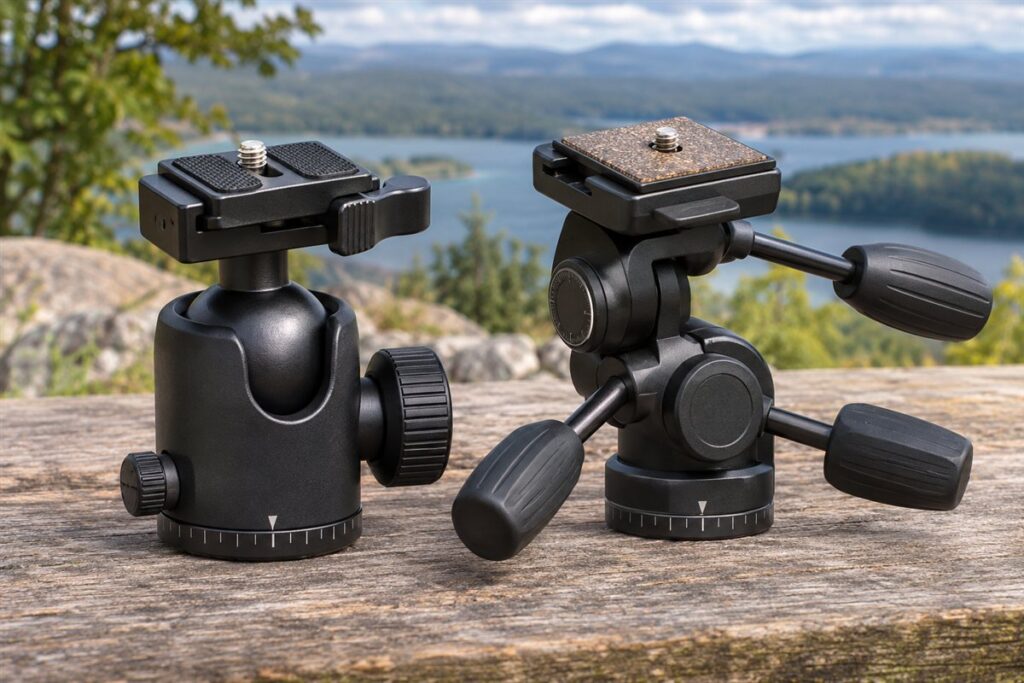
A ball head offers quick, free movement with a single lock, while a pan-tilt head lets you adjust each axis on its own. Neither is better in every case. Your subjects and your patience for fine tuning should decide, along with how much weight and bulk you are willing to carry.
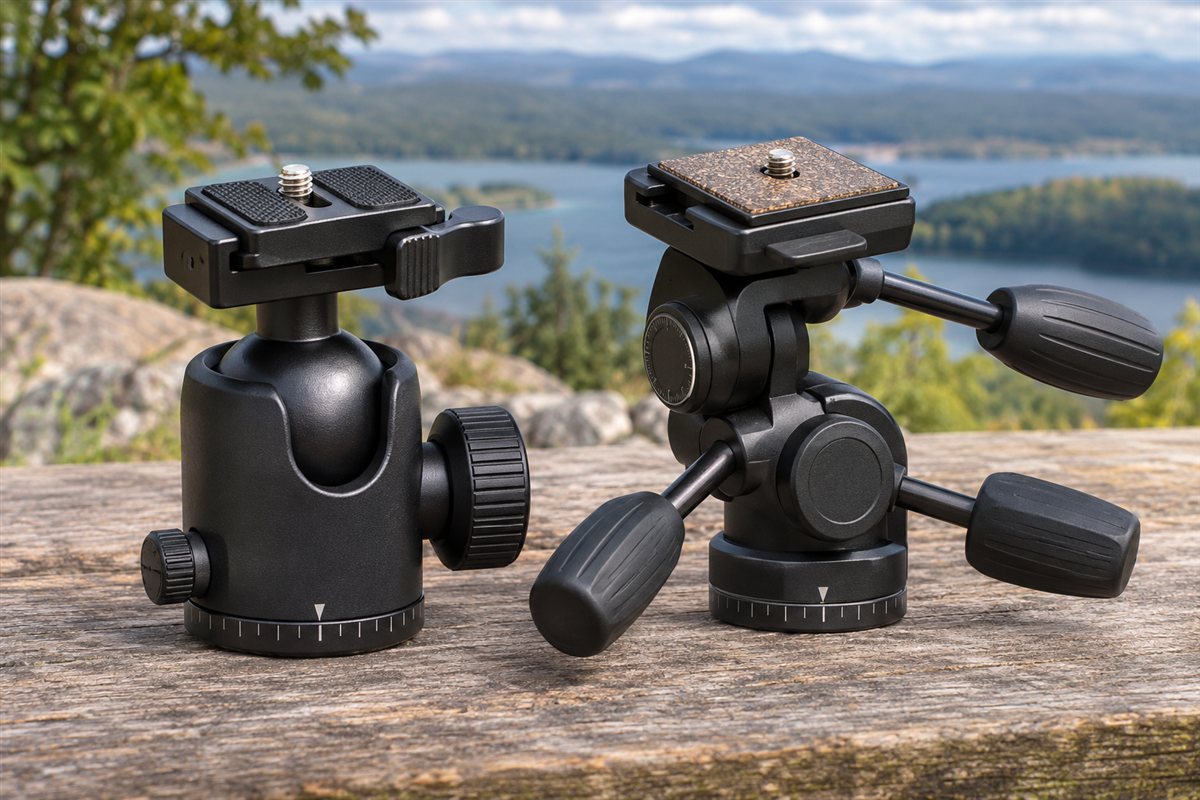
How Each Head Works
A ball head holds the camera on a ball set in a socket. Loosen the lock and the camera can swing in nearly any direction; tighten it and everything is fixed. Some include a separate tension control and a panning base.
A pan-tilt head, sometimes called a three-way head, has separate handles for panning side to side, tilting forward and back, and tilting sideways. Each handle locks its own axis.
Key Differences
| Aspect | Ball head | Pan-tilt head |
|---|---|---|
| Speed | Very quick to reposition | Slower, one axis at a time |
| Precision | Can shift slightly when locked | Very controlled adjustments |
| Size | Compact and light | Bulkier, with handles |
| Learning curve | Simple to understand | More controls to learn |
| Video panning | Limited smoothness | Better for steady pans |
Where Each Fits
- Ball heads suit travel, wildlife, street and general use where quick changes matter.
- Pan-tilt heads suit architecture, product photography, panoramas and careful landscape work.
- Video shooters often prefer a fluid head, which is a related design.
Things to Check Either Way
- Look at the stated load capacity in the maker’s guide and choose well above your heaviest setup.
- Check the quick-release plate system and whether it fits your camera and lens.
- Confirm that the mounting thread matches your tripod.
- Try the locks, and see that the camera does not droop when you tighten them.
A practical way to decide is to think about the last ten pictures you took on a tripod. Were you reframing constantly, or setting up one careful composition and waiting for the light? Constant reframing favours a ball head. Careful, level compositions favour a pan-tilt head, because you can correct one axis without upsetting the others. If you are unsure, a small ball head with a panning base and a built-in level covers many situations and keeps your bag light.
Walkthrough: Setting Up and Levelling a Head
These steps work for both designs, with small differences noted along the way.
- Extend the tripod legs to a height that lets you look through the viewfinder without bending. Extend the thick upper sections first and the thin lower ones last, because thicker sections are steadier.
- Check that the centre column is down or only slightly raised. A raised column adds wobble.
- Level the tripod base using the legs and the bubble level if there is one, so the top plate is roughly flat.
- Attach the quick-release plate to the camera or lens collar, tighten it by hand or with a coin or key, and make sure it cannot twist.
- Slide the plate into the head clamp, close the clamp, and give the camera a gentle push to confirm that it is held firmly.
- On a ball head, hold the camera with one hand, loosen the lock, frame the shot, then tighten while you keep a hand on the camera. On a pan-tilt head, release and adjust one handle at a time and lock each as you finish.
- For a level horizon, turn the panning base so the camera swings along a flat line, then check the electronic level or horizon line in the viewfinder.
- Hang a bag from the centre hook if the legs are spread on soft or windy ground, which adds stability.
Common Scenarios
A bird perched on a branch
The subject moves and shifts position quickly. A ball head with adjustable tension lets you follow the animal with a loose hold and then lock when it settles.
A building facade with converging lines
You need a precise tilt without any sideways drift. A pan-tilt head lets you set the forward tilt to level the camera, then pan with the sideways axes unchanged.
A multi-frame panorama
The camera must pan along a perfectly level line. A head with a marked panning base, whether a ball head with a base or a pan-tilt head, keeps each frame aligned with the last.
A tabletop product setup
Small, repeatable adjustments matter. The separate axes of a pan-tilt head make it easy to nudge the angle without losing framing.
Mistakes to Avoid
- Choosing a head near its stated load limit. Lenses and flashes add weight, and a small margin leads to creeping.
- Letting go of the camera before locking. Even a firm lock may need a second to hold, so keep a hand on the body.
- Over-tightening the clamp with tools. Excess force can damage plates and threads.
- Using a long lens on a plate attached to the camera body instead of the lens collar. The weight hangs forward and strains the mount.
- Skipping the level. A tilted horizon is hard to correct later without cropping.
Quick Troubleshooting
| Symptom | Likely cause | What to try |
|---|---|---|
| Camera droops after locking | Load too heavy or lock worn | Raise the tension, rebalance the lens, or choose a head with a higher capacity |
| Camera twists on the plate | Plate loose or no anti-twist feature | Re-tighten and use a plate with a lip or second screw |
| Image shakes after pressing the shutter | Vibration from wind or hand | Use the self-timer or a remote release, and lower the centre column |
| Head feels gritty when moving | Dirt in the ball or threads | Wipe clean with a dry cloth and follow the maker’s cleaning advice |
Care and Upkeep Over Time
Whichever you choose, tighten the camera plate firmly and keep the lock clean. Dirt on a ball or on the handle threads can make a head feel gritty and let the camera drift under load, so wipe it down after trips to sandy or wet places. Let everything dry before putting the tripod away, and store the legs extended slightly to let air circulate if the maker allows it. Check screws and knobs from time to time, because vibration during travel can loosen them.
Glossary
- Load capacity: the maximum weight the head is designed to hold.
- Quick-release plate: the small plate that attaches to the camera and slides into the head.
- Panning base: a rotating section that turns the camera horizontally.
- Tension control: a setting that sets how much resistance the ball has when loose.
- Fluid head: a head with damped movement, used for smooth video.
- Tripod collar: a ring on a long lens that lets you mount the lens, not the camera body, on the tripod.
FAQ
Which is best for a heavy telephoto lens?
Many people use a sturdy ball head or a gimbal head designed for long lenses. Always check the load capacity and mount the lens by its tripod collar.
Can I swap heads later?
Often yes, if the tripod has a standard mounting thread. Check the maker’s guide for compatibility.
Is a pan-tilt head better for landscapes?
It can be, since each axis can be fine-tuned and locked. A good ball head with a panning base and level also works well, so it comes down to preference.
Do I need a head with a built-in level?
It is not required, but a level saves time and helps you get straight horizons. If your camera has an electronic level, you can rely on that instead.
What does a friction or tension knob do?
It adjusts how freely the ball moves when loose. Setting it so the camera stays in place but can still be moved by hand makes fine framing much easier.
The Short Version
Choose a ball head if you value speed and a compact set-up. Choose a pan-tilt head if you need exact, repeatable adjustments for levelled shots, panoramas or architecture. Keep the load well under the limit and the connections clean.