Disclosure: As an Amazon Associate, reviewstook.com earns from qualifying purchases. Links to Amazon on this page are affiliate links; they cost you nothing extra.
A combo gives you a keyboard and mouse for one price. The trade-off is that both parts are usually entry-level, so it suits budget PC gaming and everyday use.
This guide covers six combos sold on Amazon. It is built from product listings, not our own testing, so confirm layout and compatibility on each product page.
New to gaming mice? Read our gaming mouse buying guide.
By the Reviewstook Editorial Team. Last updated: October 31, 2026.

In this guide
Quick Picks
| Product | Type | Best for |
|---|---|---|
| Redragon S101-3 PRO Keyboard and Mouse | Wired gaming combo | A budget wired RGB combo |
| Redragon S101M-KS Wireless Combo | Wireless gaming combo | A tri-mode wireless combo |
| Redragon S107 Keyboard and Mouse | Wired gaming combo | 25-key anti-ghosting and 10,000 DPI |
| RedThunder K10 Combo with Wrist Rest | Wired gaming combo | A full-size keyboard with wrist rest |
| AULA Gaming Keyboard and Mouse | Wired metal-panel combo | A metal-panel combo with a phone holder |
| BlueFinger RGB Keyboard and Mouse | Budget wired combo | A very low-cost RGB combo |
6 Best Gaming Keyboard and Mouse Combos for PC

Top pickBest for budget PC gamers
1. Redragon S101-3 PRO Keyboard and Mouse
A wired RGB gaming keyboard and mouse combo with programmable keys and software, per the listing.
Good for: Budget PC gamers. Strengths: One low-cost bundle for both. Weaknesses: A combo trades quality for price. Skip it if you want a mechanical keyboard.

Best for desks without cables
2. Redragon S101M-KS Wireless Combo
A wireless tri-mode RGB gaming keyboard and mouse combo with a 4,800 DPI mouse, per the listing.
Good for: Desks without cables. Strengths: Tri-mode wireless and RGB. Weaknesses: A basic mouse sensor. Skip it if you want competitive-level gear.

Best for budget PC gamers
3. Redragon S107 Keyboard and Mouse
A wired RGB gaming combo with 25-key anti-ghosting and a 10,000 DPI mouse, per the listing.
Good for: Budget PC gamers. Strengths: Anti-ghosting and a wide DPI range. Weaknesses: Combo-grade build. Skip it if you want a high-end keyboard.


Best for users who want a wrist rest in the bundle
4. RedThunder K10 Combo with Wrist Rest
A wired RGB combo with a 104-key mechanical-feel keyboard, a wrist rest and a 7,200 DPI mouse, per the listing.
Good for: Users who want a wrist rest in the bundle. Strengths: Wrist rest and a full-size layout. Weaknesses: A combo-grade build. Skip it if you want a true mechanical keyboard.


Best for users who want a sturdier-looking combo
5. AULA Gaming Keyboard and Mouse
A wired 104-key keyboard with an aluminum-alloy panel and floating keycaps plus a gaming mouse, per the listing.
Good for: Users who want a sturdier-looking combo. Strengths: Metal panel and a phone and pen holder. Weaknesses: A combo-grade mouse. Skip it if you want a premium mouse.


Best for entry-level and work-and-play use
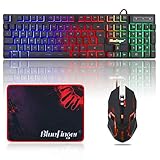
6. BlueFinger RGB Keyboard and Mouse
A USB wired 104-key RGB-backlit keyboard with a backlit mouse, per the listing.
Good for: Entry-level and work-and-play use. Strengths: Very low cost. Weaknesses: A basic build. Skip it if you want durability.
Best Picks by Category
These labels summarize the picks by category and are not hands-on test results.
- Top rated: Redragon S101-3 PRO Keyboard and Mouse — check price on Amazon.
- Most reviewed: Redragon S101-3 PRO Keyboard and Mouse
- Best value: BlueFinger RGB Keyboard and Mouse — a budget-tier pick; check price on Amazon.
- Lowest price: BlueFinger RGB Keyboard and Mouse — a budget-tier pick; check price on Amazon.
- Premium option: Redragon S101M-KS Wireless Combo — a mid-range wireless option; check price on Amazon.
Price, Rating and Review Comparison
The table compares the picks by price tier. Prices change often, so check price on Amazon.
| Product | Price | Rating | Ratings | Price tier |
|---|---|---|---|---|
| BlueFinger RGB Keyboard and Mouse | Check price on Amazon | — | — | Budget |
| AULA Gaming Keyboard and Mouse | Check price on Amazon | — | — | Mid-range |
| Redragon S107 Keyboard and Mouse | Check price on Amazon | — | — | Mid-range |
| Redragon S101-3 PRO Keyboard and Mouse | Check price on Amazon | — | — | Mid-range |
| RedThunder K10 Combo with Wrist Rest | Check price on Amazon | — | — | Mid-range |
| Redragon S101M-KS Wireless Combo | Check price on Amazon | — | — | Mid-range |
How Much Feedback Backs Each Rating
A high average from a handful of ratings is weaker evidence than a slightly lower average from thousands.
How to Choose
Wired or wireless
Wired combos are cheaper and have no latency worries. Wireless combos reduce cable clutter.
Keyboard type
Combos often use membrane or mechanical-feel keyboards. A true mechanical keyboard costs more.
Check the mouse
Many combo mice are basic. If you play competitively, buy a mouse separately.
How We Chose These Keyboards
We start from products that are sold on Amazon with a full product name and clear specifications, and we skip results that show only a brand name or a vague title. We then read the listing and the manufacturer information for each one and note the features that matter for this kind of keyboard: layout, switch type, connection and build. We do not run our own lab tests, and this guide does not contain hands-on measurements. Use it to build a shortlist, then check current prices, dimensions and return terms on the Amazon page.
Buying Guide: What to Check Before You Choose
Combos: convenience versus quality
A keyboard and mouse bundle is cheap and simple, but components are usually entry-level. If you play seriously, buying the mouse and keyboard separately gives more choice over shape and switches.
Pick the layout first
Full-size, TKL, 75%, 65% and 60% layouts differ mainly in which keys are left out. List the keys you use daily, then choose the smallest layout that keeps them.
Quick Reference: Which Pick Suits Whom
- Redragon S101-3 PRO Keyboard and Mouse: suits budget PC gamers
- Redragon S101M-KS Wireless Combo: suits desks without cables
- Redragon S107 Keyboard and Mouse: suits budget PC gamers
- RedThunder K10 Combo with Wrist Rest: suits users who want a wrist rest in the bundle
- AULA Gaming Keyboard and Mouse: suits users who want a sturdier-looking combo
- BlueFinger RGB Keyboard and Mouse: suits entry-level and work-and-play use
Common Mistakes to Avoid
- Choosing the smallest layout without checking which keys you use every day.
- Buying clicky switches for a shared room.
- Paying for wireless and then leaving the backlight on full.
- Ignoring the return window and the warranty.
- Assuming a higher price means a better fit for your hands and desk.
Setup and Care
- Install the maker’s software only if you need remapping or lighting changes.
- Check the language and layout setting in your operating system.
- Clean under the keycaps now and then and wipe with a slightly damp cloth.
- Keep the dongle on a nearby port if the board is wireless.
Decoding the Gaming Features on a Combo Box
Gaming combos are marketed with a long list of terms, and the same few show up on nearly every box. Knowing what each one means keeps you from paying attention to the wrong number.
Anti-ghosting and key rollover
When you press several keys at once, a cheap keyboard may fail to register some of them. Anti-ghosting reduces that problem, and the figure usually given is how many keys will register together, such as the 25-key anti-ghosting stated for the Redragon S107. For most games, being able to hold movement keys, a modifier and an ability key together is enough. Full rollover, where every key registers independently, matters mostly for fast typing and rhythm games.
DPI and sensitivity
DPI describes how far the cursor moves for each inch you move the mouse. A big top figure, such as 10,000 DPI, is mostly a headline. Most players settle between roughly 400 and 3,200 DPI and fine-tune with in-game sensitivity. What matters more is that the mouse tracks smoothly at the setting you actually use, and that the DPI steps are easy to switch with a button.
Polling rate
This is how often the mouse reports its position to the computer. Higher rates reduce tiny delays. Entry-level combo mice often run at a lower rate than dedicated gaming mice, which is rarely a problem for casual play and more noticeable in fast shooters.
Backlighting
RGB lighting looks good and helps in a dark room, but it does not change performance. On wireless sets it also drains the battery faster, so a lighting profile you can dim or turn off is a practical feature.
Programmable keys and macros
Extra buttons on the mouse and remappable keys are useful in games with many commands. They usually require the maker’s software, so check that it runs on your operating system before you count on them.
Membrane, Mechanical-Feel and True Mechanical Compared
Listing wording can blur the difference between keyboard types, and in combos the blur is common. Descriptions such as “mechanical feel” describe a membrane keyboard designed to resemble a mechanical one, not one with individual switches under each key. The table lays out the differences.
| Type | How it works | Feel and sound | Typical drawback |
|---|---|---|---|
| Membrane | Rubber dome under the key presses a contact layer | Soft, quieter, a little mushy | Less precise actuation, wears with heavy use |
| Mechanical-feel | Membrane with stiffer domes or a tactile design | Crisper than plain membrane | Still not a switch you can replace |
| True mechanical | Individual switch under each key | Distinct click, tactile bump or smooth travel | Costs more, can be loud |
For the budget range, a membrane or mechanical-feel board is a reasonable choice, especially in a shared room. A real mechanical keyboard rarely appears in a combo at this level. If the key feel matters to you, plan on buying that part separately, and treat the bundled mouse as the part you can use while you save.
Matching a Combo to the Games You Play
Different genres lean on different parts of the set, so it helps to think about what you do most.
- Fast shooters. The mouse carries most of the load. Look for a sensor that tracks cleanly, a comfortable weight and no wireless lag. A wired mouse is the safer choice here, and a combo with only a basic sensor is the first thing you may outgrow.
- MOBA, MMO and strategy. You press many keys and use shortcuts constantly. Anti-ghosting, readable key legends and extra mouse buttons help more than a top DPI figure.
- Single-player and story games. Comfort over long sessions matters most. A wrist rest, like the one bundled with the RedThunder K10, makes sense if you play for hours.
- Casual and mixed use. If the same desk is used for work, school and the occasional game, a quiet keyboard and a plain wired or wireless set will serve everyone best.
- Living room or couch PC. Wireless sets such as the tri-mode Redragon S101M-KS reduce cable tangles, but check the range and whether the receiver can sit near the keyboard.
A useful habit is to write down the three things you do most on the computer and pick the combo that serves those, rather than the one with the longest feature list.
Comfort, Size and Desk Fit
A set you enjoy using is a set you keep. Full-size keyboards with 104 keys include a number pad and take up significant desk width, which pushes the mouse further to the right and can strain the shoulder over time. If you rarely use the number pad, a smaller layout in a separate keyboard may be more comfortable later, though most combos are full size.
Mouse shape is personal. Large hands usually prefer a longer body that supports a palm grip, while smaller hands may favor a lighter, shorter mouse that suits a claw or fingertip grip. Check the listed dimensions and weight, and think about whether the side buttons sit where your thumb rests naturally.
Wrist position matters more than people expect. A keyboard that is too tall without a rest can bend the wrist upward. A soft wrist rest helps when you pause, but it should support the heel of the hand rather than become something you type on. Keep the keyboard and mouse at similar height and close enough that your elbows stay near your sides.
Finally, a mouse pad changes how a sensor behaves. A large cloth pad improves tracking and glide on most budget mice, and it is one of the cheapest upgrades you can make.
When to Split the Combo and Upgrade One Part
A combo is a good starting point, but there is a moment when it stops being the best value. If you notice that you are reaching for features the mouse does not have, or the keyboard feels worse than your typing needs, upgrade the part that bothers you rather than replacing the whole set.
The mouse is usually the right first upgrade for gaming because small differences in sensor quality, weight and shape are felt immediately. The keyboard is the right first upgrade if you type a lot or want a specific switch feel. You can keep the other half of the combo as a spare for travel, a second PC or a guest.
Consider also how the pieces connect. Wired parts avoid pairing problems and battery changes, while wireless parts keep the desk neat. If you mix brands, remember that the lighting effects and software will not sync across them.
Software and compatibility checks
Before buying, look at what the listing says about operating systems. A set that works as a plain USB keyboard and mouse will usually function on any computer, but remapping, macros and lighting profiles often require software that runs only on Windows. Also check whether the keyboard has a Windows key lock and whether the lighting settings are stored on the keyboard or have to be reapplied after each restart.
Noise, Shared Spaces and Long-Session Habits
Sound is an underrated part of choosing a keyboard. Membrane and mechanical-feel boards are generally quieter than clicky mechanical switches, which matters in a dorm, a home office or a bedroom where someone else is sleeping. Mouse buttons also differ, and a mouse with loud, sharp clicks can be tiring over a long evening. If you play late or stream with a microphone, quieter parts are worth prioritizing over a bigger feature list.
Long sessions bring ergonomic concerns too. Take short breaks, keep your wrists roughly straight, and avoid resting your palms hard on the desk edge. If your forearm or the base of your thumb aches after a session, the cause is often grip, desk height or a mouse that is too small for your hand, not the gaming itself. Lowering the mouse sensitivity slightly can reduce the need for large arm swings, while a larger mouse pad gives your arm room to move.
Keep the set clean as well. Dust and crumbs collect under keys and around the mouse sensor window, and either can cause missed inputs. A can of compressed air for the keyboard and a dry cloth for the mouse feet and sensor area do most of the work, and a quick monthly routine keeps budget parts behaving like new for longer.
Finally, think about cable management. A wired mouse cable that drags on the desk edge adds friction and can pull the cursor at the worst moment. A simple cable clip or a mouse bungee costs very little and removes the problem.
Living With a Combo: One Purchase, Two Habits to Build
A keyboard and mouse combo succeeds or fails as a pair of daily habits, not as a list of shared features. The keyboard shapes your typing, your game controls and the sound of your room, while the mouse shapes your aim and your desk comfort, and a combo asks you to accept both tools from one design decision. This section helps you live with that decision well: how to set the pair up as a coherent desk, how to judge each half by its own standard during the first weeks, and how to plan the upgrade path that combos naturally create, so the set you buy now becomes a foundation rather than a dead end.
Set the desk up around the keyboard first, because its size decides everything else. A full-size layout with a number pad pushes the mouse further from your body’s centre, which matters during long sessions more than any gaming feature on the box. If your combo has a large keyboard, check that your mouse still sits in the comfortable zone in front of your shoulder rather than out to the side where your arm must reach. Smaller layouts buy mouse room at the cost of keys some players and workers genuinely use. There is no correct answer, only the layout whose trade-off matches your games and your daytime work, and the time to discover a mismatch is the first week, while your options are open, not the first month when it has become a grievance.
Judging the Keyboard Half and the Mouse Half Separately
Resist giving the combo a single verdict. Test the keyboard on its own terms: whether your game keys can be pressed together reliably, whether long typing stays comfortable, whether the sound suits your room and anyone who shares it, and whether the legends and lighting help or distract in your actual lighting. Test the mouse on its own terms too: shape fit for your grip, tracking at your speeds, button and wheel feel, and cable or wireless behaviour across your pad. Combos often pair a stronger half with a weaker one, and knowing which half is which tells you exactly what your first future upgrade should be. That knowledge is part of what you bought, so earn it deliberately rather than vaguely feeling that the set is fine.
Software and settings should be set up once for the pair and then left alone. Assign the few programmable keys you will truly use, choose a lighting behaviour you can live with nightly, set the mouse sensitivity in one place rather than stacking adjustments, and write down what you changed. Shared and family computers especially benefit from that restraint, because a combo whose behaviour depends on layered profiles confuses everyone who sits down after you. The best combo setup is the one a guest can use without instruction and you can use without thought.
Noise, Shared Rooms and Long Sessions
Combos are often bought for bedrooms, shared flats and family rooms, where sound is a feature whether the box mentions it or not. Mechanical-feel and membrane designs differ in noise as much as in feel, and the mouse click that seems crisp at noon can seem loud at midnight. Test the pair at the hour you will actually play, in the room you will actually play in, and weigh the result seriously. A combo returned for noise is not a failed purchase; it is a successful test. A combo kept despite noise becomes a nightly negotiation with the household, which no saving justifies.
Long sessions reveal the comfort details. A wrist rest, where a combo includes one, helps only if it supports the palm during pauses rather than pressing the wrist while you type or aim. Your chair and desk height matter more than any accessory, so set them before blaming the tools. Take the small breaks that keep hands fresh, and notice which half of the combo your body mentions first when a session ends. That noticing, repeated over weeks, is the most honest review you will ever read of your own setup, and it points directly at the single upgrade that would help you most.
The Upgrade Path a Combo Naturally Creates
Almost every combo owner eventually upgrades one half first, and planning for that moment makes the original purchase smarter. If the mouse is the weaker half for your games, your next purchase is a mouse chosen for your grip with the knowledge this combo taught you. If the keyboard limits you, a standalone keyboard in the layout you proved you prefer transforms the desk while the combo mouse continues in service. Nothing about a combo obliges you to replace both halves together, and sellers who imply otherwise misunderstand their own product. Buy the combo for honest value now, learn your preferences on real hardware, and let the first upgrade be surgical. That is how a budget-friendly starting set becomes, over time, a desk that fits you precisely, without ever having wasted a purchase.
The First Month With a Combo, Week by Week
Week one is for fit and discovery: layout against your shoulder, mouse shape against your grip, sound against your room at the hour you play. Change only sensitivity in that week, and write down the changes. Week two is for reliability: your regular games, your regular work, the pair used without novelty to hide behind. Notice which half you think about and which half you forget, because the forgotten half is the successful one. Week three is for the household test, where other users, other hours and ordinary mess enter the picture, and the combo either settles into the desk or reveals itself as a personal tool in a shared space. Week four is for the verdict you will actually live by: not whether the combo is impressive, but whether you would buy the same pairing again knowing your hands as you now do.
That monthly structure turns a combo from a gamble into an instrument. It tells you which half carries the set, which half will be upgraded first and what that upgrade must fix, in the language of your own sessions rather than a listing. Keep the notes with the receipt. Months later, when the upgrade moment arrives, those four weeks of evidence will choose the replacement more accurately than any new review could, because they were measured on the only hands and the only desk that the decision has ever really been about.
Combos for Younger Players and First Gaming Desks
Many combos become a younger player’s first gaming desk, and that role deserves its own care. Choose the layout the young hands can actually span, set the lighting and programmable features up with them rather than for them, and teach the maintenance habits, clean hands, tidy cables, drinks at a distance, as part of the excitement rather than as rules imposed afterwards. A first combo that is cared for teaches the same lesson as a first instrument: the gear responds to how it is treated. Keep the spare packaging until the fit is proven, because growing hands may need the layout question revisited sooner than an adult would.
For a first desk, the combo’s great virtue is that it removes every barrier between the box and the game. One purchase, one setup, everything matching, nothing waiting on a second decision. Parents and gift-givers should value that completeness over any single specification, while still applying this guide’s checks on size, sound and the mouse’s fit. A first desk that feels right encourages the practice, gaming or homework, that the desk exists for. That encouragement, delivered by an affordable matching pair, is the combo category at its most worthwhile.
Setting Up a Combo for Two Different Users
When one combo must serve two players with different hands and habits, the setup becomes a negotiation worth doing explicitly. Agree the keyboard layout position and the mouse’s home so neither user begins by rearranging the desk. Set sensitivity per game profile rather than per person where the software allows it, and name the profiles so plainly that a tired user at midnight cannot choose the wrong one. If the mouse shape suits one hand far better than the other, be honest early: a second, inexpensive mouse for the ill-served user costs less than a year of shared resentment, and the combo still earns its place as the desk’s foundation.
Shared combos also need a fairness rule for wear and care: whoever notices the cable fraying, the feet scratching or the keys sticking says so when they notice, not when they next need the desk. Small faults reported early stay small. The combo that serves two users well is rarely the one with the most features; it is the one whose few compromises were chosen together, documented together and maintained by both. That is a fitting final lesson for the category, because a combo is, by design, a shared decision made physical.
Genres Compared Through the Combos: Matching the Pair to the Library
A combo serves a library of games, not a single title, so audit your library before the final choice. Shooter-heavy libraries judge the mouse half harshly and the keyboard mainly on reliable simultaneous keys and a layout that leaves aiming room. Strategy and simulation libraries forgive the mouse and interrogate the keyboard: number pads, macro-friendly keys and comfort across long, thoughtful sessions. Creative and work-heavy libraries care about typing feel and quiet more than any gaming feature, and party or family libraries care about durability, simplicity and a price of entry that lets everyone play without preciousness. Each library finds a different winner among the six combos in this guide, which is precisely why the guide describes them by character rather than crowning one for all purposes.
Write your library’s verdict in one sentence before ordering: the genre that dominates your hours, the half it judges hardest and the compromise it will never notice. Buy the combo that sentence describes. Then run the monthly structure this article prescribes, and let your own desk confirm or correct the sentence with evidence. A combo bought by library, tested by weeks and upgraded by halves is not a compromise purchase at all. It is a system, assembled in the correct order, at the correct price of learning.
If You Only Remember Three Things About Gaming Combos
First, judge the halves separately and buy for the weaker half’s forgiveness: a combo lives or dies on the keyboard’s layout against your shoulder and the mouse’s shape against your hand, and no shared feature can compensate for either failing daily. Second, set the pair up once and completely: sensitivity in one place, lighting you can live with nightly, the few programmable keys you will truly use, all of it written down for the next person who sits at the desk. Third, plan the surgical upgrade from the start, because the combo’s destiny is to teach you your preferences and then be improved one half at a time, and owners who expect that path get full value from both halves for their entire service.
The Desk the Combo Starts
Remember, too, what a combo really starts. Few gaming desks begin with a flagship anything; they begin with a matched, affordable pair that removes every excuse to begin playing, learning and working at the same desk. The habits built on that first pair, the layout discovered, the grip understood, the sound tolerated or rejected, become the permanent specification of every later purchase. In that sense the cheapest item in this guide may influence a player’s desk for a decade. Choose it with the library audit, test it with the monthly structure and maintain it with the shared-desk fairness this article describes, and the combo will have done something no expensive single peripheral can do: it will have started everything, correctly.
A Closing Note on Beginnings
Every experienced player’s desk has a beginning, and for a great many of them the beginning looked exactly like the products in this guide: one box, one keyboard, one mouse, everything matching and nothing yet customised by knowledge. There is no shame in that beginning and a great deal of wisdom in honouring it, because the combo stage is where preferences are formed that money cannot later buy back. The player who rushes past it, assembling expensive separates before knowing their own grip or layout, often ends up owning impressive equipment fitted to someone else’s hands. The player who lives in the combo stage deliberately, testing, noting and learning, arrives at every later purchase already knowing the answers.
So let the combo be a beginning done properly. Audit the library, judge the halves, set the pair up once and completely, run the monthly structure and keep the small notes that turn experience into evidence. When the first surgical upgrade eventually comes, it will feel less like spending and more like graduating, with the remaining half of the original pair still serving beside its successor as a reminder of where the desk started. That continuity is worth more than the saving that defines the category, though the saving, honestly earned and honestly kept, is nothing to dismiss either.
Choose the pair your library describes, and begin.
One Last Practical Promise to Make to the Pair
Make one promise when the combo is set up, and keep it for a season: the desk returns to its standard state after every session. Keyboard in its agreed place, mouse in its home, cable routed as it was routed on setup day, settings restored after any experiment. Shared and family desks decay by millimetres, each user leaving the pair slightly otherwise, until nobody’s muscle memory matches the desk in front of them. The standard-state promise stops the decay at its source and costs each user five seconds. In return, every session starts from the same, known, comfortable beginning, which is the closest thing a busy household can offer to a professional setup.
Keep the companion promise too: faults get reported when they are noticed, in the moment, to whoever shares the desk. A sticking key mentioned today is a five-minute clean. The same key mentioned next month, after it has cost three matches and two documents, is a grievance with a history. Combos thrive in households that communicate in small, prompt, unblaming notes. That, more than any specification in this guide, is what makes an affordable pair feel like a premium desk.
That is the note to end on, because it captures what a good combo quietly becomes after months of correct ownership: not a compromise that was settled for, but a foundation that was built on. The games played on it, the work typed on it and the preferences learned from it all remain part of the desk long after either half is eventually upgraded. Choose the pair your library describes, keep the pair’s small promises, and the beginning this guide has described will have been, in the fullest sense, a good one.
Begin there, with the library in one hand and this guide in the other, and the first desk will already be better than most.
Frequently Asked Questions
Are keyboard and mouse combos good for gaming?
For casual and budget gaming, yes.
Do they work on console?
Some consoles support keyboard and mouse. Check your console’s compatibility.
What about Mac?
Check the listing for Mac support.
How do I choose between keyboard layouts?
List the keys you use every day, then choose the smallest layout that keeps them. See our layout guide.
Are mechanical keyboards worth it?
They offer better feel and replaceable parts, but cost more and can be louder. Membrane boards are fine for casual use. See mechanical vs membrane.
Do these keyboards work on Mac?
Most work as standard keyboards, but software features may be Windows-only. Check each product page.
What DPI should I use for gaming?
Most players land between about 400 and 3,200 DPI, then fine-tune with in-game sensitivity. Lower settings suit precise aiming in shooters, and higher ones help on large or multi-monitor desktops. A very high maximum DPI on the box is mostly marketing, so pick a setting that feels controllable and stick with it.
What does anti-ghosting mean on a gaming keyboard?
Anti-ghosting lets a keyboard register several keys pressed at once instead of dropping some. A listed figure such as 25 keys means that many can be held together. For most games, holding movement keys plus a modifier and an ability key is the real test, and a decent anti-ghosting board handles that.
Is a wireless gaming keyboard and mouse laggy?
Modern wireless sets using a 2.4 GHz receiver are fine for most games, but input can feel slightly less consistent than wired, particularly over Bluetooth. Competitive shooters favor wired mice for that reason. Casual and strategy players rarely notice. Battery life and a receiver placed close to the keyboard make the biggest difference.
Should I upgrade the mouse or the keyboard first?
For gaming, upgrade the mouse first. Sensor quality, weight and shape affect aim immediately, and combo mice are usually the weakest part of the bundle. Upgrade the keyboard first if you type a lot or want a specific switch feel. Either way, the leftover piece makes a handy spare.
Do I need the manufacturer software for a gaming combo?
Not for basic use. Most combos work as plain USB devices without installing anything. Software is needed for remapping keys, recording macros, changing DPI steps and saving lighting profiles. If you only want typing and aiming, skip the download, and install it later if you decide you want customization.
How should I judge a combo in its first week?
Judge each half separately: the keyboard for key behaviour, typing comfort and sound in your room, and the mouse for grip fit, tracking and button feel. Knowing which half is weaker defines your first future upgrade.
Why does keyboard size matter for mouse comfort?
A full-size keyboard pushes the mouse further from your body’s centre, which loads the shoulder over long sessions. Check that the mouse still sits in the comfortable zone in front of your shoulder with your chosen layout.
How should I handle combo software and lighting?
Set them up once: a few programmable keys you truly use, a lighting behaviour you can live with nightly, and mouse sensitivity set in one place. Record what you changed so other users are not confused.
Do I have to replace both halves when I upgrade?
No. Upgrade the weaker half first, using what the combo taught you about your grip and layout preferences. The other half can continue in service, which is what makes a combo a sensible foundation.
Bottom Line
For a budget wired set, the Redragon S101-3 PRO or S107. For wireless, the Redragon S101M-KS. For a wrist rest in the bundle, the RedThunder K10.
Related Reading
- 6 Best Gaming Mice Under $50
- 6 Best Gaming Mice for FPS: Valorant, CS, Fortnite and Warzone
- 6 Best Hard Gaming Mouse Pads: Plastic, Glass and Polycarbonate
- Best Mouse DPI for Gaming: What DPI and eDPI Should You Use?
- Best Mouse Grip for Gaming: Palm, Claw and Fingertip Explained
More Gaming Mouse Guides
- Best Budget Gaming Mice
- Gaming Mouse Buying Guide
- best-xl-gaming-mouse-pads
- Best Wireless Gaming Mice


