reviewstook.com is reader-supported. When you buy through links on our site, we may earn an affiliate commission.
Where to buy
A novice photographer, as this guide uses the word, is not a casual snapper and not yet an enthusiast: they are a learner, deliberately acquiring a craft — enrolled on a course, working through the fundamentals, or teaching themselves with intent. That distinguishes this guide from its sibling for normal people, which optimises for zero learning, and from the young photographers guide, which is organised around age and family buying. Here the question is pedagogical: which camera teaches exposure, focus and seeing most effectively, at a novice’s budget, without becoming a ceiling in year two? Each model below is available on Amazon.
Buy the memory card and the spare battery with the camera, and a notebook with both: the notebook is not a joke accessory but the novice’s lab book, and the shop that sells you one with the camera has understood the assignment better than the shop that sells you a filter kit.
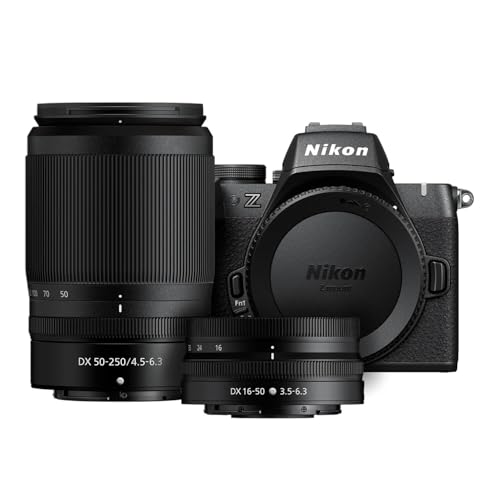
- Nikon Z50 II with Two Lenses: check price on Amazon
- Nikon Z50 II: see the current price on Amazon
- Panasonic LUMIX S5II: view this camera on Amazon
- Canon EOS R6 Mark II: check availability on Amazon
- Sony ZV-1F: see it on Amazon
- OM SYSTEM Tough TG-7: look at it on Amazon
The best cameras for novice photographers are teaching instruments before they are imaging instruments. A novice needs a camera that makes the fundamentals visible: aperture you can watch changing the photograph, shutter speed whose effects are unmistakable, focus that can be handed over to automation while composition is learned and taken back when focus itself becomes the lesson. The camera must also survive the novice’s curriculum — the night shoot for the course, the portrait session with a patient friend, the landscape weekend — and still have headroom when the novice, a year in, is no longer one. Buy too little camera and the learner outgrows it by spring; buy too much and the complexity taxes every lesson.
This guide assumes the novice is serious and budgets accordingly — not lavishly, but with the understanding that a real system, bought once and learned deeply, costs less across five years than two compromises bought and sold. It also assumes instruction is happening somewhere: a course, a book, a club, a structured self-education. The camera choices below are matched to that assumption. They are the bodies instructors quietly hope their students arrive with, because their controls are where the textbooks say controls should be, their files behave the way the lessons predict, and their limitations are the honest physical kind that teach, rather than the arbitrary kind that merely frustrate.
The distinction from this batch’s neighbouring guides deserves one clear paragraph. Normal people want photographs without photography; this guide is for people who want photography itself, and are at the start of wanting it well. Young photographers share much of this list, but their guide weighs age, gifts and family funding; this one weighs curriculum, controls and the second year. A novice of fifty will find more of themselves here than in either sibling, and a novice of fifteen who is truly studying will too.
Read the six as a syllabus with prices attached. The Nikon kit is the standard first system of the modern era, and it takes the top place on teaching merit. The bodies-only and full-frame options map the routes for novices with lenses, ambitions or budgets of particular shapes. The compacts serve the novice whose learning will happen on the street and the journey, where a small camera’s lessons are availability and nerve. All six will make a photographer. They differ in how they teach, and teaching is the criterion.
A word about money, because novices are sold fear in both directions — that a cheap camera will waste their talent, and that an expensive one will substitute for it. Neither is true at the level of this list. Every system here is capable of the entire first-year curriculum and a credible portfolio; the differences are in emphasis, headroom and the shape of the second year. Choose by the teaching, fund the practice around it — the prints, the club, the one good book — and let the talent, which is mostly persistence wearing a disguise, do the rest.
Key Takeaways
- A novice needs a teacher, not just a camera: controls that make the fundamentals visible.
- The Nikon Z50 II two-lens kit is the standard first system — viewfinder, dials, two focal ranges.
- Learn one variable at a time; the right camera makes each lesson obvious in the file.
- Full-frame can wait for most novices — unless the course, the dark or the budget says otherwise.
- A fast prime is the second purchase that teaches fastest; the kit zoom is the first.
- Judge a novice camera by year two: it should be a floor to stand on, not a ceiling.
In this guide
Quick Picks
| Camera | Badge | Why it is here |
|---|---|---|
| Nikon Z50 II with Two Lenses | Best first system for novice photographers | The complete learning kit: viewfinder, honest dials, and wide-plus-telephoto lenses for the whole first-year curriculum. |
| Nikon Z50 II | Best body for novices with a lens plan | The same teaching body alone — for novices pairing it with one deliberate lens, often a fast prime. |
| Panasonic LUMIX S5II | Best full-frame start for novices | Full-frame files and a value lens ecosystem for the novice whose course, subjects or budget point straight to the large sensor. |
| Canon EOS R6 Mark II | Best novice camera for people and events | Superb autofocus, kind colour and forgiving handling for the novice whose subjects are people in motion. |
| Sony ZV-1F | Best compact for street and travel novices | A fixed-lens compact for the novice learning by walking — street, travel and the daily photographic diary. |
| OM SYSTEM Tough TG-7 | Best novice camera for outdoor and macro learning | An indestructible compact whose macro modes teach the miniature world — for novices whose classroom is outdoors. |
How did we judge cameras as instruments for learning?
We assessed each camera against a novice’s actual first-year curriculum: the exposure exercises, where a control’s effect must be visible in the resulting file or the lesson evaporates; the focus module, where automation must be good enough to ignore until manual focus becomes the subject; the low-light assignment, the portrait assignment, the landscape weekend and the first small series submitted for critique. We scored control layout as a textbook would — are aperture and shutter under the fingers, is the exposure compensation reachable without a menu dive, does the viewfinder show the photograph the settings predict?
We weighted the ecosystem of learning around each body: the availability of affordable lenses for the exercises that need them, the depth of the used market for a student’s budget, the tutorials, courses and clubs that assume the system, and the file’s behaviour in the editing software the novice will learn alongside the camera. A novice does not buy a body; they enrol in a system, and this guide graded the whole institution.
One more consideration ran through the judging and belongs on the record: the novice’s hands and habits are still forming, so we favoured cameras whose default behaviour is correct behaviour — metering that rewards the standard technique, colour that does not need rescuing, menus that group the curriculum’s tools where a student would look for them. A novice’s first camera writes their reflexes. We chose reflex-writers whose habits a photographer need never unlearn, because unlearning is the most expensive tuition in any craft.

Nikon Z50 II with Two Lenses — Best first system for novice photographers
The two-lens Z50 II kit is the closest thing modern photography has to a standard-issue education. The viewfinder teaches the first and hardest lesson — that a photograph is a selection, a rectangle cut from the world — better than any screen, because it excludes everything else and makes the novice responsible for the edges. The twin dials put aperture and shutter under the two hands the textbooks assume. And the two zooms divide the curriculum between them: the wide for space, context and landscape; the telephoto for compression, isolation and the portrait exercises, each focal range teaching the seeing that only it can.
Nikons’s colour and JPEG quality perform a pedagogical kindness in the first months: the novice’s correctly exposed, well-composed frames come out looking finished, which rewards the fundamentals while they are fragile, while the raw files wait for the editing module of the course. Instructors recognise the pattern — students whose early work looks good persist, and persistence is the entire mechanism of learning a craft. A camera that encourages its novice is not coddling them; it is retaining them for the harder lessons.
The subject-detection autofocus deserves a teacher’s specific praise: it removes focus from the list of simultaneous worries while composition, light and moment are being learned, then steps aside — manual focus, focus peaking, the works — when the curriculum turns to focus itself. Sequencing is the soul of teaching, and this camera sequences itself: automation first as scaffolding, craft later as structure, exactly as a good course is built.
Buy it as the novice’s foundation and add nothing until a named exercise fails for a named reason — the low-light module asking for the fast prime, the portrait series asking for the longer lens. Kit bought by failed exercises is a curriculum; kit bought by anticipation is a collection. On that discipline, this system carries a novice from the first exposure triangle to a credible portfolio without a single wasted purchase.
- Format: APS-C mirrorless, two-lens kit
- Viewfinder: electronic, eye-level
- Lenses: wide zoom and telephoto zoom
- Controls: twin dials, full manual modes
- Colour: pleasing JPEGs plus raw files
Strengths
- Every first-year exercise is covered by the kit
- Controls sit where the textbooks describe
- Files teach cleanly in any editing software
Trade-offs
- A system to grow costs more than a compact
- Kit lenses are teachers, not heirlooms
- The hobby it enables will ask for a prime next
Best for: novices on courses or structured self-teaching who want one complete system. Not suited for: casual photographers with no intention to learn — see the normal-people guide

Nikon Z50 II — Best body for novices with a lens plan
The body-only Z50 II serves the oldest apprenticeship in photography: one camera, one fixed lens, one year. A respected school of teaching holds that the novice learns seeing fastest when zooming is impossible — when the feet must find the frame, when every photograph is composed at the same honest distance, when the lens’s single view becomes the photographer’s own. For the novice under a teacher who prescribes that discipline, or self-teaching by its considerable literature, this body plus a fast standard prime is not a compromise version of the kit. It is a different and arguably deeper education.
The second constituency is the inheritor, again: the novice whose family cupboard holds Nikon lenses from the film or DSLR generations, adaptable to this mount. For them the body alone converts an inheritance into a curriculum, and the exercises can be shot on glass with histories — a grandfather’s portrait lens teaching a grandchild’s eye is a sentence this guide is happy to write, because photography’s continuity is one of its genuine beauties.
The warning from the sibling guides stands unchanged: the lens must be funded with the body, or the enrolment is a drawer. A body-only purchase without a lens plan is the one configuration in this guide we actively argue against for a true beginner, because a novice’s motivation is a perishable good and the first photographs must happen in the first week. With the lens in hand, though, this is the connoisseur’s start — the same viewfinder, dials and files as the kit, aimed by a single focal length like a rifle rather than a hose.
Choose it when a teacher, a tradition or an inheritance points that way, and commit to the year. The novices who serve the one-lens apprenticeship emerge with a seeing that zoom-raised photographers spend years retrofitting, and their second purchase — whatever the portfolio asks for — is made by a photographer, not a shopper.
- Format: APS-C mirrorless, body only
- Mount: Nikon Z, adaptable to older Nikon glass
- Viewfinder: electronic, eye-level
- Controls: full manual and custom modes
- Role: foundation for a one-lens apprenticeship
Strengths
- The classic body-plus-prime apprenticeship
- Adapts inherited Nikon lenses for exercises
- Identical teaching virtues to the kit
Trade-offs
- Requires the lens budget in the same season
- One focal length frustrates some beginners
- Total can exceed the kit if lenses multiply
Best for: novices advised by a teacher to learn on one prime, and inheritors of Nikon lenses. Not suited for: novices without a lens plan — the kit is the safer enrolment

Panasonic LUMIX S5II — Best full-frame start for novices
Some novices know their territory on arrival: the available-light portraitist, the landscape devotee, the student whose course is built around full-frame. For them the S5II is the honest start — a full-frame body at a price that leaves the lens budget alive, in the mount whose affordable primes make the classic exercises affordable at full-frame quality. Its files forgive the novice’s two great early enemies, darkness and the lifted shadow, with a generosity that keeps coursework presentable while the craft catches up.
The L-Mount economics are a curriculum feature. The fast prime for the aperture module, the portrait lens for the second term, the wide zoom for the landscape weekend — each exists at a working student’s price from Sigma or Panasonic, which means the novice’s system can grow at the speed of their learning rather than the speed of a promotion. Systems whose every next step costs a fortune quietly ration their students’ education; this one does not, and instructors in budget-conscious programmes have noticed.
Its stabilisation teaches a subtle early lesson in reverse: hand-holding succeeds at shutter speeds the textbook forbids, which is a gift for the night assignment and a trap for technique if the novice never learns the tripod’s discipline. Good teachers name the trap; the camera’s virtue is that it lets the lesson be taught by choice rather than by ruined coursework. The novice who learns both — the stabilised hand and the disciplined tripod — owns the whole craft’s foundation.
Commitment is the honest entry requirement. This is more camera, more weight and more money than the Nikon kit, and for the novice still unsure whether photography is a phase, that is an argument for the Nikon. For the novice who has finished a first course, filled a notebook and knows the territory is theirs, the S5II is the start that never needs apologising for or replacing — the floor that turns out, years later, to have been a foundation.
- Format: full-frame mirrorless, L-Mount
- Sensor: 24.2-megapixel full-frame
- Stabilisation: strong in-body stabilisation
- Focus: phase hybrid autofocus
- Lenses: L-Mount value primes and zooms
Strengths
- Full-frame low-light files from lesson one
- Affordable fast primes for the classic exercises
- No sensor ceiling to outgrow in year two
Trade-offs
- Heavier total investment than the Nikon kit
- Larger body and lenses to carry daily
- Autofocus a step behind class leaders for action
Best for: novices committed to low-light, portrait or landscape paths from the start. Not suited for: uncertain beginners still testing whether the craft is theirs

Canon EOS R6 Mark II — Best novice camera for people and events
The R6 Mark II is the novice’s people camera: the body for the learner whose coursework and ambition both point at faces — portraiture, events, the long road to weddings. Its people-detection autofocus is the finest scaffolding in this guide for that path, holding a subject’s eye through movement and crowd while the novice learns the harder, slower lessons of light and timing. A portrait student whose focus is handled can spend a whole session on the only thing portraits are actually about, which is the person, and that allocation of attention is worth marks in any critique.
Canon’s colour is the second teaching asset, and it teaches by example. The novice who sees, weekly, what well-judged skin tones look like in their own files develops a palate — an internal standard that later informs their editing, their lighting and their choice of hour. Cameras teach taste as surely as they teach technique, and this one’s taste in people is the industry’s reference. The portrait module’s critique sessions are measurably kinder to the Canon novice’s files, and kindness, in term one, is retention.
Its handling completes the case for the events path: controls that fall to hand, stabilisation that forgives the novice’s stance, sealing for the weather that events ignore. The caveat a good instructor would add belongs in this section too — its excellence can mask gaps, delivering files the novice’s technique has not yet earned, and the wise learner periodically shoots the exercises on full manual, automation off, to keep the fundamentals honest. The camera permits that discipline completely; it merely does not enforce it.
Buy it when the people path is certain and the budget is real. It is the most expensive start in this guide and, for its constituency, the most direct: a professional’s working body that a novice can grow inside for the better part of a decade, arriving at competence to find the camera was never the limitation. That is a fine thing to be able to say about a first camera, and few first cameras earn it.
- Format: full-frame mirrorless
- Focus: deep-learning people detection
- Colour: Canon skin tones
- Stabilisation: strong in-body stabilisation
- Body: weather-sealed, intuitive controls
Strengths
- Focus success while composition is learned
- Skin tones flatter the portrait modules
- Handling that rewards daily practice
Trade-offs
- Full-frame system costs from day one
- Resolution modest beside rivals
- Capability may mask technique gaps a course should expose
Best for: novices aiming at portraits, weddings and events from the start. Not suited for: budget-first novices — the Nikon and Panasonic teach for less

Sony ZV-1F — Best compact for street and travel novices
There is a school of photographic education that begins not with settings but with seeing, and its instrument is the small fixed-lens camera carried everywhere. The ZV-1F in black is that school’s modern textbook: a wide lens that matches the street’s and the journey’s grammar, a sensor good enough that the files reward attention, and a simplicity that forces the novice’s eye outward — to light, gesture and moment — because the camera offers nothing else to fiddle with. Street photography, travel photography and the daily diary are all learned this way, and they are learned faster on a camera that is present for all of them.
Its pedagogical honesty should be stated plainly: this camera will not serve a formal syllabus. There is no viewfinder for the composition module’s strictest exercises, no lens to change for the focal-length module, and the course that assumes a system camera will strand its owner by term two. The ZV-1F novice is the autodidact of the street, learning from books, walks and the ruthless critique of their own contact sheets — a real education with real masters, from Winogrand onward, but a different institution from the Nikon’s.
Within that institution it excels. The wide fixed lens is the street’s classic focal length; the pocket size is the traveller’s whole argument; the video serves the mixed-media diary that modern seeing increasingly is. And its files, from the 1-inch sensor, print respectably and critique honestly — the novice’s work stands or falls by the seeing, which is the precise pressure this school applies on purpose.
Choose it with open eyes as the diary camera and the street apprenticeship, ideally with the intention — confessed at purchase — that a system camera may follow when the seeing outgrows the tool. Many great photographic lives began exactly here, with a small camera and a large curiosity, and the ZV-1F is the friendliest current door into that beginning.
- Format: compact camera, fixed wide lens
- Sensor: 1-inch class sensor
- Operation: simple, with manual options
- Video: 4K for mixed-media projects
- Carry: pocketable, unobtrusive
Strengths
- Always carried — the diary never misses a day
- Wide lens suits street and travel grammar
- Simple enough to learn light before settings
Trade-offs
- No viewfinder for formal composition study
- Fixed lens limits the curriculum’s range
- Serious courses will ask for more camera
Best for: novices learning through street, travel and daily practice. Not suited for: course students whose syllabus assumes interchangeable lenses

OM SYSTEM Tough TG-7 — Best novice camera for outdoor and macro learning
The TG-7 teaches the outdoors curriculum, and it teaches two modules no other camera here can offer at all. The first is weather: photography continued in rain, spray, frost and river water, where the novice learns that the interesting light and the interesting subjects keep the worst hours. The second is macro — the miniature landscape at the feet — where its close-focus modes handle the technical scaffolding (focus stacking, close lighting) while the novice learns the seeing: patience, stillness, the composition of a world three centimetres wide. A novice can build a genuine portfolio, and a genuine practice, inside those two modules alone.
Its manual and scene options give the fundamentals a foothold — aperture choices, exposure compensation, the works — within a body that forgives the novice’s first-year accidents completely. Dropped in the stream during the river module, frozen during the frost morning, lent to the expedition’s least careful member: the TG-7’s survival is a pedagogical feature, because a novice whose camera is precious learns caution before craft, and caution is the wrong first lesson in the outdoors.
The boundaries are the familiar ones and they bind: the small sensor will limit the low-light and large-print coursework, and no lens system waits beyond it. The TG-7 novice is specialising early — in nature, macro and expedition — and should do so knowingly, with the system camera as the confessed second chapter if the craft generalises. For the novice whose heart is already outdoors, that specialisation is not a limitation but a head start, in the only classroom they intend to graduate from.
It closes this list as the specialist’s door, standing open in all weathers. The novice who walks through it will learn photography the way naturalists always have: by attendance, in the field, in the rain, at the scale of the small and the patience of the seasons.
- Format: rugged compact camera
- Build: waterproof, freeze-proof, crush-proof
- Close focus: microscope-style macro modes
- Modes: manual and scene options for learning
- Logging: field sensors for nature diaries
Strengths
- Learning continues in rain, rivers and frost
- Macro modes teach a whole genre alone
- Survives the novice’s first-year accidents
Trade-offs
- Small sensor limits low-light coursework
- No interchangeable lenses for later modules
- Not the camera for a formal general syllabus
Best for: novices learning through nature, macro and expedition photography. Not suited for: general-course novices needing a system camera
How should a novice practise in the first ninety days?
One variable, one week, one printed result. Week one is aperture alone: the same subject at every aperture, printed and pinned, until depth of field is a fact the hands know. The following weeks take shutter speed at moving water and traffic, then ISO in a dim room, then focus — where it falls, how it misses, how the camera’s aids behave. The cameras here were chosen partly for how legibly they teach these isolations: change one thing, and the file changes in exactly the way the book promised. A novice who has isolated the variables owns the exposure triangle as a set of tools rather than a diagram to recite.
Keep a practice log with the humility of a lab book: date, exercise, setting, result, one sentence of verdict. Ninety days of entries is a personal textbook written in the only dialect its reader fully trusts, and reviewing it monthly shows the improvement curve that daily practice hides. Shoot daily if life allows, but shoot deliberately when it does not — twenty considered frames teach more than two hundred hopeful ones, and the contact sheet reviewed coldly is the novice’s truest tutor.
End the ninety days with a small series — five to eight photographs on one subject, edited ruthlessly and printed — because a series converts exercises into photography. Show it to someone whose eye you respect and take the critique standing up. The novice who completes the ninety days and the series has crossed the craft’s real threshold: they are no longer learning about photography. They are a photographer, learning.
What should a novice buy in the second year?
Nothing until the portfolio names it — and then, usually, the fast prime. The second year’s purchases should be dictated by the first year’s failures, each of which is a purchase order written in the novice’s own hand: the low-light frames that grain forbade argue for the fast lens; the portraits that asked for separation argue for the longer prime; the landscapes that wanted width argue for the wide zoom. A novice who buys in that order builds a kit that is a biography of their seeing, every item earned by a photograph that almost existed.
The exceptions are the unglamorous infrastructures, which may be bought on sight: the tripod the landscape module keeps borrowing, the second battery, the backup drive, the course or the club membership that constitutes the second year’s real curriculum. Of these, the club and the course outrank every object, because the second year’s bottleneck is never equipment — it is critique, company and the standards of photographers further along. Money spent joining their world returns more photographs than any lens in this guide’s systems.
Resist, above all, the second body. The novice who upgrades the camera in year two restarts the familiarity clock, spends the lens budget on a duplicate of what they own, and learns the new menus instead of the next lesson. Bodies are replaced when they limit the work visibly or fail physically; the cameras in this guide were chosen so that, for a novice, that day is years away and honestly earned when it comes.
How does a novice learn to see light before chasing it?
By staying still. The beginner’s instinct is to hunt — new places, new subjects — while the craft’s first secret is that light transforms the familiar more completely than travel transforms the light. Photograph one window through a whole day; one street corner across a season; the same face by the same lamp at every hour the household allows. The resulting contact sheets teach the day’s grammar — the raking morning, the flat noon, the golden argument of evening — more thoroughly than a safari, because the subject held still while the variable performed.
Then learn light’s vocabulary by naming it in the log: hard, soft, raking, back, top. A novice who can name the light in a scene before raising the camera has acquired the craft’s master skill, from which composition and exposure both follow as clerical work. The cameras here support the study impartially — this is the one module where the compact and the flagship are equals — which is the deepest reason the ninety-day discipline outranks any purchase in this guide.
What separates novices who become photographers from those who drift away?
A practice structure, almost never a talent gap. The ones who persist have a rhythm the hobby fits inside — the Saturday walk, the club night, the monthly print — and a small society that expects their photographs: a course cohort, a club, one honest friend. The ones who drift usually own equal cameras and greater initial enthusiasm, but their photography has no appointments, and enthusiasms without appointments evaporate by spring. Build the rhythm before upgrading anything; join the club before buying the lens; print monthly before questioning the camera.
The second separator is the archive of failures, kept and studied. Novices who delete every miss delete their tuition; the ones who review the misses monthly, log the pattern — always the light, always the edges, always a beat late — and aim the next month’s practice at the pattern, improve at a rate that looks, from outside, like giftedness. It is not giftedness. It is bookkeeping, applied to seeing, and every novice in this guide’s audience is fully equipped to do it starting tonight.
How should a novice approach editing without losing the photograph?
Edit in the order the craft was learned: selection first, then the honest corrections, then — much later and lightly — interpretation. Selection is editing’s master skill and it is learned on the contact sheet, with a stranger’s coldness: the novice marks the frames that work before touching a single slider, and discovers, across a year, that their hit rate in the field is the true graph of their education. The corrections follow the exposure lessons in software form — the histogram is the same instrument, the white balance is the same decision — which is why this guide treats camera and editor as one curriculum taught in two rooms.
Keep every edit reversible and every original untouched, and re-edit one old frame each month. The monthly re-edit is the novice’s progress made visible to themselves: the same file, a better photograph, the difference attributable to nothing but the photographer’s growth. It is also the standing argument for shooting raw from early on — the file must contain more than the first attempt needed, because the second attempt, a year later, will know what to do with it.
What does a novice need to understand about lenses before buying a second one?
That focal length is a way of seeing before it is a measurement. The wide lens includes and exaggerates; the long lens selects and compresses; the standard lens reports. A novice who has shot the kit’s two zooms for a season already owns the data of their own seeing — the archive records which lengths their best frames cluster at — and the second lens should be bought to serve that cluster, deepening a demonstrated love rather than prospecting for a hypothetical one. This is the same archive-led logic the landscape guide in this batch applies, and it is the single most money-saving habit a novice can form.
Aperture, the lens’s other number, buys two things at once: light and separation. The fast prime’s gift to the portrait module is the subject lifted from the background; its gift to the night module is the shutter speed that makes the assignment possible. Buy the aperture your subjects need, at the length your archive votes for, and the second lens will feel less like a purchase than like a promotion — which, in the novice’s education, is exactly what it is.
How do genres — portrait, landscape, street, nature — change what a novice should practise?
Each genre is a different weighting of the same fundamentals, and the novice’s second term is well spent discovering their weighting by trial. Portraiture weights light on a face and the ethics of direction; landscape weights patience, the tripod and the print; street weights nerve, timing and the ethics of strangers; nature weights fieldcraft and the calendar. The cameras in this guide lean toward different weightings — the Canon toward faces, the TG-7 toward the field, the ZV-1F toward the street — but the fundamentals transfer entire, which is why the first term belongs to the general system and the genres are visited as electives before any is chosen as a major.
Choose the major late and by evidence: the genre whose practice sessions end too soon, whose failures teach rather than discourage, whose masters’ work the novice studies without being assigned to. A photographic life is long, and its genre is usually a recognition rather than a decision — the novice discovers, somewhere in the second year, that their archive has been quietly specialising without their permission. Let it. The camera bought by this guide’s logic will serve the specialisation or fund its successor honourably, and either outcome is the education working as designed.
How should a novice handle critique without losing heart or standards?
By separating the photograph from the photographer, which is critique’s whole technology. The frame failed or succeeded for reasons that live in the frame — the edge nobody watched, the light nobody waited for, the moment a beat early — and reasons can be fixed in a way that worth cannot be questioned. The novice who learns to hear “the background is fighting the subject” as an instruction rather than a verdict has acquired the professional’s skin, and with it the ability to keep improving for decades, because the supply of useful criticism only ends when the photographer stops being able to hear it.
Seek critique from photographers whose work you respect and whose honesty you can verify, in rooms — physical or virtual — where the work is looked at properly: printed, projected, given time. Drive-by opinion under a social post is weather, not critique. And give critique as carefully as you hope to receive it, because articulating why another novice’s frame works is an education equal to any exercise in this guide — the eye that can say it can, soon after, do it.
Comparison Table
| Camera | Type | Role in this guide | Key virtue |
|---|---|---|---|
| Nikon Z50 II with Two Lenses | APS-C mirrorless, two-lens kit | Best first system for novice photographers | The complete learning kit: viewfinder, honest dials, and wide-plus-telephoto lenses for the whole first-year curriculum. |
| Nikon Z50 II | APS-C mirrorless, body only | Best body for novices with a lens plan | The same teaching body alone — for novices pairing it with one deliberate lens, often a fast prime. |
| Panasonic LUMIX S5II | full-frame mirrorless, L-Mount | Best full-frame start for novices | Full-frame files and a value lens ecosystem for the novice whose course, subjects or budget point straight to the large sensor. |
| Canon EOS R6 Mark II | full-frame mirrorless | Best novice camera for people and events | Superb autofocus, kind colour and forgiving handling for the novice whose subjects are people in motion. |
| Sony ZV-1F | compact camera, fixed wide lens | Best compact for street and travel novices | A fixed-lens compact for the novice learning by walking — street, travel and the daily photographic diary. |
| OM SYSTEM Tough TG-7 | rugged compact camera | Best novice camera for outdoor and macro learning | An indestructible compact whose macro modes teach the miniature world — for novices whose classroom is outdoors. |
What mistakes do novice photographers make in the first year?
The first is buying twice — the timid first camera outgrown by spring, its replacement bought in resentment — which this guide’s whole structure exists to prevent: buy the system that fits the second year, once. The second is learning settings before seeing: the novice who can recite the exposure triangle but has never watched one window for a day owns the map of a country they have not visited. The third is the unprinted year, where a thousand files teach less than twelve prints would have, because the screen forgives what the wall examines.
The fourth mistake is comparison with the wrong cohort — the novice’s term-one series judged against a professional’s decade, with the camera blamed for the difference. And the fifth is secrecy: work never shown, critique never risked, the portfolio private until it is perfect, which is to say forever. Photography is learned in public, a little at a time, by people brave enough to pin the print up. The cameras here will do their half. The pinning is yours.
A sixth mistake completes the set: treating the camera as the identity — introducing oneself by one’s equipment, joining the forums of a brand rather than the company of photographers, defending a purchase instead of developing a practice. The craft does not care what you shoot with nearly as much as the industry needs you to believe. Pin the print up, take the critique, shoot the next series: the photographers are the ones doing that, on every brand ever made, and there is room among them for any novice willing to do the work.
Final Recommendation
For the novice who wants the complete, standard, no-regrets start, the Nikon two-lens kit is this guide’s answer — a teacher with a viewfinder, two focal ranges and a decade of headroom in its files. The body-only Nikon serves the one-lens apprenticeship and the inheritor; the Panasonic opens full-frame to the committed; the Canon carries the people-path novice straight toward professional work; and the two compacts teach the street and the wild respectively, for novices whose classrooms have no walls.
Whichever you enrol with, begin the ninety days this week: one variable, one week, one printed result. The camera is the syllabus’s instrument, but the practice is the syllabus — and the novice who practises becomes, by the oldest mechanism in the craft, a photographer.
And a last word from every instructor whose students we have watched cross the threshold: the novices who make it are rarely the ones who arrived with the best camera or the most obvious eye. They are the ones still photographing in month nine — still printing, still showing up, still curious about the next frame. Buy the camera that maximises your month nine, by fitting your hands, your budget and your intentions honestly today, and the craft will take care of the rest, one deliberate frame at a time.
Frequently Asked Questions
Is a mirrorless kit too much camera for a complete beginner?
No — it is the standard teaching instrument of the era, and the Z50 II kit was designed to be friendly in automatic while the novice grows into its controls. Too much camera is a real phenomenon, but it lives at the flagship tier, not here. A novice on a course will use everything this kit offers by the second term.
Should a novice learn fully manual from day one?
Learn one variable at a time in the semi-automatic modes, which is how the craft is actually taught: aperture-priority while depth of field is the lesson, shutter-priority for movement, manual when the studio module arrives. Full manual from day one teaches juggling, not photography, and the drop rate among its novices is the proof.
Do I need a full-frame camera to take a course?
Almost certainly not — courses are built around the cameras students own, and APS-C systems like the Nikon kit are the commonest serious student cameras in the world. Full-frame earns its place for specific paths — low light, large prints, professional portraiture — and the Panasonic and Canon here serve novices who are certain of those paths from the start.
What is the best first lens after the kit?
A fast prime near the standard focal length for your sensor. It teaches footwork and depth of field, opens the low-light module, flatters the portrait exercises and holds its value. Buy it when a named exercise asks for it — typically the aperture and low-light modules — rather than on the first day’s enthusiasm.
How long before a novice outgrows these cameras?
Years, by design. The Nikon kit and the full-frame bodies here are still working cameras in professionals’ second bags; the novice who outgrows one has become an advanced photographer with a portfolio that specifies its successor precisely. The compacts are the exception, and their sections say so plainly.
Can I learn photography properly without a course?
Yes — the ninety-day structure in this guide, a good book, a club and monthly printing constitute a complete self-education, and the street and nature schools have run on it for a century. What a course adds is pace, cohort and a teacher’s eye on your contact sheets. If you can join one, do; if you cannot, the discipline here will carry you, provided the printing and the showing actually happen.
What does the histogram tell me that the screen cannot?
Camera screens brighten and dim with room light, so a picture that looks perfect on a sunny pavement may be hopelessly dark indoors. The histogram graphs the tones actually captured: a graph bunched hard against the left edge warns of blocked shadows, while one climbing the right edge signals blown highlights that no editing can rebuild. Learn to glance at it after unusual scenes — snow, stage lights, white dresses, black cats — and adjust exposure compensation by a stop, then shoot again. Blink warnings that flash overexposed areas serve the same purpose. Trust these tools over your eyes whenever the viewing conditions lie.
How do I work out why a photograph came out blurred?
Separate the suspects methodically. Blur everywhere in one direction suggests camera movement and a shutter speed too slow for your lens length. A sharp background with a soft subject means focus landed behind them, common when the camera chose a nearer contrasty object. Softness creeping in from the corners points to a very wide aperture or a smudged front element. Take three test frames of a bookshelf, raising shutter speed, narrowing aperture and cleaning the lens between each, and note which change fixes it. This small experiment teaches more than a week of anxious forum reading.
Why return to one ordinary location again and again?
A single street corner, allotment or railway platform photographed across a season removes novelty as a crutch and forces you to notice light, weather and small human patterns. Set yourself narrow assignments there: only reflections one visit, only hands the next, only pictures taken from waist height on the third. Compare each set honestly and print the best frame from every trip for a growing wall sequence. Familiar ground also lowers the pressure to perform, which suits a novice building confidence. By the sixth visit you will be composing before raising the camera, and that seeing-first instinct transfers everywhere.
Keep a pocket notebook for those repeat visits and jot down the settings, the weather and one honest sentence about what disappointed you in each set. Patterns emerge within a month: perhaps every blurred frame shares one lens, or every dull composition was taken at midday from standing height. Those observations turn vague frustration into a short, personal practice list, far more useful than generic advice. Photographers improve fastest when their exercises answer their own evidence, and a notebook is the cheapest teacher a beginner will ever hire.
Related Guides
Related reading: the best cameras for new young photographers, the best cameras for normal people, how to practise photography in your first ninety days.


