reviewstook.com is reader-supported. When you buy through links on our site, we may earn an affiliate commission.
Where to Buy a First Camera for the Outdoors
The best cameras for beginner nature photographers must survive two educations at once: yours and the weather’s. Nature work splits into the patient empire of wildlife — distant, fast, gone in a blink — and the contemplative republic of landscapes, where the light moves slowly and the photographer may not move at all. A beginner’s camera has to introduce both worlds honestly, with autofocus that can find a bird’s eye and files that hold a dawn sky together, in a body that does not mind drizzle.
Beginners in this genre face one brutal economic fact: reach costs money, and the lens usually matters more than the body. This guide therefore ranks systems, not just cameras — favouring mounts where an affordable telephoto exists, crop sensors that stretch lenses further, and bodies whose subject-detection autofocus gives a novice a fighting chance at the fleeting frames that make wildlife photography addictive.
Links from our verified pool support four picks here; a further two nature favourites get prose-only coverage, with no links attached. A warning applies across the whole genre: fieldcraft defeats equipment at every level, and the guide sections give approach, patience and ethics as much space as cameras — because the beginner who learns to be early, quiet and near will out-photograph the beginner who merely buys well.
Key Takeaways
- In nature photography the telephoto lens is the budget’s centre of gravity — choose the system by its affordable reach.
- Crop sensors are a beginner’s ally outdoors, stretching every lens longer for distant wildlife.
- Animal and bird eye detection transforms a novice’s keeper rate more than any other single feature.
- Weather sealing matters from the first season; nature schedules its best light inside its worst weather.
- Fieldcraft — approach, wind, patience, dawn alarms — outranks equipment at every level of this genre.
- Start with the subjects near home: garden birds and local woods teach the skills that safaris later spend.
In this guide
Quick Picks
| Pick | Badge | Why it made the list |
|---|---|---|
| Nikon Z50 II with Two Lenses | Best starter kit for nature | A telephoto kit lens from day one, crop reach and friendly handling — the complete beginner nature package. |
| Canon EOS R6 Mark II | Best step-up wildlife body | Superb animal detection and low-light strength for beginners who know wildlife has claimed them. |
| OM SYSTEM Tough TG-7 | Best for macro and rough weather | A sealed compact that opens the miniature world of insects, fungi and shore life in any weather. |
| Sony Alpha 7 IV | Best for landscape-leaning beginners | Full-frame files that hold dawn skies together, with a lens shelf covering every nature genre. |
| Canon EOS R50 | Best budget wildlife learner | A light crop body that pairs beautifully with affordable long lenses, covered prose-only here. |
| OM SYSTEM OM-5 | Best portable nature system | Sealed, tiny-lensed and computationally clever, prose-only and beloved by hiking nature photographers. |
How Did We Choose the Best Cameras for Beginner Nature Photographers?
Subject detection led our scoring, because it is the feature that most changes a beginner’s results outdoors. A novice tracking a warbler through branches is already managing exposure, footing and excitement; autofocus that finds and holds an animal’s eye converts that chaos into keepers. Every interchangeable pick here offers genuine animal or bird detection rather than a marketing approximation of it.
System reach came second. We mapped each mount’s affordable telephoto path — the lens a beginner will actually buy in year one — and favoured systems where that path is short, light and financially survivable. Crop bodies scored their natural advantage here, stretching modest telephotos into serious wildlife tools, while full-frame picks earned their place through low-light quality and landscape depth.
Third, we graded outdoor manners: sealing against drizzle and dust, battery behaviour on cold dawns, weight across a day’s walking, and controls usable in gloves. Nature beginners quit over discomfort as often as over difficulty, and a camera that respects the field — quiet shutters near wildlife included — keeps its owner returning to learn the craft’s real lessons.
Which Nature Camera Fits the Beginner You Are Becoming?
Wildlife-first beginners should start with the Nikon kit or the prose-only Canon R50 and put every spare coin toward the telephoto fund, because birds will not come closer while you save for a body. Landscape-first beginners should weight the Sony’s files and the OM-5’s portability, since their genre rewards dynamic range and dawn endurance over frame rates.
The macro-curious and the all-weather walkers have a genuine friend in the Tough TG-7, which opens a miniature nature world available in every garden. And the beginner who already knows — who has the field guide, the dawn alarm and the obsession — should read the Canon R6 Mark II section as permission to buy once and grow for years.

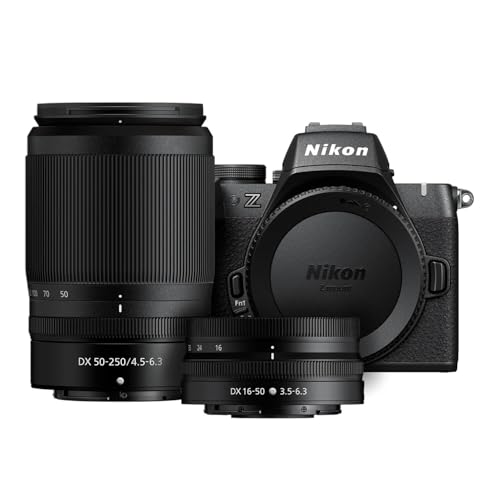
Nikon Z50 II with Two Lenses — Best starter kit for nature
Starting nature photography with a telephoto already in the box changes everything: the beginner photographs actual wildlife in week one instead of saving toward the possibility. Nikon’s crop reach, friendly presets and sharing tools make this the genre’s most encouraging first package.
The first morning out decides whether a nature beginner becomes a nature photographer, and the Nikon Z50 II with Two Lenses rigs that morning in their favour. Because a telephoto lens is already in the box, the beginner photographs an actual heron on day one instead of photographing the idea of one while saving up. Nikon’s crop sensor stretches that lens’s reach further, and the friendly presets render dawn colours kindly while technique is still forming. Sharing a first success to a phone from a riverbank completes the hook. Starting with reach is starting with encouragement, and encouragement is the scarcest resource in this genre. The learning continues at home, where the day’s files — some triumphant, some instructive — can be reviewed on the television and argued over by the whole household.
Field conditions test beginners and equipment simultaneously, and this kit shares the burden fairly. Its sealing shrugs off the drizzle that produces the best woodland light, so the beginner learns the genre’s first secret — weather is opportunity — without risking the purchase. Animal eye detection that a novice can trust finds a warbler’s eye among spring branches, removing the focus despair that ends many first seasons. The two lenses teach the twin crafts of the genre in parallel: wide for habitat and landscape, long for portraits of wary subjects. A starter kit that teaches both halves of nature photography is doing double duty. Its battery life across a long field day removes the rationing anxiety that makes beginners conserve frames exactly when they should be experimenting freely with a new subject.
Value in nature photography hides in the system around the body, and Nikon’s is kind to beginners. Affordable telephoto options within the range mean the second purchase, when it comes, extends reach without restarting the whole investment. Files from the kit tolerate the cropping that distant subjects inevitably demand, so a slightly-too-far deer still becomes a presentable photograph rather than a deletion. Colour that flatters fur, feather and foliage straight from the camera keeps editing time low during the learning months. The beginner’s budget survives to fund the things that matter next: boots, field guides and dawn petrol. There is also a quiet advantage in starting inside a popular system: hides and reserves are full of Nikon owners whose borrowed lenses and hard-won local knowledge educate a beginner faster than any course.
There is a social dimension to starting with this kit. Its results are good enough, quickly enough, that a beginner dares to join the local nature group and share photographs at the first meeting. That community — its hides, its intelligence about where the owls are, its gentle critique — accelerates learning faster than any equipment. The camera’s compact size also suits the long, slow walking that real fieldcraft requires, never becoming the burden that shortens an outing. Nature photography is mostly walking and waiting; a kit that respects both earns its place in the rucksack. The kit’s controls, gloves-friendly enough for cold dawns, keep the beginner shooting through the season when most nature photography in northern latitudes actually happens.
Judge this Nikon by the beginner’s second season, when its virtues compound. The presets that flattered first attempts have taught colour judgement by example; the telephoto has taught distance ethics by experience; the sealing has taught that rain is a location, not an excuse. Owners rarely feel the platform limiting them before their fieldcraft does, which is the correct order of limitations. As a first nature system it is complete, encouraging and honest about what matters. The genre will supply enough difficulty on its own; the camera should supply confidence, and this one does. Its weight deserves a final mention, since a kit light enough for a full day’s walking will be carried on the speculative outings where unexpected subjects live.
- Wireless photo sharing
- Compact mirrorless body
- Two-lens kit in the box
- Easy colour presets
Strengths
- Files with editing headroom for nature photography
- Support, lenses and accessories around weather sealing for real field conditions
- Controls that stay learnable during a red deer stag watching from bracken in still air
Trade-offs
- Accessories for affordable telephoto reach within the system add up quietly
- Lens costs rival body costs in nature photography
- Honest weight checks precede a fungi cluster glowing on a damp forest floor
Best for: beginners wanting wildlife reach from day one
Not suited for: beginners set on full-frame from the start

Canon EOS R6 Mark II — Best step-up wildlife body
Canon’s animal detection is the stuff of beginner legend — eyes found through grass, birds held against cluttered skies — and its low-light strength suits the dawn and dusk hours when nature performs. This is the body for the beginner wildlife has already chosen.
The Canon EOS R6 Mark II is the body for the beginner whom wildlife has already chosen — the one who dreams in kingfishers. Its animal detection finds eyes through reeds and holds birds against cluttered skies with a tenacity that feels like a partnership. Low-light strength matches the genre’s working hours, since dawn and dusk are when the natural world performs and this Canon is fluent in both. A beginner starting here skips the upgrade conversation entirely and spends their money where nature photography insists it be spent: on reach. It is a serious beginning for a serious calling. Its price is the obvious objection, and the guide answers it in the R50 section below for those whose certainty has not yet caught up with their ambition.
Learning wildlife technique on this body is an education in what matters. Because focus is handled so capably, the beginner’s attention is free for the real curriculum: wind direction, approach angles, the patience to let a stag close the distance itself. Its burst shooting captures the single frame in a heron’s take-off where the wings describe a perfect arc, and its files withstand the cropping that even good fieldcraft cannot always avoid. Quiet operation near wary subjects protects the encounter, so behaviour stays natural and photographs stay honest. The camera removes beginner failure modes one by one, leaving only the fieldcraft to learn. Its image stabilisation works with the lens’s own to steady the long, cold waits at a hide window, where a beginner’s excitement is itself a source of camera shake.
The Canon’s steadiness in poor light deserves particular respect from dawn workers. A roe deer in a misty field at first light is a photograph made of almost nothing — grey on grey, breath and patience — and this body’s sensor and stabilisation gather that almost-nothing into a printable image. Beginners learn quickly that their expensive hours are the dim ones, and they equip accordingly. Paired with an affordable long lens, the system delivers professional-looking wildlife portraits while its owner is still learning to identify what they are photographing. That early quality sustains commitment through the blank mornings every wildlife photographer endures. The electronic viewfinder’s clarity in near-darkness helps composition at the hours when the eye alone can barely separate a subject from its background.
Ownership economics favour the committed here. The body will not need replacing when skill matures, Canon’s telephoto shelf offers reachable glass at several levels, and resale values forgive even a change of heart. Weather sealing suits a genre conducted outdoors in Britain’s full repertoire of rain. For the beginner certain of their direction, buying the destination body first is not extravagance; it is the avoidance of paying twice. The guide simply insists the certainty be real, because this is a purchase sized for a decade of dawns. Consider it the tuition-free route: the money a beginner might have spent replacing an outgrown body instead funds the telephoto lens collection this genre ultimately demands.
There is also the matter of trust between photographer and tool at the decisive second. A bittern rises from the reeds once; the Canon either holds focus or the season’s best opportunity becomes a story instead of a photograph. Beginners who start here learn to spend that second composing rather than worrying, and their archives show the difference. Confidence of this order cannot be rented or borrowed. It is bought, carried into wet fields for years, and repaid in frames that lesser bodies would have surrendered to the mist. Its dual card slots add a professional’s insurance policy, protecting a once-a-year encounter from the small catastrophes that haunt memory cards and beginners alike.
- Fast continuous shooting
- Full-frame sensor
- 24.2 megapixel CMOS sensor
- In-body stabilisation
Strengths
- Controls that stay learnable during a garden warbler flickering through spring branches
- Composed behaviour during a kingfisher streaking a riverbank in low light
- Build quality suited to regular nature photography
Trade-offs
- Accessories for affordable telephoto reach within the system add up quietly
- Honest weight checks precede a heron lifting off a misty reedbed at dawn
- Lens costs rival body costs in nature photography
Best for: wildlife-committed beginners buying long-term
Not suited for: casual beginners on strict budgets

OM SYSTEM Tough TG-7 — Best for macro and rough weather
Not every nature subject is distant. The TG-7’s sealed body and celebrated macro modes open fungi, insects, rockpools and frost patterns — a complete nature genre available in any weather, in any garden, at a fraction of telephoto money.
The OM SYSTEM Tough TG-7 argues that nature photography is not only about distance. Its sealed body and celebrated macro modes open an entire second genre living within arm’s reach: fungi after rain, frost feathers on a gate, a crab in a rockpool, the architecture of a snowflake’s brief career. A beginner with this camera is never without a subject, because the small world performs in every weather and every garden. Its bright lens keeps woodland shade luminous, and its toughness removes the fear that keeps other cameras indoors. For macro explorers and all-weather walkers, it is the most liberating tool in this guide. Its underwater credentials extend to streams and shorelines, where a beginner can photograph trout, newts and the strange geology of the littoral without specialist housings.
The TG-7 changes a beginner’s relationship with bad weather, which is to say with most of the British year. Rain becomes a macro studio: droplets on spider silk, saturated bark colours, snails conducting their slow business in perfect light. The camera goes where the weather is, underwater in rockpools and streams, into the sand of a dune system, out in the frost that makes every leaf edge a crystal diagram. Its owner learns the genre’s deepest lesson early — that spectacle is a matter of attention, not altitude or rarity. A camera that can be carried everywhere, feared for nowhere, teaches that lesson daily and without lectures. Its accessory ecosystem of lights and grips for close work lets a beginner deepen the macro habit gradually, each small addition opening another cupboard of the small world’s wonders. The camera’s cheerful colours in dull weather also lift a beginner’s morale, which sounds unscientific and is nevertheless a real factor in whether a second outing follows the first.
Close focusing is the headline talent, and it deserves the headline. A beginner can fill the frame with a single bee orchid or the eye of a frog, working at distances where technique is forgiving and results are startling. Focus-stacking assistance, described in plain language, rewards the curious with images that look like natural-history plates. Children and grandparents alike are recruited by its output, which makes it a family nature camera as well as a beginner’s. The genre’s gateway drug, experienced naturalists call it, only half joking. Its grip and controls remain usable with numb fingers on a frost morning, precisely when its macro subjects are wearing their most photogenic crystals.
Honesty requires noting what the TG-7 is not: a bird photographer’s main tool. Distant, wary subjects belong to the telephoto systems elsewhere in this guide. What it offers instead is the near empire, complete and weatherproof, at a fraction of telephoto money. Many beginners discover their true genre is the small one, and for them this camera is not a compromise but a destination. Others use it as the second body that covers macro while a telephoto system matures. Either way, its sealed cheerfulness earns a permanent place in the rucksack. Its resale market is brisk among divers, paddlers and gardeners, so the experiment carries an exit if the near empire fails to claim its photographer.
Battery endurance across a wet weekend and controls that work with cold fingers complete the field package. This is a camera designed by people who understood that nature beginners do not photograph in studios. Its photographs of the small world print beautifully and win surprising respect in camera-club competitions, where judges reward seeing over spending. Starting nature photography here builds the observation muscles every genre later depends on. The distant stag can wait; the fungi are glowing now, and this little OM SYSTEM is ready. Its instant readiness matters in the small world too, since a butterfly’s patience is measured in seconds and a camera still booting photographs only the flower it left.
- 4K video recording
- Waterproof compact body
- Freeze-proof construction
- Bright fast lens
Strengths
- A bright lens for a compact that directly serves animal eye detection that beginners can trust
- Composed behaviour during a heron lifting off a misty reedbed at dawn
- Files with editing headroom for nature photography
Trade-offs
- Menus reward setup before a coastal squall arriving mid-landscape shoot
- Menus reward setup before a garden warbler flickering through spring branches
- Accessories for animal eye detection that beginners can trust add up quietly
Best for: macro explorers and all-weather walkers
Not suited for: distant bird photography as a main goal

Sony Alpha 7 IV — Best for landscape-leaning beginners
For the beginner whose heart is in landscapes that occasionally contain wildlife, the Sony’s files are the argument: skies that grade smoothly, shadows that lift cleanly, and a lens catalogue that covers every future direction including serious telephoto glass.
The Sony Alpha 7 IV suits the beginner whose heart belongs to landscapes that occasionally contain wildlife. Its full-frame files are the argument: skies that grade from storm to gold without banding, shadows under a woodland canopy that lift cleanly, and detail that survives the large prints landscapes demand. Hybrid design means the deer that wanders into the landscape can be filmed as competently as it is photographed. For a beginner leaning toward the wide, patient genres, this body provides a foundation that will not need relaying when their work matures. It treats scenery with the seriousness scenery deserves. Its screen and viewfinder both serve long compositions well, the one for low tripod work among the heather, the other for bright days on the coast.
Working with this Sony teaches landscape discipline gently. Because its files reward careful exposure, the beginner learns to read a histogram like a weather forecast and to wait for the light the scene actually needs. Its handling stays composed during long, tripod-based vigils, and its lens catalogue spans every direction a landscape photographer might grow — ultra-wide for interiors of forests, telephoto for compressed mountain layers. Weather sealing protects the investment during the coastal squalls that produce the best seascapes. The camera’s patience matches the genre’s, which is a deeper compatibility than any specification comparison captures. Its battery and storage systems suit the long, sparse shooting rhythm of landscape work, where a day might produce thirty considered frames and every one of them matters. The body’s reputation among working landscape photographers also gives a beginner’s questions a large, experienced audience online, shortening the lonely phase of the craft considerably.
Wildlife capability, while not the headline, is genuinely present. The Sony’s resolution forgives cropping when a bird keeps its distance, and its autofocus handles the opportunistic animal encounter that interrupts a landscape morning. Beginners who refuse to choose a single genre yet — and most beginners should refuse — find this body keeps both doors open. Its files also serve the print ambitions that landscape work reliably creates, holding together at sizes that turn a hallway into a gallery. Versatility with a landscape accent is the honest summary, and for many beginners that is precisely the right accent. Its colour science renders the greens of a British spring — the genre’s most abused palette — with unusual honesty, sparing beginners the neon woodland that betrays lesser processing.
The ownership proposition centres on the lens shelf. Sony’s catalogue is the industry’s broadest, so a beginner’s second and third lenses exist at every price and ambition level, including the serious telephoto glass a landscape photographer eventually borrows for wildlife. Resale strength protects the journey if tastes change. The body’s hybrid video quality adds a further future: many landscape beginners become filmmakers of weather and seasons, and this camera is already fluent. Buying it is buying options, and options are what a beginner’s unsettled taste most requires. Its menu system, while deep, can be customised into a simple field configuration, so the beginner need not excavate a setting while a storm rearranges the valley light.
Choose the Alpha when the photographs you dream about are places first and creatures second. It will photograph the creature honourably when one appears, and it will render the place with a depth that keeps you returning to the same valley in different seasons — the true landscape education. Its learning curve is real but surmountable, and the guide’s fieldcraft sections matter more than any setting. A beginner who grows on this body grows into a complete outdoor photographer, equipped for whatever the land eventually asks of them. Its weight is the honest cost of the full-frame bargain, and the guide’s portable picks exist for those whose knees vote against paying it.
- Extensive native lens catalogue
- Full-frame sensor
- Interchangeable-lens mirrorless body
- Hybrid stills and video design
Strengths
- Support, lenses and accessories around weather sealing for real field conditions
- Build quality suited to regular nature photography
- Controls that stay learnable during a coastal squall arriving mid-landscape shoot
Trade-offs
- Video depth outruns most nature photography needs
- Honest weight checks precede a coastal squall arriving mid-landscape shoot
- Honest weight checks precede a heron lifting off a misty reedbed at dawn
Best for: landscape-leaning beginners who also shoot wildlife
Not suited for: beginners needing the cheapest telephoto path
Canon EOS R50 — Best budget wildlife learner
The R50 is the budget wildlife strategist’s body: light, crop-sensored and perfectly matched to the affordable long zooms that make bird photography financially possible. Covered prose-only, it leaves the budget where nature photography needs it — in the lens.
The Canon EOS R50 is the budget wildlife strategist’s body, and its strategy is sound: spend less on the camera so the telephoto lens — the purchase that actually decides bird photography — can be better. Light and crop-sensored, it flatters long lenses twice over, stretching their reach while keeping the whole outfit carryable on long walks to the hide. Its creator-oriented controls and vari-angle screen suit the beginner who also films their learning for an audience. Covered in prose only, it is the guide’s recommendation for making wildlife photography financially possible without pretending the compromise away. The money saved is not saved; it is repositioned into glass. Its simplicity of operation at dawn, half awake in a cold hide, is a field virtue no specification sheet captures and every wildlife beginner learns to prize.
Carrying this Canon teaches the beginner’s body as much as their eye. A featherweight outfit gets taken on the speculative evening walk, the one that produces the unexpected barn owl, whereas a heavy system stays home negotiating with its owner’s shoulders. Its crop sensor turns an affordable telephoto zoom into a serious birding instrument, and its autofocus — inherited from Canon’s serious bodies — finds small birds in big hedgerows with encouraging reliability. Files crop gracefully when distance still wins, as distance often does in year one. The beginner learns the genre’s economics physically: reach is bought in millimetres, and this body makes millimetres cheaper. Its screen’s brightness in daylight and the body’s responsive start-up keep pace with fleeting encounters, and its files share quickly to a phone for the evening’s identification debates with fellow beginners. Over a first season those small efficiencies decide whether the hobby feels like a pleasure or an administrative burden, and this Canon consistently lands on the pleasure side of the line.
The R50’s friendliness should not be mistaken for toy status. Its sensor is a modern, capable one, its menus are Canon-clear, and its video tools serve the growing fashion for filming wildlife encounters as well as photographing them. A beginner can document a whole first season — the spring arrivals, the summer fledglings, the autumn rut — on this body and be proud of the archive. Limitations appear mainly in deep low light and ultimate file depth, territories the landscape purists elsewhere in this guide inhabit. For birds on a budget, those are the right limitations to accept. Its kit lens, while no wildlife tool, covers the habitat and landscape context shots that complete a day’s storytelling, so the beginner’s archive reads as a place as well as a species list.
There is a community advantage to the Canon path as well. Affordable RF telephoto options are multiplying, nature reserves are full of Canon shooters happy to lend and advise, and the upgrade route to bodies like the R6 Mark II keeps every lens relevant. A beginner’s ecosystem is part of their education, and this one is populous and generous. The R50 places its owner inside that ecosystem at the lowest sensible price of admission. For the strategist beginner, admission price matters because the season’s other costs — hides, travel, time — are already queuing. Its resale value holds respectably, so the strategist who graduates to a flagship recovers much of the admission price and keeps the lenses as the real inheritance. That population also means demonstration gear circulates at reserve open days, letting a beginner handle the system before committing a penny.
In the field, the R50’s lightness becomes a fieldcraft advantage: a photographer who can stay still comfortably, for longer, in worse positions, photographs more natural behaviour. Its screen helps at awkward heights, from ground-level wader work to overhead canopy attempts. Nothing about it intimidates the beginner or the subject. When the year’s archive is reviewed, the photographs taken because the camera was present will outnumber the ones lost to its limitations by a wide margin. Presence, again, is the beginner’s decisive specification, and this Canon maximises it. Its quiet shutter modes respect the hide etiquette that shared hides demand, sparing both the subject and the neighbouring photographers whose goodwill a beginner needs. Its start-up speed respects the genre’s sudden seconds as well, waking before a flushed snipe has finished its escape arc across the marsh.
- Vari-angle touchscreen
- APS-C mirrorless body
- Creator-oriented controls
- Compact RF-mount design
Strengths
- Composed behaviour during a kingfisher streaking a riverbank in low light
- Build quality suited to regular nature photography
- Support, lenses and accessories around affordable telephoto reach within the system
Trade-offs
- Menus reward setup before a heron lifting off a misty reedbed at dawn
- Video depth outruns most nature photography needs
- Lens costs rival body costs in nature photography
Best for: budget strategists funding a telephoto first
Not suited for: landscape purists wanting maximum file depth
OM SYSTEM OM-5 — Best portable nature system
Hiking nature photographers swear by the OM-5’s combination of sealing, tiny lenses and computational aids for long exposures and star work. Prose-only here, it is the system for beginners whose nature is reached on foot, uphill, in weather.
The OM SYSTEM OM-5 is the hiker’s nature camera: a weather-sealed body at the centre of the lightest serious system in this guide. Its computational talents — long-exposure simulation for waterfalls, stacking for star trails — give beginners results that once required technique, patience and luck in industrial quantities. Tiny lenses mean a full nature kit rides in a small rucksack alongside lunch and waterproofs, so the camera attends the high, far places where nature photography becomes adventure. Prose-only here, it is the system for beginners whose subjects are reached on foot, uphill, in weather that sorts the committed from the curious. Its classic styling also makes it a pleasure to own between outings, and objects that please their owners at home get carried more readily abroad.
Portability rewrites a beginner’s map. With the OM-5, the far side of the valley, the offshore island and the summit tarn all become day-trip locations rather than expeditions, because the photographic payload no longer dominates the packing decision. Its sealing handles the mountain weather that arrives uninvited at altitude, and its stabilisation — among the finest anywhere — keeps handheld shots steady when a tripod would still be in the car park of the photographer’s intentions. Beginners learn quickly that the best nature locations are the ones they actually reach, equipped. This system maximises reaching. Its lens range includes macro and telephoto options of almost comical smallness, so the hiker’s kit can genuinely cover every genre this guide discusses inside a single small bag. That completeness transforms trip planning: no genre needs to be left behind when the weather forecast changes the plan at the trailhead.
The computational features deserve respect as teaching tools rather than gimmicks. Watching a long exposure build live on the screen teaches a beginner how water and cloud movement will render before the exposure ends — feedback film photographers waited days for. Focus stacking introduces macro depth with guidance instead of despair. These aids shorten the distance between a beginner’s imagination and their results, which keeps motivation alive during the genre’s long apprenticeship. The OM-5’s small sensor asks for honesty about ultimate low-light limits, and repays it with a system whose total weight is measured in hundreds of grams saved. Its menus reward a quiet evening’s customisation, after which the camera’s field behaviour can be made almost entirely dial-driven, suiting gloved hands and failing light.
For the walking photographer, system weight compounds across a season into locations visited and photographs attempted. The OM-5’s owner simply goes more often, further, and in worse weather than owners of heavier systems, and the archive reflects that arithmetic. Its classic handling and dials please photographers who like their tools mechanical in feel. Paired with the system’s compact telephoto options, it even covers respectable wildlife work for the hiker who refuses to specialise. Versatility per gram is its defining metric, and by that metric it leads this entire guide. Its second-hand community is large and enthusiastic, offering the beginner both a sensible route in and a library of hard-won, mountain-tested settings advice.
Choose the OM-5 when your nature is measured in miles. It will not win the low-light argument against the full-frame bodies here, and it does not need to; it wins the attendance argument, which for a hiking beginner is the argument that decides the archive. Its photographs from high, wet, distant places will be photographs nobody else in the beginner class has, because nobody else’s camera came along. That is a decisive advantage disguised as a compromise, and experienced hill photographers recognise it immediately. Its computational tricks add a final dividend on the trail, turning a rest stop beside a stream into a long-exposure study without a filter kit’s weight.
- Computational photography modes
- Micro Four Thirds mirrorless
- Weather-sealed compact body
- Strong stabilisation
Strengths
- Files with editing headroom for nature photography
- Files with editing headroom for nature photography
- Files with editing headroom for nature photography
Trade-offs
- Accessories for affordable telephoto reach within the system add up quietly
- Menus reward setup before a heron lifting off a misty reedbed at dawn
- Overkill if your nature photography stays casual
Best for: hiking nature photographers counting grams
Not suited for: shooters wanting the largest sensor possible
How Do the Best Cameras for Beginner Nature Photographers Compare?
Nature systems divide by reach, sealing and file depth — this table shows the honest trade each pick offers a beginner.
| Pick | Badge | Standout quality |
|---|---|---|
| Nikon Z50 II with Two Lenses | Best starter kit for nature | Most complete ready-to-shoot wildlife start |
| Canon EOS R6 Mark II | Best step-up wildlife body | Finest animal detection and dawn performance |
| OM SYSTEM Tough TG-7 | Best for macro and rough weather | Unmatched macro and weather freedom |
| Sony Alpha 7 IV | Best for landscape-leaning beginners | Deepest landscape files of the group |
| Canon EOS R50 | Best budget wildlife learner | Smartest budget route to real reach |
| OM SYSTEM OM-5 | Best portable nature system | Lightest sealed system for hikers |
What Should a Beginner Nature Photographer Check Before Buying?
Price the lens before the body — specifically, the telephoto you will buy within a year — and let that total choose your system. A body is a down payment on a lens shelf, and nature photography’s shelf is measured in millimetres. Beginners who run this arithmetic first never find themselves owning a beautiful camera that cannot reach a heron.
Check the detection modes by name: animal, bird and eye tracking are specific technologies, not synonyms, and their real-world behaviour differs between systems. Read field reports from photographers shooting your subjects — warblers are a sterner test than zoo lions — and weight keeper-rate stories over specification tables.
Finally, check the carrying and weather reality: a daypack that fits body and telephoto, a rain plan for both, and gloves you can operate dials in. Then spend the remaining budget on the genre’s true accelerants — a hide or patience, local knowledge, and dawn alarms — which no manufacturer sells and every great nature photograph requires.
How Does a Beginner Actually Get Close to Wildlife?
Let the animal close the distance. Choose a spot with the wind bringing scent away from your subject, settle before the light arrives, and become furniture: most wildlife accepts a still, quiet shape within minutes and rewards it with natural behaviour at honest range. This single discipline produces more great beginner frames than any lens upgrade ever purchased.
Work the near empire first — garden birds on a feeder you maintain, deer in a local park at dawn, herons on a familiar stretch of river. Known subjects in known light teach prediction, and prediction is the wildlife photographer’s real skill. Keep notes on times, tides and behaviours; nature repeats itself for those who record it.
Before You Commit: Notes on Nature Photography
Before committing to the Sony Alpha 7 IV, a landscape-leaning beginner should be honest about the balance of their dreams. If most imagined photographs are wide, still and patient — valleys, coasts, forests in fog — this body’s file quality will serve those dreams for a decade. Its composed handling suits the tripod-and-waiting workflow, and its lens catalogue covers every future direction including serious wildlife glass. The purchase only disappoints when birds were secretly the priority all along. Named honestly, the priority makes this Sony an easy, durable decision. Its video quality adds insurance for the beginner who discovers, mid-season, that moving pictures of weather and water are their real subject after all.
Experienced nature photographers asked about this body return to one theme: its files forgive a beginner’s exposure education while rewarding its progress. A coastal squall that would ruin a lesser capture becomes a dramatic, printable seascape; a warbler in spring branches, cropped hard, still holds together. That forgiveness keeps a beginner’s early archive worth keeping, which matters because early archives are what motivation feeds on. The Sony does not replace fieldcraft — nothing does — but it ensures fieldcraft, once learned, is never wasted on inadequate capture. Its customisable controls let the beginner build a simple field layout — one button for focus mode, one dial for exposure — and ignore the rest until curiosity returns.
Reach within the Sony system deserves a final word for the undecided. A beginner can begin with landscape glass, then add an affordable telephoto when wildlife curiosity declares itself, all on the same body and the same batteries. That staged path spreads the genre’s considerable cost across seasons instead of demanding it upfront. The Alpha’s hybrid strengths mean the same investment also films the rut, the murmuration and the storm. Few bodies in this guide keep as many futures open at once, and futures are what a beginner is actually buying. Its second-hand availability also deserves mention, since a careful used purchase can bring this flagship quality within a beginner’s staged budget without sacrificing the lens plan. Staging the cost also keeps each purchase considered, which suits a genre where rushed buying is punished by seasons rather than return windows.
Ownership value in nature photography is measured across seasons: in resale strength if the genre releases you, in lens choice if it claims you, and in files that still satisfy when your eye has outgrown your first-year technique. The Alpha scores on all three measures. Its photographs of a first fungi season or a first coastal storm will survive the photographer’s own later judgement, which is the sternest test any archive faces. For the landscape-leaning beginner, that durability is the complete argument for starting here. That is the standard this guide applies to every pick, and the Sony meets it with the particular grace of a body designed for people who photograph the world professionally.
Which Mistakes Do Beginner Nature Photographers Make?
Chasing animals instead of waiting for them
Pursuit produces photographs of fleeing wildlife and a reputation among the animals of the valley. Patience, position and wind awareness produce portraits. The beginner who learns to wait in the first season skips years of frustration.
Disturbing subjects for a closer frame
No photograph justifies flushing a nesting bird or stressing a resting animal. Ethical fieldcraft — distance, awareness of stress signals, legal protections — is not a constraint on nature photography; it is nature photography, practised properly.
Blaming the camera for empty outings
Wildlife does not perform on schedule, and blank mornings are the genre’s tuition. The photographers who persist learn that observation itself — tracks, calls, behaviour — is the reward that carries them between photographs.
Shooting only the spectacular species
Beginners who wait for rarities ignore the pigeons, squirrels and blackbirds whose abundance makes them perfect teachers. Mastery is built on common subjects photographed uncommonly well, and the rarities benefit when they finally appear.
Final Recommendation
Start with reach and encouragement: the Nikon kit for the complete beginning, the Canon R50 route for the budget strategist, and the TG-7 for the miniature world. Grow toward the R6 Mark II or the Sony as your genre declares itself, and let the OM-5 carry the hikers. Every path here leads into the field, which is where this genre is actually learned.
Buy the camera, then buy the dawn alarm, the field guide and the patience. Nature photography rewards the beginner who shows up early, quietly and often — the camera simply needs to be worthy of the showing up.
Frequently Asked Questions
How much reach does a beginner wildlife photographer need?
Enough that your local subjects fill a satisfying portion of the frame at ethical distances — for most birds and mammals that means the longer end of affordable telephoto zooms, helped by a crop body. Your neighbourhood species, not safari brochures, should set the number.
Is a crop sensor a disadvantage for nature work?
For wildlife it is often the opposite: the crop stretches lenses further and keeps systems lighter and cheaper. Landscapes ask more of a sensor, which is why this guide includes a full-frame path — but beginners routinely overestimate the penalty and underestimate the reach gift.
Can beginners photograph wildlife ethically with modest gear?
Yes — ethics live in behaviour, not equipment. Keep distances that leave animals relaxed, never bait or flush protected species, and let welfare outrank any frame. Modest gear used patiently and ethically produces both better photographs and a better photographer.
What should a nature beginner buy after the camera?
The telephoto lens if wildlife calls, a sturdy tripod if landscapes call, and in both cases a season of early mornings before anything else. Field time is the only upgrade that improves every photograph you will ever take.
Do I need camouflage and a hide to start?
No. Stillness, dull clothing, wind awareness and local knowledge outperform expensive camouflage for beginners. A simple hide becomes worthwhile when a specific, patient project — a nest site watched lawfully, a regular feeding station — asks for it.
Related Guides
Nature photography deepens into these specialisms — follow your genre when it declares itself: best cameras for wildlife photography best cameras for landscape photography best cameras for bird photography


