reviewstook.com is reader-supported. When you buy through links on our site, we may earn an affiliate commission.
Where to Buy These Picks, and Why This Guide Exists
Three hundred is the most honest budget in photography. It is too much for a toy and too little for a system, and inside it live the cameras that teach beginners what a dedicated camera is actually for. The best beginner digital cameras under 300 will not out-specify a good phone across the board — nothing at this level honestly can — but they beat it in the specific places beginners feel: real zoom, real durability, real buttons, and photographs taken deliberately rather than incidentally.
Shopping this tier demands one skill above all: reading past the megapixel headline. Budget cameras advertise resolution because it is the only number that sounds impressive, while the things that decide your photographs — sensor size, lens brightness, autofocus honesty and whether the camera survives its first drop — hide in the small print or nowhere. This guide reads the small print for you, and discards the models whose numbers were doing all the work.
The six picks below divide the budget three ways. Two are action cameras that trade stills versatility for toughness and video, one is the name-brand entry to that same world, and three are traditional compacts: a featherweight point-and-shoot, a slim classic with a proper zoom, and a travel zoom with a viewfinder for beginners who already suspect they are serious. Three picks carry verified links from this site’s pool; three are prose-only.
A word about the used market before we begin, because at this budget it is a genuine rival: last-generation mid-range cameras change hands inside this figure and can out-photograph everything here. They also carry no warranty and unknown histories. This guide recommends new cameras for beginners who cannot yet diagnose a fault — but a careful used purchase from a reputable dealer is the one alternative we will not argue against.
Meet the actual buyers at this budget, because the guide was written for them and not for the specification race. A parent whose daughter has asked, with unusual persistence, for ‘a real camera’. A student whose course begins in September and whose phone has started to feel like a toy. A grandfather returning to the photography he left in the film era, unwilling to spend seriously until he knows the love is still there. Every pick in this guide was judged against those people’s actual first years, not against a laboratory’s.
There is a dignity argument for this tier that deserves stating plainly. Photography’s gatekeepers have always implied that serious work requires serious spending, and every generation, beginners with modest cameras prove otherwise in the only court that matters — the photographs. The cameras here are sufficient instruments. Their limitations are real but they are the honest limitations of physics at a price, not the manufactured frustrations of the toy market, and a beginner’s talent will reach those limits long after it has produced work worth framing.
The tier also teaches the healthiest shopping habit in photography: buying for the work in front of you. At this level nobody is investing in a system or signalling a tribe; they are buying a tool for this year’s family, this course, this trip. That clarity is worth preserving as budgets grow, and many experienced photographers trace their best purchasing decisions to the discipline this tier taught them — name the job, buy the honest tool, spend the savings on the light and the miles.
Families should hear the hand-me-down argument in full. A named-maker camera at this level, bought for one beginner, routinely serves a second and a third: the sibling, the cousin, the parent who borrows it for a holiday and returns it reluctantly. Counted per photographer educated, the cost of the picks here approaches the negligible, and the camera itself accumulates the patina of a family instrument — which is what, in the end, the best of them become.
One more constituency: the returners. Adults who photographed in the film era and drifted away often re-enter exactly here, testing whether the love survived the decades. For them this tier’s simplicity is mercy — no system to commit to, no menus like aircraft — and its quality is a pleasant shock. Several picks here were chosen with the returner’s hands in mind, and the guide’s blessing on them is uncomplicated: welcome back; the light waited.
And the youngest beginners deserve the last word of this introduction. A child with a real camera — theirs, named, carried on their own adventures — learns seeing, patience and care for an instrument in one curriculum, and produces a record of childhood photographed from inside it. The budget that buys that is not a compromise purchase. It is one of the best-value educations a family can hand a ten-year-old, and this guide’s kindest picks exist to deliver it.
Key Takeaways
- Best rugged starter: AKASO Brave 7 LE, waterproof action filming with a touchscreen.
- Best simple action value: AKASO EK7000, the budget classic for first adventures.
- Best brand-name action: GoPro HERO, the polished small entry to a big ecosystem.
- Best pocket point-and-shoot: Kodak PIXPRO FZ55, featherweight and forgiving.
- Best slim classic: Canon PowerShot ELPH 360 HS, a proper zoom in a card-sized body.
- Best travel zoom: Panasonic Lumix ZS70, a viewfinder and long reach for growing skills.
In this guide
Quick Picks: Best Beginner Digital Cameras Under 300
| Pick | Badge | Why it earns its place |
|---|---|---|
| AKASO Brave 7 LE | Best Rugged Starter | A weather-sealed action camera with a touchscreen and real stabilisation. |
| AKASO EK7000 | Best Simple Action Value | The long-running budget action classic, with everything a first kit needs. |
| GoPro HERO | Best Brand-Name Action | GoPro’s compact entry model with the ecosystem and polish of the flagship line. |
| Kodak PIXPRO FZ55 | Best Pocket Point-and-Shoot | A featherweight compact that asks nothing and forgives everything. |
| Canon PowerShot ELPH 360 HS | Best Slim Classic | Canon’s pocketable line at its most refined, with a proper optical zoom. |
| Panasonic Lumix ZS70 | Best Travel Zoom | A long zoom, a viewfinder and manual controls for a beginner going places. |
How Did We Choose Beginner Cameras at This Budget?
We began by excluding the anonymous end of the market: cameras whose brands have no service network, whose specifications dissolve under scrutiny, and whose reviews cannot be distinguished from their own marketing. At this budget the temptation to buy a spec sheet is strongest and the punishment for it is worst, because a beginner cannot tell whether bad photographs are their fault or the camera’s — and a bad camera teaches a beginner to blame themselves and quit.
Sensor and lens honesty came next. We favoured the largest sensors and brightest lenses the budget allows, treated extreme zoom claims and interpolated resolutions as the fiction they are, and valued a modest specification truthfully delivered over a heroic one delivered in the small print. Every pick here produces photographs a beginner can be proud of in daylight and respectable ones in shade, which is the honest promise of this tier.
We then judged the teaching environment: controls a beginner can understand in an afternoon, automatic modes that make good decisions, and a path — however short — toward manual curiosity. A first camera’s real product is a photographer, and the cameras below were chosen because beginners grow on them rather than merely through them.
Finally, survivability and support. Budget cameras live in school bags, gloveboxes and coat pockets; the picks favour designs and makers that tolerate that life and answer for it afterwards. A warranty from a real company is a specification, and at this price it may be the most important one.
We also weighed what happens at month thirteen, when the warranty conversation and the first repair question arrive. Every maker in this guide answers its phone, sells its spare batteries and publishes its manuals — unglamorous virtues that separate a budget camera from a disposable one. A beginner’s first camera should be the start of a relationship with photography, not a countdown to landfill.
Which Camera Under This Budget Should a Beginner Start With?

AKASO Brave 7 LE — Best Rugged Starter
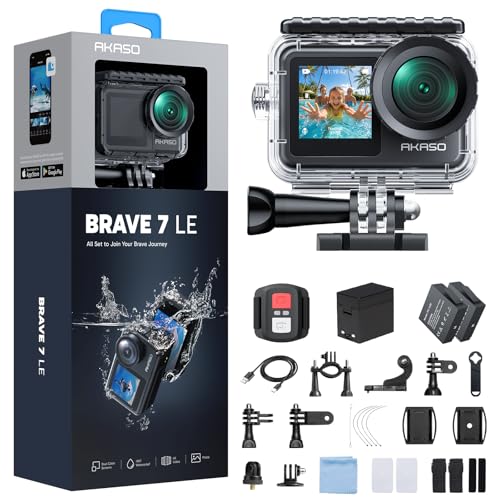
The Brave 7 LE is what the budget action camera grew up to be: weather-sealed, stabilised, touchscreen-controlled and honest about its abilities. For a beginner whose camera will be strapped to a bicycle, buried in a beach bag or rained on at a festival, its toughness is not a feature but the whole argument — a camera that survives is a camera that keeps teaching, and this one survives things that would end the compacts in this guide.
The touchscreen matters more than it sounds, because AKASO’s earlier menu systems were the brand’s weak point; here, settings are reachable by a beginner in seconds, the dual screens frame self-filmed pieces properly, and the included remote covers the mounted-camera situations that define action filming. Daylight video is lively and steady, and stills serve social sharing happily.
Its limits are the physics of its class: a small sensor that prefers daylight, batteries sized for sessions, and stills that support the video rather than leading. Beginners whose photography is movement, outdoors and adventure should start here without a qualm; beginners whose world is indoor and familial should start with the compacts below.
The Brave 7 LE also serves a beginner’s stills more kindly than its action label suggests: mounted on a small tripod, its wide view makes group photographs at viewpoints genuinely easy, remote included. Families whose holidays involve water — kayaking, coasteering, the waterpark day that destroys phones — find it becomes the trip’s official camera within a day, because it is the only one allowed everywhere. Permission, once again, is a photographic feature.
- Type: Action camera, waterproof in its housing and sealed body design
- Video: 4K recording with electronic stabilisation
- Control: Touchscreen plus remote control in the box
- Extras: Dual screens for framing self-filmed pieces
Strengths
- Survives the drops, rain and sand of beginner adventures
- Touchscreen makes it the easiest AKASO to learn
- Accessories in the box cover most first-year mounts
Trade-offs
- Stills are secondary to its video talents
- Low light is its ceiling, like every small action sensor
- Battery life suits sessions, not whole days of recording
Best for: Beginners whose photography involves bikes, beaches and weather.
Not suited for: A beginner whose main subject is family portraits indoors.

AKASO EK7000 — Best Simple Action Value
The EK7000 is the camera that introduced a generation to action filming at a price that made experimentation painless, and its longevity is itself a specification: every problem it has is known, every accessory exists, every mounting question has been answered by thousands of owners. For a beginner — especially a younger one whose camera will be dropped, dunked and loaned — that maturity is worth more than novelty.
The bundle philosophy defines it: the box contains the housing, mounts and remote that turn a camera into a kit, so the first ride, swim and hike need no further spending. Its footage in daylight remains cheerful and shareable, and its button-driven simplicity, while slower than a touchscreen, has the hidden virtue of working with gloves and wet hands.
Choose it over its newer sibling when the budget is tightest or the user is youngest, and accept its era: no touchscreen, humbler stabilisation, charging from an older standard. As the camera a beginner is allowed to risk, it has no equal in this guide — and learning photography with a camera you are allowed to risk is a genuine education.
The EK7000’s wrist remote deserves its own sentence of praise: start and stop recording from the handlebars, the helmet or the far end of a group photograph without touching the camera, a small luxury beginners use constantly once they discover it. It is also the camera in this guide most often bought twice — once for the beginner, once for the sibling who borrowed it — which is a market verdict no review can manufacture.
- Type: Action camera with a waterproof housing
- Video: 4K recording with electronic stabilisation
- Control: Buttons and a wireless remote wrist strap
- Kit: A generous bundle of mounts and accessories included
Strengths
- Proven design with years of owner knowledge behind it
- Bundle includes the mounts beginners would otherwise buy twice
- Simple operation suits young and first-time users
Trade-offs
- No touchscreen; settings are a button-press journey
- Stabilisation and low light trail its newer sibling
- Micro-USB era charging dates its design
Best for: First action cameras for younger beginners and rough use.
Not suited for: Anyone wanting touchscreen ease or the latest stabilisation.

GoPro HERO — Best Brand-Name Action
The little HERO is GoPro distilled: the stabilisation that made the brand, a waterproof body that needs no housing ceremony, and a touchscreen that behaves like it was designed this decade. For a beginner who knows action filming is the point — the rides, the runs, the water — it delivers the flagship experience’s essence in a smaller, simpler body, and its footage cuts seamlessly with material from its bigger siblings.
The ecosystem is the long-term argument. Every mount ever made for action cameras fits its world, every tutorial assumes its menus, and the app turns a beginner’s clips into edited stories with a competence that keeps motivation alive. Those soft advantages compound across a first year more than any specification in this guide.
Its costs are size’s usual tax: a battery for sessions rather than expeditions, and a price that consumes this guide’s whole budget frame before a card or a mount is added. Buy it as the deliberate choice of action filming as a craft, not as the cheap camera, and it rewards the seriousness immediately.
GoPro’s little HERO has one more beginner virtue: it forgives the learning curve’s timeline. Its footage from day one looks like the internet’s, because its stabilisation and colour do the heavy lifting while the beginner learns framing and timing. Motivation in a first year is a resource, and a camera that returns watchable footage from the first outing funds the practice that makes the second year’s footage genuinely good.
- Type: Compact action camera, waterproof without a housing
- Video: 4K recording with HyperSmooth stabilisation
- Control: Touchscreen with voice control options
- Ecosystem: GoPro mounts, accessories and app support
Strengths
- Stabilisation quality that embarrasses the budget class
- Waterproof body needs no housing for most adventures
- App and accessory ecosystem are the deepest in action filming
Trade-offs
- Small body means a small battery and session-scale recording
- Its price sits at the top of this guide’s budget frame
- Some app features live in GoPro’s subscription tier
Best for: Beginners who want action filming done properly from day one.
Not suited for: Buyers stretching the budget who need mounts and cards included.
Kodak PIXPRO FZ55 — Best Pocket Point-and-Shoot
The FZ55 succeeds by understanding its actual job: to be the camera a family or a young beginner uses instead of a phone, without weight, menus or fear. It is slim enough for any pocket, simple enough for a grandparent or a ten-year-old to master in minutes, and its photographs in ordinary light are bright, cheerful and honestly better than its tiny price suggests — particularly the zoom, which no phone at this level answers optically.
Kodak’s PIXPRO line survives by serving exactly this reader, and the FZ55’s rechargeable battery and USB charging fit modern households better than the AA-powered antiques still haunting this price tier. Its scene modes make the small decisions kindly, and its forgiveness — of shaky hands, of mixed light, of being handed around a party — is a design achievement beginners benefit from daily.
Its ceiling is clear and should be respected: dusk and indoor sport will test it, and nobody will print its files at exhibition size. As the camera that starts a child or a casual adult on real photography, carried everywhere because carrying it costs nothing, it is the most likeable pick in this guide.
The FZ55’s kindness extends to its battery manners: USB charging means the family power bank, the car’s socket and the café’s borrowed cable all feed it, so its owner never performs the proprietary-charger hunt that strands older compacts. For a child’s first camera, that universality matters more than any imaging specification — a camera that can always be charged is a camera that is always ready for the school trip and the birthday.
- Type: Slim point-and-shoot compact
- Lens: Optical zoom covering everyday scenes
- Power: Rechargeable battery with USB charging
- Controls: Scene modes and simple automatic operation
Strengths
- So light and slim it travels where cameras are usually left behind
- Operation simple enough for any age of beginner
- A kind first camera for children and casual family use
Trade-offs
- Small sensor limits low-light and print ambitions
- No viewfinder and a basic screen for bright days
- Video is a convenience, not a headline
Best for: Families and young beginners wanting a real camera, simply.
Not suited for: Anyone planning to print large or shoot seriously after dark.
Canon PowerShot ELPH 360 HS — Best Slim Classic
The ELPH line is the compact camera’s classic form — a slim metal card that disappears into a pocket and reappears with a real optical zoom — and the 360 HS is a refined late example. For a beginner whose photography is travel, family and the everyday, it offers the two things phones simulate and cannot match: genuine zoom reach and the simple physical pleasure of a camera that is only a camera.
Canon’s colour science flatters the subjects beginners actually photograph, its stabilisation rescues the zoom’s far end in ordinary light, and Wi-Fi sharing respects the modern truth that a photograph unshared is a photograph unfinished. It is a gentle, competent, unpretentious tool, and generations of beginners have learned on its ancestors exactly because nothing about it fights back.
Its generation shows in video ambition and screen specification rather than in stills, where it remains entirely respectable. Buy it for photographs, carry it everywhere, and it will quietly out-shoot the phone it replaces in every scene involving distance, which on most holidays is half of them.
The ELPH’s Wi-Fi, easy to dismiss as a bullet point, is in practice its beginner superpower: photographs move to the phone in the moment, so the camera participates in the sharing life that motivates beginners to keep shooting. Cameras whose files are imprisoned until a cable and a laptop convene tend to fall silent by month three. The Canon understood the modern photograph’s full journey — capture, transfer, share — earlier than most, and beginners feel that understanding daily.
- Type: Slim compact in Canon’s long-running ELPH line
- Lens: Long optical zoom in a card-sized body
- Features: Image stabilisation and Wi-Fi sharing to a phone
- Handling: Simple automatic operation with scene guidance
Strengths
- Zoom reach in a body that truly fits a pocket or clutch bag
- Canon’s colour and handling polish at a beginner price
- Wi-Fi transfer keeps the phone-sharing habit alive
Trade-offs
- An older design whose video and screen show their generation
- Small sensor shares the class’s low-light limits
- Battery life is day-scale; a spare is a wise companion
Best for: Beginners wanting a discreet everyday camera with real reach.
Not suited for: Video-first creators or low-light specialists.
Panasonic Lumix ZS70 — Best Travel Zoom
The ZS70 is the beginner camera for travellers who refuse to choose between the panorama and the eagle. Its very long zoom lives in a pocketable body, and — the feature that separates it from every rival here — a real electronic viewfinder means the far end of that zoom can actually be used in bright alpine or beach light, where screens wash out and guesswork begins. For wildlife gardens, distant landmarks and candid street distance, it is in a class of one in this guide.
Panasonic also gave it the growing room beginners elsewhere in this guide must change cameras to find: manual controls, a lens ring, and 4K photo modes that pluck stills from bursts for the moments too fast for a finger. A beginner can start on full automatic, where it behaves kindly, and still be learning from the same camera two years later.
Its small sensor asks daylight for its best work, and its price presses the ceiling of this guide’s frame, which is why the used market matters for this model in particular. As the one camera a travelling beginner carries for everything, though, its combination of reach, viewfinder and growth is unmatched at the level.
The ZS70 rewards one specific beginner habit better than any rival here: the evening review. Its viewfinder and screen make the day’s frames a pleasure to audit, and its manual controls mean the audit can immediately become tomorrow’s experiment — a different aperture on the same viewpoint, the zoom worked like a muscle. Beginners who review nightly on a camera that can answer their questions improve at a rate that startles their future selves.
- Type: Travel zoom compact with an electronic viewfinder
- Lens: Very long zoom range in a pocketable body
- Controls: Manual modes and a lens control ring
- Video: 4K video and 4K photo modes for action moments
Strengths
- Viewfinder transforms bright-day and telephoto shooting
- Zoom reach covers wildlife, landmarks and candid distance
- Manual controls give a beginner somewhere to grow
Trade-offs
- Small sensor means the long zoom prefers daylight
- The most complex camera here; budget an evening to learn it
- Sits at the top of the budget frame, especially bought new
Best for: Travelling beginners who want one camera for every distance.
Not suited for: Point-and-shoot purists who never want to see a setting.
What Can a Camera at This Level Honestly Do Better Than a Phone?
Four things, and they are worth naming precisely. Optical zoom: a real lens reaching across a valley or a school hall without the digital mush phones substitute. Ergonomics: buttons, grips and dials that work with gloves, wet hands and haste. Endurance of attention: a camera does nothing else, so it never interrupts a photograph with a notification, a call or a dying battery shared with your whole digital life. And intention: carrying a camera changes how a beginner looks at the world, and that change — not any specification — is the largest image-quality upgrade in this entire guide.
Where the phone still wins, honesty requires listing: computational low-light magic, instant sharing, and the screen. A beginner who understands both columns chooses a camera for the first column’s reasons and keeps the phone for the rest, which is exactly the division of labour every pick here was designed to serve.
How Should a Beginner Spend the Rest of a Small Budget?
The camera is roughly two-thirds of a working budget at this level. The remainder buys, in order: a memory card from a known maker (counterfeit cards are this tier’s silent plague), a simple case or pouch that will actually be used, a spare battery for the compacts that accept one, and a wrist strap for the cameras that will be handed to children. That list is deliberately boring; boring accessories are the ones standing between a beginner and the hobby’s commonest disasters.
Resist the accessory bundles sold alongside budget cameras, whose tripods wobble, whose bags smell of glue and whose ‘kits’ exist to clear shelves. Buy the camera, live with it for a month, and let its real frictions choose your accessories one at a time. A beginner’s second purchase should answer a problem they have actually had, which is the cheapest shopping education available.
How Does a Beginner Get Good Photographs From a Modest Camera?
Light is the whole secret, and it is free. Modest sensors are excellent in good light and honest in poor light, so the beginner who shoots in the morning and the golden evening, who moves subjects toward windows and out of murky corners, and who learns to turn a scene until the light agrees with it, will out-photograph a careless owner of a camera ten times the price. This is not a consolation; it is photography’s central skill, and a modest camera teaches it faster because it refuses to cover for its absence.
Stability is the second free upgrade: brace elbows, lean on walls, hold the zoom’s far end with both hands and a held breath. The third is closeness — beginners photograph everything from too far away, and the discipline of filling the frame transforms modest files into strong ones. Master those three habits on any camera in this guide and your photographs will ask questions of cameras far above this budget.
How Do You Tell a Genuine Budget Camera From a Toy in Disguise?
Apply four tests, all readable from a listing without buying anything. The maker test: is there a real company with a service address, firmware updates and other models, or a name that exists only on this box? The lens test: is the zoom optical, with a stated range, or ‘digital’ magnification of a fixed view? The sensor test: is a real sensor size or type named, or only a megapixel figure with adjectives? The ecosystem test: do independent reviews, spare batteries and cases exist for this exact model?
A genuine budget camera passes all four modestly; a toy in disguise fails at least two loudly. The picks in this guide were chosen by these tests before any photograph was considered, because at this budget the first purchase decision is not which camera is best — it is which cameras are cameras at all. Beginners deserve that gate kept for them, and keeping it is most of this guide’s value.
When Should a Beginner at This Budget Upgrade, and to What?
Upgrade when a named limitation taxes you on a schedule — the zoom that cannot reach the school stage, the dusk that defeats the sensor at every family gathering, the video that cannot follow the sport your life now contains. A limitation with a name and a calendar is a tool requirement; a vague sense that photographs should be better is a practice requirement, and practice is free.
When the day comes, the natural steps from this tier are the ones this series maps elsewhere: the value systems in the bang-for-buck guide for stills-led beginners, a fuller action flagship for the adventure-led, or a careful used purchase inside a chosen lens system. Keep the budget camera as the second, the loaner, the risk-taker — almost every photographer in this guide’s audience still owns their first camera, and uses it more than they expected to.
How Does a Beginner Learn to See Photographically on a Budget Camera?
The camera cannot teach seeing, but it can stop preventing it, and that is this tier’s real curriculum. Begin with the one-subject discipline: choose a single subject — a tree, a doorway, a grandparent — and photograph it weekly for a season, in every light and weather. The subject stays still; your seeing does the growing, and a modest camera records the growth with perfect fidelity. Beginners who do this exercise own, by winter, a small body of work that teaches them more than any equipment thread ever written.
Continue with the constraint games that cost nothing: a day of only vertical frames, a walk where every photograph must contain the colour red, an hour photographing nothing but shadows. Constraints sound like school and feel like play, and they rewire attention faster than any tutorial, because they give the eye an assignment. The cameras in this guide are ideal instruments for this stage — present, forgiving, and honest enough to show the student exactly what changed.
Finish the season by printing. Choose the ten best frames, print them at a size that frightens you slightly, and live with them on a wall for a month. Paper is the strictest teacher in photography and the cheapest at this level: it forgives nothing, flatters nothing, and shows a beginner precisely which of their habits to keep. A budget camera that has been through a printed season has delivered an education that expensive cameras, unprinted, routinely fail to deliver.
How Do the Six Budget Beginner Cameras Compare?
At this level every camera is a deliberate trade, so the table compares each pick’s gift against the limitation its owner should accept knowingly.
| Pick | Badge | Standout trait | Watch out for |
|---|---|---|---|
| AKASO Brave 7 LE | Best Rugged Starter | A weather-sealed action camera with a touchscreen and real stabilisation. | Stills are secondary to its video talents |
| AKASO EK7000 | Best Simple Action Value | The long-running budget action classic, with everything a first kit needs. | No touchscreen; settings are a button-press journey |
| GoPro HERO | Best Brand-Name Action | GoPro’s compact entry model with the ecosystem and polish of the flagship line. | Small body means a small battery and session-scale recording |
| Kodak PIXPRO FZ55 | Best Pocket Point-and-Shoot | A featherweight compact that asks nothing and forgives everything. | Small sensor limits low-light and print ambitions |
| Canon PowerShot ELPH 360 HS | Best Slim Classic | Canon’s pocketable line at its most refined, with a proper optical zoom. | An older design whose video and screen show their generation |
| Panasonic Lumix ZS70 | Best Travel Zoom | A long zoom, a viewfinder and manual controls for a beginner going places. | Small sensor means the long zoom prefers daylight |
The recurring shape of the tier: toughness, reach, simplicity and growth are sold separately, and the art of buying here is knowing which one your beginner will spend. Choose that one thing well and the rest of the camera’s compromises fade into the background of a happy first year.
What Mistakes Do Beginners Make at This Budget?
Believing the megapixel headline
At this level, resolution is the cheapest specification to inflate and the least connected to the photographs a beginner will love. A modest sensor with a bright lens and honest processing out-shoots a paper champion every evening of the week. Judge by sensor size, lens and maker — the unglamorous trio — and let the megapixel contest be won by cameras you did not buy.
Buying the anonymous mega-bundle
A camera-shaped object bundled with forty accessories at a miraculous price is miraculous mainly in its marketing. Beginners cannot yet tell whether the fault is theirs or the equipment’s, and bad equipment teaches self-doubt. The named makers in this guide exist at this budget precisely so that a beginner’s failures are their own — instructive, temporary and fixable.
Forgetting the memory card’s importance
The card is the film, the archive and the single point of failure, and counterfeit or bargain cards corrupt quietly and completely. Buy one card from a known maker through a reputable seller, format it in the camera, and back photographs up to a second home weekly. This paragraph is the least exciting in the guide and will save more photographs than any other.
Judging the camera by its worst photograph
Every beginner camera produces a terrible frame in a dark hall at full zoom, and owners who judge by it return good cameras and repeat the experiment at the same result. Judge by the hundredth photograph in decent light instead — that is the camera’s character. The first hundred frames are tuition, and tuition is supposed to look like learning.
Skipping the manual’s first twenty pages
Budget cameras hide their best behaviours — stabilisation settings, scene modes, the zoom’s macro trick — behind defaults a beginner never meets. Twenty pages and one evening’s experimentation separate the owner who fights their camera from the one who collaborates with it, and no upgrade at this budget buys that difference afterwards.
Letting a child learn on a phone instead ‘because it is easier’
Easier is not the same as better for learning: a phone teaches photography as one app among forty distractions, while a simple dedicated camera — the Kodak in this guide exists for this — teaches it as a craft with one job, real buttons and no notifications. Children rise to the seriousness of a real tool with a speed that surprises adults, and the photographs they keep are theirs in a way a borrowed phone’s never are.
Final Recommendation
For the beginner whose world is outdoors and moving, start with the AKASO Brave 7 LE, or its simpler EK7000 sibling if the budget must stretch to accessories as well; for the beginner who wants the polished action flagship experience, the little GoPro waits at the top of the frame. All three will survive the education they provide, which at this level is half the curriculum.
For stills-first beginners, the Kodak is the kindest first step, the Canon ELPH the discreet everyday classic, and the Panasonic ZS70 the traveller’s growth machine. Whichever you choose, spend the remainder of the budget on a real memory card and a case, shoot in the good light, and judge the camera at frame one hundred — by then it will have started to make a photographer of its owner.
A closing encouragement, because this budget tier attracts an unfair sneer: some of the most beloved photographs in any family were made on cameras humbler than every pick here, by beginners who pointed them at people they loved in good light. The equipment in this guide is sufficient — demonstrably, joyfully sufficient. What it awaits is a beginner willing to carry it daily and judge it at frame one hundred, by which point the sneerers have usually gone quiet.
Related guides
Frequently Asked Questions
Is a camera at this budget really better than a phone for a beginner?
For specific things, decisively: optical zoom, operation with gloves and wet hands, a battery devoted to photography, and the deliberate habit that carrying a camera builds. For computational night modes and instant sharing, the phone remains ahead. Most beginners who thrive use both, and the camera’s role — the deliberate, zooming, surviving role — is the one this guide’s picks were chosen to fill.
Should I buy a used mid-range camera instead?
It is the strongest alternative at this budget and the right choice for a beginner with a knowledgeable friend to vet the purchase, or the patience to buy graded stock from a reputable dealer with a returns window. What used buys is image quality; what it risks is history — shutter wear, sensor marks, tired batteries. New buys certainty and a warranty. Choose by your access to advice, honestly assessed.
What does ‘interpolated’ resolution mean in budget listings?
It means the camera manufactures extra pixels by guessing between real ones, inflating the headline number without adding any actual detail. Judge a camera by its sensor’s true resolution and, far more, by its sensor size and lens. Listings that lead with interpolated figures are telling you something about the seller, and this guide’s named makers are recommended partly because their small print survives reading.
Can these cameras shoot in RAW?
Mostly no, and at this level that is the right priority: beginners are learning light, composition and timing, not post-processing, and these cameras’ JPEG files are tuned to please immediately. The exception-minded beginner who already edits should look at the Panasonic’s richer modes or save toward the next tier. RAW is a second-year conversation for almost everyone, and postponing it costs nothing.
How long will a beginner keep a camera at this level?
Typically one to three years — long enough to learn whether photography is a passing curiosity or a lasting love, which is precisely the question this budget exists to answer. The action cameras often stay in service for years as second cameras even after an upgrade, and the compacts become family hand-me-downs. Money at this level is tuition with a resale value, and judged that way it is rarely wasted.
What is the best first subject for a total beginner?
The people and places already loved: family in window light, the family dog at the park, the street you live on at dawn. Familiar subjects forgive technical learning curves and reward the beginner with photographs that matter immediately. Save the ambitious expedition for month three, when the camera is boring in your hands and the light has become something you can see coming.
Do I need a tripod with a budget camera?
Not at first. Learn the free stability first — braced elbows, walls, tables, the two-second timer trick for static scenes — and let a specific recurring failure make the tripod’s case later. When it does, buy one honest small tripod rather than a bundle’s wobbling accessory. Beginners’ money works hardest in the order this guide has repeated: card, case, spare battery, and only then the furniture.
Are budget action cameras good enough for family holidays?
For the wet, sandy, moving half of a family holiday, they are not merely good enough but correct: the footage is lively, the risk is painless and the sharing is easy. Pair one with a phone or a compact for the still, indoor, evening half and the holiday is covered completely. Many families find the action camera becomes the holiday’s official historian precisely because nobody is precious about it.
What zoom do I need for school events and sports days?
Enough to fill the frame from a parent’s seat, which in practice means the longest honest optical zoom your budget and pocket allow — the reason the travel zoom in this guide exists. Shoot at the zoom’s far end in the best light you can find, brace well, and accept that indoor evening sport is the hardest assignment in beginner photography at any budget. Outdoor daytime events, by contrast, are exactly where these cameras shine.
Can a budget camera handle a school photography course?
Comfortably, for the first year of almost any course: the curriculum is light, composition and intention, all of which these cameras serve, and tutors are accustomed to modest equipment in beginners’ hands. If a course later requires full manual control or RAW capture, that requirement arrives with warning and defines the upgrade precisely — which is the healthiest way any camera purchase can be made, as this guide has argued throughout.
Is a budget camera a good gift for a teenager?
One of the best, provided it matches their world: the action picks for the skater, rider and swimmer; a compact for the traveller and family documenter. A real camera tells a teenager their seeing is worth an instrument, and it survives the school bag in a way a fragile gift would not. Add a card and a case, wrap the whole kit, and include one sentence of permission: it is yours, take it everywhere, risk it honestly.
How do I stop a budget camera’s photographs looking washed out?
Usually the light, not the camera: avoid shooting into bright skies that fool the exposure, move closer so the subject fills the frame and meters honestly, and use the scene modes — portrait, landscape, sport — that exist precisely to encode these judgements. A gentle tap of exposure compensation, which most picks here offer, rescues the rest. Washed-out is a diagnosis with a free cure, and learning it is a beginner milestone.
Can these cameras be used for a small business’s product photographs?
For daylight, honestly presented products — market stalls, handmade goods, café specials — yes, especially the compacts with a macro mode and a bright lens, shot near a window on a plain background. Businesses outgrow them when volume, consistency and low light become commercial requirements, at which point the upgrade defines itself. Many a shop’s first year of photography was made at exactly this level, and customers never knew or cared.
What is the difference between these and a disposable camera revival?
Everything except the price conversation: these are reusable instruments with screens, zooms, video and files you keep forever, while the disposable revival sells nostalgia and surprise at a per-roll cost that quietly exceeds a budget compact within a year. A beginner who wants photography should buy the instrument; the disposable is a party favour with a lens, and parties, unlike hobbies, end.
How do I know if a beginner has outgrown a budget camera?
By the same named-limitation test this guide applies everywhere: when the same frustration — the reach, the dusk, the video — taxes them on a schedule, and their photographs are otherwise thriving, the camera has become the ceiling and an upgrade is a tool purchase. Until that day, a budget camera’s limitations are mostly invisible behind the larger, happier limitation of being a beginner, which practice removes free of charge.
What should a beginner do on the first day with a new camera?
Charge it fully, fit the card, set the date, and then take it somewhere ordinary and beloved for a hundred unhurried frames — the street, the park, the family’s faces in window light. Resist the unboxing-video urge to test every mode; instead, learn the one dial that matters, the shutter, in the company of subjects that forgive. End the day by looking at every frame once, kindly, and deleting nothing in anger. The second day is for the manual’s first twenty pages.
Should a beginner turn off the camera’s digital zoom and never use it?
Yes, as a standing rule: digital zoom is cropping performed in the camera, discarding the pixels you paid for and enlarging the remainder with guesswork. Walk closer, use the optical zoom, or crop calmly later on a computer where the decision can be revisited. The single exception is framing for a quick share where quality is secondary to the moment — and even then, the beginner who keeps the habit optical will thank themselves at printing time.
Related Guides
Keep exploring with best cameras and easiest for beginners and best bang for buck digital cameras for beginners and best blog cameras for beginners.


