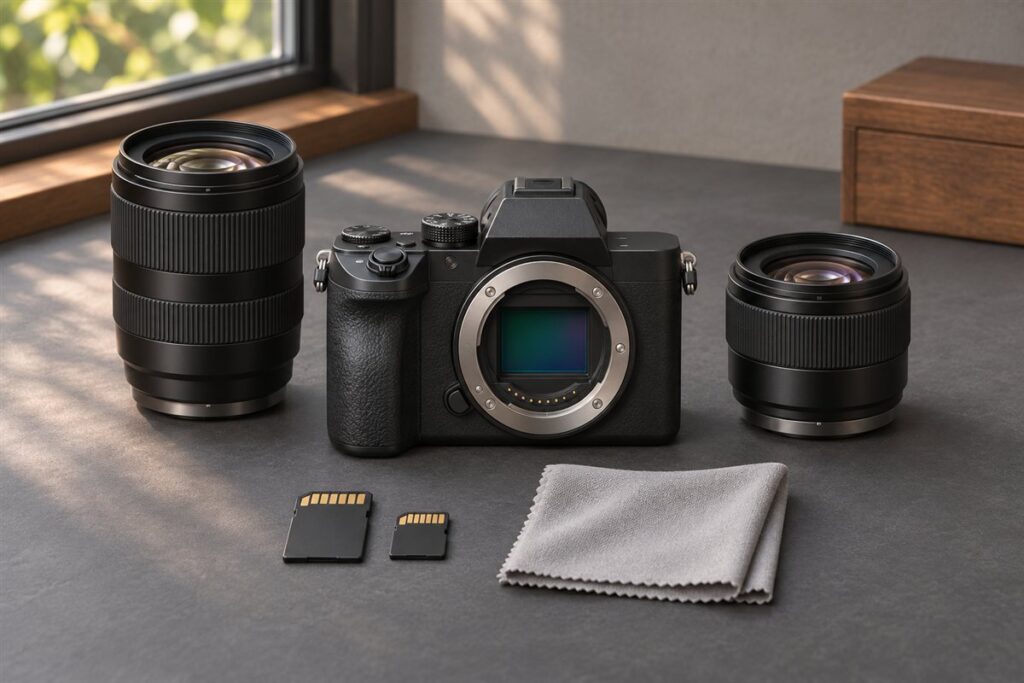
The main benefits of a mirrorless camera are a smaller body, an electronic viewfinder that shows your exposure before you shoot, and modern autofocus and video features. The trade-offs are battery use and, for some people, getting used to a screen-based viewfinder.
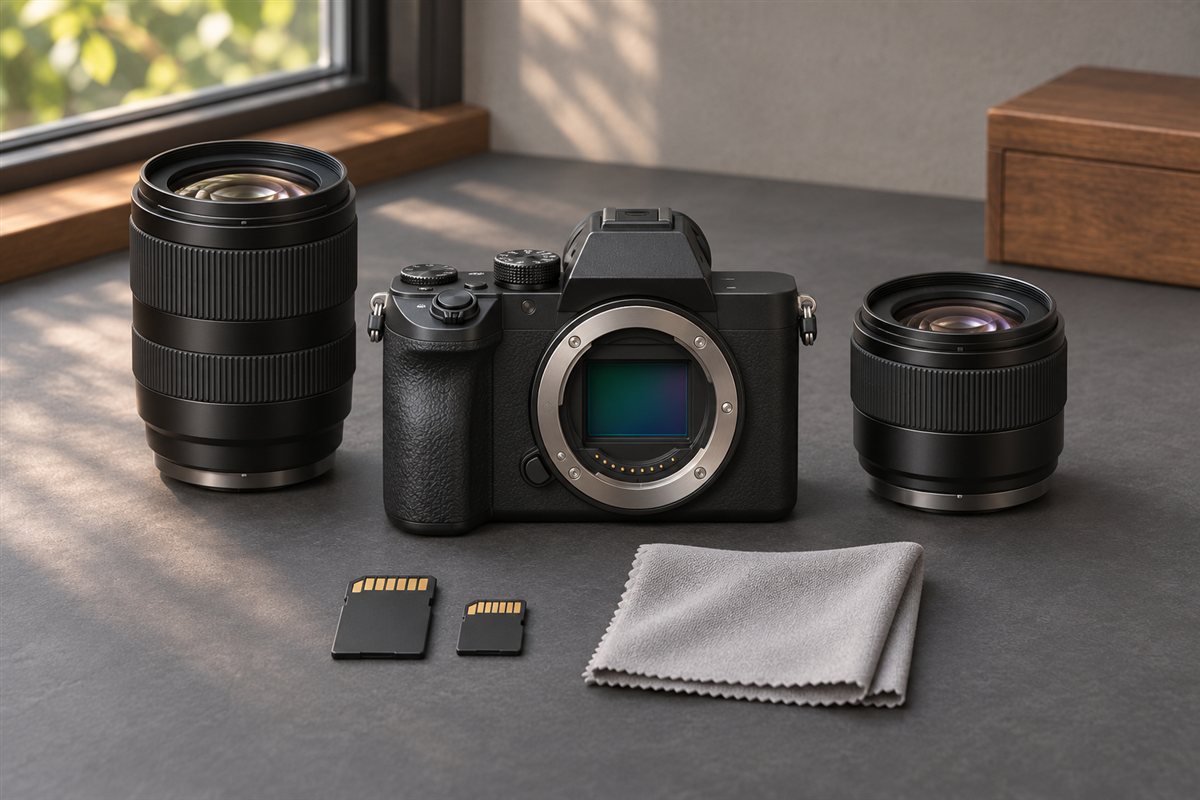
What Mirrorless Means
A mirrorless camera has no flipping mirror inside the body. Light goes straight to the sensor, and the image you see in the viewfinder or on the back screen comes from that sensor. Traditional DSLRs use a mirror and an optical viewfinder instead.
The Main Benefits
- Smaller and lighter bodies. Without the mirror box, many models are more compact, which is handy for travel. Lenses can still be large, especially telephotos.
- A live look at the result. An electronic viewfinder can show brightness, color and depth cues as you adjust settings, so fewer surprises appear on the screen afterward.
- Advanced autofocus. Many models offer face and eye detection and subject tracking across the frame.
- Video features. Mirrorless cameras are often built with video in mind, offering good autofocus during recording and a range of formats.
- Quiet shooting options. An electronic shutter mode allows near-silent operation, useful at events and in wildlife settings. It can distort fast-moving subjects, so use it with care.
- Active lens development. Camera makers now focus most new lens designs on mirrorless mounts.
The Trade-Offs
| Area | Mirrorless | DSLR |
|---|---|---|
| Body size | Often smaller | Often bulkier |
| Viewfinder | Electronic, shows a live look | Optical, direct view |
| Battery life | Often shorter per charge | Often longer |
| Lens choice | Growing, plus adapters | Large used market |
How to Decide
- List what you shoot: travel, family, sports, video or portraits.
- Handle a few bodies in a shop to check grip and viewfinder comfort.
- Look at the lens lineup for your needs, not just the body.
- Plan for spare batteries if you shoot long days.
- Consider whether you already own lenses that could be adapted.
Cost and value are worth a thought as well. Used and older models can offer plenty of capability, and the lens you buy often shapes your results more than the body does. Many models can also be charged over USB, which is handy when traveling, though you should check which cables and chargers your model accepts. If you are unsure, rent or borrow a mirrorless body for a weekend and see whether the electronic viewfinder and menu layout suit you before committing.
Autofocus in Real Shooting Situations
Autofocus is where many people notice the day-to-day difference. Because a mirrorless camera reads focus information directly from the sensor, the focus area can cover much of the frame, so you are not limited to a small cluster of points near the center. That makes it easier to compose off-center and still keep a subject sharp.
Many bodies offer detection modes for people, animals or vehicles, and some follow a subject once you select it. These modes can help with children running, pets, birds in flight and sports, but they are not magic. They still struggle at times with busy backgrounds, low contrast, subjects partly hidden by branches or fast erratic movement. Practice with your chosen mode before an important event, and learn how to switch between tracking and a fixed point when the subject is unclear.
Different models vary a lot in how well they track, and manufacturers describe their systems in different words. Instead of trusting a brand label, look at the camera’s own manual for which detection types it supports, and look for real-world sample footage from owners of that model. Also check how the autofocus behaves in video, since some models handle smooth focus transitions better than others.
A final note: the lens affects focus performance too. Newer lens designs are often built for quick, quiet focusing, which helps both stills and video. If you adapt older lenses, check what autofocus features still work.
Using the Electronic Viewfinder Every Day
The electronic viewfinder is the feature people either love quickly or need time to accept. Its main strength is that it shows the image as the sensor will record it. When you change exposure compensation, white balance or a picture style, the preview responds. In dim rooms, many viewfinders brighten the view so you can compose more easily than through an optical finder.
It also offers tools that an optical viewfinder cannot easily provide:
- Grid lines and a level indicator to keep horizons straight.
- A histogram or exposure warning displayed while you compose.
- Focus aids that highlight sharp edges when focusing manually.
- Playback of the last shot without taking the camera from your eye.
There are quirks to consider. Viewfinders vary in size, sharpness and refresh behavior, and fast action can look different in a screen-based view than in a direct optical one. Some people notice a slight delay or a flicker in certain lighting. Eyeglass wearers should test eye relief, meaning how far back your eye can sit and still see the whole frame.
The best advice is to look through the viewfinder of a model before buying. Walk around the shop, point it at a window and a dark corner, and see whether you like what you see. If you plan to shoot a lot outdoors in bright light, check how the viewfinder and rear screen perform in sun.
Battery Planning and Power Habits
Battery life is the most common complaint from people who switch, because the sensor, the viewfinder and the rear screen all draw power. Manufacturers publish shot-count figures, but real use differs with temperature, video recording, screen brightness and how often the camera wakes up. Treat the published number as a rough comparison, not a promise, and check how it was measured on the maker’s page.
A few habits stretch what you get from each charge:
- Turn off the camera between shooting sessions, or use a short sleep timer.
- Lower rear-screen brightness, and use the viewfinder when you can.
- Switch off features you do not need, such as wireless connections left running in the background.
- Keep batteries warm in a pocket in cold weather, since cold reduces capacity.
Carry at least one spare for long days, and label your batteries so you know which are charged. Check whether the camera can be charged through a USB cable, and whether it can run from a power bank, since that can be a useful backup on trips. Confirm the supported charging power and cable type in your manual, as not every model accepts every charger.
Use batteries from the camera maker or reputable makers listed as compatible, and avoid swollen, damaged or very old cells. If your camera loses charge quickly after a year or two, replacement is cheaper than missing a shot.
Using Your Existing Lenses With Adapters
One concern for many photographers is what happens to the lenses they already own. Because mirrorless bodies sit closer to the lens mount, adapters can often connect lenses from older systems. Some adapters simply fit the lens, while others pass along electronic signals for autofocus, aperture control and stabilization. What works depends entirely on the specific camera, adapter and lens, so check the maker’s compatibility lists before buying.
Think about the trade-offs. An adapter adds length and a small amount of weight, and it is another point where dust or looseness can creep in. Autofocus on adapted lenses can be slower or less accurate than on lenses designed for the new mount. Features such as eye tracking may behave differently, or may be limited. For video, manual focus lenses can work nicely with focus aids on the screen.
Adapting makes sense when:
- You own several good lenses and want to spread the cost of switching.
- You enjoy manual focus lenses with a particular look.
- You plan to replace lenses gradually, starting with the one you use most.
It makes less sense if you rely on fast, precise autofocus for action. In that case, factor the cost of native lenses into your budget from the start. Ask the seller or maker’s support what features survive adaptation for the exact lens you own.
Who Gains Most and Who Can Wait
Not everyone needs to switch. A fair way to decide is to list the problems you face now and see whether mirrorless addresses them. If your camera is heavy and stays at home, a smaller body could change how often you shoot. If you struggle to nail exposure or focus on moving subjects, live previews and tracking could help. If you shoot video regularly, mirrorless designs often include features that DSLR bodies lack.
Those who may gain less include people with a well-matched DSLR kit that already serves them, especially if battery life and an optical view are priorities. Used DSLR gear can be a sensible choice for a beginner on a tight budget, because older bodies and lenses are widely available. Waiting also lets you see how your preferred brand’s lens lineup develops.
Beginners should not obsess over body specifications. A good lens, steady technique and good light matter more. Ask yourself a few practical questions: Will I carry it? Do I enjoy using the viewfinder? Can I afford a lens that suits my main subject? If the answers lean yes, mirrorless is a solid choice. If you are unsure, rent a body for a weekend, or visit a shop and handle several models, then decide at your own pace.
Is a Mirrorless Camera Good for Travel and Daily Carry?
Yes, a mirrorless camera is often a good travel choice because the body is usually smaller and lighter than a comparable DSLR. The saving is real for the body, but the lens you mount decides how compact the whole kit feels.
A small body with a large zoom lens can still fill a bag. If portability is your main reason for switching, think about the complete setup, not just the camera on its own.
- Prime lenses are usually the most compact option and pair well with a small body for walking around a city.
- Standard zooms cover many situations with one lens, but they add length and weight.
- Telephoto lenses stay large on any system, so a mirrorless body does not shrink a wildlife or sports kit very much.
Handling matters as much as size. A very small body can feel cramped in larger hands, and a deep grip makes a heavier lens easier to hold steady. Try holding the camera with the lens you plan to use, and check that the buttons you need most are easy to reach without looking.
Think about the extras too. Spare batteries, a charging cable, memory cards and a cleaning cloth all take space. A compact body helps most when you also keep the rest of the kit lean, so decide in advance which lenses really earn a place in the bag for a trip.
Which Mirrorless Camera Should You Buy for Your Kind of Shooting?
The right mirrorless camera depends on what you shoot most, because each type of shooting leans on different features. Match your main subject first, then compare bodies.
- Travel and street: look for a compact body, a comfortable grip and a small prime or light zoom. Lens size matters more than the body here.
- Family and pets: prioritize reliable subject tracking and a quick start-up, so you catch moments that do not repeat.
- Sports and wildlife: look for a fast burst rate, a deep buffer and a lens lineup with long telephotos. Check how well the electronic viewfinder keeps up with fast action.
- Portraits: eye detection and a good selection of fast primes matter more than the headline sensor size.
- Video and vlogging: check the recording formats, a flip-out screen, a microphone input and how long the camera can record before it warns about heat.
- Beginners on a budget: a used or older body with a good lens usually gives more value than a new body with a basic lens.
If you fit more than one group, rank your needs. A family photographer who also films holidays may decide that autofocus reliability beats every other feature, and that makes the shortlist much shorter.
Do not choose on a single specification. Read the manual or the maker’s specification page for the features you care about, and look for sample photos or footage taken with the exact model you are considering.
How Does a Mirrorless Camera Help You Learn Photography?
A mirrorless camera helps you learn faster because the viewfinder and screen show the effect of your settings before you press the shutter. That feedback shortens the gap between changing a setting and understanding what it did.
When you raise exposure compensation, the preview gets brighter. When you change white balance, the colors shift on screen. Beginners often find this easier than shooting, checking the result and trying again.
These tools are worth learning early:
- Histogram: shows how brightness is spread across the frame, so you can spot an image that is too dark or too bright.
- Exposure warnings: highlight areas that may lose detail in the brightest parts of a scene.
- Focus peaking: outlines sharp edges when you focus by hand.
- Level indicator: keeps horizons straight without checking afterward.
Do not rely on automatic modes forever. Try aperture priority to see how the background changes as you open and close the lens, then try shutter priority to freeze or blur motion. The live preview makes these experiments quick.
One caution: the preview is a guide, not a guarantee. Screen brightness and viewfinder settings can make an image look better or worse than it really is. Check the histogram, and review a few frames on a computer before you decide your settings are right.
What to Check Before You Buy a Mirrorless Camera
Before buying a mirrorless camera, confirm that the body, lenses, storage and power all work together for the way you shoot. Most disappointments come from missed details rather than from the camera itself.
- Lens mount and lineup: check that the lenses you want exist for this system, and that you can afford the one you will use most.
- What is included: confirm whether the listing includes a lens, battery, charger, strap and memory card, or only the body.
- Memory card type: check the card format and speed class the camera needs, especially for video.
- Charging method: see whether the camera charges over USB, and which cables and chargers it accepts.
- Screen and ports: look for a tilting or flip-out screen if you shoot video or low angles, and for a microphone or headphone jack if audio matters.
- Weather sealing: confirm what the maker claims, and do not assume every body or lens is sealed.
- Warranty and returns: read the terms on the listing, including who handles repairs and how long the return window lasts.
Ask whether the seller is an authorized dealer, particularly for expensive bodies, because warranty coverage can depend on it. If the listing is for a used camera, ask about shutter count, battery condition and cosmetic wear.
Finally, keep a small budget for accessories. A spare battery, a good card and a sturdy bag often improve daily use more than a slightly better body would.
Is a Mirrorless Camera Worth the Switch, or Should You Skip It?
A mirrorless camera is worth it if its strengths match your problems, and not worth it if your current kit already does the job. Be honest about the downsides before you spend money.
- Battery life: expect to carry spares, since the viewfinder and screen draw power constantly.
- The viewfinder: some people never warm to a screen-based view, especially in fast action or in unusual lighting.
- Lens costs: a new system can mean buying lenses again, or living with adapters that may limit autofocus.
- Learning time: menus and custom buttons take a while to set up the way you like.
Skip or delay the switch if you rarely feel limited by your current camera, if you shoot mostly in bright conditions with an optical viewfinder you enjoy, or if the cost of new lenses would leave you with a worse kit than the one you have.
Switch if you want a lighter bag, better subject tracking, strong video features or access to the latest lens designs. For many people, the benefits show up in how often they bring the camera along.
Compare the options that fit your subjects, check the current listing for what is included and which lenses are supported, then choose the body that fits how you will use it.
FAQ
Is mirrorless better than DSLR?
Not in every case. Mirrorless leads in features and size, but a DSLR can be a fine choice, especially if you already own lenses for it.
Do I need a full-frame sensor?
No. Smaller sensors give lighter kits and often cost less to build around. Choose based on your needs for low light and image quality.
Is the electronic viewfinder laggy?
Modern viewfinders usually refresh quickly, but models differ. Some people notice lag or flicker with fast action or certain lighting. Try the model in person if you shoot moving subjects.
Are mirrorless cameras better for video?
Many are designed with video in mind and offer continuous autofocus and varied recording formats. Still, specific features differ by model, so check the specification page for the resolution and frame rates you need.
Do mirrorless cameras get dust on the sensor more easily?
With no mirror, the sensor can be exposed when a lens is removed, so change lenses quickly and point the body downward. Many models include a sensor-cleaning feature, but check your manual for care instructions.
How many spare batteries should I carry?
It depends on how you shoot. For a day of travel or an event, one or two spares are common. Video and cold weather drain batteries faster, so plan extra for those.
Is the electronic shutter safe to use all the time?
It is useful for quiet shooting, but fast movement or artificial lights can cause distortion or banding. Many photographers use it selectively and switch back to the mechanical shutter for action.
Will my old memory cards work?
Often yes, but check the card type and speed class your camera needs, especially for video. Some newer bodies use different card formats than older ones.
Should a beginner buy mirrorless or DSLR?
Either can work. Mirrorless gives a live preview that helps learning, while a used DSLR can cost less. Pick based on budget, lens availability and how comfortable the camera feels in your hands.
Are mirrorless cameras good for beginners?
Yes, many are well suited to beginners because the live preview shows how settings change the image. Automatic modes help at first, and you can move to manual control as you learn. Choose a model that feels comfortable and has a lens you can grow with.
What is the difference between mirrorless and DSLR cameras?
A DSLR uses a mirror and an optical viewfinder, while a mirrorless camera sends light straight to the sensor and shows a digital preview. Mirrorless bodies are often smaller and offer more video and autofocus features. DSLRs often last longer per battery charge and have a large used lens market.
Do mirrorless cameras take better photos than DSLRs?
Not automatically. Image quality depends mostly on the sensor size, the lens and the light, not on whether there is a mirror. A good DSLR and a good mirrorless camera can produce very similar results.
Can you use a mirrorless camera for sports and wildlife?
Yes, many people do, but check the burst rate, buffer size and subject tracking of the specific model. Long telephoto lenses are still large and heavy. Test the viewfinder with moving subjects if you can.
Why does a mirrorless camera drain the battery so fast?
The electronic viewfinder, rear screen and sensor are active whenever the camera is on. Wireless features and video recording add more drain. Turning the camera off between shots and carrying spares helps.
Should I buy a mirrorless camera body only or with a kit lens?
A kit lens is convenient and often cheaper than buying the pieces separately, so it suits beginners. Body only makes sense if you already have lenses or plan to choose a specific one. Check the listing to see exactly what is included.
Is a used mirrorless camera a good idea?
It can be a sensible way to get good features for less. Ask about battery condition, shutter use and any damage, and confirm what the seller's return terms are. A trusted seller with a clear policy lowers the risk.
Do I need to clean the sensor on a mirrorless camera?
Dust can reach the sensor when you change lenses, and you may notice small spots in bright, plain areas of photos. Many cameras have a built-in cleaning function, so try that first. For stubborn dust, follow the manual or ask a camera service to clean it.
The Short Version
Choose mirrorless for compact gear, helpful autofocus and live exposure views. Weigh battery life and your existing lenses before switching.