reviewstook.com is reader-supported. When you buy through links on our site, we may earn an affiliate commission.
Where to buy
Yoga is the cruellest subject a camera can be asked to film, precisely because it looks so gentle. The performer travels constantly — standing sequences at the back of the mat, floor work at the front, inversions that relocate the head to where the feet were — and the audience needs to see all of it, in one unbroken frame, clearly enough to copy. A camera that crops a raised foot or loses the teacher during a transition has not made a slightly worse yoga video; it has made a useless one. The best cameras for yoga videos solve that geometry first: wide enough views for small rooms, tracking that follows a body through a flow, and focus that copes with a subject who will not hold still and face the lens like a newsreader.
- OBSBOT Tiny 2: check price on Amazon
- DJI Osmo Pocket 3: check price on Amazon
- Sony ZV-1F: check price on Amazon
- GoPro HERO13 Black: check price on Amazon
- Insta360 X4: check price on Amazon
- Insta360 GO 3S: check price on Amazon
Two philosophies divide the six picks. The first says the camera should move: motorised and gimbal cameras that physically follow the teacher, keeping a flowing practice centred without anyone touching a control. The second says the view should be so wide that movement stops mattering: ultra-wide and 360 cameras that swallow the whole room and let the framing be chosen afterward. Both philosophies are honestly represented below, because yoga spaces differ — a dedicated studio with room to place a camera is a different problem from a bedroom corner where the lens sits a metre from the mat.
Readers filming for students rather than for an audience should weight this guide slightly differently. A class is a teaching document: students pause it, rewind it, practise alongside it for months, and its failures are instructional failures — a cropped foot teaches a wrong alignment, a lost transition teaches a gap. Cameras for yoga therefore repay a conservatism that entertainment filming does not. The reliable frame, the calm tracking, the voice that never dips under the music: these unglamorous virtues are the ones a catalogue is built on, and they outrank novelty in every ranking below.
Sound deserves a sentence before the products begin, because yoga audio is unlike any other category in this series. The teacher’s voice is quiet, breath-paced and often delivered facing away from the camera, over music, in a room chosen for its calm acoustics. No camera microphone at framing distance captures that voice beautifully; the leading picks below are therefore judged as imaging devices, and the buying-guide section explains the inexpensive microphone arrangement that serious teachers pair with any of them.
Key Takeaways
- OBSBOT’s Tiny 2 pans and tilts to follow a teacher through a flow, so nobody has to choose between demonstrating and operating.
- DJI’s Osmo Pocket 3 pairs a stabilised gimbal with subject tracking for the smoothest class footage here.
- Sony’s ZV-1F uses a genuinely wide lens to fit a full standing sequence into small rooms.
- GoPro’s HERO13 sees nearly everything from a corner mount and shrugs off studios, gardens and retreats alike.
- Insta360’s X4 records the whole room in 360 degrees and lets the frame be directed in editing.
- The tiny GO 3S mounts almost anywhere, including on the teacher, for demonstration angles no tripod reaches.
In this guide
Quick Picks
| Camera | Badge | Why it is here |
|---|---|---|
| OBSBOT Tiny 2 | Best for solo teachers | AI tracking on a motorised head keeps a moving practice framed, hands-free, class after class. |
| DJI Osmo Pocket 3 | Best all-in-one class camera | Gimbal smoothness, a large sensor and tracking in a device that sets up in a minute. |
| Sony ZV-1F | Best for small rooms | A wide 20mm-equivalent lens fits head-to-toe standing work where other cameras crop. |
| GoPro HERO13 Black | Best ultra-wide on a budget of space | Enormous field of view, mounts anywhere, indifferent to being knocked or splashed. |
| Insta360 X4 | Best for reframing in edit | Records every direction at once; choose the shot later and never lose a pose to framing. |
| Insta360 GO 3S | Best demonstration angles | A thumb-sized camera for chest, wall and mat-level views that show exactly what a pose feels like. |
What does filming yoga actually demand?
Vertical travel is the demand nobody expects. A standing sequence needs headroom above raised arms and fingertips; ninety seconds later the same practice is on the floor, and the frame must contain a body lying along the mat without the camera being touched. Cameras answer this in only three ways — a view tall and wide enough to hold both, a head that tilts to follow, or a recording so complete that the tilt can be faked in editing. Every pick below embodies one of those answers, and choosing between them is the real decision this guide exists to structure.
Distance is the second constraint, and in home practice it is brutal. The camera often stands barely two metres from the mat, against a wall or on a bookshelf, because that is where the room ends. At that range most lenses amputate: feet vanish in standing poses, raised arms exit the top. Wide optics stop being a style choice and become the difference between a class a student can follow and a guessing game. Two picks below — the Sony and the GoPro — compete directly on this ground.
Focus behaviour matters in a way unique to this subject. A yoga teacher turns away, folds forward until their face points at the floor, rises with hair across their eyes, and holds positions where the recognisable human outline dissolves into geometry. Autofocus systems trained on faces get confused; the better picks here track bodies and movement rather than insisting on an eye to lock onto. The reviews below judge each camera’s tracking on exactly that evidence — what it does during a sun salutation, not during a portrait.
Stillness of the apparatus is a subtler virtue. A class is a quiet room; a camera that whirs, clicks or visibly jerks as it tracks inserts machinery into a practice built on calm, and students watching the recording feel it too. The gimbal and motorised picks were assessed partly on how gracefully they move — smooth pursuit rather than robotic correction — because in this category the camera’s manners are part of the product being sold.
Colour and light in this category carry a commercial weight outsiders miss. Students choose classes partly by how the room feels on screen — the warmth of the light, the calm of the palette — and a camera that renders a serene space as harsh and clinical taxes every video it makes. The larger-sensor picks hold a genuine advantage here that no specification comparison captures: they preserve the mood the teacher arranged, and mood, in wellness content, is not decoration but product.
Endurance closes the brief. Classes run forty-five to ninety minutes, teachers film several in a day, and a camera that overheats, fills its card or flattens its battery mid-flow has failed at the only moment that mattered. Power and recording arrangements are covered per pick, because in yoga filming the unglamorous logistics — a cable, a big card, a charged spare — are what separate a channel that publishes weekly from one that apologises monthly.

OBSBOT Tiny 2 — Best for solo teachers
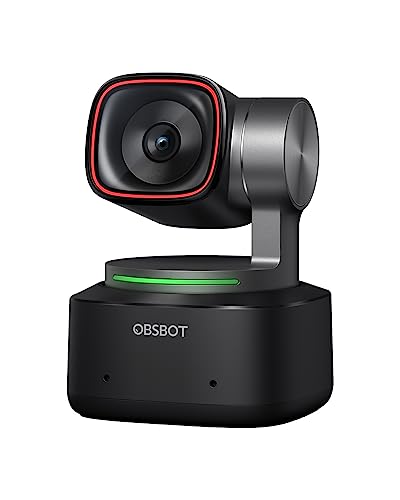
A solo teacher has no camera operator, no producer and no second take that feels the same as the first, and the Tiny 2 was plainly designed by people who understood that loneliness. It is a 4K camera on a motorised head with AI tracking: place it at the end of the mat, start the class, and it pans and tilts to keep the practice framed as you travel from standing sequences to the floor and back. The teacher’s attention — the entire saleable asset — stays on the teaching.
The tracking’s character suits this subject specifically. It follows the body as a whole rather than hunting for a face, so folding forward, turning away or dropping into a prone sequence does not break its concentration the way face-dependent systems falter. Movements are pursued smoothly, with the head’s motion damped into something that reads on screen as an attentive cameraman rather than a security camera. During a flowing vinyasa the framing breathes with the practice instead of correcting it in lurches.
Control from the mat is the feature that turns a good idea into a working tool. Gestures start and stop tracking, adjust the framing and manage zoom from wherever the teacher is standing, because a camera that requires walking back to a laptop between sequences would tax exactly the calm it was bought to protect. Voice control covers the moments when hands are occupied holding a pose. Setup before class is a placement and a power cable; the rest is choreography the machine handles.
Its sensor is large by webcam standards, and the dividend shows in the soft, window-lit rooms yoga prefers. Early-morning classes filmed in natural light keep their tonal gentleness instead of being amplified into contrast and noise, and skin and mat colours stay truthful — a real consideration for teachers whose visual brand is serenity rather than spectacle. The 4K resolution, meanwhile, buys the right to crop a wide safety frame tighter in editing without softness.
Placement discipline still applies. The Tiny 2 must see the whole mat area to track across it, so it wants a clear station at the room’s end, roughly at hip height, with its travel unobstructed by plants, furniture or a wandering dog. Teachers in extremely small rooms may find even its wide view tested by floor work at the frame’s edges — the one scenario where the 360 camera below argues back. And as a tethered USB device it belongs to fixed studios and home practice corners rather than gardens and retreats.
For the teacher filming alone in a known room, though, this is the most complete answer in the guide: an operator that never sleeps, never sighs and never misses the transition to the floor. Channels built on solo teaching live or die by consistency of output, and consistency is precisely what a tireless tracking head manufactures.
Live classes deserve a mention of their own, because the Tiny 2 doubles as a streaming camera of unusual intelligence. A teacher broadcasting a live session to remote students normally appears as a shrinking figure whenever the practice travels; here the class watches the teacher stay framed and legible through the whole flow, which is the difference between a live class students return to and one they quietly abandon for recordings. The same tracking that serves the catalogue serves the livestream without a single changed setting.
- Type: 4K PTZ camera with AI body tracking
- Control: gesture and voice, from the mat
- Sensor: large sensor for its class
- Setup: fixed station, USB powered
Strengths
- Follows standing-to-floor transitions automatically
- Body tracking survives turned backs and folds
- Hands-free control preserves the class’s calm
Trade-offs
- Needs a fixed, unobstructed station
- Tethered to USB power and a computer
- Tightest rooms can still test its view
Best for: solo teachers filming regular classes in one room. Not suited for: outdoor sessions or travelling retreats.

DJI Osmo Pocket 3 — Best all-in-one class camera
The Pocket 3 approaches the yoga problem from the opposite direction to a fixed tracking head: it is a complete camera — 1-inch sensor, mechanical gimbal, screen, microphones — in a body the size of a chocolate bar, and its stabilisation is physical rather than computational. Set it on its small tripod at the mat’s end and the gimbal absorbs the world: floorboards flexing under a class, a door closing, the teacher’s own demonstration steps near the camera. The footage stays level and liquid in a way electronic stabilisation imitates but never quite equals.
Its subject tracking, DJI’s ActiveTrack, locks onto the teacher and the gimbal reframes continuously to hold them — walking the room to adjust a student, demonstrating at the side wall, returning to the mat. Because the whole camera moves on three axes, the reframing has a floating, intentional quality, like a very slow dolly that never sleeps. For filmed classes that will be sold rather than merely posted, that production sheen is visible in every minute and compounds across a catalogue.
The sensor earns its keep in the rooms yoga actually happens in. Studios favour soft, indirect light; homes offer a window and a lamp. A 1-inch sensor renders those conditions with a tonal richness smaller cameras flatten, and its autofocus — fast by the standards of this list — re-acquires a moving teacher decisively after each transition. Teachers filming at dawn for a morning-class catalogue will notice the difference first and forgive the price fastest.
Audio, unusually for this guide, gets a genuine mention: the Pocket 3’s built-in microphones are competent, and its wireless-microphone ecosystem lets a teacher wear a small transmitter whose voice then arrives at full presence regardless of where the practice travels. That pairing solves the category’s oldest problem — the quiet voice at framing distance — inside one brand’s accessory shelf, which is why so many working teachers standardise on this little camera as their entire kit.
Its limits are the limits of a fixed position. The lens, while wide, is not the widest here; in a genuinely small room the frame may still crop a tall standing sequence, and unlike the Tiny 2 it cannot be gesture-summoned from across the room with the same repertoire of controls. Battery life across a multi-class filming day wants spares or a power bank in the bag. These are logistics, not flaws, but they should be planned rather than discovered.
As a single purchase that films a beautiful class indoors or out, travels in a jacket pocket to retreats, and grows into wireless audio when the channel earns it, the Pocket 3 is the most rounded instrument in this guide. Teachers who film in many places rather than one studio should start here and stop reading; the remaining picks are specialists.
Short-form content is a quiet bonus in its design. The Pocket 3 shoots vertical natively for the platforms where pose tips and flow fragments now recruit most new students, and its screen and controls make a sixty-second demonstration a two-minute job rather than a production. Teachers building a channel rather than merely archiving classes will find the little camera working three jobs — catalogue, livestream backup and daily short-form — which is how its price gets amortised across a working week.
- Type: gimbal camera with 1-inch sensor
- Tracking: ActiveTrack subject following
- Audio: built-in mics, wireless mic ecosystem
- Form: pocket-sized, tripod-mounted for classes
Strengths
- Physical stabilisation, visibly smoother footage
- Travels anywhere a class can be taught
- Wireless audio path solves the quiet-voice problem
Trade-offs
- View narrower than the ultra-wide picks
- Multi-class days need spare power
- Premium pricing for its size class
Best for: teachers filming in varied locations, including retreats. Not suited for: the very smallest rooms or fixed-studio gesture control.

Sony ZV-1F — Best for small rooms
Most yoga filming does not happen in a studio. It happens in a spare bedroom with the bed pushed aside, a living room corner between the sofa and the wall, a rented flat where the mat nearly touches both ends of the available floor. In those rooms the binding constraint is brutally simple: can the lens see a standing person, arms raised, from two metres away? The ZV-1F’s wide 20mm-equivalent lens was chosen by Sony for arm’s-length vlogging, and redeployed at a room’s end it becomes the small-space yoga camera — head, hands and feet inside the frame where conventional cameras amputate.
That width changes the teaching, not just the picture. A teacher who trusts the frame stops shrinking their practice to fit it: full extensions, wide stances and travelling sequences return to the class, because the camera has stopped editing the choreography. Students at home, often in equally small rooms, see movements demonstrated at honest scale and can mirror them in their own corners. The wide lens is, in this narrow sense, a pedagogical feature.
The 1-inch sensor behind it keeps the image worthy of the geometry. Colour is Sony’s creator tuning — skin rendered kindly, the muted palettes of practice rooms kept distinct rather than smeared — and low light from a single window stays clean enough that dawn classes need no lighting rig. Autofocus is eye-led and decisive when the teacher faces the camera, and while it lacks the body-tracking specialisation of the two picks above, a fixed wide frame asks less of autofocus than any other arrangement in this guide: the subject rarely leaves, so the focus rarely needs to travel.
Operation is deliberately simple. The ZV-1F is a fixed-lens camera with a touchscreen, a prominent record button and none of the interchangeable-lens ceremony of bigger systems; a teacher can frame with the flip screen, tap to focus, and teach. It also serves as a high-quality USB camera for the live-streamed class, so one device covers both the recorded catalogue and the real-time session — a consolidation small-room teachers, whose storage is as limited as their floor space, tend to appreciate.
Its boundaries are clear. There is no tracking head and no gimbal; if the practice travels beyond the frame, the frame does not follow, and a teacher who roams a large studio adjusting students will walk out of this camera’s attention. Stabilisation is electronic and adequate for a tripod-mounted camera, which is the only way it should be used for classes. Battery and recording limits across a long filming day want the usual planning — mains power where possible, a generous card.
Bought for the room it suits, the ZV-1F is a precision answer: the wide, kind, simple camera for the corner where most home yoga teaching actually happens. Large studios have better-matched picks above and below; the spare bedroom has this one.
There is also a confidence dividend to a frame the teacher never has to think about. Filming anxiety — the background worry about hands exiting the top of shot — visibly tightens a demonstration, and students read tension in a teacher’s body before they hear a word. A wide fixed frame that has been verified once and then forgotten lets the practice be taught at full expression, and that relaxation, oddly, is the most professional thing in the resulting video.
- Type: compact camera, 1-inch sensor
- Lens: wide 20mm-equivalent fixed lens
- Focus: eye autofocus, touchscreen control
- Live use: USB streaming for live classes
Strengths
- Fits full standing sequences into small rooms
- Kind colour and clean window-light performance
- Simple enough to operate between breaths
Trade-offs
- No tracking — the frame stays where you put it
- Electronic stabilisation only
- Roaming teachers can exit its attention
Best for: home teachers filming in spare rooms and corners. Not suited for: large studios or peripatetic teaching styles.

GoPro HERO13 Black — Best ultra-wide on a budget of space
When even a wide conventional lens cannot see the whole practice, the action camera’s answer is to see nearly everything. The HERO13’s ultra-wide view — wider still with its lens options — takes in a room corner-to-corner from a mount high in the corner or low at the mat’s edge, and a standing sequence with raised arms becomes a framing problem that has simply been abolished. Teachers stop composing and start teaching, which for many is the entire point of the purchase.
Ruggedness rewrites the placement rules. A GoPro can be mounted where a camera worth protecting cannot: clamped to a shelf edge over the mat, fixed low on a wall for floor-work angles, taken outside for garden and retreat sessions without a weather prayer. It will survive being knocked off a stack of blocks by a falling bolster, and in rooms where students move with props, weights and enthusiasm, survivability is a working specification rather than a marketing line.
The image character is distinct and should be chosen knowingly. Ultra-wide optics bend straight lines at the frame’s edges — door frames bow, the mat’s rectangle trapezoids — and while the camera’s narrower digital lenses tame this, the full-width look is unmistakably an action camera’s. Many yoga channels embrace it: the slight fisheye energy suits dynamic flows and outdoor sessions. Teachers building a soft, serene studio brand may find the aesthetic argues with the content, and should weigh the Sony or DJI looks above.
Focus, at least, is a solved problem by design: the deep depth of field of a small wide lens keeps everything from mat to far wall acceptably sharp, so there is no autofocus to lose the teacher mid-fold. What the arrangement asks instead is exposure sense — a bright window in frame will pull the exposure its way — and a mounting position chosen with the sun in mind. Set those once and the camera becomes the most forgettable, in the best sense, on this page.
Audio from the camera itself is the weakest here relative to its imaging, serviceable for cues in a quiet room but thin at distance; the microphone guidance in the buying section applies to this pick with double force. Battery swaps across a long filming day are quick and expected. Neither point dents the core proposition, which is width and toughness at a price that lets a teacher own a second angle.
That second-angle role may be its highest calling. Paired with any primary camera in this guide, a HERO13 in the corner guarantees the wide safety shot — the frame that rescues an edit when the main camera cropped a transition — and guarantees it outdoors, on retreats and in borrowed spaces where the primary setup cannot go. Channels grow into multi-angle editing; this is the cheapest durable way to have the angle waiting.
Retreat filming shows the GoPro at its most liberated. A teacher leading sessions in a borrowed pavilion, on a beach at dawn or in a mountain lodge has no control over the space and no time to negotiate with it; the HERO13 clamps to whatever exists — a railing, a beam, a tripod planted in grass — and its width forgives the placement. Footage gathered in imperfect, beautiful places often becomes a channel’s most loved material, and this is the camera that gathers it without a logistics meeting.
- Type: action camera with ultra-wide lens options
- Focus: deep depth of field, no hunting
- Build: waterproof and knock-resistant
- Mounts: extensive clamp and adhesive ecosystem
Strengths
- Sees the whole practice from almost anywhere
- Survives studios, gardens and retreats
- The ideal wide safety angle beside a main camera
Trade-offs
- Ultra-wide distortion shapes the look
- Built-in audio is the weakest here
- Exposure needs the window considered
Best for: outdoor sessions, retreats and second-angle insurance. Not suited for: teachers wanting a soft studio aesthetic.

Insta360 X4 — Best for reframing in edit
The X4 refuses the premise of every other pick. Instead of aiming a frame at the practice, it records in all directions at once — two lenses, a full sphere of video — and the framing decision is postponed to the editing desk, where the teacher, calm and seated, directs the shot that the room never allowed them to operate. A standing sequence can be framed wide; the floor sequence that follows can be reframed tighter and lower from the same continuous recording. Nothing the body did during class escapes, because there was no outside of the frame.
For yoga specifically, that postponement solves the category’s nastiest surprise: the pose that travelled further than expected. A travelling sequence that drifts toward the camera, a balance that relocates the body half a metre sideways — on a fixed camera these are ruined takes; in a 360 recording they are merely reframing instructions. Teachers filming demanding flows alone, where a ruined take means repeating twenty minutes of practice, will feel the insurance value in their shoulders.
The editing workflow is the price, and it is paid in time and in a changed relationship with the footage. Reframing a class means reviewing it with a director’s attention, choosing angles passage by passage — enjoyable for teachers who already edit carefully, a burden for those who publish raw. Resolution is also divided across the sphere, so a tightly reframed shot carries less detail than a dedicated camera’s native frame; the X4’s generous headline resolution keeps reframed class footage comfortably publishable, but perfectionists comparing centre-frame sharpness against the DJI or Sony should know the trade they are making.
Placement is liberation itself. The camera sits on a small stand at the mat’s side or centre-adjacent, sees the teacher and the room, and — with the selfie-stick effect — can even float the viewpoint. It asks for no operator position, no tracking station, no wall to back against, which makes it the natural pick for borrowed studios, outdoor sessions and any space whose geometry defeats tripods. One device, one small footprint, every direction covered.
Its audio and low-light behaviour are respectable rather than leading; plan the microphone solution from the buying guide, and expect very dim rooms to favour the larger-sensor picks. Battery and storage across long classes need the standard planning, with the sphere’s files being the largest here — a filming day produces an archive, and the archive wants a drive.
Teachers who edit will find the X4 the most forgiving camera ever pointed at a yoga practice: it converts filming from a performance of precision into a record from which precision can be recovered later. Teachers who never edit should buy almost anything else on this page, because the X4’s genius is entirely downstream of the edit suite.
Multi-angle classes from a single device deserve emphasis, because they change what a solo teacher can publish. From one X4 recording, an editor can cut between the wide establishing view, a tighter frame for the standing sequence and a low, close reframe for floor work — the grammar of a two-camera production with one camera’s setup, cost and failure modes. Channels competing against studio-produced content use exactly this trick to close the apparent budget gap, and yoga, with its predictable geography, is the ideal subject for it.
- Type: 360 action camera, dual lenses
- Workflow: reframe after recording in the app or studio software
- View: full sphere — no outside of frame
- Files: large; plan storage for class-length takes
Strengths
- Impossible to miss a pose or transition
- One placement covers every kind of space
- Angles can be directed calmly in editing
Trade-offs
- Reframing adds real editing time
- Tight crops carry less detail than native frames
- Largest files and storage appetite here
Best for: editing-minded teachers filming complex flows alone. Not suited for: publish-raw workflows or the dimmest rooms.

Insta360 GO 3S — Best demonstration angles
Every pick so far watches the teacher from across the room. The GO 3S asks what the student actually needs at the hardest moments: not the wide shot, but the detail — the exact rotation of a wrist in a bind, the placement of a heel, the way the shoulders stack in an arm balance. This is a camera the size of a thumb that mounts almost anywhere: clipped to a chest strap for the teacher’s own viewpoint, magnetised to a stand at mat level, perched on a block beside the action. It films the angles that explain.
Its natural role is the second camera and the insert shot. A class filmed on any primary pick above can cut to the GO 3S’s close view for the thirty seconds where alignment matters, then return to the wide — an editing grammar borrowed from produced fitness content that instantly raises a channel’s teaching quality. Solo creators also use its wearable view for entire short-form pieces: the practice seen from inside, which on social platforms performs with an intimacy no tripod shot achieves.
Freedom of placement is total in a way that invites experiment. Mat-level cameras change how floor work reads — the body moves toward and across the lens with a physicality wide shots flatten — and wall-mounted high angles reveal the geometry of a sequence, the spacing of hands and feet, better than any eye-level frame. Because the camera is tiny and inexpensive to risk, teachers try positions they would never ask a flagship to occupy, and some of those experiments become signatures.
Honesty about scale is required. The GO 3S is a small-sensor camera with recording limits suited to segments rather than ninety-minute classes; it is a scalpel, not the surgery. Image quality in soft light trails the larger picks, stabilisation is electronic, and its files are meant to be gathered into an edit rather than published untouched. A channel that buys it as its only camera will feel every one of those limits within a week.
Bought as the specialist it is, the economics delight. It costs a fraction of the primary cameras, mounts with accessories that are themselves inexpensive, and multiplies the teaching value of footage the channel was already shooting. Pose breakdowns, alignment shorts, form-check content for students to film themselves with — the GO 3S opens content categories that a room camera cannot enter at any price.
Think of it, then, as the guide’s recommendation for the teacher whose main camera already works and whose students keep asking the same question: yes, but what exactly does that pose look like up close? This is the camera that answers.
Students can be sent into the same trick from the other side. A teacher who lends or recommends a GO 3S for home form-checks receives footage from the student’s own mat-level viewpoint — the angle at which alignment errors are actually visible — instead of a distant room shot in which every question must be guessed. Few accessories in this guide change the teaching relationship itself; this one, used that way, quietly does.
- Type: thumb-sized wearable camera
- Mounts: magnetic and clip accessories for body and room
- Role: close demonstration and insert angles
- Recording: segment-length takes, editing intended
Strengths
- Demonstration angles no other pick can reach
- Wearable point-of-view for short-form content
- Inexpensive multiplier for an existing setup
Trade-offs
- Not a whole-class primary camera
- Small sensor trails in soft light
- Footage wants editing, not raw publishing
Best for: pose breakdowns and second-angle detail beside a main camera. Not suited for: filming full classes as the only camera.
What about live-streamed classes versus recorded ones?
The two formats share a camera shortlist but weight it differently. A recorded class can be reframed, re-shot in part and rescued in editing, which is what makes the X4’s postpone-everything philosophy and the GO 3S’s insert shots so powerful there. A live class permits no rescue: the frame the students see is the frame the camera produces in the moment, so tracking hardware — the Tiny 2’s head, the Pocket 3’s gimbal — earns a premium live that it does not need on tape, and the fixed wide frame of the ZV-1F earns its keep by having nothing that can go wrong in real time.
Live audio is stricter still. A recording can be rebalanced, denoised and captioned; a livestream carries the teacher’s voice as it lands, echo and all, to students deciding within minutes whether this class feels professional. The wireless lavalier recommended in the kit section is therefore not an accessory for live teachers but the foundation of the whole enterprise, and the camera should be chosen partly for how gracefully it accepts that microphone’s receiver.
Many teachers run both formats from one kit, and the picks above were sequenced with that dual life in mind: the tracking cameras lead because they serve live and recorded work equally, the wide and 360 cameras follow as recorded-format specialists, and the little GO 3S closes the list as the detail camera both formats share. Buy for the format that pays you; the other will inherit more than it needs.
How do the six compare at a glance?
| Camera | Approach | Signature strength | Watch out for |
|---|---|---|---|
| OBSBOT Tiny 2 | Motorised tracking | Hands-free framing for solo teachers | Fixed studio station required |
| DJI Osmo Pocket 3 | Gimbal tracking | Smoothest, richest class footage | Narrower view, spare power needed |
| Sony ZV-1F | Wide fixed frame | Small-room coverage | No tracking of any kind |
| GoPro HERO13 Black | Ultra-wide fixed | Sees everything, survives anything | Distortion and modest audio |
| Insta360 X4 | 360 record, reframe later | Nothing escapes the recording | Editing time and big files |
| Insta360 GO 3S | Wearable detail | Close demonstration angles | Segments, not whole classes |
How does the style of yoga change the right camera?
Slow practices forgive almost any camera. A yin or restorative class moves between a handful of positions, holds each for minutes, and asks mainly for a frame wide enough to contain a body among props and a sensor calm in soft light — the ZV-1F and Pocket 3 territory, where image quality outranks tracking because nothing travels far enough to need following. Teachers of gentle formats should spend on the picture and the microphone, in that order, and let the tracking specialists go.
Power and vinyasa practices invert the priorities. The body is in near-constant transit, transitions are the content, and a frame that loses the flow loses the class — which is where the Tiny 2’s pursuit, the Pocket 3’s gimbal and the X4’s total record earn their premiums. Heat adds a practical footnote for hot-yoga filming: cameras live outside the heated room’s worst of it where possible, lenses fog when carried from cool corridors into humid studios, and a few minutes of acclimatisation before class saves the first take. Rugged action cameras tolerate the environment best, which is one more reason the HERO13 keeps appearing in working teachers’ bags.
Chair yoga, prenatal classes and other seated or supported formats sit between the extremes: modest travel, a premium on clarity of the upper body and hands, and audiences who often watch on tablets at close range. Here a tighter, higher-quality frame beats a cavernous wide one, and the Pocket 3 or ZV-1F at a closer station will serve better than an ultra-wide mounted for a standing practice it will never film. Name your format honestly before shopping; the style of the practice is the first specification.
What else belongs in a yoga filming kit?
A microphone, before anything else. The teacher’s voice is the class, and the reliable arrangement is a small wireless lavalier whose transmitter clips to the teacher’s top and whose receiver feeds the camera or a phone — the Pocket 3’s ecosystem makes this native, and every other pick accepts the same idea through its audio input or a separately recorded track. Budget for it with the camera, not after the first comment complains about echoing cues.
Power and storage come next. Class-length recording at high resolution consumes both at a rate short-clip cameras never reveal; mains adapters where the camera allows, spare batteries where it does not, and cards sized for a full filming day prevent the mid-class failure that no editing can forgive. A small, stable tripod or stand suited to your camera’s weight completes the kit — yoga rooms punish wobbly furniture-grade tripods through floor vibration alone.
Light last, and gently. Most yoga filming improves more from a curtain adjustment than from a lighting purchase: diffuse the window, turn the mat so the light falls across rather than behind the teacher, and let the larger-sensor picks do what they were bought for. Teachers filming at night in rented halls are the exception — a single soft panel light, placed high and far, lifts the whole production without breaking the room’s calm.
How should you position a camera for a full practice?
Start from the mat, not the camera. Lay the mat where the class will happen, stand at its far end with arms raised, and have the frame — checked on the camera’s screen or app — contain fingertips and feet with a margin at both extremes. Then lie down along the mat and check again: a frame that holds the standing pose but crops the supine one will fail forty minutes into the class, when nobody can fix it. Both extremes, verified before recording, is the whole secret.
Mark the camera’s world with tape once the framing is proven: a small strip where the tripod feet stand, another at the mat’s corners, so the arrangement can be rebuilt in a minute after the room has been used for living. Teachers who film in multi-purpose spaces lose more classes to a subtly shifted setup — the frame almost right, discovered wrong at the first standing pose — than to any equipment failure, and two pieces of tape are the cheapest insurance in this entire guide.
Height shapes the teaching more than teachers expect. A camera near hip height flatters standing work and reads floor work clearly; a high corner mount reveals alignment geometry but distances the viewer; mat level dramatises everything and suits segments rather than classes. Choose the height for the class type — flow classes read best near hip height — and then leave it alone for a month, because students orient themselves by a consistent viewpoint the way they orient by a familiar studio.
What goes wrong most often in yoga videos?
A fifth failure is subtler and sadder: the class that was filmed beautifully once and never again, because the setup took forty minutes and the teacher’s filming day quietly died of friction. Complicated rigs are a tax levied on every future class, and teachers abandon them at exactly the rate the tax predicts. The setups in this guide were all chosen to assemble in minutes and survive being left assembled — because the best yoga camera, in the end, is the one still standing at the end of the mat next month.
Cropped extremities lead the list: the raised hand or extended foot that exits the frame at the moment of full expression, teaching students to imitate a pose they cannot fully see. Second is the wandering teacher walking out of a fixed frame to adjust an imaginary student. Third is audio — cues whispered to the floor, lost under music, in footage whose picture is beautiful. Fourth is the mid-class stoppage: battery, card or overheating ending a take that cannot be repeated with the same energy. Every one of these is prevented by a pick matched to the room and a ten-minute setup ritual, which is why this guide spends as long on arrangements as on cameras.
Final Recommendation
Budget order matters for teachers assembling a kit from nothing. The camera comes first, the wireless microphone a close second, and everything else — lights, stands, a second angle — can wait for the channel’s first earnings, because the six cameras above were chosen to work in ordinary rooms with ordinary light. Resist the reverse order, in which a beautiful lighting rig illuminates footage from a camera whose frame crops the practice: students forgive a dim room long before they forgive a missing foot.
Solo teachers in a fixed room should buy the Tiny 2 and let it operate; teachers who travel should carry the Pocket 3 and its wireless microphone. Small rooms belong to the ZV-1F’s wide lens, outdoor and retreat work to the HERO13, and meticulous editors to the X4’s all-seeing record. Add the GO 3S when students start asking what a pose looks like up close. Whichever you choose, verify the frame at both extremes of the practice before the first real class, record one full session as a rehearsal rather than a launch, and watch the result at the size your students will watch it — faults invisible on a studio monitor announce themselves plainly on a phone. The camera that contains the whole body, every time, is the one your students can actually learn from.
Frequently Asked Questions
Can I film a good yoga class with just my phone?
A recent phone films a respectable class, and many channels start there. The upgrades in this guide buy specific reliefs: wider views for small rooms, tracking so the frame follows you, larger sensors for soft light, and mounts and endurance for class-length recording. Upgrade when one of those limits, named honestly, is the one your footage keeps hitting.
Is vertical video worth filming for yoga?
For short-form platforms, yes — pose tips and flow excerpts are naturally vertical, though a full body in vertical frame needs the camera further back or a wider lens than horizontal work. Teachers often film the class horizontally for the catalogue and extract vertical clips in editing, where the X4’s reframing is especially convenient.
How do I record my voice clearly while moving?
Wear the microphone. A wireless lavalier on the teacher’s clothing keeps the voice at constant presence through turns, folds and floor work that defeat every camera-mounted microphone. It is the single highest-value accessory in this category, ahead of any lens or light.
Do I need 4K for yoga videos?
Not for its own sake. Platforms will compress the class regardless; 4K earns its place as cropping and reframing headroom — tightening a wide safety frame in editing — and as insurance for the catalogue’s future. A clean 1080p frame that contains the whole practice beats a cropped 4K one every time. Teachers selling downloads or teaching on large television screens are the exception: there, the extra resolution is genuinely visible and worth having.
Can one camera film both my classes and my short pose tips?
Yes, and the Pocket 3 and Tiny 2 are the natural dual-role picks: both handle class-length framing and produce vertical short-form without a second device. The GO 3S enters when the tips need close demonstration angles the main camera cannot reach. Teachers publishing both formats from a single camera should simply confirm the vertical mode and the quickest path from recording to phone before buying.
Where should the camera go for floor-heavy classes?
Lower and slightly further back than instinct suggests: near hip height or a little below, far enough that a body lying along the mat fits with margin at head and feet. Verify with the longest pose in the class — usually a supine twist or savasana with arms extended — before recording.
Related Guides
Teachers who also take meetings and live sessions from the same room will find the best cameras for work from home guide a useful companion, while the tracking discussion continues in the best cameras for YouTube autofocus roundup. For filming movement outdoors and on retreats, the best cameras for youth sports guide covers fast subjects and long distances.


