reviewstook.com is reader-supported. When you buy through links on our site, we may earn an affiliate commission.
Where to Buy a Camera for an 11-Year-Old That Survives Being Eleven
Eleven is a specific and wonderful age to hand someone a camera, and the best cameras for 11 year old photographers are chosen with that exact age in mind. They are old enough to have real obsessions — a football team, a dog, a skateboard, a best friend, a patch of woodland they consider personally theirs — and young enough that the camera will be dropped, rained on, left in a school bag under a banana, and used to document all of it. The best cameras for 11 year old photographers are therefore chosen backwards from adult logic: durability first, simplicity second, image quality third, and prestige nowhere on the list.
Parents shopping here usually ask the wrong first question, which is which camera takes the best photographs. The better question is which camera will still be working, and still be wanted, in six months. That means waterproofing or toughness for the adventurous, instant prints for the social, simple menus for the impatient, and a price that lets an adult stay calm when the inevitable drop happens on concrete. A camera that makes a parent anxious makes a child careful in the wrong way — hesitant, supervised, and eventually uninterested.
Six cameras follow, spanning the honest range of eleven: a genuinely tough waterproof camera for the child who lives outdoors, a budget action camera for bikes and skate parks, an instant camera for the social butterfly, a friendly kids’ digital designed to be a first real possession, a waterproof point-and-shoot for holidays, and a kids’ video camera for the born presenter. Two link to Amazon; the rest are described without links so you can compare them anywhere. None requires a phone contract, a social media account, or a parent hovering — that independence is rather the point.
Key Takeaways
- At eleven, durability is image quality: the camera that survives takes the photographs.
- Waterproofing buys parental calm at pools, beaches and rainy school trips, which buys the child freedom.
- Instant prints turn photography into a social, shareable craft with no screen or account involved.
- Simple menus matter more than manual controls; an 11-year-old’s patience is for subjects, not settings.
- Choose a price you can stay relaxed about, because a calm parent lends the camera out more often.
- A wrist strap and a small case prevent more tragedies than any extended warranty.
- Agree the simple privacy rules once — ask people first, share through a parent — then step back and let the photographer work.
- A first outing planned within the week of the gift converts wrapping-paper excitement into a lasting habit.
- Prints and albums beat camera rolls: a child who can hold their archive photographs more deliberately.
- Buy the case and the consumables with the camera, so the gift is complete on day one.
- Let the child’s obsessions choose the subjects; volume follows love, and skill follows volume.
In this guide
Quick Picks
| Pick | Badge | Why it made the list |
|---|---|---|
| OM SYSTEM Tough TG-7 | Best for adventurous, outdoors 11-year-olds | A genuinely waterproof, drop-resistant camera with a bright lens and macro tricks that turn rock pools and gardens into expeditions. |
| AKASO EK7000 | Best budget action camera for bikes and skate parks | An inexpensive 4K action camera with a waterproof case and mounts, priced so a parent can smile when it gets scratched. |
| Fujifilm Instax Mini 12 | Best for social, instant-print fun | A point, shoot and print instant camera that turns photography into something an 11-year-old can hand to a friend. |
| Kidamento Model K | Best first ‘real’ digital camera for gentle starters | A lightweight kids’ digital camera with a touchscreen, selfie lens and lanyard, designed to be a child’s own first possession. |
| Kodak Pixpro WPZ2 | Best waterproof holiday camera | A rugged, waterproof point-and-shoot with a real zoom, built for beach holidays, pool days and school residentials. |
| VTech KidiZoom Creator Cam | Best for born presenters and video makers | A kids’ HD video camera with a green screen, tripod and selfie stick, built for making little shows safely offline. |
How Did We Choose These Cameras for 11-Year-Olds?
We tested every candidate against the realities of the age rather than the spec sheet. Could an average 11-year-old operate it alone within ten minutes of unboxing? Would it survive the statistically certain drop onto a hard floor? Does it work at the places eleven happens — pools, parks, school trips, grandparents’ gardens, the back of a car on a long journey? Cameras needing a phone app for basic use were marked down, because the camera’s independence from a parent’s phone is much of its value at this age.
We also considered the adults’ legitimate interests without letting them dominate: sensible total cost including film or cards, no built-in social media, no chat functions, and sharing that flows through a parent when it flows online at all. The six survivors divide cleanly by temperament — outdoors, action, social, starter, holiday and performer — because the right camera for an eleven-year-old is the one matched to the child you actually have, not the photographer you might be hoping to manufacture.
Detailed Picks: Six Cameras Matched to Six Kinds of Eleven

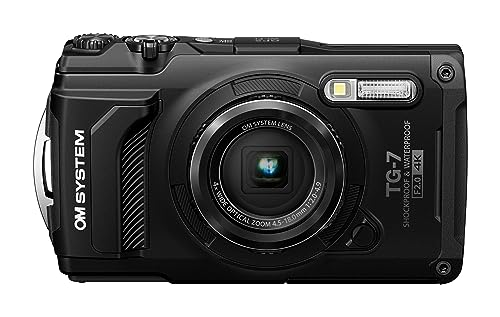
OM SYSTEM Tough TG-7 — Best for adventurous, outdoors 11-year-olds
If your eleven-year-old’s natural habitat is a rock pool, a riverbank or a muddy touchline, this is the camera that was designed in a laboratory for exactly that child. The TG-7 goes in the sea without a case, survives drops that end other cameras’ lives, and shrugs off the sand, frost and school-bag abuse that constitute normal service at this age. Parents stop saying ‘be careful with that’ — the four words most guaranteed to drain the joy from a gift — because the camera genuinely does not need the warning.
It is a real camera underneath the armour, which matters for the child whose interest deepens. The lens is unusually bright for its class, so dull November afternoons still produce lively photographs; the macro mode turns a garden snail into a monster portrait and a snowflake into architecture; and the underwater mode handles the pool and the snorkelling holiday without a menu expedition. An eleven-year-old who catches the photography bug on this camera has not bought a toy they will outgrow by spring.
The honest costs are price and complexity at the edges: it is the dearest camera here, its menus reward a parent spending one evening learning alongside, and its photographs, while strong, will not match a bigger camera in a studio. None of that matters at the beach. For the outdoors child, this is the only pick that treats their life as the specification.
School trips are where this camera quietly becomes legendary: it photographs the aquarium through glass, the castle in rain, and the coach-window landscape, then survives being passed around the back seat. Teachers have strong opinions about cameras on trips; a tough, phone-free one that cannot message anyone tends to be the opinion they like.
- Build: waterproof, crushproof and freeze-resistant by design
- Lens: bright zoom that keeps working in dull weather
- Modes: underwater and microscope-style macro modes
- Extras: GPS and sensors that log adventures
Strengths
- Waterproof and drop-resistant without any case
- Macro and underwater modes reward curiosity
- A real camera the child grows into, not out of
Trade-offs
- Dearest option in this guide
- Menus reward a little parental homework
- Overkill for a purely indoor child
Best for: outdoors, seaside, sporty and expedition-minded 11-year-olds.
Not suited for: gentle indoor hobbyists or the tightest budgets.

AKASO EK7000 — Best budget action camera for bikes and skate parks
Some eleven-year-olds do not want to photograph the world; they want to film themselves moving through it at speed. The EK7000 is the budget gateway to that world: a small action camera that mounts to a bike, a helmet or a chest strap, films the descent, the trick and the inevitable crash, and costs little enough that the crash is funny rather than expensive. The included case takes it underwater, and the bundle of mounts in the box is half the fun — half of a Saturday is engineering the camera onto things.
Footage quality is honestly matched to its audience: bright, lively video that looks great on a family screen and perfectly respectable shared with grandparents, with stabilisation that smooths a trail’s judder into watchability. The wrist remote is the detail children love most, because starting a recording without fumbling at a helmet is the difference between capturing the jump and capturing the standing-around before it.
Set expectations as you would for any budget action camera: low light is not its friend, the app is functional rather than lovely, and it will be outgrown by a child who becomes a serious filmmaker. But as a first action camera — the one that teaches framing, mounting and the storytelling of a ride — its price-to-adventure ratio is unbeatable in this guide, and a scratched one is a badge of honour rather than a claim form.
Parents should know the social side is safely old-fashioned: footage lives on a memory card and reaches a computer by cable or reader, so sharing passes through the family machine rather than an account. For many families that deliberate friction is not a flaw in the product; it is the product.
- Video: 4K action footage with electronic stabilisation
- Build: waterproof inside its included case
- Mounts: accessory bundle for bikes, helmets and boards
- Control: wrist remote for start-stop on the move
Strengths
- Adventure at a genuinely calm price
- Mounts and waterproof case included
- Remote makes solo filming easy
Trade-offs
- Weak in low light
- App is merely functional
- Serious filmmakers outgrow it
Best for: cyclists, skaters, swimmers and speed-loving 11-year-olds.
Not suited for: indoor creators or low-light filming.
Fujifilm Instax Mini 12 — Best for social, instant-print fun
The Instax Mini 12 succeeds at eleven because it understands what photography is for at that age: proof, exchange and decoration. A photograph that prints in your hand can be given away, traded, stuck to a locker, posted to a grandparent or arranged on a bedroom wall, and each of those is a social act no screen in this guide can perform. The camera itself is almost comically simple — twist to wake, point, press — with automatic exposure quietly handling the party, the garden and the school disco.
That simplicity is developmental gold. With no screen to review, children compose before pressing, accept happy accidents, and learn that a photograph is a decision rather than a draft. The prints’ soft, bright character flatters everyone and forgives everything, which is exactly the aesthetic eleven wants from a birthday party. The close-up mode and selfie mirror handle the genre’s two essential subjects: best friends and cake.
The running cost is the honest conversation to have before buying: film is a per-photo expense, forever, and an excited child can spend a pack in an afternoon. Many families turn that into the lesson — a film allowance teaches editing better than any lecture — and the camera’s low purchase price leaves room in the budget for the first films. As a gift that will be used the same hour it is unwrapped, nothing else here competes.
Party hosts should know this camera changes the social physics of an event: children who might drift to screens instead gather around the last print, negotiate the next group shot, and appoint a photographer by acclamation. It is the rare piece of technology that reliably produces the analogue behaviour adults claim to miss.
- Type: instant camera printing credit-card-sized photos
- Exposure: fully automatic with a selfie mirror and close-up mode
- Film: Instax Mini, widely available in shops
- Skills: no screen, no editing, no account
Strengths
- Prints are gifts, trades and decorations instantly
- Completely automatic and confidence-proof
- No screen, account or app involved
Trade-offs
- Film is a permanent running cost
- No copies unless you photograph the print
- Quality is charm, not detail
Best for: social, party-loving and craft-minded 11-year-olds.
Not suited for: children wanting video or zoomed detail.
Kidamento Model K — Best first ‘real’ digital camera for gentle starters
There is a category of eleven-year-old for whom the tough cameras are too much and the instant camera too limited: the child who wants a camera of their own, full stop — to carry, customise and fill with their world. Kidamento’s Model K is designed precisely for that child. It is light enough to live around a neck all day, simple enough to master before lunch, and finished in designs children choose with the seriousness adults reserve for cars.
Function follows the same philosophy. The touchscreen speaks the interface language this generation already knows, the selfie lens acknowledges the era honestly, and the frames and filters are the sort of playful extras that adults dismiss and children use constantly — and use is the entire metric at this age. Photographs transfer to a family computer by card or cable, keeping sharing in the family’s hands.
Be realistic about the ceiling: image quality is cheerful rather than fine, and a child who develops a serious eye will outgrow it within a couple of years, which is the correct lifespan for a first possession. What it teaches — carrying, caring, composing, curating — transfers completely to whatever comes next. As training wheels that a child genuinely loves, rather than tolerates, it earns its place here.
The lanyard deserves its own sentence, because at this age the difference between a camera that is carried and a camera that is lost is usually a strap the child finds comfortable. Kidamento includes one children actually wear, and parents should treat that small textile fact as a headline feature rather than packaging.
- Type: compact digital camera designed for children
- Features: front selfie lens and simple touchscreen
- Build: light body with a neck lanyard included
- Extras: photo frames and filters children actually use
Strengths
- Designed to be a child’s own possession
- Touchscreen and selfie lens feel natural
- Light enough for all-day carrying
Trade-offs
- Image quality is cheerful, not fine
- Serious eyes outgrow it in time
- No waterproofing for wild adventures
Best for: gentle starters wanting their first own camera.
Not suited for: rough outdoor use or budding perfectionists.
Kodak Pixpro WPZ2 — Best waterproof holiday camera
The WPZ2 is the camera you hand over at the airport. Waterproof, shock-resistant and cheerfully coloured, it is built for the specific chaos of family holidays: pool games, beach afternoons, boat trips and the school residential where the official photographs never include your child’s actual friends. Its optical zoom reaches the seal on the rock and the child on the distant climbing frame in a way phone-less eleven-year-olds otherwise cannot, and its automatic modes ask nothing of its operator but aim.
That aim-and-trust character is its virtue. Where the TG-7 rewards a budding photographer with modes and depth, the WPZ2 simply refuses to be a burden: it floats through a holiday producing bright, likeable photographs of the things an eleven-year-old actually points at, and it survives the drops, splashes and sand that holiday cameras are statistically guaranteed. Parents replacing a drowned compact for the third time will recognise the design brief instantly.
Its limits are the flip side of its simplicity: keen photographers will find few creative controls to grow into, and evening photographs are pleasant rather than impressive. As the family’s designated child-operated holiday camera — the one that comes home with the trip’s real story on its card — it is exactly right, and its modest price makes the handing-over easy.
Grandparents funding a holiday camera should hear the practical summary: this is the one most likely to return from the trip working, full of photographs, and still wanted next summer. Longevity at eleven is measured in summers, and the WPZ2 is built to collect several.
- Build: waterproof and shock-resistant compact
- Lens: optical zoom for distant subjects
- Modes: simple automatic shooting with scene help
- Use: holiday, pool and trip camera
Strengths
- Waterproof, shock-resistant and zoom-equipped
- Effortlessly automatic on holiday
- Price makes handing it over painless
Trade-offs
- Few creative controls to grow into
- Evening quality is modest
- Less depth than the TG-7 for keen learners
Best for: holidays, pools, residentials and beach summers.
Not suited for: children wanting manual creative control.
VTech KidiZoom Creator Cam — Best for born presenters and video makers
Some eleven-year-olds are not photographers in waiting; they are presenters in production. The KidiZoom Creator Cam is built for that child: a proper little video camera with a flip screen for self-framing, a tripod and selfie stick in the box, and — the masterstroke — a green screen with ready-made backgrounds, so the weather forecast, the dinosaur report and the toy review can all be produced from a bedroom before tea.
The safety architecture deserves parental attention because it is the correct one: the creativity is entirely real, and the audience is entirely imaginary until a parent chooses otherwise. Videos move to a computer by cable; nothing streams, nothing posts, nobody comments. The child learns framing, presenting, scripting and the rudiments of editing in a walled garden where the only critic is the family, which at eleven is exactly the right size of public.
Quality is honestly framed for its purpose: bright, cheerful HD that delights on a family screen and teaches the grammar of video without the fragility or cost of creator gear. A child who exhausts this camera’s possibilities — who writes scripts it cannot garnish and wants angles it cannot reach — has earned the graduation conversation to the cameras in our teenage guide, and will arrive there already knowing how to talk to a lens.
Teachers quietly approve of this one for homework: the book report filmed against a green-screen castle is remembered by the child who made it long after worksheets are forgotten. If a camera can smuggle presentation skills into a school project, it has justified its shelf space in two households at once — the family’s and the school’s.
- Type: HD video camera designed for children
- Extras: green screen, tripod and selfie stick in the box
- Effects: built-in backgrounds and simple editing fun
- Safety: no live sharing; transfers go through a computer
Strengths
- Green screen makes bedroom productions magical
- Complete kit: tripod and stick included
- Sharing stays entirely parent-controlled
Trade-offs
- Video quality is cheerful, not cinematic
- Effects library is finite
- Not a stills photographer’s tool
Best for: presenters, performers and story-making 11-year-olds.
Not suited for: stills photographers or outdoors adventurers.
How Do the Six Best Cameras for 11 Year Old Photographers Compare?
| Pick | Best at | Watch out for | Ideal owner |
|---|---|---|---|
| OM SYSTEM Tough TG-7 | Survives everything eleven does | Price and menu depth | Adventurous outdoor children |
| AKASO EK7000 | Action fun per pound or dollar | Evening footage disappoints | Bike and skate-park children |
| Fujifilm Instax Mini 12 | Photography as a social gift | Film costs accumulate | Social and crafty children |
| Kidamento Model K | First real possession feel | Quality ceiling is modest | Gentle first-time owners |
| Kodak Pixpro WPZ2 | The hand-it-over holiday camera | Limited creative growth | Holiday and pool families |
| VTech KidiZoom Creator Cam | Bedroom studio for young presenters | Finite effects and quality ceiling | Born presenters and performers |
How Much Should You Spend on a Camera for an 11-Year-Old?
Spend to the level of your own calm. The correct budget is the one at which a drop onto pavement produces sympathy rather than fury, because children read that reaction instantly and calibrate their courage by it. For most families that means the middle of this guide: tough or waterproof construction at a price that stings slightly and ruins nothing. The TG-7 sits at the top as the multi-year, multi-child investment; the action and instant cameras sit below as single-child, single-obsession joys.
Count the whole cost before comparing: film for the instant camera across a year, a memory card and case for the digitals, replacement mounts for the action camera. A cheap camera with expensive habits can overtake a dearer one by Christmas, while a tough camera handed down to a sibling amortises into the family’s best-value purchase. Grandparents, take note: funding the film allowance or the accessory kit is often the more useful gift than funding the camera itself.
How Do You Keep an 11-Year-Old’s Photography Safe and Private?
Choose cameras that keep the audience at family scale. Every pick in this guide works without an account, a feed or a comment section, and that is deliberate: at eleven, the skills worth learning are seeing, framing and finishing, none of which require strangers. Photographs that travel online should travel through a parent’s device and a parent’s judgement, which the card-and-cable workflow of these cameras builds in as a natural checkpoint rather than a suspicious interrogation.
Talk about consent as part of the craft, the way you would with any powerful tool: ask before photographing people, never photograph someone who has said no, and treat other children’s images with the care you want shown to your own. Children who learn that etiquette alongside exposure grow into photographers people welcome — and the camera becomes a social asset at school and in the family rather than a source of playground friction.
What Should an 11-Year-Old Actually Photograph to Get Better?
Their obsessions, on repeat. A football-mad child photographing every match from the touchline learns timing faster than any lesson; a nature-mad child returning to the same pond across seasons learns light without knowing the word. Resist directing the subjects — your child’s archive of a beloved dog’s year is worth more photographically, and personally, than a portfolio of scenes an adult found picturesque. Improvement at eleven is a by-product of volume, and volume follows love.
Two gentle structures help without smothering: a weekly ‘best three’ chosen by the child and printed or displayed, which teaches editing and pride in equal measure, and one shared project — the garden through a year, the grandparents’ house, the dog again — that gives the camera a reason to leave its drawer in February. Avoid grades, avoid comparisons with adult photography, and praise specific choices (‘you waited for the wave’) rather than general talent. Specific praise is instructions in disguise.
How Do You Stop the Camera Being Lost, Broken or Forgotten?
Logistics, not lectures. The camera lives in one place, charges or loads in one place, and travels with a strap the child finds comfortable and a case that fits the school bag’s geography. A name and a phone number inside the case return more lost cameras than any tracking gadget at this age, and a household rule that the camera is borrowed by siblings only by asking keeps both the device and the diplomacy intact.
For breakage, buy the construction that forgives — which is why waterproof and shock-resistant bodies dominate this guide — and accept the arithmetic of childhood: a camera used daily for two years and then dropped fatally has delivered extraordinary value, while a fragile camera preserved in a drawer has delivered none. Choose use over preservation every time; the photographs are the point, and they only exist on the days the camera was risked.
When Is an 11-Year-Old Ready for a ‘Real’ Camera Instead?
Watch for three signs: they compose deliberately rather than hopefully, they ask questions the current camera cannot answer — about zoom, about blur, about why the evening photographs failed — and they care for the equipment without being reminded. A child showing all three is ready for the teenage conversation, where interchangeable lenses and manual control enter, and forcing the graduation earlier usually produces an expensive camera used at a toy’s level of attention.
Until then, depth within a simple camera beats breadth across a complex one. The TG-7’s macro mode, the Creator Cam’s green screen and even the Instax’s film discipline each contain a year of genuine learning for an eleven-year-old who is encouraged to exhaust them. Graduation should feel like a door the child pushes open from inside, not a ladder a parent lowers from above.
How Should Grandparents and Relatives Choose From This List?
Buy for the child you have watched, not the one in the advertisement. The outdoors grandchild gets the tough camera, the performer gets the Creator Cam, the social one gets the Instax — and when in doubt, the holiday-proof WPZ2 pleases almost every eleven-year-old alive. Include the consumables: a spare film pack, a memory card, a case. A camera that arrives complete gets used that day; a camera awaiting accessories joins the drawer of good intentions.
Coordinate quietly with the parents on one point: whether the household wants prints, files or video, because each creates a different family workflow. A five-minute conversation prevents the duplicated gift and the orphaned format, and lets the relative’s generosity land as a working system rather than a beautiful object. Then step back and enjoy the best part of the gift, which is being photographed by it, badly and often, for years.
Why Does a Camera Beat a Phone as an 11-Year-Old’s First Device?
Because it does one thing, and childhood is currently short of single-purpose joys. A camera carries no messages, no feeds, no comparisons and no strangers; it cannot buzz during homework or glow at midnight. What it teaches — patience, framing, finishing, giving prints away — arrives without the negotiations that surround a first phone, which is why many families deliberately sequence the camera years before the phone years.
There is also the archive argument. Photographs taken on a child’s own camera, stored as the family’s files and prints, belong to the child in a way a parent’s phone library never quite does. Eleven-year-olds assembling their first album — physical or digital — are doing identity work disguised as a hobby, and the cameras here were chosen to make that archive rich, survivable and entirely theirs.
What Do Schools and Clubs Prefer Children to Bring?
Ask, because policies differ, but the pattern is consistent: dedicated cameras are welcome where phones are banned, and teachers favour devices without messaging, browsers or accounts — which describes every pick in this guide. Toughness is the second preference on any residential trip, where the camera will be used at waterfalls and on night walks by a child whose care level is age-appropriate rather than conservation-grade.
For photography clubs specifically, a camera with even basic manual options stretches further across a term’s projects, which is where the TG-7 quietly outlasts its rivals in this list. But clubs also teach the guide’s recurring lesson in reverse: the child with the simple camera and the strong obsession produces the exhibition print that the equipped dabbler does not. Equipment opens the door; attendance walks through it.
How Can Parents Encourage Without Taking Over?
Be the audience, not the art director. Ask to see the week’s photographs, choose favourites and say why, print the child’s selections at a size that honours them, and resist re-shooting their scene ‘properly’ with your phone — the fastest known method of ending a young photographer’s career. Offer logistics generously: lifts to interesting places, film money, a shelf for the archive. Offer opinions only when invited, and then about the photographs, never about the child’s worthiness of the equipment.
Share your own failures if you photograph: the missed focus, the ruined roll, the sunset that defeated you. Children who see adults treat photographic failure as weather rather than verdict develop the resilience the hobby demands, and resilience, at eleven, is the real gift inside the camera box. The device is replaceable in a way the encouragement is not.
Which Accessories Actually Help an 11-Year-Old Photographer?
A strap they like, a case that fits their bag, and storage — film, cards, a small album or box for prints. That is the whole essential list, and its brevity protects both the budget and the child’s attention. A mini tripod earns its place for the video makers and the group-photo timers, and a simple cleaning cloth teaches care as a ritual rather than a reprimand.
Skip the gadget creep: filters, lighting rigs and editing software subscriptions belong to the graduation conversation, not this one. Every accessory added at eleven should answer the question ‘will this make them photograph more?’ and most fail it. The money saved funds the one accessory that always passes — more opportunities: the trip, the match, the museum — because subjects, not equipment, are what a young photographer’s work is actually made of.
How Do You Print and Keep an 11-Year-Old’s Photographs?
Print early, print cheaply and print the child’s choices rather than yours. A shoebox or a simple album that fills across a year teaches more about photography than any app: sequences form, favourites emerge, and the physical pile makes progress visible in a way a camera roll never does. For the digital cameras, a monthly ritual — child selects ten, family prints ten — builds the archive without turning it into homework, and the prints become birthday cards, grandparents’ gifts and bedroom walls.
Back up the digital files the way you back up family photographs, because a child’s archive is family history recorded from a metre lower. One folder per year on the family drive, copied when you copy everything else, is sufficient ceremony. The point worth teaching the child is only that photographs are kept, deliberately, by people who value them — a habit that will protect their work long after this first camera is a memory.
What Photographs Will an 11-Year-Old Treasure at Twenty?
Not the landmarks. Adults who kept childhood cameras report the same treasures: the dog asleep in a forbidden place, the best friend mid-laugh with cake on her chin, the bedroom exactly as it was, the grandparent concentrating on a jigsaw. The common thread is access — these are scenes only an insider of eleven could photograph — which is why the guide keeps insisting the camera must go where the child’s life actually happens, including the boring Tuesdays.
Parents can quietly help the archive by occasionally suggesting the documentary subjects adults forget until too late: the current house before the move, the favourite teacher, hands — grandparents’ hands especially — and the child’s own view from their bedroom window. Suggest, never assign. The photographs an eleven-year-old takes unprompted will embarrass and delight them in equal measure at twenty, and both reactions are the archive doing its work.
How Should You Handle the First Broken or Lost Camera?
With proportion, because your reaction is the real lesson being photographed. A camera dropped in honest use has completed its purpose; a camera lost through genuine carelessness earns a calm conversation and perhaps a shared replacement cost, scaled to eleven-year-old economics. What must never happen is the transformation of a hobby into a debt of anxiety, where the child stops carrying the replacement for fear of the reckoning — the drawer outcome this guide has warned against from its first page.
Build the expectation at purchase instead: this is a tool, tools get used, used tools sometimes break, and the family’s insurance policy is buying the construction that forgives. When breakage comes anyway, debrief it like a match report — what happened, what the strap was doing, what changes next time — and move on. Photographers who survive childhood with their enthusiasm intact become adults who still carry cameras, which was the entire investment thesis.
Why Do Children Photograph Differently From Adults, and Why Protect That?
Children photograph from a lower height, a closer distance and a more honest curiosity. They point cameras at things adults have stopped seeing: the pattern of a drain cover, a snail’s entire biography, the underside of the stairs. Adult photographers pay money for workshops that attempt to restore exactly this vision, which is why the wisest response to a child’s strange archive is interest rather than correction. Technique can be added to vision at any age; vision unlearned is harder to recover.
So let the eleven-year-old’s camera be a child’s camera in output as well as ownership. Resist curating their subjects towards the picturesque, and you may find the family archive acquiring something it has never had: a record of your shared world at one metre tall, in the years when it was changing fastest. That is not a consolation prize for imperfect technique. It is the rarest thing photography offers any family.
How Do Birthdays, Holidays and School Terms Change the Choice?
Timing shapes gifts more than brochures do. A camera given at the start of summer walks into months of daylight, trips and unstructured time — the richest possible first season — while a Christmas camera must survive on indoor light and family events until spring, which favours the instant camera’s flash-lit sociability and the Creator Cam’s indoor productions. A birthday before a big trip argues for the waterproof holiday cameras; a birthday before a school photography club argues for the TG-7’s depth.
None of this overrides matching the child, but it refines the match between near-equals. It also suggests the gift-giver’s follow-through: the summer camera deserves a memory card the size of the summer, the Christmas instant camera deserves film enough to survive the party season, and every camera deserves its first outing planned within the week, while the wrapping paper is still on the floor and the enthusiasm is at full charge.
What Is the Right Response When the Photographs Are Genuinely Good?
Take them seriously at exactly the child’s own valuation. Frame the print they are proud of, credit them when relatives admire it, and let them photograph the family event as a practitioner rather than a mascot. Children calibrate their ambitions by the seriousness of their audience, and a family that treats an eleven-year-old’s good photograph as a good photograph — full stop — gives the hobby its most powerful fuel.
Then resist the immediate upgrade. Talent at eleven is best rewarded with opportunity — the trip, the match, the exhibition entry, the afternoon at the wildlife hide — rather than with equipment that raises the stakes and the supervision. The camera that produced the good photograph has more good photographs in it, and discovering them is the next lesson. Graduation will announce itself through the questions the child asks, as the earlier section described, and until then the kindest gift is a fuller calendar, not a fuller camera bag.
How Does a Camera Change a Family Holiday From Inside?
Give an eleven-year-old the camera and the holiday acquires a second author. The official family record — parents’ phones, posed groups — is joined by the expedition as experienced at one metre tall: the pool’s underwater geography, the hotel corridor’s mysteries, the ice-cream taxonomy documented with scientific rigour. Families consistently report that the child’s photographs are the ones still being shown in November, precisely because they record the holiday’s texture rather than its itinerary.
It also redistributes patience. A child with a photographic mission tolerates the museum’s second hour, the scenic drive and the grandparents’ village walk with a purpose adults underestimate at their peril. Pack the charger with the same seriousness as the swim kit, agree whose card gets backed up each evening, and let the young photographer present the day’s best three at dinner. The ritual costs ten minutes and quietly becomes the holiday’s favourite institution.
What Should You Do in the First Week After the Camera Arrives?
Keep it joyful and keep it simple. Day one is unboxing, charging and the household safari — pets, parents pulling faces, the garden in whatever weather it offers. Within the week, engineer one genuine outing where the camera is the point: a zoo, a match, a beach, a grandparent visit. Early photographs taken in interesting places teach the child what the camera is for far better than a month of hallway experiments, and the first album page deserves a real adventure on it.
Set the two household systems while enthusiasm is high: where the camera lives, and how its photographs get saved and shown. A child who knows their work will be printed, displayed or backed up treats the archive as real from the start. Then step back into the audience role described earlier, and let the second week belong entirely to the photographer.
Which Mistakes Should You Avoid?
Buying a fragile ‘grown-up’ compact because the photographs are better. They are, for the three weeks before the drop. At eleven, expected lifespan is a picture-quality specification, and the tough cameras here exist because the arithmetic of childhood is undefeated.
Handing down an old phone and calling it a camera. It is a phone: with accounts, distractions and a social world a camera deliberately lacks. The family also loses the checkpoint that a card-and-cable workflow provides, and the child loses a possession that is truly theirs.
Forgetting the running costs. Film packs, cards, cases and batteries are part of the gift’s real price. Budget them at purchase, or the camera stalls in a drawer by half-term awaiting consumables nobody planned for.
Supervising every photograph until the fun evaporates. Safety rules about people and privacy are essential; hovering over subjects and settings is not. Agree the boundaries, then let the child photograph their world at their eye level — literally, since eleven is a height adult photographers forget.
Comparing their work to adult photography online. Nothing extinguishes a beginner faster. Compare this month’s photographs to last month’s, praise specific decisions, and let the archive’s growth be the only league table in the house.
Final Recommendation
Match the child, not the dream: the outdoors adventurer gets the Tough TG-7, the speed merchant gets the AKASO EK7000, the social soul gets the Instax Mini 12, the gentle starter gets the Kidamento, the holiday family gets the Kodak WPZ2, and the born presenter gets the VTech Creator Cam. Every one of them will be used this week, which is the only specification that ultimately matters at eleven.
Buy the strap, stock the consumables, agree the simple safety rules, and then do the hardest part: hand it over and let it be theirs. The photographs that come back will be crooked, joyful and irreplaceable, and a few of them — sooner than you expect — will be genuinely good. That is what a first camera is for.
And when the first memory card comes home full, sit down together and look at all of it — the blur, the genius and the forty photographs of the dog. Somewhere in that card is the beginning of how your child sees the world, and it is worth every penny of the camera that carried it home.
Related guides
Frequently Asked Questions
Is 11 too young for a real camera?
No — it is close to ideal. Children this age have the motor skills for real controls, the obsessions that supply subjects, and years of practice ahead before any formal study. The cameras in this guide simply remove the two barriers that waste that readiness: fragility and complexity.
Should I buy waterproof even if we do not swim much?
Waterproofing is really weatherproofing and drop-day insurance: rain on the school trip, a spilled drink, a muddy pitch. Families who choose it report lending the camera more freely, and a camera lent freely is photographed with more — which is the entire return on the purchase.
How many megapixels does an 11-year-old need?
Far fewer than marketing suggests. Every camera here produces photographs that print happily at family sizes and look bright on screens. At this age, light, lens and the child’s enthusiasm decide picture quality; megapixel counts decide almost nothing and should decide no purchases.
What if my child loses interest after a month?
It happens with every hobby at eleven and is rarely final. Leave the camera accessible rather than stored as a reproach, keep printing the occasional photograph they took, and let trips and events revive it naturally. Many photographers’ archives have a gap at twelve and a roaring return at thirteen, when the teenage guide takes over.
Can these cameras be used for school projects?
Yes, and teachers generally prefer them to phones. Photographs and videos transfer by card or cable to school or home computers, the green-screen camera turns reports into productions, and none of the picks brings messaging or social apps into the classroom in its wake.
Should siblings share one camera?
They can, with a booking culture and separate memory cards or film budgets, but ownership is half the magic at this age. If sharing is necessary, the tough and holiday cameras tolerate the diplomacy best, and a rota for big events prevents the only arguments that matter.
Should the camera be a surprise or chosen together?
For this age, a shortlist chosen together usually wins: the parent controls budget and durability, the child chooses between two or three finalists and owns the decision. A complete surprise risks the mismatch this guide exists to prevent — the tough camera for the indoor artist, the instant camera for the filmmaker — while total child choice risks the fragile fashion model. Shortlist together, wrap it anyway.
What about a camera for an 11-year-old who only wants to film themselves?
That is the Creator Cam’s exact brief, and if the presenting instinct survives a season of bedroom productions, the family has learned something valuable cheaply. Resist jumping straight to creator gear marketed at adults: the walled-garden stage, where the audience is the family and the craft is the point, is worth a full year at this age.
Do these cameras need a memory card bought separately?
Most digitals do, and a modest card is enough — children fill cards with enthusiasm but rarely with volume that justifies the largest sizes. Buy the card, a small case and any film the instant camera needs at the same time as the camera, so the gift works completely on its first day.
Related Guides
When the photographer grows, the guidance grows too — these companion guides cover the next steps and the family’s side of the hobby: best cameras for 13 year olds moving up how to print and display children’s photographs best instant cameras for family parties


