Disclosure: As an Amazon Associate, reviewstook.com earns from qualifying purchases. Links on this page are affiliate links; they cost you nothing extra. Prices and availability change often, so check the current Amazon listing before you buy.
The smart plug vs smart switch question looks like a product comparison and is actually a philosophy comparison. A smart plug automates an appliance at its outlet: reversible, portable, installed in seconds. A smart switch automates a circuit at the wall: permanent, invisible, installed with the power off and the screwdriver out. Set smart plug vs smart switch side by side and almost every criterion — effort, scope, elegance, who it suits — flows from that single difference in where the intelligence lives.
The quick verdict: choose the plug for lamps and plug-in appliances, for renting, for experimenting and for any job you may want to undo. Choose the switch for ceiling lights and whole circuits that a household uses all day, where the wall control must keep working naturally for everyone including guests. Most mature homes, honestly assessed, end up with both — and this comparison exists to help you draw the border between them in the right places, room by room.
Key Takeaways
- Plug = appliance-level, reversible, instant. Switch = circuit-level, permanent, invisible.
- The wall test decides: if people must be able to use the light naturally at the wall, the switch wins; if the device plugs in, the plug wins.
- Renters take the plug; owners graduate key circuits to switches and keep plugs for everything that moves.
- Safety differs in shape, not strictness: plugs carry a load-matching duty; switches carry an installation duty — breaker off, wiring respected, professionals when unsure.
In this guide
Smart Plug vs Smart Switch: The Side-by-Side
| Criterion | Smart plug | Smart switch |
|---|---|---|
| What becomes smart | One plugged-in appliance | An entire wired circuit |
| Installation | Seconds; no tools, no wiring | Wiring work; breaker off; possibly an electrician |
| Wall control | The appliance’s own switch must stay on | The wall switch itself is the smart control |
| Portability | Moves rooms or homes in seconds | Fixed to its circuit permanently |
| Best loads | Lamps, fans, chargers, aquarium and media gear | Ceiling lights, wired fixtures, multi-light rooms |
| Visibility | A visible body at the outlet | Indistinguishable from an ordinary switch |
| Renter fit | Excellent — leaves no trace | Poor — modifies the wiring |
| Failure fallback | Physical button on the plug | The paddle works like any switch |
Read the table as two coherent personalities rather than a scorecard. The plug’s column describes a guest in the electrical system — welcome anywhere, committed nowhere. The switch’s column describes a citizen — rooted, responsible for a whole circuit, and expected to behave impeccably for everyone who touches it, forever. Neither personality is superior; they are answers to different questions, and the criteria below show how those questions arise in real rooms.
Installation and Effort
Nothing in the smart home installs like a plug: unbox, socket, pair, done — a job measured in minutes with zero tools and zero risk beyond ordinary outlet care. The switch asks for a different afternoon entirely. The circuit is isolated at the breaker, the old switch comes out, wires are identified and landed on the new device, and the wall box must have the wiring the smart switch expects. Confident homeowners do this routinely; everyone else should budget for an electrician and treat that cost as part of the product. Verdict: the plug wins on effort, and it is not close.
Everyday Control and the Guest Test
Here the personalities invert. A plug-controlled lamp carries a hidden rule — the lamp’s own switch must be left on forever — and every guest, cleaner and grandparent will break that rule innocently, leaving the ‘smart’ lamp dumb until someone restores it. A smart switch has no such rule: the wall control is the control, working identically for the app, the voice and the visiting finger. In rooms used by everyone, that naturalness is worth more than any feature either product offers. Verdict: the switch wins wherever non-enthusiasts touch the lights.
Scope: Appliances Versus Circuits
A plug’s scope is anything with a cord — including things no switch can ever reach, like the aquarium, the charger drawer or the fan that migrates with the seasons. A switch’s scope is everything on its circuit at once: the six ceiling lights in a kitchen become smart together, with one device, one pairing and one point of control. Ask which unit your job comes in — appliances or circuits — and the scope question answers itself. Verdict: a draw, decided entirely by the shape of the job.
Cost and Value, in Honest Qualitative Terms
Per controlled thing, the plug is the cheaper instrument at entry and mid tiers, and its cost is fully visible up front. The switch can be the better value in a many-light room — one device serving a whole circuit — but carries the installation asterisk: your own careful labour, or an electrician’s invoice, belongs in its true price. Both are inexpensive next to the appliances and fixtures they command, and both punish false economy: a plug fleet in five brands and a switch bought without checking the wall box are the category’s classic wasted money. Verdict: the plug for single appliances, the switch for whole circuits.
Permanence, Renting and Moving
The plug is the only serious option where wiring may not be touched, and its value compounds at every move: the entire system packs into a shoebox and re-deploys in an afternoon. The switch is an investment in a specific house — excellent when the house is yours for a decade, stranded when it is not. Owners in transition homes often run a hybrid with a future: plugs everywhere now, switches added circuit by circuit as rooms are renovated. Verdict: the plug, unconditionally, for renters and movers.
Safety: Two Different Duties
Each device carries its own safety discipline. The plug’s duty is load matching: steady loads welcome, motors only where the maker invites them, heating and large cooling appliances excluded unless their makers explicitly allow remote operation, and never any daisy-chaining of strips. The switch’s duty is installation integrity: power isolated and verified, wiring identified honestly, box fill and compatibility respected, and a professional called the moment anything looks unfamiliar. Neither duty is optional and neither substitutes for the other in a mixed home. Verdict: equal strictness, different shape — respect both.
Strengths and Trade-Offs of Each Side
The plug’s case: instant, reversible, portable, and able to automate appliances no switch can touch — balanced against a visible body, a wall-switch rule guests will break, and a strict load-matching duty. The switch’s case: invisible, natural for every user, and able to smarten a whole circuit with one device — balanced against installation effort, permanence and a wiring compatibility check before purchase. Notice that each side’s signature strength is the mirror of the other’s signature weakness, which is why the mature answer is so often ‘both, in their places’ rather than a champion.
Who Each Option Suits — and Who Should Skip Each
Choose plugs if you rent, if the jobs are lamps and appliances, if you are learning your household’s routines, or if the rooms in question change purpose with the seasons. Skip plugs for ceiling circuits everyone uses, and for any load that fails the safety screen. Choose switches if you own the walls, the job is wired lighting used all day, and guests’ natural behaviour matters. Skip switches where the wiring is unknown or incompatible, where you may move soon, or where the ‘light’ is actually a plug-in lamp wearing a ceiling costume.
How to Decide: Questions That Branch
Ask, in order: Does the thing plug in, or is it wired? Plug-in ends the inquiry — the answer is a plug. Is it used by guests and family at the wall, daily? Yes argues for the switch with real force. May you touch the wiring, and will you be here in five years? Two yeses license the switch; any no returns you to the plug. Is the job one appliance or a roomful of lights? Appliance, plug; roomful, switch. Run each room through those four questions and a whole-home plan assembles itself — usually a switch map for the wired lighting skeleton and a plug map for everything with a cord.
Automations built on top of schedules deserve the same realism. Linking a plug to a door sensor, a motion detector or your phone’s arrival can produce genuinely useful behaviour — an entry lamp that greets you, an aquarium light tied to the household’s actual day — but each link is also a failure point and a small maintenance debt. The owners who stay happy automate few things, name them clearly, and revisit them when seasons or routines change. The owners who automate everything spend their evenings debugging their own house. Start with timers, live with them for a month, and add triggers only where a real annoyance asks for one.
Form also decides dignity. A plug on a visible living-room outlet becomes part of the room, and the plainer designs disappear while the sculptural ones announce themselves. Outdoor models are their own branch of the family: chunkier, weather-sealed, often with two sockets and a short mounting tab, built to live under eaves and run holiday lights or pond pumps through the seasons. Treat indoor and outdoor as separate purchases with separate standards, and never let an indoor plug migrate outside for ‘just one season’ — weather finds every seam eventually.
Where to Buy: Representative Models for Each Side

TP-Link Kasa Smart Plug
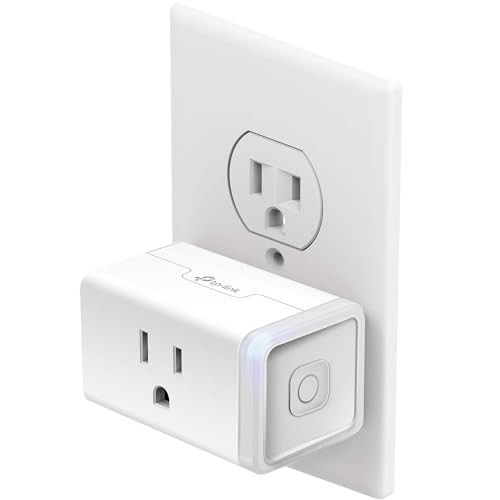
The TP-Link Kasa Smart Plug represents the polished all-rounder approach to this category: a compact Wi-Fi plug from a networking brand that treats the companion app as a first-class product. In daily use that heritage shows in the details owners mention most — setup that follows a calm, linear flow, schedules that behave predictably, and an away mode that varies lighting patterns so a home looks lived-in rather than mechanically timed. The housing is shaped with the neighbouring outlet in mind, designed to leave the second socket of a duplex outlet usable, which sounds trivial until a chunky plug has blocked one in your own home.
Kasa plugs sit in the mid tier of the market: not the cheapest way to make an outlet smart, and not priced like a luxury object either. The honest trade-offs are ecosystem-shaped. The experience is strongest inside the Kasa app and with the major voice assistants; households building around newer cross-platform standards should check the current listing carefully for the exact model variant, because the Kasa family spans several generations with different feature sets. For a lamp, a fan or a coffee maker that simply needs to obey a schedule for years, this is the plug many owners buy once and then quietly multiply around the house.
Best for: readers whose priorities match its strengths below. Not suited for: anyone whose main need is listed among its trade-offs. It sits in the mid-tier of this market — check price on Amazon for the current listing before deciding.
- Strength: Polished, dependable app with scheduling and away mode
- Strength: Compact housing designed to respect the second outlet
- Strength: Backed by an established networking brand
- Trade-off: Feature set varies between model generations — check the exact variant
- Trade-off: No substitute for checking the load guidance against your appliance
- Trade-off: Best experience lives inside its own app ecosystem

Leviton Decora Smart Plug
The Leviton Decora Smart Plug comes from a company whose day job is electrical hardware, and that perspective shapes the product: this is a plug pitched at people who are building a whole smart-lighting scheme rather than experimenting with a single outlet. Managed through the My Leviton app alongside the Decora range of smart switches and dimmers, it lets a household keep one visual language and one control system across wall switches and plug-in devices alike — an underrated virtue when a partner or guest has to live with the system too.
Positioned toward the premium end of the plug market, it asks you to pay for that coherence and for a broad set of voice-assistant partnerships rather than for novelty features. The honest limitations are the usual ones for the category: it remains a Wi-Fi device dependent on your network’s manners, and its plug-in form can never offer the permanence or the wall-plate neatness of the wired Decora switches it is designed to complement. For homes already committed to Decora on the walls, though, it is the natural way to bring lamps and small appliances into the same fold.
Best for: readers whose priorities match its strengths below. Not suited for: anyone whose main need is listed among its trade-offs. It sits in the premium-leaning tier of this market — check price on Amazon for the current listing before deciding.
- Strength: One app and design language with Decora wall switches
- Strength: Electrical-brand heritage and broad assistant support
- Strength: Premium-leaning build suited to whole-home schemes
- Trade-off: Premium positioning versus simpler rivals
- Trade-off: Still network-dependent like every Wi-Fi plug
- Trade-off: Cannot match a wired switch for permanence
TP-Link Kasa Smart Switch
On the switch side, the TP-Link Kasa Smart Switch represents the wired approach at a mid-tier position: it replaces the wall switch itself, so the ceiling light it controls behaves smartly for everyone — app, voice, schedule or a finger on the paddle — with no plug visible anywhere. The cost of that elegance is installation: the circuit must be switched off at the breaker, the existing switch removed and the smart switch wired in its place, work many homeowners do confidently and others rightly hand to an electrician.
Best for: readers whose priorities match its strengths below. Not suited for: anyone whose main need is listed among its trade-offs. It sits in the mid-tier of this market — check price on Amazon for the current listing before deciding.
- Strength: Invisible once installed — the wall control just works
- Strength: Controls the actual ceiling circuit
- Strength: Same app family as Kasa plugs for mixed homes
- Trade-off: Requires wiring work and a compatible wall box
- Trade-off: Fixed to one circuit forever
- Trade-off: Not renter-friendly

Leviton Decora Smart Wi-Fi Switch
The Leviton Decora Smart Wi-Fi Switch is the premium-leaning wired option: part of the same Decora family as Leviton’s plug, it brings a whole-home lighting scheme under one app and one design language. For rooms where several lights share one switch — kitchens, hallways, living rooms — a single smart switch outperforms any number of plugs, because the circuit itself becomes smart rather than each lamp individually. Installation carries the same caveats as any wired device: breaker off, wiring verified, and professional help whenever anything looks unfamiliar.
Best for: readers whose priorities match its strengths below. Not suited for: anyone whose main need is listed among its trade-offs. It sits in the premium-leaning tier of this market — check price on Amazon for the current listing before deciding.
- Strength: One device makes a whole circuit smart
- Strength: Matches Decora plugs and dimmers in one system
- Strength: Wall control remains natural for guests
- Trade-off: Installation effort and possible electrician cost
- Trade-off: Cannot move rooms when you do
- Trade-off: Overkill for a single plug-in lamp
Final Recommendation by Use Case
For the lamp-lit, renting, experimenting household: plugs, standardised on one ecosystem, with the safety screen applied load by load. For the owned home with busy wired lighting: switches on the main circuits, plugs at the margins where appliances live — the combination each product’s inventors would recognise as their device used exactly as intended. The comparison’s real loser is indecision between them at the level of a whole house; at the level of a room, the right answer is almost always obvious once the four branching questions are asked out loud.
Going Deeper: Living With Smart Plugs Long-Term
There is a quieter virtue to standardising on smart plugs that rarely appears in buying advice: the system becomes legible to the whole household. When every automated outlet behaves the same way — same app, same button feel, same recovery after an outage — guests, partners and older children absorb the pattern without instruction. Mixed fleets break that legibility. Each brand’s plug has its own pairing ritual, its own idea of what a schedule is and its own failure personality, and the household’s knowledge fragments accordingly. The plug is a small product, but it multiplies, and everything about it multiplies too.
Placement strategy deserves a paragraph of its own. The outlets that benefit most from automation are rarely the convenient ones at waist height in the hallway; they are the awkward ones — behind the aquarium cabinet, under the desk, beside the bed frame — where reaching a switch is a daily minor annoyance. Automating an annoyance is the highest-value use of a plug, because the benefit is collected every single day. Automating an outlet you could reach without thinking buys novelty instead, and novelty depreciates quickly. Walk the house with that lens before ordering, and the shopping list writes itself in the right order.
Finally, think about the exit. Every smart plug ecosystem is a small commitment, and the honest buyer considers, before the fleet grows, what leaving would cost: re-pairing a handful of plugs is an evening; re-pairing a houseful is a project. That is not an argument against buying — it is an argument for choosing the ecosystem deliberately at the start, when the choice is free, rather than discovering at plug twelve that the household has drifted into a platform nobody would have picked on purpose. Standards like Matter are slowly lowering those exit costs, which is one more reason to favour plugs that speak them.
Holiday lighting is the seasonal showcase that converts more sceptics than any other plug job. Trees, window candles and outdoor displays share three traits: they are pure, predictable resistive loads; they run on a strict daily rhythm for a few weeks; and their switches are inevitably in the least reachable places in the house. A plug — outdoor-rated for anything outside — removes the nightly crawl behind the tree entirely, follows sunset as the evenings draw in, and shuts the whole performance down at a civilised hour. It is also the perfect pilot job: high frequency, low risk, and a benefit the whole household can see from the street.
Aquariums and terrariums are a connoisseur’s plug job, because their inhabitants live by light cycles and gentle water movement rather than by human convenience. A plug gives the lights a day that starts and ends at the same minute all year, immune to forgotten evenings and holiday absences, and grouping the lights separately from filtration lets the life-support equipment run untouched while the lighting performs its theatre. The discipline here is conservative: automate the predictable, supervise any change for a full cycle, and keep the manual override where a hand can reach it without moving furniture.
The home office hides one of the best plug audits in the house. Monitors, docks, printers, speakers and chargers gather around a desk and sip standby power through every night and weekend, individually trivial and collectively constant. A plug on the non-essential cluster — never on the machine that might be mid-update or holding unsaved work — cuts the sip on a work-hours schedule, and a monitoring model can price the habit precisely before you commit. Owners who run this audit once tend to repeat it room by room, which is how one plug becomes a household energy policy.
Helping an older relative’s home is a use case owners describe with real warmth. A plug on a parent’s reading lamp, set to a gentle evening routine, removes a daily reach behind furniture; remote visibility lets family confirm the lamp came on as usual; and none of it requires the relative to learn anything new, because the lamp’s own switch still works when the plug is on. The same conservatism applies double here: safe loads only, nothing involving heat, and automations chosen for reassurance rather than cleverness.
Time-of-use electricity tariffs give scheduling a sharper edge. Where energy costs more at peak hours, a plug can shift the flexible loads — charging, the dehumidifier’s working hours within its maker’s guidance, the entertainment stack’s standby window — toward cheaper times automatically. The savings per device are modest, but the behaviour is free once set, and monitoring plugs close the loop by showing whether the shift actually happened. It is the plug working as a tiny, tireless tariff clerk rather than as a remote control.
Naming and grouping sound like housekeeping and behave like infrastructure. The fleet that stays usable for years follows a ruthless convention — room first, appliance second, spoken exactly as a guest would say it — because voice control, routines and troubleshooting all navigate by those names. Groups mirror rooms, not technologies, so ‘downstairs’ can be quieted in one command when the house sleeps. Owners who skip this discipline own plugs named like network printers and a household that routes around the system; owners who keep it describe their setup in one breath.
Scenes and routines are where plugs stop being switches and start being stagehands. A single ‘evening’ routine can bring two lamps up, wake the entertainment stack and start the fan, each on its own plug, in one breath of a command or at one minute of the clock. The craft is restraint: scenes built around real transitions — arriving, dining, watching, sleeping — get used daily, while scenes built to impress visitors get used twice. Build for the transitions your household actually makes, name them in the household’s own words, and let the exotic ideas wait until a real evening asks for them.
Privacy deserves a clear-eyed paragraph. A plug knows when its load runs, and its app therefore holds a small diary of the household’s rhythms — when the lamps lit, when the coffee brewed, when the house woke. Reputable ecosystems guard that data as account data, and owners should treat it with the same ordinary care: strong passwords, account security features switched on, firmware kept current and old devices removed when retired. None of this is cause for alarm; all of it is cause for choosing established platforms over anonymous ones when the fleet grows.
Second-hand and hand-me-down plugs deserve a caution of their own. A used plug arrives with a previous life: an unknown load history, firmware that may be generations old and a pairing to someone else’s account. None of that is disqualifying — the category is durable — but the sensible ritual is fixed: factory-reset the device, update its firmware before trusting it with a routine, watch its first supervised cycles on a gentle load, and retire without sentiment any unit that runs warm, smells of hot plastic or shows a discoloured body. A bargain plug is only a bargain while it behaves like a new one.
Moving house is the plug fleet’s finest hour and a small test of its record-keeping. Because nothing is installed, the whole system travels in a box and redeploys in an afternoon — provided the names still make sense in the new rooms and the account survived the move. Owners who kept a simple inventory card find the new house automated by the first weekend; owners who relied on memory spend that weekend re-pairing mysteries. The same card serves when a router is replaced, which is the other occasion when a fleet’s discipline pays out all at once.
Seasonal review is the maintenance habit that separates systems from accumulations. Twice a year — when the clocks change is the classic cue — walk the fleet in the app: delete schedules the household no longer lives by, rename plugs whose appliances have moved, retire the routine built for a summer that ended, and confirm each plug still answers from its real position. Ten minutes, twice a year, prevents the slow drift by which automations start firing for households that no longer exist, and it is when most owners notice the one plug that has quietly stopped reporting.
Certification and build trust are the unglamorous end of choosing, and worth a deliberate look. Reputable plugs carry the safety certification marks of the market they are sold in, come from makers who publish support channels and firmware updates, and state their load guidance in plain language rather than hiding behind a single heroic number. Anonymous plugs with miraculous claims and no accountable maker are the category’s false economy: the saving is small, the device sits on mains power in your wall for years, and the downside is not a metaphor. Buy the accountable plug.
Guests and housesitters reveal whether a smart home is a system or a performance. A plug-based room passes the guest test when the visitor can get light without instruction: the lamp’s switch behaves because the plug is on, the schedule is forgiving, and nothing requires an app the guest does not have. Design routines for the household’s least technical night, not its most technical one — automations that need explaining are automations that will be unplugged, literally, by someone trying to charge a phone at midnight.
The router-reboot plug is a folk remedy worth examining honestly. Owners of remote cabins and rentals sometimes place a plug on the network equipment itself, so a frozen router can be power-cycled from afar — with the obvious paradox that a dead router cannot receive the command, which is why the trick only works through plugs with independent connectivity or scheduled self-resets. Treated as a curiosity it is harmless; treated as infrastructure it disappoints. The episode teaches the category’s central lesson in miniature: a plug’s cleverness is bounded by the path its commands travel.
Workshop and utility loads sit at the careful edge of the plug’s kingdom. Dust extraction, battery-charger benches and utility fans are motor or electronic loads with personalities, and the owners who automate them successfully share a pattern: the plug’s maker explicitly welcomes the load type, the first cycles are supervised, the appliance’s own safety features remain fully in charge, and nothing that cuts, heats or spins unattended is ever left to a schedule. The plug may fetch and carry power in a workshop; it must never be the thing standing between a tool and its operator’s judgement.
Finally, there is the question of enough. A household’s plug fleet has a natural size — roughly, the number of genuine daily routines plus a monitoring instrument or two — and fleets that grow past it begin to generate their own maintenance weather. The owners who report the deepest satisfaction are not the ones with the most plugs; they are the ones who can still list theirs from memory, each earning its outlet. Let the routines ask for plugs, one honest job at a time, and the fleet will stay a servant rather than becoming a second household to manage.
Strip away the branding and a smart plug is a radio with a relay attached, so the radio decision shapes everything. The mainstream choice is direct Wi-Fi: the plug joins your home network, talks to its app and your voice assistant, and needs no additional hardware. The strength is simplicity and price; the weakness is that every plug is another client your router must keep happy, and a crowded or weak network shows up as plugs that respond slowly or drop offline at the far end of the house. A plug is only ever as reliable as the Wi-Fi reaching the outlet behind the sofa.
The alternatives organise around hubs and newer standards. Some ecosystems route plugs through a hub or a mesh protocol, trading a little setup complexity for a network that stays responsive when the internet itself is down. Matter, the cross-brand standard, and Thread, the mesh radio many Matter devices use, aim to end the era of choosing a plug by logo: a Matter plug should, in principle, join whichever platform runs your home. That promise is maturing rather than complete, so the practical advice is unchanged — buy for the ecosystem you actually use today, treat standards support as future-proofing rather than present fact, and check the exact model, because families of plugs often mix generations with different radios under one familiar name.
Whichever radio you choose, placement is destiny. A plug tucked behind a metal appliance in a basement corner lives at the edge of coverage, and no app update fixes physics. Before standardising on a model, test one unit in the worst outlet you intend to automate; if it holds a connection there for a week of ordinary use, the rest of the house will be easy. Owners who skip that pilot buy sometimes own a box of plugs and a grudge; owners who run it own a system.
Energy monitoring is the feature that divides this category into toys and tools. A monitoring plug measures what the attached appliance actually consumes and reports it in the app — as live draw while it runs, and as accumulated usage across days and weeks. The first week with one is genuinely educational. You learn which devices earn their keep and which ones charge you rent: the entertainment stack idling all night, the old spare fridge cycling far more than it should, the dehumidifier whose appetite explains a bill that had seemed mysterious.
The mature use of monitoring is not surveillance of every lamp — it is auditing. Put the monitoring plug on one suspect appliance at a time, let it gather a week of honest data, then act: replace, repair, reschedule or simply accept the cost with open eyes. After the audit, the plug can move to the next suspect or settle into permanent duty on the one load whose consumption you truly manage, such as a workshop tool or a pump where running time itself is information. Owners who buy monitoring for every outlet usually stop reading the graphs within a month; owners who buy one or two monitoring plugs and rotate them deliberately extract value for years.
Scheduling is the least glamorous feature of a smart plug and the one owners rely on longest. Voice control delights for a fortnight; a lamp that simply comes on before you get home delights for years. The schedules that survive are the ones matched to real rhythms: lights that follow sunset rather than a fixed clock, a coffee maker warmed and ready on weekday mornings only, a fan that runs through the first hours of the night and then rests. Every credible plug app handles these basics, and the differences that matter are subtleties — whether schedules are stored on the device or in the cloud, whether they survive an internet outage, and how gracefully the plug behaves when power returns after a cut.
Voice control is the doorway through which most smart plugs enter a home, and the assistant you already use is the strongest single predictor of which plug you should buy. A plug that joins your existing ecosystem natively will answer quickly, group naturally with your other devices and appear in the routines you have already built. A plug that requires a bridge skill, a second app or a workaround will work — and will remind you of the friction every time it answers slowly or forgets its group. Compatibility lists should be read for the exact model and the exact assistant, because ‘works with’ claims age quickly as platforms evolve.
It is also worth deciding what voice should be allowed to control. Lamps, fans and entertainment gear are natural voice loads: harmless, reversible and pleasant to command from the sofa. Anything involving heat, water or security deserves more deliberation — many owners deliberately keep such loads out of voice reach, or behind the confirmation steps some platforms offer, so that a misheard command or a visiting child cannot start something best started deliberately. The plug does not know what it controls; the household’s rules supply the judgement the product lacks.
Ask owners what irritates them about a smart plug they otherwise like and the answer is rarely software — it is geometry. Early smart plugs were famously bulky, swallowing both sockets of a duplex outlet and crowding neighbouring plugs on a strip. Modern designs have largely learned manners: compact housings shaped to leave the second outlet free, side-facing sockets on some models, and dual-outlet designs that put two independently controlled sockets in one body for entertainment stacks and desks. Before buying a fleet, hold the candidate’s shape in mind against your real outlets — behind the bed, inside the media cabinet, at the crowded kitchen counter — because the best plug on paper is useless in the outlet it physically dominates.
You will interact with a smart plug’s app a hundred times for every time you touch the plug, which makes software the real product. A good plug app shares a recognisable personality: pairing that succeeds on the first attempt, a home screen that shows state at a glance, schedules you can build without a manual, and naming and grouping that match how you think about rooms rather than how databases think about devices. Firmware updates arrive quietly and improve things. The mediocre apps are equally recognisable — pairing rituals that fail behind furniture, schedules buried three menus deep, and accounts that demand attention the hardware never would.
A practical test before committing to a brand: download the app first, read its recent owner feedback with a sceptical eye, and look specifically for how the maker responds when things break — because across a fleet of plugs owned for years, something eventually will. Also consider the household dimension. The best system is the one a partner, a teenager or a housesitter can operate without a tutorial, which is why physical buttons on the plug itself matter more than spec sheets admit: when the network sulks, a fingertip on the plug should still turn the lamp on.
Every smart plug owner eventually meets the two failure moments that define the category: the internet goes down, and the power goes out. Mature plugs handle the first with grace — schedules stored on the device keep running, the physical button keeps working, and only remote access pauses. Lesser designs freeze their timers in the cloud and leave lamps doing whatever they were doing when the connection died. The second moment, power restoration, has its own etiquette: a good plug can be told what to do when electricity returns — stay off, resume its previous state, or turn on — and the right answer differs by load. A lamp resuming is pleasant; a pump or a fan resuming may or may not be what you want at an unknown hour.
None of these behaviours appears in headline marketing, and all of them appear in long-term owner reports, which is why reading owner experience matters more in this category than in most. It is also why the humble manual override deserves respect in every buying decision: whatever the network, the app or the cloud is doing, the person standing at the outlet must always be able to win. A plug that respects that hierarchy will serve quietly for years; one that fights it will be replaced by one that does.
Worked Examples: Choosing Between These Two, Room by Room
Comparisons are usually settled by a table, but households are not tables. This section works through the decision between the two options as real situations, the rooms, routines and constraints that push the answer one way or the other. If your situation appears below, you have your answer; if it does not, the pattern of the examples will still show you which questions decide it.
Judge a smart plug as an electrical device first: the loads it is rated to switch, its size on your outlet and whether it blocks the neighbouring socket, then by its software, scheduling, energy reporting and how it recovers after an outage. The plug’s job list in your home should be written before the plug is bought. Walk the outlets you plan to automate and check the appliance at each one: does it resume correctly when power returns, does it have a mechanical switch that stays on, and is it a load a plug should switch at all. Confirm the network reaches the furthest outlet, especially in garages and utility rooms.
On a lamp with an awkward switch, a plug plus a schedule quietly removes a daily annoyance for very little money. Rotated between suspect appliances for a week each, one energy-reporting plug builds the picture of what your home actually uses. For seasonal items such as fans, decorations or a dehumidifier in a damp corner, a plug adds timing control without replacing a working appliance. Notice that the deciding factors are rarely the headline features. They are the constraints of the room, the habits of the household and the infrastructure you already own, which is why copying a friend’s choice so often disappoints.
Apply all of this to the listings in front of you. When a listing such as the TP-Link Kasa Smart Plug, Leviton Decora Smart Plug and TP-Link Kasa Smart Switch catches your eye, resist judging it by its headline claim and instead run the checks above against it: does its stated role match the room you measured, does its control path suit your household, and does the maker’s own guidance support the job you have in mind. A model that answers those questions cleanly on paper usually answers them cleanly in the home, and one that dodges them in the listing will dodge them on your wall, shelf or desk as well.
Heating and large cooling appliances are the danger zone: many makers forbid remote switching, and a plug is the wrong tool where a load can restart unattended into an unsafe state. Appliances with electronic controls often wake in standby when power returns, so the plug switches the supply but the appliance still waits for a button press. If a plug drops offline, test it in an outlet nearer the router; corners, metal appliances and thick walls eat signal. If schedules drift or miss, check whether the plug lost its network and time source after an outage.
- Identify the constraint in your home that most favours one side for your smart plug.
- Decide which weakness you would rather live with daily for your smart plug.
- Check which option fits the infrastructure you already own for your smart plug.
- Consider who else in the household each option must work for for your smart plug.
- Prefer the option you can test and return most easily for your smart plug.
- Write down the deciding reason so the choice survives second thoughts for your smart plug.
If a plug feels warm or clicks repeatedly under load, remove it from service; that load is beyond what it should be switching. Keep plugs dust-free and firmly seated, review schedules when the clocks change, update firmware through the maker’s app, and keep a written note of which plug serves which appliance so replacements are painless.
If the worked examples leave you tied, choose the option whose weaknesses fall where your household is strongest. Every product in this comparison has a weakness; the art is placing it where it will never be stepped on.
Frequently Asked Questions
Can a smart switch and a smart plug be used together?
Yes — that is the mature pattern. Switches run the wired lighting skeleton of the home; plugs run everything with a cord. The craft is to keep them in one ecosystem where possible, so one app and one set of routines govern both, and to never stack their authority on the same load: a lamp should obey a plug or its circuit’s switch, not fight both.
Which is better for a lamp: a smart plug or a smart bulb?
For a simple lamp, the plug usually wins: it automates the lamp you already own and leaves bulb choice free. The bulb wins when dimming or colour from the lamp itself is the point. The switch enters this contest only if the lamp is one of several on a wired circuit you want to control as a room — otherwise it is answering a question the lamp never asked.
Is a smart switch hard to install?
For a confident homeowner with a compatible wall box, it is a careful hour: breaker off and verified, wires identified, connections landed, power restored, pairing done. For anyone unsure at any step, it is an electrician’s short visit — and that is the correct answer, not a defeat. The plug exists precisely for the jobs and households where that hour is not available or not permitted.
Do smart switches work if the Wi-Fi goes down?
The wall paddle keeps working like an ordinary switch, which is one of the switch’s quiet superiorities — the house never becomes unusable, only un-automated. Schedules and app control depend on the model and its design. A plug in the same outage keeps its physical button too, but a plug-controlled lamp additionally depends on the lamp’s own switch having been left on.
Which option is better for saving energy?
They save in different places. Plugs attack standby waste — whole stacks of idle devices switched off on a schedule, with monitoring models to prove it. Switches attack lighting discipline — whole circuits scheduled and grouped so lights are not left burning in empty rooms. Audit your own waste first; the device that addresses the larger pile is your better buy.
I can only afford to start with one. Which should it be?
Start with a plug on your most annoying lamp. It costs the least, teaches the most and commits you to nothing — and its month of service will tell you whether your home’s future is plug-shaped, switch-shaped or, as in most homes that start exactly here, a deliberate mixture of both.
Related Guides
how to choose a smart plug, step by step
whether a smart plug is worth it for your home
the complete smart plug buying guide
smart plug pros and cons, weighed honestly
our in-depth smart plug review
how to read smart plug reviews like an owner
the best Wi-Fi smart plugs we have tested
our guide to the best smart light switches