Disclosure: As an Amazon Associate, reviewstook.com earns from qualifying purchases. Links on this page are affiliate links; they cost you nothing extra. Prices and availability change often, so check the current Amazon listing before you buy.
So, is a smart plug worth it? The short answer: worth it if your home holds good, simple appliances whose only fault is a manual switch — lamps that should follow the sunset, a fan that should rest after midnight, chargers and entertainment gear that should stop sipping power while you sleep. In those homes a plug pays for itself in removed errands within weeks. Not worth it if the appliance you dream of automating is a heater or a large cooling unit that should never be remotely switched, if your Wi-Fi cannot reach the outlet, or if you are buying automation in search of a problem it can solve.
That verdict deserves its evidence, and this article supplies it in the order a decision actually forms: what you truly get when a plug enters your home, what it costs beyond money, the households for whom it plainly pays, the households it plainly does not, and the honest alternatives competing for the same job. By the end, a short checklist converts the whole argument into a decision you can make about your own outlets in about a minute.
Key Takeaways
- Worth it when: the load is safe and predictable, the routine is daily, and the outlet is reachable by your network.
- Not worth it when: the target appliance involves heat or large-scale cooling, or the ‘routine’ would be used twice and forgotten.
- The value is subtraction: plugs pay by removing errands and idle consumption, not by adding spectacle.
- One pilot plug answers the question for your house more honestly than any verdict written for everyone’s.
In this guide
Is a Smart Plug Worth It? What You Actually Get
Scheduling is the least glamorous feature of a smart plug and the one owners rely on longest. Voice control delights for a fortnight; a lamp that simply comes on before you get home delights for years. The schedules that survive are the ones matched to real rhythms: lights that follow sunset rather than a fixed clock, a coffee maker warmed and ready on weekday mornings only, a fan that runs through the first hours of the night and then rests. Every credible plug app handles these basics, and the differences that matter are subtleties — whether schedules are stored on the device or in the cloud, whether they survive an internet outage, and how gracefully the plug behaves when power returns after a cut.
Voice control is the doorway through which most smart plugs enter a home, and the assistant you already use is the strongest single predictor of which plug you should buy. A plug that joins your existing ecosystem natively will answer quickly, group naturally with your other devices and appear in the routines you have already built. A plug that requires a bridge skill, a second app or a workaround will work — and will remind you of the friction every time it answers slowly or forgets its group. Compatibility lists should be read for the exact model and the exact assistant, because ‘works with’ claims age quickly as platforms evolve.
You also get a quieter kind of value that owners mention with genuine feeling: the house that behaves while you are away. Lights that follow a lived-in rhythm rather than a burglar-readable timer, an aquarium that keeps its day, a dehumidifier’s holding pattern in a damp basement — within the safety rules — are worth real money to people who travel. And on monitoring models you get the truth about consumption, which is the rare smart-home feature that can reduce a bill rather than merely rearrange it. None of this is spectacle. All of it compounds, daily, in the currency of small frictions that no longer exist.
The Real Costs Beyond Money
You will interact with a smart plug’s app a hundred times for every time you touch the plug, which makes software the real product. A good plug app shares a recognisable personality: pairing that succeeds on the first attempt, a home screen that shows state at a glance, schedules you can build without a manual, and naming and grouping that match how you think about rooms rather than how databases think about devices. Firmware updates arrive quietly and improve things. The mediocre apps are equally recognisable — pairing rituals that fail behind furniture, schedules buried three menus deep, and accounts that demand attention the hardware never would.
Small disciplines compound. Give the plugs a stable network name that will not change when you next replace the router, or accept a weekend of re-pairing when it does. Keep a simple written note — a card in a drawer is fine — of which plug controls what and which account runs the system; future you, standing in a dark hallway while the app updates, will be grateful. None of this is glamorous, and all of it is the difference between a system that feels like magic and one that feels like a hobby you never asked for.
There are softer costs, too, and honesty requires listing them. A plug adds a layer between you and an appliance: when the layer sulks, the lamp needs its physical button, and the household needs to know that. There is a learning curve, modest but real, and a small standing obligation — firmware updates, schedules revisited when seasons turn, a fleet inventory kept truthful. And there is clutter of a digital kind: one more account, one more app icon, one more ecosystem with opinions. Households that thrive with plugs accept these costs knowingly; households that resent them usually bought the plugs on impulse and the costs as a surprise.
Who It Pays Off For
The routine-rich household. If your days run on rhythms — up at a fixed hour, out at a fixed hour, lamps at dusk, fans at night — a plug converts those rhythms from chores into background. The payoff is collected in minutes and micro-decisions, hundreds of times a year, which is why these owners describe the purchase as obviously worth it and buy more.
The auditor. If an unexplained bill is quietly bothering you, a monitoring plug is among the cheapest diagnostic instruments a home can own. It replaces suspicion with a week of data, per appliance, and the decision that follows — replace, reschedule, or relax — is worth many times the plug’s tier price.
The renter and the cautious beginner. Plugs are the only smart-home upgrade that is fully reversible in seconds and leaves no trace at moving-out time. For anyone forbidden from rewiring, or simply unwilling to commit, that reversibility is the entire case — and it is a strong one.
Who Should Skip It
The heat-seeker. If the appliance you want to automate makes heat or serious cold, the honest answer is that a plug is the wrong product and possibly a dangerous one, unless its maker explicitly blesses remote operation. Buy the appliance with proper built-in smart controls instead; it costs more and it is the actual solution.
The novelty buyer. If there is no daily routine asking to be removed, a plug becomes a voice-controlled party trick with a half-life of a fortnight. The drawer of retired gadgets in every home has a plug-shaped space, and it was bought by someone whose sentence — ‘I will use it to…’ — was never finished.
The weak-network household, for now. A plug at the edge of coverage delivers the worst version of the category: missed schedules and offline sulks. The purchase that is worth it, first, is the mesh node or extender; the plugs become worth it the week after.
Strengths and Trade-Offs of Owning One
Ownership, weighed plainly, looks like this — and the balance tips on how many of the strengths your routines can actually collect.
- Strength: Daily errands — lamps, fans, chargers — quietly abolished by schedules
- Strength: Standby waste made visible, and on monitoring models, measurable
- Strength: Fully reversible: unplug it and the home is exactly as it was
- Trade-off: A new dependency on your network and one more app to maintain
- Trade-off: Useless on appliances with electronic controls that will not resume after a power cut
- Trade-off: Strictly bounded kingdom: heat and large cooling loads stay outside it
Alternatives to Consider
The mechanical timer plug is the plug’s humble ancestor and, for a single fixed schedule on a lamp, still a rational purchase: no app, no network, no account — and no flexibility, no remote control, no sunset-following, no data. A smart bulb beats a plug when the job is light alone and dimming or colour matters, because the intelligence lives in the lamp itself. A smart switch beats a plug when the job is a ceiling circuit used by a whole household, trading installation effort for permanence and invisibility. And a smart power strip beats a single plug at the entertainment stack, where several devices want coordinated control from one outlet. The plug wins its own contests — retrofitting simple appliances, renting, auditing — and loses gracefully elsewhere.
Two of those alternatives deserve a product-level look for plug-shaped jobs, because they bracket the value question neatly:

TP-Link Kasa Smart Plug
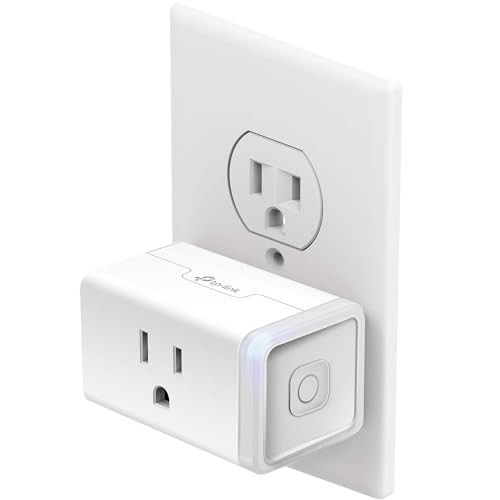
The TP-Link Kasa Smart Plug represents the polished all-rounder approach to this category: a compact Wi-Fi plug from a networking brand that treats the companion app as a first-class product. In daily use that heritage shows in the details owners mention most — setup that follows a calm, linear flow, schedules that behave predictably, and an away mode that varies lighting patterns so a home looks lived-in rather than mechanically timed. The housing is shaped with the neighbouring outlet in mind, designed to leave the second socket of a duplex outlet usable, which sounds trivial until a chunky plug has blocked one in your own home.
Kasa plugs sit in the mid tier of the market: not the cheapest way to make an outlet smart, and not priced like a luxury object either. The honest trade-offs are ecosystem-shaped. The experience is strongest inside the Kasa app and with the major voice assistants; households building around newer cross-platform standards should check the current listing carefully for the exact model variant, because the Kasa family spans several generations with different feature sets. For a lamp, a fan or a coffee maker that simply needs to obey a schedule for years, this is the plug many owners buy once and then quietly multiply around the house.
Best for: readers whose priorities match its strengths below. Not suited for: anyone whose main need is listed among its trade-offs. It sits in the mid-tier of this market — check price on Amazon for the current listing before deciding.
- Strength: Polished, dependable app with scheduling and away mode
- Strength: Compact housing designed to respect the second outlet
- Strength: Backed by an established networking brand
- Trade-off: Feature set varies between model generations — check the exact variant
- Trade-off: No substitute for checking the load guidance against your appliance
- Trade-off: Best experience lives inside its own app ecosystem
Wyze Plug
The Wyze Plug is the entry-tier invitation to this category: an inexpensive Wi-Fi plug from the Wyze ecosystem, sold singly and in pairs, designed to give camera-and-sensor households an easy way to control lamps and small appliances from the same app. Vacation mode, grouping and scheduling cover the everyday asks, and the plug’s unpretentious design suits the outlets nobody looks at — behind the sofa, beside the aquarium, under the holiday tree.
Entry pricing buys entry expectations. The experience is happiest inside the Wyze app and with the major assistants, advanced energy insight is not the point here, and owners building a mission-critical automation should graduate to the category’s heavyweights. Reliability in owner reports tracks the quality of the home network more than the plug itself, which is true across the category but felt first at this tier. As a first plug, a holiday-lights plug or a cheap way to test whether outlet automation suits your life at all, it does its job without drama.
Best for: readers whose priorities match its strengths below. Not suited for: anyone whose main need is listed among its trade-offs. It sits in the entry tier of this market — check price on Amazon for the current listing before deciding.
- Strength: Entry-tier pricing, often in convenient pairs
- Strength: Vacation mode and grouping cover the everyday jobs
- Strength: Natural fit for existing Wyze households
- Trade-off: Best inside its own ecosystem
- Trade-off: No advanced energy reporting
- Trade-off: Depends heavily on a well-behaved home network
How to Get the Most Value If You Buy
Energy monitoring is the feature that divides this category into toys and tools. A monitoring plug measures what the attached appliance actually consumes and reports it in the app — as live draw while it runs, and as accumulated usage across days and weeks. The first week with one is genuinely educational. You learn which devices earn their keep and which ones charge you rent: the entertainment stack idling all night, the old spare fridge cycling far more than it should, the dehumidifier whose appetite explains a bill that had seemed mysterious.
The mature use of monitoring is not surveillance of every lamp — it is auditing. Put the monitoring plug on one suspect appliance at a time, let it gather a week of honest data, then act: replace, repair, reschedule or simply accept the cost with open eyes. After the audit, the plug can move to the next suspect or settle into permanent duty on the one load whose consumption you truly manage, such as a workshop tool or a pump where running time itself is information. Owners who buy monitoring for every outlet usually stop reading the graphs within a month; owners who buy one or two monitoring plugs and rotate them deliberately extract value for years.
Setting up a smart plug well is a short job done in the right order. Start at an outlet near the router for pairing, even if the plug’s final home is across the house; a calm first connection avoids most of the pairing folklore that fills support forums. Name the plug for the appliance and the room — ‘reading lamp, lounge’ ages better than ‘plug three’ — and assign it to its room in the app immediately, while the scheme is fresh. Then set the one schedule or routine you actually bought it for, test the physical button, and only then move the plug to its working outlet and confirm it reconnects there.
A Safety Reality Check Before the Verdict
A smart plug is a remotely controlled electrical switch, and that sentence deserves more respect than the product’s friendly marketing gives it. Everything you plug into it is an appliance connected to mains power, now able to turn itself on at three in the morning because a schedule said so. The first safety rule is therefore about heat. Devices whose whole job is to get hot — space heaters, kettles, toasters, hair tools, irons, heated blankets and similar heating appliances — should not be run from a smart plug unless the appliance manufacturer explicitly allows remote or unattended operation, because a heater that restarts unexpectedly against curtains, bedding or a tipped-over frame is a fire scenario, not a convenience.
The same caution applies, with even less room for debate, to air conditioners and other large cooling or workshop appliances. Beyond the question of whether the plug suits the load, many of these appliances are simply not designed to be power-cycled by an external switch, and their makers say so. The honest rule that experienced owners follow is this: if an appliance would worry you when it starts unattended, it does not belong on a smart plug, whatever the plug’s packaging claims. A smart plug’s legitimate kingdom is the predictable, low-risk load — lamps, fans, chargers, entertainment gear, aquarium equipment, holiday lights — loads that are boring to start and safe to leave.
Two further habits separate careful owners from cautionary tales. First, never daisy-chain: a smart plug goes directly into a wall outlet, never into a power strip that is itself plugged into another strip, and never stacked with a second smart plug to create improvised multi-stage control. Each connection is a point of resistance and heat, and chains multiply them. Second, respect the environment the plug lives in. Indoor plugs belong indoors, dry and ventilated; outdoor control belongs to plugs explicitly rated for outdoor use, mounted so their outlets face down and stay out of standing water. A plug that feels warm, smells of hot plastic or shows discolouration is not a quirk to monitor — it is a device to unplug and retire.
The Decision Checklist
Answer honestly, then apply the rule below:
- Can I name the appliance and the daily behaviour I want, in one sentence?
- Is the load steady and predictable — or a motor the plug’s maker explicitly welcomes?
- Is it free of heat and large-scale cooling, or explicitly approved by its maker for remote operation?
- Does my voice assistant ecosystem already exist, with a plug that joins it natively?
- Does my Wi-Fi reach the intended outlet strongly?
- Would I still want the behaviour if voice control vanished and only the schedule remained?
- Am I willing to pilot one plug for a month before buying more?
The rule: six or seven yes answers — buy the pilot today. Four or five — fix the no answers first; they are almost always network or load problems, and both are solvable. Three or fewer — the honest purchase is the alternative that fits your actual job, and this article has done its work by saving you a drawer space.
Going Deeper: Living With Smart Plugs Long-Term
There is a quieter virtue to standardising on smart plugs that rarely appears in buying advice: the system becomes legible to the whole household. When every automated outlet behaves the same way — same app, same button feel, same recovery after an outage — guests, partners and older children absorb the pattern without instruction. Mixed fleets break that legibility. Each brand’s plug has its own pairing ritual, its own idea of what a schedule is and its own failure personality, and the household’s knowledge fragments accordingly. The plug is a small product, but it multiplies, and everything about it multiplies too.
Placement strategy deserves a paragraph of its own. The outlets that benefit most from automation are rarely the convenient ones at waist height in the hallway; they are the awkward ones — behind the aquarium cabinet, under the desk, beside the bed frame — where reaching a switch is a daily minor annoyance. Automating an annoyance is the highest-value use of a plug, because the benefit is collected every single day. Automating an outlet you could reach without thinking buys novelty instead, and novelty depreciates quickly. Walk the house with that lens before ordering, and the shopping list writes itself in the right order.
Finally, think about the exit. Every smart plug ecosystem is a small commitment, and the honest buyer considers, before the fleet grows, what leaving would cost: re-pairing a handful of plugs is an evening; re-pairing a houseful is a project. That is not an argument against buying — it is an argument for choosing the ecosystem deliberately at the start, when the choice is free, rather than discovering at plug twelve that the household has drifted into a platform nobody would have picked on purpose. Standards like Matter are slowly lowering those exit costs, which is one more reason to favour plugs that speak them.
Holiday lighting is the seasonal showcase that converts more sceptics than any other plug job. Trees, window candles and outdoor displays share three traits: they are pure, predictable resistive loads; they run on a strict daily rhythm for a few weeks; and their switches are inevitably in the least reachable places in the house. A plug — outdoor-rated for anything outside — removes the nightly crawl behind the tree entirely, follows sunset as the evenings draw in, and shuts the whole performance down at a civilised hour. It is also the perfect pilot job: high frequency, low risk, and a benefit the whole household can see from the street.
Aquariums and terrariums are a connoisseur’s plug job, because their inhabitants live by light cycles and gentle water movement rather than by human convenience. A plug gives the lights a day that starts and ends at the same minute all year, immune to forgotten evenings and holiday absences, and grouping the lights separately from filtration lets the life-support equipment run untouched while the lighting performs its theatre. The discipline here is conservative: automate the predictable, supervise any change for a full cycle, and keep the manual override where a hand can reach it without moving furniture.
The home office hides one of the best plug audits in the house. Monitors, docks, printers, speakers and chargers gather around a desk and sip standby power through every night and weekend, individually trivial and collectively constant. A plug on the non-essential cluster — never on the machine that might be mid-update or holding unsaved work — cuts the sip on a work-hours schedule, and a monitoring model can price the habit precisely before you commit. Owners who run this audit once tend to repeat it room by room, which is how one plug becomes a household energy policy.
Helping an older relative’s home is a use case owners describe with real warmth. A plug on a parent’s reading lamp, set to a gentle evening routine, removes a daily reach behind furniture; remote visibility lets family confirm the lamp came on as usual; and none of it requires the relative to learn anything new, because the lamp’s own switch still works when the plug is on. The same conservatism applies double here: safe loads only, nothing involving heat, and automations chosen for reassurance rather than cleverness.
Time-of-use electricity tariffs give scheduling a sharper edge. Where energy costs more at peak hours, a plug can shift the flexible loads — charging, the dehumidifier’s working hours within its maker’s guidance, the entertainment stack’s standby window — toward cheaper times automatically. The savings per device are modest, but the behaviour is free once set, and monitoring plugs close the loop by showing whether the shift actually happened. It is the plug working as a tiny, tireless tariff clerk rather than as a remote control.
Naming and grouping sound like housekeeping and behave like infrastructure. The fleet that stays usable for years follows a ruthless convention — room first, appliance second, spoken exactly as a guest would say it — because voice control, routines and troubleshooting all navigate by those names. Groups mirror rooms, not technologies, so ‘downstairs’ can be quieted in one command when the house sleeps. Owners who skip this discipline own plugs named like network printers and a household that routes around the system; owners who keep it describe their setup in one breath.
Scenes and routines are where plugs stop being switches and start being stagehands. A single ‘evening’ routine can bring two lamps up, wake the entertainment stack and start the fan, each on its own plug, in one breath of a command or at one minute of the clock. The craft is restraint: scenes built around real transitions — arriving, dining, watching, sleeping — get used daily, while scenes built to impress visitors get used twice. Build for the transitions your household actually makes, name them in the household’s own words, and let the exotic ideas wait until a real evening asks for them.
Privacy deserves a clear-eyed paragraph. A plug knows when its load runs, and its app therefore holds a small diary of the household’s rhythms — when the lamps lit, when the coffee brewed, when the house woke. Reputable ecosystems guard that data as account data, and owners should treat it with the same ordinary care: strong passwords, account security features switched on, firmware kept current and old devices removed when retired. None of this is cause for alarm; all of it is cause for choosing established platforms over anonymous ones when the fleet grows.
Second-hand and hand-me-down plugs deserve a caution of their own. A used plug arrives with a previous life: an unknown load history, firmware that may be generations old and a pairing to someone else’s account. None of that is disqualifying — the category is durable — but the sensible ritual is fixed: factory-reset the device, update its firmware before trusting it with a routine, watch its first supervised cycles on a gentle load, and retire without sentiment any unit that runs warm, smells of hot plastic or shows a discoloured body. A bargain plug is only a bargain while it behaves like a new one.
Moving house is the plug fleet’s finest hour and a small test of its record-keeping. Because nothing is installed, the whole system travels in a box and redeploys in an afternoon — provided the names still make sense in the new rooms and the account survived the move. Owners who kept a simple inventory card find the new house automated by the first weekend; owners who relied on memory spend that weekend re-pairing mysteries. The same card serves when a router is replaced, which is the other occasion when a fleet’s discipline pays out all at once.
Seasonal review is the maintenance habit that separates systems from accumulations. Twice a year — when the clocks change is the classic cue — walk the fleet in the app: delete schedules the household no longer lives by, rename plugs whose appliances have moved, retire the routine built for a summer that ended, and confirm each plug still answers from its real position. Ten minutes, twice a year, prevents the slow drift by which automations start firing for households that no longer exist, and it is when most owners notice the one plug that has quietly stopped reporting.
Certification and build trust are the unglamorous end of choosing, and worth a deliberate look. Reputable plugs carry the safety certification marks of the market they are sold in, come from makers who publish support channels and firmware updates, and state their load guidance in plain language rather than hiding behind a single heroic number. Anonymous plugs with miraculous claims and no accountable maker are the category’s false economy: the saving is small, the device sits on mains power in your wall for years, and the downside is not a metaphor. Buy the accountable plug.
Guests and housesitters reveal whether a smart home is a system or a performance. A plug-based room passes the guest test when the visitor can get light without instruction: the lamp’s switch behaves because the plug is on, the schedule is forgiving, and nothing requires an app the guest does not have. Design routines for the household’s least technical night, not its most technical one — automations that need explaining are automations that will be unplugged, literally, by someone trying to charge a phone at midnight.
The router-reboot plug is a folk remedy worth examining honestly. Owners of remote cabins and rentals sometimes place a plug on the network equipment itself, so a frozen router can be power-cycled from afar — with the obvious paradox that a dead router cannot receive the command, which is why the trick only works through plugs with independent connectivity or scheduled self-resets. Treated as a curiosity it is harmless; treated as infrastructure it disappoints. The episode teaches the category’s central lesson in miniature: a plug’s cleverness is bounded by the path its commands travel.
Workshop and utility loads sit at the careful edge of the plug’s kingdom. Dust extraction, battery-charger benches and utility fans are motor or electronic loads with personalities, and the owners who automate them successfully share a pattern: the plug’s maker explicitly welcomes the load type, the first cycles are supervised, the appliance’s own safety features remain fully in charge, and nothing that cuts, heats or spins unattended is ever left to a schedule. The plug may fetch and carry power in a workshop; it must never be the thing standing between a tool and its operator’s judgement.
Finally, there is the question of enough. A household’s plug fleet has a natural size — roughly, the number of genuine daily routines plus a monitoring instrument or two — and fleets that grow past it begin to generate their own maintenance weather. The owners who report the deepest satisfaction are not the ones with the most plugs; they are the ones who can still list theirs from memory, each earning its outlet. Let the routines ask for plugs, one honest job at a time, and the fleet will stay a servant rather than becoming a second household to manage.
Strip away the branding and a smart plug is a radio with a relay attached, so the radio decision shapes everything. The mainstream choice is direct Wi-Fi: the plug joins your home network, talks to its app and your voice assistant, and needs no additional hardware. The strength is simplicity and price; the weakness is that every plug is another client your router must keep happy, and a crowded or weak network shows up as plugs that respond slowly or drop offline at the far end of the house. A plug is only ever as reliable as the Wi-Fi reaching the outlet behind the sofa.
The alternatives organise around hubs and newer standards. Some ecosystems route plugs through a hub or a mesh protocol, trading a little setup complexity for a network that stays responsive when the internet itself is down. Matter, the cross-brand standard, and Thread, the mesh radio many Matter devices use, aim to end the era of choosing a plug by logo: a Matter plug should, in principle, join whichever platform runs your home. That promise is maturing rather than complete, so the practical advice is unchanged — buy for the ecosystem you actually use today, treat standards support as future-proofing rather than present fact, and check the exact model, because families of plugs often mix generations with different radios under one familiar name.
Whichever radio you choose, placement is destiny. A plug tucked behind a metal appliance in a basement corner lives at the edge of coverage, and no app update fixes physics. Before standardising on a model, test one unit in the worst outlet you intend to automate; if it holds a connection there for a week of ordinary use, the rest of the house will be easy. Owners who skip that pilot buy sometimes own a box of plugs and a grudge; owners who run it own a system.
Automations built on top of schedules deserve the same realism. Linking a plug to a door sensor, a motion detector or your phone’s arrival can produce genuinely useful behaviour — an entry lamp that greets you, an aquarium light tied to the household’s actual day — but each link is also a failure point and a small maintenance debt. The owners who stay happy automate few things, name them clearly, and revisit them when seasons or routines change. The owners who automate everything spend their evenings debugging their own house. Start with timers, live with them for a month, and add triggers only where a real annoyance asks for one.
It is also worth deciding what voice should be allowed to control. Lamps, fans and entertainment gear are natural voice loads: harmless, reversible and pleasant to command from the sofa. Anything involving heat, water or security deserves more deliberation — many owners deliberately keep such loads out of voice reach, or behind the confirmation steps some platforms offer, so that a misheard command or a visiting child cannot start something best started deliberately. The plug does not know what it controls; the household’s rules supply the judgement the product lacks.
Ask owners what irritates them about a smart plug they otherwise like and the answer is rarely software — it is geometry. Early smart plugs were famously bulky, swallowing both sockets of a duplex outlet and crowding neighbouring plugs on a strip. Modern designs have largely learned manners: compact housings shaped to leave the second outlet free, side-facing sockets on some models, and dual-outlet designs that put two independently controlled sockets in one body for entertainment stacks and desks. Before buying a fleet, hold the candidate’s shape in mind against your real outlets — behind the bed, inside the media cabinet, at the crowded kitchen counter — because the best plug on paper is useless in the outlet it physically dominates.
Form also decides dignity. A plug on a visible living-room outlet becomes part of the room, and the plainer designs disappear while the sculptural ones announce themselves. Outdoor models are their own branch of the family: chunkier, weather-sealed, often with two sockets and a short mounting tab, built to live under eaves and run holiday lights or pond pumps through the seasons. Treat indoor and outdoor as separate purchases with separate standards, and never let an indoor plug migrate outside for ‘just one season’ — weather finds every seam eventually.
A practical test before committing to a brand: download the app first, read its recent owner feedback with a sceptical eye, and look specifically for how the maker responds when things break — because across a fleet of plugs owned for years, something eventually will. Also consider the household dimension. The best system is the one a partner, a teenager or a housesitter can operate without a tutorial, which is why physical buttons on the plug itself matter more than spec sheets admit: when the network sulks, a fingertip on the plug should still turn the lamp on.
Every smart plug owner eventually meets the two failure moments that define the category: the internet goes down, and the power goes out. Mature plugs handle the first with grace — schedules stored on the device keep running, the physical button keeps working, and only remote access pauses. Lesser designs freeze their timers in the cloud and leave lamps doing whatever they were doing when the connection died. The second moment, power restoration, has its own etiquette: a good plug can be told what to do when electricity returns — stay off, resume its previous state, or turn on — and the right answer differs by load. A lamp resuming is pleasant; a pump or a fan resuming may or may not be what you want at an unknown hour.
None of these behaviours appears in headline marketing, and all of them appear in long-term owner reports, which is why reading owner experience matters more in this category than in most. It is also why the humble manual override deserves respect in every buying decision: whatever the network, the app or the cloud is doing, the person standing at the outlet must always be able to win. A plug that respects that hierarchy will serve quietly for years; one that fights it will be replaced by one that does.
The Usage Audit: Does a Smart plug Earn Its Place in Your Routine?
Worth-it questions are really usage questions. A smart plug earns its place through the hours it is used, the annoyances it removes and the problems it quietly prevents, so the honest way to answer is an audit of your own routine rather than a verdict in the abstract. Run the audit below against your last month, not your best intentions, and the answer usually becomes obvious.
Judge a smart plug as an electrical device first: the loads it is rated to switch, its size on your outlet and whether it blocks the neighbouring socket, then by its software, scheduling, energy reporting and how it recovers after an outage. The plug’s job list in your home should be written before the plug is bought. Walk the outlets you plan to automate and check the appliance at each one: does it resume correctly when power returns, does it have a mechanical switch that stays on, and is it a load a plug should switch at all. Confirm the network reaches the furthest outlet, especially in garages and utility rooms.
On a lamp with an awkward switch, a plug plus a schedule quietly removes a daily annoyance for very little money. Rotated between suspect appliances for a week each, one energy-reporting plug builds the picture of what your home actually uses. For seasonal items such as fans, decorations or a dehumidifier in a damp corner, a plug adds timing control without replacing a working appliance. Be strict about the difference between use you can point to and use you merely intend. A smart plug bought for a routine you do not have will not create the routine; it will join the cupboard of good intentions.
Apply all of this to the listings in front of you. When a listing such as the TP-Link Kasa Smart Plug and Wyze Plug catches your eye, resist judging it by its headline claim and instead run the checks above against it: does its stated role match the room you measured, does its control path suit your household, and does the maker’s own guidance support the job you have in mind. A model that answers those questions cleanly on paper usually answers them cleanly in the home, and one that dodges them in the listing will dodge them on your wall, shelf or desk as well.
Heating and large cooling appliances are the danger zone: many makers forbid remote switching, and a plug is the wrong tool where a load can restart unattended into an unsafe state. Appliances with electronic controls often wake in standby when power returns, so the plug switches the supply but the appliance still waits for a button press. If a plug drops offline, test it in an outlet nearer the router; corners, metal appliances and thick walls eat signal. If schedules drift or miss, check whether the plug lost its network and time source after an outage.
- Count the days in the last month this product would genuinely have been used for your smart plug.
- Name the annoyance it removes and how often that annoyance occurs for your smart plug.
- Check whether something you own already covers the same job for your smart plug.
- Decide the chore you accept in exchange and who will do it.
- Set a review date a month after purchase to judge it on evidence for your smart plug.
- Be honest about the difference between your routine and your intentions for your smart plug.
If a plug feels warm or clicks repeatedly under load, remove it from service; that load is beyond what it should be switching. Keep plugs dust-free and firmly seated, review schedules when the clocks change, update firmware through the maker’s app, and keep a written note of which plug serves which appliance so replacements are painless.
If the audit shows steady use and removed annoyances, the smart plug has already answered the worth-it question in the only currency that counts. If it shows good intentions and an empty routine, the honest answer is to wait until the routine exists.
Frequently Asked Questions
Is a smart plug worth it for saving energy?
For standby waste, yes — with evidence. Entertainment stacks, chargers and office gear sip power around the clock, and a plug that cuts them off on a schedule removes that sip entirely; a monitoring model can show you the size of the win. For a single lamp, the saving is trivial and the value is convenience instead. Buy the energy case where the loads idle, not where they shine.
How long does a smart plug take to pay for itself?
In convenience terms, most owners feel repaid within the first month of a schedule that fires daily — the errand simply stops existing. In bill terms it depends entirely on the load: a hungry idle stack repays a plug far faster than a bedside lamp ever will. The honest framing is that plugs are bought with convenience money and occasionally refunded by the meter.
Is a smart plug worth it for a rented home?
It is arguably the most renter-worthy device in the smart home: no wiring, no permission needed, fully removed in seconds when you leave. Lamps, fans and chargers in a rental are exactly a plug’s kingdom. The only renter-specific caution is network quality in older buildings — pilot one plug in the far room before standardising.
What job makes a smart plug most obviously worth it?
The daily, boring, slightly annoying one: the lamp behind the sofa whose switch requires a reach, the fan that must be started and stopped at bedtime, the aquarium light on its fixed day. Frequency is the multiplier of value in this category — a job done twice a year cannot repay any gadget, and a job done twice a day repays a modest one quickly.
When is a smart switch worth it instead of a plug?
When the load is a ceiling light circuit used by everyone, all day. A switch makes the circuit itself smart — wall control, app and voice in permanent agreement — and no plug can match that invisibility. It costs installation effort and suits owners, not renters. Many homes end up with both, each where it belongs.
Can a smart plug be worth it if I never use voice control?
Completely. Scheduling is the feature owners rely on longest, and it needs no microphone anywhere. A plug that silently runs a lamp’s sunset routine and an aquarium’s day is earning its keep around the clock for a household that never speaks to it once.
Related Guides
how to choose a smart plug, step by step
the complete smart plug buying guide
smart plug pros and cons, weighed honestly
our in-depth smart plug review
how to read smart plug reviews like an owner
smart plug vs smart switch, compared directly
the best Wi-Fi smart plugs we have tested
our guide to the best smart light switches