Disclosure: As an Amazon Associate, reviewstook.com earns from qualifying purchases. Links on this page are affiliate links; they cost you nothing extra. Prices and availability change often, so check the current Amazon listing before you buy.
The wallhack sp is the glass mousepad that carried an entire surface category from forum curiosity to esports furniture, and this review begins with the naming honesty its listing deserves: the pad sold today is the SP-004A, the current revision of the SP-004 that the settings and review world knows by the shorter name. Same lineage, current production — and it is the SP-004A, exactly as listed, that this page links and reviews. What follows is a complete account of the glass-pad proposition as this pad embodies it: why a sheet of tempered glass became a serious answer to the question every FPS player asks of their desk, how it behaves across flicks, swipes, seasons, and skin, what it demands of your mouse, your skates, and your habits, and who should buy it with confidence versus who should admire it from the cloth side of the fence.
Some context for readers meeting the category here. Mousepads spent decades as cloth’s uncontested kingdom, with hard pads as a plastic footnote, until glass — refined by specialist makers, Wallhack (formerly SkyPAD) prominent among them — demonstrated that a properly finished glass surface could offer something neither cloth nor plastic could: a glide that does not age, does not drink humidity, and does not change its character between the first week and the fiftieth. The SP-004 line became the category’s reference in the settings-obsessed corners of competitive FPS, where its name appears in setup lists the way certain mice and monitors do — as furniture of the serious. This review tests that reputation against the physics, the maintenance, and the honest debits, because a pad this opinionated deserves a review with opinions of its own.
Key takeaways
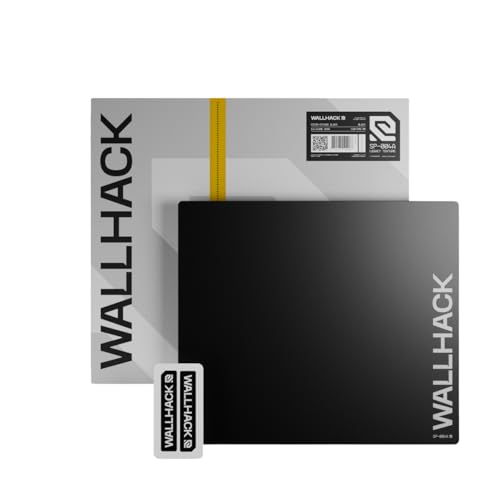
- The current listing is the SP-004A — the present revision of the SP-004 glass pad — in a medium 15.4 by 17.7 inch format, black, on a full non-slip silicone base.
- Glass offers the most consistent glide in the pad world: no humidity drift, no centre wear, no washing calendar — the surface in year two is the surface from week one.
- The glide is fast and free, which flatters tracking and large flicks and demands braking skill from the hand; tactical players should read the stopping sections carefully.
- Skates become consumables with a schedule: glass wears mouse feet faster than cloth, and fresh PTFE is part of the running cost.
- Buy it for consistency, longevity, and speed; stay with cloth for maximum stopping control, warmth, silence, and forgiveness.
In this guide
Wallhack SP-004A — the subject at a glance
- Product: tempered glass gaming mouse pad (listing)
- Revision note: listed as SP-004A, the current revision of the SP-004
- Size listed: medium, 15.4 x 17.7 in
- Colour listed: black
- Surface character listed: smooth tracking for FPS and esports
- Base listed: non-slip 60A silicone base
- Link: Check price on Amazon
That is a short box for a product with a long argument, and the argument is the review: glass is not a material upgrade so much as a different theory of what a pad is for. Cloth treats friction as a tuning tool — a brake and a texture the hand collaborates with. Glass treats friction as a constant to be minimised and then forgotten, handing the entire job of control back to the hand and the mouse’s skates. Everything below is an exploration of that handover: where it liberates, where it exposes, and how to prepare for it if you sign.
How does glass actually feel to play on?
The first hour is the famous one. The mouse moves with a freedom that cloth players experience as a missing sense — the breakaway friction at the start of a movement, the tiny negotiation every cloth stroke begins with, is simply not there, and the cursor answers the hand’s intention with an immediacy that feels, at first, like the sensitivity has been turned up. It has not; the tax has been removed. Micro-corrections become fingertip whispers. Long flicks travel as if the pad were larger than its dimensions, because none of their energy is spent on the surface’s resistance. Players arriving from control cloth describe the same sequence: alarm, delight, and then a recalibration period in which overshoot — the hand’s old habit of pushing through friction that no longer exists — is unlearned stroke by stroke.
By the second week the character clarifies into its true shape. Glass is not slippery in the way ice is slippery; a quality tempered surface like this one has a fine, consistent texture that gives the glide a grain the skates can read, and the sensation settles into something better described as honesty: the mouse does exactly what the hand does, neither helped nor hindered, at every speed, in every direction, in every corner of the pad. That uniformity is the product. A cloth pad is a small landscape of faster and slower parishes — centre worn smooth, edges still fresh, humidity rewriting the map by season. The SP-004A is a billiard table: one surface, one character, no geography to memorise. For players whose aim model is built on repeatable mechanics, that uniformity is worth more than any single glide property, because muscle memory can finally trust the ground it stands on.
The counterweight, stated plainly, is stopping. Cloth’s dynamic friction is a brake the hand has relied on since its first mouse; glass declines to brake, and the stop must come from the hand itself — from finger pressure, from the flick’s own shaping, from technique. Tactical-shooter players, whose genre pays for dead stops, face the steepest version of this tuition, and the settings section below addresses their sensitivity and skate choices directly. Tracking-heavy players pay almost no tuition at all, which is why the glass congregation skews towards their games — and why this review will not pretend the pad is genre-neutral when its physics so clearly are not.
Strengths
- Permanent consistency: no wear-in, no humidity drift, no slow centre — the glide is a constant of your setup rather than a variable.
- Effortless, uniform glide that flatters tracking, large flicks, and fingertip micro-corrections.
- Tempered glass longevity with a wipe-clean surface and a full silicone base that stays planted.
Trade-offs
- No braking assistance: stopping is the hand’s job, and tactical players face a real adaptation.
- Skates wear faster than on cloth, making replacement feet a scheduled consumable.
- Cold, hard, and audible under the mouse — the desk’s texture changes, and not everyone loves the new one.
Best for: FPS and esports players — tracking-leaning especially — who value consistency above all and will invest in skate discipline. / Not suited for: players who rely on cloth’s braking, who play in cold rooms with bare forearms on the pad’s edge, or who want a pad that asks nothing of them.
What does glass demand of your mouse and skates?
On cloth, skates are a wear item you replace when the glide feels tired. On glass, they are a partnership with a maintenance schedule, and going in with that understanding is the difference between the pad’s devotees and its casualties. Glass is harder than PTFE, so the feet wear — evenly and predictably, but measurably — and as they thin, the glide’s character shifts subtly and the mouse sits lower on its sensor. The discipline is simple: inspect the feet monthly under a lamp, replace them when the edges round or the surface scratches, and keep a spare set in the drawer as a standing policy rather than an emergency purchase. Our roundup of replacement mouse skates and feet covers the options, and glass owners are its most faithful readership for a reason.
The mouse itself asks for two qualities. A sensor that behaves on glass’s reflective character — modern flagship optical sensors handle it as a matter of course, but very old or very cheap sensors deserve a test before the pad is blamed — and a weight the hand can brake unaided. Light mice are the natural citizens here, because the hand’s braking authority over a light shell is total; heavier mice carry momentum the surface will not help arrest, and their owners face the stopping tuition at a higher rate of interest. Lift-off and grip complete the picture: a player whose technique lifts and resets the mouse will hear and feel glass’s hardness at every reset, and players with a heavy resetting hand sometimes choose a hybrid life — glass for the tracking games, cloth for the tactical ones — which this review regards not as indecision but as the surface wardrobe working as intended.
How do you set up a glass pad and adapt to it?
Setup begins with the desk: glass wants a flat, clean surface beneath it, because any grit under a rigid pad becomes a point of pressure and a threat to the material’s one true vulnerability — it is glass, tempered and tough, but not immortal, and it should be laid down like the precision surface it is rather than slid into place across a dirty desk. The full silicone base in the listing is the pad’s anchor: once placed, the SP-004A should not travel, and its position deserves the deliberation of furniture — centred on your neutral mouse position, with its medium format’s territory mapped against your sensitivity’s longest stroke before the first game rather than discovered during it. Our wider pad coverage at the best gaming mouse pads shows the size landscape this medium sits in, for readers measuring their own desks against it.
Adaptation is a curriculum of about a week, and it should be run like one. Days one and two: deathmatches and aim trainers only, at your existing sensitivity, while the hand learns that its old pushing force is now an overshoot — expect the flicks to land long and the corrections to feel whispered. Days three and four: introduce the braking technique deliberately — finishing flicks with finger pressure rather than with the surface’s help, shaping the stroke’s end instead of colliding with it — in practice tools before ranked pride is wagered. Days five to seven: your real games, with one settings question now legitimately open: many converts settle a small step lower in sensitivity than their cloth setting, because the removed friction effectively quickened their hand, and a single, small, recorded adjustment at this point is tuning rather than churn. Players coming from the cloth world of our sibling guide to the VAXEE PB mousepad will find the contrast instructive: the PB’s philosophy tunes friction, this pad’s philosophy deletes it, and a player can only know their allegiance by playing both sides of the argument.
Sound and temperature complete the setup’s honesty. Glass is audible — a faint, smooth hiss under fast strokes that some players love as feedback and others manage with skate choice and a headset’s existence — and it is cool to the touch, which in summer is a luxury and in a cold room, under a bare forearm resting on the pad’s edge, is a genuine consideration that wrist rests and sleeves exist to answer. Neither trait is a flaw; both are physics, and a review that omitted them would be selling you a surprise.
What mistakes do glass-pad buyers make?
The first is treating the purchase as a cloth upgrade rather than a category change — expecting the same aim with better materials, and reviewing the pad harshly for the adaptation it honestly requires. The second is skate neglect: running worn feet until the glide roughens and the mouse begins to scratch its complaints into the experience, then blaming the glass for a consumable’s calendar. The third is sensitivity denial — refusing, out of superstition, the small adjustment the new friction legitimately asks for, and spending a month muscling a setting that belongs to a surface that no longer exists. The fourth is housekeeping theatre: glass needs a wipe, not a ritual, and owners who fear it into a cabinet between sessions never collect the consistency that is its entire point. The fifth is the cold-room surprise, preventable by one honest thought about where your forearm rests in January. And the sixth, for readers of settings lists: copying a professional’s glass setup without copying their sensitivity, their skates discipline, and their ten thousand hours — the pad is the most copyable part of a pro’s desk and the least sufficient, a truth our Valorant mouse guide states for mice and that applies here with the nouns changed.
How does glass compare with cloth and hard plastic, surface by surface?
Three surface religions share the modern desk, and the SP-004A’s position is clearest against its rivals. Cloth is the collaborator: its friction helps you start, helps you stop, and forgives your technique’s rough edges, at the price of aging, humidity, and a character that varies across its own map. Hard plastic and resin pads are the sprinters: fast and durable, but with a texture many players find harsh, a wear pattern of their own, and a sound and feel that divide rooms. Glass is the purist: the freest glide of the three and the only one whose character is a true constant, bought with the hand’s full responsibility for control and a consumables bill for skates. None of the three is the correct answer to a question the other two were asking — they are answers to different questions about where control should live: in the surface, shared with the surface, or in the hand alone. The SP-004A’s congregation is the third answer’s, and it is growing for the reason constants always gain followers in a hobby of variables: once your ground stops changing, every other part of your aim becomes legible.
Hybrid lives are common and respectable. Many glass owners keep a cloth pad for the tactical title whose technique they refuse to rebuild, and the wardrobe approach — surfaces matched to games the way mice are matched to grips — is a sign of a mature setup rather than an indecisive one. What this review counsels against is only the unexamined default: the player who has never asked where their control lives, playing on whatever surface arrived with the desk. Ask the question, and either answer — glass’s freedom or cloth’s collaboration — becomes a choice instead of an inheritance.
What does the medium size mean in practice?
The listing’s medium format — 15.4 by 17.7 inches — deserves translation into desk language. It is a full playing field for a mouse: generous width for the low-sensitivity sweep, real depth for the vertical corrections that taller games demand, in a footprint that still shares a desk with a keyboard without annexing the monitor’s stand. Players on very low sensitivities with full-arm technique should measure their longest stroke against those dimensions honestly, because glass’s freedom tempts the arm into longer journeys than cloth ever allowed, and a pad outgrown by its owner’s new style is a familiar story in this category. Players at medium and higher sensitivities will find the territory ample to the point of luxury. Either way, the measurement is a minute with a tape against your current pad’s worn map — the polished region your mouse actually inhabits — and it is the cheapest consultation in this entire review.
Placement interacts with size in one way cloth never teaches: a rigid pad cannot overhang, drape, or be casually shoved half under a keyboard. It occupies its rectangle completely and permanently, so the desk plan should be drawn around it deliberately — keyboard angled or shifted, monitor’s feet considered, the forearm’s resting place at the pad’s edge auditioned in both summer and winter clothing. Players who give the rectangle its planning hour report that the pad disappears into the desk’s architecture; players who drop it into a crowded desk report a season of small collisions. The product is identical in both stories. The planning is the difference.
How do seasons and rooms treat a glass pad?
Cloth owners learn to read their pad as a weather instrument; glass owners are free of the instrument and subject to a different climate — their own skin’s. In summer, a warm room and a fast surface conspire pleasantly: the glide stays exactly itself while cloth rivals are drinking humidity and slowing, and the pad’s cool touch reads as luxury under a warm hand. In winter the same coolness is the pad’s one recurring complaint, felt at the wrist and the forearm’s edge where they rest on or near the surface, and answered by the category’s folk remedies — a sleeve, a wrist rest placed at the edge, a room heated like a room rather than like a server closet. Sweat deserves its sentence in both seasons: a damp palm or forearm changes the hand’s own friction against mouse and pad edge, and glass, which hides nothing, will report your summer hands to you more honestly than cloth did. Players in very humid climates, meanwhile, are glass’s natural converts, because they have the most to gain from a surface that ignores the air entirely — for them the SP-004A is not an exotic upgrade but the first pad that has ever behaved the same in August as in January.
Dust is the glass owner’s daily parish, and it is worth reframing rather than resenting. A glass surface shows its dust — visibly, honestly, before it matters — where cloth hides its loading until the glide has already changed. The wipe that answers it takes thirty seconds and restores the exact surface, every time, with no cumulative cost. Owners describe the ritual the way vinyl owners describe theirs: a small, regular act of care that is also a moment of contact with the instrument. The pad that asks for thirty seconds a day and gives back a constant is making a fair trade, and it makes it in the open.
What do the pros’ settings lists actually tell you?
The SP name’s presence in competitive setup lists is real evidence, and it deserves a precise reading. It establishes that the surface survives the highest level of play — that its glide, consistency, and dimensions serve players whose income is their aim — and that the support ecosystem around it, from skates to community knowledge, is mature. It does not establish that the surface will serve your technique, because the professionals on those lists share more than a pad: they share sensitivities in a known band, mice in a known class, and a volume of practice that would make almost any consistent surface look wise. The correct inference is narrower and still valuable — glass is not a gimmick that elite play tolerates, but a tool elite play chooses — followed by the honest question the trial week answers: whether your hand, your sensitivity, and your games are the kind that choose it too. Copy the pad if the trial blesses it; copy nothing else about those lists without the same examination, because a setup is a system and its parts are not transferable individually, however famous the desk they were photographed on.
How does glass change aim training?
Aim trainers are where a surface change confesses first, and glass’s confession is flattering and dangerous in equal measure. Scores in tracking scenarios often rise quickly — the removed friction is a pure gift to continuous pursuit — while flicking scenarios tell a two-part story: the flick itself arrives faster and freer, and the landing, deprived of the surface’s brake, scatters until the hand rebuilds its stopping technique. Players who judge the pad by week-one trainer numbers will therefore misjudge it in whichever direction their favourite scenario leans. The correct use of the trainer during the glass transition is diagnostic rather than evaluative: use the flicking scenarios to watch the landing distribution tighten across the week, because that tightening is the adaptation made visible, and use the tracking scenarios sparingly, because their early generosity can seduce you into skipping the braking homework your actual games will examine. By the second week the trainer and the game agree again, and the agreement — not either number alone — is the signal that the surface has become yours.
There is a longer gift hidden in the consistency: a training routine performed on a surface that never changes becomes a measurement instrument for the player themselves. On cloth, a bad week could always be partly the pad’s weather; on glass, the ground is a constant and the variance is yours — your sleep, your tension, your form — which makes progress legible in a way that quietly improves practice itself. Several of the category’s devotees cite exactly this as the reason they stayed after the glide novelty faded: the pad stopped being equipment and became a laboratory bench, and their aim became an experiment with one variable removed.
What should a brand-new glass pad prove before its first serious match?
Glass deserves an inspector’s welcome, because its virtues are uniformity and its faults, when they occur, are visible early. Unbox it onto a clean, soft surface — never directly onto a gritty desk — and examine the playing field in raking light for any blemish, then run a fingertip slowly across the whole territory feeling for the texture’s evenness: the surface should read as one continuous character from corner to corner. Glide the mouse in slow diagonals across every region and listen; the sound and resistance should be a single note, and any parish that feels different is information to act on while exchanges are easy. Check the base’s grip by placing the pad on your clean desk and pushing its corners — a full silicone base should refuse with authority. Then play the first session with your inspection hat still on: confirm your sensor’s manners at your working sensitivity with long straight strokes, and confirm the pad’s position against your longest stroke before the furniture arrangement sets like concrete.
Anything that fails this inspection is a conversation for the first days, not the third month — that is what the window is for, and glass, being a premium and opinionated purchase, deserves an owner who uses it. Anything that passes can be forgotten, and should be: the pad’s whole promise is that after the first week you will never think about it again, and an owner still inspecting in month two has mistaken the laboratory bench for a hobby.
How long does a glass pad last, and what does ownership cost across years?
The pad itself is close to a permanent object: tempered glass does not wear in any timeframe a player’s career will notice, its surface does not fatigue, and its resale dignity — a category cloth cannot enter — reflects that permanence. The running costs live in the partnership: skates on a replacement rhythm measured in months for heavy players, the occasional microfibre, and nothing else. Set against a cloth pad’s replacement calendar — a quality cloth surface is a consumable with a lifespan of seasons, however lovingly washed — the glass pad’s economics invert the sticker shock: the expensive rectangle is, across three years, frequently the cheaper one, and it spends those years at its first week’s performance while the cloth spends them in gentle decline. Buyers should still price the whole system honestly, skates included, because a review that hides a running cost in the footnotes is doing marketing’s work. Priced whole, the SP-004A remains what its congregation claims: not a cheap pad, but a finished one — the last pad purchase many of its owners expect to make, bought once and then simply present, like the desk itself.
That permanence carries one responsibility worth naming: a permanent object should be bought deliberately, because it will outlast the impulse that bought it. The trial week, the size measurement, the genre honesty — this review’s recurring liturgy — matter more for a five-year citizen of your desk than for a seasonal consumable. Get the deliberation right and the permanence is the product; get it wrong and the permanence is the punishment, which is why glass pads have both the most devoted owners and the most eloquent detractors in the entire pad world.
A note on the name on the box, for the historically curious
Readers who have followed this category for years may know the maker under its earlier name — the brand built its reputation as SkyPAD before becoming Wallhack, and the SP line’s fame spans both names, which is why older reviews, settings lists, and forum wisdom may cite the pad’s ancestors under the old badge. The practical guidance is simple: the lineage is continuous, the current listing under the current name is the product this review links, and the SP-004A designation marks the present revision of that line. Buyers comparing sources across the years should read the older material as the same family’s history rather than as a rival product’s — and should always let the current listing, not any review including this one, have the last word on what is actually in the box today.
How does glass treat different grips and play styles at the desk?
Fingertip players are glass’s aristocracy: their control already lives in small forces precisely applied, and a surface that removes friction’s noise lets those forces speak at their natural volume — the micro-correction becomes a thought rather than a negotiation. Claw players follow closely, with one adaptation: the rear contact they lean on for braking must be retrained as a pressure brake rather than a friction anchor, a change most complete inside the adaptation week. Palm players face the longest negotiation, because their style distributes the stop across the whole hand’s contact and the surface’s drag, and glass withdraws the drag’s share entirely; the palm players who convert successfully tend to lower sensitivity, lengthen their strokes, and let the arm do what the surface no longer will. None of these verdicts is a ranking — they are tuition rates, quoted honestly, so that each grip can budget its week.
Arm aimers and wrist aimers divide similarly. The wrist aimer’s small, fast territory is where glass’s freedom is most intoxicating and its braking most absent; the arm aimer’s long strokes gain the most from the pad’s uniformity, because a metre of travel crosses no parish boundaries on glass. Players who lift and reset frequently should test their reset’s landing during the trial — a hard surface announces every landing, and a technique with a heavy reset may prefer the hybrid wardrobe described earlier. The pad does not grade these styles; it reveals them, which is what a laboratory bench is for.
What does glass do to your desk’s sound and social life?
A small, honest section on acoustics and cohabitation, because glass pads are bought by people who often share rooms. The glide’s faint hiss is a private sound at a desk and a present one in a silent shared office at midnight; skate material and condition move its volume meaningfully, and a headset-wearing household will never hear it at all. The pad also changes the desk’s percussion: a mouse set down firmly, a phone placed on the surface, a mug arriving with intent — glass reports these events more crisply than cloth muffles them, and the cohabitants of glass owners learn the desk’s new voice within a week. None of this has ever, to this review’s knowledge, ended a relationship; all of it belongs in a complete account of a product that changes the physical character of a shared surface. Buyers in studios and shared bedrooms should simply add the household’s ears to the trial’s jury, alongside their own hand.
The one-week verdict framework, stated as a checklist
For the reader who likes their experiments written down, here is the trial this review has been prescribing, condensed into the order of operations. Before the pad arrives: record your current sensitivity, photograph your skates’ condition, and note your honest expectation in one sentence. Day one: inspect the pad as the forty-eight-hour section directs, fit fresh skates if yours are worn, and play only low-stakes modes. Days two and three: practise the hand-brake deliberately in trainers, and note whether flick landings are tightening. Day four: measure your longest stroke against the pad’s territory in your real games, and adjust the pad’s position — not your sensitivity — if the geography argues. Days five and six: play your ranked or serious modes, and write two sentences each evening — one about control, one about comfort, including the forearm’s report. Day seven: decide, in the notebook’s words rather than the day’s mood, and act inside the window whichever way the sentences point. A trial run to that standard converts the most opinionated pad in the category into a known quantity, and the notebook — as this entire series of reviews keeps insisting — becomes the most valuable peripheral you own.
Why consistency, of all virtues, wins tournaments of one
It is worth ending the evidence with the deepest claim glass makes, because it explains the devotion better than glide ever will. Every other component of a gaming setup can be held constant by its owner: the sensitivity by discipline, the mouse by loyalty, the monitor by its settings file. The cloth pad alone refused constancy — it aged, it drank the seasons, it wore a map of your habits into its centre and then played that map back at you as inconsistency. A player could never be entirely sure whether a strange week was theirs or their surface’s. Glass retires that uncertainty permanently. The ground holds still, and everything the player does on it becomes attributable — to practice, to form, to sleep, to the thousand honest variables of a human hand. That attribution is the real product the SP-004A sells, and its price, its tuition, and its skate bills are all, in the end, the cost of a laboratory with one variable removed. Players who understand that buy the pad for life; players who wanted merely a faster rectangle sometimes sell it within the season, and both outcomes are the framework working exactly as it should.
How does the SP-004A serve games beyond the FPS genre?
The pad’s fame is an FPS fame, but its physics are genre-blind, and its life on a real desk includes every other kind of play. MOBA and strategy players, whose mice live in the small, rapid territory at the pad’s centre, take to glass’s micro-correction freedom immediately and rarely look back — their genre never asked a surface for braking in the first place. Simulation and creative work divide by verb, as this series’ other pad coverage puts it: traversing a timeline or a canvas flatters the free glide, while pixel-placing work asks the hand to supply all the steadiness, which a fingertip technique does happily and a heavy palm technique resents. Desktop life itself — the spreadsheets, the browsing, the thousand small journeys of a working day — is where glass’s consistency becomes almost invisible, which is the compliment working tools earn: the surface stops being a gaming accessory and becomes simply the desk’s reliable floor. The buyer whose desk is mostly work and partly play should therefore not let the esports framing frighten them off; the pad’s demands scale with the speed of the game, and at office tempo it asks for nothing but a wipe.
A sceptic’s questions, answered without flinching
Is it just a piece of glass with a logo? In the sense that a violin is just a box with strings — the material is simple and the finishing is the product: the surface’s texture at microscopic scale, the edges’ treatment, the base’s full coverage, and the consistency of all three across production are what the price buys, and what a hardware-store pane does not have. Will it break? Tempered glass is engineered to be strong in its plane and to fail safely if it ever fails; treat its edges with the respect any precision object deserves, keep grit from beneath it, and the realistic risks are the ones this review has priced — skates and adaptation — rather than catastrophe. Is the glide measurably different from a good hard pad? In character, yes, in the ways the comparison section describes; in a stopwatch sense, the difference that matters is not speed but sameness, and sameness cannot be photographed for a listing — which is why the trial week, once more, is the only honest arbiter this review will ultimately recognise.
The pad as a gift, a spare, and a second desk’s citizen
Glass pads occupy an unusual place in the gift economy of gaming: too opinionated to give blindly, and unforgettable when given knowingly. The right recipient is a player whose technique you have actually watched — whose braking you know lives in their hand rather than in their cloth — and for that player the SP-004A is the rare peripheral gift that says you understand their game rather than merely their wishlist. The wrong recipient is any player whose style is a rumour to you, because a surface this committed, given to the wrong technique, becomes an expensive coaster with excellent glide. Second-desk citizenship is the pad’s other social role: a glass pad at a study desk, a workbench, or a second home holds its character across months of neglect in a way no cloth can, asking only for a wipe on arrival — permanence serving the itinerant life as faithfully as the settled one. Owners with two desks often end with glass at both, not from extravagance but from the relief of a variable eliminated in two places at once.
One last piece of physics: why the hand can learn to brake
Sceptics of the glass proposition often ask, reasonably, whether a lifetime of cloth braking can really be unlearned in a week — and the motor-learning answer is encouraging. Braking on cloth was never a conscious skill; it was a calibration, tuned unconsciously across thousands of strokes to a surface’s resistance. Recalibration to a new constant is the same unconscious process run again, and it runs at the speed of repetition rather than of insight — which is why this review’s curriculum is measured in strokes and days rather than in understanding. The hand does not need to be persuaded that glass is consistent; it needs a few thousand landings on a surface that actually is consistent, after which the new calibration is as automatic as the old. This is also why intermittent glass use — an evening here, a weekend there — adapts so slowly: the calibration never accumulates enough repetitions to retire the old one, and the player lives in the expensive border between two surfaces. Commit for the trial week, wholly, and the physics of learning is on your side; dabble, and you will review the dabbling rather than the pad.
The same physics explains the converts’ famous evangelism, and lets a sceptical reader discount it accurately. A recalibrated hand experiences its new surface as skill — the landings tighten, the corrections quieten, the game feels more legible — and skill is intoxicating in a way equipment rarely is, so the pad collects credit for the player’s own learning. The honest residue, after that discount, is still considerable: the learning was only possible because the ground held still long enough to be learned on, and a surface that makes your practice cumulative rather than approximate has done something no amount of cloth kindness can imitate. Credit the hand for the braking, by all means. Credit the glass for making the braking worth learning once, permanently, instead of relearning it against a new map of wear and weather every season.
And credit yourself, if you run the trial and the sentences say no, with exactly the same respect: a player who has tested the glass argument properly and chosen cloth has not rejected a product but confirmed a technique, and their cloth pad — bought now with knowledge rather than by default — will serve them better for the comparison. The SP-004A does not need every desk. It needs the desks whose hands brake for themselves, and it has never, in its whole lineage under either of its maker’s names, pretended to need any others. That restraint — a product that knows its congregation and declines the rest — is rarer in this market than tempered glass, and it is the final reason this review can recommend the pad without a single asterisk of its own. Buy it as its congregation buys it: deliberately, measured, and for keeps — with fresh skates in the drawer and a notebook open beside the keyboard for the week’s honest evidence, gathered day by day, in your own hand, for your own verdict, reached in your own time and kept for years of identical mornings and evenings alike. The desk will not change under you again; what changes, from the first week onward, is only your aim — and that, in the end, was always supposed to be the variable that belonged to you, and to no one and nothing else in the whole setup, ever, at all, in any season or year.
Frequently asked questions
Is the SP-004A the same pad as the SP-004 I see in pro settings lists?
It is the current revision of it. The settings and review world knows the line as the SP-004; the pad actually listed and sold today carries the SP-004A name, and this review links and describes that current listing. Treat the shorter name in older sources as the same family’s earlier production, and the A as the present tense of the same design.
Will a glass pad scratch or wear out?
Tempered glass is exceptionally hard-wearing as a playing surface — it does not develop cloth’s slow centre or worn patches, and its glide in year two is its glide from week one, provided it is kept clean. What wears is the other side of the partnership: your mouse’s PTFE feet, which should be inspected monthly and replaced as a consumable. The pad itself asks for ordinary respect — no grit beneath it, no point impacts on its edges — rather than for replacement.
Is glass too fast for tactical shooters like Valorant?
It is fast, and tactical players pay the highest adaptation tuition because their genre buys stopping power above all. Many pay it gladly for the consistency and the micro-correction freedom, adjusting sensitivity a step and learning hand-braking across a week. Others conclude, honestly, that cloth’s brake is part of their technique and stay. Neither verdict is a failure of the pad; the genre question is a technique question, and the week’s trial answers it better than any review.
Does glass work with any mouse?
With any mouse whose sensor behaves on it — which means effectively every modern flagship optical sensor — and whose weight your hand can brake unaided. Very old or very basic sensors deserve a quick test, and heavier mice ask more of the hand’s stopping technique. Skates matter more than brand: fresh, full PTFE feet are the partnership’s working surface.
How do I clean and maintain it?
A wipe with a microfibre cloth is the whole liturgy — dust and skin oils are visible on glass sooner than on cloth, which owners come to see as a virtue, because the pad tells you when it needs its thirty seconds. No washing calendar, no drying day, no rotation schedule. Add the monthly skate inspection and the occasional check that the silicone base’s grip is clean underneath, and the pad’s maintenance is complete.
Glass or cloth — how do I finally choose?
Choose glass if your priorities are consistency, longevity, and glide freedom, and if your technique can supply its own braking. Choose cloth if your aim is built on the surface’s brake, if your room is cold and your sleeves are short, or if you want the pad to ask nothing of your habits. The two philosophies are surveyed side by side in our pad coverage, including the hard-surface context at the best hard gaming mouse pads — and the honest buyer’s last resort is the trial week, which glass, like every opinionated surface, deserves to be judged by.
What is the final verdict on the Wallhack Sp?
The SP-004A is the glass argument in its reference form: a tempered surface whose consistency is absolute, whose glide hands control entirely to the player, and whose demands — skate discipline, braking technique, a week’s honest adaptation — are stated in this review as plainly as its virtues. For the player whose aim is built on repeatable mechanics and who is tired of a surface that ages, drifts, and drinks the weather, it is not an upgrade to the mousepad. It is the end of the mousepad as a variable — the desk’s last moving part, stilled. For the player whose technique leans on cloth’s kindness, it is a beautiful instrument in someone else’s orchestra, and the cloth world surveyed in our best mouse pads roundup will keep them happily for years. Know which player you are, run the week if you are the first, and the glass will do the rest — identically, every day, for a very long time.