Disclosure: As an Amazon Associate, reviewstook.com earns from qualifying purchases. Links on this page are affiliate links; they cost you nothing extra. Prices and availability change often, so check the current Amazon listing before you buy.
Building the best mmo gear setup is an exercise in matching hardware to a genre that asks more of your hands than any other: a dozen abilities on a global cooldown, raids that run for hours, voice chat that never stops, and keybinds layered three deep. This roundup assembles the setup as a system rather than a shopping list — an MMO mouse whose side grid becomes your second keyboard, a wired alternative for players who prefer tethered certainty, a headset built for marathon sessions and clear callouts, and a tenkeyless keyboard whose modern switch technology serves both raid macros and everyday typing. Each pick is reviewed on the terms MMO play actually imposes, and the guides that follow cover how to bind, configure and sit with the whole arrangement through the long sessions that define the genre.
Key takeaways
- The MMO mouse is the setup’s centre of gravity: a programmable side grid moves a rotation’s worth of abilities under your thumb.
- Wireless freedom (Naga V2 Pro) and wired certainty (Scimitar RGB Elite) are both legitimate answers — choose by desk habits, not dogma.
- Comfort is a performance stat in a genre of three-hour sessions; the headset and the chair-side details matter as much as any sensor.
- Bind deliberately: the grid only pays off when abilities are mapped by logic and practised until the thumb knows them blind.
- A modern TKL keyboard with adjustable actuation covers the keyboard half without surrendering desk space to a numpad you rarely use.
In this guide
Quick picks: the best MMO gear setup at a glance
| Product | Role | Standout trait |
|---|---|---|
| Razer Naga V2 Pro | MMO mouse, wireless | Three swappable side plates, 19+1 buttons |
| Corsair Scimitar RGB Elite | MMO mouse, wired | 17 buttons, adjustable key slider |
| HyperX Cloud III | Headset | Memory foam comfort, 10mm mic, triple connectivity |
| Corsair K70 PRO TKL | Keyboard | Hall effect adjustable switches, rapid trigger |
How the picks were chosen
The setup was assembled by role coverage and genre fit: two MMO mice representing the wireless and wired philosophies, chosen for genuine side-grid designs rather than merely button-rich ordinary mice; a headset prioritising long-session comfort and microphone clarity, the two traits raid communication actually tests; and a keyboard in the tenkeyless format most MMO desks prefer, with switch technology that earns its place in both gaming and typing. All four are verified listings with official imagery, and the reviews judge each against the specific demands — binding depth, session endurance, callout clarity — that separate MMO gear from general gaming gear.

1. Razer Naga V2 Pro — best wireless MMO mouse
Badge: The genre’s flagship, untethered
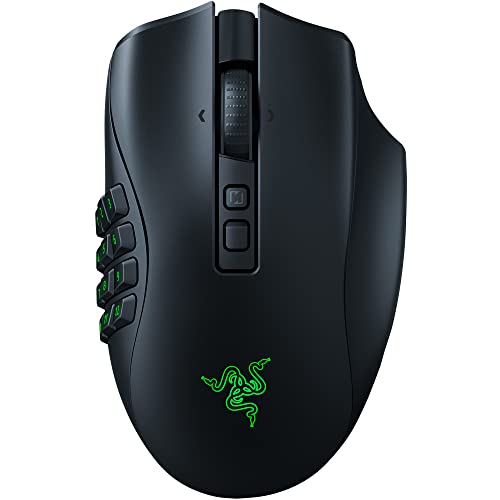
The Naga line essentially defined the MMO mouse, and the listing describes the V2 Pro’s fullest expression of the idea: a wireless mouse with 19+1 programmable buttons, three swappable side plates that let the same mouse present different button layouts, a HyperScroll Pro wheel, a Focus Pro 30K optical sensor and battery life the listing states at 300 hours. The swappable plates are the concept’s maturity — the twelve-button grid for raid nights, a slimmer plate for the evenings spent in shooters or spreadsheets — turning one mouse into the desk’s whole roster. Wireless at this level removes the cable drag that side-grid mice, worked hard across big pads, otherwise suffer, and the sensor specification is far beyond anything MMO play can challenge. This is the setup’s anchor recommendation for players who want the genre’s defining tool without its historical tether.
Mini spec box — Razer Naga V2 Pro
- Buttons: 19+1 programmable
- Side plates: 3 swappable layouts
- Sensor: Focus Pro 30K optical (per listing)
- Battery: up to 300 hours (per listing)
- Wheel: HyperScroll Pro
Strengths
- The swappable side plates make one mouse serve MMO grids and lighter layouts alike.
- Wireless freedom suits the wide, busy mouse movements of grid-heavy play.
- The button count covers full rotations, mounts, consumables and communication binds with room to spare.
Trade-offs
- A grid this size has a learning curve measured in weeks of deliberate practice.
- It is a substantial mouse; small hands and fingertip grips should look elsewhere.
- Flagship positioning — this is an investment piece, not an experiment.
Best for: committed MMO players who want the full grid, wirelessly, as their one primary mouse. Not suited for: small-handed players or anyone whose games never use more than six buttons.
2. Corsair Scimitar RGB Elite — best wired MMO mouse
Badge: The grid, perfected on a wire
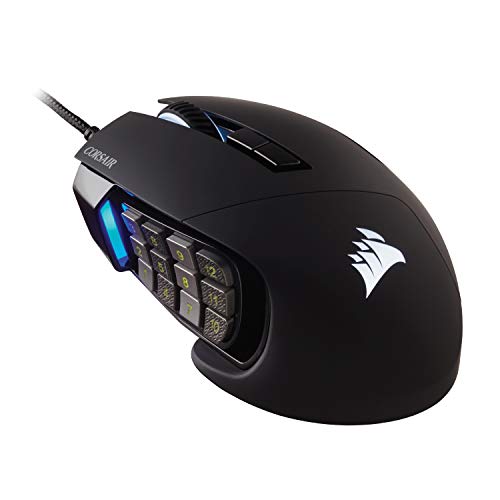
Corsair’s answer to the MMO mouse question keeps the cable and spends the savings on the grid’s ergonomics: the listing describes a wired mouse with 17 programmable buttons, an 18,000 DPI sensor, Omron switches and — its signature — an adjustable key slider that lets the side grid’s position shift to meet your thumb rather than the reverse. That slider is a genuinely thoughtful response to the genre’s oldest complaint, that fixed grids fit the hand they were designed around and merely tolerate everyone else’s. Wired connection removes battery management from the raid-night checklist entirely, and iCUE compatibility ties its profiles into the same software ecosystem as the Corsair keyboard below. For players whose desk never travels and whose philosophy is that a cable has never once run out of charge mid-pull, the Scimitar is the setup’s wired heart.
Mini spec box — Corsair Scimitar RGB Elite
- Buttons: 17 programmable
- Sensor: 18,000 DPI (per listing)
- Side grid: adjustable key slider
- Switches: Omron (per listing)
- Connection: wired; iCUE compatible
Strengths
- The adjustable slider solves grid fit, the wired MMO mouse’s classic ergonomic gamble.
- No batteries, no charging rota — it is ready every single session.
- Shares the iCUE ecosystem with the K70 PRO TKL for unified profiles and lighting.
Trade-offs
- The cable is a permanent desk companion; drag management is on you.
- One fixed twelve-key grid philosophy — no swappable plates for lighter games.
- Wired-only by design, which travel and couch setups will feel.
Best for: wired loyalists and Corsair-ecosystem players who want the grid fitted precisely to their thumb. Not suited for: wireless devotees or players wanting one mouse for desk and travel bag alike.

3. HyperX Cloud III — best headset for long raid sessions
Badge: Marathon comfort, callout clarity
MMO audio is a social medium before it is a soundscape: hours of voice chat, callouts that must land first time, and game audio that underscores rather than stars. The Cloud III’s listing speaks directly to that brief — a wired headset with memory foam cushioning, a durable frame, an ultra-clear 10mm microphone and connectivity across USB-C, USB-A and 3.5mm, spanning PC and the current consoles. The Cloud family’s reputation was built on exactly this combination of wear-it-all-evening comfort and a microphone teammates never ask you to repeat yourself through, and in a genre where a misunderstood callout wipes twenty people, mic clarity is a progression stat. The triple connectivity also makes it the setup’s diplomat, serving the raid PC and the console alt with equal ease.
Mini spec box — HyperX Cloud III
- Connection: USB-C, USB-A and 3.5mm (per listing)
- Microphone: 10mm, ultra-clear (per listing)
- Cushioning: memory foam
- Frame: durable construction (per listing)
- Platforms: PC, PS5, PS4, Xbox Series X|S (per listing)
Strengths
- Memory foam comfort engineered for the genre’s longest sessions.
- A clear 10mm microphone that raid communication genuinely depends on.
- Three connection types cover PC and consoles without adapters or second headsets.
Trade-offs
- Wired only — no wireless freedom for the couch or the kitchen run between pulls.
- Tuned for clarity and comfort rather than bass spectacle.
- No active noise cancelling for loud households.
Best for: raiders and social players whose sessions run long and whose voice is part of the team’s toolkit. Not suited for: wireless-only players or those wanting ANC for noisy rooms.

4. Corsair K70 PRO TKL — best keyboard for the MMO desk
Badge: Hall effect speed in a tenkeyless frame
The keyboard half of an MMO setup is a study in division of labour: with the mouse grid carrying the rotation, the keyboard’s job narrows to movement, modifiers, communication and the binds that anchor the hand — work a tenkeyless board does while returning desk space to the mouse’s wide sweeps. The K70 PRO TKL’s listing describes pre-lubed Hall effect MGX Hyperdrive adjustable switches with rapid trigger and simultaneous SOCD handling, in a wired TKL frame with ABS double-shot keycaps. Adjustable actuation lets movement keys fire at a hair’s pressure while the macro-adjacent keys stay deliberate, rapid trigger rewards the strafing adjustments MMO movement lives on, and sharing iCUE with the Scimitar above means one software home for the setup’s Corsair half. It is a thoroughly modern board wearing an MMO-appropriate size.
Mini spec box — Corsair K70 PRO TKL
- Format: tenkeyless (TKL), wired
- Switches: pre-lubed Hall effect MGX Hyperdrive, adjustable (per listing)
- Features: rapid trigger, simultaneous SOCD (per listing)
- Keycaps: ABS double-shot (per listing)
- Layout: QWERTY US (per listing)
Strengths
- Adjustable Hall effect actuation tunes each key’s personality to its job.
- TKL footprint frees the wide mouse space grid play consumes.
- Rapid trigger and SOCD handling serve high-level movement play.
Trade-offs
- No numpad — spreadsheet-heavy day jobs may miss it (the mouse grid covers in-game number duty).
- Wired only, in keeping with its tournament-grade brief.
- Its feature depth rewards players who will actually configure it.
Best for: MMO players who want a modern, configurable TKL and a unified Corsair setup. Not suited for: numpad-dependent users or wireless-minimalist desks.
How do you bind an MMO mouse grid so it actually works?
The grid fails more players through binding chaos than through hardware, so bind by logic and in layers. Put the core rotation on the grid’s most reachable keys in the order you cast them, so the thumb walks the fight’s rhythm rather than hunting it. Place situational tools — interrupts, defensives, mobility — on the grid’s edges, distinct enough to find blind in a panic. Reserve one consistent key across every character and game for the universal verbs: mount, potion, push-to-talk if your setup routes it there. Then practise against a training dummy until the thumb’s knowledge is physical, because a grid you must look at is a keyboard you are operating with the wrong organ. Rebind reluctantly after that: muscle memory is the entire return on the grid’s investment, and every casual reshuffle spends it. Players curious how deep the button philosophy goes can read how many buttons a gaming mouse needs after the raid.
What should you look for when assembling an MMO setup?
Judge every component by the genre’s three stress tests. First, the binding test: can this device hold your whole ability ecosystem — rotation, utility, communication, quality-of-life — without modifier gymnastics that collapse under pressure? The two mice here pass by architecture; headsets and keyboards pass by not obstructing. Second, the endurance test: at hour three of a progression night, does the gear disappear? Memory foam, sensible weight and a grid your thumb trusts are endurance features wearing plain clothes. Third, the failure test: what happens when something dies mid-session — a battery, a cable, a key? Setups that survive the genre keep answers ready, from the Naga’s long battery to the Scimitar’s never-needs-charging wire. Buy against those three tests and the setup coheres; buy by specifications alone and you will own excellent parts of somebody else’s setup. Readers comparing the wider field can cross-check against our gaming headset picks and our gaming keyboard picks, and the lightweight alternative philosophy lives in our Starlight X guide — a fine mouse that would be the wrong tool here, which is precisely the point of genre-specific gear.
How do you set up the full desk for raid night?
- Position the keyboard so your movement hand rests naturally with modifiers in reach, then give the mouse the wide, unobstructed territory grid play sweeps across.
- Load your binding profile before the session, verify the grid against a dummy for one rotation, and confirm push-to-talk works before the first pull depends on it.
- Set headset levels with game audio beneath voice: callouts are the raid’s operating system and must win every contest with the boss’s soundtrack.
- Stage the session’s logistics — water within reach, charging cable for the wireless mouse parked nearby, a break rhythm agreed with the group.
- After the session, note one binding or comfort adjustment while it is fresh; setups reach their final form one raid at a time.
What mistakes do MMO players make with gear?
Buying buttons without a binding plan is the classic: the grid arrives, gets mapped randomly, and is abandoned within a month as a gimmick that was actually a curriculum nobody studied. Chasing shooter-gear for a raider’s desk is the mirror error — ultralight mice and minimalist boards are superb tools aimed at a different game’s demands. Neglecting the microphone is the social one, paid by nineteen teammates. And treating comfort as luxury rather than infrastructure is the endurance error, discovered at hour three of every progression night until it is fixed. The setup in this guide is assembled against all four mistakes, which is most of what “best” means in a genre measured in hundreds of hours.
Final recommendation: which setup should you build?
Choose the Naga V2 Pro as the centre if wireless freedom and plate-swapping versatility match your multi-game life; choose the Scimitar as the centre if your desk is fixed, your ecosystem is Corsair, and fitted-to-your-thumb certainty appeals. Either way, complete the system with the Cloud III’s marathon comfort and callout clarity, and the K70 PRO TKL’s configurable tenkeyless foundation — then bind deliberately, practise honestly, and let the gear disappear into the game, which is the highest praise MMO hardware can earn. Round out the wider desk philosophy with the best CS2 skins for the cosmetics side of gaming identity, differently-genred but kindred in spirit.
Frequently asked questions about MMO gear
Do I really need an MMO mouse with a side grid?
If your game gives you more abilities than your keyboard hand comfortably reaches, yes — the grid moves a rotation under the thumb and is the genre’s single most transformative hardware idea. Players of ability-light games will not feel the benefit, which is why the Naga’s swappable plates exist for mixed libraries.
Wireless or wired for MMO play?
Both are fully viable at this level. Wireless removes drag and desk clutter and asks for a charging habit; wired removes the habit and keeps the cable. The Naga V2 Pro and Scimitar RGB Elite in this roundup are the two philosophies at their best — choose by lifestyle, not latency folklore.
How long does a mouse grid take to learn?
Expect a few weeks of deliberate dummy practice before the thumb works blind, and a full raid tier before it is invisible. Bind by logic, practise the rotation, and resist rebinding — the learning curve is the price of the genre’s highest hardware ceiling.
Why a tenkeyless keyboard for MMOs?
Because the mouse grid absorbs the number-row duties a numpad would serve, while the TKL’s smaller footprint returns desk space to the wide mouse movements grid play uses. Players whose day jobs live in spreadsheets may prefer full-size — the honest exception.
What makes a headset right for raiding?
Comfort across hours, a microphone your team never has to ask twice about, and a tuning that keeps voices intelligible over game audio. The Cloud III’s memory foam and clear 10mm mic target exactly that brief.
Can one setup serve MMOs and other genres?
Yes — that versatility is designed into this roundup: the Naga’s lighter side plates, the K70’s rapid trigger for movement shooters, and the Cloud III’s console connectivity all moonlight happily. MMO gear chosen well is a superset, not a specialisation trap.
Binding by role: tank, healer, damage
The grid’s logic deepens when it is tuned by role, because each job loads the thumb differently. Tanks live on defensives and interrupts: put the panic buttons on the grid’s most unmistakable real estate, the keys your thumb can find during the exact moments your eyes cannot leave the boss. Healers live on targeting and triage: party-target keys and the instant-cast toolkit belong on the grid in party order, so the thumb walks the raid frames the way the eyes do. Damage roles live on rhythm: the rotation in cast order, cooldowns grouped where a glance at the grid’s geography mirrors the priority system’s logic. Across all three, keep the universal verbs — mount, consumable, interrupt — on identical keys, because role-swapping players are betrayed by inconsistent basics far more often than by any boss mechanic. The setup’s mice both hold multiple profiles, so build one per role and let the hardware remember what the evening requires; the discipline is in designing each profile from the role’s actual minute-by-minute life rather than from the spellbook’s table of contents.
The ergonomics chapter nobody reads until it hurts
MMO play’s session lengths turn ergonomics from advice into arithmetic: small strains multiply by hundreds of hours. Keep the mouse at elbow height with the forearm supported, the grid’s thumb work coming from the thumb’s base rather than its tip to spare the joint its overtime. Let the headset’s clamp be the session’s governor — if the Cloud III’s memory foam is doing its job you should forget it for stretches at a time, and any headset that announces itself hourly is failing the endurance test regardless of its sound. Break on the group’s rhythm, not your discomfort’s: the agreed pause between pulls is when hands unclench, shoulders drop and water happens. None of this is glamorous, and all of it is performance — the player whose hands still work precisely in hour three out-executes the better-geared player whose have been quietly failing since the second boss. Gear chosen for endurance, posture maintained by habit: that is the setup beneath the setup.
Profiles, macros and playing within the rules
Both ecosystems in this setup — Razer’s and Corsair’s software — invite automation, so the honest guidance matters: use profiles and keybinds freely, use macros as keybind organisation, and stay on the right side of each game’s rules about automated play, which generally bless one press producing one action and frown on anything that plays the game unattended or chains decisions for you. The grid’s legitimate power is positional, not robotic: it puts your own decisions under faster fingers. Players who respect that boundary keep their accounts and their achievements; the setup’s job is to make the boundary painless by ensuring no honest technique ever needs more than the hardware’s honest features. When in doubt about a specific game’s stance, the game’s own published rules outrank any forum’s folklore — check them the way you check a listing’s switch variant, before the purchase of effort rather than after.
One desk, several games: the profile discipline
Most MMO setups serve a library, and the profile discipline is what keeps the library coherent. Keep one master layout philosophy — universal verbs fixed, role clusters grouped the same way — and let each game’s profile be a dialect of it rather than a fresh language. The Naga’s swappable plates literalise the idea: grid for the MMO, lighter plate for the shooter, the same hand position and sensor behaviour underneath both. The Corsair pair answers with software: iCUE profiles that travel between the Scimitar and the K70 together, lighting and binds shifting as one organism. Either route, the principle protects the only irreplaceable component in the setup — your muscle memory — from being re-negotiated every time the group’s game of the month changes. Hardware can be re-profiled in an evening; hands take a season, and wise setups spend the evening to save the season.
Voice, tuned: getting the most from the headset’s microphone
A good microphone underused is a wipe with extra steps, so tune the Cloud III’s like a raid tool. Position the boom a couple of fingers from the mouth’s corner, off the breath’s direct line, and set input gain so your excited voice — the progression-kill voice, not the library voice — sits clear without clipping. Choose push-to-talk or disciplined voice activation deliberately: open microphones broadcast households, and the raid’s audio commons are a shared resource your setup should pollute never. Test with a teammate, not a recording of yourself, because the path runs through your game’s voice stack and their ears are the destination that matters. Then keep the arrangement boringly permanent: mic technique, like binding logic, pays out in proportion to how completely it becomes habit, and the raid leader whose callouts land first time, every time, is usually running nothing fancier than a well-placed boom and the discipline to leave it there.
Maintenance: keeping the setup raid-ready for years
Grid mice collect what twelve-key crevices invite; a soft brush and occasional compressed air keep the Scimitar’s slider and the Naga’s plates honest, and plate swaps are the moment to clean the contacts you never otherwise see. Headset foams are consumables on a genre timescale — replace the Cloud III’s cushions when they flatten rather than when they disintegrate, because comfort decay is gradual enough to go unnoticed until a session reminds you. Keyboard care is the standard liturgy: keycaps off, debris out, and the Hall effect switches’ contactless design quietly removing one whole failure mode from the calendar. None of this is weekly work; it is seasonal, like the content cycle, and a setup maintained on that rhythm will outlast several expansions without a single mid-raid obituary.
The upgrade order, for players building in stages
Budgets arrive in instalments, so spend them in the order the genre feels them. The mouse first: the grid changes what your character can do, and no other purchase rewrites a rotation. The headset second, because communication failures are the ones other people pay for. The keyboard third — the K70’s refinements are real but they polish a hand the first two purchases have already armed. Within that order, resist the parallel temptation to upgrade the desk’s appearance before its function; lighting synchronises beautifully across this setup’s ecosystems, and it should be the celebration of a finished build, not the camouflage of an unfinished one. Staged this way, every instalment is felt in the next session, which is the correct reward schedule for gear bought to be used rather than displayed.
Felt in the next session, and in the hundredth — the instalment plan’s compound interest is simply hours of play in which the gear never once becomes the story. Build in that order and the setup’s story stays where it belongs: in the clears, the callouts and the company.
Two desks, honestly imagined
Picture the wireless build first: Naga on a wide pad, its full grid loaded for the main and its slim plate in the drawer for shooter nights, the Cloud III hanging on its hook, the K70 the desk’s only cable of consequence. The whole arrangement packs into a bag in minutes and reassembles anywhere, which suits the player whose raiding happens at home, at a partner’s flat and at the occasional LAN with equal comfort. Now the wired build: Scimitar fitted by its slider to the millimetre, K70 beside it in matching iCUE light, profiles shifting as one organism, nothing in the setup capable of dying of battery at any hour the progression demands. It never travels and never needs to; it is a cockpit. Neither desk is the correct one — they are the same correct philosophy, genre-first and honestly bound, expressed in the two materials the modern desk offers: freedom and certainty. Choose the material your life is made of, and the rest of this guide applies word for word.
Word for word, pull for pull — the philosophy travels even when the cockpit does not, because it lives in the bindings and the habits rather than in the boxes.
The social hardware: your setup as your guild sees it
An MMO setup has an audience no solo genre imposes: your group experiences your gear as your reliability. They hear the microphone, they feel the interrupt that arrived because the grid put it under a thumb, they notice the healer whose targeting keys never fumble a triage. This is why the genre’s gear culture, for all its specifications, keeps circling back to trust — the setup is a promise made to nineteen other schedules that your end of the encounter will hold. Build with that audience in mind and the priorities order themselves exactly as this guide ordered them: the inputs that execute, the voice that communicates, the comfort that endures. The boss does not care what your desk looks like. Your guild cares what it does, pull after pull, and the best mmo gear setup is ultimately the one they would choose for you if the choice were theirs.
Let them choose, in effect, by building the setup their trust describes — then spend the saved deliberation where it belongs, on the encounters themselves.
What the first month with the grid feels like
Set expectations honestly, because the grid’s first month decides whether it becomes a superpower or a drawer resident. Week one is humbling: the thumb is a student driver, old keyboard habits keep reaching for keys that moved, and overall play may dip — this is tuition, not failure. Week two finds the geography: the rotation’s first keys go blind, the panic buttons earn their first saves, and the dummy sessions start feeling like rehearsals rather than homework. Weeks three and four are the conversion: the thumb begins suggesting binds your conscious mind had not planned, the keyboard hand relaxes into movement and modifiers, and one evening a mechanic resolves itself under your thumb before your eyes have finished reading it — the moment every grid owner remembers, and the moment the learning curve’s invoice is repaid with interest. Persist through week one on faith in that moment. It is scheduled; it simply does not announce its date.
Faith, in this one case, is a training plan — dummy sessions, logical binds, and the patience to let a thumb become a scholar.
Scholar, then artist, then — on the pull where it matters — reflex.
The setup as a whole, reviewed as one product
Step back and judge the four pieces as the single organism they become: inputs divided by labour so neither hand is ever the bottleneck, communication carried on a microphone the group trusts, comfort budgeted across the genre’s marathon distances, and software profiles holding the whole arrangement’s memory so the player’s can be spent on the game. Its weaknesses are the honest ones of any specialised system — it asks a month of learning, it fills a desk with intent rather than minimalism, and its excellence is invisible in genres that never load it. Its strength is the only one the genre ultimately grades: at hour three, on the hardest pull of the tier, with nineteen other people depending on the same second you are, the setup does exactly what your hands ask, in the order they ask it, without once becoming the reason the attempt failed. Everything else in this guide is commentary on that sentence.
Commentary the pulls themselves will finish, in clears and in wipes alike — the setup’s promise is only that none of those endings will be its fault, and that promise, kept nightly, is the whole review.
Packing the guide into a raid bag
For the player who reads best in checklists, the whole philosophy folded small: grid mouse chosen by connection lifestyle, bound by logic, practised for a month; headset worn for its microphone and its third hour, boom placed once and left alone; keyboard sized to free the mouse’s territory, its actuation tuned per job; profiles kept as dialects of one language across every game and role; rules of each game respected as scrupulously as listing variants; posture and breaks treated as progression content. Carry that card and the boxes choose themselves — Naga or Scimitar, Cloud overhead, K70 under the left hand — and the next tier’s first pull becomes the setup’s true unboxing.
Unbox it there, where the audience is honest and the stakes are shared — and may the first pull already feel like the tenth.
It will not, quite — week one is week one — but the tenth will feel like a promise the first one made, and kept.
Sign-off: the genre deserves its own tools
Every genre eventually builds the hardware it deserves, and the MMO’s century of accumulated ability bars, raid calendars and voice culture has built this: mice that are keyboards, keyboards tuned like instruments, headsets that treat a three-hour conversation as a design brief. The setup in this guide is the current, verified expression of that lineage — four products, two philosophies of connection, one philosophy of play. Assemble it, bind it, learn it for a month, and then forget it entirely, which is what it was for: the best mmo gear setup is the one still working, unnoticed, in the background of the best stories your guild tells about itself.
Unnoticed, until the night it saves the pull — and even then, only by the one pair of hands that felt it happen.
Those hands will know. That knowledge is the review’s final score, and it does not come in stars.
It comes in clears, in callouts landed, and in third hours that feel like first ones.
One more evening’s thought, for the undecided
If the choice between the two mice is the knot, untie it with a diary rather than a debate: write down, for one ordinary week, every time your current mouse’s cable annoyed you, every time a battery anywhere in your life died at a bad moment, and every game you actually played. The page will vote, and its vote will be about your life rather than about specifications, which is the only electorate whose result you will still respect in a year. Then buy the winner without a second ballot, complete the system around it, and spend the deliberation you saved on the binding layout — the one component of this entire setup that no purchase can make for you, and the one that will still be paying out when every box here has been replaced twice over.
Twice over, and then some — good layouts, like good guilds, outlive their founding hardware by years.
Build the layout like you build the guild: deliberately, kindly, and for the long term.
The long term, in this genre, is measured in friendships as much as in tiers — and the gear that serves both is the gear this guide set out to find.
Found, verified, and ready for its first pull.
Epilogue: what the setup cannot do, said plainly
Honesty to close: no mouse teaches encounter knowledge, no microphone calls the strategy, no keyboard supplies the patience a progression wall demands. The setup removes friction; it does not remove the game. What it can do — all it has ever claimed — is ensure that when knowledge, strategy and patience arrive, as they do on the pull nobody predicts, the hardware’s answer is instantaneous, comfortable and exact. Players who understand that division of credit get the most from gear like this, because they invest their hope in the party and their money in the friction’s removal, and are therefore never disappointed by either. Assemble it in that spirit, and the next tier is already, in the only sense gear can promise, within reach of your hands.
Within reach of your hands — and, once the month of learning has passed, within reach of your thumb alone, which is where the genre always wanted its rotations to live.
Let it live there, practised and unhurried, for many tiers to come.
The guide, as your future self would summarise it
A season from now, the summary writes itself in your group’s folklore: the tier where the interrupts stopped missing, the progression night the callouts turned crystalline, the month the new mouse stopped being new. None of those sentences mention a brand, and that is the setup’s triumph — four verified products, honestly framed, absorbed so completely into the play that the play is all anyone remembers. If this guide has done its work, your future self’s only gear-related sentence will be the recommendation you pass to the next player who asks, delivered with the shrug of someone whose desk simply works: grid under the thumb, voice in the clear, keys tuned to their jobs — and then, because the genre always returns to it, the pull timer counting down over a setup nobody has to think about at all.
Counting down, then, over yours — starting with the very next session you schedule with the people the setup was built to serve.
Serve them well — the setup already intends to.
Final pull: the guide’s closing argument
Everything recommended here survives a single test the genre applies without mercy: the ready check. When it sounds, the Naga or the Scimitar sits under a thumb that knows its geography, the Cloud III carries a voice the group has learned to trust, the K70 waits with its keys tuned to their assignments, and the player — the only component no store sells — is free to spend the whole of their attention on the encounter. That freedom is the product. The boxes are merely how it ships. Buy them in the order your life dictates, bind them with the logic your roles demand, give them the honest month they ask for, and then go and be, for your group, the player whose end of the fight simply never comes up in the post-mortem — except, occasionally, in the part where they describe how it was won.
Won, in the end, the way this genre wins everything worth winning: together, on schedule, with every hand exactly where the fight needed it.
Yours among them, grid under thumb, ready when the check sounds.
Ready — the setup’s favourite word, and soon, its reputation.
Postscript: a note to the player still on a ordinary mouse
You are the reader this guide most respects, because you have been doing with ten fingers what the grid does with a thumb’s help, and your rotations have the calluses to prove it. Nothing here calls that skill inadequate — the grid is not a replacement for it but a relocation of it, and players who arrive with strong keyboard fundamentals convert fastest of all, because the discipline the grid rewards is the one they already own. Your first week will still humble you; your fourth will astonish you. When it does, remember to be patient with the next ordinary-mouse player who asks whether the grid is worth it. You were them, a month is short, and the genre is long.
The genre is long, and it rewards the hands that prepare for its length — with grids, with foam, with tuned keys, and with the breaks that keep all three honest.
Prepare, then — the next tier is not going to clear itself, and it has been waiting for hands like yours.
Equipped, now, to stop waiting politely.
Really, finally: the ready check, answered
Somewhere in your game’s next tier there is a pull with your name woven through its mechanics — an interrupt only your thumb is positioned to make, a callout only your voice will land in time, a third hour only your preparation will survive smiling. The setup in this guide exists so that when that pull arrives, nothing between your intention and its execution is left to chance, habit debt or hardware apology. That is the whole of it: four products, one system, zero excuses — and a group chat, even now, asking who is ready. You know what to click. It is bound, conveniently, right under your thumb.
Click it, and let the tier begin.
It has waited long enough for a group this ready.
Ready, grouped, and — for the first time in the tier’s history — properly equipped down to the last bind.
The last bind was the ready check itself. It will not be the last one your thumb surprises you with.
Surprises of that kind are the genre’s true loot table, and your drop rate just improved permanently.
Permanently — muscle memory does not roll on a table. It accrues, pull after pull, in the only currency the genre never devalues.
Spend it on the encounters. It is what the setup was saving it for.
A benediction for the raid, and out
May your grid never ghost, your callouts never garble, your cushions never flatten mid-tier, and your keys fire exactly as tuned, in the order your hands intend, for as many expansions as the group chat can schedule. May the month of learning feel short in the retelling, and may the first pull on the new setup already carry, somewhere in its second minute, the small unmistakable click of a thumb arriving exactly where the fight needed it — the sound this entire guide was written to make ordinary.
Ordinary, reliable, and — on the nights that enter the folklore — quietly legendary.
Legendary in the only register the genre keeps: the stories told after the clear, by the people who were there.
Be there — equipped, bound, rested and ready — when the next story starts.
It starts on the pull timer, and the timer, as always, is already running.
Run with it — hands ready, voice clear, grid loaded.
Loaded, and — after the honest month — unforgettable to play with and impossible to play without.
That is the setup’s whole ambition, stated in one line at the very end, where the genre keeps its most important things.
At the end, and at the ready check, and everywhere in between.
Out, for real: assemble, bind, pull
Three verbs remain, in the order the genre insists on. Assemble: choose the mouse your life describes, add the voice and the keys, verify every variant on its listing as carefully as this guide verified its picks. Bind: give the grid your rotation’s logic, your roles their dialects, your universal verbs their permanent homes, and write the layout down where a future rebind can find it. Pull: schedule the session, sound the check, and let a month of honest learning begin inside real encounters rather than in further deliberation. The guide has nothing left to add that a boss cannot teach better — except this, from the far side of the learning curve, where the players who finished it are already standing: it is worth it, it compounds, and the group is waiting.
Waiting, ready-checked, and — once your thumb joins the grid — about to be very glad you came.
Glad, geared, and in voice — the three states the next tier rewards.
Claim the rewards in order: assemble, bind, pull.
And then, for many tiers to come: clear.
Clear, together, on the first pull nobody expected — the genre’s favourite kind of surprise.
Expect it anyway. Prepared groups manufacture those surprises wholesale.
Wholesale, weekly, and with your name in the production credits.
Roll credits, then — the next tier is already loading.
Encore: the setup, applauded in one breath
Grid under thumb, voice in the clear, keys tuned to their callings, comfort budgeted to the third hour, profiles speaking one language across every role you play — that is the best mmo gear setup as this guide leaves it: assembled from verified parts, bound by your own logic, and aimed at the only review that has ever mattered in this genre, the one your group writes together, pull by pull, in the space between the ready check and the clear.
Write your chapter of it this week — the ready check is not going to answer itself, and your thumb, at last, knows exactly where the answer lives.
It lives, as of this build, at grid position one — where your best decisions have always wanted to be.
Keep them there, all twelve rows of them, and the genre is yours on schedule.
On schedule, in voice, and out of excuses — the complete MMO condition.
Achieve it once and every future tier inherits it.
Inheritance, in this genre, is the highest form of loot.
Collect yours at the next ready check.
It is already sounding, somewhere in your group’s channel, in your honour.
Answer it the way this setup taught you: instantly, exactly, and without looking down.
Looking down is for admiring the setup. Save it for after the clear.
Admire it then, all you like. It will have earned the looking.
And so will you.
The last ready check of the guide itself
Mouse: chosen by lifestyle, bound by logic. Headset: tuned for the third hour and the first callout alike. Keyboard: sized for the mouse’s territory, switches set per duty. Profiles: dialects of one language. Rules: respected. Posture: scheduled. Group: informed and, by now, impatient in the best way. The guide finds every box ticked and nothing left to deliberate — which means its work is finished and yours, the better work, is queued in a channel full of people who have been waiting for exactly this version of your desk. Answer them.