Disclosure: As an Amazon Associate, reviewstook.com earns from qualifying purchases. Links on this page are affiliate links; they cost you nothing extra. Prices and availability change often, so check the current Amazon listing before you buy.
The zv 1f is Sony’s answer to a very specific creator: the person whose channel is themselves — talking, reacting, demonstrating, travelling — and who needs a camera that behaves like a talented friend rather than a film school. It is a compact vlogging camera built around a 1-inch sensor, a wide 20mm-equivalent lens that fits your face and your surroundings in frame at arm’s length, and 4K video, all in a body that disappears into a jacket pocket. This review covers the two verified ways to buy it, explains the wide-lens philosophy that defines it, and is honest about the fixed-lens borders within which its considerable charm operates.
Start with the lens, because everything follows from it. A wide fixed lens sounds like a limitation until you film yourself handheld: suddenly the framing forgives your movement, the background tells the story of where you are, and focus stays a calmer negotiation than with longer glass. The ZV-1F is designed around that reality, plus the creator conveniences — pleasing colour out of the camera, a form made for one-handed use, and a price tier that respects a channel’s early economics. If your work is mostly you, in places, talking to people who feel like friends, this little camera was drawn around your day.
Key Takeaways
- Compact vlogging camera with a 1-inch sensor and 4K video, per its confirmed listings, in black and white versions.
- The wide 20mm-equivalent fixed lens is the design’s thesis: arm’s-length framing that includes your environment without a selfie stick.
- Fixed lens means fixed borders — no optical zooming across a room, no lens swapping — so buy it for the work it is shaped to do.
- The black listing here is an official Sony USA partner bundle with case, extra battery, filters, and software; the white listing is the camera in its clean retail form.
- Creators who need interchangeable lenses or long reach should look at a mirrorless all-rounder instead, such as the sibling Z50 II guide.
- Audio, light, and a small tripod will shape your results more than any remaining camera decision at this level.
In this guide
Quick Picks: black bundle or white camera?
| Pick | What the listing describes | Best suited to | Link |
|---|---|---|---|
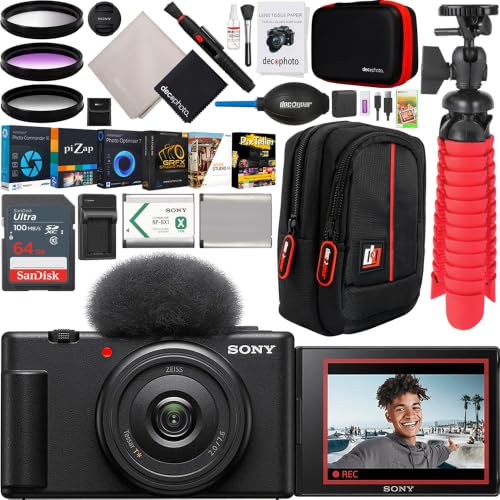
| Sony ZV-1F, black, official partner bundle | 4K video, 20.1MP stills, with case, extra battery, filters, and photo software | Creators who want a working kit in one purchase | Check price on Amazon |
| Sony ZV-1F, white | Compact 4K camera, 1-inch sensor, 20mm lens for vlogging, streaming, and social media | Buyers who prefer the clean camera and their own accessories | Check price on Amazon |
Same camera heart, two purchasing shapes. The bundle answers the new creator’s accessory questions in advance; the plain listing respects the creator who already owns a case, batteries, and opinions. The reviews below keep that distinction clean and never pretend the bundles that crowd this model’s search results are all equal — they are not, which is why only confirmed listings are linked here.
How were these picks chosen?
Both listings were confirmed through marketplace data with titles naming the Sony ZV-1F, its 4K video, and its 1-inch sensor design. The black pick is explicitly an official Sony USA partner model listing; the white pick is the straightforward camera listing in that colourway. This model’s search results are famously crowded with third-party bundles of varying sense, and those were excluded in favour of the two listings whose contents can be stated plainly. Each pick appears with its official product image before its review.

Sony ZV-1F black, official partner bundle — the ready-to-film kit
Badge: Best for new creators who want one complete purchase. The black bundle pairs the camera — 4K video and 20.1MP stills for creators and vloggers — with a case, an extra battery, filters, and photo software, which reads like a checklist written by someone who has watched a new channel stall on missing accessories.
- Camera: compact vlogging model, 1-inch class sensor design
- Video: 4K capture for content creation
- Stills: 20.1MP per the listing
- Bundle: case, extra battery, filters, photo software
- Listing status: official Sony USA partner model
- Lens: wide fixed lens for arm’s-length framing
Strengths
- The spare battery alone justifies the bundle logic, because vlogging days end when power does and this camera is built for long, mobile sessions.
- A fitted case from day one protects a camera whose whole purpose is to be carried everywhere, often in bags with keys and chaos.
- Buying the official partner route keeps the purchase’s provenance clean in a category flooded with improvised bundles.
Trade-offs
- Bundle extras vary in how much any individual creator will use; the filters and software may sit idle for a talking-head channel.
- If you already own equivalents of the accessories, you would be paying to duplicate your shelf.
- The bundle cannot change the camera’s fixed-lens nature, which remains the decision that matters most.
Judge this bundle by a simple audit: price the spare battery and case you would certainly buy anyway, and see how much of the bundle’s premium they already explain. For most new creators the arithmetic is kind, and the convenience of a single delivery — camera ready for a full filming day — has a value beyond the sum of its parts. Channels begin on momentum, and a kit that removes three small shopping trips protects momentum surprisingly well.
Best for: new and returning creators who want the camera plus its essential companions in one official purchase. / Not suited for: accessory-rich upgraders, or anyone still unsure whether a fixed wide lens suits their format.

Sony ZV-1F white — the clean camera, your own kit
Badge: Best for creators with accessories already in hand. The white listing is the camera in its essential form: a compact 4K body with a 1-inch sensor and the 20mm lens, described for vlogging, streaming, and social media, in the colourway that photographs beautifully on a desk and disappears less in a bag — which some of us count as a feature.
- Camera: compact vlogging model, 1-inch sensor
- Video: 4K capture
- Lens: 20mm wide fixed lens
- Colourway: white
- Positioning: vlogging, streaming, social media
- Kit: camera itself; accessories chosen separately
Strengths
- A clean purchase with nothing duplicated and nothing to store from a bundle you did not want.
- The white finish suits desk-streaming setups where the camera is part of the visible scene.
- You can direct the accessory budget precisely — a better microphone before a second case, if your format says so.
Trade-offs
- You must remember the essentials yourself; a spare battery and protection are not optional for a carry-everywhere camera.
- White shows travel grime more honestly than black, asking for a wipe now and then.
- As ever with this model, the fixed lens defines the ceiling of the whole purchase.
This is the connoisseur’s route into the same camera: camera first, then a microphone chosen for your voice and room, a small tripod chosen for your surfaces, and light chosen for your window. Creators upgrading from a phone often already own half the ecosystem — grips, lights, a streaming desk — and for them the plain listing is not the lesser option but the precise one.
Best for: creators with an existing accessory shelf, streamers with a desk aesthetic, and deliberate minimalists. / Not suited for: first-time buyers who would benefit from a bundle’s checklist being answered for them.
Zv 1f and the wide-lens philosophy: why 20mm changes your filming
Hold a phone at arm’s length and film yourself: the frame is tight, the room is a rumour, and every step you take swings the picture. The ZV-1F’s 20mm-equivalent view widens that world decisively. Your face sits in a place rather than in a void, gestures survive the frame’s edges, a second person can lean in without a negotiation, and walking shots feel like travel instead of like a periscope. For the formats that dominate creator platforms — day-in-the-life, reviews at a desk with products beside you, event walk-throughs, cooking and making — that width is not a style preference but the grammar of the shot.
The same width defines the borders. Across a hall, a speaker stays small; at a zoo, the animal stays distant; at a concert, the stage remains a postcard. Creators whose formats live at distance need optical reach this camera does not pretend to offer, and they should spend their money on a system with lenses — the sibling all-rounder in Z 50ii is the natural comparison. Knowing which side of that line your next fifty videos live on is the entire buying decision, and it can be made from your own channel’s archive in ten minutes.
How to build a small filming kit around this camera
Audio first, because audiences forgive soft pictures and abandon bad sound. A compact microphone that gets closer to your mouth than the camera sits will transform intelligibility in kitchens, streets, and echoing rooms. Light second: film facing a window when you can, and add one soft, dimmable light for evenings, placed to the side at face height. Support third: a small tripod or grip that fits your hand and your tabletops, because a stable frame reads as professional before any other upgrade does. The wider creator context, including microphones and lights by budget, is mapped in best vlogging cameras and best vlogging cameras with flip screen.
Then build the habit kit: a spare battery in the same pocket every time, a card routine that offloads footage the evening it is shot, and a two-minute test recording whenever the room changes. The ZV-1F rewards this discipline by being forgettable in the best way — charged, present, framed wide, and ready — so your attention can live on what you are saying rather than on the device recording it. That forgettability is the product. The specifications merely deliver it.
How does it serve streaming and stills?
As a streaming camera it plays the role of the tidy desk upgrade: a real sensor and a proper lens in place of a laptop’s apologetic webcam, with the wide view framing a streamer and their space in one shot. Confirm your streaming software and connection route as part of setup, and light your face as you would for any camera, because no sensor rescues a silhouette. As a stills camera, its 20.1MP listing figure and wide lens make it a joyful travel and social shooter — the camera that is actually in the pocket when the light turns beautiful — while reminding specialists that fixed wide glass is a choice, not a universal tool.
That dual life is worth one more sentence, because it is how many owners actually use the camera: weekday streaming fixture, weekend pocket companion, family-event videographer in between. Versatility within a clear specialism is a rarer and more useful thing than versatility without one, and it is why this model has a durable audience despite — honestly, because of — its refusal to zoom.
Common mistakes ZV-1F buyers make
The first is buying it for a format it cannot serve — distant stages, sports, wildlife — and then blaming the camera for arithmetic. The second is neglecting audio while upgrading everything else, a misallocation this guide has already scolded once and will happily scold again. The third is bundle roulette: choosing an unofficial mega-bundle for its photograph of accessories without checking what the camera listing itself confirms, in a model category where bundles multiply like rabbits. Buy the confirmed listings, then add accessories from experience.
Fourth, some creators film for months with the camera perpetually at arm’s length and wonder why their footage feels samey; the wide lens loves variety — desk tripod conversations, overhead making shots, walking pieces — and a small tripod unlocks most of it. Fifth, remember the comparison that matters is against your phone, not against a cinema rig: judged as the pocketable, wide, creator-first step up from a handset, this camera’s design coheres completely, a point the broader compact class at best compact camera under 200 helps frame for cross-shoppers.
How does it compare with the alternatives?
| Route | What it does best | What it asks of you | Suits |
|---|---|---|---|
| ZV-1F | Wide, pocketable, creator-first video and stills | Accept a fixed lens and its framing borders | Talking, travelling, desk and lifestyle creators |
| Mirrorless all-rounder | Lens choice, reach, stills depth | Size, cost, and lens decisions — see Nikon Z 50ii | Mixed photo-video creators who need glass |
| Phone alone | Zero friction, instant posting | Smaller sensor look, weaker audio and low-light craft | Beginners testing whether they enjoy creating |
| Action camera | Mount-anywhere toughness and stabilised adventure | Tiny controls, wide distortion character | Sport and travel extremes |
The ZV-1F wins its row by specialising gracefully. It is the camera for the creator whose subject is a person in a place — most often themselves — and whose audience values presence and clarity over cinematic reach.
Final recommendation
If your next fifty videos are you, talking and doing, in rooms and streets and kitchens, buy the ZV-1F and spend your remaining budget on a microphone and a light. Choose the black bundle if you are starting from an empty shelf, and the white camera if your shelf already holds the essentials. If your formats live at a distance or your photography ambitions are growing teeth, take the mirrorless path instead and let this little camera be what it is: the best pocket companion a self-filming creator can carry, honest about its borders and excellent inside them.
What does a filming day with this camera actually look like?
Morning: the camera comes out of the jacket pocket where it lives, battery checked the night before, and a walking piece to the coffee shop is filmed in one continuous, wide, place-rich shot that a tighter lens would have chopped into fragments. Midday: it sits on a small tripod at the desk, framing you and the product you are reviewing in the same honest composition, while a microphone does the audio work and a window does the lighting. Evening: it is the camera at the family table because it was the camera in the bag, catching the unrepeatable thing nobody would have fetched a bigger camera for. Night: footage offloads while you eat, and the camera charges in its usual spot, ready to be forgotten again tomorrow.
That diary is the review, in a sense. Cameras with interchangeable lenses would beat it in a studio comparison and lose to it in that diary, because the diary’s currency is presence. The ZV-1F’s design — pocketable body, wide lens, creator-first controls, colour that needs no apology — is a machine for being present. Channels are built out of days like that one, accumulated. If your filming life resembles the diary, the camera fits it; if your filming life is a studio, a sideline, or a safari, the alternatives table earlier has already pointed you onward with this page’s blessing.
How should a beginner grow into it over the first season?
Month one is for volume and framing: film often, learn where the wide lens wants you to stand, and let quantity teach what tutorials cannot. Month two is for sound: add the microphone, record the same room three ways, and hear your production value step up more than any camera upgrade could have managed. Month three is for light and routine: a repeatable evening setup, a card and battery rhythm, an offload habit that never loses a clip. By the season’s end the camera will have disappeared from your list of problems, which is where good tools live, and your attention will have moved to scripting, pacing, and the audience — the subjects that actually grow a channel.
Resist, during that season, the upgrade itch that creator culture cultivates as a business model. A bigger camera bought before your habits mature will mostly photograph your immaturity at higher resolution. The ZV-1F’s borders — fixed lens, compact ambitions — are, for a first-season creator, a curriculum disguised as a limitation: master framing with your feet, master sound, master light, and you will know exactly what your second camera must do if a second camera is ever truly needed. Many creators discover it is not, and that this little wide-eyed box was the destination all along.
Frequently asked questions
Does the ZV-1F zoom?
Its lens is a fixed wide 20mm-equivalent, which is the design’s whole point: arm’s-length framing that includes your surroundings. Any zooming is digital rather than optical, with the quality trade that implies, so the honest guidance is to compose with your feet and your tripod placement. Creators who need true optical reach across rooms or venues should choose a camera with interchangeable or zoom glass instead.
Is it good for streaming?
Yes — the listings themselves position it for streaming alongside vlogging and social media, and its sensor and lens are a decisive step up from a built-in webcam for a desk setup. Plan your connection route and software as part of the purchase, light your face properly, and the camera will hold up its side of the broadcast without drama.
Which colour should I choose?
The cameras are the same; choose by context. Black disappears in a bag and suits the bundled official kit route offered here. White suits visible desk setups and creators whose filming environment is part of their aesthetic. Grime shows sooner on white, anonymity comes easier to black, and neither fact has ever decided a channel’s success.
What accessories matter most on day one?
A spare battery and a way to protect the camera in transit — both of which the black bundle answers — followed closely by a microphone suited to your room and format. A small tripod or grip comes next, then light. Everything else can wait for the evidence of your first month of uploads, which will nominate purchases far more wisely than anticipation can.
Can it replace my phone for travel video?
For deliberate travel filming, yes, and gladly: the wide lens, larger sensor, and creator-first handling produce footage with a presence phones work hard to imitate. The phone remains the better spontaneous device and the better posting machine. Most travelling creators carry both and let each do what it is best at, which is not indecision but good tool discipline.
How does it differ from the ZV-1 I have heard about?
They are siblings with different lens philosophies: the model on this page commits to a fixed wide lens and a simpler, lighter proposition aimed squarely at self-filming, while its better-known relative offers zoom flexibility. If your filming is arm’s-length and place-rich, this page’s camera is the more focused tool; if your framing distances vary wildly, research the zoom sibling before deciding.
How does Product Showcase mode help someone who sells on camera?
Hold a product up towards the lens and the camera shifts its focusing attention from your face to the object, then returns to you when you lower it again. That single behaviour removes the familiar dance of tapping screens, waving a hand behind a jar or box, and apologising while focus hunts. Sellers filming short demonstrations benefit most, because the item stays readable long enough for a viewer to recognise labels, colours and scale against your hand. Practise the handover speed at home first, since a slow, deliberate presentation reads as confidence, whereas thrusting items at the lens makes even a willing camera hesitate. It also pairs naturally with the camera’s face priority the rest of the time, so a talking segment and a product segment can share one continuous take without menu diving between them.
Which external microphone makes sense for street vlogging?
Choose based on how far the camera travels from your mouth once filming starts. A compact wireless lavalier suits walking pieces to camera, because your voice stays level while the wide lens keeps streets, stalls and companions in frame behind you. A small wired lavalier is the calmer choice for seated recordings near home, with no transmitter battery to remember before leaving. Outdoors, wind protection matters more than microphone pedigree: a furry cover over whichever microphone you pick will rescue more sentences than an expensive upgrade recorded bare. Check a short test recording at full playback volume before committing to a whole afternoon. Listen especially for handling noise and passing traffic, the two sounds a cheerful preview on a phone speaker tends to forgive and a viewer on headphones never will.
A note on buying this model in a sea of bundles
Few cameras attract bundle creativity like a popular vlogging model, and the discipline this page applied — two confirmed listings, contents stated plainly, official partner status valued — is worth carrying into any further shopping you do around it. When a bundle’s photograph shows a mountain of accessories, read the text for what is actually promised, price the two items you genuinely need, and let the rest be valued at what it is: packing material with ambitions. The camera is the purchase. Everything else is a negotiation, and negotiations go better when you know the camera’s own listings cold — which, having read this far, you now do.
How does the camera handle colour and skin tones for creators?
A vlogging camera lives or dies by how it renders the person in front of it, because that person is the channel. Sony’s creator line has built its reputation on colour that flatters without falsifying — skin that reads as healthy rather than processed, backgrounds that stay believable, and an automatic exposure temperament that does not panic when you step from shade into sun mid-sentence. For a creator filming alone, that temperament is a crew member: you cannot watch a monitor and perform at the same time, so the camera must make a hundred small decisions correctly while you make the one big decision of what to say. Judge any rival by the same standard — not by its best frame, but by its behaviour across a whole walking, turning, gesturing take.
That is also why this guide resists specification maximalism for this model. A creator’s audience does not watch resolution; it watches a person, in a place, saying something worth hearing, rendered pleasantly and heard clearly. The ZV-1F’s specification — 1-inch class sensor, 4K video, wide lens — is exactly the set that serves that sentence, and the money it does not spend on zoom mechanics is money the buyer can spend on the microphone that the audience will actually notice. In an industry that sells creators ever longer feature lists, a camera whose features all point at the same job is a small masterpiece of priorities.
What should you check in the first week before the return window closes?
Film your real formats, not test charts. Record a talking piece at your desk, a walking piece in your neighbourhood, and a low-light piece in your evening kitchen, then watch all three at full size with your audience’s patience rather than your own. Check that the wide framing suits your gestures, that faces hold pleasing colour in your actual light, that the audio path you plan — camera alone at first, microphone when it arrives — is intelligible in your actual rooms. Handle the camera one-handed until the controls are boring. Confirm the battery rhythm fits your longest filming day, with the spare where your hand expects it.
If those tests pass, keep the camera and stop shopping; the season plan earlier in this guide is your next page. If a test fails on the lens’s borders — your formats genuinely live further away than the wide view serves — honour the evidence while the window is open and take the mirrorless path without regret. A return made from evidence is a successful purchase process, not a failed one, and it is infinitely cheaper than a year of filming around a mismatch you diagnosed in week one and ignored.
How does the camera serve different creator formats?
The talking-head educator gets a camera that frames a face and a bookshelf in one composed shot, with colour that keeps a lesson’s tenth take as fresh as its first. The travel vlogger gets the pocketable wide eye that turns a street, a market, or a mountain viewpoint into a place the audience is standing in rather than looking at. The maker and cook get overhead and counter-side angles where the wide view captures hands, ingredients, and workspace together — the grammar of demonstration — without a rig. The family documentarian gets the camera that was in the bag, which is the only camera that has ever mattered for birthdays. The live streamer gets a desk presence with a real lens’s depth, separating them from the flat webcam look their audience has unconsciously learned to discount.
Each format also exposes the same border from a different side: the educator cannot punch in on a whiteboard across the hall, the traveller cannot isolate the distant temple detail, the sports parent cannot reach the far touchline. A camera honest about its specialism lets those creators self-select out before spending, and lets the rest buy with the confidence of a tool matched to a trade. That matching — format first, camera second — is the method this whole guide has been teaching in miniature, and it generalises to every creator purchase you will ever make, from microphones to lights to the second camera that this one may eventually introduce you to.
What is the camera’s relationship with your phone, really?
Not replacement — promotion. The phone becomes your scout, your teleprompter, your posting machine, and your backup, while the camera becomes the eye. Most creators who adopt a dedicated vlogging camera describe the same division settling in within a month: anything worth keeping is shot on the camera, anything worth sharing instantly is shot on whichever device is in hand, and the transfer habit moves the keepers to the phone fast enough that the distinction stops feeling like friction. The phone’s footage even improves in the arrangement, because its owner stops asking it to be a cinema camera and lets it be a brilliant snapshot machine again.
There is a budget truth inside that relationship too. A creator phone upgrade cycle is expensive and relentless, and much of its cost is camera hardware you may barely use if a dedicated camera carries your channel. A ZV-1F-class purchase can let a creator choose a humbler phone tier without surrendering an ounce of published quality, quietly funding itself across a contract or two. Nobody markets cameras that way, because the companies involved would rather sell you both flagships — but a buying guide works for the buyer, and the buyer should hear it.
How do you film well with a wide lens, technically?
Width rewards proximity and punishes distance, so the first technique is simply to be closer than your instincts suggest — the lens will include the room anyway, and your face will gain the presence that makes an audience feel addressed rather than broadcast at. The second technique is background choreography: because the frame sees so much, the objects behind you become co-stars, and five minutes spent arranging the shelf, the plant, and the lamp returns more production value than any setting in the camera. The third is movement discipline — walk slower than feels natural, pan by turning your whole body rather than your wrist, and let the wide view’s natural stability flatter you. The fourth is light placement: with more of the room in frame, a single soft source placed near the camera’s side models your face while letting the background fall into a pleasant, readable dimness.
Sound technique, in the wide-lens world, has a special wrinkle: the camera is often further from your mouth than it looks, because the wide frame makes a healthy working distance feel intimate on screen. That is a gift for composition and a trap for audio, and it is why this guide’s microphone refrain is not a generic upsell but a specific consequence of this lens. Get the microphone closer than the camera — on a small stand at the desk’s edge, clipped, or boomed just out of the generous frame — and the wide shot’s visual intimacy finally gets an audio intimacy to match. Technique, on this camera, is mostly the art of exploiting width while compensating for its two honest costs: distance and inclusion. Master those, and the little box will make you look like a much larger production.
What should families and non-creators know about it?
Not every ZV-1F buyer runs a channel, and the camera serves the quieter majority gracefully: parents who want family video with a presence phones flatten, travellers who film for the group chat rather than an audience, grandparents whose video calls deserve a better eye. For those buyers the advice simplifies beautifully. Buy the bundle if the shelf is empty, learn the one-button habits, keep the spare battery in the same pocket, and let the wide lens make your rooms and your people look the way they feel to be among. The creator apparatus in this guide — microphones, season plans, format analysis — can be adopted à la carte or not at all; the camera’s core gift, presence, requires none of it.
That breadth is worth a closing sentence of respect for the design. A specialist tool that also serves the generalist at the family table has threaded a needle most products miss in one direction or the other. The ZV-1F knows exactly what it is — a wide, pocketable, person-first camera — and it turns out that a great many people, creators and otherwise, are exactly who it is for.
How do you maintain and protect a pocket camera?
A camera that lives in pockets and bags collects the world on its lens, so the first maintenance habit is a soft cloth kept in the same pocket and used without ceremony whenever the front element looks filmed — a smeared wide lens softens everything with a democracy that no setting can override. The second habit is a case or sleeve for transport, which the black bundle on this page answers in the box, because pocket cameras die by a thousand small collisions rather than by one dramatic drop. The third is battery rotation: mark your packs, alternate them, and never let a spare sit discharged for a season, because a vlogging day is only as long as its second battery. Cards deserve the same boring respect — format them in the camera, offload nightly, and let no card become the only copy of anything you would grieve.
None of that is glamorous, and all of it is the difference between a camera that feels trustworthy in year two and one that develops small mysteries. Pocket tools earn their keep by being ready; readiness is a maintenance outcome, not a purchase feature, and the creators whose ZV-1F is simply always there have usually just internalised these five-minute habits. Build them during the first season, alongside the filming habits this guide laid out, and the camera will repay you in the only currency it deals in: footage that exists.
What is the honest case against buying it?
The prosecution is short and has been visible throughout this guide. The lens does not zoom optically, so distant subjects are permanently out of reach. The fixed design means no growth path through glass — when your ambitions outgrow the wide view, the answer is a second camera, not a new lens. The compact body makes its compromises in the places compact bodies do: controls are fewer, handling is lighter, and the stills experience, while joyful, is not a system camera’s. And the model’s popularity has made its marketplace a thicket of bundles in which the unwary can overpay for accessories they will never touch. If your formats need reach, growth, or a photographer’s full toolkit, the prosecution wins and the mirrorless sibling guide is your next page. If your formats are a person in a place, talking and doing, the prosecution has described a camera you will never ask to do those things — and the defence, which is this entire review, rests.
A worked example: three buyers, three right answers
Buyer one is starting a cooking channel from a small kitchen, filming alone, talking constantly. The wide lens frames her and the counter in one honest shot, the bundle gives her the spare battery her filming days will burn, and her remaining budget buys the microphone her echoing kitchen demands — the ZV-1F, in black, is not a compromise for her but the exact shape of her format. Buyer two films his running club’s races and his children’s football matches from the touchline; every format he owns lives at a distance this fixed lens cannot reach, and the honest answer for him is the mirrorless sibling with a telephoto, however charming this camera’s pocketability is. Buyer three streams a evening craft show from a beautiful desk, already owns lights, a microphone, and a shelf of accessories; the white camera alone completes her setup, and the bundle would only duplicate her life. Three readers, one camera, three verdicts — decided, as every section of this guide has insisted, by the formats first and the product second.
Closing note: a small camera with a clear conscience
The ZV-1F never pretends to be the camera for everything, and that honesty is why it can be recommended without asterisks to the creators it does serve. Wide, pocketable, person-first, and content to let a microphone share the credit — it is a tool that knows its trade. Buy it for the trade it knows, in the listing shape your shelf prefers, and spend the season becoming the kind of creator whose equipment is the least interesting thing about their channel.
One more test: the fifty-video question
Before any money moves, open your camera roll or your channel plan and sort your next fifty imagined videos into two piles: arm’s-length and place-rich, or distant and reach-hungry. Count honestly, including the family and travel filming you do not call content. If the first pile towers, this camera is not a compromise candidate but the front-runner, and the remaining decision is merely bundle or plain, black or white. If the piles balance, the mirrorless path deserves its premium in your budget, because a tool that serves half your formats serves none of them completely. If the second pile towers, close this page with thanks and buy reach. The fifty-video question takes ten minutes, requires no expertise, and has never once been improved by reading another review first — which is why it appears here, near the end, as the guide’s parting gift to every creator still scrolling.
Frequently revisited: bundle or plain, one last time
Because it is the only purchasing decision this page truly asks of you, it deserves a rule of thumb with its exception attached. Audit your shelf before you audit the listings: if it lacks a spare battery and a case, the black bundle answers your first month in a single delivery and its official provenance keeps the thicket of third-party bundles out of your life. If your shelf already holds those essentials — or if your desk’s visible aesthetic makes the white body the one you will enjoy seeing daily — take the plain listing and spend the difference on the microphone your room has been requesting. The exception is uncertainty itself: a buyer still unsure whether the fixed wide lens suits their format should buy the plain camera through the sanest returns route available, because the lens question must be answered by filming, and everything else in either box can be added later at leisure.
The glossary this camera deserves
Equivalent focal length: the field of view expressed in familiar terms — here a wide 20mm, the number that decides how much of a room joins your face in frame. One-inch sensor: the format class at this camera’s heart, decisively larger than a phone’s and the source of its low-light and depth advantages. Fixed lens: glass that neither zooms optically nor detaches, the design’s founding commitment. Arm’s-length framing: the self-filming distance this camera was composed for. Creator colour: processing tuned so people look like themselves on their best day, straight from the camera. Bundle: a camera sold with companions, whose value lives entirely in whether the companions are the ones you needed. With those terms settled, the ZV-1F’s proposition can be stated in one breath — a wide, fixed, pocketable eye with a real sensor, aimed at the person holding it — and your fifty-video answer will tell you whether that breath describes your next camera.
What a great vlogging camera should leave behind
Judge this camera, a season from now, by what is absent. Absent: the footage you did not take because the camera was at home, the takes ruined by a lens too tight for the room, the evenings spent colour-correcting instead of publishing, the upgrade anxiety that creator culture cultivates like a crop. Absent, too, the sense that your equipment is the story — because a camera this focused lets the story return to its rightful owner, which is you, in places, saying things. In their place, an archive: dozens of wide, warm, present-tense documents of a year that actually happened, filmed by a tool small enough to have been there for all of it. That archive is the ZV-1F’s real specification, and no rival’s zoom range can be converted into it after the fact.
Buy it if your fifty-video answer said so, in the listing shape your shelf prefers, and then protect the purchase from the only enemy it has — the itch to replace it before your habits have matured enough to judge it. A season of filming will tell you whether its borders are truly yours to keep. For a great many creators, the season ends with the discovery that the borders were the making of them: that learning to frame with their feet, light with a window, and speak to a wide and forgiving lens taught them the whole craft, on a camera that cost less than the phone in their pocket. That is a remarkable thing for a little white or black box to accomplish, and it is why this model endures.
A parting checklist for the day you order
Run the fifty-video count and let it sign the decision. Audit your shelf for a spare battery and a case, and let the audit choose between the bundle and the plain listing. Choose the colour by where the camera will live — bag or desk, invisible or on show. Put the microphone at the top of the accessory list and a small tripod directly beneath it, ahead of every other temptation. Plan the first week’s three test films — desk, street, evening kitchen — before the box arrives, so the return window, if it is needed, is spent on evidence rather than on unboxing. Then commit to the season plan and stop reading camera reviews until it ends. A camera bought with that much intention tends to stay bought for the whole of a channel’s growth, and the footage it gathers along the way — wide, warm, and actually existing — will be the only review of the decision that anyone, yourself included, ever needs to read again.
How the ZV-1F rewards the creator who keeps a routine
Channels are rarely killed by equipment and often by friction, and this camera’s deepest virtue is how little friction it leaves for a routine to grab onto. The routine that unlocks it is almost embarrassingly small: camera charged in its place, card offloaded the same evening, one test frame whenever the room changes, batteries rotated without thinking. Creators who install those four habits in the first month stop losing footage, stop starting filming days with a dead camera, and stop attributing avoidable chaos to their tools. What remains is the work itself — ideas, delivery, consistency — which is where channels were always going to be won or lost. A tool that clears the stage that completely, at this size and tier, has earned its place in the kit bag of anyone whose fifty-video answer pointed at it. The rest, as this guide has said in several ways and now says for the last time, is filming.
What to do in the first ten minutes after it arrives
Charge it fully before filming anything that matters, format the card in the camera, and set the clock — the three unglamorous sacraments of every camera on this site. Then walk your own street and film the familiar: your doorway, your coffee place, your face in your window’s light, talking about nothing. Watch it back at full size that evening, not to judge the camera but to meet it — the width of its world, the sound of your room, the colour of your skin in its rendering. That ten-minute film, kept, becomes the first entry in the archive this guide kept promising, and the baseline against which every later improvement in your craft will be visible. Everything else — microphone, tripod, season plan — starts tomorrow. Tonight, the camera has already done its first job: it was there.