Disclosure: As an Amazon Associate, reviewstook.com earns from qualifying purchases. Links on this page are affiliate links; they cost you nothing extra. Prices and availability change often, so check the current Amazon listing before you buy.
The luminkey75 by createkeebs is a 75 percent mechanical keyboard built from architectural-grade aluminium, and this review covers the version buyers can actually purchase today: the LUMINKEY75 V2, the current edition of the Luminkey75 line, sold in Orange White and Carbon Black colourways with Astral linear switches, a multi-function knob, tri-mode connectivity, and a hot-swappable PCB. No original-version listing is currently offered, so the V2 is treated throughout as what it is, the living form of this keyboard, and the review examines its case, its sound, its switches, and its software-free temperament for gamers and typists alike.
Custom-adjacent keyboards live or die by feel, because their entire reason to exist is that a mainstream board, however competent, sounds and feels like an appliance while these feel like instruments. The Luminkey75’s pitch is material: a machined aluminium case with genuine heft, gasket-era typing manners, and a design language that treats the keyboard as desk architecture. Whether that pitch survives contact with your games, your documents, and your household’s tolerance for a keyboard with presence is the question the following sections take apart.
Key takeaways
- The V2 is the current Luminkey75; both colourways share the same aluminium build and Astral linear switches.
- Tri-mode connectivity and a hot-swappable PCB give it modern flexibility inside a boutique shell.
- The multi-function knob is a daily pleasure for volume and media control.
- Linear switches and a 75 percent layout suit gamers and compact desks; number-pad devotees should look elsewhere.
In this guide
The two V2 colourways
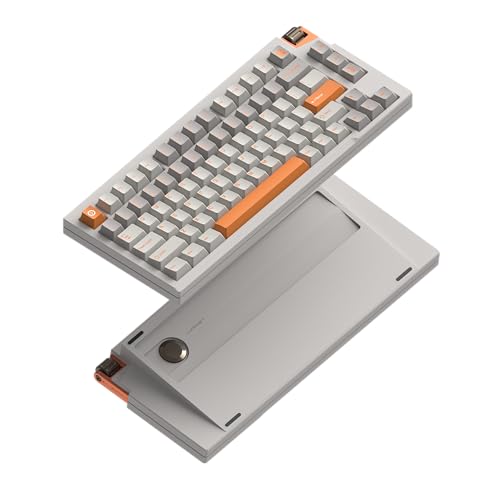
- LUMINKEY75 V2, Orange White — the brighter colourway: Astral linear switches, architectural-grade aluminium, multi-function knob, tri-mode connection, hot-swappable PCB as listed.
- LUMINKEY75 V2, Carbon Black — the darker colourway with the identical specification as listed, for desks that dress in black.

LUMINKEY75 V2 in Orange White: the review subject
Badge: Review subject — the statement colourway
- Layout: 75 percent, with multi-function knob as listed
- Case: architectural-grade aluminium as listed
- Switches: Astral linear, hot-swappable PCB as listed
- Connections: tri-mode, low latency as listed
- Colourway: orange and white as listed
Begin with the case, because the case is the argument. Architectural-grade aluminium is marketing’s way of saying the shell is machined to tolerances and a finish that belong to building hardware rather than to plastic consumer goods, and in the hand the claim survives: the board is dense, cold, and utterly unwilling to flex, with seams that read as design lines rather than as assembly apologies. On the desk it sits the way a paperweight sits, with intent, and that planted quality changes the typing experience before a single switch is pressed, because a keyboard that cannot be nudged out of place by an enthusiastic keystroke becomes part of the desk’s geography.
The Astral linear switches continue the theme of smoothness. Linear travel, no tactile event to interrupt the stroke, suits the gaming half of this board’s life, where repeated movement keys and rapid ability presses reward an uninterrupted path, and the factory tuning keeps the sound profile in the creamy register the enthusiast community prizes: a deep, muted bottom-out rather than a clatter, the case’s mass and internal damping doing acoustic work that plastic boards must fake with foam alone. Typists who love a tactile landmark should note the absence honestly; this board’s typing pleasure is textural and auditory rather than tactile, and it will not convert a committed bump enthusiast.
Tri-mode connectivity is the modern necessity executed properly: a low-latency wireless mode for gaming, Bluetooth for the second and third machines, and a wired connection for charging and for the days when only a cable will do. The knob, machined to match the case’s ambitions, defaults to volume and earns its place within the first day, because a physical, detented control under the right hand is the kind of luxury that reorganises habits permanently. Hot-swappable sockets complete the enthusiast contract, letting the board’s second owner, or your own future taste, change switches without a soldering iron ever entering the story.
Strengths
- Machined aluminium case with genuine heft and finish
- Smooth Astral linear switches with a refined sound profile
- Tri-mode connectivity plus hot-swap flexibility
Trade-offs
- Linear switches offer no tactile landmark for typists who need one
- Aluminium weight makes it a desk anchor, not a traveller
- 75 percent layout omits the number pad by design
Best for: gamers and enthusiasts who want a boutique aluminium board ready out of the box. / Not suited for: tactile-switch devotees, number-pad professionals, and laptop-bag commuters.
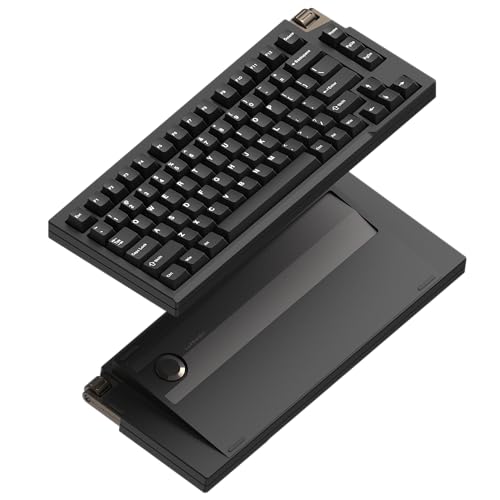
LUMINKEY75 V2 in Carbon Black: the same board, dressed down
Badge: Alternative colourway — identical specification
- Layout: 75 percent, with multi-function knob as listed
- Case: architectural-grade aluminium as listed
- Switches: Astral linear, hot-swappable PCB as listed
- Connections: tri-mode, low latency as listed
- Colourway: carbon black as listed
The Carbon Black edition is the same keyboard in a different mood, and the choice between the colourways is a legitimate desk-design decision rather than a specification decision. Black suits the monochrome battlestation, hides the evidence of daily use more forgivingly, and lets keycap colours, if you later swap them, carry the desk’s personality alone. Orange White is the extrovert: a designed object that anchors a lighter room and photographs like it was placed by a stylist. Neither ages more gracefully than the other in mechanical terms; they age differently in the eye, and the eye is a legitimate stakeholder in a purchase that will sit at the centre of your visual field for years.
Because the specification is shared, the buying advice is unusually pure: choose with your room. Consider the desk surface, the monitor’s finish, and whether your setup’s other citizens, mouse, headset stand, lamp, are black or bright, and then buy the colourway that completes the sentence they are already speaking. In a category where buyers routinely agonise over grams and milliseconds, a decision that is honestly about beauty is a relief, and this board, to its credit, makes that decision the only one left after its engineering has settled everything else.
Strengths
- Identical flagship specification in a versatile finish
- Forgiving of daily marks and fingerprints
- Pairs naturally with black peripherals and keycap sets
Trade-offs
- Less of a statement piece than the Orange White
- Same linear-only switch character as its sibling
- Same desk-anchor weight as its sibling
Best for: monochrome desks and understated setups. / Not suited for: buyers wanting the board to be the room’s bright accent.
Buying guide: who should enter the aluminium tier
The first question is whether you are the audience for a boutique board at all. The Luminkey75 V2’s premium buys materials, sound, and finish, not additional keys or competitive advantage, and a player whose current board’s feel has never once entered their thoughts may find the tier puzzling. The audience that understands it instantly is the one that has caught itself admiring a keyboard’s sound in a video, or resenting a plastic board’s flex during a long session. For that audience the purchase is not indulgence but correction, the removal of a small daily friction they had been politely ignoring.
The second question is layout discipline. A 75 percent board keeps the arrows and the function row within a compact frame and dismisses the number pad, which is the correct trade for gaming desks and most writing desks, and the wrong one for accounting, data entry, and simulation players whose right hand lives on the pad. Be honest about the count of times a week your hand seeks numbers in a grid; if the count is high, buy a full-size board or budget a separate pad, and do not let an aluminium finish talk you out of your own workflow’s arithmetic.
The third question is switch temperament, and this board answers it for you: linear, smooth, quiet-ish, gaming-friendly. If your typing religion requires a tactile event or an audible click, the hot-swappable PCB is your path, because the board will accept other switches gladly, but price that path honestly, a set of switches is a second purchase, and a buyer who plans to change them on day one should ask whether a different factory configuration elsewhere serves better. Buy the board as it is if its factory character is the character you want; the sockets are for evolution, not for rescue.
How to set up the Luminkey75 V2
Unbox it onto a clear desk and give the case a moment of inspection, because machined aluminium rewards a buyer who checks seams and finish while the return window is wide open. Connect by cable first, let it charge and be recognised, then pair the wireless modes to their machines in the order you will use them, gaming connection to the gaming PC, Bluetooth to the laptop or tablet. Set the knob’s behaviour before anything else, because your hand will reach for it within the hour and it should answer with volume, the function every desk agrees on, before you experiment with its other talents.
Then type something long and play something familiar, in that order, because the board’s two lives deserve separate first impressions. Adjust your expectations of sound: an aluminium board on a hard desk can ring faintly if the desk itself is a sounding board, and a desk mat beneath it, which most gaming setups already own, completes the acoustic design the case began. Finally, store the cable and any included extras together in one drawer, because a tri-mode board’s accessories have a way of dispersing across a home precisely one week before the day they are needed.
Common mistakes with boutique keyboards
The first mistake is buying the colourway for the photograph rather than for the room, a error the two listings in this review make easy and this review has tried to make unnecessary. The second is treating hot-swappability as homework, ordering three switch sets with the board and spending the first month as a switch laboratory instead of as a player; the factory Astrals deserve their fortnight before any jury is seated. The third is judging the board’s sound on a bare glass or metal desk, an acoustic environment no keyboard designer voices for, and returning an instrument for the room’s acoustics.
A fourth mistake is forgetting that weight is a feature with two faces. The same mass that plants the board beautifully at home makes it a serious object in a bag, and commuters who fall for the aluminium at a desk they rarely occupy should count the journeys before they count the grams. A fifth is neglecting the knob’s software or onboard settings, leaving a flagship control mapped to a function you never use while the function you need sits one configuration away. Boutique boards reward owners who finish setting them up; they are complete objects, but completeness includes the owner’s ten minutes of decisions.
Final recommendation
The luminkey75 by createkeebs, in its current V2 form, is a confident recommendation for the buyer it was built for: a gamer or enthusiast who wants an aluminium 75 percent board with linear smoothness, modern tri-mode manners, and a knob they will use daily, without entering the group-buy calendar or the soldering economy. Choose Orange White to make the desk’s statement, Carbon Black to keep it, and in either colour expect the board to out-stay several generations of the computer it serves, which is the quiet promise machined metal has always made and, in this case, keeps.
Frequently asked questions
Is the Luminkey75 V2 the same as the original Luminkey75?
The V2 is the current version of the Luminkey75 line, and it is the version current listings sell; no original-version listing was available when this review’s products were verified. Treat the V2 as the living product, with its own listings in two colourways, and be wary of any seller using the names interchangeably, because a buyer deserves to know which edition of a board is in the box. The line’s identity, aluminium case, 75 percent layout, knob, carries across the editions; the V2 is simply where that identity currently lives.
Are the Astral linear switches good for typing?
They are good for a particular kind of typing: fast, light, and unbothered by the absence of a tactile bump, the style most gaming-adjacent typists actually use. Writers who navigate by tactile landmarks may miss the bump for the first week and then, in many cases, discover their speed was never in the bump at all. Writers for whom it genuinely was can use the hot-swappable sockets to fit tactile switches later, which is the honest purpose of the feature: the board’s character can evolve with its owner instead of expiring with their first preference.
What does tri-mode connectivity actually give me?
Three ways home: a low-latency wireless link for gaming, Bluetooth for additional machines like a laptop or tablet, and a wired connection for charging, for zero-compromise sessions, and for the machine that has never heard of pairing. In practice it means the keyboard stops caring which computer is awake, which is the correct attitude for a device that may outlive three of them. Desks with one machine will use one mode and forget the others exist, and that forgetfulness is fine; the modes are insurance, not homework.
Is a 75 percent keyboard enough for everyday work?
For most everyday work, yes, comfortably: letters, arrows, and a function row cover writing, browsing, and the great majority of office tasks, and the reclaimed desk space is a daily dividend. The exceptions are number-dense professions and hobbies, where the missing pad is a missing limb, and those users should buy accordingly rather than adapt bravely. Judge by your own week’s arithmetic, not by a forum’s enthusiasm, because the forum will not be entering your invoices at midnight in the last week of the quarter.
How heavy is an aluminium keyboard in daily life?
Heavy enough to stay exactly where you put it, which at a desk is a virtue disguised as a specification. It will not skate during an excited match, it will not flex when you lean on it mid-thought, and it will announce its quality every time you reposition it with two hands, because one hand will not casually flick it aside. In a bag it is a commitment. The board is furniture-grade equipment and should be bought by people whose keyboard lives in one place and is loved there, rather than by people whose keyboard commutes.
Can I change the keycaps and switches later?
The hot-swappable PCB accepts compatible switches without soldering, and the standard layout accepts the wide world of keycap sets, so the board’s second and third personalities are limited mainly by your curiosity. Change one variable at a time, keep the factory parts labelled in a bag, and give each change a week before judging it, because a keyboard’s character is a system and systems need settling time. Owners who treat the board this way often find that its factory form was right all along, which is a compliment to the original tuning rather than a waste of the experiment.
Sound, feel, and the vocabulary enthusiasts use
Enthusiast keyboard language sounds like wine criticism until you have heard the differences it names. Clack is the high, sharp voice of a board whose case and caps emphasise the top of the stroke; thock is the low, rounded voice of mass and damping; marbly and creamy describe the smooth middle registers where this board lives. The Luminkey75 V2’s aluminium case and factory tuning place it deliberately in the deeper registers, because a heavy case absorbs the frequencies that make cheap boards sound hollow, and linear switches remove the tactile click’s punctuation from the sentence entirely. What remains is a sound closer to rainfall on a roof than to a typewriter, and for shared rooms and late sessions that register is a social feature as much as an aesthetic one.
Feel has its own vocabulary, and the governing word for this board is planted. Each keystroke lands on a foundation that does not move, so the fingers learn exactly how much force a bottom-out requires and stop wasting effort bracing against a shifting deck. Over a long document that economy compounds into a calmness that typists describe as the board disappearing, the same compliment trackball owners pay their mice. A keyboard that disappears at speed and reappears, as an object of beauty, at rest has solved the central paradox of its category, and it is the solution, more than any switch specification, that the aluminium tier’s money actually buys.
The knob, considered seriously
A volume knob sounds like a garnish until a desk has one, after which every keyboard without one feels like it is missing a door handle. The Luminkey75’s multi-function knob earns a section because its machined weight makes the adjustment feel analogue in the best sense: detents you can count with a fingertip, inertia that stops where you stop, and a press for mute that ends a loud moment faster than any software slider ever summoned. In calls it becomes the microphone’s volume diplomacy, in games it tames the menu music without leaving the match, and in media it is simply how volume is done, the way it was done for fifty years before the function row got ideas above its station.
Multi-function is the operative phrase, because a knob that can be reassigned, to zoom, to scroll, to brush size in creative software, becomes a small control surface for whatever program owns your evenings. Creative workers in particular should note it: a physical dial for a parameter you adjust a hundred times a day is an ergonomic intervention disguised as a luxury. Set it to your most-repeated adjustment, whatever that is, and let the factory volume role go if your work argues otherwise; the knob’s loyalty is to frequency, not to any single function the marketing photographed it performing.
Where the Luminkey75 sits in the wider keyboard landscape
To its left sit the mainstream flagships, the slim Logitech boards and their Razer counterparts, which offer polish, ecosystems, and retail support at the cost of plastic-adjacent construction and soldered finality. To its right sit the true customs, the group-buy boards with year-long calendars, kit assembly, and a depth of personalisation this board does not attempt. The Luminkey75 V2 occupies the deliberate middle: a complete, machined, hot-swappable object available like a product rather than a project. For the large class of buyers who want the custom feel without the custom calendar, that middle is not a compromise but the entire point, and it is why boards in this position have become the enthusiast market’s centre of gravity.
Its rivals in that middle are other aluminium 75 percent boards from the new generation of keyboard-first brands, and the contests among them are decided by sound tuning, case finish, and the small print of connectivity rather than by any headline specification. Against that field the Luminkey75’s credentials are its case grade, its knob, and a colourway with the confidence to be orange. Buyers cross-shopping the field should listen to sound tests with scepticism, because microphones flatter and rooms differ, and should weight the returnable purchase of the board that can actually be auditioned at their own desk over the board that merely won a recording.
Ownership: cleaning, caps, and the second year
Aluminium asks little and rewards it visibly. A soft brush weekly keeps the board’s seams honest, a microfibre cloth restores the case’s finish after a month of hands, and the keycaps, removed with the included puller if one is provided or a wire puller of your own, wash in warm soapy water and dry overnight into factory freshness. Do that twice a year and the board will photograph like the listing indefinitely, a property plastic boards, whose legends fade and whose cases polish unevenly, cannot promise. The second year of ownership is where the tier justifies itself, in a board that has aged into patina rather than into wear.
The hot-swap sockets invite one ownership ritual worth scheduling rather than improvising: the annual experiment. Once a year, if curiosity persists, try one change, a switch set or a keycap profile, live with it for a month, and keep the winner. This pacing converts the board from a purchase into a small, managed hobby with a yearly chapter, and it prevents the frantic first-month tinkering that leaves so many boutique boards in a permanent state of almost-finished. A keyboard this well resolved from the factory deserves an owner whose modifications are as deliberate as its machining.
Gaming with a board built like furniture
It is fair to ask what an aluminium case does for a game, and the honest answer is: nothing measurable, and something real. Nothing measurable, because latency lives in the connection and the switches, and this board’s tri-mode wireless and linear switches handle that side of the contract without the case’s help. Something real, because a board that never shifts during a frantic sequence, never flexes under a frustrated palm, and never adds its own rattle to the audio of a tense round is a board the player’s body trusts, and trust is a performance attribute even when it refuses to appear in a benchmark table. Competitive players buy shoes, chairs, and mice on exactly this logic; the keyboard was simply the last component to be allowed the same reasoning.
The 75 percent layout plays its own gaming role, reclaiming the desk’s right side for the mouse’s travel, which on low sensitivities is not a luxury but range of motion. Combined with the knob’s instant volume diplomacy, the board’s gaming personality emerges as calm competence: nothing about it shouts, everything about it holds still and answers. Players whose setups lean minimalist will recognise the aesthetic immediately, while players who want a light show should note that this board’s charms are material rather than luminous, and shop the mainstream flagships if a glowing desk is the brief they are actually furnishing.
The typing week: a diary this board tends to produce
Day one is ceremony: the unboxing weight, the first knob turn, the sound test performed for an audience of whoever is home. Day two is suspicion, because linear switches give the fingers no confirmation and the typist’s error count rises while the touch recalibrates to trust the bottom-out. Day three is the turn, when the hands lighten, the errors fall, and the board’s sound during a long paragraph becomes the pleasure the reviews promised. By day seven the diary usually records the sentence every boutique board hopes for, some version of the observation that going back to the old keyboard for an afternoon felt like typing on a toy, hollow and restless by comparison.
Not every diary ends that way, and the honest minority report deserves its lines. Some typists never forgive the missing tactile event, and their day-seven entry reads as a polite farewell and a return label. The board’s defence is that it never hid its character: linear is printed in its listings, its sound is documented across the internet, and its trial is exactly the kind the return window exists for. A keyboard is a relationship with a daily object, and this one courts openly, with its materials on the table from the first paragraph of its listing, which is all a buyer can fairly ask of any product in any category.
Value in the boutique tier, stated plainly
The money question deserves a direct answer. Against a mainstream wireless board, the Luminkey75 V2’s premium purchases no additional function that a spreadsheet can hold; it purchases the case’s material and finish, the sound that follows from them, the knob’s machining, and the right to change switches without solder. Buyers who value those things daily will find the premium amortised into invisibility within a season, because a keyboard is touched more than any other object in the home office. Buyers who do not value them will find the same money better spent almost anywhere else in the setup, and this review’s loyalty is to that arithmetic rather than to the board’s admittedly considerable charm.
Resale softens the arithmetic for the undecided. Boutique aluminium boards hold a devoted second-hand audience, and a clean, boxed Luminkey75 with its factory switches intact is a liquid object in a way that a worn mainstream board is not. That liquidity is not a reason to buy, but it is a reason the experiment this board asks for, a week at your desk, carries less financial risk than its tier suggests. Buy it like an instrument, keep its packaging like an instrument’s case, and the worst realistic outcome is a small tuition paid for precise knowledge of your own taste in the object you touch most.
Desk styling with a board that has opinions
A keyboard this designed becomes the desk’s anchor tenant, and the rest of the setup should be arranged in conversation with it rather than in competition. The Orange White colourway rewards a lighter supporting cast, pale desk surfaces, a white or silver mouse, warm lamp light, while Carbon Black disappears into the monochrome setups that dominate gaming rooms and lets a single accent, a cable, a keycap set, a plant, carry the colour. Either way, give the board visual room: an aluminium case crowded by clutter reads as expensive mess, while the same case with a clear field around it reads as intention, and the difference costs nothing but a weekly five-minute tidying ritual.
Photographers of their own setups, a constituency larger than any brand admits, will find the board unusually cooperative. Machined metal catches light with a consistency that plastic cannot imitate, and the colourways were plainly chosen by someone who understood that a keyboard now lives partly in pictures of desks. There is no shame in that dimension of the purchase; the desk is a room’s furniture and a video call’s backdrop, and an object that serves the eye while serving the fingers is doing two jobs for its money, a defence this board can make more honestly than most of the objects competing for the same square footage.
For the buyer upgrading from a first mechanical board
Most Luminkey75 buyers are on their second or third keyboard, and the upgrade path has a psychology worth naming. The first board teaches the vocabulary, switches, layouts, polling, the second board is where taste forms, and taste, once formed, is expensive to argue with. If your current board’s sins are specific, it flexes, it sounds hollow, its wireless drops a machine, its spacebar rattles like a gate, then this board is the correction of a known list, and the purchase will satisfy in proportion to the list’s accuracy. If your current board’s only sin is that it is not new, the aluminium will delight for a month and then become the new normal against which the next novelty will be measured, and the wiser purchase might be keycaps, switches, or nothing at all.
That counsel of restraint is the strongest endorsement a review can give a product in this tier, because it reserves the board for the buyers it will genuinely transform. A boutique keyboard is not an upgrade to a computer; it is an upgrade to the texture of every hour spent at one, and hours are the currency that matters. Count yours honestly, the gaming hours, the writing hours, the call hours where the knob will turn a hundred small diplomacies, and if the count is high, the board’s price divides into a daily figure so small that the only remaining question is the colourway, which is exactly where this review began and where, for the right buyer, it is happy to end.
Inspection and first-evening checklist
Give a machined product a machined welcome. Inspect the case’s edges and finish in good light, confirm the knob turns with even detents and no wobble, press every key once for a consistent voice, and pair all three connection modes to their intended machines before the packaging leaves the room. Type one long paragraph and play one familiar game, not to judge the board, which needs its week, but to certify the individual unit. Then photograph the desk, because you will want the before picture when the setup inevitably evolves around its new anchor, and register whatever warranty the maker offers while the receipt is still glowing on your screen.
Keep the box and the factory extras together in storage. With boutique boards the packaging is part of the asset, the resale market pays for completeness, and the included cable and tools are the ones fitted to the board’s ports and sockets. A year from now, whether the board is being cherished, modified, or passed to its next desk, that complete box will be the difference between a transaction and a handover, and handovers are what objects of this quality deserve from the people who own them.
What the V2 designation tells a careful buyer
A second version is a manufacturer’s confession and promise in one word: confession that the first edition taught lessons, promise that the lessons were applied. Buyers should read the V2 badge on this line as a maturity signal, the point at which a boutique design stops being a debut and becomes a product with a service history, a known community, and a maker’s continued investment. That maturity is worth real money in a category where first editions can be charming drafts, and it is one more reason this review was content to treat the V2 not as a substitute for an unavailable original but as the edition a rational buyer would choose even if both were on the shelf.
It also simplifies the second-hand and support landscape. Knowledge, firmware, and community answers accumulate around the current edition, keycap and switch advice is written for its sockets and its plate, and a new owner joins the largest, best-documented chapter of the line’s life. Products, like books, are best bought in the edition everyone is actually reading, and the Luminkey75’s current edition is unambiguous about its identity: V2, in two colours, with the line’s whole philosophy machined into aluminium and ready to be typed on tonight rather than assembled next season.
Closing: the keyboard as the desk’s signature
Every mature desk develops a signature object, the thing a visitor’s eye finds first and the owner’s hand trusts most, and keyboards are the most common holders of that title because they sit at the exact crossing of sight and touch. The Luminkey75 V2 applies for the title with unusual credentials: a case that reads as architecture, a sound that reads as weather, a knob that reads as an instrument’s dial. Whether it wins the title at your desk depends on the week’s evidence your own fingers gather, and this review’s final advice is simply to gather that evidence properly, a full week, real work, real games, no tinkering, before letting any verdict, including this article’s warm one, stand in for your own.
If the week confirms the promise, the board will do what signature objects do: it will stop being reviewed and start being used, season after season, while computers and monitors rotate around it. That longevity is the deepest sense in which an aluminium keyboard is a rational purchase, and it is the note on which a review of a metal object should properly end, not with a specification but with a timescale.
A note for readers arriving from the original’s reviews
Some readers will arrive here carrying reviews of the first Luminkey75 written when the line was new, full of the excitement and the caveats that attend a debut. Read those reviews for the design’s biography and this one for its current state, because the purchasable object has moved on, as living products do, into its second edition. The continuities are the ones that matter, the aluminium thesis, the layout, the knob, the linear smoothness, and the discontinuities are the ordinary refinements of a maker who listened. A buyer who understands that relationship will not waste an evening hunting for a first-edition listing that the market has retired, nor mistake the V2’s availability for a compromise; it is the line, present tense.
Practicalities: cables, charging, and connection manners
A tri-mode board’s daily manners are decided by small behaviours. It should wake its machine without losing the first keystroke, hold its Bluetooth pairing through sleep cycles without renegotiation theatre, and charge from the cable without demanding the desk be rearranged around the ritual. The Luminkey75 V2’s low-latency wireless is specified for gaming, which sets the bar for all three behaviours, and owners should still perform the unglamorous checks in the first week: wake it from sleep a dozen times, swap between its machines until the sequence is muscle memory, and confirm the wired mode works with the cable stored where you intend to keep it. A boutique board earns its tier in these transitions as surely as in its machining, because a beautiful object that fumbles a wake-up taxes its owner daily in a currency no finish can repay.
The gift question, and the shared-desk question
This is a board people buy for other people, because its beauty makes it legible as a present in a way a specification-led board never is, and it is a good gift under two conditions. The recipient’s switch taste must be known or safely linear-friendly, because a tactile devotee gifted a linear board receives a beautiful apology, and the desk it will live on must be a settled one, because gifting an anchor to a nomad is a logistics error in a handsome box. Meet both conditions and the Luminkey75 is the rare peripheral gift that lands as an heirloom rather than as equipment, the kind of object whose giver is remembered kindly every time the knob turns.
Shared desks raise the mirror question. A board this personal, tuned to one owner’s taste in sound and switch, serves a household best when it is understood as one person’s instrument that others may borrow, rather than as communal property whose settings are a democracy. Households that respect that settlement keep the peace and the board’s configuration intact; households that renegotiate the knob’s function weekly will find the board’s completeness wasted on them, and should buy a cheerful mainstream board whose personality nobody needs to defend. Even here, at the edge of domestic diplomacy, the board’s thesis holds: it is a finished, opinionated object, and it flourishes where opinions are allowed to settle.
Final word on colour, once more with feeling
Return, at the end, to the only decision the board leaves entirely to taste, because it is a pleasant place for a long review to land. Orange White is the colourway of a desk that wants a protagonist; Carbon Black is the colourway of a desk that wants a foundation. Neither will date faster than the other, because both were chosen from the durable end of the palette, the warm metal-and-cream register and the monochrome register that gaming rooms have cycled through for a decade without exhausting. Choose the one your room has been asking for, the one that completes the photograph you already carry in your head of your own setup, and then stop choosing: the board’s remaining virtues, enumerated at length above, are identical in either dress, and they begin accumulating from the first evening’s first paragraph typed.
Envoi: objects that earn their square footage
A desk is a small country with strict immigration laws, and every object on it should be able to state its business. The Luminkey75 V2 states its business in metal: to be the surface your fingers trust, the sound your room tolerates gladly, and the dial your hand turns without looking, for longer than the computer it serves will remain your computer. Few peripherals can state a case that complete, and fewer still can machine it into a single object that arrives ready rather than as a kit of intentions. If your desk has a vacancy at its centre, this is currently one of the most persuasive applicants for it, in either of its two well-chosen suits.
A last practical note on ordering the right listing
Because the two colourways share a name, a layout, and nearly a photograph, the ordering moment deserves the same care this review gave the M575 family in a neighbouring article: read the colourway in the listing title twice, confirm it in the order confirmation, and check the box against both before the packaging is recycled. A Carbon Black delivered to an Orange White intention is a fine keyboard and a failed errand, and the exchange, while painless, costs the one resource this board was bought to enrich, which is evenings at the desk. Precision at the checkout is the final feature of a precision instrument, supplied, as with so many of this board’s virtues, by the owner rather than the factory.
Postscript: the sound of a room settling
Owners of aluminium boards often report a moment, weeks in, when a visitor types a sentence on the board and pauses, surprised by a sound they did not know keyboards could make. That pause is the product’s whole argument compressed into a second: that the objects we touch ten thousand times a day deserve the materials and the tuning we reserve for instruments, and that the difference is audible to anyone, not only to the initiated. The Luminkey75 V2 manufactures that pause reliably, in either colour, on any desk willing to give it a week. A review can ask for no cleaner verdict than a stranger’s surprised silence, and this one is content to rest its case there.
And a word on patience with boutique stock
Boutique keyboards move in smaller batches than mainstream boards, and a colourway can sell through and return on the maker’s rhythm rather than the retailer’s. A buyer who finds their chosen colour temporarily absent should treat the wait as the category’s normal weather rather than as a sign to settle for the wrong suit of a board they will look at daily for years. Colour is forever in a purchase like this; a few weeks of patience is a trivial premium for the right one, and the board’s whole philosophy, deliberate, material, unhurried, argues that its buyer is exactly the person capable of seeing that arithmetic clearly.
The shortest possible summary
For the reader who scrolled: a machined aluminium 75 percent board, currently sold as the V2, with smooth linear switches, a proper knob, three ways to connect, and sockets that let it evolve. Buy the bright colourway to anchor a light desk or the black one to ground a dark desk, give it a week to teach your fingers its manners, and expect it to be the last keyboard you buy for reasons of quality rather than novelty. Everything else in this long review is the evidence; that paragraph is the verdict the evidence supports.
Keep the factory switches and caps labelled in their bag whatever you change later, because a complete, reversible board is a board whose owner can experiment without fear, and fearlessness, in a hobby built on taste, is the most valuable specification of all.
And when the board has settled, as it will, into the desk’s permanent geography, notice how the questions that filled this review, colour, switches, sockets, have all gone quiet, leaving only the typing. That quiet is the product working. It is also, not coincidentally, the sound the board itself makes: low, even, and entirely sure of its materials.
One more consideration for writers, specifically
Writers evaluating this board should run a particular test during the trial week: a full drafting session at their natural speed, followed immediately by an editing session at reading speed, because the two activities ask opposite things of a switch. Drafting rewards the linear smoothness that lets words outrun deliberation; editing rewards the ability to land on a single character and change it without disturbing its neighbours, a test of control rather than speed. The Luminkey75’s planted case serves the second activity better than its linear switches might suggest, because a board that never shifts makes the cursor’s micro-geography trustworthy, and writers who pass it on both sessions can buy with a confidence that a single afternoon’s typing test could never have given them.
The same two-session test, adapted to your own crafts, is the fairest trial any keyboard in this price tier can be given, and a board that passes it in your hands has earned its place by evidence rather than by reputation, which is how every object on a serious desk should be hired.
Hire it, then, if the evidence points that way, and let the desk’s centre stop being a compromise you renew with every computer. A keyboard bought once, correctly, in the right colour, is a small declaration that the hours spent typing deserve instruments, and instruments, unlike appliances, tend to be kept, cared for, and eventually handed on with pride.
That handing-on is the final test of the tier, and aluminium passes it in a way plastic rarely attempts: a board that can be cleaned, re-switched, and presented to its next owner as an object rather than as e-waste has justified its materials twice over before the second owner’s first keystroke lands.
Related guides
the G915 X, a slim aluminium rival philosophy
Logitech against Razer for the mainstream choice
wireless boards tuned for competitive shooters
wireless keyboards at an accessible tier