Disclosure: As an Amazon Associate, reviewstook.com earns from qualifying purchases. Links on this page are affiliate links; they cost you nothing extra. Prices and availability change often, so check the current Amazon listing before you buy.
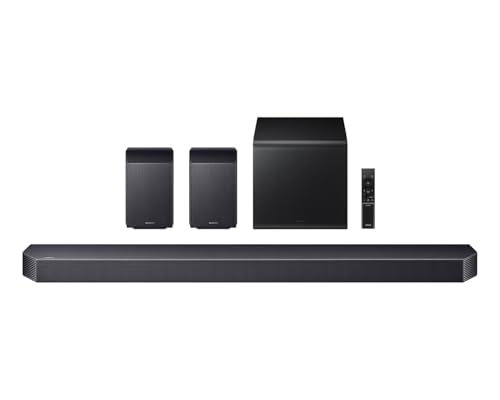
The hw q930f is the Samsung soundbar system most buyers actually mean when they say they want proper home cinema sound without building a receiver-based setup from separate parts. It is a 9.1.4-channel package: a main bar, a wireless subwoofer, and two wireless rear speakers that carry genuine surround and height information rather than leaving the bar to fake everything from the front of the room. Wireless Dolby Atmos and DTS:X decoding sit at the centre of the pitch, Q-Symphony lets a compatible Samsung television keep its own speakers working alongside the bar, and SpaceFit Sound Pro tunes the output to the room it lands in. This guide treats the system as a whole ownership proposition — placement, wiring, calibration, daily behaviour with ordinary television, and the points where a bigger flagship or a simpler bar would serve you better.
A four-box soundbar system occupies an interesting middle ground, and understanding that middle ground is the key to judging this one fairly. Below it sit single bars and bar-plus-subwoofer packages that are cheaper and tidier but cannot place sound behind you. Above it sit separates systems with a receiver, five or seven passive speakers, and speaker cable run around the room — more capable at the extremes, but a weekend of installation and a permanent furniture commitment. The Q930F asks for mains power at four points in the room and nothing else: no cable runs, no receiver shelf space, no amplifier matching. What it gives back is real rear channels, real height channels, and a subwoofer you can position where the room sounds best rather than where a cable reaches. Buyers who grasp that exchange tend to be happy with it; buyers who expect it to behave like a single bar with extra volume tend to trip over the rear speakers within the first week.
There is also a model-year trap worth naming at the start, because Samsung’s Q-series naming recycles letters across generations. The Q930F is the 2025 model in this line. Its predecessor carried a different suffix, and the step above it in the same range is the Q990F, an 11.1.4 system covered later in this guide as the upgrade alternative. Listings, reviews, and second-hand adverts blur these together constantly, so every claim in this guide is tied to the verified F-generation listing pictured below, and the buying sections return to the naming question more than once. If you read nothing else, read the sections on rear-speaker placement and on Q-Symphony compatibility — those two topics decide more real-world satisfaction with this system than any specification on the box.
Key takeaways
- True rear speakers and four height channels make this a genuine surround system, not a wide stereo bar with processing
- Each rear speaker and the subwoofer needs its own mains socket — count your outlets before ordering
- Q-Symphony only adds value with a compatible Samsung TV; with other brands the bar works alone, which is fine
- Wireless Atmos still depends on your TV passing the right audio format over eARC, so check the television first
- The Q990F alternative in this guide buys two extra surround channels and a second subwoofer driver arrangement, not a different class of sound
Where to buy the Hw Q930f
The linked listings in this guide go to Amazon, where each product section carries a plain link so you can check price on Amazon and confirm the exact bundle in the box before ordering. That confirmation step matters more for multi-box systems than for almost any other category: the package should contain the main bar, the wireless subwoofer, two rear speakers, their power supplies, an HDMI cable, and the remote. Open-box and marketplace listings sometimes split systems or substitute a subwoofer from a different generation, and a missing rear speaker turns a 9.1.4 system into an expensive 5.1.2 one. Check the seller, check the contents list, and check that the model suffix in the listing title matches the F generation discussed here. If the full system is unavailable in your region, the alternatives section explains which compromises are safe and which change the product fundamentally.
In this guide
Quick picks at a glance
| Product | Channels | Best for |
|---|---|---|
| Samsung HW-Q930F | 9.1.4 | The subject of this guide: full surround and height from four wireless boxes |
| Samsung HW-Q990F | 11.1.4 | Larger rooms and buyers who want the widest rear soundstage in the range |
How these picks were chosen
Both systems in this guide were verified against Amazon’s catalogue data before a word of the reviews was drafted: the listing title had to name the exact model and generation, the channel configuration in the title had to match the product being discussed, and an official product image had to exist for the listing. That sounds like a low bar until you search this category yourself and find Q930C, Q930D, and Q930F listings interleaved, refurbished units described with new-model language, and rear-speaker kits sold separately under near-identical names. The Q930D, notably, could not be verified to that standard, so it appears in this guide as prose context only and is never linked as if it were the F model. The Q990F earns its place as the single alternative because it is the honest step up within the same design language — same calibration tools, same television integration, more channels — rather than a random rival chosen to fill a table.
What a 9.1.4 system actually does in a living room
Channel counts get quoted like horsepower figures, so it is worth translating 9.1.4 into furniture. The nine ear-level channels are the front left, centre, and right in the bar itself; two wide channels that push effects beyond the bar’s physical ends; two side surround channels; and two rear surround channels in the separate speakers behind your seat. The single subwoofer channel handles the low-frequency effects and the bottom octaves of everything else. The four height channels — two firing upward from the bar, two from the tops of the rear speakers — bounce Atmos height information off the ceiling. In a film mix, that arrangement means dialogue stays anchored to the screen, a helicopter genuinely crosses overhead, and rain in a scene surrounds the seating position instead of arriving as a louder version of the front soundstage. In a room where the rears cannot go behind the sofa, much of that geometry collapses, which is why this guide keeps returning to placement: the specification is a promise the room has to keep.
The centre channel deserves its own paragraph because it is where soundbar systems quietly win or lose households. Most television dialogue lives in the centre channel, and a dedicated centre driver array in a bar of this size renders voices with a weight and clarity that television speakers and small bars cannot match, especially at the modest volumes people use after children are in bed. Samsung adds voice-focused processing on top, and the practical effect is that you stop riding the volume control between whispered conversations and explosions. If your household’s main complaint about film night is rewinding to catch lines of dialogue, that — not Atmos — is the upgrade you are actually buying, and it applies to every channel of broadcast television and every streaming drama you watch, not just blockbuster discs.

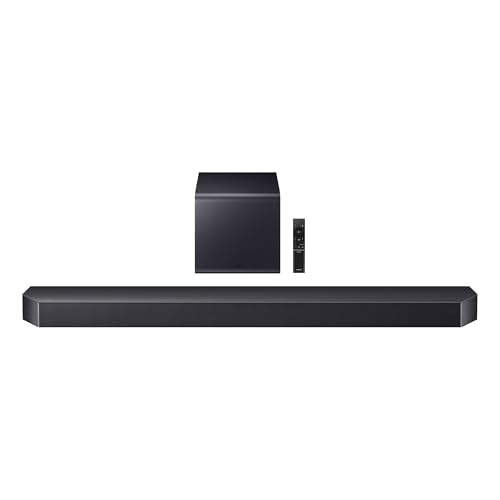
Samsung HW-Q930F 9.1.4ch Soundbar with Subwoofer and Rear Speakers
Badge: The main pick — full wireless surround system
- Configuration: 9.1.4 channels across bar, wireless subwoofer, and two wireless rear speakers
- Formats: Wireless Dolby Atmos and DTS:X decoding
- Television integration: Q-Symphony with compatible Samsung TVs, SpaceFit Sound Pro room tuning, Adaptive Sound
- Connectivity: Wi-Fi and Bluetooth, Alexa built in, HDMI eARC connection to the television
- Generation: 2025 model, per the verified listing title
The Q930F’s defining decision is that its rear speakers are real speakers carrying discrete channels, and everything about living with the system flows from that. Set them on stands or side tables roughly at ear height behind the seating, give each one power, and film soundtracks gain the dimension that front-only systems simulate and never quite deliver: effects that start behind your shoulder, ambience that wraps the room, and game audio where a sound behind you is information rather than decoration. The rear units also carry the rear height channels, so Atmos material gets height information from both ends of the room. Owners upgrading from a bar-and-sub package consistently describe the first evening with proper rears as the moment the system justified itself, and that reaction is about geometry, not volume or bass quantity.
Sound character, in broad terms, is tuned for cinema first. The subwoofer is a substantial wireless unit that digs into genuine low-frequency effects — the kind you feel in a sofa during an action sequence — while staying composed enough for music playback over Bluetooth or Wi-Fi when the television is off. Adaptive Sound adjusts the balance scene by scene, lifting dialogue in quiet passages and letting effects breathe in loud ones, and most owners will leave it on permanently. SpaceFit Sound Pro uses microphones to measure the room and adjust output, which matters in the asymmetrical living rooms most people actually have: a sofa against one wall, a bookcase on the other, a subwoofer tucked into the only corner that fits. Run the calibration after final placement, and re-run it if you move the subwoofer, because the correction is specific to where everything sits.
Q-Symphony needs an honest explanation because it is the feature most likely to be oversold at the point of purchase. With a compatible Samsung television, Q-Symphony lets the TV’s own speakers keep working in coordination with the bar instead of muting, which can add height presence and widen the front stage. With a television from any other brand, the feature simply does not engage and the bar does all the work alone — which it was designed to do, and which is how the majority of owners will use it. Do not buy this system because of Q-Symphony unless your television supports it; do not reject it because yours does not. The eARC connection is the one that matters universally: it carries the full Atmos and DTS:X bitstreams from the TV, and it lets the TV remote control the bar’s volume, which is the difference between a system the whole household uses happily and one that needs its own remote hunted down every evening.
Strengths
- Discrete rear speakers deliver genuine surround placement that front-only bars cannot reproduce
- Four height channels with both front and rear up-firing drivers give Atmos mixes a complete ceiling image
- Room calibration and adaptive processing make the system forgiving of awkward living-room layouts
Trade-offs
- Four boxes each need mains power, so rooms short on sockets behind the sofa need planning
- The subwoofer is large enough that small rooms may need its level trimmed to avoid overwhelming dialogue
- Full feature value depends on an eARC-equipped television; older ARC-only sets limit the formats it can pass
Best for: film and streaming households with a sofa arrangement that allows rear speakers behind the seat and a modern eARC television. Not suited for: rooms where nothing can sit behind the seating, or buyers who want a single-box product they can move between rooms.

Samsung HW-Q990F 11.1.4 Channel Q-Series Soundbar with Subwoofer and Rear Speakers
Badge: The step-up alternative
- Configuration: 11.1.4 channels — two more ear-level channels than the Q930F
- Package: main bar, wireless subwoofer, and wireless rear speakers
- Role in this guide: the larger-room, wider-stage option within the same Samsung Q-series design
The Q990F exists for the rooms and listeners the Q930F slightly under-serves. Its two additional channels widen the surround field, which tells most in bigger spaces where the seating sits well away from walls and the rear speakers have real distance to cover. In a typical apartment living room, the difference between the two systems is subtle and mostly about headroom at high volume; in a long room or an open-plan space, the flagship’s extra width stops the soundstage feeling concentrated around the bar. Everything else — the calibration approach, the television integration, the app and remote experience — follows the same design language, so the choice between them is genuinely about room size and listening level rather than features. Buyers cross-shopping the two should measure their room before reading any further comparisons: below a certain size, the Q930F is not the compromised option, it is simply the correctly sized one.
Strengths
- Wider surround image suits long rooms and open-plan spaces
- Same calibration and television-integration toolkit as the main pick, so nothing is relearned
- Extra headroom keeps big action mixes composed at cinema volumes
Trade-offs
- Costs meaningfully more for channels a small room cannot exploit
- The larger bar needs a longer television bench or wall span
- In modest rooms its advantage over the Q930F narrows to near invisibility
Best for: large living rooms, dedicated media rooms, and listeners who watch at high volume. Not suited for: compact flats where the Q930F already fills the space, or budgets that would rather put the difference toward the television itself.
Hw Q930f compared with the step up and the generation before
| System | Channels | Rear speakers | Notes |
|---|---|---|---|
| Samsung HW-Q930F | 9.1.4 | Yes, wireless, with rear height | 2025 model; the balanced point of the range |
| Samsung HW-Q990F | 11.1.4 | Yes, wireless | Flagship width for larger rooms |
| Samsung HW-Q930D | 9.1.4 | Yes, wireless | Earlier generation, discussed in prose only here; verify any listing carefully |
The Q930D row in that table is there to prevent a specific mistake. The D generation is a legitimate product that many owners are happy with, and it appears in the second-hand and clearance market at tempting prices. But it is not the F, its firmware and tuning differ, and reviews written about one are routinely attached to listings for the other. Because no exact-match listing for the D could be verified to the standard this guide requires, it is not linked here. If you find one for sale, treat the listing title — not the headline, not the photos — as the authority on what you would actually receive, and price it as the older model it is.
Buying guide: what to check before a multi-box soundbar
Start with the television, because it is the source of nearly every disappointment in this category. The bar connects over HDMI eARC, and eARC is what allows the television to pass full-quality Dolby Atmos and DTS:X from streaming apps, consoles, and disc players through to the bar. A television with plain ARC can still pass compressed surround and will work for everyday viewing, but it caps what the system can do with the best sources. While you are behind the TV, confirm there is a free HDMI socket for the bar that does not displace a console you use daily, and check the TV’s audio settings menus for a passthrough or bitstream option — the bar can only decode what the television agrees to send. Buyers planning a television upgrade within a year should sequence the purchases TV-first if the current set lacks eARC entirely.
Next, walk the room with a tape measure and a socket count. The bar needs to fit under the television without blocking the screen’s lower edge or the TV’s infrared receiver; if it cannot sit on the bench, wall-mounting is possible but becomes a bigger job. The subwoofer wants a floor position near a wall or corner, with some freedom to move it a metre in either direction during setup, because bass response changes dramatically with placement. The rear speakers need positions behind and slightly to the sides of the main seat, ideally near ear height when seated, and each needs power. A room where the sofa backs directly onto a wall is the hardest case: rears can sit on a shelf or stands immediately behind the sofa angled toward the listeners, which still works, but expectations for envelopment should adjust downward. Sketch this before ordering and the installation becomes an hour of pleasure instead of an afternoon of improvisation.
Ceiling shape is the third check, and it is the one Atmos marketing never mentions. The height channels bounce sound off the ceiling, which works well with flat ceilings of ordinary height and poorly with vaulted, beamed, or very high ceilings. In a difficult-ceiling room the height effect softens rather than disappears — the rear speakers still deliver surround, and the system remains a major upgrade — but buyers in converted barns and double-height loft spaces should weight the height channels less heavily in their decision and judge the system mainly as an excellent 9.1 surround package. Finally, think about sources: a household that watches broadcast television and one streaming service uses perhaps half of what this system can do, which is fine, but a household with a disc collection, a current console, and several streaming subscriptions will hear the full return on the purchase every single week.
How to set up the Hw Q930f step by step
Step 1: Position everything before connecting anything
Place the bar centred under the television, the subwoofer along the front wall offset from the exact corner, and the rear speakers behind the main seat at ear height, angled inward. Leave the subwoofer a little slack in its position — you will nudge it later. Resist the urge to power up as you go; a system placed calmly in one pass calibrates better than one assembled piecemeal around furniture moved three times.
Step 2: Connect eARC and set the television to passthrough
Run the HDMI cable from the television’s eARC-labelled socket to the bar. In the TV’s sound settings, select the bar as the output, enable eARC, and set digital audio output to passthrough or bitstream rather than PCM, so Atmos and DTS:X arrive intact for the bar to decode. Power the subwoofer and rears; the wireless links pair automatically in normal circumstances, and each unit’s indicator confirms its connection. If a rear fails to link, move it temporarily closer to the bar for pairing, then return it to its position.
Step 3: Run SpaceFit Sound Pro and set your levels
With the room in its normal evening state — curtains as they will be, doors as they will be — run the room calibration from the remote or app and let it complete without talking over it. Afterwards, set the subwoofer level by ear using a familiar film scene with dialogue over action: voices should stay clear with the bass present as weight rather than as a separate event. Note your preferred subwoofer level for films; music playback often wants a notch less.
Step 4: Test with three kinds of content
Play an Atmos film scene with overhead effects to confirm the height image, a dialogue-heavy drama at low volume to confirm centre clarity, and a football match or similar broadcast to confirm the system behaves with ordinary stereo television content, which it will upmix. Check that the television remote controls volume and that the bar wakes and sleeps with the TV. Any problem is easiest to fix now, while the cable layout is still fresh in your mind.
Step 5: Tidy, label, and save your settings
Route the power leads so rear-speaker cables do not cross walkways, photograph the back of the television before you push the bench back, and write down your subwoofer and centre levels somewhere durable. Firmware updates arrive occasionally; apply them with the system idle, and re-run calibration after any update that mentions audio changes. Readers comparing complete packages may also want our roundup of the best soundbars for a living-room upgrade and the dialogue-focused selection in soundbars that make speech easier to follow.
Common mistakes with systems like this one
The most frequent mistake is placing the rear speakers beside the television because the cables or the furniture make it easier, then concluding surround sound is underwhelming. Rears at the front produce a wider front stage and nothing more; the entire point of the package is behind you. The second mistake is burying the subwoofer inside a cabinet or tight alcove, which turns controlled bass into a one-note boom that no calibration fully repairs — give it open air on at least two sides. Third, buyers often leave the television’s audio output set to PCM from an old setup, silently downmixing every Atmos stream to stereo for months; the passthrough setting in Step 2 exists precisely because this is so common. Fourth, running calibration with the room in an unusual state — doors open that are normally shut, a party’s worth of extra chairs — bakes the wrong room into the tuning. Finally, judging the system in its first ten minutes with a compressed broadcast feed, rather than with a proper Atmos source after setup, leads to returns of systems that were never actually heard.
Everyday living: streaming, sport, games, and music
Most hours on a system like this are not film nights. They are news at breakfast, a series episode midweek, a match at the weekend, a child’s programme at full negotiation volume. The Q930F’s adaptive processing earns its keep here, keeping commentary intelligible over crowd noise and preventing the ad-break volume jump that plagues lesser setups. For gaming, the rear channels turn positional audio into usable information in shooters and racing titles, and the low-latency eARC path from a modern television keeps lip-sync and input response aligned; players sensitive to delay should use the television’s game mode passthrough settings rather than adding processing in the bar. Music over Wi-Fi or Bluetooth will not trouble a decent stereo pair, but as a single system that fills a room evenly for a gathering it is entirely convincing, with the subwoofer level the one adjustment worth making when you switch from films. Households deep in television ecosystems on this site often pair research here with soundbars with wireless subwoofers compared before deciding how much hardware their room can absorb.
Room scenarios: where this system sings and where it struggles
Consider the most common British and American living room first: a three-seat sofa facing a television on the opposite wall, four to five metres of depth, a rug in the middle, curtains on one side. This is the room the Q930F was designed in, effectively. The rears sit on stands behind the sofa corners with a metre of breathing space, the subwoofer lives beside the TV bench, and the ceiling is flat plasterboard at a standard height. In this room everything in the specification works as advertised, calibration converges quickly, and the system delivers the full effect with no compromises worth discussing. If your room resembles this paragraph, stop worrying and buy on the other criteria in this guide.
The open-plan kitchen-living space is the second scenario, and it tests the system differently. There is no back wall near the seating, one side of the room opens into a kitchen with hard surfaces, and the television wall is shared with a dining area. Rear speakers on stands become islands that need power from floor sockets or long leads along skirting, and the room’s total volume is far larger than its seating area suggests, so the subwoofer works harder and calibration has an asymmetrical space to model. The Q930F still performs well here — SpaceFit exists for exactly this — but this is the scenario where the Q990F’s extra width and headroom begin to justify themselves, and where buyers should be realistic that no soundbar system pressurises a forty-square-metre open plan like a cinema. Seat-centred listening remains convincing; wandering to the kitchen sink with expectations of full surround is not what any of these systems promise.
The small flat is the third scenario: a two-seat sofa, television two metres away, neighbours on every side. Here the system’s virtues invert — the centre channel’s clarity at low volume matters more than the height channels, the subwoofer spends its life trimmed down, and the rears sit close behind the listeners where their discreteness is almost luxurious at modest levels. The risk in this room is not under-buying but over-driving: run everything at cinema levels and the subwoofer becomes a neighbour-relations problem. The system scales down gracefully, which is not true of every flagship package, and its night-time manners make it a better small-flat citizen than its specification sheet suggests.
The dedicated media room is the fourth scenario, and the honest advice changes. If you have a room whose purpose is films — blackout blinds, a projector or large screen, seating placed for sound — then a receiver and separate speakers will ultimately out-perform any soundbar package, including this one, in dynamics, upgradeability, and sheer output. The Q930F’s counter-argument is installation time measured in an hour rather than a weekend, and a room that stays presentable. Some media-room owners choose it knowingly for exactly those reasons. But buyers building a true cinema room from scratch should at least price the separates route before defaulting to a package, because that room is the one place the package’s core convenience buys nothing.
Subwoofer placement, properly explained
Bass behaves differently from every other part of the soundtrack because its wavelengths are measured in metres, comparable to the room itself. Where the subwoofer sits and where you sit interact to create peaks where bass booms and nulls where it vanishes, and moving the subwoofer half a metre can matter more than any setting in the menu. The classic technique is the subwoofer crawl: place the sub temporarily at your listening position, play a bass-heavy scene, and walk the front wall listening for where the bass sounds tightest and most even — that spot is where the subwoofer wants to live. In practice, most owners settle for trying the two or three positions the furniture allows and picking the best by ear, which captures most of the benefit. Corners maximise output but also maximise boom; a position along the front wall, a little away from the corner, is the usual compromise the Q930F’s calibration is happiest correcting.
Once placed, judge the subwoofer by integration rather than by impact. The correct level is the one where you stop noticing the subwoofer as a separate box: explosions have weight, a double bass in a film score has body, but dialogue never acquires a chesty thickness and the sub never announces its location. If you can point at it during a scene, it is too loud or badly placed. Recheck after calibration, because room correction sometimes sets a level that measures flat but sounds lean to ears accustomed to a hi-fi’s warmth; a single notch of personal preference on top of a calibrated baseline is legitimate and takes ten seconds.
Rear speakers: stands, shelves, and the power problem
Because the rears are wireless, their only physical tie is a power lead, and that single fact generates most installation creativity. Purpose-made stands at seated ear height are the cleanest answer and worth their modest cost for the improvement in imaging over a low side table. Wall shelves behind the sofa work nearly as well and keep floor space clear. What does not work is placing them on the floor, inside a bookcase cavity, or on top of tall furniture firing over the listeners’ heads — height and line-of-sight to the listening position matter for the rear height channels especially, whose drivers fire upward and need open air above them. For power, a slim multi-socket strip behind the sofa, fed from the nearest wall outlet, solves most rooms; running a single extension lead to a strip is tidier than two long individual leads. Renters should note the whole installation is reversible in minutes, which is a genuine advantage of this category over drilled-and-cabled separates.
Troubleshooting the four problems owners actually meet
Audio delay — lips moving before voices arrive — is the first classic. It usually originates in the television’s processing, not the bar: set the TV’s output to passthrough, disable any audio processing in the TV menus, and use the bar’s sync adjustment only as a last resort, in small increments. The second classic is a rear speaker that drops its link, almost always because it sits at the edge of wireless range through several walls or beside a router competing for airspace; moving the router or the speaker by a metre, or re-pairing at close range, resolves most cases. Third, a subwoofer that hums or thumps when the system sleeps usually shares a power circuit with a dimmer or a fridge; a different socket circuit is the fix. Fourth, Atmos content playing as plain surround means the television is not passing the bitstream — return to the passthrough setting, and confirm the streaming app’s own audio setting is on its highest tier. None of these require service visits; all four are configuration, and all four are easier on day one than in month three, which is why the setup section insists on testing three kinds of content before you tidy the cables away.
What different content reveals about the system
Animated family films are secretly the best demonstration material in the house: their mixes are aggressive, playful, and mixed without restraint, with effects orbiting the room and height channels worked hard. If the Q930F’s rears are even slightly misplaced, an animated film exposes it within minutes because its sounds are placed so deliberately. Prestige television drama is the opposite test — whispered conversations, room tone, a score that creeps — and it examines the centre channel and the system’s low-volume composure. Live sport examines something else again: the upmixing of a stereo or 5.1 broadcast into the full array, where a good system keeps commentary locked to the screen while the crowd becomes a room-filling wash that never swallows the whistle. Concert films and music documentaries test the subwoofer’s musicality and the bar’s stereo imaging when the rears are asked to carry hall ambience. Running one title from each family through the system in its first week teaches you its character faster than any specification table, and gives you the reference points to judge whether a later change — a moved sofa, a new television — has shifted anything.
Ownership over years, not weeks
A closed system like this ages differently from separates. There is no upgrade path, which sounds like a criticism until you price the alternative honestly: separates owners spend years in a rolling programme of receiver replacements for new video standards, speaker additions, and cable projects, while the package owner simply uses the thing. The realistic lifespan questions are about standards rather than sound. The bar’s eARC connection and format support are current-generation; the risk horizon is a future television or console standard the bar cannot pass, which historically arrives slowly and usually affects video passthrough before audio decoding. Physical care is minimal — dust the bar’s top surface where the up-firing drivers sit, keep the subwoofer’s driver clear of being a footrest or a plant stand, and do not stack anything on the rear speakers’ upward-firing surfaces. Keep the boxes if you have storage space: multi-box systems resell and move house far better in their original packaging, and the second-hand market for complete, boxed Q-series systems is consistently stronger than for separates odds and ends.
Support expectations should be set plainly. Firmware updates for soundbars arrive through the app or over Wi-Fi and occasionally change tuning, which is why this guide suggests re-running calibration after audio-related updates. If a single component of the package fails years from now, replacement is a manufacturer conversation rather than a generic spare-part purchase, because the components are paired as a system. That is the standing trade of the category — integration in exchange for modularity — and it is better decided consciously at purchase than discovered at repair time.
A short decision framework
Answer four questions and the decision makes itself. Can speakers physically sit behind your main seat, with power? If not, this category is wrong for you regardless of model. Does your television have eARC, or will it within the year? If not, either budget the television first or accept capped formats. Is your room small-to-medium, or genuinely large? That answer alone separates the Q930F from the Q990F. And is your household’s core complaint dialogue clarity, surround immersion, or both? Both is this system’s home ground; dialogue alone can be solved for less, and immersion alone at any cost points toward separates. Buyers who answer those four honestly rarely return this system, because its disappointments are almost never about sound quality — they are about rooms and televisions the purchase never accounted for.
Reading the specification sheet without being misled
Soundbar specifications reward scepticism in a few specific places. Total power output, quoted in watts, is the least informative number on the page: it is measured under conditions that flatter it, it says nothing about how cleanly that power is delivered, and it cannot be compared meaningfully between brands. Two systems with identical wattage can differ enormously in how loud they play without strain, because driver quality, cabinet volume, and amplifier control matter more than the headline figure. Channel count, by contrast, is a factual claim you can verify by counting boxes and reading the configuration — 9.1.4 either has rear speakers or it does not. Format support is similarly checkable: Dolby Atmos and DTS:X decoding, eARC, and the wireless standards for streaming are yes-or-no properties. Weight your reading accordingly: trust the verifiable architecture, discount the wattage, and treat phrases like cinematic or room-filling as decoration rather than data.
Driver counts inside the bar follow the same rule. A bar of this class packs many small drivers angled in different directions — forward for the front channels, upward for height, outward for the wide channels. The count matters less than the geometry: wide channels only widen if the room’s side walls give their output something to reflect from, which is why a bar placed in the middle of an open-plan space produces a narrower front image than the same bar in an enclosed room, and why calibration that measures the actual reflections is worth more than any driver census. Similarly, the subwoofer’s driver size predicts less than its cabinet volume and placement freedom; a wireless sub you can position properly will outperform a larger one imprisoned in the only corner the cable allowed, which is an argument for this package’s wireless design that has nothing to do with convenience.
Finally, be careful with the word wireless itself, which does three different jobs in this category. It describes the links between bar, subwoofer, and rears — genuinely cable-free for signal, though not for power. It describes how the bar receives music from a phone, over Wi-Fi or Bluetooth. And in the phrase wireless Dolby Atmos, used by several brands, it historically described a television-to-bar link on certain TV models. None of these is a lesser form of the others, but a buyer who conflates them can end up expecting a system with no cables at all, including to the television. The Q930F’s arrangement — one HDMI cable to the TV, power leads at four boxes, nothing else — is the realistic version of wireless in this class, and it is still a transformation compared with the speaker-cable era.
Second-hand and previous-generation buying advice
Because Samsung refreshes this line annually, the used and clearance market around it is active, and it rewards careful readers. A previous-generation Q930 at a genuine discount can be a rational buy: the architecture is the same, the rear-speaker concept identical, and the differences are refinements in tuning, processing, and television integration rather than a different product. The traps are condition and completeness. Insist on the full box count — bar, subwoofer, both rears, both rear power supplies, remote — because a system missing one rear speaker is not a bargain at any price, and replacement components are not sold as ordinary spares. Test the wireless links before paying, check the subwoofer driver surround for damage, and confirm the bar’s HDMI socket is undamaged, since it is the one connection the whole system depends on. Ex-display units deserve a firmware reset and a fresh calibration in your room, which the setup steps in this guide cover in order. What you should not do is pay new-model money for an older suffix because a listing headline blurred the generation; the model suffix printed in the listing title is the contract, and this guide’s insistence on reading it applies to the second-hand market with double force.
One last practical note on remotes and control, because it decides daily friction more than any audio specification. With eARC connected and HDMI control enabled on the television, the TV remote becomes the only remote most households touch: it powers the bar with the screen, adjusts its volume, and leaves the bar’s own remote in a drawer for calibration and mode changes. Set this up during installation, test it with the television remote alone, and the system passes the household test — anyone can use it without instruction. Skip it, and even a superb-sounding system acquires a reputation for being fiddly that it never quite shakes off.
Final recommendation
The Q930F is the point in Samsung’s range where the money buys geometry instead of garnish: real speakers behind you, height from both ends of the room, calibration that adapts to the space you actually have, and a centre channel that fixes the dialogue problem most households are really trying to solve. Buy it if your room can host rear speakers and your television can feed it over eARC. Step up to the Q990F only if the room is genuinely large. Step down to a bar-and-subwoofer package only if the seating arrangement makes rears impossible — and if that is your situation, be honest about it before ordering rather than after. Within its intended room, this is a system that disappears into film nights within a week and simply becomes how your television sounds.
Frequently asked questions
Does the Hw Q930f need speaker cable anywhere?
No speaker cable runs between the components: the bar, subwoofer, and rear speakers link wirelessly. What each box does need is its own mains power lead, so the installation question is socket positions, not cable routing. The only signal cable in the system is the HDMI lead between the television and the bar.
Will Q-Symphony work with my non-Samsung television?
No. Q-Symphony is a Samsung-to-Samsung feature and only engages with compatible Samsung televisions. With any other brand the bar mutes the TV speakers and does all the work itself, which is its normal standalone mode and the way most owners use it. Judge the system on its own performance, and treat Q-Symphony as a bonus if your TV happens to support it.
Can I add more speakers to the Q930F later?
The system is a closed package: the bar, subwoofer, and rears are designed and calibrated as a set, and there is no path to bolt on extra channels or a second subwoofer. If you think you will want to grow a system piece by piece over years, a receiver-based separates setup is the honest recommendation. If you want the finished result now, the closed package is the point.
What if my sofa is against the back wall?
The system still works, with adjusted expectations. Place the rears on a shelf or slim stands directly behind the sofa, angled toward the listeners, and let calibration sort out the short distances. Envelopment is reduced compared with a metre or two of space behind the seat, but discrete rear effects and rear height information still register clearly.
Is wireless Atmos different from wired Atmos?
The phrase refers to how the bar receives and distributes the signal without speaker cables, not to a lesser version of the format. Fed over eARC from the television, the bar decodes the same Dolby Atmos and DTS:X bitstreams as any wired system. The limiting factors are your television’s passthrough settings and your source quality, not the wireless links inside the package.
How does it handle late-night viewing?
Well, because the centre channel carries dialogue so cleanly at low volume and the adaptive processing reins in effects peaks. You can follow a whispered conversation without the next explosion waking the house, which is precisely the scenario small bars and TV speakers handle worst. Trimming the subwoofer a notch at night is the only adjustment most households bother with.
Should I wall-mount the bar or sit it on the bench?
Either works acoustically provided the up-firing drivers keep a clear path to the ceiling — nothing should overhang the bar’s top surface. A bench is the simpler choice and makes cable access painless when you change televisions or add a source. Wall-mounting looks cleaner and frees the bench, but it commits you to the position and makes the calibration worth redoing carefully once the bar is fixed at its final height. Households that rearrange furniture seasonally should stay on the bench; households with a fixed media wall and toddlers who treat a bench-top bar as a climbing aid should mount it. The rear speakers, by contrast, should almost never be wall-mounted high: their height drivers and surround imaging both assume a position near seated ear level.
Related guides
Continue with our full best soundbars roundup, the step-up flagship in this same cluster, and Samsung’s all-in-one alternative for rooms without rears. Gamers building a full setup may also like gaming headsets with surround sound.