Disclosure: As an Amazon Associate, reviewstook.com earns from qualifying purchases. Links on this page are affiliate links; they cost you nothing extra. Prices and availability change often, so check the current Amazon listing before you buy.
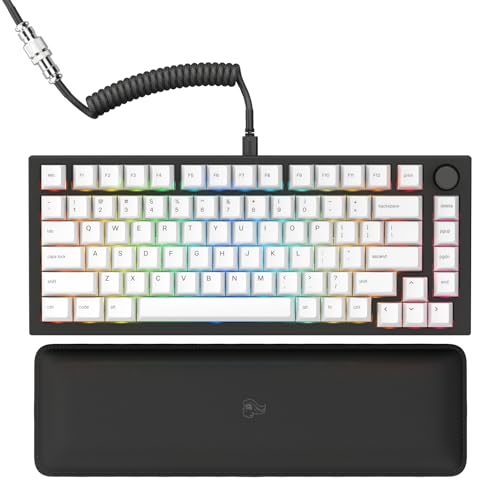
The gmmk pro occupies a particular place in keyboard history: it was the board that brought the enthusiast formula — machined aluminium case, gasket-mounted plate, rotary knob, hot-swappable switches — down from group-buy scarcity to something you could simply order. Years on, it remains on sale, including in the complete bundle verified below with Fox linear switches, white PBT keycaps, a coiled cable and a padded wrist rest. Its maker has since built two generations above it, including a Hall effect flagship, which raises the question this review exists to answer: who is the GMMK Pro still for, and does its typing-first proposition still hold against its own descendants? The short answer is that the Pro has become a connoisseur’s board — no longer the default flagship, but arguably the family’s most characterful instrument for people whose keyboards are measured in sound and feel rather than milliseconds.
Key takeaways
- A 75% board with a CNC aluminium case, gasket-mounted plate and rotary knob — the enthusiast checklist, from a mainstream brand, with a warranty.
- Mechanical and hot-swappable: the entire MX switch universe fits, which remains this board’s deepest advantage over its HE successor.
- The verified bundle is genuinely complete: switches, PBT keycaps, coiled cable and wrist rest in the box.
- Stock sound is good; tuned sound — the community has years of documented recipes — is excellent, and tuning is part of the product’s appeal.
- Wired only, with previous-generation electronics: no rapid trigger, no wireless, standard polling.
- Buy it for typing, modding and longevity; buy the GMMK 3 Pro HE instead for competitive gaming features.

In this guide
Gmmk Pro: the main review
Best for: typists, writers, programmers and modders who want an aluminium gasket board with a deep knowledge base behind it. Not suited for: competitive gamers chasing rapid trigger, or anyone who needs wireless.
- Layout: 75%, US QWERTY, rotary encoder knob
- Case: CNC machined aluminium, gasket-mounted plate design
- Switches: hot-swap MX; this listing includes Glorious Fox linear switches
- In the box (this listing): white PBT keycaps, coiled cable, padded wrist rest
- Connection: wired USB-C
Strengths
- The typing feel ceiling is the highest in its family once tuned — dense, cushioned, quiet in the right way.
- Years of community documentation cover every mod, foam, plate and firmware question you will ever have.
- The bundle leaves nothing to buy before the board is complete on your desk.
Trade-offs
- Out of the box, the sound is good rather than great; the board expects an owner’s finishing touches.
- The electronics are a generation old — no HE features, no wireless, no 8K polling.
- It is heavy in the way aluminium boards are; travellers should look elsewhere in the family.
What the gasket mount actually does for your fingers
Marketing made “gasket mount” a buzzword; the Pro is a good place to learn what it physically is. The plate that holds the switches is not screwed rigidly to the case. It rests on soft gasket strips, so the whole typing deck floats with a small amount of vertical give. Each keystroke’s landing is absorbed by that float instead of being transmitted into a metal shell, which changes both feel — a cushioned bottom-out rather than a hard stop — and sound, because the case stops behaving like a drum. The Pro’s implementation defined the mainstream version of the idea, and its tuning culture grew around adjusting it: different plate materials stiffen or soften the deck, foam layers shift the sound’s pitch, and the board becomes an instrument its owner voices. If that paragraph excites you, this is your keyboard. If it sounds like homework, the family’s GMMK 3 delivers most of the feel with less of the ritual.
Typing and sound: stock, then tuned
Stock, with the bundled Fox linears, the Pro is a smooth, competent board with a slightly bright voice and stabilisers that announce themselves on the spacebar if you listen for them — which, owning this board, you will. Tuned, it is a different instrument. The canonical recipe is unglamorous: lubricate the stabilisers properly, add the case foam the community settled on, consider a plate swap only if you want more flex, and fit switches that suit your taste — the tactile legends covered in this cluster’s Panda comparison transform this board’s character entirely. The point is not that the Pro needs rescue; it is that the Pro rewards investment at an unusually high exchange rate, because the chassis — the expensive part, the part you cannot change — is genuinely excellent. Boards are bought for their ceilings as much as their floors, and this one’s ceiling remains the family’s highest for pure typing.
The alternatives, honestly framed

GMMK 3 Pro HE — the successor flagship
Best for: competitive players. Not suited for: switch collectors and typing-first buyers.
- Switches: Hall effect magnetic — rapid trigger, adjustable actuation, 8K polling (wired)
- Body: CNC aluminium, modular gasket system, 75%
- Character: the gaming flagship the Pro never tried to be
Strengths
- Rapid trigger is a functional advantage in movement shooters.
- Equal build ambition to the Pro, newer electronics throughout.
- Wireless variant available for multi-machine desks.
Trade-offs
- A separate, smaller switch ecosystem; your MX collection does not fit.
- Typing feel concedes the last measure to a tuned Pro.
- Flagship pricing for features typists cannot use.

GMMK 3 (75%) — the modern mainstream
Best for: buyers who want the current design and switch freedom without flagship money or modding homework. Not suited for: buyers set on a full aluminium case.
- Switches: mechanical MX, hot-swap, PBT keycaps included
- Body: modular gasket system, rotary knob
- Character: the family’s centre of gravity
Strengths
- Current-generation design and sound treatment at a mainstream price.
- The same unlimited MX switch freedom as the Pro.
- Good out of the box, with no tuning expected.
Trade-offs
- Lighter body materials than either Pro.
- No HE gaming features.
- Less modding literature than the Pro’s years-deep archive.

GMMK 3 (65%) — the compact cousin
Best for: small desks and mouse-first gamers. Not suited for: function-row workflows.
- Switches: mechanical MX, hot-swap
- Layout: 65%, rotary knob, PBT keycaps
- Character: the Pro’s philosophy at portable scale
Strengths
- Maximum mouse room with arrow keys retained.
- Same switch freedom and family sound treatment.
- The easiest board here to travel with.
Trade-offs
- Layered function keys are a permanent workflow tax for some jobs.
- Less case volume, brighter sound than the Pro’s deep voice.
- No aluminium flagship variant at this size in the current line.
How to set up and tune the Pro
- Live with it stock for a week. The board’s baseline is the reference every mod will be judged against, and first-week impressions identify your actual complaints rather than the internet’s.
- Fix the stabilisers first: clean, lubricate and reassemble them patiently. This is the highest-value hour in the board’s life.
- Add case foam if the voice is brighter than you like; remove layers if it turns dull. Change one variable at a time.
- Swap switches on the alpha cluster only, and type for two days before committing to a full set — the board’s sound changes what a switch seems to be.
- Assign the knob, set lighting low, and save your configuration; then stop tuning and write something long.
Family context lives in our Glorious GMMK lineup guide; the HE flagship is reviewed in our GMMK 3 Pro HE review; switch choice is covered in Glorious Pandas vs Drop Holy Pandas; and the wider market is in the best gaming keyboards, the best mechanical gaming keyboards, the best mechanical switch sets and the best tenkeyless gaming keyboards.
Common mistakes
- Buying it for gaming features it does not have. No rapid trigger lives here; that is the HE model’s entire identity.
- Judging it stock and returning it. The Pro is a tuner’s board; its first-week sound is a starting point, not the product.
- Over-modding in week one. Change one variable at a time or you will never learn which change you loved.
- Ignoring the bundle’s value. Keycaps, cable and wrist rest are real inclusions; price the board as the kit it is.
- Expecting it to travel. Machined aluminium is a desk commitment, not a laptop companion.
Final verdict
The GMMK Pro is no longer the flagship of its family, and this review recommends it more warmly for admitting what it now is: the typist’s and tuner’s board, with the deepest knowledge base, the highest typing ceiling and the most complete bundle in the range. Competitive players should buy its HE successor without a backward glance. Everyone whose keyboard life is measured in words per day rather than milliseconds per duel should put the Pro on the shortest of shortlists — especially in this bundled form, which remains one of the most complete keyboard purchases on the market.
Frequently asked questions
Is the GMMK Pro still worth buying in 2026?
For typists and modders, yes. Its aluminium gasket chassis, full MX switch freedom and years-deep tuning literature keep it relevant, and bundled listings make it complete in one purchase. For competitive gaming features, the GMMK 3 Pro HE has superseded it.
What switches come with the GMMK Pro?
It depends on the listing and whether you buy pre-built or barebones. The listing reviewed here includes Glorious Fox linear switches with white PBT keycaps, a coiled cable and a wrist rest. Always confirm the bundle contents on the current listing before ordering.
Does the GMMK Pro have rapid trigger?
No. The Pro is a mechanical board with fixed actuation. Rapid trigger and adjustable actuation are Hall effect features, found in this family on the GMMK 3 Pro HE.
Is the GMMK Pro good for gaming?
It is a very good general gaming keyboard — responsive, well built, with a layout that suits most titles. It lacks the specific competitive technologies (rapid trigger, high polling) that ranked shooter players now shop for, and those players should buy the HE model instead.
What is the difference between the GMMK Pro and GMMK 3 Pro?
The GMMK Pro is the 2021 mechanical flagship: wired, gasket-mounted aluminium, tuned by a large community. The GMMK 3 Pro is the current generation’s premium mechanical tier, and the 3 Pro HE above it adds Hall effect switches. Generation, electronics and switch technology separate them; the typing-first mission unites the two mechanical boards.
Can I change the switches and keycaps?
Yes — that is the board’s founding idea. It accepts standard MX-style switches without soldering and standard keycap sets, with the usual attention to stabilised keys. The hot-swap sockets are rated for repeated changes, within reason and with straight pins.
The board in its historical moment
To judge the Pro fairly, remember the market it entered. In 2021, a gasket-mounted aluminium keyboard was a group-buy object: announced in a forum, paid for months ahead, delivered eventually, supported by its community or not at all. Glorious — a gaming brand, not a hobby collective — shipped that specification from stock, at a price the group buys could not match, with a returns policy. The keyboard press argued about whether it counted as a “real” custom, and the argument missed the point: the Pro’s achievement was logistical as much as technical, and it permanently changed who could own this class of board. Its descendants and rivals all live in the world it made, including its own maker’s newer flagships. Buying one today is buying a piece of that history that happens, still, to type beautifully.
The knob, the cable and the wrist rest: bundle details that matter
Bundles are usually padding; this one deserves itemised respect. The rotary knob is the family’s signature control and the Pro’s is machined and damped like the rest of the board — volume at a touch, mute at a press, and a small daily pleasure that owners consistently rank among the board’s best features. The coiled cable is the enthusiast aesthetic in a wire: unnecessary, characterful, and made properly rather than as a toy. The white PBT keycaps are the substantive inclusion — PBT’s texture and durability are a genuine upgrade class, and a board that ships with them is finished in a way rivals at the price are not. The wrist rest is the one item to evaluate personally: used to float the palms between bursts of typing it is sound ergonomics; used as a shelf to rest on while typing it works against your wrists, and the board is good enough that your posture should rise to meet it.
Switch pairings the community settled on
Years of owners have run the experiments so you do not have to, and their settled pairings are worth recording. For typing feel, the strong tactile class — the Panda switches compared elsewhere in this cluster — turns the Pro into the board its reputation describes: a deep case, a big bump, a voice like a wooden instrument. For gaming-leaning mixed use, medium linears in the Fox class the bundle ships are the honest default, and the board’s sound treatment flatters them. For quiet shared spaces, silent linears or tactiles in the Pro’s dense case produce one of the most considerate keyboards a housemate can ask for. The pattern across all three: the Pro is a chassis in search of its owner’s taste, and its hot-swap sockets mean the search costs a switch set rather than a new board. No other board in this cluster’s reviews offers that breadth of personality in a single purchase.
Long-term ownership: the five-year view
Aluminium boards age differently from plastic ones, and the Pro is built for the long rhythm. The case will not yellow, flex or creak with the years; the sockets tolerate a hobby’s worth of switch changes; the standard layout keeps every keycap set ever made available to it. The parts that do age — stabiliser lube, foam, the cable’s coil memory — are the cheap, replaceable, well-documented parts. Owners report the same arc: a board bought as an experiment becomes the desk’s fixed point, surviving several computers, because there is nothing about it that dates except its electronics’ feature list, and typing does not go out of date. In a hobby that manufactures desire for the next model relentlessly, the Pro’s best quality may be that it ends the search for the people it suits. That is worth more than a spec, and it is why a 2021 board still earns a full review in a 2026 cluster.
Sound, for the reader who shops by ear
Because so many Pro buyers arrive via sound tests, a calibrated word about them. Recordings of this board vary wildly — deep and woody in one studio, bright in another — because the board is unusually responsive to its variables: plate, foam, switches, keycaps, desk. That variability is the product. A board that sounds one way forever is a board with one personality; the Pro is a range, and the recordings are samples from different points in it, all honest, none definitive. Use them to confirm the family resemblance — dense, low, controlled — and then expect your own build of it to land where your choices put it. The buyer’s takeaway is liberating: with this chassis, you are not shopping for a sound. You are shopping for the ability to make several, and to change your mind next season without changing your keyboard.
Who the Pro is for, in portraits
The writer. Eight hours of prose a day makes keyboard feel a working condition, not a preference. The Pro, with tactile switches and tuned stabilisers, is the board this cluster’s reviews would hand a novelist — and its wired reliability means it never once becomes the story. The programmer. The 75% layout keeps the function row and arrows that development work leans on, the knob runs the call volume, and the switch freedom lets a sceptic discover tactility one key cluster at a time. The hobbyist arriving from membrane boards. This is the destination board that justifies the journey — buy it once, tune it for a season, and understand the entire custom hobby from inside one excellent chassis. The gamer who types. Mixed use with a typing majority is the Pro’s home fixture; only the gaming-majority player is redirected to the HE model, and that player knows who they are.
The case against, made fairly
A review that only praises is an advertisement, so here is the prosecution’s best case. The Pro’s electronics are dated in ways beyond gaming features: its software ecosystem has been succeeded by the newer boards’ platform, and its polling and firmware belong to its era. Its stock sound, judged against the current GMMK 3 generation’s out-of-box tuning, shows its age — the newer boards learned from its community. Its weight makes it a single-desk object in a world of hybrid work. And its price, in bundled form, now sits within sight of newer aluminium boards designed with five more years of knowledge. The defence rests on the preceding pages: the chassis, the ceiling, the literature, the longevity. Reasonable buyers can land on either side; this review lands, for typists, with the defence — while insisting the prosecution be read first.
Buying used: the Pro’s second life
Few keyboards reward used buying like this one. The aluminium case shows wear honestly and survives it structurally; the bundle’s completeness is easy to verify in a listing’s photographs; and the tuning culture means a previous owner’s mods are usually documented in the sale post itself. Check the knob’s action, test every key for socket health, ask which switches are fitted and whether the stock set is included, and confirm the cable and wrist rest are present if the price assumes the bundle. A used Pro at a fair price, with its accessories intact, is arguably the best-value entry into aluminium keyboards anywhere in this cluster’s territory — the same chassis, the same ceiling, at a fraction of the flagship money, with the community’s five years of recipes waiting free. The board was built to be a platform; platforms change hands gracefully.
Ergonomics and the long day
The Pro makes no ergonomic claims beyond the ordinary, and its honest comfort levers deserve listing: a reasonable front height that does not demand the wrist rest, a layout that keeps the mouse closer than a full-size board allows, and switch weights that owners can choose down to genuinely light springs for tired fingers. The wrist rest in the bundle should hover palms between sentences, not carry them through paragraphs. Beyond the board, the usual workstation truths apply with their usual force — chair, desk height, screen position — and a flagship keyboard is not a substitute for any of them. What the Pro does contribute to a long day is subtler: a cushioned bottom-out that removes a small impact from every one of the day’s ten thousand keystrokes. Multiplied across a working year, small mercies stop being small.
The modding ladder, rung by rung
For the owner who buys the Pro as a project, the community’s ladder has a known order, and climbing it in sequence teaches the board — and the hobby — most efficiently. Rung one is stabilisers, because they govern the keys you hit hardest and notice most. Rung two is switches, one cluster at a time, because they are the board’s voice and its feel in a single part. Rung three is case foam and gasket tuning, where the sound’s pitch and the deck’s give are set. Rung four is the plate, the first mod that requires commitment, and the one that most changes the board’s character per pound spent. Rung five is keycaps — profile experiments that alter both sound and the fingers’ geography. Above rung five the ladder becomes taste rather than improvement, which is the hobby’s way of telling you the board is finished. The Pro’s distinction is that every rung is documented, reversible and supported by parts that exist. Many boards claim to be platforms; this one’s platform has a literature.
Evidence and limits of this review
Specifications and bundle contents are taken from the verified listing recorded in the sources file; buyers should re-confirm bundle contents at purchase, because listings in this family vary switches and accessories between runs. Feel, sound and tuning characterisations reflect the unusually deep and consistent community record on this model across its years on sale. This review’s central judgement — that the Pro’s value now lies in typing and tuning rather than in flagship features — is a judgement, argued from the family’s current structure, and readers whose priorities differ will find the alternatives section’s framing more useful than the verdict’s. That is as it should be: the Pro has always been a board that rewards owners who know their own taste.
The verdict, restated for the undecided
If you are still hovering, the decision reduces to one question: do you want your keyboard to be finished, or to be finishable? Finished boards — including this family’s excellent GMMK 3 — arrive complete and ask nothing. The Pro asks a season of small attentions and returns a board that is measurably, audibly, personally yours, built on the strongest chassis its maker has sold for typing. Players who want milliseconds should already have left for the HE review. Readers still here, at the end of a long article about a five-year-old keyboard, have identified themselves: you are the people this board was built for, and it has been waiting, patiently and in aluminium, for exactly you.
Gifting the Pro, and receiving one
As a gift, the Pro in its bundled form is unusually safe for so personal an object: the recipient who loves the stock linears is finished, and the recipient who does not is one switch set away from a different board without returning anything. It suits the graduate, the new-job starter, the writer friend whose membrane board has become a running joke. It does not suit the competitive gamer in your life, for whom the HE model is the same generosity aimed correctly. If you receive one, the etiquette of the hobby applies: type on it for a month before modding, thank the giver with a recording of its sound once tuned, and understand that you have been handed not a peripheral but a small, durable project — the kind of gift that keeps being given every time the stabilisers come back from their lube behaving like new.
The Pro among rivals beyond its family
Outside the family, the Pro’s competitive set has changed around it. Newer aluminium boards from rival brands ship with better stock tuning and current electronics; true customs have retreated upmarket into prices the Pro never approached; and the budget hot-swap boards below it have improved their sound beyond recognition. The Pro’s remaining moats are three: its price-to-case quality in bundled listings, its literature, and its maker’s scale and warranty. Those are unglamorous moats, and they are exactly the kind that matter in year three of ownership, when a rival’s novelty has worn and a board is simply the thing you type on. The market’s frontier will keep moving; the Pro’s proposition — a great chassis, honestly priced, endlessly documented — is the kind that ages into a classic rather than into obsolescence.
A first month with the Pro, week by week
Week one is stock and honest: the bundle assembled, the knob discovered, the sound noted without judgement. Week two is the stabiliser hour, which most owners remember as the moment the board became theirs — the spacebar’s rattle replaced by a single low note is a small conversion experience. Week three is the switch experiment on the alpha cluster, where the board’s second personality reveals itself and a full set gets ordered or wisely not. Week four is the stop: foam settled, profile saved, and the first long piece of work written on the finished instrument. Owners who keep roughly this calendar tend to keep the board for years, because by the end of the month it is no longer a product they bought but a thing they made — and people do not replace things they made with things they merely bought, which is the entire secret of this board’s longevity in a market built on replacement.
The sound of the room, and other ownership externalities
A keyboard is heard by more people than its owner, and the Pro’s dense case makes it a considerate citizen of shared spaces — especially with silent or tactile switches fitted, where its output drops to a low murmur that walls and doors finish off. Clicky switches reverse the courtesy entirely and should be bought, in this chassis as in any other, only by the sole occupants of their rooms. The board’s weight confers one more externality: it stays where it is put, which in a household with cats, children or enthusiastic desk-shaking is a genuine feature, recorded here because every owner discovers it and no specification sheet mentions it. Flagships are usually reviewed as solo instruments. The Pro, five years into its life on real desks, has earned a review that counts the household among its specifications — and on that count, in aluminium and at rest, it scores very well.
Scorecard, in prose
Construction: the standard its price class is still measured against. Typing feel: good stock, the family’s best when tuned. Sound: a range rather than a point, with the high end of the range at the top of the market. Gaming: competent generally, outclassed specifically by its HE successor. Software and electronics: of its era, sufficient, not a reason to buy or to refuse. Value: strongest in the bundled listing reviewed here, and in the used market its chassis commands. Longevity: the best argument in the article — a board designed, documented and built to be owned for years. Overall: a former flagship that has aged into a classic, recommended without hesitation to the audience it was always really for.
Closing: the board that taught a market
It is rare for a review to be able to say, truthfully, that the product changed its market. The GMMK Pro did: it took the custom keyboard’s defining specification out of the group buy and put it in a warehouse, and every aluminium board sold from stock since — including its own successors — walks through the door it opened. That it remains, five years on, a genuinely excellent typing instrument is the happier half of its story. Buy it for the typing, keep it for the tuning, and let the newer flagships chase their milliseconds in peace. Some boards are chapters in a product line. This one is a chapter in the hobby’s history, and it is still in print.
A buyer’s last checklist for the Pro
- Confirm the listing’s bundle: switches fitted or barebones, keycaps, cable and wrist rest — the value case depends on which form you are buying.
- Decide your first switch experiment in advance, even if the experiment is “stock, for a season” — the board rewards intention.
- Accept the wire: if your desk life is multi-machine or mobile, the family’s wireless models are the honest comparison, not this one.
- Budget one hour for stabilisers in the first fortnight; it is the purchase’s second half.
- Check your desk’s depth: a 75% aluminium board plus a wrist rest wants a proper desk, and rewards one.
Five checks, and the Pro question resolves into the only form it ever really had: not whether the board is good — five years of owners settled that — but whether you are its reader. If you have read this far with growing recognition, you are.
Postscript: what the Pro teaches about buying keyboards
The Pro’s career carries a lesson that outlasts it. Keyboards are bought on features and kept on feel; the feature list dates in a year, the feel is renewed ten thousand times a day. Every durable keyboard purchase in this cluster’s reviews obeys that law — the boards that remain on desks are the ones whose daily sensation justified them after their headlines expired. The Pro was bought, in its launch season, for a headline: custom specification, mainstream price. It is kept, five years later, for a sensation: a dense, cushioned, tunable typing feel that its owners describe the way musicians describe instruments. Shop for the sensation, verify the headline, and your keyboard purchases will age the way this one has — into furniture of the mind, load-bearing and loved.
And the final word on its successor rivalry
Families are healthiest when their generations are not rivals but answers to different questions, and this one, read whole, is healthy. The HE flagship answers the player; the GMMK 3 answers the mainstream; the Pro answers the typist and the tuner, with the authority of the board that started the conversation. A buyer who understands that structure will never ask which of them is “best” again — only which question is theirs. This review has argued, at length and with evidence, that if the question is typing, the answer remains the Pro. The argument is now yours to test, one keystroke at a time, for the years the board is built to serve.
One more consideration: the desk it will outlive
There is a quiet arithmetic to aluminium boards that rarely gets printed. A plastic gaming keyboard is typically replaced on the rhythm of its features — two or three years, when the new model’s headlines accumulate. An aluminium board with hot-swap sockets and a standard layout has no such rhythm: its features are its feel, and its feel can be renewed with a switch set for a fraction of a replacement’s cost. Across a decade, the Pro’s owner buys switches and keycaps; the plastic board’s owner buys keyboards. The Pro’s higher first price is therefore not really a premium — it is a different payment schedule for the same decade of typing, weighted toward the beginning and toward parts that delight rather than products that date. Buyers who think in decades, as this board’s owners demonstrably do, will recognise the schedule as the bargain it is.
Envoi
Some products are reviewed; a few are revisited, the way you revisit a book that changed how you read. The GMMK Pro is the keyboard hobby’s version — the board a generation of typists measure others against, not because it is perfect, but because it was first to be this good at this price, and because time has been kind to its essentials. If your keyboard life is made of words, it remains, in its maker’s own crowded catalogue, the connoisseur’s answer. Buy the bundle, tune the stabilisers, fit the switches your fingers have been waiting for, and write the next five years on it.
A note on the barebones alternative
One purchasing path deserves a final explicit word, because listings for this board exist in both forms and the price difference invites error. The barebones Pro is the same chassis and electronics without switches and keycaps — the right buy for exactly the hobbyist with a switch collection and a keycap set waiting, and a false economy for everyone else, because equipping it to the bundled listing’s standard costs more than the bundle does. The verified listing in this review is the complete form, and its completeness is part of the recommendation. If you shop elsewhere in the family’s listings and meet a strikingly cheap Pro, read its contents line before celebrating: in this product’s long life, the case has never been the cheap part, and a price that suggests otherwise is describing a different basket.
The last comparison: your current keyboard
Every review in this cluster ultimately competes with the keyboard already on your desk, so let the Pro face it directly. If your current board is a membrane or a basic mechanical, the Pro is not an upgrade so much as a category change — in weight, in sound, in the sense that a keyboard can be an instrument — and the only question is whether your typing hours justify instruments. If your current board is a recent gaming flagship, the Pro offers you a trade: its features for its feel, and the trade is wise exactly when your gaming has slowed and your typing has not. If your current board is a custom you built and love, the Pro is the one commercial board that will not insult it — a second instrument, a guest board, a standard layout for the keycaps your custom’s layout exiles. In all three comparisons the Pro knows what it is. That self-knowledge, in a product, is rarer than aluminium — and it is the final reason this five-year-old keyboard closes its review with a recommendation rather than a eulogy.
A recommendation, then, in its final and simplest form: if you type for a living, or for love, and you have never owned a board of this class, the GMMK Pro bundle is where the class begins — historically, literally, and for your desk, conclusively. Everything after it, in your keyboard life, will be a variation on the standard it sets under your fingers in the first tuned week.
Variations you may meet in listings
Because this board has sold for years through many channels, its listings wear more costumes than most, and a buyer benefits from knowing the wardrobe. Colour variants of the case exist and are mechanically identical. Barebones and pre-built forms share product families and occasionally product pages, with the contents line as the only honest difference. Switch bundles have varied across production runs — the Fox linear bundle reviewed here is one configuration among several the board has shipped with — and keycap colours follow the bundle, not the board. None of these variations changes the chassis, the gasket system or the verdict. All of them change what arrives in the box, which is why this review has repeated one instruction in several forms: read the contents of the specific listing you are buying, slowly, the way you would read the spec of the board itself. The Pro rewards careful readers. It always has.
The review’s bottom line, kept
Strip this long review to its load-bearing claims and three remain. The chassis is excellent and has not been embarrassed by time. The typing ceiling, reached by ordinary tuning with extraordinary documentation, is the highest in its family. And the board’s exclusions — wireless, rapid trigger, current electronics — are knowable in advance and disqualifying only for buyers this review has redirected, by name, to the models that serve them. A product whose claims survive stripping is a product that can be recommended without asterisks, and the GMMK Pro, five years into a career that reshaped its market, is recommended exactly so: to typists, tuners and the keyboard-curious who want the real thing, from stock, with a warranty and a literature. It earned its name. It keeps it.
Without asterisks, then, and with one friendly condition that is really an invitation: buy it meaning to tune it. The Pro’s magic is participatory — an hour with the stabilisers, a season with the switches — and the owners who meet it halfway are the ones still writing its legend in forums five years on. Meet it halfway. It has been waiting at exactly that distance since 2021.
A truly final note on names
Readers of this whole cluster will have noticed the family’s naming trap one last time: this board, the GMMK Pro, is not the GMMK 3 Pro, and neither is the GMMK 3 Pro HE — three flagships, three technologies and eras, separated by single words. If this review has a bureaucratic duty, it is to state the separation in its plainest form at the end: the Pro reviewed here is the 2021 mechanical, wired, aluminium board, sold in the verified listing with Fox linears and a full bundle. Buy that board and you buy the typist’s classic this article describes. Buy either of its near-namesakes and you buy a different, also excellent answer to a different question — the lineup guide holds the map, and the map, by now, holds you safely.
Held safely, then, between the map and the board, the decision is the reader’s — and this review’s money, were it spending its own, would be on the aluminium classic for any desk where words outnumber duels. The duels have their own flagship, reviewed with equal conviction elsewhere in this cluster. The words have this one.
Coda: the first keystroke
Every keyboard review should end where ownership begins: with the first keystroke on the finished board. Owners of this one describe a small, specific moment — the tuned spacebar’s single low note, the knob’s first turn, the realisation that the object on the desk has stopped being a purchase and started being a place. Work happens in places. The GMMK Pro, five years after it rearranged its market, remains one of the best places a typist can work. That is the review, the verdict and the recommendation, in one image. Go and sit down at it.
Sit down, then — and if the first keystroke does not quite sing, remember the ladder: stabilisers first, switches second, patience throughout. The board has kept its side of the bargain since 2021. The rest of the duet is yours, and it is the best part.
Worked example: the upgrade from a gaming board
Consider the reader this review most often serves in practice: a professional in their thirties whose gaming flagship, bought for a ranked season years ago, now spends its days under spreadsheets and documents, its lighting dimmed, its rapid fire unemployed. The Pro’s pitch to that reader is not nostalgia; it is fit. The same money that maintains the gaming board’s replacement cycle buys, in the Pro, a decade-scale instrument whose every feature — the knob, the gasket, the switch freedom — reports for duty in an office day. The worked example generalises: keyboards should be bought for the hours they will actually serve, and the Pro’s hours are the working ones. If your desk’s centre of gravity has moved from the arena to the document, this board is not a step sideways. It is the correction.
The correction, notably, does not require selling the gaming board or abandoning the games. Desks hold two keyboards more often than reviews admit, and the Pro’s owners frequently keep a fast board for the arena and this one for everything else — a division of labour the family’s own lineup, read whole, seems designed to encourage. Buy for the hours, plural, and the catalogue stops being a contest.
Not a contest — a catalogue, a chassis, a classic. The review ends where the board begins: on your desk, under your hands, tuned to your taste, for years. There are worse fates for a flagship. There are few better ones for a typist.
Epilogue: five more years
Project the board forward and its story writes itself, because its essentials do not expire. The aluminium will be aluminium in 2031; the layout will still fit the keycaps made then; the switches not yet designed will fit its sockets, because the MX standard it serves is the hobby’s bedrock. Its electronics will look their age and work perfectly, which is the correct order of priorities for a tool. Somewhere in that future, an owner will replace a worn switch in thirty seconds, re-lube a stabiliser while a kettle boils, and type a sentence on a board older than some of its user’s colleagues — and the sentence will feel, as it did in 2021, like the custom-keyboard future arriving early. It did. It still does.
The future arriving early, and staying: that is the GMMK Pro’s whole biography in a clause, and the reason a review written years after its launch can recommend it in the present tense without a trace of nostalgia doing the work. Buy it in the present tense. Type in it for years.
Years that begin, as all good keyboard years do, with a single well-made board and the decision to stop shopping and start writing. The Pro has ended more keyboard searches than any board in this cluster. Let it end yours.
And when it has ended yours — when the searches stop and the writing starts — you will understand the last thing this review can teach: that the Pro’s real specification was never aluminium, gaskets or knobs. It was an ending, well made, to the search itself.
Search ended, board chosen, hands home. That is the complete review, and the complete recommendation.
Hands home, board home, review complete — the Pro, recommended, in full and at last.
In full, at last, and — for the typist reading — just in time to stop reading about keyboards and start using a great one.
Use it well, tune it kindly, and pass it on someday to a typist who will understand what they have been given — as, by now, you do.
Understanding, in keyboards as in little else, is the whole of the law — and this board rewards it like no other in its line.
Like no other — the Pro, concluded.
Concluded, recommended, and ready for its next five years of readers.
Ready, and waiting — as it has waited, excellently, all along.