Disclosure: As an Amazon Associate, reviewstook.com earns from qualifying purchases. Links on this page are affiliate links; they cost you nothing extra. Prices and availability change often, so check the current Amazon listing before you buy.
The gateron yellow vs cherry mx red compared debate is the linear switch world’s oldest argument, and it survives because both sides are right about different things. Cherry’s MX Red is the original: the German-engineered linear switch that defined what a light, smooth, no-nonsense gaming switch feels like, now refined in the MX2A generation with factory lubrication and a redesigned spring. Gateron’s Yellow — in the verified listing here, the G Pro 3.0 version — is the beloved challenger: a slightly heavier linear that the enthusiast community adopted as its budget benchmark, famous for a smoothness out of the box that stock switches rarely match and for a deeper, softer sound that recording after recording has made famous. Both are linear, both actuate lightly, both will serve a gamer or a typist for years. They differ in spring weight, in factory tuning, in sound, in stem wobble, in ecosystem and in price philosophy — and those differences, small on a spec sheet, are exactly the kind your fingers can feel. This comparison takes each difference in turn, gives a verdict per criterion, and ends with the only honest overall answer: which hand, which board and which budget each switch belongs to.
A methodological note before the verdicts: switch feel is the most sample-sensitive judgement in the keyboard hobby. Two switches of the same model from different production runs can differ more than marketing admits, and a switch’s character changes with the board it sits in, the keycaps above it and the desk beneath it. The comparisons below therefore describe each switch’s consistent tendencies — the traits that survive across boards and batches — rather than pretending a single sample is a laboratory result. Where a trait is board-dependent, the article says so.
Key takeaways
- Gateron Yellow is the heavier switch — its spring asks noticeably more of the finger than the Red’s, which fans describe as control and detractors as effort.
- Cherry MX Red, especially in MX2A form, counters with refinement: tighter tolerances, factory lubrication and the original’s famously consistent travel.
- Out of the box, the Gateron usually sounds deeper and feels smoother; the Cherry usually feels crisper and more precise.
- For gaming, the Red’s lighter spring favours rapid repeated presses; for typing, the Yellow’s weight forgives resting fingers and reduces accidental actuations.
- Price and availability favour Gateron for full-board builds; heritage, consistency and resale favour Cherry.
In this guide
Quick verdict
If you are building or re-switching a whole board on a sane budget and you type as much as you game, buy the Gateron Yellows: their factory smoothness and forgiving weight make them the easiest linear to live with, and a full set costs what a partial set of flagships does. If you are equipping a gaming board where the lightest, crispest press is the entire point — or you simply want the original, with its consistency and its ecosystem of boards that ship with it — buy the Cherry MX Reds, in MX2A form where available. Players who cannot decide should buy a small sample of each before committing a whole board; switches are the one component where a tiny experiment outperforms a hundred reviews, including this one.
The contenders, as verified for this comparison
Both switches below link to listings verified through the site’s Creators API catalogue data on 2026-11-24, with exact titles in the accompanying sources file. A third listing — an affordable 60% board from the Gateron ecosystem — appears as the practical way to live with these switches before committing to a full custom build.
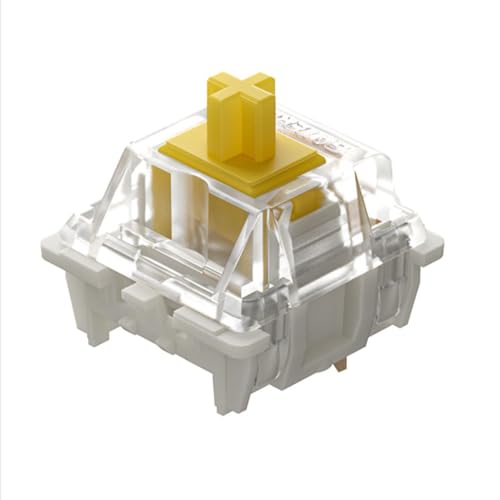
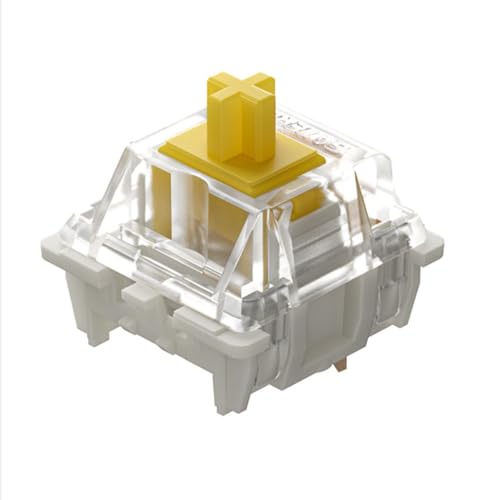
Gateron G Pro 3.0 Yellow — the people’s linear
Badge: Best value and best stock smoothness
- Type: linear, pre-lubricated per the listing
- Pins: 5-pin in the verified listing, 110-count pack
- Character: medium-weight spring, deep sound signature
- Generation: G Pro 3.0, with the line’s pin enhancements
The Yellow’s reputation was built by typists before gamers adopted it, and the order matters: this is a switch whose virtues are about the whole stroke. The factory lubrication on the G Pro line is applied with a generosity stock switches rarely show, so the travel feels like it is happening on a film rather than on dry plastic — no scratch, no spring ping worth naming in most samples, a bottom-out that lands soft and deep. The spring is the personality: heavier than the Red’s, with a resistance that builds in a way fingers describe as supportive. Rest your hands on a Yellow board and the keys hold you up a fraction more; type fast and the return is energetic, the keys coming back to meet your fingers like they are participating. In games, that weight is the one honest argument against it — rapid double-taps on a single key ask slightly more of the finger, and players coming from very light switches feel it in the first hour. Most adapt within days and thereafter read the weight as precision. The 5-pin format in the verified listing suits plate-less and enthusiast builds and clips happily into 3-pin boards, and the pack sizes make a full-board conversion an ordinary purchase rather than a flagship one.
Strengths
- Factory smoothness that rivals hand-lubricated switches
- Supportive spring weight forgives resting fingers and heavy typists
- Deep, soft sound signature beloved by the recording community
Trade-offs
- Heavier press is a real, if small, tax on rapid repeated inputs
- Stem wobble is present in the line’s character, if mild in recent generations
- Third-party listings vary; buy the genuine line from reputable sellers
Best for: full-board builds, typists, and gamers who want one switch for both lives. Not suited for: players who know they want the lightest possible press.

Cherry MX2A Red — the original, refined
Badge: Best for pure gaming lightness and consistency
- Type: linear, original Cherry MX design
- Kit: 36 switches in the verified listing, RGB variant
- Generation: MX2A, with factory lubrication and updated spring design
- Character: light spring, crisp and precise travel
Cherry invented this category, and the MX Red’s decades of service in gaming boards have made its feel the reference against which every rival — including the Yellow — is secretly measured. The press is light and immediate: the key starts moving when you think about it, travels in a straight, no-drama line, and bottoms out with a cleaner, higher-pitched finality than the Gateron’s soft landing. The MX2A generation answers the two criticisms history laid on the original — a scratchiness in the travel and an audible spring — with factory lubrication and a redesigned spring, narrowing the smoothness gap that made Gateron’s reputation, while keeping the Cherry virtues of tolerance and consistency: switch after switch, board after board, the Red feels like the Red. That consistency is why manufacturers build flagship boards around it and why players who travel between machines find their timing intact on any Cherry board they meet. The lighter spring is the gaming argument in full: rapid repeated presses, quick ability double-taps and long sessions of light-touch play all ask less of the finger, and players with a hovering, fingertip style will call the Yellow’s weight work by comparison.
Strengths
- The lightest, crispest press in this comparison
- Generation-deep consistency across boards and batches
- MX2A lubrication and spring updates close the old smoothness gap
Trade-offs
- Light spring invites accidental actuations from resting fingers
- Sound is higher-pitched and less beloved by the recording crowd
- Cost per switch runs above the Gateron for full-board builds
Best for: competitive players, light-touch typists, and buyers of boards that ship with Cherry switches. Not suited for: heavy-handed typists who rest their fingers’ full weight.
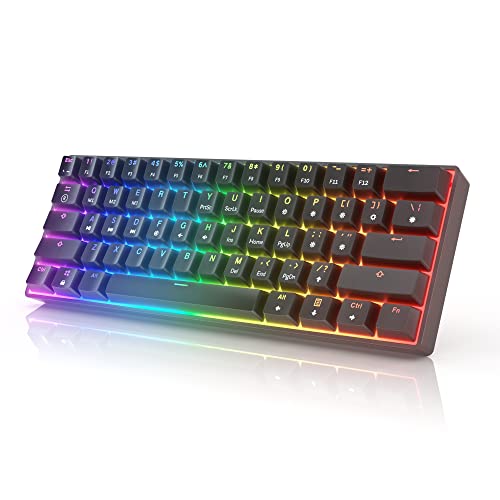
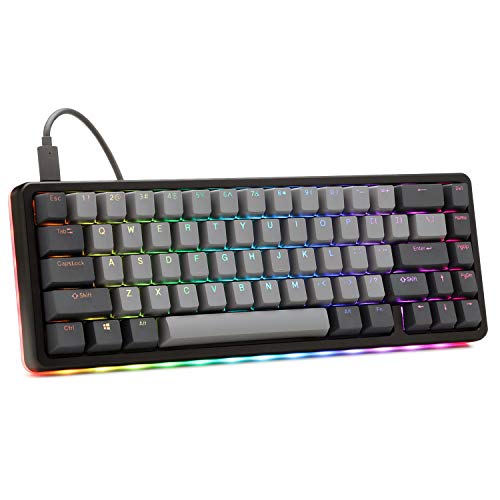
HK Gaming GK61 — the affordable way to live with Gaterons
Badge: Best trial board for switch shoppers
- Layout: 60%, wired, programmable per the listing
- Switches: Gateron optical-mechanical ecosystem in this board family
- Lighting: RGB backlit
Switch samples on a tester tell you about a keystroke; a board tells you about a life. The GK61 — reviewed in full elsewhere in this cluster — is the budget 60% board through which a generation of players met Gateron switches in situ, and it earns its place in this comparison as the cheapest honest experiment available: live with a Gateron board for a month of real typing and gaming, and the Yellow-versus-Red question answers itself in your own hands before you commit to a premium build. Its own virtues and limits as a keyboard are covered in its dedicated review; here it is simply the laboratory.
Strengths
- A whole board’s worth of Gateron experience at an experiment’s price
- Compact 60% format suits gaming desks
- Programmable layers soften the small layout’s compromises
Trade-offs
- Budget build quality is a trial’s, not a destination’s
- 60% layout asks newcomers to learn function layers
- Optical variants in this family behave differently from the MX-style switches compared above
Best for: switch shoppers who want evidence before a big build. Not suited for: buyers wanting their final keyboard in this purchase.
Criterion by criterion
Spring weight and the shape of effort
Verdict: Yellow for control, Red for speed. The numbers matter less than the curve: the Yellow’s resistance greets the finger early and builds, so a press feels guided; the Red’s lighter spring gets out of the way, so a press feels released. Over a thousand presses the difference compounds into two different relationships with the keyboard — the Yellow’s owner rests on the board, the Red’s owner hovers over it. Neither is correct; they are gaits. Choose by the gait your hands already have, and be honest about it, because a switch cannot retrain a gait without a fight your wrists will referee.
Smoothness out of the box
Verdict: Yellow, by a nose that MX2A has shortened. Gateron’s factory lubrication remains the more generous application, and in unmodified switches the Yellow’s travel has a silk the Red approaches but does not quite match in most samples. Cherry’s MX2A updates were aimed precisely here and they land — a current Red is a smooth switch by any honest standard — but if the criterion is the first keystroke from the box with no owner intervention, the challenger’s reputation survives the champion’s revision.
Sound
Verdict: Yellow for the recording, Red for the room. The Gateron’s deeper, softer signature is the sound the enthusiast community means when it says a board sounds good, and on a desk microphone the difference is not subtle. The Red’s brighter, crisper voice is not unpleasant — it is simply more audible as typing, which in a shared room at midnight is a social fact as much as an acoustic one. Boards, keycaps and desks move both voices considerably; treat this verdict as the switches’ tendencies, not their destinies.
Stem wobble and precision of travel
Verdict: Red. Cherry’s tolerances give its stems a straighter, more disciplined path, most noticeable on larger keys and to players who strike off-centre. Gateron has narrowed this across generations and the G Pro line is respectable, but the original’s manufacturing discipline remains the benchmark the challenger is measured against — a pattern this comparison repeats: the Yellow wins the sensations, the Red wins the metrology.
Gaming performance
Verdict: Red for rapid-fire, draw for everything else. Both switches actuate at the same conceptual point in the stroke and neither has a gaming feature the other lacks — no rapid trigger lives in either, a fact worth stating in a cluster full of magnetic boards. The Red’s lighter spring cycles a fraction faster under a tapping finger, which competitive players in rhythm-heavy titles can feel. In the far larger territory of ordinary play — movement, abilities, menus, chat — the switches are interchangeable, and any claim otherwise is marketing wearing a stopwatch.
Typing over long days
Verdict: Yellow for most hands. The supportive spring reduces the two failure modes of light linears over long documents: accidental actuations from resting weight, and the bottom-out fatigue of keys that offer no resistance to land against. Fast, light typists are the exception and will prefer the Red’s effortlessness; everyone else should let the Yellow’s small effort protect them, because over ten thousand words the protection is the performance.
Value and the full-board calculation
Verdict: Yellow, clearly. A keyboard consumes switches by the boardful — sixty to a hundred-plus at a time — so per-switch differences multiply into real money. Gateron’s pricing for genuine line switches, in packs like the verified 110-count, makes a full conversion an ordinary purchase; Cherry’s per-switch cost, in kits like the verified 36-count, prices a full board at a clear premium. The premium buys consistency and heritage rather than a different class of feel, which is a legitimate purchase — but it should be made knowingly, as this comparison exists to arrange.
How to decide with your own hands: the two-sample method
Step one: buy small before you buy a boardful
Order the smallest genuine packs of each switch you can find — the Cherry kit in this comparison is exactly the right size for the experiment — and resist the full-board purchase until the samples have lived in a board. Switches are the cheapest component in the hobby to test properly and the most expensive to guess wrong at scale, because a wrong guess multiplies by every key you own.
Step two: test them in the same board, side by side
Install a row of each in one hot-swappable board, under identical keycaps, and type the same paragraph and play the same game segment on both rows across several days. Side-by-side in one board removes the variables — case, caps, desk — that make cross-board comparisons folklore. Your fingers will form a preference with a clarity no review can deliver; trust it over this article wherever the two disagree.
Step three: test the failure modes, not the honeymoon
Rest your fingers on each row as you would while reading, and count accidental actuations. Double-tap one key of each a hundred times and note which finger tires. Type at your worst — tired, fast, sloppy — because that is the typist the switch must serve at midnight before a deadline. Switches are chosen for their worst hour behaviour, not their best, exactly like the friends and laptops of this world.
Step four: commit, and keep the loser
Buy the boardful of the winner and keep the sample of the loser. Preferences migrate — a hand that wanted lightness at twenty-five may want support at thirty-five — and the kept sample is your future self’s free experiment. The hobby’s veterans all have a drawer like this; it is not indecision, it is a library.
Side-by-side comparison
| Criterion | Gateron G Pro Yellow | Cherry MX2A Red |
|---|---|---|
| Feel | Supportive, smooth, soft landing | Light, crisp, precise landing |
| Spring character | Medium weight, building resistance | Light weight, minimal resistance |
| Sound tendency | Deeper, softer | Brighter, crisper |
| Best arena | Typing days and mixed use | Competitive and rapid play |
| Value | Strong for full boards | Premium for consistency |
Mistakes switch shoppers keep making
Buying a boardful on a reviewer’s adjectives
Smooth, creamy, crisp — the hobby’s vocabulary describes real sensations through other people’s fingers. Adjectives can shortlist; only samples can decide. The two-sample method above costs less than the return shipping on a wrong boardful, and it converts the loudest argument in the hobby into a private, settled fact.
Judging a switch in the wrong board
A switch installed in a hollow budget case will sound and feel like the case’s opinion of it. Players routinely condemn excellent switches for a chassis’s sins and praise ordinary ones for a great case’s generosity. If your test board is not your destination board, discount your conclusions accordingly — especially about sound, which belongs to the whole instrument.
Assuming heavier means slower in games
The Yellow’s weight is a typing protection that gaming folklore misreads as a handicap. In ordinary play the difference in cycling speed is beneath notice; only rhythm-specialist play feels it, and even there, plenty of players prefer the deliberate return. Do not let a forum’s stopwatch overrule your own hundred double-taps in the sampling step.
Final recommendation
For most readers — mixed typists and gamers building or refreshing a board — the Gateron G Pro Yellow is the recommendation: smoother from the box, kinder across long days, deeper in voice and gentler on the budget at board scale. For the competitive specialist, the light-touch player, and the buyer who values the original’s consistency across every board they will ever meet, the Cherry MX2A Red remains what it has been for decades: the reference linear, refined. The comparison’s real verdict is that the hobby is lucky — its two defining linears are both excellent, differently — and that the correct choice is the one your own sampled fingers make, with this article’s role reduced to what it should be: the map that got you to the experiment.
How the rivalry got here: a short history of two switch philosophies
Cherry’s MX switch is older than most of its users, a German design from the 1980s that outlived the keyboard era that created it and returned with gaming’s rise as the default heart of the mechanical board. Its philosophy is industrial: tight tolerances, enormous production discipline, and a feel defined by consistency across millions of units. When Cherry’s patents aged and the MX pattern became an open invitation, a generation of Chinese manufacturers accepted it — and Gateron became the name the enthusiast community trusted first, by competing on the sensations Cherry’s industrial philosophy underweighted: factory smoothness, sound, and springs tuned for typists rather than for spec sheets. The Yellow is that competition’s most successful product, a switch that exists because a community of typists described what they wanted — a medium linear, smooth without homework, priced for boardfuls — and a manufacturer listened. Read the rivalry that way and the verdicts in this comparison stop looking like contradictions: Cherry optimised the switch as a component, Gateron optimised it as an experience, and the modern buyer inherits both optimisations at once, in a market where the two now refine each other — MX2A’s factory lubrication is unthinkable without Gateron’s pressure, and Gateron’s tightening tolerances are unthinkable without Cherry’s example.
The modding chapter: lubing, filming and spring swapping
Both switches accept the hobby’s standard modifications, and the comparison changes interestingly once modification enters. Lubricating either switch by hand narrows the smoothness gap to nearly nothing — a lubed Red and a lubed Yellow are separated mainly by their springs — which means the Yellow’s out-of-box advantage is, precisely, the labour it saves you. Switch films, which tighten the housing, help the Gateron’s wobble more than the Cherry’s, continuing the pattern of the challenger benefiting most from the owner’s bench. Spring swapping is the deepest mod and the one that can dissolve this comparison entirely: a Yellow’s housing with a lighter spring approaches the Red’s character, and a Red with a heavier spring approaches the Yellow’s, which teaches the comparison’s final lesson — a switch is a system of housing, stem, spring and lubricant, and the brands’ identities live in the proportions they ship, not in any single part. Beginners should buy the proportions they like stock; the bench will still be there when curiosity ripens.
Longevity: what a hundred million presses means in a human life
Both switches carry durability ratings in the tens of millions of presses, figures that translate, at a heavy typist’s few thousand presses per key per day on the hardest-worked keys, into decades. In practice, switches are retired by taste, by boards, by spilled drinks and by the hobby’s restlessness — almost never by wearing out. What does change across years is character at the margins: springs soften almost imperceptibly, factory lubricant migrates and dries over very long horizons, and a board’s most-struck keys can grow marginally smoother than its least-struck, a patina typists notice and some cherish. Neither switch holds a longevity advantage worth a buying decision; both will outlast the keycaps above them and the USB standard beneath them. Choose for the first year of feel, confident that the tenth is already taken care of by either badge.
Force curves, explained for readers who skip graphs
Enthusiast reviews publish force-travel graphs for these switches, and the graphs reward a plain translation. Both curves are straight lines — that is what linear means — rising as the spring compresses, with a small step where the contacts meet and the keystroke registers. The Yellow’s line sits higher everywhere and climbs a little more steeply, which is the graph’s way of saying what your finger reported: more support at rest, more resistance at the bottom, more energy returned on the way up. The Red’s line hugs the floor of the category, the lightest full-size press the MX world offers. Two features of the graphs deserve a buyer’s attention beyond the headline weights. The first is the smoothness of the line itself: a scratchy switch draws a jagged ascent your finger feels as texture, and the factory lubrication both brands now ship is visible in the graphs as calm. The second is consistency across samples — a tight bundle of curves means every key feels alike, and it is in that bundle’s tightness that Cherry’s industrial discipline shows its graphs’ advantage. Read together, the two graphs are this entire comparison in miniature: the Yellow’s is the more comfortable line, the Red’s the more disciplined one, and your hand already knows which it prefers.
The ecosystem question: boards that ship with each
A switch is also a decision about which prebuilt boards you can buy without a soldering iron or a switch puller. Cherry’s decades of manufacturer relationships mean a vast catalogue of boards ships with Reds installed, from office lines to esports flagships, and a player who never wants to open a keyboard can live their whole life inside that catalogue. Gateron’s ecosystem grew from the other direction — the custom and budget boards, the hot-swap kits, the 60% darlings like the GK61 in this comparison — and it dominates the world of boards designed to be opened. The practical consequence is a fork in the hobby’s road: buy prebuilt and sealed, and Cherry will meet you everywhere; buy to tinker, and Gateron’s pricing and packs will fund the tinkering. Neither ecosystem is a trap — hot-swap has made emigration cheap — but a first-time buyer should notice which country they are immigrating to, because the switch in the board you buy today teaches your fingers the dialect your next board will be judged in.
Three buyers, three settled arguments
The competitive player building a 65% for ranked
His keys cycle in bursts, his fingers hover, and his budget is real but secondary to the ladder. The Red’s lightness serves his bursts and his hover, and if his board ships with Cherry he should keep them and spend his money on keycaps he likes looking at. If he is building barebones, the sampling method will likely still crown the Red for his hands — but he should run the double-tap test himself, because the minority of burst players who prefer the Yellow’s return energy are vocal for a reason: a spring that pushes back can set a rhythm a light spring cannot.
The writer who games on weekends
Her board produces a hundred thousand words a year and a modest ranked habit. The Yellow is her switch by every criterion that touches her actual life — support across long days, forgiveness for resting fingers, a voice her microphone and her household can live with, and a price that lets her re-switch the whole board when curiosity or a spill demands it. The Red would serve her weekends identically and her weekdays slightly worse, which is the definition of the wrong way round for her census.
The tinkerer on a first build
He will lube, film and spring-swap whatever he buys, so the stock verdicts matter less than the platform’s ceiling and the community around it. Gateron’s packs, pricing and enthusiast ubiquity make the Yellow his natural starting material — and starting is the operative word, because the tinker’s first switch is a hypothesis, and the Yellow is the cheapest well-made hypothesis in the hobby. The Red will be waiting in his drawer by year two, as it waits in every tinker’s drawer, for the build that wants the original’s discipline.
What about the other colours? Placing this pair in the wider switch world
Readers meeting switches through this comparison should know the map extends well past it. Both brands sell tactile and clicky siblings, heavier and lighter linears, silent variants that trade feel for hush, and enthusiast lines — Gateron’s Ink and Oil King relations, Cherry’s special editions — that chase particular sensations at premium prices. The Yellow and the Red endure as the category’s centre because they are the balanced expressions of their philosophies: not the lightest, heaviest, quietest or richest switches either brand makes, but the ones a whole board of ordinary days is best spent on. A buyer who starts here starts at the centre of the map, and every later preference — for tactility, for silence, for ceremony — will be measured as a distance from one of these two. That is a good place for a comparison to leave its reader: oriented, sampled, and argued with honestly.
Counterfeits, naming fog and buying the genuine article
Popularity has a tax, and the Yellow pays it in imitators: switches wearing similar colours and hopeful names crowd marketplaces, and a meaningful share of the disappointment reported about famous budget switches traces to stock that was never the genuine line. The defences are ordinary but worth printing. Buy from the brand’s recognised storefronts or established keyboard retailers; treat prices dramatically below the line’s normal range as a question rather than a gift; and check the housing markings on arrival against the genuine article’s known moulds, which the community documents thoroughly. Cherry’s fog is different — fewer counterfeits, more confusion between generations and variants, with original MX, MX2A, RGB and plate-versus-PCB formats all wearing the same famous name. The verified listings in this comparison exist partly to cut both fogs: the G Pro 3.0 Yellow in its 110-count 5-pin form, and the MX2A Red in its 36-switch kit, are the specific articles this comparison’s verdicts describe, and a reader who buys those articles is buying the switches the article is about.
The verdict after the longest possible look
Comparisons in this hobby often end by crowning a winner the evidence cannot quite carry, so let this one end by honouring its own data. Across seven criteria the Yellow took value, smoothness, sound and the long typing day; the Red took metrology, rapid play and the ecosystem of sealed boards; and the deciding variable in every criterion was the reader’s own hand, which no verdict can replace. That is not indecision — it is the accurate shape of a mature rivalry between two excellent, different answers to the same question. Buy the Yellow for the life most hands actually lead, buy the Red for the game some hands play at the highest level, sample both if the budget allows the small experiment, and know that whichever box arrives, you have bought one of the two switches by which all other linears are judged. There are worse foundations for a keyboard, and in this category, there are no better ones.
Keycaps, boards and desks: the variables that can reverse a verdict
An honest comparison must confess the conditions under which its own verdicts flip, because switches do not live alone. Tall, heavy keycaps add momentum that flatters the Yellow’s support and can make the Red feel washy; low, light caps sharpen the Red’s crispness and can make the Yellow feel like work. A gasket-mounted board softens both switches’ landings toward each other, while a stiff tray-mount board exaggerates their difference — the same pair of switches can be a clear choice in one chassis and a coin toss in another. Even the desk participates: a hard surface returns energy that brightens both voices, a mat swallows the low frequencies the Yellow’s fans prize. The practical moral returns, as every section of this comparison returns, to the sampling discipline: test the switches in the board, with the caps, on the desk they will actually live with, because the instrument is the whole assembly and the switch is only its most famous component. Reviewers who conceal that truth sell certainty; this one would rather sell you the experiment that produces the real thing.
What streamers, recordists and the microphone hear
One modern constituency judges switches by a criterion their inventors never imagined: how they sound through a microphone, to an audience. The Yellow’s deep, soft signature is the runaway winner of that criterion, which is why it populates so many typing videos and stream decks — its bottom-out reads as a satisfying thock at broadcast distance while the Red’s crisper voice reads as ordinary typing. Streamers should nonetheless hear the confession this comparison owes them: the microphone exaggerates differences the room barely notices, and a board bought for its broadcast voice should still be sampled for its feel, because the audience hears the switch for an evening while the player’s fingers live with it for years. If both criteria matter, the Yellow is the rare switch that serves them in the same direction — one more reason its popularity compounds, as each new recording recruits the next buyer more persuasively than any review, including the one you are reading.
The office test: eight hours neither marketing department photographs
Strip away the gaming frames and the recording microphones, and both switches spend most of their lives in the least glamorous arena of all: the working day. There, the comparison resolves into a handful of lived details. The Yellow’s support shows up at hour six, when tired fingers start resting between sentences and a light board would be firing stray characters into documents. The Red’s lightness shows up in the data-entry sprint, when a practised hand is moving at dictation speed and every gram of resistance is a tax collected ten thousand times. The Yellow’s voice shows up in the open-plan afternoon, where a deeper sound carries less far across desks. The Red’s consistency shows up in the hot-desking week, when any board you sit at feels like the board you left. An office buyer reading a gaming comparison may feel like a tourist; in truth they are the majority constituency of both switches, and the verdict this section hands them is the same one the gamers received, translated: sample both, in your board, at your worst hour, and let the hand that pays your salary make the final call.
A closing note on why this argument will outlive both switches
Every era of the keyboard hobby replays this comparison in new materials: the established original, disciplined and consistent, against the beloved challenger, warmer and cheaper, each generation’s MX2A answering each generation’s G Pro. The names will change — magnetic switches are already queuing to replay it — but the underlying question is permanent, because it is not really about switches. It is about whether a tool should be judged by its measurements or by its sensations, by the laboratory or by the hand. This comparison has tried to honour both courts: the graphs and tolerances that crown the Red, the recordings and long days that crown the Yellow, and the sampling method that lets each reader convene the only court with final jurisdiction. Whichever switch you choose, you are choosing a philosophy as much as a spring weight — and the hobby’s good fortune is that both philosophies, at their best, produce a keystroke worth building a keyboard around.
Practical arithmetic: how many switches your board actually needs
First-time switch buyers routinely under-order, so the arithmetic deserves print. A 60% board needs roughly sixty-one switches; a 65% a few more; a 75% around eighty; a tenkeyless in the high eighties; a full-size board passes a hundred, before spares. Spares are not optional garnish — a small reserve covers the bent pin, the dropped switch that finds the floor vent, and the one unit in any large batch that feels off enough to swap. The verified Gateron pack’s 110 count is sized by people who understand this arithmetic, covering a full-size board with its reserve included; the verified Cherry kit’s 36 count is a sampler and a partial-board size, honest for the experiment this article prescribes and insufficient for a whole keyboard. Price the two accordingly — the Cherry’s full-board cost is the sum of several kits — and let the arithmetic, rather than the sticker of a single pack, inform the value verdict you carry to checkout.
Installation day: seating a boardful without casualties
Whichever switch wins your sampling, installation day has its own small craft, and a paragraph of it belongs in a complete comparison. Work on a clear, hard surface with the board unplugged; align each switch’s pins with the socket before pressing, because the classic beginner’s casualty — the pin folded flat against the housing — is always a misalignment, never a defect, and a folded pin straightens once with tweezers if you catch it before forcing. Press from the switch’s centre, seat it fully, and test each key as you go rather than discovering a dead letter after ninety switches. Keep the removed switches, whatever they were; they are your future samples, your spares for a board you have not bought yet, and the beginning of the drawer every veteran in this hobby maintains. Installation is also the moment the comparison becomes real in a way samples cannot fully predict — a whole board of one switch has a collective voice and feel that a row of samples only sketches — so keep the packaging until the board has survived a week of your real life. If it has not, the other switch in this comparison is the cheapest possible next experiment, and you will run it with a connoisseur’s confidence the second time.
The one-paragraph version, for the reader at the checkout
Yellow if your keyboard works for a living and games in the evening, if your fingers rest heavy, if your room shares your typing, if your budget is counted per board. Red if your keyboard is a competitive instrument first, if your touch is light and hovering, if your play lives on rapid repeats, if consistency across every board you will ever touch is worth a premium to you. Both if you can sample, because the experiment is cheaper than the argument. Neither is a wrong answer; they are the two right answers the linear world has spent a decade refining, and the reader who has followed this comparison to its end now owns the only instrument that can choose between them with authority — a pair of hands, informed.
A note on regional availability and the second-hand switch drawer
Both switches circulate in a healthy second-hand and surplus market, because the hobby’s restlessness supplies it constantly: players sell boardfuls they sampled and moved past, and a patient buyer can equip a board from that circulation at a fraction of retail. The cautions mirror the counterfeit advice above — buy from sellers who can say what the switches are and where they came from, and treat mystery bags as the lottery tickets they are. The circulation also means your own sampling leftovers hold value, which quietly improves the economics of the two-sample method this article prescribes: the experiment’s cost is partly recoverable, and the drawer of almost-right switches every hobbyist accumulates is less a sunk cost than a lending library for future builds and friends. A comparison that began with two products thus ends with a small economy — and the economy, like the rivalry, shows every sign of outliving any single generation of either switch. Readers who join that economy, even with a single sampled boardful, will find the hobby’s door held open by both of the switches in this comparison at once: the original that started the modern era, and the challenger that taught it to listen to typists. Whichever one is under your fingers as you read this sentence, the other is a small, affordable experiment away from teaching you something true about your own hands. Run the experiment once, record the result the way this programme’s other guides record their fixes, and the oldest argument in the linear world will never need to be an argument for you again — it will be a settled fact with your name on it, filed in a drawer beside the switches that proved it. That drawer, in the end, is the real destination of every comparison worth reading: not a verdict imposed from outside, but an instrument the reader built for themselves, one honest sample at a time, in the only laboratory whose results have ever truly mattered in this entire hobby: the familiar desk where the keyboard will actually spend its long and ordinary working life, day after day, year after year.
Frequently asked questions
Are Gateron Yellows heavier than Cherry MX Reds?
Yes — the Yellow’s spring asks noticeably more of the finger through the stroke, which is the single most consistent difference between them. Players experience it as support and control in typing, and as a small tax on rapid repeated presses in gaming. It is a difference of degree, not of kind: both are light linears by the wider switch world’s standards.
Which switch is quieter?
Neither is a silent switch — both are standard linears whose sound is dominated by bottom-out and the board around them. The Yellow’s voice is deeper and softer in character, the Red’s brighter and crisper. If genuine quiet is the requirement, shop the dedicated silent variants of either line rather than asking these two to be something they are not.
Do these switches fit the same keyboards?
Both follow the MX pattern that the hot-swap world is built on, and the verified Gateron listing’s 5-pin format fits enthusiast boards and clips to fit 3-pin sockets. As always with switches, confirm your specific board’s socket type before ordering a boardful — the two-sample method makes the confirmation free.
What does MX2A change versus the original MX Red?
Cherry’s MX2A revision adds factory lubrication and a redesigned spring across the line, addressing the original’s two long-running criticisms — travel scratchiness and spring noise — while keeping the Red’s light, crisp character. In this comparison it narrows Gateron’s smoothness lead without changing the fundamental personalities on either side.
Which is better for a first custom keyboard?
The Yellow, for most first builds: it is forgiving to type on, satisfying to hear, affordable at board scale, and its factory tuning means a beginner’s unlubricated build still feels finished. First builders with a competitive focus or a known love of very light switches should sample the Red first — the two-sample method exists precisely for this decision.
Can I mix both switches on one board?
Players do, deliberately: Reds under the gaming cluster for lightness, Yellows under the typing field for support, is a coherent build that this comparison’s criterion verdicts practically design. Hot-swap boards make the experiment reversible, and a mixed board built from sampled preferences is the hobby at its best.
How can I compare the two switches fairly before buying a full set?
A switch tester with one of each is a start, but a single key pressed in isolation teaches less than most buyers hope, because typing feel emerges from rhythm across many keys rather than from one deliberate press. A fairer test installs a small cluster of each switch into the same board, perhaps one brand under your home row letters and the other under the surrounding keys, then asks you to type real sentences for an evening rather than tapping thoughtfully for a minute. Alternate which hand hosts which switch the following evening, since your dominant hand is a more generous judge than your other one. Pay attention to the bottom of the stroke and to the sound in your actual room, at your actual desk, rather than in a quiet shop. If a full experiment is impossible, at least test with the keycaps you intend to keep, because a heavier cap changes the personality of a light linear switch enough to mislead a careful buyer.
Which of these suits long typing sessions and tired fingers?
For writers, programmers and anyone whose keyboard earns its keep in documents rather than matches, the deciding question shifts from speed to fatigue. Both switches ask for a light touch, yet they spend your finger strength differently across a long day. The lighter spring rewards a typist who has learned to float, pressing just past actuation and letting the key return on its own, while the slightly firmer spring gives a heavier-handed typist a clearer sense of where the bottom of the stroke is, which can reduce the habit of slamming every key home. Neither answer is universal, because hands differ more than switch charts do. A practical approach is to notice how your fingers feel at the end of your longest ordinary session for a week. If the ache gathers in your fingertips, you are bottoming out too hard and should work on touch before hardware. If it gathers in the effort of pressing, the lighter option deserves the next trial in your board.
Related guides
Glorious Pandas versus Drop Holy Pandas
mechanical keyboard switch types explained
the complete Glorious GMMK lineup guide