Disclosure: As an Amazon Associate, reviewstook.com earns from qualifying purchases. Links on this page are affiliate links; they cost you nothing extra. Prices and availability change often, so check the current Amazon listing before you buy.
This fiio utws5 review starts from a question every owner of good wired earphones eventually asks: can a pair of wireless ear hooks honestly replace the cable without squandering what made those earphones worth buying? The UTWS5 is FiiO’s serious attempt at an answer, a set of true-wireless adapters with real amplification and modern codec support that clip onto detachable-cable in-ear monitors and turn them into cable-free earphones. The idea is simple; whether it works for you depends on a connector, a fit, and a handful of daily habits that this review examines one at a time.
The comparison in this guide is deliberately narrow. Beside the UTWS5 sits FiiO’s BTR7, a portable Bluetooth receiver and headphone amplifier that keeps the cable but shortens it, clipping to a shirt or sitting in a pocket while your earphones plug into it. The two products solve the same frustration, the long cable to the phone, by opposite philosophies: one deletes the wire between the ears entirely, the other keeps the wire and upgrades everything around it.
Every factual claim in the pick sections traces to the verified listings recorded for this article, including the DAC named in the UTWS5’s listing, its codec and battery figures, and its connector options. Impressions are given in the ordinary language used for these documented products, and no prices or scores are printed, because both date too quickly to be honest in a guide meant to last.
Key takeaways
- MMCX versus two-pin connector choice
- Codec support and connection stability
- Ear-hook comfort with glasses
- Charging case size and battery behaviour
In this guide
Quick picks for Fiio Utws5 Review
| Model | Best for | Listing |
|---|---|---|
| FiiO UTWS5 2025 | Best for travellers | Check price on Amazon |
| FiiO BTR7 | Best for quiet spaces | Check price on Amazon |
Choose the UTWS5 if the wire itself is your problem: if you want your favourite monitors on a commute, at a desk you move around, or in a gym bag, with nothing crossing your chest or catching on door handles. Choose the BTR7 if your earphones are precious, your sources are varied, and you would rather keep a short cable in exchange for a more powerful, more flexible amplifier that also works wired. Both are legitimate; they simply refuse to compromise in the same places.
How the selection was chosen
A review of a wireless adapter earns its keep by testing the conversion, not by re-reviewing every earphone it might carry. The UTWS5 was therefore judged on the things that belong to it: connector compatibility, amplification quality, codec behaviour, hook comfort, case practicality, and call handling. The BTR7 was chosen as the alternative because it is the strongest argument against the whole adapter idea from inside the same maker’s catalogue.
Only products with verified listings and confirmed images appear as linked picks. Products that could not be verified were left out rather than described from memory, which is why this guide compares two well-documented options thoroughly instead of surveying a dozen adapters thinly.
Detailed reviews

FiiO UTWS5 2025
Best for travellers
| Variant | FiiO UTWS5 2025 |
|---|---|
| Segment | Audio Accessories |
| What its entry leads with | wireless operation, Bluetooth connectivity |
| Entry tag | Check price on Amazon |
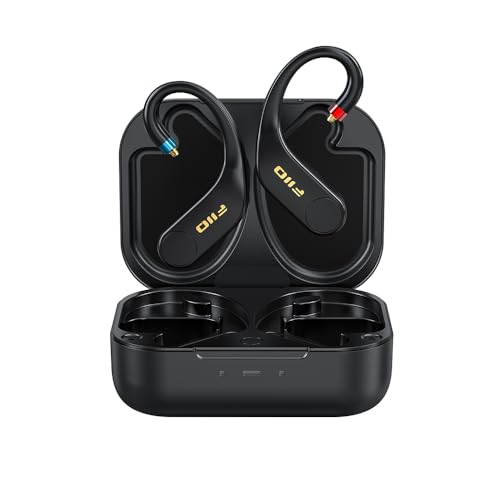
The 2025 edition of the UTWS5 is listed as a true-wireless Bluetooth ear-hook and headphone amplifier for in-ear monitors, built around an AK4332 DAC, with high-resolution wireless support up to 96kHz and 24-bit over LDAC, a ten-band parametric equaliser, a stated twenty hours of battery life, and a choice of MMCX or 0.78mm two-pin connectors. Read that specification slowly, because each clause answers a historic objection to adapters. The named DAC and proper amplification answer the objection that adapters sound thin. LDAC answers the objection that Bluetooth must mean a low ceiling. The equaliser answers the objection that a converted earphone cannot be tuned.
The conversion experience is the product. You detach your monitor’s cable, click each shell onto a hook, and the earphones you already love become earphones you can wear while making tea, walking to a platform, or working through a gym session, with the hooks carrying the electronics behind your ears. Sound quality with a good monitor attached is startlingly close to the wired original for most listeners, because the amplifier in each hook was designed for exactly this load rather than borrowed from a phone.
The compromises are physical and procedural. The charging case is larger than a typical earbud case because it must swallow two hooks and your attached monitors, and it will not slip into a jeans coin pocket or a slim clutch. The hooks add weight behind the ear that glasses wearers must test honestly. And the whole system inherits a new chore: two hooks and a case to keep charged, where a cable asked for nothing.
Calls and controls deserve plain treatment. Touch or button controls on the hooks handle the essentials, and call quality is serviceable for the ordinary purposes of a commute or a kitchen, but an adapter riding behind your ear will never match a phone held to your head or a headset built around its microphones. Buy the UTWS5 for music with calls as a convenience, not as a call tool that also plays music.
Strengths
- Proper amplification and a named DAC give converted monitors a genuinely hi-fi feed.
- LDAC high-resolution support lifts the wireless ceiling far above basic Bluetooth audio.
- A ten-band parametric equaliser lets you tune the converted earphone in the companion app.
Trade-offs
- The charging case is bulky, sized for hooks plus your monitors rather than for pockets.
- No active noise cancelling exists in this system; isolation is whatever your monitors provide.
- Connector choice is permanent, so the wrong version is useless for your earphones.
Best for: an owner of detachable-cable monitors who wants them wireless for daily movement without buying a second, lesser earphone. Not suited for: buyers who need noise cancelling, tiny cases, or studio-grade call quality. Check price on Amazon

FiiO BTR7
Best for quiet spaces
| Item | FiiO BTR7 |
|---|---|
| Range | Audio Accessories |
| What its listing leads with | Bluetooth connectivity, aptX codec support |
| Expense | Check price on Amazon |
The BTR7 is listed as a portable Bluetooth receiver and headphone amplifier with high-resolution support including MQA, LDAC, and aptX HD, handling digital audio up to 384kHz and 32-bit plus DSD256, for phones, computers, cars, and home audio. It is a small, serious DAC-amplifier that receives your music wirelessly and hands it to any wired earphone or headphone you own through a short cable.
Its argument against the UTWS5 is quality and universality. One BTR7 serves every earphone in your drawer, including the ones with fixed cables that no hook adapter can touch, and it serves full-size headphones that hooks could never drive. It can also work as a wired USB DAC, which makes it a desk upgrade as well as a portable one, and its output options suit balanced cables for owners who have invested in them.
The counter-argument is the cable that remains. It is short and manageable, clipped at a collar or pocket, but it exists, and in the gym or on a crowded platform it will eventually snag, swing, or remind you why you went shopping. The BTR7 makes the wired life better in every measurable way except the one way the UTWS5 abolishes entirely.
Strengths
- Universal compatibility with every wired earphone and headphone you already own.
- A more powerful, more flexible amplifier that doubles as a wired USB DAC.
- Broad codec support including LDAC and aptX HD for high-quality wireless feeds.
Trade-offs
- A short cable remains, with all the snagging and swinging that cables do.
- Another box to carry, clip, and keep charged alongside your phone.
- Overkill for a listener with one monitor who simply wants the wire gone.
Best for: a listener with several earphones or full-size headphones who wants one high-quality wireless and wired hub for all of them. Not suited for: anyone whose whole goal is the complete abolition of the cable. Check price on Amazon
Buying guide: what really settles Fiio Utws5 Review
MMCX versus two-pin connector choice
This is the decision that cannot be undone, so it gets the first section. The UTWS5 is sold in an MMCX version and a 0.78mm two-pin version, matching the two connector families that dominate detachable-cable monitors. Order the version that matches your earphones, verified against your monitor’s own specification rather than against a photograph, because the two systems look deceptively similar in pictures and are entirely incompatible in the hand.
Check the recessed or protruding style of your two-pin sockets too, since two-pin implementations vary in how the plug shroud sits. A connector that clicks your monitor onto a hook will be handled daily, connected and disconnected across months, and any strain at that joint concentrates exactly where a prized shell can least afford it. If your monitor’s connector is unusual, fragile, or proprietary, that is a genuine argument for the BTR7 route instead.
Codec support and connection stability
LDAC support matters because it raises the ceiling of what Bluetooth can carry, letting the UTWS5 feed your monitors a high-resolution stream when your phone supports the same codec. Owners on phones that favour other codecs will still get competent wireless audio, but the honest summary is that the adapter’s best performance is a partnership: both ends of the link must speak the same high-quality language.
Stability is the less glamorous half of wireless life and the half you will actually judge daily. A good adapter holds its connection through a commute, reconnects to the case and the phone without ceremony, and keeps the two hooks in step with each other. Judge any wireless system in its first week by counting interventions: every manual reconnect is a small tax, and a system that taxes you daily will be abandoned for the cable it replaced.
Ear-hook comfort with glasses
The hooks carry amplifiers, batteries, and radios behind your ears, which is territory your glasses may already occupy. Many wearers find the combination perfectly manageable once the hook is seated before the glasses arm, or after, in whichever order their anatomy prefers. Some never reconcile the two. There is no specification for this, only a fitting, which is why the first-week comfort test in the setup section is written the way it is.
Weight distribution is the hooks’ saving grace. Because the electronics sit behind the ear rather than dangling from the canal, the monitors themselves stay light in the ear, and long sessions fatigue the ear’s outer cartilage before they fatigue the canal. Rotate the hooks fully into place, seat the monitors after, and give the arrangement a full album before judging it.
Charging case size and battery behaviour
The case is the UTWS5’s most visible compromise. It must house two hooks with your monitors attached, so it is closer in spirit to a small hard case for earphones than to the pebble that true-wireless earbuds travel in. It fits a jacket pocket, a gym bag, and a desk drawer happily; it does not fit the small pockets that earbud owners take for granted. Decide where it will live in your routine before it arrives.
Battery behaviour rewards a rhythm rather than vigilance. The stated twenty hours of listening spreads across the hooks and the case’s reserves, and owners who drop the hooks into the case whenever they take them off rarely meet an empty battery. Owners who leave hooks on desks and in pockets meet it weekly. The product quietly sorts its buyers into those two groups, and the setup section exists to put you in the first.
Fiio Utws5 Review in real schedules
Scene: a hobbyist converting a favourite IEM for commuting
A commuter with a beloved set of monitors faces the classic fork: buy a separate wireless earbud for the train and accept its lesser sound, or convert the favourite. He chooses the UTWS5, matches the connector carefully, and discovers that the train becomes the best listening of his day, because the monitors he already fitted and tuned are suddenly the ones in his ears at 8 a.m.
His adjustments are mundane and decisive. The case lives in his work bag’s side pocket rather than his jeans. The hooks go back into the case at his desk, every time, so charge never becomes a topic. And he keeps the original cable in the bag’s other pocket, because a wired fallback costs nothing to carry and ends every possible bad day in ten seconds.
Scenario: a gym listener who wants their good earphones wireless
A gym listener wants the sound of her good monitors without a cable bouncing against her chest on every stride. The hooks deliver exactly that: nothing crosses her torso, nothing catches on equipment, and the monitors stay seated through movement because the hooks stabilise them. She accepts the two honest costs, that sweat and electronics require a wipe-down ritual afterwards, and that her monitors’ own water resistance, not the adapter’s, sets the limit of the experiment.
Her verdict after a month is that the conversion works because her expectations were correctly shaped. She did not ask a hi-fi adapter to be sports equipment; she asked it to free a good earphone for an hour a day, and she maintains it like the instrument it is. Buyers who expect sports-earbud indifference to rain, sweat, and drops should buy sports earbuds.
Situation: a traveller cutting cables from a carry-on kit
A frequent traveller is tired of untangling a cable at security, at the gate, and in the seat. The UTWS5 removes the tangle and pairs his best monitors to both his phone and his laptop across a trip. He is also the buyer who feels the case size most, because carry-on space is audited in a way home pockets are not, and his packing absorbs the case by retiring a separate earphone pouch the hooks now replace.
His one disappointment is the aeroplane seatback screen, which speaks no Bluetooth language his adapter understands. The cable in his bag solves it, which is why this guide keeps recommending that cable’s presence like a refrain. Wireless conversion done well is an addition to a kit, not a bonfire of the old one.
Setup and first-week how-to
Step 1 for Fiio Utws5 Review: test the piece on your worst typical day
Do not judge the conversion on a quiet Sunday. Take it through your worst ordinary day: the crowded commute, the noisy errand, the long call, the gym hour. Wireless systems earn their place by surviving bad days gracefully, and weaknesses in stability, comfort, or battery rhythm will all introduce themselves before dinner if you give them the chance.
Step 2 for Fiio Utws5 Review: re-verify comfort after a session of use
Wear the hooks for one continuous, realistic session, an album or a commute, before forming a comfort verdict. Hook pressure and glasses conflicts announce themselves across forty minutes, not four, and small reseating adjustments need the same full session to evaluate. Comfort conclusions from a mirror fitting are how good adapters get returned by impatient owners.
Step 3 for Fiio Utws5 Review: run one typical session at default settings and write down what bothers you
Resist the equaliser for the first sessions. Live with the converted earphone’s default presentation through your ordinary listening, and write down the specific bothers in plain words: a little bright on old recordings, a little shy in the bass on the train. A written list turns the ten-band equaliser from a toy into a tool with assignments.
Step 4 for Fiio Utws5 Review: change one variable at a time
When you do tune, move one band, live with it for a day, and keep or revert it on evidence. The parametric equaliser is powerful enough to make a beloved monitor unrecognisable, which is a warning as much as a feature. Owners who tune in single steps end with a personal preset they understand; owners who drag everything at once end with a mess they cannot explain or repeat.
Step 5 for Fiio Utws5 Review: show the setup to the next user who shares your space
If a partner or housemate will ever borrow the system or tidy it away, show them how the hooks seat in the case and how the monitors detach. Wireless adapters die domestic deaths: hooks forced into a case backwards, monitors pulled off at an angle, a case left unplugged for a month. A one-minute demonstration is the cheapest insurance in this entire guide.
Common mistakes with Fiio Utws5 Review
Ordering the wrong connector for your earphones
The classic, expensive, entirely preventable mistake. MMCX and two-pin are different worlds, and a photograph is not evidence. Read your monitor’s specification, match it character for character against the adapter version, and if your earphones use anything proprietary, stop and take the BTR7 route instead of gambling a return on hope.
Expecting ANC from an adapter that has none
The UTWS5 adds amplification and wireless freedom; it does not add active noise cancelling, because cancellation is a property of a sealed system designed around its own microphones and drivers. Your converted monitors isolate exactly as well as they ever did with a cable. Buyers who need cancellation should buy cancelling earbuds and keep their monitors for quieter joys.
Forgetting the case is larger than typical earbud cases
Owners arriving from pebble-case earbuds feel the UTWS5 case as a daily friction until they give it a home: a bag pocket, a desk corner, a gym kit. The friction is never the size itself; it is the absence of a decision about where the case lives. Make the decision on day one and the complaint evaporates.
Head-to-head: separating the lineup
Freedom is the UTWS5’s clean win. Nothing crosses your chest, nothing snags, and your best monitors become your everyday wireless earphones rather than a home-only treat. For owners whose frustration is specifically the cable, no amplifier quality on the BTR7 side of the table answers the actual complaint.
Everything else leans toward the BTR7. It drives more kinds of headphones, serves every earphone you own rather than one connector family, works wired when wireless is forbidden or flat, and asks less of your ears’ outer cartilage. It is the better audio component; the UTWS5 is the better answer to a narrower question.
So the head-to-head resolves into self-knowledge. If you own one beloved detachable monitor and a life spent moving, the hooks are the honest product. If you own a drawer of wired gear and a temperament that enjoys a proper amplifier, the receiver is. Buyers with both profiles exist, and they tend to end up owning both products, each for its own hours.
Living with the decision: care and longevity
Converted monitors need the same care as wired ones, plus charging discipline. Keep the hooks’ contacts clean, store the system in its case rather than loose in a bag where connectors meet keys, and detach monitors with a straight, patient pull whenever you swap them back to a cable. The connector joint is now the hardest-working part of your favourite earphones, and it should be treated accordingly.
Batteries set this product’s horizon in a way cables never do. The hooks and case will age across years of charge cycles, gradually holding less, while your monitors remain exactly themselves. That asymmetry argues for a simple habit: when the hooks eventually tire, the monitors return to their cable and lose nothing. Buy the conversion as a chapter in your earphones’ life, not as their final form.
Firmware and the companion application deserve occasional attention, since equaliser presets, control behaviour, and codec handling can all improve or shift with updates. Update deliberately, at home, with time to re-check your settings afterwards, rather than in an airport with a boarding call approaching.
Final recommendation
The UTWS5 2025 succeeds at the job it advertises: it turns good detachable monitors into genuinely good wireless earphones, with amplification and codec support strong enough that most owners stop mourning the cable within a week. Verify your connector, accept the case, build the charging rhythm, and the conversion becomes the rare upgrade that changes how often you use the gear you already loved.
Choose the BTR7 instead if your collection is broad, your headphones are demanding, or your ears and glasses reject hooks on honest testing. And keep the original cable either way. The best wireless setup in this guide still includes a wire, coiled in a bag, waiting patiently for the one day it saves.
Frequently asked questions
What counts most when choosing for fiio utws5 review?
Connector match counts most, because it is binary: the right version converts your earphones and the wrong version converts nothing. After that, hook comfort across a long session and a case that fits your routine decide whether the conversion becomes your default or a novelty you abandon by the second month.
How much should a beginner spend for fiio utws5 review?
A beginner should first own earphones worth converting. The UTWS5 is an accessory to a monitor you already love, so the sensible budget order is the monitor first, learned and fitted over months, and the adapter second. Listeners without detachable-cable monitors should spend on the earphones themselves, or on complete wireless earbuds, rather than on an adapter with nothing to adapt.
Which slip do customers of fiio utws5 review regret most?
Ordering by photograph and receiving the wrong connector is the regret with the longest queue behind it. It costs a return, a wait, and a dent in enthusiasm for a product that would have delighted the same buyer a week later. Thirty seconds with the monitor’s specification page prevents it entirely.
How long does it typically take to get used to a new fiio utws5 review setup?
Most owners settle within the first week. The hooks’ feel becomes familiar across a few long sessions, the case finds its home in the routine, and the charging rhythm turns automatic. The listeners who take longer are usually still negotiating with glasses or with an equaliser preset, both of which respond to the patient, one-variable method in the setup section.
When is the premium choice in fiio utws5 review really worth it?
The premium step, whether that means the UTWS5 over basic adapters or the BTR7 over both, is worth it when sound quality is the reason you own your monitors in the first place. Cheap adapters audibly tax good earphones; these two do not. If your monitors are modest and your listening casual, complete wireless earbuds may serve you more simply, and there is no shame in that arithmetic.
What should I verify first if my fiio utws5 review purchase disappoints?
Verify the basics in order: the connector is fully seated on both shells, both hooks are charged and paired as a pair, and your phone is actually using the best codec the two devices share. A surprising share of disappointing first sessions are a half-seated connector or a phone quietly using its most basic wireless mode, and both are free to fix before any verdict on the product.
Related guides
- Fiio Fa9
- Fiio Fh5s
- Best Earbuds And Iems for nearly Minor Ears
- Earfun Clip 2 Earbuds carefully Wave Pro X Headphones CES
- Best Wireless Earbuds
- Best Noise Cancelling Earbuds
The related guides cover the monitors this adapter most often converts, including the FA9 and the semi-open FH5s, and the complete wireless earbuds that compete for the same pocket. Read the monitor reviews before the adapter if you are building the whole system from nothing, because the earphone choice shapes everything the hooks will ever do.
One more angle: codec support and connection stability, revisited
Codec choice has a battery shadow that marketing rarely mentions: the highest-quality wireless modes generally draw more power and can be less forgiving in crowded radio environments such as stations and airports. Owners who value an unbroken commute over the last degree of fidelity sometimes choose a sturdier codec for travel and reserve LDAC for home, where the air is quiet and the listening is attentive.
That two-mode habit is the mature way to own any high-resolution wireless system. The adapter supports ambition; the owner supplies judgement about when ambition helps. A dropped connection during the chorus costs more pleasure than a slightly lower ceiling ever will, and the settings exist so you never have to choose blindly.
One more angle: MMCX versus two-pin connector choice, revisited
Owners with monitors from both connector families face the version question twice, and the honest answer may be that one family gets converted and the other stays wired or graduates to the BTR7. Trying to serve two families with one hook set invites constant swapping, and constant swapping is how connector joints wear and tempers fray.
Convert the monitor you reach for daily. The occasional pair loses nothing by keeping its cable, and may even gain a role as the wired reference against which you judge the conversion. Every healthy audio setup benefits from one fixed point, and a cabled favourite is the most musical fixed point available.
One more angle: charging case size and battery behaviour, revisited
The case’s size has one unexpected virtue: it is hard to lose. Pebble cases vanish into sofas and coat linings; the UTWS5 case announces itself in a bag and sits visibly on a desk, which quietly improves the charging rhythm the buying guide prescribed. Owners frequently report that the bulk they resented in week one becomes the reason the system is always charged in month two.
Treat the case as furniture for the earphones rather than as packaging. It has a place, it stays plugged in there, and the hooks return to it the way keys return to a hook by the door. Systems survive on such small domestic architecture far more than on battery specifications.
One more angle: ear-hook comfort with glasses, revisited
Glasses wearers should experiment with order: hooks first, then glasses arms resting over them, or glasses first with hooks tucked inside the arms. One order usually wins decisively for a given head, and the loser feels like a design flaw when it is only a sequence. Hats and masks with ear loops join the same negotiation, and all three are solvable in a mirror with two patient minutes.
If no order reconciles the combination across a full album, believe the evidence. Hook adapters are one route to wireless monitors, not the only one, and the BTR7 exists precisely for ears that decline to share their real estate. Comfort refusals are information, and this guide would rather lose the sale than your goodwill.
One more angle: codec support and connection stability, revisited
Interference has a geography worth learning in your own routine: the station platform, the office floor with a hundred networks, the kitchen when the microwave runs. Note where dropouts live during the first week, because a system that falters in one repeatable place can often be helped by a codec change or by carrying the phone in a different pocket, moving the radio path away from your own body.
Bodies block signals more than brochures admit. A phone in a back pocket, a winter coat, and a crowded carriage compose a genuinely hard radio environment, and the adapter that survives your version of it has passed the only stability test that was ever about you.
One more angle: MMCX versus two-pin connector choice, revisited
One last connector discipline: detach and reattach monitors as rarely as your routine allows. Every cycle is wear, however careful the hands, so owners who convert a pair should generally leave it converted, and owners who swap daily should reconsider whether a receiver suits their habits better. The UTWS5 rewards commitment to one pairing.
That is, in the end, the product’s whole philosophy. It is not a universal key to wireless life; it is a devoted partner for one set of earphones. Matched well, verified carefully, and worn daily, it disappears into the routine it was built to serve, which is the highest state any adapter can aspire to.
One more angle: charging case size and battery behaviour, revisited
Travellers should rehearse the case in their actual bag before the first trip, because its shape interacts with chargers, pouches, and book spines in ways a product page cannot predict. Five minutes of packing Tetris at home prevents the discovery, at a departure gate, that the case has evicted something you needed. The rehearsal sounds fussy until the first smooth trip justifies it.
One more angle: ear-hook comfort with glasses, revisited
Long-session comfort also improves as the hooks’ shape becomes familiar to your hands. The first week involves fumbling, mirror checks, and one hook worn slightly wrong for an hour. By the second week the motion is automatic, the seat is right every time, and comfort judgements made then are the trustworthy ones. Judge any wearable at its practised best, not at its clumsy first attempt.
One more angle: the ten-band equaliser as the conversion’s secret weapon
Every converted monitor sounds very slightly different on hooks than on its cable, because the amplifier driving it has changed. The ten-band parametric equaliser is how the UTWS5 answers that difference, and used properly it is the feature that separates this adapter from the basic Bluetooth hooks that merely make earphones louder and wireless. Parametric means each band’s centre, width, and gain can be shaped, which is enough control to correct a tonal tilt rather than to vaguely season the sound.
The method matters more than the tool. Start from your wired impression of the same monitor on the same track, identify the single difference you hear, and address only that: a touch less energy where the hooks brighten, a touch more foundation where they lighten. Save the result as your preset for that monitor, name it after the monitor, and then stop tuning. The equaliser’s greatest risk is not error but endlessness, and a named, saved preset is the owner’s declaration that the conversion is finished.
Different monitors deserve different presets, and owners who convert a second pair later should resist copying the first pair’s settings across. Each preset is a small biography of one earphone’s meeting with these amplifiers. Written and saved, those biographies are also a record of your own hearing, which becomes more valuable the longer you keep the system.
One more angle: calls, meetings, and the honest limits of hook microphones
Microphones on ear hooks sit behind the ear, far from the mouth, and physics collects its fee on every call. Your voice reaches the microphones after travelling around your head, competing with collar rustle, wind, and the room, while the electronics work to isolate it. For a quick call on a platform or a chat while cooking, the result is entirely serviceable, and callers will understand you without strain.
For a working day of meetings, honesty requires a different tool. A dedicated headset, a desk microphone, or even the phone itself will present your voice with a clarity that hook microphones cannot match, and colleagues judge professionalism by exactly that clarity. The UTWS5’s proper role in a workday is listening to the meeting beautifully and speaking occasionally, not carrying a presentation.
Wind deserves its own sentence, because outdoor callers meet it first. Moving air across behind-ear microphones produces the rushing noise that makes callers ask you to repeat yourself, and no setting fully cures it. Step into shelter for important calls, as generations of mobile users have done, and let the adapter’s musical gifts carry the rest of the day.
One more angle: two sources, one pair of hooks
Modern listening life is split between a phone and a computer, and an adapter earns goodwill by moving between them gracefully. Learn the pairing behaviour of your specific setup in the first week, at home, rather than mid-journey: which device the hooks greet first, how a switch is requested, and what happens when both are awake and competing. Every wireless system has a personality here, and fluency in yours removes the small daily frictions that otherwise accumulate into dislike.
A traveller’s pattern that works well is deliberate single-source days. Pair to the laptop for the working leg of a trip, re-pair to the phone for the evening, and let the cable handle the aeroplane screen. Deliberateness sounds like a limitation until you compare it with the alternative, which is two devices negotiating over your ears while you are trying to board.
Whatever pattern you adopt, write it in the setup note recommended earlier. Wireless behaviour is invisible knowledge, held in habit rather than in any manual, and the day you replace a phone or lend the system, that note becomes the difference between a five-minute setup and an evening of rediscovery.
One more angle: adapters versus buying true-wireless earbuds instead
The sharpest competitor to the UTWS5 is not the BTR7 but a good set of complete wireless earbuds, which offer noise cancelling, tiny cases, wireless charging, and microphones designed for calls. The comparison is fair and the earbuds win several rounds outright. Anyone whose priorities are cancellation, calls, and pocketability should buy them without a backward glance.
The adapter wins on the one axis earbuds cannot contest: it uses the earphones you already chose, fitted, and love. A monitor selected across months of listening, with tips that suit your ears and a tuning that suits your library, is not replaced by a competent earbud; it is merely accompanied by one. Owners with such a monitor are not buying wireless convenience, they are buying wireless access to a sound they already own.
There is also an economics of waste in the adapter’s favour. Earbuds are sealed units whose batteries end their lives in a few years, taking good drivers with them. Hooks age the same way, but the monitors they carried walk away unharmed to a cable or to a future adapter. Listeners who dislike disposable audio find that asymmetry decisive, and it is a respectable reason to choose this route even at equal sound.
One more angle: durability, sweat, and the realities of daily carry
Electronics worn behind ears live harder lives than electronics kept in pockets. They meet rain on the walk from the station, sweat at the gym, sunscreen in summer, and the inside of bags in every season. The UTWS5 is built for daily wear rather than for sport, and owners who treat it as precision equipment, wiped down after exercise and cased when idle, report the long service the price implies.
The monitors attached to it deserve the same realism. A prized set of shells was probably not designed with gym duty in mind either, and converting it does not change its tolerances. Many owners solve this by hierarchy: the best monitors convert for commuting and desk life, while an older, tougher pair takes the hooks to the gym. The adapter serves both without complaint, and the swapping discipline from the connector sections keeps the wear where it belongs.
Drops are the final reality. A hook that falls on pavement usually survives; a monitor that falls attached to it has the same chances it always had. The case habit is again the quiet hero, because equipment that lives in a case is equipment that is rarely falling, sitting in puddles of spilled coffee, or being swept off desks by the cables it was bought to replace.
One more angle: which monitors convert best
Not every detachable monitor is an equally happy traveller on hooks. Light, compact shells convert beautifully, because the hooks were balanced around them and the combined unit stays discreet. Very large multi-driver shells can feel cumbersome behind the ear and may angle awkwardly where a cable’s drape once forgave their size. If your favourite monitor is a flagship of the larger kind, audition the combination with particular care during the return window.
Sensitivity matters too. Efficient monitors reach generous volume from the hooks’ amplifiers with ease, while unusually demanding designs may ask more than a battery-powered hook should give. Most mainstream in-ear monitors sit comfortably in the efficient camp, which is precisely the camp this product was designed around, but owners of exotic loads should verify with their specific pairing rather than with general reassurance.
Finally, consider the monitor’s own value and your feelings about it. Some owners happily convert their best pair and never look back; others discover they are too protective of a prized shell to gym it, travel it, and occasionally drop it. Converting the second-best pair is not a failure of nerve. It is a legitimate strategy that keeps the favourite safe and the daily wireless sound nearly as good.
One more angle: a short checklist before you commit
Confirm these in order and stop at the first failure. One: your monitor’s connector family, read from its specification, matches the adapter version you are ordering. Two: your main phone or player supports a codec partnership you are happy with. Three: your ears, with your glasses if you wear them, tolerate hooks across a full album, tested in a shop or under a fit-friendly return policy.
Four: the case has a named home in your routine, a bag pocket or desk corner, decided before it arrives. Five: your expectations for calls and cancellation are the honest ones from this review, convenience rather than excellence. Six: the original cable has a place in your bag, because the best version of this system includes its own fallback.
Six checks, perhaps ten minutes in total, separate the owners who describe the UTWS5 as transformative from the owners who describe it as a drawer of good intentions. The product does not change between those two groups. The preparation does, which is the most useful sentence in this entire review.
One closing thought for the reader still weighing the cable against the hooks. The cable was never really the enemy; it was a superb, lossless, zero-maintenance connection that simply refused to fit a moving life. The UTWS5 does not defeat it so much as excuse you from it during the hours when movement matters, and its designers were wise enough to build a system that hands you back to the cable gracefully whenever fidelity, aeroplanes, or flat batteries demand it. Judge the conversion by that standard, whether your favourite earphones become your daily wireless companions without ceasing to be themselves, and the UTWS5 passes with room to spare. Keep the cable, charge the case, match the connector, and enjoy the strange small luxury of hearing your best earphones on a crowded train, untethered at last.
And if the experiment fails honestly, if your ears refuse the hooks or your routine refuses the case, let it fail in the first week while returns are painless, and take the BTR7 path with the knowledge that you tested the freer option properly. A decision reached by evidence, even a negative one, leaves a listener better equipped than a decision reached by reviews alone, including this one. That is the spirit in which the whole guide was written: verify the connector, test the worst day, log what bothers you, and let your own routine cast the deciding vote.
The owners who thrive with this system share one trait that has nothing to do with audio: they finish their setups. They pick the preset, name the case’s home, coil the fallback cable, and then they stop shopping and start listening, which is the entire point of every product in this series of guides. Half-finished conversions, like half-finished anything, generate the complaints that fill forums. Finished ones generate music, on trains, at desks, in gyms, and in kitchens, from earphones that were already loved before a single hook was involved. Finish the setup, and the UTWS5 will do the rest quietly for years.
One final practical suggestion, offered because it has rescued more first weeks than any setting in this guide: keep a tiny log for seven days, one line per day, noting where the connection faltered, where the hooks rubbed, and whether the case was charged when you reached for it. Patterns that feel like random bad luck on day two reveal themselves as fixable routines by day seven, a phone pocket that blocks signal, a hook seated a fraction shallow, a case that lives one room too far from the door. Wireless freedom turns out to be a handful of such small arrangements, each trivial alone, together decisive. Make the arrangements once, write them down, and the conversion stops being an experiment and becomes simply how your earphones work now.
That log, kept honestly, is also the fairest review of the product you will ever read, because it was written by your own routine rather than by anyone else’s. Trust it over this guide where the two disagree. Reviews can map the territory and name the traps, but only your seven days can say whether the hooks belong in your life, and the UTWS5 is good enough to welcome that verdict either way.
Start tonight, with the connector check and one familiar album, and let the week make the decision with you.
The earphones you already love are closer to wireless freedom than the industry usually admits; one careful conversion, honestly tested, is all that stands between them and the commute they were never wired for.
Make the conversion carefully, and it will repay you daily.
Begin there, and begin today.