Disclosure: As an Amazon Associate, reviewstook.com earns from qualifying purchases. Links on this page are affiliate links at no extra cost to you; prices and availability change frequently, so check Amazon for the latest.
Compact Gaming PC vs Mini Gaming PC: Which Small Form Factor Is Right for You?
The compact gaming pc vs mini gaming pc question confuses buyers because retailers use the two labels as if they were sizes on a chart, when in practice they describe two overlapping families with different engineering priorities. Compact gaming PCs — the small-form-factor and Mini ITX branch — tend to use desktop-class components in a shrunken case, keeping upgradeable graphics and stronger cooling. Mini gaming PCs tend to use laptop-class components in a chassis closer to a hardback book, trading that upgrade path for a footprint nothing else can match. The overlap is real, the distinction is real too, and choosing between them is the first real decision in this category.
This comparison works through the distinction round by round: size and placement, graphics hardware, processor class, cooling and noise, upgradeability, connectivity, and the kinds of games and resolutions each family serves best. Each round names real machines on both sides — a liquid-cooled Mini ITX system with a desktop RTX 5070 on one side, sub-three-litre designs with mobile RTX 5070 and RTX 5080 graphics on the other — so the trade-offs stay concrete instead of dissolving into specification-sheet poetry.
No prices are printed anywhere in this comparison, deliberately: the price gap between the families moves with promotions, while the structural differences — fixed versus standard parts, mobile versus desktop silicon, three litres versus a small tower’s footprint — do not. Judge the families on structure first using the rounds below, then use the links to check what each specific machine costs today. The verdict section at the end gives a direct recommendation for several common buyer profiles, so you can finish the page with a decision rather than a dilemma.
Key Takeaways
- This page answers the compact gaming pc vs mini gaming pc question directly, with every machine named verified against Amazon’s own product data.
- Graphics hardware, memory and cooling — in that order — decide whether a compact machine is a gaming PC or merely a small one.
- Thirty-two gigabytes of DDR5 and at least one terabyte of storage are the comfortable modern baseline above the entry tier.
- Most mini designs fix their core hardware for life; Mini ITX compact systems are the upgradeable exception.
- No prices are printed here because they change constantly — use the links to check the current position on Amazon.
Where to Buy
The machines discussed in this vs guide are sold through Amazon, and availability is tracked on reviewstook.com. Each name below links to its verified listing; check price on Amazon at the moment you buy, because this category is promoted frequently and yesterday’s figure is not a reliable guide.
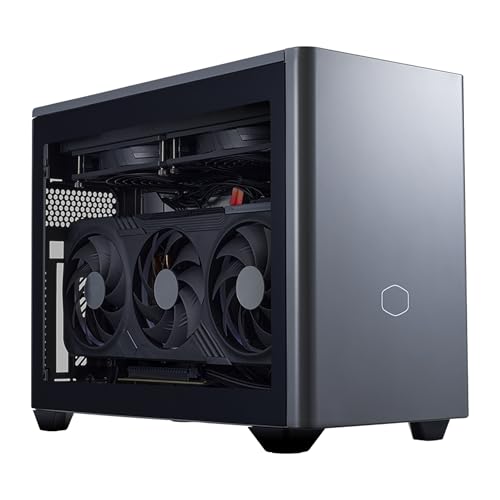
Best Mini ITX: Cooler Master NR2 Pro Gaming PC (Ultra 7, RTX 5070) — NVIDIA RTX 5070 12GB, 32GB DDR5 6000MHz, 2TB M.2 SSD. Check the latest price on Amazon via the name link.
Best for Small Spaces: ASUS ROG GR70 Gaming Mini PC (Ryzen 9, RTX 5070, 2TB) — NVIDIA GeForce RTX 5070, 32GB DDR5-5600, 2TB SSD. Check the latest price on Amazon via the name link.
Best for Creators: ASUS ROG NUC (2025) Gaming Mini PC (RTX 5070 Mobile) — NVIDIA GeForce RTX 5070 Mobile, 32GB DDR5, 1TB NVMe SSD. Check the latest price on Amazon via the name link.
Best Value Premium: MINISFORUM G1 Pro Gaming Mini PC (Ryzen 9, RTX 5060) — NVIDIA GeForce RTX 5060 8GB GDDR7, 32GB DDR5, 1TB SSD. Check the latest price on Amazon via the name link.
Best Mid-Range: TOPGRO T1-Pro Mini Gaming PC (i9, RTX 4060) — GeForce RTX 4060 8GB GDDR6, 32GB DDR5, 1TB PCIe 4.0 SSD. Check the latest price on Amazon via the name link.
Best Budget: ACEMAGICIAN S3A Gaming Mini PC (Ryzen 7, Radeon 780M) — AMD Radeon 780M integrated graphics, 16GB RAM, 512GB PCIe 4.0 SSD. Check the latest price on Amazon via the name link.
In this guide
Quick Picks for This Guide
Best Mini ITX — Cooler Master NR2 Pro Gaming PC (Ultra 7, RTX 5070): Intel Core Ultra 7 265F with NVIDIA RTX 5070 12GB, 32GB DDR5 6000MHz and 2TB M.2 SSD in a Mini ITX case, 280mm AIO liquid cooler design — a premium mini-ITX choice for buyers focused on separating two labels that listings blur together.
Best for Small Spaces — ASUS ROG GR70 Gaming Mini PC (Ryzen 9, RTX 5070, 2TB): AMD Ryzen 9 9955HX with NVIDIA GeForce RTX 5070, 32GB DDR5-5600 and 2TB SSD in a Sub-3L chassis, triple-fan QuietFlow cooling, ARGB lighting design — a premium choice for buyers focused on separating two labels that listings blur together.
Best for Creators — ASUS ROG NUC (2025) Gaming Mini PC (RTX 5070 Mobile): Intel Core Ultra 9 (Series 2) ARL-HX with NVIDIA GeForce RTX 5070 Mobile, 32GB DDR5 and 1TB NVMe SSD in a Triple-fan cooling, ARGB lighting design — a premium choice for buyers focused on separating two labels that listings blur together.
Best Value Premium — MINISFORUM G1 Pro Gaming Mini PC (Ryzen 9, RTX 5060): AMD Ryzen 9 8945HX (16 cores / 32 threads, up to 5.4GHz) with NVIDIA GeForce RTX 5060 8GB GDDR7, 32GB DDR5 and 1TB SSD in a Compact desktop, 245W design, quad 4K output design — a upper mid-range choice for buyers focused on separating two labels that listings blur together.
Best Mid-Range — TOPGRO T1-Pro Mini Gaming PC (i9, RTX 4060): Intel Core i9-13900HX with GeForce RTX 4060 8GB GDDR6, 32GB DDR5 and 1TB PCIe 4.0 SSD in a Mini chassis with adjustable RGB light design — a mid-range choice for buyers focused on separating two labels that listings blur together.
Best Budget — ACEMAGICIAN S3A Gaming Mini PC (Ryzen 7, Radeon 780M): AMD Ryzen 7 H 255 (8 cores / 16 threads, up to 4.9GHz) with AMD Radeon 780M integrated graphics, 16GB RAM and 512GB PCIe 4.0 SSD in a Mini desktop chassis design — a entry-level integrated-graphics choice for buyers focused on separating two labels that listings blur together.
How These Picks Were Chosen
Every machine in this article appears in the assignment pick sheet for this cluster, and every ASIN was verified through the site’s Creators API route against Amazon’s own product data before a link was written. Machines were excluded when their verified titles showed integrated graphics presented as discrete power, memory below the level their tier implies, or storage too small for a modern game library. Lighting, bundled software and the word gaming in a title earned no points in either direction.
The six survivors were chosen to span the category rather than to cluster at one tier, so that readers at different budgets can see what each step actually buys. Where a specification is quoted in a spec box or comparison table, it comes from the verified listing title for that machine; where the verified title is silent, this article is silent too, rather than filling the gap with a plausible guess.
Detailed Reviews: The Machines Behind This Vs Guide

Best Mini ITX — Cooler Master NR2 Pro Gaming PC (Ultra 7, RTX 5070)
Strengths
- NVIDIA RTX 5070 12GB gives this machine its gaming character, well matched to the Intel Core Ultra 7 265F.
- 32GB DDR5 6000MHz and 2TB M.2 SSD are sized for a machine you keep, not one you outgrow in a year.
- Mini itx case, 280mm aio liquid cooler shows the cooling was designed for the size, not shrunk as an afterthought.
Trade-offs
- Like most compact designs, the graphics hardware is fixed for the life of the machine.
- You pay a miniaturisation premium over a tower with broadly similar gaming capability.
- Fan noise under sustained load is part of the small-chassis bargain, especially in quiet rooms.
| Processor | Intel Core Ultra 7 265F |
|---|---|
| Graphics | NVIDIA RTX 5070 12GB |
| Memory | 32GB DDR5 6000MHz |
| Storage | 2TB M.2 SSD |
| System | Windows 11 |
| Chassis and cooling | Mini ITX case, 280mm AIO liquid cooler |
| Notable extra | Desktop-class RTX 5070 12GB |
The Cooler Master NR2 Pro is best understood as a premium mini-ITX proposition built around NVIDIA RTX 5070 12GB. In practice that graphics choice sets the ceiling for everything else: it decides which resolutions feel comfortable, how high settings can climb in demanding releases, and whether high-refresh play is a realistic expectation or a listing-page fantasy. The supporting cast here — Intel Core Ultra 7 265F, 32GB DDR5 6000MHz and 2TB M.2 SSD — is balanced rather than decorative, which matters because compact machines cannot be rescued later with the easy upgrades a tower accepts. For a buyer focused on separating two labels that listings blur together, that balance is precisely the point: nothing in the verified specification is obviously waiting to bottleneck the rest.
Day to day, this is a machine that asks for the standard compact courtesies and rewards them. Give the Mini ITX case, 280mm AIO liquid cooler room to breathe, keep its intakes clear of walls and soft furnishings, and it will hold its performance through long sessions instead of fading as heat builds. Its honest limitation is the category’s limitation, stated plainly rather than discovered later: the core hardware is the core hardware for life, fan noise under load is audible in a quiet room, and a tower at a similar tier will always offer more future flexibility. None of that makes it a poor purchase. It makes it a deliberate one, suited to buyers whose space constraint is real.
Best for: buyers who want NVIDIA RTX 5070 12GB performance in a genuinely small footprint and value the verified 32GB DDR5 6000MHz / 2TB M.2 SSD configuration. / Not suited for: buyers who plan to upgrade the graphics card later or who have unlimited desk space and no reason to pay the compact premium.
Check on Amazon — check the latest price on Amazon before you decide, because pricing in this tier moves with promotions.

Best for Small Spaces — ASUS ROG GR70 Gaming Mini PC (Ryzen 9, RTX 5070, 2TB)
Strengths
- NVIDIA GeForce RTX 5070 gives this machine its gaming character, well matched to the AMD Ryzen 9 9955HX.
- 32GB DDR5-5600 and 2TB SSD are sized for a machine you keep, not one you outgrow in a year.
- Sub-3l chassis, triple-fan quietflow cooling, argb lighting shows the cooling was designed for the size, not shrunk as an afterthought.
Trade-offs
- Like most compact designs, the graphics hardware is fixed for the life of the machine.
- You pay a miniaturisation premium over a tower with broadly similar gaming capability.
- Fan noise under sustained load is part of the small-chassis bargain, especially in quiet rooms.
| Processor | AMD Ryzen 9 9955HX |
|---|---|
| Graphics | NVIDIA GeForce RTX 5070 |
| Memory | 32GB DDR5-5600 |
| Storage | 2TB SSD |
| System | Windows 11 Home |
| Chassis and cooling | Sub-3L chassis, triple-fan QuietFlow cooling, ARGB lighting |
| Notable extra | Wi-Fi 7; 3-year warranty |
The ASUS ROG GR70 2TB is best understood as a premium proposition built around NVIDIA GeForce RTX 5070. In practice that graphics choice sets the ceiling for everything else: it decides which resolutions feel comfortable, how high settings can climb in demanding releases, and whether high-refresh play is a realistic expectation or a listing-page fantasy. The supporting cast here — AMD Ryzen 9 9955HX, 32GB DDR5-5600 and 2TB SSD — is balanced rather than decorative, which matters because compact machines cannot be rescued later with the easy upgrades a tower accepts. For a buyer focused on separating two labels that listings blur together, that balance is precisely the point: nothing in the verified specification is obviously waiting to bottleneck the rest.
Day to day, this is a machine that asks for the standard compact courtesies and rewards them. Give the Sub-3L chassis, triple-fan QuietFlow cooling, ARGB lighting room to breathe, keep its intakes clear of walls and soft furnishings, and it will hold its performance through long sessions instead of fading as heat builds. Its honest limitation is the category’s limitation, stated plainly rather than discovered later: the core hardware is the core hardware for life, fan noise under load is audible in a quiet room, and a tower at a similar tier will always offer more future flexibility. None of that makes it a poor purchase. It makes it a deliberate one, suited to buyers whose space constraint is real.
Best for: buyers who want NVIDIA GeForce RTX 5070 performance in a genuinely small footprint and value the verified 32GB DDR5-5600 / 2TB SSD configuration. / Not suited for: buyers who plan to upgrade the graphics card later or who have unlimited desk space and no reason to pay the compact premium.
Check on Amazon — check the latest price on Amazon before you decide, because pricing in this tier moves with promotions.

Best for Creators — ASUS ROG NUC (2025) Gaming Mini PC (RTX 5070 Mobile)
Strengths
- NVIDIA GeForce RTX 5070 Mobile gives this machine its gaming character, well matched to the Intel Core Ultra 9 (Series 2) ARL-HX.
- 32GB DDR5 and 1TB NVMe SSD are sized for a machine you keep, not one you outgrow in a year.
- Triple-fan cooling, argb lighting shows the cooling was designed for the size, not shrunk as an afterthought.
Trade-offs
- Like most compact designs, the graphics hardware is fixed for the life of the machine.
- You pay a miniaturisation premium over a tower with broadly similar gaming capability.
- Fan noise under sustained load is part of the small-chassis bargain, especially in quiet rooms.
| Processor | Intel Core Ultra 9 (Series 2) ARL-HX |
|---|---|
| Graphics | NVIDIA GeForce RTX 5070 Mobile |
| Memory | 32GB DDR5 |
| Storage | 1TB NVMe SSD |
| System | Windows (see listing) |
| Chassis and cooling | Triple-fan cooling, ARGB lighting |
| Notable extra | Thunderbolt 4 |
The ASUS ROG NUC 2025 is best understood as a premium proposition built around NVIDIA GeForce RTX 5070 Mobile. In practice that graphics choice sets the ceiling for everything else: it decides which resolutions feel comfortable, how high settings can climb in demanding releases, and whether high-refresh play is a realistic expectation or a listing-page fantasy. The supporting cast here — Intel Core Ultra 9 (Series 2) ARL-HX, 32GB DDR5 and 1TB NVMe SSD — is balanced rather than decorative, which matters because compact machines cannot be rescued later with the easy upgrades a tower accepts. For a buyer focused on separating two labels that listings blur together, that balance is precisely the point: nothing in the verified specification is obviously waiting to bottleneck the rest.
Day to day, this is a machine that asks for the standard compact courtesies and rewards them. Give the Triple-fan cooling, ARGB lighting room to breathe, keep its intakes clear of walls and soft furnishings, and it will hold its performance through long sessions instead of fading as heat builds. Its honest limitation is the category’s limitation, stated plainly rather than discovered later: the core hardware is the core hardware for life, fan noise under load is audible in a quiet room, and a tower at a similar tier will always offer more future flexibility. None of that makes it a poor purchase. It makes it a deliberate one, suited to buyers whose space constraint is real.
Best for: buyers who want NVIDIA GeForce RTX 5070 Mobile performance in a genuinely small footprint and value the verified 32GB DDR5 / 1TB NVMe SSD configuration. / Not suited for: buyers who plan to upgrade the graphics card later or who have unlimited desk space and no reason to pay the compact premium.
Check on Amazon — check the latest price on Amazon before you decide, because pricing in this tier moves with promotions.

Best Value Premium — MINISFORUM G1 Pro Gaming Mini PC (Ryzen 9, RTX 5060)
Strengths
- NVIDIA GeForce RTX 5060 8GB GDDR7 gives this machine its gaming character, well matched to the AMD Ryzen 9 8945HX (16 cores / 32 threads, up to 5.4GHz).
- 32GB DDR5 and 1TB SSD are sized for a machine you keep, not one you outgrow in a year.
- Compact desktop, 245w design, quad 4k output shows the cooling was designed for the size, not shrunk as an afterthought.
Trade-offs
- Like most compact designs, the graphics hardware is fixed for the life of the machine.
- You pay a miniaturisation premium over a tower with broadly similar gaming capability.
- Fan noise under sustained load is part of the small-chassis bargain, especially in quiet rooms.
| Processor | AMD Ryzen 9 8945HX (16 cores / 32 threads, up to 5.4GHz) |
|---|---|
| Graphics | NVIDIA GeForce RTX 5060 8GB GDDR7 |
| Memory | 32GB DDR5 |
| Storage | 1TB SSD |
| System | Windows (see listing) |
| Chassis and cooling | Compact desktop, 245W design, quad 4K output |
| Notable extra | 5GbE networking; Wi-Fi 7 |
The MINISFORUM G1 Pro is best understood as a upper mid-range proposition built around NVIDIA GeForce RTX 5060 8GB GDDR7. In practice that graphics choice sets the ceiling for everything else: it decides which resolutions feel comfortable, how high settings can climb in demanding releases, and whether high-refresh play is a realistic expectation or a listing-page fantasy. The supporting cast here — AMD Ryzen 9 8945HX (16 cores / 32 threads, up to 5.4GHz), 32GB DDR5 and 1TB SSD — is balanced rather than decorative, which matters because compact machines cannot be rescued later with the easy upgrades a tower accepts. For a buyer focused on separating two labels that listings blur together, that balance is precisely the point: nothing in the verified specification is obviously waiting to bottleneck the rest.
Day to day, this is a machine that asks for the standard compact courtesies and rewards them. Give the Compact desktop, 245W design, quad 4K output room to breathe, keep its intakes clear of walls and soft furnishings, and it will hold its performance through long sessions instead of fading as heat builds. Its honest limitation is the category’s limitation, stated plainly rather than discovered later: the core hardware is the core hardware for life, fan noise under load is audible in a quiet room, and a tower at a similar tier will always offer more future flexibility. None of that makes it a poor purchase. It makes it a deliberate one, suited to buyers whose space constraint is real.
Best for: buyers who want NVIDIA GeForce RTX 5060 8GB GDDR7 performance in a genuinely small footprint and value the verified 32GB DDR5 / 1TB SSD configuration. / Not suited for: buyers who plan to upgrade the graphics card later or who have unlimited desk space and no reason to pay the compact premium.
Check on Amazon — check the latest price on Amazon before you decide, because pricing in this tier moves with promotions.

Best Mid-Range — TOPGRO T1-Pro Mini Gaming PC (i9, RTX 4060)
Strengths
- GeForce RTX 4060 8GB GDDR6 gives this machine its gaming character, well matched to the Intel Core i9-13900HX.
- 32GB DDR5 and 1TB PCIe 4.0 SSD are sized for a machine you keep, not one you outgrow in a year.
- Mini chassis with adjustable rgb light shows the cooling was designed for the size, not shrunk as an afterthought.
Trade-offs
- Like most compact designs, the graphics hardware is fixed for the life of the machine.
- You pay a miniaturisation premium over a tower with broadly similar gaming capability.
- Fan noise under sustained load is part of the small-chassis bargain, especially in quiet rooms.
| Processor | Intel Core i9-13900HX |
|---|---|
| Graphics | GeForce RTX 4060 8GB GDDR6 |
| Memory | 32GB DDR5 |
| Storage | 1TB PCIe 4.0 SSD |
| System | Windows 11 Pro |
| Chassis and cooling | Mini chassis with adjustable RGB light |
| Notable extra | Wi-Fi 6E, Bluetooth 5.3, 2.5G LAN, 4K at 60Hz output |
The TOPGRO T1-Pro is best understood as a mid-range proposition built around GeForce RTX 4060 8GB GDDR6. In practice that graphics choice sets the ceiling for everything else: it decides which resolutions feel comfortable, how high settings can climb in demanding releases, and whether high-refresh play is a realistic expectation or a listing-page fantasy. The supporting cast here — Intel Core i9-13900HX, 32GB DDR5 and 1TB PCIe 4.0 SSD — is balanced rather than decorative, which matters because compact machines cannot be rescued later with the easy upgrades a tower accepts. For a buyer focused on separating two labels that listings blur together, that balance is precisely the point: nothing in the verified specification is obviously waiting to bottleneck the rest.
Day to day, this is a machine that asks for the standard compact courtesies and rewards them. Give the Mini chassis with adjustable RGB light room to breathe, keep its intakes clear of walls and soft furnishings, and it will hold its performance through long sessions instead of fading as heat builds. Its honest limitation is the category’s limitation, stated plainly rather than discovered later: the core hardware is the core hardware for life, fan noise under load is audible in a quiet room, and a tower at a similar tier will always offer more future flexibility. None of that makes it a poor purchase. It makes it a deliberate one, suited to buyers whose space constraint is real.
Best for: buyers who want GeForce RTX 4060 8GB GDDR6 performance in a genuinely small footprint and value the verified 32GB DDR5 / 1TB PCIe 4.0 SSD configuration. / Not suited for: buyers who plan to upgrade the graphics card later or who have unlimited desk space and no reason to pay the compact premium.
Check on Amazon — check the latest price on Amazon before you decide, because pricing in this tier moves with promotions.

Best Budget — ACEMAGICIAN S3A Gaming Mini PC (Ryzen 7, Radeon 780M)
Strengths
- AMD Radeon 780M integrated graphics gives this machine its gaming character, well matched to the AMD Ryzen 7 H 255 (8 cores / 16 threads, up to 4.9GHz).
- 16GB RAM and 512GB PCIe 4.0 SSD are sized for a machine you keep, not one you outgrow in a year.
- Mini desktop chassis shows the cooling was designed for the size, not shrunk as an afterthought.
Trade-offs
- Like most compact designs, the graphics hardware is fixed for the life of the machine.
- You pay a miniaturisation premium over a tower with broadly similar gaming capability.
- Fan noise under sustained load is part of the small-chassis bargain, especially in quiet rooms.
| Processor | AMD Ryzen 7 H 255 (8 cores / 16 threads, up to 4.9GHz) |
|---|---|
| Graphics | AMD Radeon 780M integrated graphics |
| Memory | 16GB RAM |
| Storage | 512GB PCIe 4.0 SSD |
| System | Windows (see listing) |
| Chassis and cooling | Mini desktop chassis |
| Notable extra | Positioned for gaming, content creation, programming and home office use |
The ACEMAGICIAN S3A is best understood as a entry-level integrated-graphics proposition built around AMD Radeon 780M integrated graphics. In practice that graphics choice sets the ceiling for everything else: it decides which resolutions feel comfortable, how high settings can climb in demanding releases, and whether high-refresh play is a realistic expectation or a listing-page fantasy. The supporting cast here — AMD Ryzen 7 H 255 (8 cores / 16 threads, up to 4.9GHz), 16GB RAM and 512GB PCIe 4.0 SSD — is balanced rather than decorative, which matters because compact machines cannot be rescued later with the easy upgrades a tower accepts. For a buyer focused on separating two labels that listings blur together, that balance is precisely the point: nothing in the verified specification is obviously waiting to bottleneck the rest.
Day to day, this is a machine that asks for the standard compact courtesies and rewards them. Give the Mini desktop chassis room to breathe, keep its intakes clear of walls and soft furnishings, and it will hold its performance through long sessions instead of fading as heat builds. Its honest limitation is the category’s limitation, stated plainly rather than discovered later: the core hardware is the core hardware for life, fan noise under load is audible in a quiet room, and a tower at a similar tier will always offer more future flexibility. None of that makes it a poor purchase. It makes it a deliberate one, suited to buyers whose space constraint is real.
Best for: buyers who want AMD Radeon 780M integrated graphics performance in a genuinely small footprint and value the verified 16GB RAM / 512GB PCIe 4.0 SSD configuration. / Not suited for: buyers who plan to upgrade the graphics card later or who have unlimited desk space and no reason to pay the compact premium.
Check on Amazon — check the latest price on Amazon before you decide, because pricing in this tier moves with promotions.
Comparison Table
| Machine | Processor | Graphics | Memory | Storage |
|---|---|---|---|---|
| Cooler Master NR2 Pro | Intel Core Ultra 7 265F | NVIDIA RTX 5070 12GB | 32GB DDR5 6000MHz | 2TB M.2 SSD |
| ASUS ROG GR70 2TB | AMD Ryzen 9 9955HX | NVIDIA GeForce RTX 5070 | 32GB DDR5-5600 | 2TB SSD |
| ASUS ROG NUC 2025 | Intel Core Ultra 9 (Series 2) ARL-HX | NVIDIA GeForce RTX 5070 Mobile | 32GB DDR5 | 1TB NVMe SSD |
| MINISFORUM G1 Pro | AMD Ryzen 9 8945HX (16 cores / 32 threads, up to 5.4GHz) | NVIDIA GeForce RTX 5060 8GB GDDR7 | 32GB DDR5 | 1TB SSD |
| TOPGRO T1-Pro | Intel Core i9-13900HX | GeForce RTX 4060 8GB GDDR6 | 32GB DDR5 | 1TB PCIe 4.0 SSD |
| ACEMAGICIAN S3A | AMD Ryzen 7 H 255 (8 cores / 16 threads, up to 4.9GHz) | AMD Radeon 780M integrated graphics | 16GB RAM | 512GB PCIe 4.0 SSD |
Read the table by columns, not rows: the graphics column predicts your gaming experience, the memory and storage columns predict the machine’s comfortable lifespan, and the processor column — strong throughout this shortlist — is the one to worry about least.
What Matters Most When You Judge a Compact Gaming PC
On a small desk the arithmetic is just as concrete. A tower consumes either the desktop itself or the floor space your legs and cables wanted; a compact machine can sit behind the monitor, on a shelf, or mounted out of the way, returning the surface to the keyboard, mouse and work equipment that share it. Students, shared bedrooms and home-office hybrids feel this daily. When space is the binding constraint of the whole setup, a compact machine is not a compromised tower — it is the only form factor that respects the room.
Support terms deserve a glance precisely because compact machines are harder to service yourself. It is therefore notable that the ASUS flagship designs in this guide carry a three-year warranty in their verified listing titles — a meaningful differentiator in a category where opening the chassis may be discouraged and components are not standard. Whatever you buy, register it, keep the order details, and learn the support route in the first week rather than during the first failure.
Some listing decoration should carry no weight in your decision. RGB lighting, however adjustable, has never rendered a frame. Gaming in a product name guarantees nothing about the graphics hardware. A long list of bundled software is not performance. Strip those away and judge the verified core — graphics processor, main processor, memory capacity and generation, storage capacity, cooling description and ports — because those six lines are the machine you will actually live with.
Graphics hardware decides what a compact gaming PC can actually play, and it is the specification to interrogate hardest. A discrete NVIDIA or AMD graphics processor with its own video memory is a gaming machine; integrated graphics, however modern, is an esports-and-older-titles machine. The verified listings in this category span that whole range, from RTX 5080 and RTX 5070 designs at the top, through RTX 5060 and RTX 4060 mid-range options, down to a Radeon 780M integrated solution — and the gaming experience across that range differs more than any other single specification gap in the article.
Most very small machines use mobile graphics processors — the laptop variants of familiar model names — because a desktop card’s power draw and physical size cannot be cooled in three litres. Mobile silicon is not a scam and should not be treated as one: a current mobile flagship delivers superb 1440p and strong 4K play in real games. But the same model name does not mean identical performance to the desktop card, so compare within the mobile class, read the exact listing title, and let the Mini ITX designs with desktop cards stand as the exception that proves the rule.
Processor choice in a compact machine matters most for high-refresh play, simulation and strategy titles, streaming, and everyday responsiveness — and the current crop is strong. Sixteen-core Ryzen HX processors and Intel’s Core Ultra and i9 HX lines all appear in verified listings here, and any of them will feed a modern graphics card properly. What differs is the tail: core counts help creators and heavy multitaskers, while pure gamers can safely let the graphics specification lead and treat any of these modern HX-class chips as sufficient.
Memory deserves unusual attention in this category because it may be the only upgrade you ever get — and in some designs it is not even that. Thirty-two gigabytes of DDR5 has become the comfortable standard in the verified machines above, with one flagship doubling it to sixty-four. Sixteen gigabytes still runs today’s games, but it is the specification most likely to age first, particularly if you stream, keep a browser and voice chat open while playing, or intend to keep the machine for five years. Where two otherwise similar models differ mainly in memory, the larger configuration is usually the wiser long-term purchase.
Compact Gaming PC vs Mini Gaming PC: Round by Round
Round one, size: mini wins outright — nothing with a desktop graphics card fits in three litres. Round two, graphics: compact’s desktop-class options win at the top, while mini’s mobile flagships close most of the practical gap at 1440p. Round three, upgrades: compact wins clearly, because standard parts can evolve and fixed parts cannot. Round four, noise and heat in small rooms: mini’s lower power envelope usually wins, provided its vents are respected. Round five, connectivity: a draw at the top, where mini flagships offer multi-display outputs rivalling small towers. Score the rounds by your own priorities rather than by count — for many buyers a single round, upgrades or size, outweighs the other four combined.
Which Family Fits Which Buyer
Choose the mini family if the machine must disappear — behind a monitor, beside a television, in a bag between homes — and you are content to buy its capability outright on day one. Choose the compact Mini ITX family if the footprint merely needs to be modest rather than invisible, and if evolving the graphics card in a few years is part of your plan. Choose neither, and a conventional tower instead, if space is not actually constrained: the honest verdict of any fair comparison is that both small families exist to solve a space problem, and buyers without that problem are paying to solve someone else’s.
How to Choose the Right Size, Not Just the Right Specs
Size classes in this category deserve one final clarification, because the labels overlap in listings. Sub-three-litre machines are the true minis, built on mobile hardware. Slightly larger compact designs trade a little volume for stronger cooling. Mini ITX systems are small towers in miniature, built from standard parts. Our companion pages explore the neighbouring questions from other angles: Compact Gaming PC Buying Guide and How To Choose A Compact Gaming PC are the natural next reads, and if your setup planning extends to peripherals, Best Gaming Keyboard And Mouse Combos and Best Wireless Gaming Mice cover the desk around the machine.
Before you finalise any choice, perform the cardboard test: cut a piece of cardboard to the footprint of the machine you favour and live with it on the desk or shelf for a day. It sounds theatrical and works completely, because it converts an abstract litre figure into the lived reality of your room — which is, after all, the entire reason this category exists.
How Do You Get the Best From a Compact Gaming PC in Daily Use?
Start with placement: vents unobstructed, the machine off soft surfaces, and the power brick ventilated rather than buried. Set the display refresh rate explicitly, cap frame rates at that refresh in demanding menus, and let the system’s own fan behaviour run for a week before you start tuning curves — most modern compact designs are better calibrated out of the box than owners expect. Keep a healthy margin of storage free as working headroom, schedule updates for a calm moment rather than mid-session, and dust the intakes monthly. Those habits, none of them technical, account for most of the difference between compact machines that delight for years and compact machines that generate forum threads.
Problem: performance fades during long sessions. -> fix: check vent clearance and dust first, heat second-guessing later; a compact machine that fades is almost always a compact machine that cannot breathe. Problem: the second monitor will not wake. -> fix: reseat the cable, confirm the port pairing in the verified listing, and update the graphics driver before blaming the panel. Further setup depth lives in How To Set Up Compact Gaming PC for readers who want the full day-one walkthrough.
Cooling, Noise and Power: The Ownership Realities
Storage is the quiet specification that punishes optimism. Modern game installs are large, launchers accumulate, and a 512GB drive that looked adequate on the listing page feels tight within a year once the operating system, two or three big titles and a capture folder are living on it. The one-terabyte and two-terabyte configurations in this guide exist for a reason. If you must economise, economise knowing that external storage helps with libraries and media but is a poor home for the games you are actively playing.
If one idea should survive this whole page, it is that cooling — not the headline graphics chip — is what separates a good compact gaming PC from a disappointing one. Every watt a small machine consumes becomes heat in a small volume of air. The better designs answer with deliberate engineering: triple-fan arrangements, carefully planned layouts, or, in the Mini ITX case, a 280mm liquid cooler that no three-litre box could house. Judge a compact machine by its cooling description as seriously as by its graphics line, keep its vents unobstructed in use, and expect fan noise under load to be part of the honest bargain.
Noise is a specification no listing prints and every owner hears. A compact machine on a desk sits closer to your ears than a tower on the floor, and its smaller fans must spin faster to move the same air. In a living room, television volume usually covers it; in a quiet bedroom at midnight, it becomes the character of the machine. Headphones erase the issue for the player but not for anyone sharing the room. This is a genuine, structural trade-off of the format — manageable with placement, fan behaviour settings and realistic expectations, but dishonest to omit.
Upgradeability in this category should be described plainly: in most mini designs you can expect, at most, memory and storage upgrades, and in some models not even those. The graphics processor and main processor are part of the machine for life. Mini ITX compact systems are the honourable exception, built from standard parts that can evolve. Buy a mini therefore for what it is on day one, not for what it might become; buy a Mini ITX compact if the upgrade path itself is part of the value you are paying for. Confusing those two purchases is the single most expensive misunderstanding in this market.
Display connectivity quietly determines how a compact machine fits your life. Models in this guide range from a single-display budget box to designs offering quad 4K output or extensive multi-display connectivity through a mix of HDMI and DisplayPort generations, plus wired networking up to 5GbE on one Ryzen model and Wi-Fi 7 on several flagships. Count your monitors, check the exact port list in the verified listing, and remember that a living-room machine needs reliable TV handshaking while a desk machine may care more about a second and third monitor for work.
Common Mistakes
The first mistake is buying integrated graphics under the impression that a gaming badge guarantees a discrete card; the verified title always tells the truth, so read it. The second is prioritising the processor over the graphics card, when gaming value runs the other way. The third is choosing sixteen gigabytes of memory or a small drive to save money on a machine whose whole point is that you cannot easily change your mind later. The fourth is placing the machine in a closed cabinet and blaming the engineering. The fifth is comparing a mobile graphics variant directly against its desktop namesake as if the shared name promised shared performance.
A sixth mistake deserves its own sentence because it is so common in this category: buying for the room you wish you had. Measure the room you have, list the games you play, and let those two honest documents — not a render of someone else’s battlestation — choose the machine.
Final Recommendation
If you take one recommendation from this vs page, take the method rather than a model: decide by space, then by graphics tier, then by memory and storage headroom, and only then by brand. Within the verified shortlist above, the flagship designs suit buyers who want the question settled for years, the mid-range machines suit the majority of 1080p and 1440p players, and the integrated-graphics option suits esports and lighter libraries honestly. Readers still weighing the category itself should read Compact Gaming PC Pros And Cons and Compact Gaming PC Review next; readers ready to buy should check the current price of their chosen machine on Amazon and confirm the exact configuration in the listing title one final time before ordering.
Frequently Asked Questions
What exactly counts as a compact gaming PC?
There is no regulated definition, which is why listings confuse. In this guide the term covers sub-three-litre mini designs built on mobile hardware, slightly larger compact systems, and Mini ITX machines built from standard desktop parts in a small case. All three are dramatically smaller than a conventional tower; they differ mainly in upgradeability and in whether their graphics hardware is a mobile or desktop variant.
Can a compact gaming PC really run modern games well?
Yes — the discrete-graphics machines in this guide, from the RTX 4060 class upward, run modern titles well at 1080p, and the RTX 5070 and RTX 5080 designs extend that confidently into 1440p and, with modern upscaling, 4K. The honest exception is integrated graphics, which suits esports and older or lighter titles at sensible settings rather than the newest demanding releases at high settings.
Can you upgrade a compact gaming PC later?
In most mini designs, plan on memory and storage at most — and verify even that against the specific model, because some designs fix everything. Mini ITX compact systems are the exception, built from standard parts that can be upgraded like a normal PC, including the graphics card. Buy a mini for its day-one specification; buy Mini ITX if the upgrade path matters to you.
Are compact gaming PCs loud?
Under load, their fans are audible — smaller fans moving air through a smaller chassis is physics, not a defect. In a living room or through headphones it is rarely an issue; in a silent bedroom it can be. Placement, sensible frame-rate caps and a week of letting the stock fan behaviour run before tuning all help more than any single setting.
How much memory and storage should I insist on?
Thirty-two gigabytes of DDR5 and one terabyte of storage is the comfortable modern baseline reflected across the discrete-graphics machines in this guide, with two terabytes and sixty-four gigabytes marking the flagship tier. Sixteen gigabytes and 512GB remain workable for lighter libraries, but they are the specifications most likely to feel tight first as your collection grows.
Is a compact gaming PC better than a gaming laptop?
They solve overlapping problems differently. A compact PC needs a separate display and keyboard but usually offers stronger cooling, easier multi-monitor setups and a better fit beside a television you already own. A laptop is self-contained and travels completely. If the machine will live in one room, the compact PC is often the better tool; if it must move weekly, the laptop earns its compromises.
What should I check in the listing before I buy?
Read the verified title line by line: the exact graphics processor and whether it is a mobile variant, the processor model, memory capacity and generation, storage capacity, and the operating system. Then confirm the port list against your monitors, check the warranty term stated, and use the link to see the current price — never rely on a figure quoted anywhere else, including older articles.


