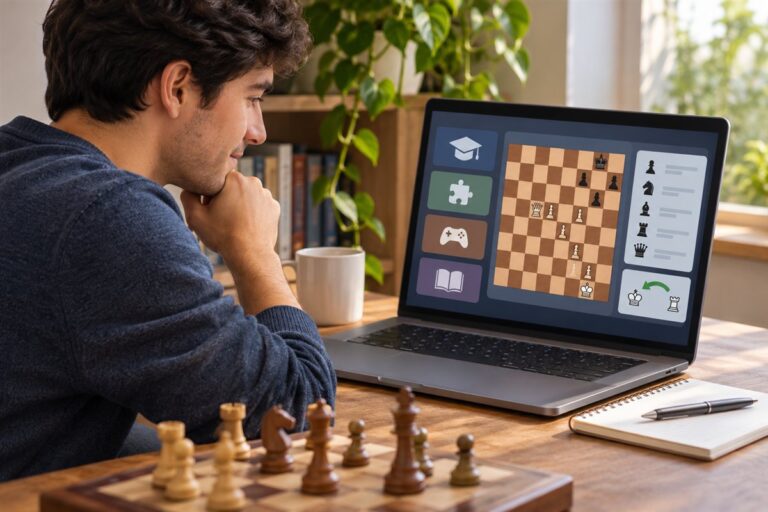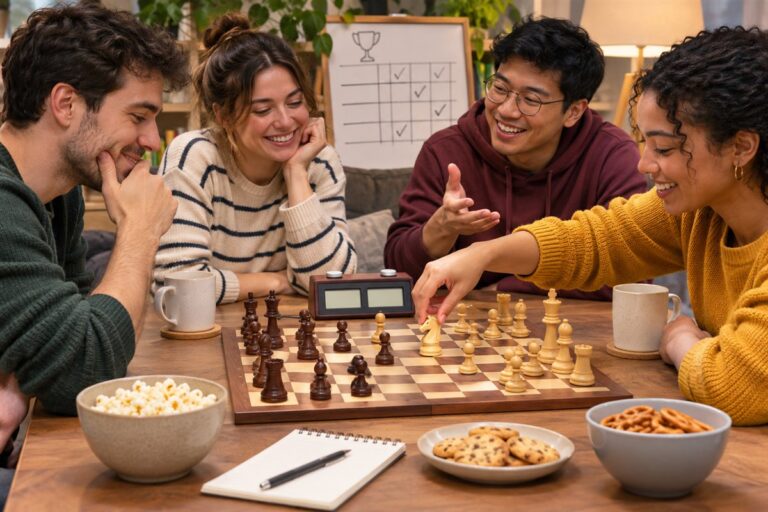
A home chess club needs only a regular time, a few boards and a simple format that suits everyone who attends. Keep the mood friendly, keep the rules clear, and let the group grow slowly.

Decide the Basics
Choose a day and time that repeats, such as a weekday evening every week or a weekend afternoon every two weeks. Regular timing helps people remember. Choose a space with a good table, comfortable seats and decent light. Quiet matters because players need to think, so offer a separate spot for chatting and snacks.
Gather the Equipment
- One board and set for every two players, with spares if people bring friends.
- Chess clocks if you plan timed games. Even one or two are enough for a small group.
- Score sheets or a notebook for those who want to record moves.
- A wall board or a spare board for going over interesting positions together.
- Drinks and light snacks kept away from the boards.
Choose a Format
| Format | How it works | Good for |
|---|---|---|
| Casual play | Players find opponents and play freely | Mixed levels, relaxed nights |
| Ladder | Challenge someone above you to move up | Ongoing friendly competition |
| Round robin | Everyone plays everyone once | Small groups of four to eight |
| Swiss style | Pair players with similar scores each round | Larger groups on special nights |
| Theme night | Play from a set position or with a rule twist | Variety and learning |
Plan a Typical Night
- Welcome everyone and set up boards while people arrive.
- Pair players by level where possible, so games feel fair.
- Play for about an hour, or use clocks with a time limit that suits the group.
- Take a short break to talk and look at one game together.
- Play a second round if energy allows, then tidy the pieces.
Agree on a few simple rules: touch-move, which means a touched piece must be moved if it can be, a handshake before and after, and no commentary on other people’s games. Going over the rules once at the first meeting prevents later arguments.
Invite people in a way that feels easy to accept. A short message with the day, the time and a line saying all levels are welcome goes a long way. Ask newcomers to bring nothing, and have spare sets ready. After a few meetings, ask the group what they enjoy and adjust the format, because a club that listens tends to keep its members.
FAQ
How do I handle players of different strengths?
Pair similar levels when you can, and let stronger players offer an advantage by giving up a minor piece, or simply suggest friendly analysis after the game.
Should the club keep rankings?
It is optional. A simple ladder or a scoreboard can add fun, but a casual group can do well with no rankings at all.
The Short Version
Set a regular time, gather boards and a clock or two, and choose a relaxed format. Share the rules at the first meeting and keep the evening friendly. A small, steady club often grows by word of mouth.