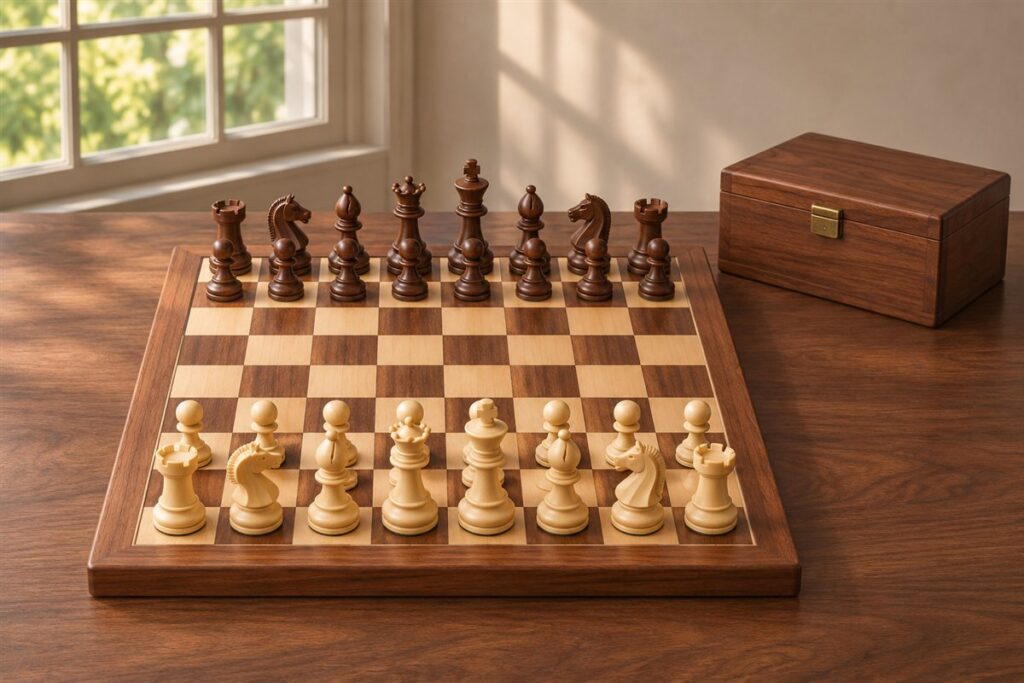
Chess960 has not replaced classical chess at the top level because the older game has deep opening theory, a long tradition, an established title system and a large body of study material. Chess960 is a lively companion format, not a direct rival.

What Chess960 Is
In Chess960, also called Fischer Random, the pieces on the back rank are placed in one of 960 possible opening arrangements, with some rules to keep the king between the rooks and the bishops on opposite colors. The pawns stay in their usual places. Since you cannot rely on memorized openings, you work out ideas over the board from the first moves.
Reasons Classical Chess Remains the Main Format
- Tradition and titles: the world championship, the title system and decades of records are built around the standard setup.
- Opening theory is part of the sport: preparation, novelties and deep analysis are valued skills that make up a large part of elite chess culture.
- Study material: books, courses, videos and databases overwhelmingly cover the standard game.
- Fans know the positions: spectators recognize famous openings, which helps them follow broadcasts and commentary.
- Organizers and sponsors: the existing calendar of events is built on the standard format.
- Engine analysis: game analysis and comparison between eras are simpler when everyone begins from the same position.
What Chess960 Does Well
- It reduces the weight of memorized lines, so creativity matters from the first moves.
- It gives players who do not want to spend hours on theory a fresh game.
- It suits exhibition events and online festivals, where novelty draws attention.
- It lets top players show how they think without preparation.
A Comparison
| Question | Classical | Chess960 |
|---|---|---|
| Opening knowledge | Central | Less important |
| Familiar to fans | Very | Less so |
| Study material | Abundant | Smaller |
| Fresh every game | No | Yes |
Could That Change?
Predicting the future is difficult. Chess960 events have grown in visibility, and formats can sit side by side, as blitz and rapid do beside classical. We cannot say how this will go, and we avoid specific claims about future plans or titles. Check current organizer announcements for facts.
For most players the practical lesson is simple. You do not need to choose one format forever, and trying both is the best way to see which one you enjoy at your level.
How the Setup and Castling Rules Work in Practice
Before comparing the two games, it helps to know the practical rules of Chess960. The back rank is arranged according to a few conditions: the king must stand somewhere between the two rooks, and the two bishops must be on squares of opposite colors. The other pieces fill the remaining squares. Black’s pieces mirror White’s, and the pawns start where they do in the standard game. Playing sites and software choose a starting position for you, usually at random, and a physical board can use a table of positions or a random drawing method.
Castling is the part that surprises newcomers. The king and rook still end up on the same final squares as in the standard game: when castling toward the side of the board where the king usually goes, the king finishes on the same square it would in ordinary chess, and the rook lands next to it. What changes is the starting squares, which can make the move look different, and the requirement that all squares between the pieces and their destinations be empty and safe in the usual way. The conditions on moving pieces and on passing through attacked squares remain.
When playing over the board, say the move clearly and take care with the order of moving the king and rook. In some tournaments, players are told to move the king first. Check the rules used in your event, since rule details and arbiter rulings matter. Online, the software handles the move for you, so a first game is easy to try. Understanding these small mechanics removes a barrier and lets you focus on the chess itself, which is where the format becomes interesting.
Principles for Playing the First Moves in a Random Setup
Without a memorized opening, you rely on general principles, and these are worth learning because they help in standard chess as well. Start by looking at the position as a whole. Which pieces are on the edges and which are in the center? Where are the bishops aimed? Are any pawns or pieces undefended from the start? In many setups, a pawn or a piece begins unprotected, and a careless first move can lose material at once.
Aim for sensible development. Control the center with pawns or pieces, bring minor pieces into play, and get the king to safety, which may require clearing squares for castling. Think about the diagonals. A bishop stuck behind its own pawns is often a weakness, so open lines for it early. Be wary of moving the same piece repeatedly in the opening, and avoid attacking too early with your queen.
- Check which of your pieces are undefended before you move anything.
- Look for natural pawn moves that open lines for bishops and queen.
- Plan where each knight will go, since the center may look different than usual.
- Decide early on which side your king will castle, and prepare it.
- Look at your opponent’s first moves for hints about their plans and for weaknesses.
With practice, you start to recognize recurring shapes across different setups. This builds a flexible understanding that many players find enjoyable, because every game asks you to think fresh from the first move.
The Role of Preparation and Computers
Part of the discussion about the top level concerns preparation. In standard chess, strong players invest enormous effort in opening research, often with the help of engines. Some commentators argue that this makes parts of the opening feel solved or reduces the room for surprise, and that Chess960 restores creativity by removing the memorized lines. Others point out that preparation is itself a skill, that the opening battle is part of the competition, and that a format changing every game cannot reward long-term research in the same way.
Engines affect both formats. In Chess960 there are many possible setups, which limits how much can be prepared in advance, but players can still study common principles and prepare general approaches for certain types of starting positions. Some events pick the position shortly before the game, while others publish the start in advance so players can work on it. Check an event’s rules to see how it handles this, because it changes how much preparation matters.
It is fair to say that opinions vary, and that strong players differ about which format they prefer. We avoid claims about specific players’ views unless they are documented in a source you can verify. What can be said in general is that the debate involves tradition, spectator experience, the value of preparation and practical organization. Neither side of the discussion needs to be dismissed, and both formats can coexist. For a learner, the main point is that understanding the ideas of chess matters in both.
Spectators, Broadcasts and Organizers
Top-level chess is also a spectator product. Broadcasts rely on commentators who explain positions to viewers, and familiar openings give the audience a shared language. When the start position changes every game, commentators must explain each new setup, which can be harder for casual viewers but can also be refreshing. Fans who enjoy seeing surprising ideas may like the variety, while others prefer to follow the stories of long-running opening battles.
Organizers face practical questions as well. How will the starting positions be chosen, and will they be fair to both sides? How will players and arbiters handle castling rules? Will the event produce rating changes or titles, and how do those fit into existing systems? Sponsors and broadcasters look for formats that audiences understand and want to watch, and they weigh the effort of introducing something new. These considerations are practical rather than a judgment about the quality of the game.
- Clear explanations at the start help casual viewers follow the game.
- Consistent rules make it easier for players to travel between events.
- A shared database of games helps fans and analysts study the format over time.
- Mixed events that combine formats can introduce audiences gradually.
Change in sport usually happens slowly. Formats that complement the main game can grow without replacing it, as the story of rapid and blitz chess suggests. Always check current organizer announcements for facts about specific events.
Using Chess960 to Improve Your Own Game
Whatever its place at the top, Chess960 is a useful training tool for club and online players. Because you cannot lean on memorized lines, it exercises the skills that decide most amateur games: development, king safety, piece coordination and tactical awareness. It also reduces the temptation to spend hours on opening theory at a level where tactics and endgames matter more.
A simple way to include it in your routine is to play a few games each week, then review them as you would standard games. After each game, write down how you handled the first ten moves, what you found hardest and which ideas worked. Ask whether you developed your pieces efficiently, whether your king was safe and whether you missed any tactics. Use an engine after your own review to compare your thinking.
It also makes a good break from routine. If you feel stale or tired of memorizing lines, playing in a different format can refresh your enthusiasm. It can be fun with friends, since both players start on equal footing. Try different time controls, and notice whether you prefer slower games, where you can think carefully, or faster ones. Many players find that studying both formats deepens their feel for the game, because the same principles apply. You do not have to pick a side. Enjoy the variety, and use each format for what it does best.
FAQ
Is Chess960 harder than standard chess?
It is different. The first moves require more thought, but the middlegame and endgame skills are the same.
Can I practice Chess960 online?
Many major chess sites offer it as a game mode, so you can try it with no equipment.
How is the starting position chosen?
Playing sites and software pick one at random, and over the board players can use a list of positions with a random draw. Events state their own method in their rules.
Does standard chess appear among the 960 positions?
Yes, the usual starting arrangement is one of the 960 possible setups. Most games will start from a different one.
Can I use opening books in Chess960?
Opening knowledge from standard chess helps only when your setup resembles it. General principles matter more, so focus on development, center control and king safety.
Is Chess960 good for beginners?
It can be, because everyone starts without memorized lines. Beginners should learn the castling rules first, and then enjoy learning the basics through play.
Are Chess960 games rated?
Many online sites keep separate ratings for variants, including this one. Check the site's rating pool to see how your results are recorded.
Why is it sometimes called Fischer Random?
The name refers to Bobby Fischer, who proposed a random-setup version of chess. Check a reliable history of the game for details about its origins.
Should I stop studying openings if I play Chess960?
No. Standard chess still uses opening theory, and your preparation helps there. Treat Chess960 as a complement for practice, not a replacement.
The Short Version
Classical chess keeps its place because of tradition, theory, study material and the way events are organized. Chess960 is a popular alternative that rewards fresh thinking, and it is well worth trying alongside the standard game.