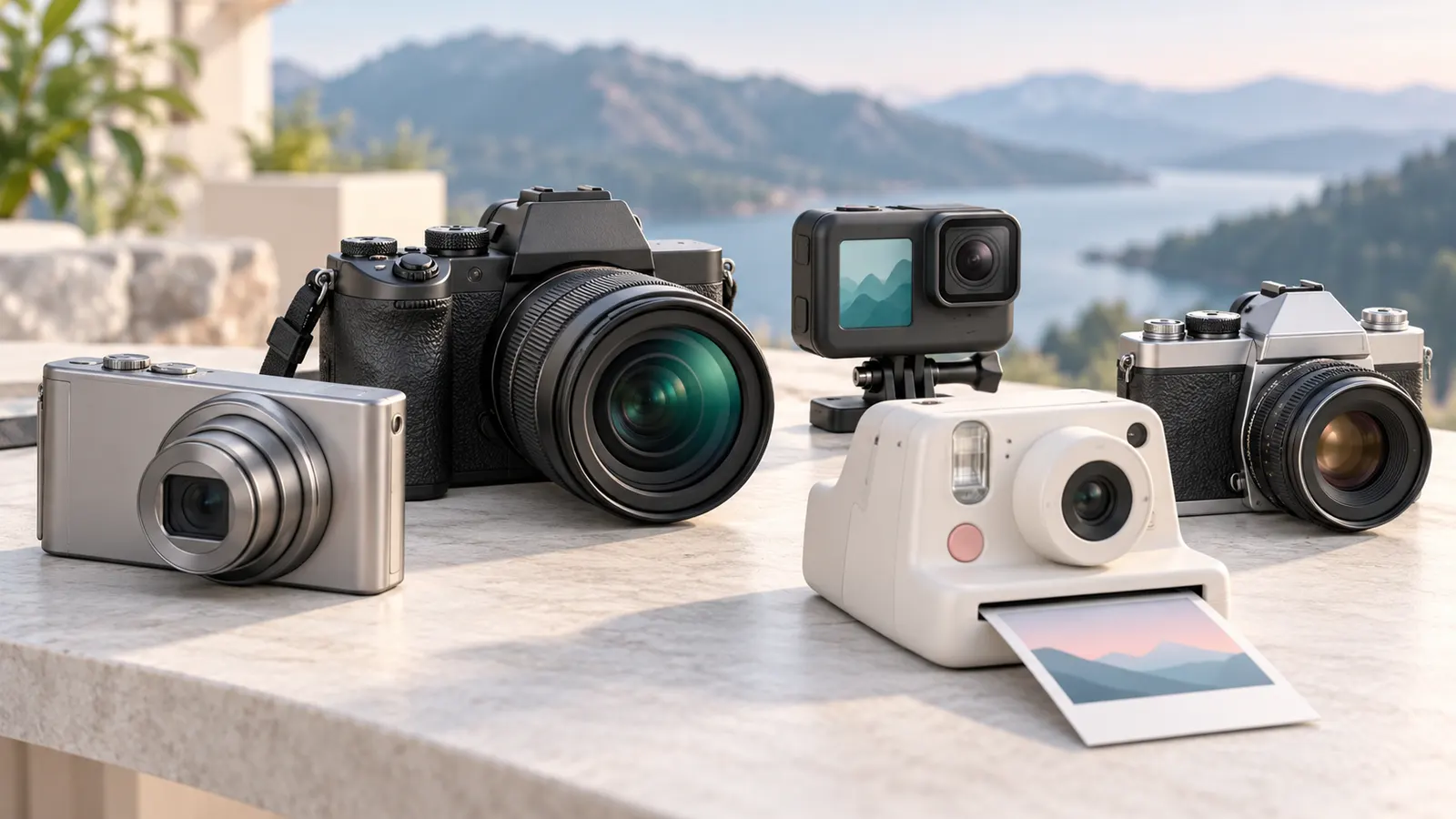
The main types of cameras are smartphone, compact, mirrorless, DSLR, action, medium format and film. Each balances size, image quality, control and cost of ownership differently, so the right one depends on what you shoot and how much you want to carry. This guide describes each type in plain language.
Everyday Cameras
Smartphones are the camera most people carry, with strong automatic processing and instant sharing. They are limited by small sensors and fixed lenses, but they keep improving. Compact cameras are small dedicated cameras with a built-in lens. Some have larger sensors and longer zooms than a phone, which suits travel and family events.
In this guide
Interchangeable Lens Cameras
Mirrorless cameras have no mirror box, so bodies can be smaller and show a live view of exposure in the viewfinder. DSLRs use a mirror and an optical viewfinder, and they have a very wide range of lenses and accessories on the used market. Both types allow you to swap lenses, and both usually have larger sensors than compacts.
| Type | Strength | Trade-off |
|---|---|---|
| Smartphone | Always with you | Small sensor, limited zoom |
| Compact | Pocketable, simple | Fixed lens |
| Mirrorless | Compact body, modern features | Battery life varies |
| DSLR | Optical viewfinder, large lens range | Bulkier body |
| Action camera | Rugged, mounts anywhere | Small sensor, wide view only |
| Medium format | Very large sensor and detail | Size, cost, slower pace |
| Film | Distinct look, deliberate process | Ongoing film and processing costs |
Specialist Cameras
- Action cameras are small, tough and wide, built for sports, bikes and travel footage.
- Medium format cameras use a sensor or film frame larger than full frame, favored for studio, landscape and fine art work.
- Film cameras range from simple point-and-shoots to manual single-lens reflex bodies, and they attract people who enjoy a slower process.
- Instant cameras print a picture within minutes, popular for fun and keepsakes.
- Bridge cameras pack a long zoom lens into a single fixed body.
How to Choose
- Write down what you want to photograph: family, travel, sports, wildlife, video or studio.
- Decide how much weight and size you will accept.
- Decide whether you want to change lenses. If not, a compact or bridge camera may be enough.
- Look at video needs, such as resolution, stabilization and microphone input.
- Check the system’s lens and accessory range, because you will probably keep the system longer than one body.
- Handle cameras in a shop if possible. Grip and menu design matter.
Sensor Size in Brief
Larger sensors collect more light, which generally helps in dim scenes and gives more shallow depth of field. Sizes range from small phone sensors, through one-inch, micro four thirds and APS-C, up to full frame and medium format. Bigger usually means a larger body and lens as well.
Megapixels and What Really Affects Image Quality
Buyers often start with the megapixel count, but it is only one factor in image quality. Megapixels describe how many pixels make up the image. More pixels allow larger prints and more cropping, but they do not by themselves make a picture sharper, cleaner or better. For sharing on screens and for modest prints, the numbers on most modern cameras are more than enough.
Several things matter more. Sensor size influences how much light each pixel collects, which helps in dim scenes. The lens controls sharpness, distortion and how much blur the background has. The image processor and the settings you choose affect noise, color and detail. Light and technique often make a larger difference than any specification.
Higher resolution has costs. Files are larger, which means more storage, slower editing on older computers and more time to transfer. Very dense sensors can also show shake more easily, so they may demand better technique or faster shutter speeds.
A sensible approach is to decide what you will do with your photos. If you mostly share online, any current camera offers enough resolution. If you plan to print large or crop heavily, a higher count helps, but only if your lenses and technique can use it. Compare real sample images at the sizes you intend to use instead of comparing numbers alone.
Video Capabilities to Compare
Almost every camera records video now, but the quality and convenience differ widely. Start with the basics: the resolution and frame rates offered, and how long the camera can record in one clip. Some cameras limit clip length or overheat in long sessions, so look for notes from users about continuous recording.
Next, look at stabilization. Phones and action cameras use strong electronic stabilization to give smooth handheld clips. Larger cameras may offer in-body or in-lens stabilization, which varies in strength. If you plan to walk while filming, a camera with effective stabilization or a gimbal will help.
Audio is easily overlooked. Built-in microphones capture decent sound for casual clips, but they pick up wind and handling noise. A microphone input lets you attach an external microphone, and a headphone output lets you monitor sound. If you plan to interview people or record speech, these connections matter.
Autofocus during video is another differentiator. Some systems track faces and subjects smoothly, while others hunt. Flip-out or tilting screens help with self-recording and awkward angles. Also check the formats and color options if you plan to edit footage heavily. For casual use, the default settings are fine; for creative work, more control is useful.
Batteries, Storage and Running Costs
The price of the camera body is only the beginning. Think about what you will need to buy over the next few years. Spare batteries are the first extra for many people, especially with mirrorless cameras and action cameras that use more power. Check how many shots a battery is expected to give according to the maker, and keep in mind that real use, cold weather and video recording reduce that figure.
Memory cards are next. Cameras use different card types, and the speed you need depends on what you record. Burst shooting and high-quality video need faster cards than casual snapshots. Read the camera manual to see which card types and speed ratings are recommended, and buy from reputable sellers to avoid counterfeit cards.
Lenses and accessories can exceed the cost of the body. A bag, a tripod, filters, a flash and an extra lens add up. If you shoot film, remember the ongoing costs of film, development and scanning. If you shoot digital, consider computer storage and backups, since photo libraries grow quickly.
Finally, think about maintenance. Sensor cleaning, repairs and occasional servicing may be necessary over time. Ask about warranty terms and local repair options. A camera that is easy to service is easier to live with.
New, Used or Refurbished
Buying used or refurbished can stretch your budget and give you access to a better camera than you might otherwise afford. The main risks are wear and hidden faults. Mechanical cameras with moving parts, such as DSLRs, have components rated for a certain number of shutter actuations, so ask about the shutter count where it is available. Mirrorless cameras with mechanical shutters follow the same logic.
Inspect the body for dents, cracks and worn buttons. Check the sensor for dust by taking a picture of a plain bright surface at a small aperture. Test the screen, the viewfinder, the ports, the card slot and the flash shoe. Take a few pictures and review them for focus accuracy.
Refurbished cameras sold by the maker or an established retailer often come with a limited warranty. Check what the warranty covers and for how long. Sellers who offer returns provide extra security.
Buying new offers the full warranty, the latest firmware and no mystery history. If features such as video or autofocus performance matter, a newer model may be worth it. If your needs are modest, an older model can serve you well. Either way, buy from sellers you trust and keep your receipt.
Matching Cameras to Everyday Situations
Thinking in situations makes the choice easier. For family life and holidays, a smartphone or a compact camera is often enough, and the best camera is the one you carry. For children’s sports and school events where you need reach, a camera with interchangeable lenses or a bridge camera with a long zoom gives more options.
For travel, weight and size matter. Mirrorless cameras offer a good balance of image quality and portability, and compacts with larger sensors are tempting if you want something pocketable. If you plan adventurous trips, an action camera adds ruggedness. Consider battery life and how easy it is to charge on the road.
For portraits and creative work, a camera that lets you control aperture and change lenses gives more room to grow. For wildlife and sports, look at autofocus tracking and the availability of long lenses. For content creation, look at video features, flip screens and microphone connections.
If you are a beginner, avoid choosing based on features you might use someday. Start with a camera you will carry and use often. You can add lenses and accessories later, and skills matter more than equipment in the early stages. Write down your top three uses and choose with those in mind.
Begin With Questions, Not Camera Names
Buyers often begin by browsing models, and end up overwhelmed. A calmer path is to answer a handful of questions about yourself first. What will you photograph most? Where will you carry the camera? How much time will you spend learning it? Do you want to share pictures right away, or edit them carefully later? Do you need video? How much are you willing to spend on the body, lenses and accessories together?
Write your answers in a short note. Your top two or three answers matter most, and the rest are tie-breakers. A person who photographs children at play and wants instant sharing has very different needs from someone who photographs birds at dawn and enjoys long editing sessions. When your note is clear, the right type of camera tends to reveal itself.
Matching Camera Types to Typical Goals
| Goal | Camera types to consider | Why |
|---|---|---|
| Everyday snapshots and sharing | Smartphone, compact | Always with you and easy to use |
| Learning photography seriously | Mirrorless, DSLR | Full manual control and lens choice |
| Travel with a light bag | Compact, small mirrorless | Small size with good quality |
| Wildlife and sport | Mirrorless or DSLR with telephoto lenses | Reach and fast focus |
| Action and adventure | Action camera | Tough, tiny and wide |
| Slow, deliberate art | Film camera, medium format | A different process and look |
Understanding Lens Systems Early
If you choose a camera with interchangeable lenses, you also choose a lens system. This system will shape your options for years, so read about the lenses available for each system you consider. Check the range of focal lengths, the availability of fast primes and the support from independent lens makers. Also consider the used market, where lenses often hold their value well.
- List the lenses you expect to buy in the first two years.
- Check their size and weight.
- Note which are available from independent makers.
- Think about adapters if you want to use older lenses.
Learning Curve and Daily Habits
Some cameras are easy to pick up, while others reward patience. A smartphone is intuitive and always with you, which is a powerful advantage. A compact with a good lens offers more control but still keeps things simple. A camera with interchangeable lenses opens a world of options but asks you to learn about exposure, focus and lenses. A film camera asks you to slow down and plan each frame.
Be honest about how much time you will spend learning. A camera that sits in a drawer because it feels complicated is a poor investment. On the other hand, a camera that grows with you can be satisfying for years. If you are unsure, begin with something simple and move up when you feel limited.
- Spend one week using your smartphone more deliberately.
- Note what you wish it could do.
- Match those wishes to camera types.
- Try a borrowed or rented camera.
- Decide whether the extra effort feels rewarding.
Viewfinders, Screens and How You Frame
How you see the scene affects how you shoot. Smartphones and many compacts use a rear screen. Mirrorless cameras offer an electronic viewfinder. DSLR cameras use an optical viewfinder. Film rangefinders use a separate window. Each style changes your relationship with the scene. Some people prefer to see the world through an eyepiece, which blocks distractions and steadies the camera. Others enjoy the freedom of holding the camera away from the face.
- Try each style in a shop if you can.
- Check visibility in bright sunlight.
- Consider whether you wear glasses.
- Think about whether you want a tilting screen for low and high angles.
Accessories Worth Considering Early
A few accessories improve almost every kind of camera. A spare battery, a spare memory card, a simple bag and a cleaning cloth are basics. A tripod is useful for low light and landscapes. A flash can help indoors. A strap or wrist strap protects against drops. Begin with the basics, and add other items when you find a real need.
Worked Example: Three Buyers, Three Paths
Consider three people shopping for cameras. Amara wants to photograph her children and share pictures quickly with family. She already owns a recent smartphone, and she discovers that a few simple habits, such as cleaning the lens and using window light, improve her pictures dramatically. She decides to wait before buying anything new.
Luis wants to photograph local birds. He needs reach and fast focus. He looks at cameras with interchangeable lenses, budgets for a telephoto zoom and a monopod, and rents a setup for a weekend. He finds it heavy but rewarding, and he buys a used kit.
Keiko loves travel and wants a small camera that gives better quality than her phone. She chooses a compact with a good zoom lens, and learns its manual controls over a few weeks. Each person chose a different type, and each was right. They matched the camera to their own goals instead of copying someone else.
Common Mistakes
- Buying the most expensive camera before learning the basics.
- Ignoring the cost of lenses and accessories.
- Choosing by megapixel count alone.
- Skipping the return policy and the warranty details.
- Buying a heavy kit and leaving it at home.
- Forgetting that a smartphone may already meet your needs.
Glossary
- Interchangeable lens camera: a camera that allows different lenses to be mounted.
- Sensor: the part that captures light to form an image.
- Megapixel: a million pixels, a measure of image size.
- Mirrorless: a camera without a mirror box, using an electronic view.
- DSLR: a camera with a mirror and optical viewfinder.
Where and How to Buy Sensibly
Buying a camera is easier when you plan the purchase. Compare the same model from reputable sellers, and check what is included in the box. Read the return policy and the warranty terms. If you buy used, inspect the camera carefully and ask for photos of the body, lens mount and screen. For expensive items, consider a seller with a good reputation and clear return terms.
- Choose your type and shortlist two models.
- Compare what is included with each.
- Check seller reputation and returns.
- Test the camera within the return window.
- Keep receipts and warranty documents together.
A Final Word
The best camera is the one you will carry and use. Do not be pressured by trends or by long lists of features. Choose a type that fits your goals, learn it well and enjoy making pictures. You can always change later when your needs grow.
Storage, Backup and Photo Management
Whichever camera you choose, plan for your photos. Pictures pile up quickly, and without a system they become hard to find. Decide where files will live, how folders will be named, and how backups will happen. A simple approach is to name folders by date and event, copy files to a computer after each outing, and keep a second copy on an external drive or cloud service.
- Copy photos soon after shooting.
- Keep two backups in different places.
- Delete poor pictures after you have backed up the good ones.
- Add keywords or labels to favorites, so they are easy to find.
A Closing Checklist for Buyers
- Write down your main subjects and where you will shoot.
- Pick the type that fits your size and learning goals.
- Budget for lenses, a card, a battery and a bag.
- Try before you buy, if possible.
- Check the return window and use it.


Products Worth a Look
As an Amazon Associate, Reviews Took earns from qualifying purchases. These picks come from our guide: 3 Best Mirrorless Cameras: Canon R100, Sony a7 III (2026).
-
Canon EOS R100 with RF-S18-45mm Kit
 Canon EOS R100 Mirrorless Camera RF-S18-45mm F4.5-6.3 is STM Lens Kit
-
Sony Alpha a7 III Full-Frame Body
-
Canon EOS R8 Mark II Body
 Canon EOS R8 Mark II Mirrorless Camera Body
Going Deeper: The Camera as a Daily Companion, Not a Specification Sheet
The camera that suits you is the one whose company you enjoy for hours, and that quality hides in places specifications never mention. How does the grip feel with cold or gloved hands? Can you change the settings you use most without lowering the camera from your eye? Does the menu logic make sense to you on the third day, or are you still hunting for the same function? These ergonomic truths decide whether a camera becomes a habit or a shelf ornament, and they are intensely personal: the body one photographer calls intuitive, another calls cramped. Whenever possible, hold candidates in your hands, ideally for longer than a shop counter allows, through rental or a friend’s loan. Ten minutes of handling teaches more about fit than a month of comparison charts, and fit is what you will live with for years.
Sound and discretion belong in the same judgement. A loud shutter changes the behaviour of people in quiet rooms, ceremonies and wildlife hides; a silent electronic option changes it back, with its own caveats for fast motion and artificial light. Photographers who work in sensitive places should weigh these behaviours heavily, because the best technical camera is a liability if its presence disturbs the very scenes it was bought to capture.
Understanding the Total System You Are Buying Into
A camera body is a ticket into a system: its lenses, flashes, accessories, second-hand market and repair network. Two bodies with identical headline performance can lead to very different ownership experiences depending on the health of the system behind them. Before committing, survey the lenses you might plausibly want in the next few years and confirm they exist in that mount at prices your budget respects. Check whether independent makers support the system, since their lenses often deliver the value that makes a kit grow affordably. Look at the used market too; a thriving one means your gear holds value and your future upgrades can be bought sensibly second-hand. Choosing a system is a longer commitment than choosing a body, and bodies are replaced far more often than the lenses and habits built around them.
Also consider the manufacturer’s habits: how long bodies receive firmware attention, how available batteries and chargers remain for older models, and how the brand treats compatibility when mounts evolve. None of this requires brand loyalty, only clear eyes. The cheapest body can become the most expensive purchase if it strands you in a system you must abandon and replace entirely two years later.
Video, Stills and the Honest Hybrid Question
Many cameras now promise excellence at both stills and video, and many deliver it, but hybrid capability should be bought for hybrid work you genuinely intend to do. Video adds its own kit and skills: audio capture, stabilisation, lighting, storage and editing time that dwarfs stills. A buyer seduced by video specifications who never shoots motion has paid, in money and in stills ergonomics, for a hobby they do not have. Conversely, if you know video is coming, perhaps for family, work or a channel, choose the body whose video tools you understand and whose limitations you have seen in real footage, and budget for the microphone before the second lens. Decide which craft is primary and let the secondary one be served adequately rather than perfectly; that ordering keeps both the budget and the learning curve sane.
Heat and recording behaviour are the unglamorous video facts that matter in practice. A camera that overheats during a school play or imposes short recording limits may be a fine stills tool and a frustrating video one. Read owner reports about sustained recording in warm rooms, not just launch reviews, if long-form video is on your list.
From First Camera to Second: A Sensible Growth Path
Most photographers do not need a new body nearly as often as marketing suggests; they need experience, light and subjects. A healthy growth path spends first on learning and access: time, travel, workshops, prints of your own work. Then on the lens that opens the subjects you have proven you love. Bodies come last, when a specific limitation, low light performance, autofocus for your children’s sports, weather sealing for your landscapes, is demonstrably costing you photographs you can name. That discipline is not austerity; it is how a kit becomes personal instead of generic, each piece answering a need your own archive documented.
When the second body does arrive, the old one often finds honourable work as a backup, a second angle at events, or a loaner that recruits a friend or teenager into the craft. Keeping it also protects paid or precious shoots from the small disasters, a failure, a drop, a forgotten charger, that ruin days. Photographers who shoot once-in-a-lifetime occasions, even family ones, learn to value redundancy in proportion to how irreplaceable the moment is.
Care, Insurance and the Boring Protections
Cameras live outdoors, in weather, crowds and car boots, and a little administration protects the investment. Keep a record of serial numbers and receipts somewhere separate from the gear itself. Consider whether your home insurance covers equipment away from home and whether dedicated cover is worthwhile at your kit’s value. Clean sensors and contacts with appropriate care or pay a technician; the cost is trivial beside a ruined trip. And carry the humble essentials, a cloth, a blower, spare cards and a charged spare battery, because most field failures are not breakdowns but small absences that preparation eliminates.
Extended Questions on Choosing a Camera
Should beginners avoid cameras with many manual controls?
No; they should avoid cameras whose automatic modes are poor. Good automation lets a beginner succeed immediately, while available manual controls wait patiently for growing skill. The camera to fear is the one that frustrates both the novice and the advancing photographer.
How long should a camera last me?
Physically, years of regular use with basic care. Practically, until a real limitation in your work appears, which for most stills photographers is far longer than upgrade cycles suggest. Judge by missed photographs, not by launch calendars.
Is it sensible to buy last year’s model?
Often it is the smartest purchase in the shop. Mature models have known quirks, available accessories, falling prices and a community of owners whose experience you can consult. The newest model mainly wins when its specific improvement matches a need you already have.
What should I check in the first week with a new camera?
Everything you will rely on later: focus accuracy with your lenses, card and battery behaviour, the controls you use most, and a full shoot in your typical conditions. Early testing happens while returns and exchanges are painless, which is exactly when you want discoveries to occur.
Going Further: Living Inside a Format: Size, Weight and Honest Physics
Sensor format discussions often collapse into a single argument about quality, but format is really a bundle of trades that follows you through every day of ownership. Larger formats gather light more easily and separate subjects from backgrounds more dramatically, and they charge for it in size, weight, lens cost and the depth of field that must be managed carefully at wide apertures, where a portrait’s far eye may soften whether you wished it or not. Smaller formats return the change as portability, depth of field that keeps groups and landscapes honest, and lenses a traveller can carry all day, while asking more of their sensors in the dark. Neither direction is a ladder; they are different answers to the question of what your photography is mostly about. The photographer who hikes to the photograph and the photographer who is driven to it are solving different problems, and their ideal cameras differ for reasons that have nothing to do with which sensor wins a laboratory contest.
Let your archive arbitrate. If your favourite work is low-light, shallow and deliberate, the larger format’s gifts are aimed at you. If your favourites are travel, family and the long walk, the smaller format’s lightness is not a compromise but the very feature that put the camera in your hand for those frames. Photographers suffer most when they buy for the minority of their work and resent the camera during the majority; the audit of your own photographs, described in the main guide, exists to prevent exactly that quiet misery.
The Phone in the Room
Any honest modern guide must reckon with the camera already in your pocket, because for many people it has quietly become their main camera, and its strengths are real: immediacy, computational cleverness in difficult light, effortless sharing, and a lens that is present for the unplanned moments that make up most of a life. A dedicated camera must now justify itself against that baseline, and the justification, where it exists, is equally real: control over depth and motion, lenses chosen for the subject, files that print large and edit deeply, and the deliberate pleasure of a tool built for one purpose. Many photographers settle into a peace treaty between the two, the phone for life as it happens, the camera for photography as a pursuit, and find the treaty holds because each device is used for what it does best rather than judged for what it is not. If you are buying your first dedicated camera, buy it for the photographs your phone demonstrably cannot make, the dim hall, the distant bird, the portrait with true separation, and the purchase will feel justified every time it is used.
Conversely, if the audit shows your phone already makes the photographs you love, permission is hereby granted to spend the camera money on travel to photogenic places instead. Cameras are means; photographs are the end; and the best photographers in this guide’s wider family are the ones who never confused the two for long.
Second-Hand Wisdom and the Art of the Test Week
The used market is the beginner’s greatest ally and deserves a method rather than a warning. Buy from sellers who describe honestly and accept returns, test the camera immediately and thoroughly, shutter, sensor, dials, sockets, a full shoot in your conditions, and keep the packaging until the test week passes. A used camera that survives its test week will usually serve for years, and the savings can fund the lens that matters more. Inherited and gifted cameras deserve the same test rather than assumptions in either direction: some elderly bodies are ready for a decade of family service after a battery and a clean, while others carry faults that only a real shoot reveals. Either way, evidence beats sentiment, and the test week is how evidence is gathered kindly.
Keep a simple record for each body you own: purchase date, source, serial number, and the small quirks you discover, a dial that prefers firm handling, a battery that reports optimistically. The record takes minutes and pays out at resale, at repair and at the moment a quirk appears mid-shoot and you need to know whether it is new. Ownership, done this way, stops being a series of surprises and becomes a practice, which is the real difference between photographers who fight their equipment and those who forget it entirely while they work.
Choosing for Someone Else: Gifts, Children and Shared Cameras
Many camera purchases are not for the buyer, and advice changes when the photographer is someone else. A camera for a teenager needs durability, forgiving automation and a price that lets the family relax about its safety; anxiety about cost radiates into every outing and can poison the gift. A camera for a parent returning to photography after decades needs controls that honour their film-era instincts, readable menus, and a viewfinder if their eyes prefer one, and it should be set up for them, charged, carded, and loaded with patience, before it is handed over. A shared household camera needs to be everyone’s second nature: simple to grab, quick to wake, and honest in its automatic modes, because its photographs will be taken by whoever is nearest when the moment happens. In each case the right question is not which camera is best but which camera will be loved by this person, in this life, and the answer is found by watching how they already photograph, with phones, with borrowed gear, with enthusiasm or with reluctance, rather than by consulting a ranking.
Include the ecosystem of the gift: a card, a spare battery, a strap that suits them, and your own time for a first outing together. The outing is the real present; the camera is its excuse, and photographs from that day will outvalue the hardware within a year.
Cameras for Work: Documentation, Selling and the Honest Record
Not every camera is bought for art. Tradespeople document jobs, sellers photograph goods, landlords record conditions, researchers log specimens, and for all of them the virtues reorder themselves: reliability, legible files, accurate colour, painless transfer to a phone or office, and a flash or low-light ability matched to interiors and workshops. A camera bought for work should be judged at work, photographing the actual boiler, bracelet or bookshelf it will serve, in the actual light, with the actual deadline pressing. Water and dust resistance may outrank resolution; a flip screen may outrank a viewfinder; and the total cost should include the case, the spare cards and the simple lighting that makes records readable. This guide’s art-oriented advice still applies in one respect: buy for the evidence of real use, not for the brochure, and the camera will be a tool that disappears into the job, which is the highest praise work equipment can earn.
For selling especially, consistency is the craft: the same background, the same light, the same framing distance, so that a shop’s photographs look like one trustworthy business rather than a rummage sale. The camera that makes consistency easy, with a tripod socket used, a self-timer or remote, and settings that stay where they were left, serves a seller better than a more gifted camera that improvises afresh each session.
The Long View: Cameras as Heirlooms and Archives
A camera purchase quietly decides the quality of a family’s future archive. The photographs taken on it will be inherited, printed, argued over and wept over, and the formats and habits chosen today determine whether those photographs survive their technology. Favour cameras that record in widely supported formats, keep the original files rather than only edited versions, and back the archive up with the same seriousness as the camera purchase itself. Teach the household the one rule that protects everything: the originals are never deleted in bulk and never exist in only one place. Cameras themselves sometimes become heirlooms, and a well-kept body with its lenses can recruit the next generation into the craft more effectively than any purchase made for them; there is a particular magic in a grandparent’s camera that still works, loaded with a fresh battery and a family’s curiosity. Buying a camera well, then, is a small act of stewardship across decades, and it deserves the unhurried, evidence-based care this guide has argued for from its first page.
Choose the camera you will carry, in the system you can grow, at the price that lets you relax, and then go and make the photographs that justify it. The best camera conversation ends, as this one does, not with a model number but with a walk, a subject and light worth meeting.
A Buyer’s Final Checklist, Distilled From the Whole Guide
Compress the decision, at the end of all this reading, into a sequence of honest acts. Audit your photographs and your phone’s gallery to name the pictures you actually take and the ones you wish existed. Set a total budget that includes the lens, the card, the spare battery and the bag, because a camera bought without its necessities is a debt disguised as a bargain. Shortlist two or three bodies that serve the audit, then hold each one, working its controls with your own hands and your own patience, and eliminate any that your hands reject, however the rankings protest. Shoot a real outing with the survivor if rental or a generous shop allows it, in your light, on your subjects, and judge the files at the size your life will actually display them. Check the system’s depth, the lenses you might grow into, the used market, the service network, and only then buy, from a seller whose returns policy respects the test week’s importance.
In the first week, test everything you will rely on, keep the packaging, and exchange without drama if the evidence demands it. In the first month, resist all further shopping, because the camera’s real specification, its fit with your seeing, can only be read across dozens of outings, and the photographers who churn equipment monthly never stay anywhere long enough to read it. At the end of the season, review the archive the camera has made possible and let that review, not the launch calendar, decide whether anything else is needed. This is the whole method, and its power is that it transfers: to the second camera, to the gift for a teenager, to the work camera for the business, because in every case the sequence is the same, evidence before money, hands before rankings, photographs before specifications.
Buy the camera you will carry, learn it until it disappears, and spend the difference in money and anxiety on the places and people worth photographing. That sentence is the guide in miniature, and everything else has been commentary.
One consideration survives every comparison in this guide and deserves the final word: time. A camera is not bought for a day but for the years of Tuesdays it will accompany, and the right question at the end of all the testing is not which body won the weekend but which one you can imagine, without resistance, picking up on an ordinary morning in year three. Familiarity compounds: the controls become reflexes, the quirks become known friends, and the photographer’s attention, freed from the tool, goes entirely to the world in front of it. That is the state every purchase in this guide has been aiming at, and it cannot be hurried, only chosen well and then allowed to happen. Choose the camera that invites the years, and the years will do the rest.
Keep the box, the receipts and the first photograph you ever made with it. The box serves resale, the receipts serve insurance, and the first photograph serves memory, marking the beginning of the archive this camera will build. Photographers who keep that first frame can measure their growth against it, and growth, made visible, is the best argument against the next unnecessary upgrade ever devised.
Now close the guide, charge the battery, and go outside. The light is doing something interesting at this very moment, as it always is, and the best camera in this entire comparison is the one that is with you when you notice.
FAQ
Is mirrorless better than DSLR?
Mirrorless is where most new development is happening, but DSLRs remain capable. Choose based on the lenses, handling and features you need.
Do I need a dedicated camera if I have a good phone?
Not always. A dedicated camera helps when you need longer reach, lens choice, manual control or faster action capture.
How many megapixels do I need?
For screens and normal prints, most current cameras have enough. If you plan large prints or heavy cropping, higher counts help. Lens quality and technique matter just as much.
Is a full-frame camera better for beginners?
Not necessarily. Full-frame cameras and lenses are usually larger and more costly. A smaller sensor camera can be a better learning tool and easier to carry.
Should I buy the camera with a kit lens?
A kit lens is a practical way to start, because it covers a useful range and saves money compared with buying separately. You can add other lenses later.
Do I need a camera bag?
A padded bag protects your camera from knocks and weather. Choose one that fits your gear with a little room to spare and that you find comfortable to carry.
Can I use my old lenses on a new camera?
Sometimes, with an adapter. Autofocus and stabilization may be limited. Check the compatibility notes from the camera maker and the adapter seller.
Is a camera with a touch screen useful?
Touch screens make it faster to select focus points and move through menus. Some people prefer buttons and dials, so try both if possible.
When is film a good choice?
Film suits people who enjoy a slower, deliberate process and the distinct look of film. It involves ongoing costs for film and development, so plan for that.
The Short Version
Phones and compacts are the simplest, mirrorless and DSLR cameras give lens choice and control, and action, medium format and film cameras serve special needs. Choose by subject, size and the lens system you want to grow into.
Related Guides
- How to Use Natural Language Prompts to Edit Photos with AI
- How to Buy a Used Camera: A Practical Checklist for Buyers
- 6 Best Crystal Whiskey Decanters: Cut and Plain Styles
- HDMI CEC, ARC and eARC Explained in Plain English
- FAA Drone Rules for Photographers in Plain English
