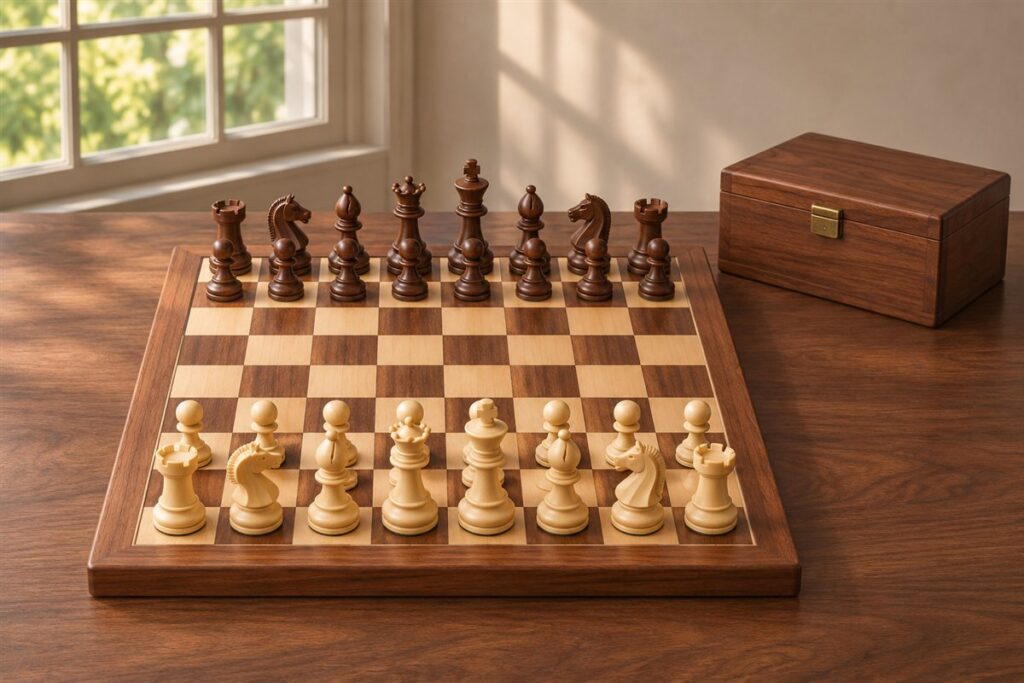
A tournament chess board is built around the size of its squares, which need to be large enough for the pieces to sit comfortably and for players to handle them. Both USCF and FIDE give guidance on square size and board appearance, and the ranges are broadly similar. Check the current rulebook of the organization running your event before you buy, because rules and recommendations can change.
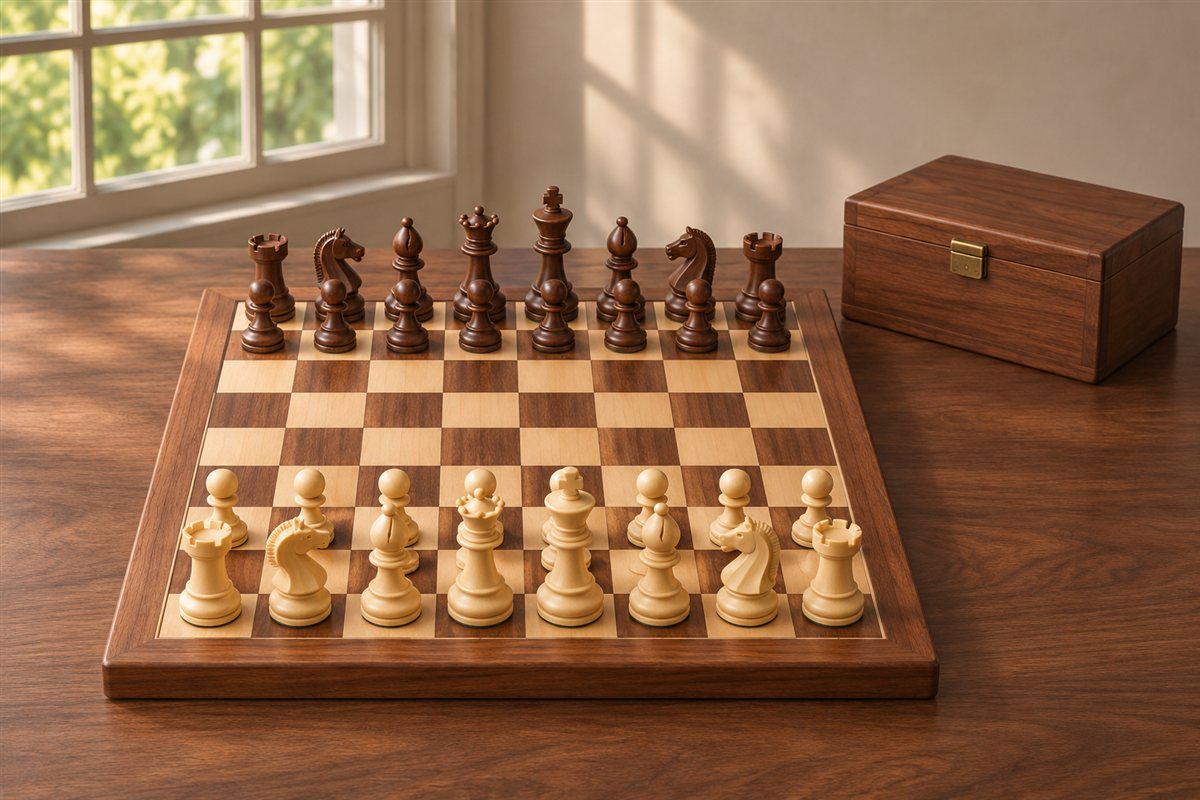
What the Guidance Covers
- Square size. Federation guidance generally points to squares of roughly 2 to 2.5 inches, about 5 to 6.5 centimeters. Confirm the exact range on the official pages.
- Piece fit. Pieces should sit well inside a square with room to grasp them, and the king should be clearly taller than the other pieces.
- Colors. The two colors of squares should contrast clearly and be easy on the eyes, usually with a matte surface to cut glare.
- Style. Staunton pattern pieces are the usual standard for tournament play.
USCF and FIDE at a Glance
| Topic | USCF | FIDE |
|---|---|---|
| Where it applies | Events run under United States rules | Events run under international rules |
| Square size | Guidance in a similar range | Guidance in a similar range, given in centimeters |
| Piece style | Staunton expected | Staunton expected |
| Who decides | The organizer, using federation rules | The organizer, using federation rules |
The table is deliberately general. Always confirm numbers on the federation’s current equipment pages, and ask the organizer if you are unsure.
Common Board Types You Will See
- Vinyl roll-up boards. Light, easy to carry and common at scholastic and club events.
- Rubber or mouse-pad style mats. Compact and quiet, though some people dislike their feel.
- Wooden boards. Heavier and more expensive, often kept for stronger events or home play.
- Folding boards. Convenient, but the fold line can bother some players.
How to Choose
- Measure a single square, not the whole board.
- Match your pieces to the board. A common pairing is a king around 3.75 inches tall with squares in the 2.25 inch area, but check your set.
- Look for a board that lies flat, with no curl at the edges.
- Choose a matte surface and clear contrast between the squares.
- Ask your local organizer if they provide boards or expect you to bring your own.
Matching Piece Size to Square Size
A board and a set must work as a pair. Pieces that are too large for the squares crowd each other and knock over neighbors when moved. Pieces that are too small look lost and are harder to see across the table. A comfortable fit leaves visible space around the base of each piece, so you can pick it up without brushing others. Tournament players handle thousands of moves, so even small frustrations add up.
The base diameter of the pieces is the key measurement. Compare it with the width of a single square, and make sure the pieces sit comfortably inside. The king is usually the largest piece, and its base should still leave clear room. Height matters for visibility, too, but a tall piece with a wide base is more demanding on space than a tall piece with a slim base. Check the maker’s listing for base diameter and king height before buying.
- Place a piece on a square, if you can, and see how much space remains on all sides.
- Check that knights, with their angled heads, do not overhang neighbors.
- Prefer weighted pieces with a felt or similar underside, which are stable and quiet.
- Avoid pieces with very tall or slim shapes that tip easily.
If you already own a set you like, measure it first and choose a board to suit. If you are buying both, choose a set designed for tournament use and a board advertised for the same size range.
Board Materials, Surface Finish and Glare
Different materials suit different situations. Vinyl and rubber boards are light, cheap to replace and easy to roll up, which is why they are so common at scholastic and club events. Their surfaces are usually matte, which reduces glare under bright hall lighting. Some rubber mats have a slight texture that grips the pieces. Wooden boards look attractive and feel solid, but they weigh more and cost more, and a glossy finish can reflect overhead lights.
The surface finish matters during long games. A glossy board can cause eye strain, and a heavily textured one can make sliding pieces difficult. A matte finish with moderate texture is a safe choice. Contrast between the two square colors should be clear but not harsh. Very dark and very pale combinations can be tiring, while subdued shades such as green and buff or brown and cream are popular because they are easy to read.
- Check that the colors remain distinct under different lighting.
- Look for a board that lies flat without curling at the corners.
- Avoid strong odors and slippery surfaces that may mark the pieces.
- Consider how the board is stored, since folds and rolls leave memory in some materials.
Some vinyl boards arrive curled from packaging. Laying them flat under books, or leaving them in a warm room for a while, often helps, though you should follow the maker’s advice.
Coordinates, Borders and Board Orientation
Boards differ in whether they have coordinates, which are the letters and numbers along the edges. For play, coordinates are optional and many players prefer a board without them, while others find them handy for learning notation and reviewing games. If your event needs you to record moves, coordinates can help you check squares without errors. Check that any markings are clear and not distracting.
Orientation is a basic but vital rule. The board must be placed so that each player has a light square at the right-hand corner closest to them. A board set up the wrong way is a common beginner mistake, and organizers may correct it. The queen starts on a square of her own color, white queen on a light square and black queen on a dark one. Remembering this helps you set up quickly and check each side.
- Place the board so a light square is in each player’s right-hand corner.
- Put the queens on their own color.
- Check the border width, since a wide border adds to the footprint on the table.
- Consider whether you want printed coordinates or a clean field of squares.
Organizers often set up tables in advance, but it is worth verifying the setup before the clock starts. A quick check avoids disputes and delays.
Table Space, Clocks and Practical Setup
The board has to fit on the table along with a clock, a scoresheet and sometimes a drink. Larger squares make a larger board, so check the dimensions of the whole thing, not only the squares. Tournament tables are often limited in width, and a board with a thick border can crowd the clock. Measure your table, if you know the size, or ask the organizer about table dimensions.
The chess clock normally sits on the side of the board by the player who has the black pieces, according to common practice, but the rules say to follow the arbiter’s direction. A larger board may need more space, so consider the layout when you plan your equipment. Digital clocks are common, and they come in different sizes and with different features. Check that your clock is allowed in your event and that you know how to use it.
- Bring a pen, a spare scoresheet and your own clock if the event asks players to bring them.
- Ask the organizer which equipment is provided and which is expected from players.
- Practice setting up your board, pieces and clock quickly.
- Keep a small bag or tube for transporting a roll-up board without creasing.
Good habits reduce stress before the game. Arrive early, set up calmly, and make sure everything fits comfortably so you can focus on the play.
Buying Checklist, Care and Storage
Before you buy, write down what you need. Decide where you will play, whether you will carry the set often and what your budget allows. Check the listing for square size, board dimensions, material, finish and what is included. Read feedback from other buyers about flatness, odor and color, remembering that individual experiences vary. If a seller is vague about measurements, ask or choose another listing.
Caring for the board extends its life. Keep vinyl and rubber boards away from heat, which can warp them, and from sharp objects. Wipe with a slightly damp cloth and let them dry, unless the maker says otherwise. Store roll-up boards loosely rolled or lying flat rather than tightly folded. Wooden boards should be kept away from damp and direct sun, which can cause warping or fading, and cleaned with products suitable for wood.
- Confirm the size of one square and the overall dimensions.
- Choose a matte surface with clear contrast.
- Match the pieces to the squares.
- Check what rules your event follows, and ask the organizer if unsure.
- Keep the board flat and clean.
A reliable board is a modest purchase that you may use for many years. Taking time to verify size and quality helps you avoid replacing it soon.
FAQ
Do I need a tournament board for casual play?
No. Any board works at home. Tournament sizes matter mainly for events where you may be required to provide equipment.
Are USCF and FIDE sizes the same?
They are similar in spirit, but each organization publishes its own wording. Read the current text from each one for exact figures.
Do tournaments always require players to bring their own equipment?
Not always. Many events provide boards, pieces and clocks, while others expect players to bring them. Check the tournament announcement or ask the organizer.
Can I use a roll-up board in a tournament?
Roll-up boards are widely used at club and scholastic events. Whether yours is acceptable depends on the event and its rules, so check the size and ask the organizer if unsure.
What does Staunton mean?
Staunton is the standard pattern of chess pieces, with a recognizable design for each piece that is easy to tell apart. Tournaments typically expect this style. It does not specify size on its own.
How do I measure a chess board square?
Measure the width of one square from edge to edge with a ruler or tape, not the full board. Do the same for the piece base. Compare with the guidance given by the federation.
Are wooden boards allowed in tournaments?
In general they are acceptable if they meet the equipment guidelines. They are heavier and costlier. Check the event rules for any restrictions.
Why does my vinyl board curl at the edges?
Rolled storage and packaging can leave it with a curl. Laying it flat in a warm room or under light weight often helps. Follow the maker's care instructions.
Should the board have coordinates?
It is a matter of preference, and both types are in use. Coordinates help with learning and notation. Check whether your event has any requirement about markings.
The Short Version
Look for squares in the common tournament range, Staunton pieces that fit with room to spare, and a flat matte surface. Confirm exact numbers with the USCF or FIDE rulebook and your event’s organizer before you buy.