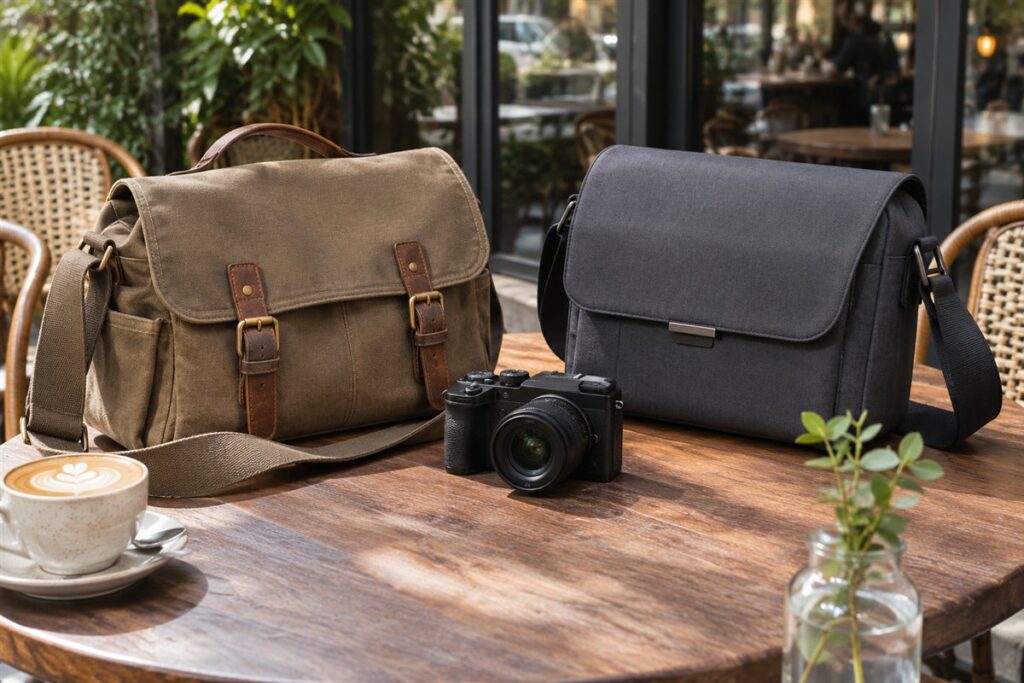
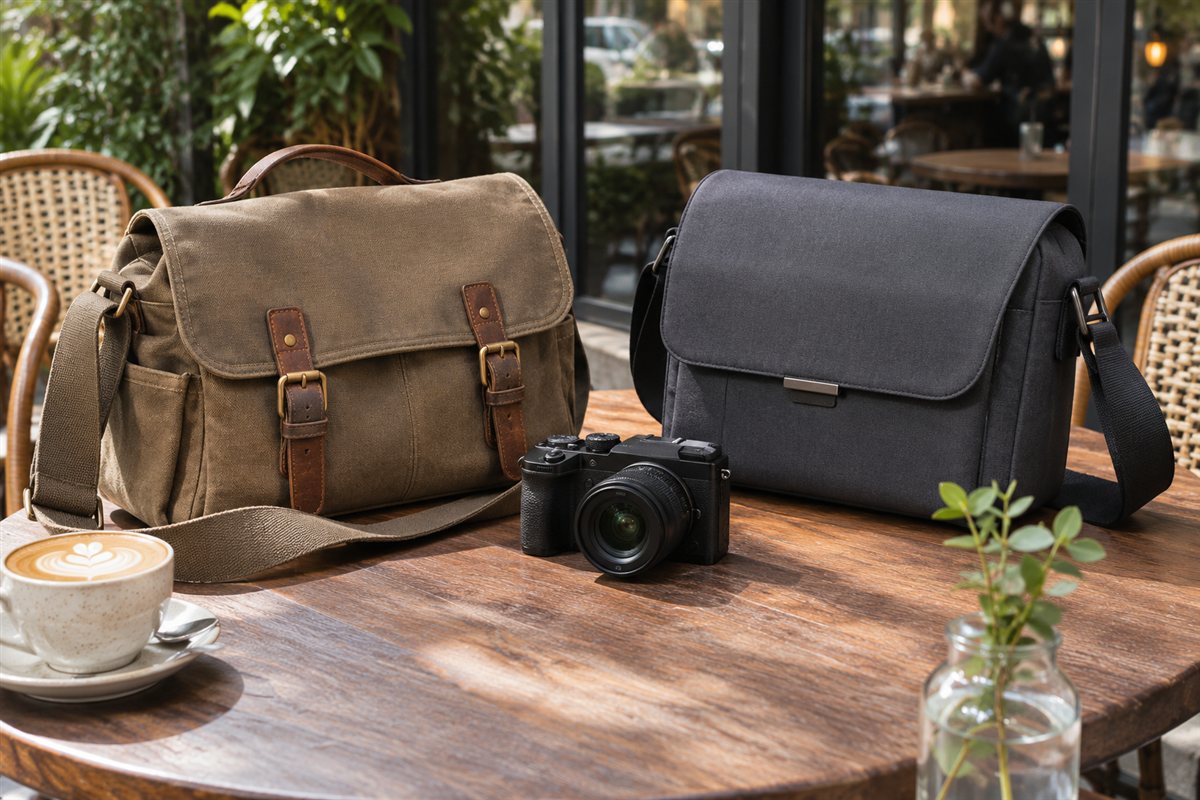
The Think Tank Retrospective is a soft, understated shoulder bag made to look like an ordinary satchel, while the Peak Design Everyday Messenger is a more structured bag with flexible dividers and a modern look. Choose the Retrospective for quiet, low profile carrying and the Everyday Messenger for adaptable organization. We have not used either bag ourselves, so confirm sizes and materials on each maker page.
What Each Bag Is For
Both bags are shoulder or messenger style camera bags meant for a body, a few lenses and some personal items. They suit city walking, events and travel days when a full backpack feels like too much.
- Think Tank Retrospective: sold in several sizes, with a classic canvas-like exterior, quiet closures and a design that avoids the look of a camera bag.
- Peak Design Everyday Messenger: available in a small range of sizes, with folding dividers, a magnetic style front closure and external pockets for everyday items.
In this guide
Key Differences
| Trait | Retrospective | Everyday Messenger |
|---|---|---|
| Look | Classic, bag-like | Modern, structured |
| Interior | Padded dividers and pockets | Flexible fold-in dividers |
| Closure | Flap with quiet fastening | Flap with magnetic latch option |
| Best for | Low profile carrying | Mixed camera and daily gear |
The table gives general impressions. Dimensions, weight and materials change between versions, so read the current product page.
How to Decide
- List what you carry: body, lenses, flash, laptop or tablet, and personal items.
- Match the size to your largest lens, not just the camera body.
- Think about how you reach the camera. Flap bags need a hand to lift and open, which suits slow, careful carrying.
- Try to decide whether you want the bag to blend in or to feel like a modern, adjustable system.
- Check the strap, shoulder pad and any carry handle against how long you wear the bag.
Practical Notes
A messenger bag puts weight on one shoulder, so keep loads modest and switch sides during long days. If you carry more than a body and two or three lenses, a backpack may be more comfortable. Also consider weather: a cover or water-resistant fabric helps, but neither bag should be assumed to keep gear dry in heavy rain without checking the maker details.
Measuring Your Gear Before Choosing a Size
Both bags come in more than one size, and picking the wrong one is the most common source of disappointment. Rather than choosing by name or by looks, measure what you plan to carry. Lay out the camera body with the lens you use most attached, the other lenses, and any extra items such as a flash, a spare battery pouch, a small notebook and a water bottle. Then measure the longest and widest items and note the stack height.
Compare those figures with the interior dimensions listed on each maker’s page, and keep in mind that interior and exterior measurements differ. Padding and dividers reduce the usable space, so a bag that looks big enough on paper can feel snug in use. If you plan to leave the lens hood reversed on the lens, remember that this makes the lens longer than the body alone.
Think about the camera position inside the bag. Some people store the body with the lens attached, ready to pull out and shoot. Others prefer the body in one compartment and lenses in another. Check whether the bag layout allows your preferred arrangement without squeezing parts of it.
- Include the largest lens you might buy in the next year, not just your current one.
- Check the height of the camera with the lens mounted, because this decides whether it fits upright.
- If you plan to carry a laptop or tablet, measure it with its case on.
Packing for Quick Access and Organization
A shoulder bag is easy to open, but the way you pack it affects how quickly you can get to your camera. Put the item you use most near the opening, and the items you rarely use deeper in the bag or in a side pocket. For example, keep the camera body with a standard lens at the top and put a second lens beside it, rather than stacking items on top of each other.
Use the dividers to keep gear from touching. Metal and glass should not rub against each other, and loose items such as keys, coins or chargers can scratch a lens or body. Keep small items in pouches so they do not disappear into corners. Put memory cards in a case with a label for used and unused cards, and carry them in the same pocket every time so that you can find them without looking.
Consider how you will access the bag in different situations. At an event, you might want to leave the bag open slightly while standing. On a crowded street, you may prefer to keep it closed and held close to your body. Practice the opening and closing routine so you can do it with one hand and without looking.
- Pack in a consistent pattern so you always know where things are.
- Keep a small cloth and a blower in an outer pocket.
- Check the bag after each outing and remove anything you do not need.
Comfort, Strap Fit and Carrying Position
A bag that feels fine in the shop for two minutes can feel very different after two hours. The strap is the key. Look at its width, padding and adjustability. A wider pad spreads the weight better, and a non-slip surface helps the bag stay on your shoulder. Check whether the strap can be adjusted easily while you wear the bag, since you will want to shorten it for quick access and lengthen it when walking.
Think about where the bag sits on your body. Many people wear a messenger bag across the body with the bag resting at the hip or lower back, and bring it forward to the front when they need to reach inside. If the bag is too long it will swing as you walk, and if it is too short it will press against your arm. Test different strap lengths with a realistic load.
A stabilizing strap or a cross strap that keeps the bag from swinging can help when walking, running for a bus or bending down. If a bag does not have one, check whether you can add one. Remember that carrying on one shoulder for long periods can cause discomfort, so switch sides and take breaks.
- Wear the bag with a realistic load before deciding.
- Check how the strap attachments are secured to the bag body.
- Look at whether a top handle is useful for you, such as when you pass through narrow spaces.
Security and Low-Profile Carrying
A camera bag holds valuable equipment, so think about security as part of your choice. A bag that looks like an ordinary satchel draws less attention than one with obvious camera branding or a distinctive shape. Even so, no bag is theft-proof, and good habits matter more than any design feature.
Look at the closures. Check how the flap is fastened, whether it can be locked or secured with a clip, and how easily someone could reach inside without your noticing. Check zip positions and whether the main compartment can be reached from the back, which is the side against your body and harder for others to open. Consider where the pockets for valuables are placed, such as a passport or phone, and whether they are accessible from the outside.
In busy places, wear the bag in front of you, keep a hand on the flap, and do not leave it on the floor or hanging on a chair. In cafes, put the strap around your leg or the chair. In vehicles, take the bag with you instead of leaving it visible. A discreet design is helpful, but your behavior is your best protection.
- Remove or cover any labels that advertise the contents.
- Keep a note of your serial numbers and consider insurance for your gear.
- Do not pack everything in one bag if the loss would be catastrophic. Split critical items when traveling.
Durability Checks, Care and Questions to Ask
A camera bag takes daily wear, so check the details that decide how long it lasts. Look at the stitching at stress points such as strap anchors, handle bases and corners. Check the zips or fasteners for smooth action. Examine the fabric for abrasion resistance and any coating, and read the maker’s description of the materials. Consider the interior lining, which should be soft enough not to scratch your gear and light enough in color to let you see items inside.
Care is simple. Empty the bag regularly and shake out dust and crumbs. Wipe the exterior with a damp cloth if needed, following the maker’s care instructions. Let the bag dry fully before packing gear, as damp padding can lead to musty smells or mold. Do not use harsh cleaners, which can damage coatings.
Before buying, ask a few questions. What is the warranty and how do I claim? Can the maker supply replacement parts such as straps or dividers? Is the bag available in sizes that suit my gear now and later? What do other users say about wear after a year of use? Read reviews with care, and treat them as opinions, not guarantees.
- Replace the bag when stitching fails, the padding collapses or the closures stop holding.
- Check straps and attachments regularly for fraying.
- Keep the original packaging details and receipt in case of a warranty claim.
Which Camera Messenger Bag Should You Buy: Retrospective or Everyday Messenger?
Choose the Think Tank Retrospective if you want a camera bag that looks like an ordinary satchel, and choose the Peak Design Everyday Messenger if you want adjustable organization and a more modern look. Both are camera messenger bags for a body, a few lenses and daily items, so the decision comes down to style, interior layout and how you carry.
Use these pairings as a starting point, then confirm details on each maker page.
- If you shoot events or quiet venues and want to avoid attention, go for the Retrospective. Its classic exterior and quiet closures are the main reasons people consider it.
- If you carry a mix of camera gear and everyday items, look closely at the Everyday Messenger. Its fold-in dividers can be rearranged, and it has external pockets for daily things.
- If you like padded, fixed-feeling compartments, the Retrospective’s padded dividers and pockets may suit you better.
- If your kit changes from day to day, the flexible dividers on the Everyday Messenger give more room to reshuffle.
- If you walk through cities and want the bag to blend in, the Retrospective’s understated look is the stronger fit on paper.
Neither choice is wrong. The better bag is the one whose interior matches your gear and whose strap and closure match how you work. If you are still undecided, picture the first minute of a typical outing: how you open the bag, where the camera sits and how you close it again. The bag that makes that moment easiest is usually the one to buy.
What to Check Before You Buy a Camera Shoulder Bag
Before you press the buy button, check size, fit, what is included and the return terms. A camera messenger bag only works if your gear fits without being squeezed, so these checks matter more than looks.
- Size for your largest lens. Measure the camera with that lens attached and compare it with the interior dimensions on the listing. Leave room for padding and dividers.
- Size for non-camera items. If you plan to carry a laptop or tablet, check the sleeve dimensions and whether your device fits with its case on.
- What is included. Look at whether the shoulder strap, shoulder pad, dividers and any rain cover come with the bag, or are sold separately.
- Version and size options. Both bags come in more than one size, and details can change between versions. Make sure the listing shows the exact size you intend to buy.
- Closure type. Decide whether you are comfortable lifting a flap each time you reach for the camera, and whether you want a quiet fastening or a magnetic latch option.
- Weather protection. Read the maker details on the fabric and any cover. Do not assume heavy-rain protection unless the listing states it.
- Warranty and returns. Confirm the warranty terms and the return window on the seller page, and keep your receipt.
- Care requirements. Check the maker’s cleaning advice so you know what to avoid.
It also helps to read feedback in general terms. See how many people have rated a bag, and look for repeated comments about strap comfort, closures and wear, rather than focusing on a single score. Treat opinions as one input beside your own measurements.
Is a Camera Messenger Bag Worth It, and Who Should Skip One?
A camera messenger bag is worth it if you carry a modest kit and value quick access and a low profile. It is a poor choice if you carry heavy gear for many hours, because the weight sits on one shoulder.
These are the fair trade-offs of both bags, and of the style in general.
- One-shoulder load. Even a well-padded strap puts weight on one side. Switching shoulders helps, but long days with a heavy kit can tire you.
- Flap access. Opening a flap takes a moment. That suits careful, unhurried carrying but is slower than a bag with a side opening when action is fast.
- Limited capacity. A messenger style holds a body and a few lenses well, not a large multi-lens kit with a laptop and spare clothing.
- Bag-style looks cut both ways. A discreet design draws less attention but cannot make a bag theft-proof.
Who should skip them? Photographers who regularly carry more than a body and a few lenses may be more comfortable with a backpack. People with shoulder or back problems should think carefully about any single-strap bag and may prefer a design that spreads weight across both shoulders.
Is it worth paying more for one over the other? The better question is which interior suits you. A bag you can organize the way you pack will protect your gear and save time. A bag that looks right but forces awkward packing will frustrate you, whichever it is. Compare current listings, and weigh features you will use daily more heavily than features you may use once.
Padded Dividers Versus Fold-In Dividers: How the Interiors Differ
Padded dividers give fixed, cushioned compartments, while fold-in dividers let you reshape the interior to suit the day’s gear. The Retrospective is described in this comparison with padded dividers and pockets, and the Everyday Messenger with flexible fold-in dividers.
Each approach has strengths. Padded, more structured compartments tend to keep items in the same place every time, which helps if you pack the same kit daily and want to find things by feel. They can feel less adaptable when your kit changes, because the layout is harder to rearrange.
Flexible fold-in dividers suit people whose load varies. On a light day you can open up space for a jacket or notebook, and on a lens-heavy day you can create more separate slots. The trade-off is that you must set the layout carefully so lenses do not touch, and recheck it after you repack.
Whichever you pick, use these habits to protect your gear.
- Keep glass and metal from rubbing against each other.
- Put the camera body where you can reach it with one hand.
- Use pouches for small items such as batteries and memory cards.
- Test the layout with your actual gear before a trip, and adjust it at home rather than in the field.
Check the listing or manual for how the dividers attach and how many you get. Those details affect how closely you can match the interior to your kit.
Messenger Bag or Backpack: When Is a Messenger Enough?
A messenger bag is enough when your kit is small and you value quick access, and a backpack is better when you carry more or walk for long stretches. The weight of the load and the length of the day are the deciding factors.
Think in terms of use cases.
- City walks and short outings: a messenger bag is easy to bring forward and open, and it looks like an everyday bag.
- Events and gatherings: the ability to reach the camera quickly and quietly is a benefit, as long as you keep the load modest.
- Travel days: a messenger bag works well as a day bag with a body, a couple of lenses and personal items. Check airline carry-on rules separately if you plan to fly with gear.
- Long hikes or all-day shoots: a backpack spreads weight better and may carry more.
Some photographers own both and pick the bag based on the day. If you only buy one, choose based on your most common outing, not the rare heavy one.
Whichever way you lean, compare the picks above, check the current listing for size and what is included, measure your gear against the interior, and then choose the bag that fits how you will actually carry it.
Two Design Philosophies You Can Feel
Messenger bags from these two traditions embody different answers to the same question: how should a camera disappear into daily life? One school hides the camera inside a bag that looks like an ordinary, slightly rumpled messenger, with soft structure, muted materials and access designed around discretion. The other school treats the bag as a piece of modern equipment, structured, weather-shedding and engineered, with hardware and access points designed for speed and security in busy environments. Neither philosophy is a styling exercise; each decides how the bag ages, how it behaves in a crowd and how it feels at hour six of a working day.
The materials tell the story on first touch. Traditional canvas and leather develop character, soften and mold to the body, and quietly signal that the bag is not worth stealing. Technical fabrics hold their shape, shrug off rain and abrasion, and look the same in year three as in week one, which some owners love and others find sterile. Think about which aging story you prefer living with, because a daily bag is a multi-year relationship, not a seasonal purchase.
Access design follows philosophy too. A soft messenger favors a flap and a roomy main compartment you can work from by feel, ideal when the camera comes out and goes back fifty times a day. A structured messenger favors defined openings, including access that lets you reach the camera without setting the bag down or opening it fully, which suits commuters and travelers moving through stations and crowds. Your working rhythm, stop-and-shoot or move-and-grab, should make this choice for you.
Carrying Comfort Over Real Distances
Messenger bags carry on one shoulder, and physics collects its fee eventually. The questions that matter are how the strap spreads the load, whether the bag stays put against your back or slides around your hip, and how the whole thing behaves on a bicycle, a crowded platform or a long walk between locations. A strap with a grippy underside and a quick way to shorten or lengthen it changes daily life more than an extra pocket ever will, because you adjust a messenger constantly: high and tight while moving, lower and looser while shooting.
Load discipline helps any messenger. These bags are happiest as camera-plus-essentials carriers rather than everything bags. Every extra lens, bottle and book multiplies the one-shoulder penalty, and photographers who overload messengers tend to conclude the style is uncomfortable when the real fault is the packing list. Audit your true daily carry honestly, then choose the size that fits that list with a little room, not the size that fits your largest imaginable day.
Test with weight before committing if you can. Shops expect it, and two minutes in an aisle with display weights will not tell you much, but walking around the store with your actual kit inside, strap adjusted properly, reveals pressure points and sliding habits that specifications never mention. Pay attention to where the bag’s edge meets your hip and whether zippers or hardware dig in when the bag is full.
Organization, Laptops and the Work-Life Blend
For many buyers the messenger is not only a camera bag but the daily work bag, which makes the laptop question central. Check not only whether your laptop fits but how it is suspended and protected, whether it shares space with the camera or has its own compartment, and how the bag’s balance changes with it aboard. A bag that carries a laptop beautifully and a camera awkwardly, or the reverse, will frustrate one half of your life daily.
Small organization reveals design maturity. Look for a place that pens, cables, batteries and cards land in the same spot every time, ideally reachable without opening the main compartment in public. Think about the objects you actually fish for mid-day: a battery during a shoot, a charger at a café, documents at a desk. The best bag is the one whose layout matches that fishing pattern, which is personal enough that two photographers can honestly rank the same two bags in opposite orders.
Also consider the bag’s life away from the camera. Dividers that remove cleanly turn a camera messenger into a briefcase, a market bag or a carry-on personal item. If your camera days and office days alternate, that convertibility may be worth more than any camera-specific feature, and it extends the bag’s useful years beyond any single hobby phase.
Weather, Security and Travel Behavior
Rain separates daily bags quickly. Canvas traditions rely on waxed or treated fabrics and on flaps that shed water by geometry; they handle showers gracefully and need occasional re-proofing to keep doing so. Technical shells rely on coated fabrics and water-resistant zippers, shrugging off heavier weather with less maintenance but sometimes admitting water at seams in a true downpour. Either way, know your bag’s plan for a storm: where the water goes, what gets wet first, and whether a simple rain cover is worth carrying in the wet season.
Security is mostly design plus behavior. Bags that do not look like camera bags attract less attention, zippers that can be secured or worn against the body deter casual hands, and compartments that open toward you rather than toward a crowd are worth real money in transit hubs. In cafés, the oldest rule still works: strap around a chair leg or your own leg, bag in sight, camera out of sight when it is not in your hand.
As a travel personal item, a messenger earns its place by sliding under seats, standing on its own in overhead bins and looking acceptable in a hotel lobby and a gallery alike. Check your usual airline’s personal item dimensions against the bag you choose, because the most elegant solution to travel is the bag that never has to be gate-checked or apologized for.
Matching the Bag to Your Camera Kit
Mirrorless and one or two lenses
This is the messenger’s home turf. Either design swallows a body with a lens mounted plus a second lens, and the choice becomes about style, weather and laptop needs rather than capacity. Prioritize access speed if you shoot street, and interior softness if your gear travels unprotected by cases.
Rangefinder and film kits
Compact, flat kits suit the softer, traditional design beautifully, and film shooters often prefer the quieter materials and the way the bag behaves in cafés and museums. Keep film in an interior pocket away from the bag’s damp outer layers on wet days.
A body, several lenses and a laptop
You are at the messenger’s honest limit. Choose the more structured design, pack ruthlessly and consider whether a small backpack would serve the heavy days while the messenger covers the rest. Many photographers end with both and are happier than with one compromised giant.
A Week With Each: The Diary Test
Specifications cannot tell you which of these bags belongs in your life, but a diary can. Imagine each bag through your actual week: the commute, the desk, the evening shoot, the weekend errand with a camera along just in case. Notice where each design helps and where it nags. The soft, discreet bag disappears into cafés, meetings and galleries, and its camera emerges without ceremony or attention. The structured, engineered bag shrugs off the rainy platform, organizes the workday tightly and presents a deliberate, professional face. Most buyers, forced to narrate the week honestly, discover the decision has already been made by their calendar; the purchase is just paperwork.
Keep the diary test in mind in the shop as well. Lift each bag loaded, wear it through your real gestures, sit with it, stand with it, reach into it the way you would on a train. The bag that fits your week’s choreography will feel obvious within minutes, and that feeling is data, not indulgence.
The Details That Decide at Month Six
Reviews are written at week one, but bags are judged at month six, by details nobody photographs. Does the zipper still glide after a season of dust, or does it catch at the same corner every time? Has the strap’s adjustment stayed where you set it, or does the bag slowly lengthen itself through every commute until it hangs wrong? Has the interior kept its shape, or have the dividers migrated into a soft nest where lenses nestle against each other unseparated? These are the questions that separate a bag you recommend from a bag you replace, and they are why experienced photographers ask owners, not reviewers, before buying.
Ask about the bad day specifically: the rainstorm, the crowded festival, the flight delay spent sitting on the bag in a terminal. Bags reveal their character under insult, in whether the contents stayed dry, whether the access worked with cold hands, whether the bag could be cleaned afterward with a cloth and forgiveness. A design that has survived its owners’ bad days with grace has passed the only certification that matters.
Finally, ask the simplest question of all: do you still reach for it? A bag can win every comparison and still lose the hallway, abandoned for a smaller, worse bag that suits the owner’s actual life. The reaching is the verdict, and it is why the diary test in this guide, imagining your real week in each design, predicts satisfaction better than any feature matrix.
Packing the Messenger: A Method
A messenger rewards a packing method as deliberate as its design. Camera first, in the position your hand expects, lens mounted, settings ready, because a messenger is a working bag, not a storage case. The second lens, if any, rides where it can be swapped in one motion over a knee or a café table. Batteries and cards live in one small pouch that never changes pockets, so a tired hand finds them in the dark of a theater or the glare of noon with equal certainty.
Weight placement governs comfort: the heaviest items against your back, the lightest toward the outer flap, so the bag hangs as a part of you rather than as a pendulum. Cables and chargers, the grit of modern photography, belong in a pouch of their own, because loose cables migrate into every corner and around every lens, and because a bag that opens to reveal order lowers the photographer’s blood pressure in a way that shows up in the work.
Repack at home after every outing, not before the next one. The discipline takes three minutes, restores the method, surfaces the missing card or the battery that needs charging, and means the bag by the door is always the bag ready. Messengers live by readiness; the method is what keeps the promise.
Selling On and Passing Down
Good messengers rarely die; they change owners. Canvas and leather examples in particular pass through the used market with their character intact and their flaws honestly visible, which makes them some of the safest used purchases in photography. If you sell, photograph the wear plainly, mention the strap and zipper condition, and include the dividers and rain cover if the design had them, because completeness is what the next owner is paying for.
If you keep, maintain the bag like the tool it is: brush out the grit that collects in the seams monthly, treat the materials as their maker directs, and repair the small failures, a loose stitch, a tired zipper pull, while they are small. A bag maintained this way can serve a decade of daily photography, which reframes its price entirely: divided by the days of a decade, even the finest messenger in this comparison costs less than the coffee carried inside it.
And if the day comes when your photography changes shape entirely, the messenger retires gracefully into ordinary life, as a work bag, a travel bag, a carrier of books and instruments. Few camera purchases end so usefully, which is one more reason the style endures while trendier carriers come and go.
The Verdict Framework: Scoring Your Own Priorities
Comparisons end, properly, by handing the reader a method rather than a winner, so here is the method in its final form. List the six things a daily messenger must do in your life, no more, in the order your week actually presents them: survive the commute, disappear in public, swallow the laptop, free the camera in seconds, shrug off the rain, sit acceptably in a meeting. Score each bag against your list from your own handling of them, or from the testimony of owners whose weeks resemble yours, and weight the top of the list ruthlessly, because a bag that wins your first two priorities and loses the rest will make you happier than a bag that is second-best at everything. This sounds obvious and is almost never done, because feature lists are seductive and weeks are unglamorous, but the week is where the bag will live.
Then apply the tie-breaker of time. Both of these designs will serve for years, so ask which one’s aging you want to watch: the softening, darkening, personal patina of traditional materials, or the unchanging, technical composure of modern ones. There is no correct answer, only the pleasure of recognition when you imagine the bag beside your chair in five years, and that pleasure is a legitimate, even wise, basis for a decision between two tools this competent.
Buy once, buy the size your real kit demands, and then close the comparison the way all good equipment questions should close: by going out with the bag on your shoulder and a camera inside it, into the ordinary, photographable day that both bags were built, in their different philosophies, to serve.
What Owners Say After the Honeymoon
Long-term owners of bags in this class tend to praise and complain about the same short list of things, and the list is worth more than a specification table. They praise the morning the bag simply worked: rain on the platform, camera out and away in seconds, laptop dry, shoulder untroubled at the day’s end. They complain, when they complain, about the small betrayals: a strap that crept, a zipper that learned a catch, a divider that migrated until two lenses introduced themselves. Notice that nothing on either list is a headline feature; ownership is decided at the level of hardware and habit, which is why this guide keeps returning to diaries, bad days and month six. A buyer who tests those levels, in a shop with real weight or through the testimony of owners with similar weeks, is doing due diligence that no feature comparison can replace.
They also, almost universally, report keeping the bag longer than planned, whichever they chose, because a daily bag becomes part of the furniture of a life and replacing it means relearning a hundred small reaches. That longevity is the final argument for choosing carefully and then stopping: the right messenger, from either of these philosophies, is not the one that wins the comparison but the one that disappears into your routine so completely that, years later, you realize it has been carrying your photography all along.
A Last Word on Enough
Enough room for the camera and the day, enough structure for the commute and enough softness for the café, enough bag and not a strap more: the messenger is the philosophy of enough worn on one shoulder, and both designs in this comparison are that philosophy’s mature expressions, differing in accent rather than in substance. The buyer who knows their week’s true contents can choose between the accents by feel and be right; the buyer still negotiating with an imaginary, larger life will find both bags somehow wanting, because no bag can carry a life its owner has not settled into. Settle the week, then choose the bag, and the choice will hold for years.
FAQ
Which bag fits a laptop?
Both makers offer sizes with a sleeve for a laptop or tablet, but the sleeve dimensions differ. Compare your device size to the listed interior measurements.
Which one is quieter to open?
The Retrospective line is known for its quiet closures, which suits events and quiet venues. Check the latest design notes for both before buying.
How do I know which size to pick?
Measure your camera with its largest lens attached, plus other items you plan to carry, and compare the numbers with the interior dimensions on the maker's page. Leave a small margin for padding.
Is a messenger bag good for heavy gear?
It suits modest loads. Heavy kits can strain one shoulder, so consider a backpack if you carry more than a body and a few lenses.
Can I use these bags for non-camera items?
Yes. Many people use them for everyday carry with a camera and personal items. Check that the dividers can be arranged to suit what you carry.
How can I make my bag less obvious to thieves?
Choose a low-profile design, remove branding, keep it close to your body and avoid leaving it unattended. Behavior matters more than appearance.
Should I buy a rain cover?
A cover is a sensible extra if you shoot outdoors often. Check whether your bag has its own cover or whether you need a separate one.
Do the bags come with a shoulder pad?
This varies by size and version, so check the product page. A separate pad is an option if comfort is a concern.
How long does a camera bag usually last?
It depends on use, load and care. Check stitching, closures and padding regularly, and replace the bag when it no longer protects your gear.
Is the Think Tank Retrospective or the Peak Design Everyday Messenger better for travel?
It depends on how you travel. The Retrospective suits travelers who want a low-profile satchel look, while the Everyday Messenger suits those who want flexible dividers and external pockets. Check the size against your gear and any carry-on limits for your airline.
Can a camera messenger bag hold a lens with a hood attached?
It can, if the interior is deep and wide enough, but a hood adds length. Measure the lens with the hood in the position you plan to store it and compare it with the interior dimensions on the listing.
How do I stop a messenger bag from swinging when I walk?
Wear it across the body with the strap adjusted so the bag sits near your hip or lower back. A stabilizing strap, if the bag has one or you can add one, helps further. Keeping the load modest also reduces swing.
Do I need a rain cover for a camera shoulder bag?
A cover is a sensible extra if you shoot outdoors in changing weather. Water-resistant fabric helps, but do not assume it keeps gear dry in heavy rain. Check the maker details for what protection is included.
How should I clean a canvas-style camera bag?
Empty it, shake out dust, and wipe the exterior with a damp cloth following the maker's instructions. Let it dry fully before loading gear, and avoid harsh cleaners that can damage coatings.
Can I use these bags without camera gear?
Yes. Many people use them as everyday bags with the dividers adjusted for personal items. Check that the layout suits what you carry, and remember that the padding takes some space.
What is the best way to carry two lenses and a camera body in a messenger bag?
Keep the body with your most-used lens near the opening and place the second lens in its own compartment beside it. Use dividers so items do not touch, and keep small accessories in pouches.
How do I know when to replace a camera bag?
Replace it when stitching fails, the padding collapses or the closures no longer hold. Check strap anchors and corners regularly, since these are the first places to show wear.
How do I stop a messenger bag swinging while I walk or cycle?
Shorten the strap so the bag rides high against your back rather than hanging at your hip, and use a stabilizing cross strap if the bag offers one. Pack heavier items closest to your body so the load does not pendulum. If swinging persists, the load is probably too heavy for the style that day, and a backpack is the honest fix.
Can these bags hold a full-frame body with a fast zoom?
Generally yes for one body with a mid-range zoom mounted, but fast telephoto zooms quickly exceed comfortable messenger territory in both size and weight. Check the interior height against your body-and-lens length, and be honest about carrying that weight on one shoulder for the distances your days actually involve.
How should I clean and maintain a daily messenger?
Empty it fully every few weeks, shake out grit that migrates into seams and corners, and wipe interiors with a damp cloth. Canvas benefits from occasional re-proofing when water stops beading, leather from a light conditioner where it flexes, and technical fabrics from a simple wash with mild soap. Let everything dry fully before repacking gear.
The Short Version
Choose the Retrospective if you want a discreet, classic camera satchel. Choose the Everyday Messenger if flexible dividers and a contemporary look matter more, and confirm the right size for your gear first.